

Patrick Comerford
We are in Ordinary Time in the Church Calendar, and this is the Third Sunday after Trinity (Trinity III, 21 June 2026). Tomorrow is also Father’s Day and the Summer Solstice, although next Wednesday (24 June) is officially Midsummer’s Day.
I hope to be involved in the Parish Eucharist in Saint Mary and Saint Giles Church later this morning. Meanwhile, before today begins, I am taking some quiet time this morning to give thanks, to reflect, to pray and to read in these ways:
1, reading today’s Gospel reading;
2, a short reflection;
3, a prayer from the USPG prayer diary;
4, the Collects and Post-Communion prayer of the day.

Matthew 10: 24-39 (NRSVA):
[Jesus said:] 24 ‘A disciple is not above the teacher, nor a slave above the master; 25 it is enough for the disciple to be like the teacher, and the slave like the master. If they have called the master of the house Beelzebul, how much more will they malign those of his household!
26 ‘So have no fear of them; for nothing is covered up that will not be uncovered, and nothing secret that will not become known. 27 What I say to you in the dark, tell in the light; and what you hear whispered, proclaim from the housetops. 28 Do not fear those who kill the body but cannot kill the soul; rather fear him who can destroy both soul and body in hell. 29 Are not two sparrows sold for a penny? Yet not one of them will fall to the ground unperceived by your Father. 30 And even the hairs of your head are all counted. 31 So do not be afraid; you are of more value than many sparrows.
32 ‘Everyone therefore who acknowledges me before others, I also will acknowledge before my Father in heaven; 33 but whoever denies me before others, I also will deny before my Father in heaven.
34 ‘Do not think that I have come to bring peace to the earth; I have not come to bring peace, but a sword.
35 For I have come to set a man against his father,
and a daughter against her mother,
and a daughter-in-law against her mother-in-law;
36 and one’s foes will be members of one’s own household.
37 Whoever loves father or mother more than me is not worthy of me; and whoever loves son or daughter more than me is not worthy of me; 38 and whoever does not take up the cross and follow me is not worthy of me. 39 Those who find their life will lose it, and those who lose their life for my sake will find it.’

Today’s Reflections:
In the Gospel reading last Sunday (Matthew 9: 35 to 10: 8 or 10: 23, Sunday 14 June 2026), Christ calls the Twelve together to prepare them for their ministry and mission. In today’s Gospel reading (Matthew 10: 24-39), Christ continues to prepare the Twelve for this mission, as both their teacher and their master. They are his students, and they are to be like him, they are told, and they receive their instructions and commission for mission, even in the most hostile of environments.
When the late Archbishop Desmond Tutu (1931-2021) received the Nobel Peace Prize in 1984, I profiled him for The Irish Times. We had met previously, at events co-hosted by AfrI and Christian CND and at dinner in Roebuck House, Seán MacBride’s house in Clonskeagh, Dublin.
I asked him about the death threats he faced in South Africa at the height of apartheid. He engaged me with that look that confirmed his deep hope, commitment and faith, and said: ‘But you know, death is not the worst thing that could happen to a Christian.’
He must have been tempted at times to give up being a thorn in the side of the regime, to stop being a ‘turbulent priest,’ and to live a comfortable life. But his conscience would never have been comfortable.
While apartheid was still in force, Desmond Tutu became Dean of Saint Mary’s Cathedral in Johannesburg, and when I first met him, he was the secretary general of the South African Council of Churches.
I was worried about the many death threats he was receiving, and I asked him how he lived with those threats. Was he worried about them? Did he ever consider modifying what he had to say because of them? His answer was similar to the one he gave when he was facing tough questioning before the regime’s Eloff Commission. He told that inquiry:
‘There is nothing the government can do to me that will stop me from being involved in what I believe God wants me to do. I do not do it because I like doing it. I do it because I am under what I believe to be the influence of God’s hand. I cannot help it. When I see injustice, I cannot keep quiet, for, as Jeremiah says, when I try to keep quiet, God’s Word burns like a fire in my breast. But what is it that they can ultimately do? The most awful thing that they can do is to kill me, and death is not the worst thing that could happen to a Christian.’
In 1987, Veritas invited me to write a short, 36-page biography of Archbishop Tutu, published as Desmond Tutu: Black Africa’s Man of Destiny. It was launched by the then Minister for Foreign Affairs, Brian Lenihan. It was a small book, hardly more than a pamphlet, but it came at an important time when both the Irish Government and the Irish Churches were becoming increasingly vocal about the evils of apartheid. It was republished in the US by Citadel (1988) and Hyperion Books (1989).
When I visited South Africa in 1990 with The Irish Times and Christian Aid, I met Archbishop Tutu in Cape Town, where once again he spoke powerfully about the changes that were beginning to take place.
Then, when my colleague Patsy McGarry was organising a monumental series of features in The Irish Times in 2000 to mark the millennium, Archbishop Tutu was one of the international contributors, along with Hans Küng, Andrew Greeley and Mary Robinson. The complete series was published by Veritas the following year as a book, Christianity, in which Part Two was my ‘Brief History of Christianity.’
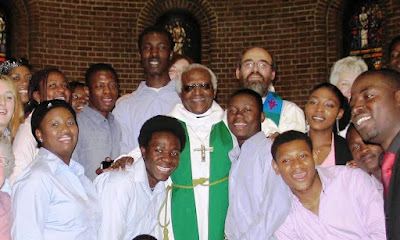
I last met Archbishop Tutu when he visited Dublin in 2005, and he preached in Saint George’s and Saint Thomas’s Church in the inner city, where Canon Katharine Poulton was then the Rector, as part of the Discovery Gospel Choir services.
His unforgettable words to me echo Christ’s words to the disciples in today’s Gospel reading: ‘Do not fear those who kill the body but cannot kill the soul; rather fear him who can destroy both soul and body in hell’ (Matthew 10: 28).
Today’s Prayers (Sunday 21 June 2026, Trinity III, Fathers Day):
In Pray with the World Church, the prayer diary of the Anglican mission agency USPG (United Society Partners in the Gospel), the theme this week, from 21 to 27 June 2026 (pp 12-13), is ‘Land Taken, Land Remembered’. This theme is introduced today with a reflection by the Venerable Rosalyn Kantlaht’ant Elm, Director of Indigenous Ministries, Anglican Church of Canada:
When I think about how land was taken from Indigenous communities in Canada, I see that it was not the work of one person or a single event. It happened slowly, over more than four hundred years. In the early days of European settlement, Indigenous peoples and settlers often lived and worked alongside one another. Though imperfect, there was a time of coexistence.
As Canada developed, laws such as the Civilization Act and the Indian Act enabled the government to take Indigenous lands and move our people onto reserves – fenced-in areas often far from our traditional territories, languages, medicines, ceremonies, and rituals. This process unfolded over generations. Today, Indigenous peoples occupy only a small fraction of our original lands. Much of the rest remains under treaty dispute or is unceded territory, often threatened by mining, forestry, and oil and gas development.
Churches also played a significant role. In partnership with the government, they sought to ‘civilise’ Indigenous children, attempting to erase our cultures. In doing so, they became complicit in what can rightly be described as a legislative form of cultural genocide.
These truths are difficult to speak and to hear. But just as Christians cannot have Easter without Good Friday, we cannot skip the hard history and move straight to celebration. Facing these truths together allows us to lament, to pray, and to understand ourselves not by what we own, but as people created by God, called to care for one another and for the land.
The USPG prayer diary today (Sunday 21 June 2026, Trinity III, Fathers Day, National Indigenous Peoples Day, Canada) invites us to pray:
Creator God, from you every family in heaven and earth takes its name. Rooted and grounded in your covenant love, empowered by your Spirit, help us speak the truth in love and walk in your way towards justice and wholeness. (Anglican Church of Canada)
The Collect of the Day:
Almighty God,
you have broken the tyranny of sin
and have sent the Spirit of your Son into our hearts
whereby we call you Father:
give us grace to dedicate our freedom to your service,
that we and all creation may be brought
to the glorious liberty of the children of God;
through Jesus Christ your Son our Lord,
who is alive and reigns with you,
in the unity of the Holy Spirit,
one God, now and for ever.
The Post-Communion Prayer:
O God, whose beauty is beyond our imagining
and whose power we cannot comprehend:
show us your glory as far as we can grasp it,
and shield us from knowing more than we can bear
until we may look upon you without fear;
through Jesus Christ our Saviour.
Additional Collect:
God our saviour,
look on this wounded world
in pity and in power;
hold us fast to your promises of peace
won for us by your Son,
our Saviour Jesus Christ.
Yesterday’s Reflections
Continued Tomorrow

Scripture quotations are from the New Revised Standard Version Bible: Anglicised Edition copyright © 1989, 1995, National Council of the Churches of Christ in the United States of America. Used by permission. All rights reserved worldwide. http://nrsvbibles.org
‘Are not two sparrows sold for a penny? … you are of more value than many sparrows’ (Matthew 10: 29-30) … a mother sparrow feds her chicks in a church in the ceiling of Aghias Anna Church, Maroulas, near Rethymnon in Crete (Patrick Comerford)
