Showing posts with label Co Meath. Show all posts

27 May 2026

A Comerford memorial
window and graves at
Saint Peter’s Basilica in
Columbia, South Carolina

Saint John (left) and Saint James depicted in a window in Saint Peter’s Basilica, Columbia, South Carolina, given ‘In Memory of Mr and Mrs Michael Comerford’

Patrick Comerford

In my prayer diary on this blog this morning (27 May 2026), one of the images I used to illustrate the Gospel reading and my reflections is a stained-glass window in Saint Peter’s Basilica, Columbia, South Carolina, depicting the apostles Saint John and Saint James and donated by Michael Comerford, originally from Co Meath.

At least eight members of the Comerford family, including Michael Comerford, are buried in Saint Peter’s graveyard, which dates from before 1820. The earliest deaths with markers are of three Irish immigrants: Mary Jane Reilly who died in 1813, Owen McEgan who died in 1819, and Patrick Elroy who died in 1820.

Work on building the present church began in 1901. It was designed by the architect Frank Pierce Milburn, was built in 1906-1908, and it was dedicated in January 1909. An expensive part of the construction was the beautiful stained glass windows, mostly imported from Germany. At least 30 windows were given in memory of parishioners.

Many of the names on graves in the graveyard are the same as those off donors or parishioners named in the windows. One prominent Irish name among these is that of Michael Comerford (ca 1798-1883), originally from Co Meath, who died on 15 March 1883, aged 85. He is commemorated on one of the large monuments in the churchyard and on the window I used to illustrate my blog posting this morning.

The Comerford window depicts the Apostles Saint John and Saint James and the inscription says it was given ‘In Memory of Mr and Mrs Michael Comerford’. By then Michael Comerford was dead for about 20 years or more, and neither of his two wives is named in the inscription.

Michael Comerford was born Co Meath ca 1798, and later moved to US, settling in Columbia, South Carolina. His first wife, Mary E Dupuy, was born in San Domingo in the West Indies in 1790, and was of French descent. She taught music and French in Columbia, and donated an organ to the church where she also built up a choir. Mary had no children, and she died on 9 February 1860, aged 69.

Michael Comerford later married Catherine Johanna Bogan (1825-1900), who was also Irish-born, and who was 27 years his junior. They were the parents of a daughter, Mary Elizabeth (‘Mamie’) Comerford (1869-1929).

Father Jeremiah Joseph O’Connell, a priest at Saint Peter’s Church, wrote of him in 1879: ‘Michael Comerford is the oldest Catholic now living in the congregation, plain, honest, and without guile; his life was uniform in virtue and piety. Having been twice married, his first wife, who was of French descent, was always first in every undertaking connected with the promotion of religion during the trying and difficult times of the early priests; she taught music and French in the most respectable families in the city, furnished to the church an organ of moderate power, was the first who built up a choir, which she conducted in the most edifying manner. Her maiden name was Dupuy; she died the death of the just, about 1858, leaving no issue. His second wife, Catherine Bogan, is a Catholic lady in the true acceptation of the word; a woman of uncommon generosity, piety, and charity.’

Michael Comerford died on 15 March 1883, aged 85; his widow Catherine survived him for 17 years and she died on 11 August 1900 at the age of 74.

Their daughter, Mary Elizabeth (‘Mamie’) Comerford (1869-1929), was born in Columbia on 15 May 1869 and she married Lucius L Bultman (1866-1923) in 1891. They were the parents of eight children, six sons and two daughters, including an infant son Willie who is buried with his grandparents at Saint Peter’s.

The inscriptions on the four sides of the Comerford monument read:

‘Erected by Michael Comerford. In memory of his wife Mary E Dupuy. Born in San Domingo 1791 and died in Col[umbi]a Feb[ruary] 9th 1860. She was a mother to orphans, a succor to the distressed, a refuge to the afflicted, a fountain of goodness to her clergy, the support for over 20 years of the choir of St Peter’s, and a constant benefactor of the church. Christians: pray for me.

‘Sacred to the memory of Catherine Comerford who departed this life Aug[ust] 11 1900 aged 74 years. A true Christian, and devoted mother.

‘Willie, son of Lucius & Mame Bultman aged 5 months.

‘Sacred to the memory of Michael Comerford, a native of Meath, Ireland. Departed this life March 15 1883, aged 85 years. Requiescat in pace.’

Michael Comerford’s daughter, Mary (Comerford) Bultman (1869-1929), is buried nearby with her husband Lucius LeGrande Bultman (1866-1923), and their daughter Louise Bultman (1899-1918). The Bultman family was descended from were immigrants from Hanover, Germany, who began a shoe business in Sumter, South Carolina, in 1871.

Two other members of the Comerford family are buried in a neighbouring grave in Saint Peter’s graveyard: Thomas Comerford (ca 1815-1843), who died in 1843 aged 28; and his widow Mary who was 83 when she died. Given their ago gap but the proximity of the grave, this Thomas may have been a younger brother or nephew of Michael Comerford.

Columbia is the capital of South Carolina and Saint Peter’s Basilica in Columbia is known as the ‘Mother Church of the Midlands’ in South Carolina. The need for a Catholic church in the area became pressing with the arrival of Irish workers brough there as a source of cheap labour for digging the Columbia canals. In 1821, Bishop John England sent an Irish-born priest, Father James Wallace, to minister to the Catholics there, in the hope of establishing a church with a cemetery.

The first church was designed by the architect Robert Mills and its cornerstone was laid in 1824. As it was the only church in the Midlands in South Carolina, Saint Peter’s Catholic Church became known as the ‘Mother Church of the Midlands.’

The parish continued to grow, and under the leadership of Father Thomas J Hegarty, the old church was razed and a new larger church was built on the same site in 1906. Frank Pierce Milburn, who designed the state capitol dome in Columbia, was chosen as the architect of the new church, which he designed in the Gothic Revival style. In keeping with a European burial tradition, Father Hegarty was buried in a memorial alcove within the church.

Pope John Paul II visited Saint Peter’s on 11 September 1987, before leading an ecumenical prayer service at the University of South Carolina's Williams-Brice Stadium. The chair and kneeler he used is near the entrance to the church, on the south side of the narthex.

Saint Peter’s continues to be a vibrant, diverse parish. In 2018, the Vatican declared Saint Peter's a Minor Basilica, recognising its historical significance, the quality and frequency of its liturgical activities and its vibrant parish life.

The Comerford memorial in the graveyard beside Saint Peter’s Basilica in Columbia, South Carolina

04 October 2025

Daily prayer in Ordinary Time 2025:
145, Saturday 4 October 2025,
Saint Francis of Assisi

A sculpture at Gormanston College, Co Meath, marking the 800th anniversary of the birth of Saint Francis of Assisi in 1982 (Photograph: Patrick Comerford)

Patrick Comerford

We are continuing in Ordinary Time in the Church Calendar, and tomorrow is the Sixteenth Sunday after Trinity (Trinity XVI, 5 October). Today, the calendar of the Church of England in Common Worship remembers (1182-1226), Friar, Deacon and founder of the Friars Minor (4 October).

Today is also the last day of Creationtide or the Season of Creation in the Church Calendar, which began on 1 September, the beginning of the Church Year in the Orthodox Church, and ends today on the feast of Saint Francis of Assisi.

Later today, I plan to drop in to Το Στεκι Μας (‘Our Place’), the ‘pop-up’ Greek Café at the Swinfen Harris Church Hall, beside the Greek Orthodox Church on London Road, Stony Stratford. This café opens every first Saturday of the month, between 10:30 am and 5 pm. Before today begins, however, I am taking some quiet time this morning to give thanks, and for reflection, prayer and reading in these ways:

1, today’s Gospel reading;

2, a reflection on the Gospel reading;

3, a prayer from the USPG prayer diary;

4, the Collects and Post-Communion prayer of the day.

A mediaeval carved statue of Saint Francis of Assisi in the ruins of the Franciscan Friary in Askeaton, Co Limerick (Photograph: Patrick Comerford)

Luke 12: 22-34 (NRSVA):

22 He said to his disciples, ‘Therefore I tell you, do not worry about your life, what you will eat, or about your body, what you will wear. 23 For life is more than food, and the body more than clothing. 24 Consider the ravens: they neither sow nor reap, they have neither storehouse nor barn, and yet God feeds them. Of how much more value are you than the birds! 25 And can any of you by worrying add a single hour to your span of life? 26 If then you are not able to do so small a thing as that, why do you worry about the rest? 27 Consider the lilies, how they grow: they neither toil nor spin; yet I tell you, even Solomon in all his glory was not clothed like one of these. 28 But if God so clothes the grass of the field, which is alive today and tomorrow is thrown into the oven, how much more will he clothe you – you of little faith! 29 And do not keep striving for what you are to eat and what you are to drink, and do not keep worrying. 30 For it is the nations of the world that strive after all these things, and your Father knows that you need them. 31 Instead, strive for his kingdom, and these things will be given to you as well.

32 ‘Do not be afraid, little flock, for it is your Father’s good pleasure to give you the kingdom. 33 Sell your possessions, and give alms. Make purses for yourselves that do not wear out, an unfailing treasure in heaven, where no thief comes near and no moth destroys. 34 For where your treasure is, there your heart will be also.’

The former Saint Francis Church … once the most important church in the Venetian town and now the Archaeological Museum of Rethymnon (Photograph: Patrick Comerford, 2025)

Today’s Reflection:

A year ago, I was with former schoolfriends, celebrating 55 years since we left school at Gormanston College in Co Meath. Over 30 or more 70-somethings gathered together for a long and lingering lunch in Peploe’s restaurant at Saint Stephen’s Green, Dublin, at a lunch organised mainly by Frank Hunt and Russell Shannon.

We had last gathered for a previous lunch like that five years earlier, in 2019, when we marked 50 years since leaving Gormanston. There were sad but grateful memories last year of those who could not join us for lunch, and we remembered those we know who died in the previous year, including John McCarthy and Tom Lappin.

Since then, Father Louis Brennan, a former Rector of Gormanston and the most inspirational and encouraging teacher I had in my schooldays, has also died.

That afternoon was also filled with memories of what were largely happy school days, and how well we were prepared to go out into the world. Some of us also remembered, with gratitude, the Franciscan values that were shared with us by the friars at Gormanston in the 1960s.

Today is the feast of Saint Francis of Assisi. This day is popular for blessing the animals and also marks the end of ‘Creation Time’ in many parts of the Church.

I was reminded of Saint Francis and his values when I lived close to the Friary in Wexford, and during my time at Sidney Sussex College, Cambridge, which was founded on the site of a Franciscan friary.

Throughout my five years when I lived in Askeaton, Co Limerick, as priest-in-charge of the Rathkeale Group of Parishes, I regularly visited the ruins of the Franciscan friary and its beautiful cloisters, with a mediaeval carved image of Saint Francis of Assisi. Earlier this year, during my Easter retreat or holiday in Crete, I visited again – as I have done so many times since the 1980s – the former Saint Francis Church, once the most important church in the Venetian town and now the Archaeological Museum of Rethymnon.

Apart from figures in the Biblical figures, Saint Francis may be the most popular saint in the Church, and he is loved in the all the churches. He inspired Pope Francis, who took the saint’s name when he was elected Pope in 2013. Like Saint Francis, Pope Francis washed the feet of women prisoners each year on Maundy Thursday and he visited a soup kitchen in Assisi.

Saint Francis was born in Assisi in Italy ca 1181-1182, and he was baptised with the name Giovanni (for Saint John the Baptist). But his father changed the boy’s name to Francesco because he liked France.

As a young boy and a teenager, Francesco di Bernardone was a rebel. He dressed oddly, spent much of his time alone and quarrelled with his father.

His father expected him to take over the family business. But young Francis was too much of a rebel. All that began to change when he was taken prisoner in 1202 during a war. When he was freed, he was seriously ill, and while he was recovering he had a dream in which he was told ‘to follow the Master, not the man.’

He turned to prayer, penance and almsgiving. One day while praying, he said, God called him to ‘repair my house.’ In 1206, he sold some valuable cloth from his father’s shops to rebuild a run-down church of San Damiano.

His father dragged the young man before the religious authorities, and that was that, finally, for Francis and his father.

Francis turned his back on all that wealth, became a friar, put his complete trust in God, and made his home in an abandoned church. He wore simple clothes, looked after the lepers, made friends with social outcasts and embraced a life of no possessions.

Others joined him, and so began the story of the Franciscans.

Saint Francis is said to have once told his followers, ‘Preach the gospel, and if necessary, use words.’ In other words, people are more likely to see what we believe in what we do rather than believe us because of what we say.

The widely known ‘Prayer of Saint Francis’ has also been attributed to Saint Francis:

Lord, make me an instrument of your peace;
where there is hatred, let me sow love;
where there is injury, pardon;
where there is discord, union;
where there is doubt, faith;
where there is despair, hope;
where there is darkness, light;
and where there is sadness, joy.

O Divine Master,
grant that I may not so much seek to be consoled, as to console;
to be understood, as to understand;
to be loved, as to love;
for it is in giving that we receive,
it is in pardoning that we are pardoned,
and it is in dying that we are born to eternal life. Amen.


Saint Francis celebrated God’s creation, and his most famous poem is his ‘Canticle of the Sun.’ He also organised the first Crib to celebrate Christmas.

Two years before his death, the Franciscan friars first arrived in England in 1224, and they soon spread to Ireland.

Saint Francis was 44 when he died on the evening of 3 October 1226. By then, his order had spread throughout western Christendom. Next year marks the 800th anniversary of his death.

I recall 83 names from my school year in Gormanston in 1969, and since then 21 have died – almost 1 in 4 or 25 per cent. That class year, remembered fondly by all of us, are:

William Barrett, + Hillary Barry, Michael Bolger, Brian Brady, Aidan Brosnan, + Derek Browne, + Henry Browne, Peter Burke, + Patrick Cassidy, Seamus Claffey,

Patrick Comerford, Justin Connolly, Breen Coyne, Thomas Delaney, David Dennehy, Michael Dervan, Gerald Dick, Frank Domoney, Paul Egan, Sean Finn,

+ Donal Geaney, Michael Geraghty, John Grogan, Richard Hayes, Michael Hickey, Liam Holmes, John Horgan, Frank Hunt, Stephen Kane, + Paul Keatings,

Noel Keaveney, Thomas Keenan, Bernard Kelly, John Kelly, David Kerrigan, + Tom Lappin, Malachy Larkin, + Cyril Lynch, David Lynch, Liam Lynch,

Domhnall Mac a Bháird, + John McCarthy, Alfred McCrann, Brian McCutcheon, + Harold McGahern, Pat McGowan, + Donal McGrath, + Joe McGuinness, + Niall McMahon, Kieran McNamee,

James Madden, Seamus Moloney, Francis Moran, + James Moran, Peter Morgan, + Raymond Murphy, Paul Nolan, Kevin O’Brien, Dermot O’Callaghan, Einde O’Callaghan,

Derry O’Connor, Des O’Connor, William O’Connor, James O’Dea, Dermot O’Donoghue, + Tim O’Driscoll, Dermott O’Flanagan, Joseph O’Keeffe, Donal O’Mahony, + Michéal O Morain,

+ Sean O’Meara, + Joe O’Neill, John O’Reilly, + Cian O'Shea, George Pratt, Dermot Rainey, Sean Regan, Noel Reilly, Russell Shannon, Paul Smith,

+ Maurice Sweeney, Donagh Tierney, Michael Walsh.

Gormanston College, Co Meath … in among the 6C year on 27 June 1969, 56 years ago

Today’s Prayers (Saturday 4 October 2025):

The theme this week (28 September to 4 October) in Pray with the World Church, the prayer diary of the Anglican mission agency USPG (United Society Partners in the Gospel), has been ‘One Faith: Many Voices’ (pp 42-43). This theme was introduced last Sunday with Reflections from Rachel Weller, Communications Officer, USPG.

The USPG Prayer Diary today (Saturday 4 October 2025) invites us to pray:

Father, thank you that you are unbound by language and all people can come to know you.

The Collect:

O God, you ever delight to reveal yourself
to the childlike and lowly of heart:
grant that, following the example of the blessed Francis,
we may count the wisdom of this world as foolishness
and know only Jesus Christ and him crucified,
who is alive and reigns with you,
in the unity of the Holy Spirit,
one God, now and for ever.

The Post Communion Prayer:

Merciful God,
who gave such grace to your servant Francis
that he served you with singleness of heart
and loved you above all things:
help us, whose communion with you
has been renewed in this sacrament,
to forsake all that holds us back from following Christ
and to grow into his likeness from glory to glory;
through Jesus Christ our Lord.

Collect on the Eve of Trinity XVI:

O Lord, we beseech you mercifully to hear the prayers
of your people who call upon you;
and grant that they may both perceive and know
what things they ought to do,
and also may have grace and power faithfully to fulfil them;
through Jesus Christ your Son our Lord,
who is alive and reigns with you,
in the unity of the Holy Spirit,
one God, now and for ever.

Yesterday’s Reflections

Continued Tomorrow

Saint Francis at the gates into Gormanston College, Co Meath (Photograph: Patrick Comerford)

Scripture quotations are from the New Revised Standard Version Bible: Anglicised Edition copyright © 1989, 1995 National Council of the Churches of Christ in the United States of America. Used by permission. All rights reserved worldwide. http://nrsvbibles.org

Updated 4 and 5 October 2025, with the addition of five names

24 October 2023

My old school in
Gormanston plans
a new build that is
more than a facelift

The school buildings at Gormanston College are typical of mid-1950s architecture … are they about to go? (Photograph: Patrick Comerford)

Patrick Comerford

I am like anyone and everyone who went to school in Ireland, I imagine, having regular dreams in which I dread looming ‘Leaving Cert’ exams, in my case in Irish, Maths and Science.

Despite my parents’ best efforts to bring my Irish up to scratch, including sending me for a month in the Kerry Gaeltacht in Ballinskelligs, I managed to scrape through barely with a pass on a pass paper in Irish. Precocious teenager that I was, I had learned more about French kissing than Irish grammar that summer in the mid-1960s.

Despite my eldest brother’s best efforts to bring my Maths up to scratch – he was six years ahead of me in Gormanston and studied maths at UCG, UCD and then at PhD level in Duke University, North Caroline – I managed to scrape through with a bare pass on a pass paper. I still wonder whether I am barely functional when it comes to numeracy skills.

Despite everyone’s best efforts to bring my science up to scratch – although there was no music at home, not even a record player, there were a number of chemistry sets – I managed to scrape through with a flimsy pass on a pass paper that combined both chemistry and physics. I still remember the poor benighted science teacher who asked me to leave the lab when I turned up wearing a poppy in my jacket in November and when I compounded his exasperation by my failure to grasp what he was saying about the periodic table.

I had been in the A stream throughout primary school. By the time I was sitting the ‘Leaving Cert’ I had slipped back to the C stream, and was taking some subjects in the D stream. My teachers seemed to have more confidence in my potential than I showed at exam time. Had there been exams in drama or debating, say, I might have left school with more than two honours (the equivalent of two A Levels). I console myself that English and Geography represent one arts and one science subject, but who counts up an additional six passes?

I still have dystopian dreams about missing classes and failing exams (Photograph: Patrick Comerford)

I still have occasional dreams – perhaps everyone else does too – in which I fret about not having prepared adequately for those end-of-school exams. Irish was compulsory in schools in those days, and a fail mark meant failing the whole gamut of exams that year. To fail maths would have been an embarrassment for my brother who had tried but failed to coach me in his chosen subject.

I got a summer job with an insurance company in Dublin when I finished the exams that year. Failure would mean going back to school to repeat another year. When I rang the school to hear my results, my favourite teacher told me assuringly that my results were good enough (as thy were in those days) to get into university and to do anything except medicine or dentistry.

But in recurring dreams, I still find myself running along the school corridors in Gormanston, barging into the wrong classroom, or feeling numbed by the realisation of the consequences of missing yet another Irish class because I have let time flit away in the art room or the music room.

With my 6C stream on the main steps at Gormanston in 1969

Now, it seems, those classrooms, science labs, art rooms, music rooms, even the school chapel and the sports pavilions are to be no more. Am I going to have to change the locations in those dreams, or are they too indelibly etched in the caverns of my mind and in memories that have been consolidated over more than half a century?

All those questions surface now that I hear that the go-ahead has been given for a new school building at Gormanston College after an appeal against the decision of Meath County Council to grant permission was rejected by An Bord Pleanála.

When I was there, Gormanston was a private, fee-paying boarding school with about 400 boys aged from 12 to 18. The facilities included a school chapel, a language laboratory, music rooms and art rooms, football pitches, athletic tracks, ball alleys, tennis courts, a swimming pool, a gym, a theatre, a sports pavilion and a nine-hole golf course.

Few of us probably realised in the 1960s how privileged we were. Yet most of us probably realised we were part of the next generation of leadership in many fields of Irish life, including business, politics, the arts, public administration, agriculture, sport, journalism, medicine and academic and church life. Many of my year still keep in touch through a What’s App group.

The school was built beside Gormanston Castle in the mid-1950s (Photograph: Patrick Comerford)

The main school building beside Gormanston Castle is a protected structure, built in 1956 in cast iron and concrete in a style that is typical of the mid-20th century. It is a multiple-bay, four-storey school, built around two central courtyards inspired by English public schools or the courts or quads of a university college. The two-storey projecting granite framed entrance, where we stood on the steps for class and year photographs, is an imposing and interesting feature with the steps leading up to the timber panelled double doors set in glazed entrance.

The design and detail of the sports pavilion, with its clock tower and the viewing gallery overlooking the playing fields, was also built ca 1956 and it too is said to be representative of architectural design in the mid-20th century.

The school chapel is said to have been inspired by Coventry Cathedral, which was being built at the same time. The details include the breakfront entrance, the angled concrete panels and windows, the stained glass windows and the etched glazed doors, all making it a mini-replica of Sir Basil Spence’s cathedral in Coventry.

The school chapel is said to have been inspired by Coventry Cathedral (Photograph: Patrick Comerford)

The first boarders arrived at Gormanston Castle in 1954 and the new college officially opened in 1956. My brother arrived at Gormanston as a schoolboy in 1959 and I followed in the 1960s. We were happy there, but we were never there at the same time.

. On the night before 1 April 1969, some of my year group climbed the water tower by one of the ball alleys and hung an effigy for all the school community to see on waking the next morning. The whole escapade was shrouded in secrecy and the instigators of the prank remain unnamed.

A lot has changed since then. The school moved from being a fee-paying school to the free school scheme in 2014, and today Gormanston is a state-run co-educational school under the patronage of the Franciscan order, catering for 430 pupils.

Change has also meant progress, but now the school’s board of management says the existing 1950s school buildings is not ‘suitable for continued use as a school. The existing building is no longer fit for purpose.’

It is planning new school buildings, and wants to build a state-of-the-art, purpose-built school that can cater for up to 1,000 pupils. The new two-storey, 37-classroom building with a total floor area of 10,753 sq m is to be built on the opposite side of the road to Gormanston College and Gormanston Castle.

The local newspaper, the Drogheda Independent, reported last month that the plans include a general-purpose hall, a multi-use hall, a special needs unit, library, staff rooms and photovoltaic roof panels. There are plans too for three grass sports pitches, five hard surface ball courts, outdoor seating and breakout areas, a sensory garden, a tech yard, new landscaping, 96 car parking spaces and 360 cycle parking spaces.

What changes are ringing for the future of the school buildings in Gormanston? (Photograph: Patrick Comerford)

The planning application coincides with the transfer of ownership of the school’s proposed new site from the Franciscans to the Educena Foundation, in anticipation of a new school becoming built. The school does not own the site of the existing school, and instead is a long-term tenant. The redevelopment and refurbishment of the existing school is complicated by the fact that Gormanston Castle and the school buildings are protected structures

A resident of Gormanston who appealed the county council’s decision to An Bord Pleanála claimed the existing school building ‘would be permanently used to house refugees, which would double the population of Gormanston.’

However, the school board points out that the preliminary surveys and assessments of the site ‘were carried out in 2021, which pre-dates the invasion of Ukraine.’ They say ‘this matter is of no relevance to the assessment of the development.’

I have no idea what the future holds for those buildings that I can recall in detail in my dreams, including the classrooms, the study halls, the dormitories, the refectory, the corridors, the staircases and the school chapel.

One Lord Gormanston is said to have created the sculpted yew walk as a triangular-shaped cloister to appease his daughter and dissuade her from becoming a nun (Photograph: Patrick Comerford)

As schoolboys we dared each other to listen at night for the baying of foxes on the lawn in front of the castle that was said to precede the death of a memberf of the Preston family. The supersition gave its name to the student-produced magazine, Tally-Ho!

What is going to happen to the trees lining Cromwell’s Avenue or the cloister-like yew walks where we were forbidden to go for fear we set them alight while smoking?

What does the future hold for the monks’ graveyard or the once carefully tended and manicured greens of the golf course?

But, perhaps, the 1950s buildings, including the dormitories, class rooms and refectory, could provide ideal accommodation for Ukrainian refugee families. It would fit in with the Franciscan values that have been at the heart of the school for decades.

I can just imagine a future generation of Ukrainians having recurring dystopian dreams, running through those corridors, anxious about missing classes and worried that they are going to fail their final exams in science, maths – or even Irish.

The stained glass in the college chapel … inspired by the glass in Coventry Cathedrsl (Photograph: Patrick Comerford)

17 January 2022

‘Flying a Kite’ at a winter
sunset in Bettystown

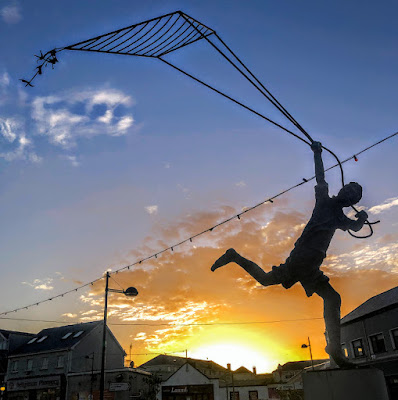
‘Flying a Kite’ or ‘Boy with Kite’by Jarlath Daly is now a landmark in Bettystown, Co Meath (Photograph: Patrick Comerford)

During a recent walk on the beaches of Bettystown and Laytown in Co Meath, a slow, lingering winter sunset brought a new light to Jarlath Daly’s sculpture, ‘Flying a Kite,’ also known as ‘Boy with Kite.’

I have been familiar with this work for many years, but the setting sun cast it in a new light for me a few weeks ago.

The sculptor Jarlath Daly was commissioned by Meath County Council to create this work, which was unveiled by Councillor Tom Kelly on 16 July 2006. It is an imposing bronze figure that graces the main entrance to Bettystown Beach, where kite flying has become synonymous with the area.

It creates the image of a boy racing across the rooftops with his kite, and this sculpture has a sense of youth, timelessness and fun.

Jarlath Daly works in bronze and his sculptures reflect public attitudes, local themes, legends, history at both the local and the epic, and sport, and he is inspired by nature and childhood memories. His works range in scale from 10 inches to 30 feet. He also works with precious metals for jewellery-making.

Jarlath Daly was born in Tipperary in 1956. When he graduated from Limerick School of Art and Design, he became a teacher and taught at second level for two decades, gradually building up a portfolio of private commissions.

His teaching career may explain his many pieces of sculpture for schools around Ireland, including Gaelscoil Tiobraid Arann, Tipperary, Saint Caimin’s Community School, Shannon, Co Clare, and Scoil Mochua, Celbridge, Co Kildare.

‘Flying a Kite’ is a whimsical art piece not to be missed when walking on the Co Meath coast. It is now a landmark in Bettystown and has become synonymous with Bettystown Square and the entrance to the beach.

A slow, lingering sunset while walking on the beach at Relish in Bettystown, Co Meath (Photograph: Patrick Comerford)

30 August 2021

Praying in Ordinary Time 2021:
93, Bective Abbey, Co Meath

Bective Abbey was founded in 1147 as a daughter house of Mellifont Abbey (Photograph: Patrick Comerford)

Patrick Comerford

Before the day gets busy, I am taking a little time this morning for prayer, reflection and reading. Each morning in the time in the Church Calendar known as Ordinary Time, I am reflecting in these ways:

1, photographs of a church or place of worship;

2, the day’s Gospel reading;

3, a prayer from the USPG prayer diary.

My theme this week is Benedictine (including Cistercian) foundations. My photographs this morning (30 August 2021) are from Bective Abbey, Co Meath.

The Abbot of Bective was a spiritual lord and sat in the mediaeval parliament (Photograph: Patrick Comerford)

The ruins of Bective Abbey are on the banks of the River Boyne in Co Meath.

Bective Abbey was founded by the King of Meath, Murchad O Maeil-Sheachlainn, in 1147 as a daughter house of Mellifont Abbey, Co Louth, which had been founded just five years earlier. This was the second Cistercian foundation in Ireland and the new abbey was dedicated to the Blessed Virgin Mary.

Unlike many Cistercian foundations that sought isolation in the wilderness, Bective Abbey was set on prime agricultural land, and quickly rose in importance. The Cistercians were one of the new monastic orders that emerged in the 12th century. Their economy was based on self-sufficiency and relied on arable agriculture.

The cereal cultivated at Bective Abbey, including oat, barley and wheat, fed the monks and any surplus food was sold in Ireland or sent to England and continental Europe. The location of the abbey on the banks of the Boyne and at the fording points on the roads to the north and south made sending these cereals to the port at Drogheda an efficient trade.

Hugh de Lacy, the Anglo-Norman Lord of Meath who built Trim Castle, was murdered in Durrow in 1195. The Abbey of Saint Thomas in Dublin and Mellifont Abbey wanted his body to be buried with them. Finally it was decided to bury his body at Bective Abbey and his head in Dublin.

The decision caused feuding between the monks of the two abbeys, and 10 years later in 1205 the Bishop of Meath and two other judges decreed that the head and body should be reunited and buried together in Dublin.

Bective Abbey was fortified in 1228 and used as a safe haven for the English and visitors from Europe.

It is possible to gauge the importance of the abbey because the Abbot of Bective was a spiritual lord and sat in the mediaeval parliament. The community at Bective Abbey were Anglo-Norman, and in 1386 men of Irish birth were effectively barred from entering the monastery.

The number of monks at Bective declined significantly in the 15th century and the abbey was substantially reduced in size. The south aisles of the church were demolished, the adjoining arcades were blocked off, the nave was truncated with the construction of a new west facade protected by a fortified tower, and a second tower was built at the south-west corner of the cloisters.

The two towers and the fortified alterations made Bective Abbey the most heavily fortified abbey in Ireland, and by the 16th century, the Cistercians of Bective Abbey had become wealthy from rents, tithes and donations.

The abbey was suppressed in 1536, the roof was removed in 1540, and almost 1,600 acres of abbey lands were confiscated. At the time of the dissolution, it was recorded that the estate of Bective contained 1,580 acres valued at £83 18s 8p.

The lands were first rented to Thomas Asgarde, an English civil servant, and bought by Andrew Wyse in 1552. Bective then passed to the Dillon family and later to the Bolton family. The complex was converted into a great mansion with the insertion of new fireplaces, chimneys and large stone windows. However, the abbey and the great mansion later fell into ruin.

Later, in 1766, Thomas Taylour (1724-1797), Lord Headfort, who had been MP for Kells, Co Meath, in 1747-1760, was given the title of Earl of Bective, of Bective Castle, in the County of Meath. However, the family lived not at Bective but at Headfort House, near Kells, and the family’s hunting lodge in Virginia, Co Cavan later became the Park Hotel.

Eventually, Bective Abbey was donated to the State in 1894.

The ruins are surrounded by an outer wall, and nothing remains of the earliest 12th century monastic buildings. The earliest stone work dates from 1274 and includes five bays of the south arcade.

The main part of the fortified abbey is built over three floors and includes cloisters and a tower giving it the appearance of a fortress rather than an abbey. The large defensive tower was built above the south range of the abbey in the 15th century.

But the best-preserved parts of the building are two surviving sections of the 15th century cloisters, with some beautiful arches that are still intact, including a pillar with the figure of mediaeval bishop or abbot carrying a crozier. Some sources say this is Saint Brendan, but it is difficult to understand why an old Irish saint would be given such prominence in an Anglo-Norman foundation. Perhaps he was the abbot responsible for building the cloisters.

Bective Abbey was a location in the filming of Mel Gibson movie Braveheart in 1995, and the cloisters were used for the scene with the Princess and her maid.

Today the ruins of the abbey are set in the middle of pasture on the banks of the River Boyne. In 2012, the Office of Public Works bought some of the land from a local farmer and converted it into a carpark, laying out a footpath leading to the abbey.

The best-preserved parts of the building are two surviving sections of the 15th century cloisters (Photograph: Patrick Comerford)

Luke 4: 16-30 (NRSVA):

16 When he came to Nazareth, where he had been brought up, he went to the synagogue on the sabbath day, as was his custom. He stood up to read, 17 and the scroll of the prophet Isaiah was given to him. He unrolled the scroll and found the place where it was written:

18 ‘The Spirit of the Lord is upon me,
because he has anointed me
to bring good news to the poor.
He has sent me to proclaim release to the captives
and recovery of sight to the blind,
to let the oppressed go free,
19 to proclaim the year of the Lord’s favour.’

20 And he rolled up the scroll, gave it back to the attendant, and sat down. The eyes of all in the synagogue were fixed on him. 21 Then he began to say to them, ‘Today this scripture has been fulfilled in your hearing.’ 22 All spoke well of him and were amazed at the gracious words that came from his mouth. They said, ‘Is not this Joseph’s son?’ 23 He said to them, ‘Doubtless you will quote to me this proverb, “Doctor, cure yourself!” And you will say, “Do here also in your home town the things that we have heard you did at Capernaum”.’ 24 And he said, ‘Truly I tell you, no prophet is accepted in the prophet’s home town. 25 But the truth is, there were many widows in Israel in the time of Elijah, when the heaven was shut up for three years and six months, and there was a severe famine over all the land; 26 yet Elijah was sent to none of them except to a widow at Zarephath in Sidon. 27 There were also many lepers in Israel in the time of the prophet Elisha, and none of them was cleansed except Naaman the Syrian.’ 28 When they heard this, all in the synagogue were filled with rage. 29 They got up, drove him out of the town, and led him to the brow of the hill on which their town was built, so that they might hurl him off the cliff. 30 But he passed through the midst of them and went on his way.

Bective Abbey was donated to the State in 1894 (Photograph: Patrick Comerford)

The Prayer in the USPG Prayer Diary today (30 August 2021) invites us to pray:

Let us pray for the Igreja Episcopal Anglicana do Brasil. May we support them in all they do to spread the Good News of Jesus Christ in Brazil.

Yesterday’s reflection

Continued tomorrow

Some sources the figure on a of mediaeval bishop or abbot carrying a crozier is Saint Brendan … but he may be the abbot responsible for building the cloisters (Photograph: Patrick Comerford)

Scripture quotations are from the New Revised Standard Version Bible: Anglicised Edition copyright © 1989, 1995, National Council of the Churches of Christ in the United States of America. Used by permission. All rights reserved worldwide. http://nrsvbibles.org

The large defensive tower was built above the south range of the abbey in the 15th century (Photograph: Patrick Comerford)

08 March 2021

Praying in Lent and Easter 2021:
20, Gormanston College, Co Meath

Stained glass windows and Stations of the Cross in the Franciscan chapel at Gormanston College, Co Meath (Photograph: Patrick Comerford)

Patrick Comerford

During Lent and Easter this year, I am taking some time each morning to reflect in these ways:

1, a photograph of a church or place of worship that has been significant in my spiritual life;

2, the day’s Gospel reading;

3, a prayer from the prayer diary of the Anglican mission agency USPG (United Society, Partners in the Gospel).

This week I am offering photographs from seven churches that have connections with my education. My photographs this morning (8 March 2021) are from the Franciscan College, Gormanston, Co Meath, where I completed my secondary education. The design of the school chapel strongly reflects the influences of Coventry Cathedral, which had been designed by Basil Spence in 1951, and which would later influence my own spiritual development in the 1970s.

Those Frannciscans not only influenced my education, but shaped my later cultural interests and helped to form my future spiritual values, and after more than half a century I am still in touch with many who were in my school year.

Luke 4: 24-30 (NRSVA):

24 And he said, ‘Truly I tell you, no prophet is accepted in the prophet’s home town. 25 But the truth is, there were many widows in Israel in the time of Elijah, when the heaven was shut up for three years and six months, and there was a severe famine over all the land; 26 yet Elijah was sent to none of them except to a widow at Zarephath in Sidon. 27 There were also many lepers in Israel in the time of the prophet Elisha, and none of them was cleansed except Naaman the Syrian.’ 28 When they heard this, all in the synagogue were filled with rage. 29 They got up, drove him out of the town, and led him to the brow of the hill on which their town was built, so that they might hurl him off the cliff. 30 But he passed through the midst of them and went on his way.

Prayer in the USPG Prayer Diary:

The Prayer in the USPG Prayer Diary today (8 March 2021, International Women’s Day) prays:

Let us give thanks again for all USPG’s partner programmes dedicated to justice and safety for women, such as the Delhi Brotherhood helpline in India, and the Anglican Church of Zambia’s Gender Justice Programme.

Yesterday’s reflection

Continued tomorrow

Stations of the Cross in the graveyard at Gormanston (Photograph: Patrick Comerford)

Scripture quotations are from the New Revised Standard Version Bible: Anglicised Edition copyright © 1989, 1995, National Council of the Churches of Christ in the United States of America. Used by permission. All rights reserved worldwide. http://nrsvbibles.org

05 March 2021

Praying in Lent and Easter 2021:
17, Saint Mary’s Church, Julianstown

Saint Mary’s Church, Julianstown, Co Meath (Photograph: Patrick Comerford)

Patrick Comerford

During Lent and Easter this year, I am taking some time each morning to reflect in these ways:

1, a photograph of a church or place of worship that has been significant in my spiritual life;

2, the day’s Gospel reading;

3, a prayer from the prayer diary of the Anglican mission agency USPG (United Society, Partners in the Gospel).

This week I am offering photographs from seven churches I recall from my childhood. This morning’s photographs (5 March 2021) are from Saint Mary’s Church, Julianstown, Co Meath, which I knew well during my schooldays nearby in Gormanston.

Matthew 21: 33-43, 45-46 (NRSVA):

[Jesus said:] 33 ‘Listen to another parable. There was a landowner who planted a vineyard, put a fence around it, dug a wine press in it, and built a watch-tower. Then he leased it to tenants and went to another country. 34 When the harvest time had come, he sent his slaves to the tenants to collect his produce. 35 But the tenants seized his slaves and beat one, killed another, and stoned another. 36 Again he sent other slaves, more than the first; and they treated them in the same way. 37 Finally he sent his son to them, saying, “They will respect my son.” 38 But when the tenants saw the son, they said to themselves, “This is the heir; come, let us kill him and get his inheritance.” 39 So they seized him, threw him out of the vineyard, and killed him. 40 Now when the owner of the vineyard comes, what will he do to those tenants?’ 41 They said to him, ‘He will put those wretches to a miserable death, and lease the vineyard to other tenants who will give him the produce at the harvest time.’

42 Jesus said to them, ‘Have you never read in the scriptures:

“The stone that the builders rejected
has become the cornerstone;
this was the Lord’s doing,
and it is amazing in our eyes”?

43 Therefore I tell you, the kingdom of God will be taken away from you and given to a people that produces the fruits of the kingdom.’

45 When the chief priests and the Pharisees heard his parables, they realized that he was speaking about them. 46 They wanted to arrest him, but they feared the crowds, because they regarded him as a prophet.

Prayer in the USPG Prayer Diary:

The Prayer in the USPG Prayer Diary today (5 March 2021) invites us to pray:

Let us pray that we might live by the golden rule, treating others how we would like to be treated, rooted in an attitude of love.

Yesterday’s reflection

Continued tomorrow

The AΩ symbol in the centre of the altar designed by James Franklin Fuller in Saint Mary’s Church, Julianstown (Photograph: Patrick Comerford)

Scripture quotations are from the New Revised Standard Version Bible: Anglicised Edition copyright © 1989, 1995, National Council of the Churches of Christ in the United States of America. Used by permission. All rights reserved worldwide. http://nrsvbibles.org

20 August 2020

The Irish countess
who converted to
Judaism in Belfast

Elizabeth Jane Caulfeild, Countess of Charlemont, in 1877 (© The Trustees of the British Museum, released as CC BY-NC-SA 4.0)

Patrick Comerford

One of the best known Jewish women in Irish social and political life was Ellen Odette Cuffe (1857-1933), Countess of Desart, wife of William Ulick O’Connor Cuffe, 4th Earl of Desart, and one of the four women appointed to the first Senate in the Irish Free State.

The Countess of Desart was born into a well-known Jewish family, but her role in Irish life overshadows another Irish countess who converted to Judaism in the late 19th century: the Countess of Charlemont, who was born into the Church of Ireland, is buried in a Church of Ireland churchyard, and is commemorated in Saint Patrick’s Cathedral, Armagh

Lady Charlemont’s conversion to Judaism became a talking point in Victorian society, yet she goes without mention in Louis Hyman’s standard reference work, The Jews of Ireland.

Lady Charlemont was born Elizabeth Jane Somerville (1834-1882) on 21 June 1834, a daughter of Sir William Somerville, later Lord Athlumney, and Lady Maria Harriet Conyngham.

Her father, Sir William Meredyth Somerville (1802-1873), who later became Baron Athlumney in 1863 and Baron Meredyth in 1866, was a Co Meath landowner and a Liberal politician. He was MP for Drogheda in 1837-1852, and in Lord John Russell’s government he was Chief Secretary of State for Ireland – effectively the senior cabinet minister in Ireland – from 1847 to 1852, during the worst years of the Great Famine. After losing his seat in Drogheda, he was elected Liberal MP for Canterbury (1854-1865), where his mother-in-law lived.

The family lived at Somerville hear Balrath, outside Navan, Co Meath, and owned Athlumney Castle, near Navan.

Elizabeth’s mother, Lady Maria Harriet Conyngham, was a daughter of Henry Conyngham (1766-1832), 1st Marquess Conyngham, who owned Slane Castle, Co Meath, and his Elizabeth, who had been one of the many mistresses of King George IV.

A fountain erected by Sir William Somerville on his Co Meath estate in 1855, a year before his daughter’s marriage (Photograph: Patrick Comerford)

Elizabeth Somerville was 22 when she married the much older James Molyneux Caulfeild (1820-1892), on 18 December 1856. He was then then Liberal MP for Armagh (1847-1857) and Lord-Lieutenant of Armagh (1849-1864).

He was the son of the Hon Henry Caulfeild and Elizabeth Margaret Browne, and a grandson of James Caulfeild (1728-1799), the 1st Earl of Charlemont, often known as the ‘Volunteer Earl.’

The family estates included the Marino estate with the Casino in Dublin; Charlemont House on Rutland Square, built by the ‘Volunteer Earl’ in 1765 and now the Dublin City Gallery on Parnell Square; and Roxborough Castle in Co. Tyrone.

The Casino in Marino … built by the ‘Volunteer Earl’ (Photograph: Patrick Comerford)

Elizabeth’s husband James Molyneux Caulfeild was born in Hockley, Armagh, in 1820 and educated at Trinity College Cambridge. On his return to Ireland, he became involved in Liberal politics, and he was elected MP for Drogheda at the age of 26.

His father, Henry Caulfeild, died in 1862, and when Francis William Caulfeild, 2nd Earl of Charlemont, died at Marino, Dublin, on 26 December 1863, James succeeded his uncle as the 3rd Earl and Elizabeth became the Countess of Charlemont.

James began remodelling and extending Roxborough Castle with the architect William Barre (1830-1867), and he moved some items from the family’s residences in Dublin to reuse in this house.

James Molyneux Caulfeild (1820-1892), became the 3rd Earl of Charlemont in 1863

Elizabeth was known as a woman of many accomplishments, an excellent linguist, and a good musician. Soon after becoming Lady Charlemont in 1863, she began attending Jewish services, sought spiritual advice from rabbis, and converted to Judaism.

Jewish services were held publicly in Belfast for the first time in 1864 in the home of Martin Jaffe, and the foundation stone of the synagogue on Great Victoria Street was laid on 7 July 1871. The first minister of the Belfast congregation was the Revd Dr Joseph Chotzner from Kraków.

Her introduction to Judaism may have come through her friend the writer George Eliot (Mary Ann Evans, 1819-1880). The Jewish philanthropist Sir Moses Montefiore, was aware of her sincerity, encouraged her move, and helped her to find relevant books to read.

She frequently attended the synagogue in Belfast, and while she was in London she worshipped at the Central Synagogue on Great Portland Street, built in 1870, and at the New West End Synagogue in Bayswater, which was consecrated in 1879 and whose founding members included Martin Jaffe from Belfast, brother of Sir Otto Jaffe (1846-1929), twice Lord Mayor of Belfast (1899-1900, 1904-1905).

The surviving gates into Marino House, Dublin (Photograph: Patrick Comerford)

Lord Charlemont sold Charlemont House in Dublin to the Government in 1870 and it became the General Register of Ireland and Census offices. Meanwhile, his aunt Anne (Bermingham), widow of the second earl, had continued to live at the family estate at Marino in Dublin, until she moved to London, where she died in 1876.

By then, James had put Marino House and estate up for sale. A notice in The Times on 8 May 1876, advising that the estate was to be sold, described the demesne in great detail. It said the ‘gardens are very tastefully laid out, and in the highest heart and condition, well stocked with fruit trees of good and new varieties. The houses consist of conservatories, greenhouses, vineries, peach houses, forcing and stove houses, of modern construction, all heated on the best principles …’

The estate, including the Casino at Marino, to Cardinal Cullen, who donated most of it to the Christian Brothers.

Four years later, Elizabeth died at Roxborough Castle, Moy, Co Tyrone, on 31 May 1882 at the age of 47. Although she had become a Jew, she was buried in the churchyard at Moy, and her husband included her name on the family memorial he erected in Saint Patrick’s Cathedral, Armagh.

The couple had no children, and James married a second time within a year. On 10 May 1883, he married Anna Lucy Lambart, daughter of the Revd Charles James Lambart, Rector of Navan, Co Meath, at the British Consulate in Pau, France.

This couple had no children either and James died in Biarritzon 12 January 1892, at the age of 71. He was brought back to Ireland and buried in Saint Patrick’s Cathedral, Armagh, on 16 January 1892.

With his death, the title of Earl of Charlemont died too. However, the title of Viscount Charlemont continues in the family, and the current holder is the 16th Viscount Charlemont.

Roxborough Castle was burned down by the IRA in 1922, fell into ruin and was dismantled. Marino House in Dublin was demolished too, but Charlemont House on Parnell Square survives as the Dublin City Gallery and the Casino in Marino has been carefully restored by the Office of Public Works in recent years.

The Caulfeild monument in Saint Patrick’s Cathedral, Armagh … Elizabeth and her husband are named in the last five lines (Photograph: Patrick Comerford)

02 January 2020

A new place in
Laytown for ‘Positivity,
Ambition and Pride’

Dearfachas, Uaillmnian and Bród … three horses by sculptor Lynn Kirkham at Colaiste na hInse in Laytown, Co Meath (Photograph: Patrick Comerford, 2019)

Patrick Comerford

As I was walking from Laytown on my way to lunch in Relish in Bettystown earlier this week, I noticed how much had changed in such a short space of time – less than 18 months – since I had last visited these two coastal towns in Co Meath.

I have known this area since childhood summer holidays in the 1960s, and I got to know it better in my schooldays in Gormanston in the later 1960s.

Of course, much has changed in over half a century, but it is surprising how much changes even within a year and a half.

After admiring Linda Brunker’s Voyager looking out to the sea above the beach at Laytown, I then noticed Lynn Kirkham’s new sculpture in Laytown of three horses in bog oak.

I suppose white horses have been crashing onto the sands at Laytown beach for centuries, and of course many people have got to know the beach at Laytown and Bettystown because of the races on the beach.

But these three new horses at Colaiste na hInse are the work of the sculptor Lynn Kirkham, who has sculpted them from bog wood.

The horses, named Dearfachas, Uaillmnian and Bród, were unveiled in July 2018, and are the result of almost two years of hard labour, with 150 separate pieces of bog oak, ewe and pine put together by Lynn Kirkham.

She is originally from Lancashire and is now based in Templemore, Co Tipperary. She has completed a similar project at the Curragh racecourse, with the landmark sculptures of Fionn Mac Cumhail and his Hounds.

The school motto is ‘Positivity, Ambition and Pride,’ and these are the names she has given to the horses in the Irish language.

The work was commissioned by Louth and Meath Education and Training Board under the Percent for Art scheme to celebrate the tenth anniversary of Colaiste na hInse, a modern secondary school that was moving to a new purpose-built, permanent location. The work was also supported by an EU grant.

The sculpture depicts three horses galloping in the waves and was inspired by the Laytown races on the extensive Meath beaches where ‘White horses of the sea’ break dramatically onto the sand.

The horses are named Bród (Pride), Uaillmhain (Ambition) and Dearfachas (Positivity). Each shows a different character and pose to represent the key words in school motto at Colaiste na hInse.

The sculpture is made from bog oak, yew and pine, gathered by Tipperary farmers and took almost two years to make, including working outdoors through a hard winter and through a heatwave. The wood had to be processed and shaped, then fitted together with brackets on steel frames. The entire project was then dismantled so the frames could be galvanised and reassembled for siting.

Lynn Kirkham’s passion for horses and animals is seen through her other well-known sculptures, including Ghost Horses from the Bog and Fionn Mc Cumhaillle and his Hounds (Kildare County Council) and Free Spirit at Slane Whiskey Distillery.

The cross on the sandbanks behind the church in Laytown, Co Meath, looking out to the Irish Sea (Photograph: Patrick Comerford, 2019)

12 July 2018

Unique house in Bettystown is
a tribute to the Bauhaus School

The Beach Haus, a unique Bauhaus-style house in Bettystown, is on the market with an asking price of €1.25 million (Photograph: Patrick Comerford, 2018)

Patrick Comerford

For almost a decade, cranes stood above a half-built house on the beach at Bettystown, Co Meath. The house remained little more than a shell for years, and the unfinished structure was exposed to elements and sometimes vandalised.

But now the beachfront Beach Haus is a family home, and it has come on the market in recent weeks with an asking price of €1.25 million.

The Beach Haus began as a builder’s swansong, but the recession turned that dream into a nightmare. The shell was bought in 2006 and now the house has a very sizeable floor area of 929 sq m (10,000 sq ft) and an incredible expanse of glass. The present owner spent 18 months finishing the house to the highest specifications

The name of the Beach Haus is a reminder that this house is built in the Bauhaus style.

Staatliches Bauhaus, known simply as Bauhaus, was a German art school from 1919 to 1933 that combined crafts and the fine arts, and was famous for the approach to design that it publicised and taught.

The Bauhaus was founded by the German architect Walter Gropius in Weimar. The German term Bauhaus (‘building house’) was understood to mean ‘School of Building,’ although the school was sought to bring together all arts, including architecture.

The Bauhaus style became one of the most influential currents in modern design, Modernist architecture and art, design and architectural education. It had a profound influence on later developments in art, architecture, graphic design, interior design, industrial design, and typography.

The school constantly changed venues, moving from Weimar (1919-1925), Dessau (1925-1932) and Berlin (1932-1933), until it was closed under pressure from the Nazis, who claimed it was a centre of communist intellectualism

The Beach Haus in Bettystown was designed by the New Zealand architect Craig Bradford (Photograph: Patrick Comerford, 2018)

The Beach Haus in Bettystown has tell-tale elements of the Bauhaus approaches to design in the rectilinear boxy construction and the huge emphasis on expanses of glass. Like Bauhaus, this house is a great example of how functionality need not be boring. And this house is anything but boring.

The Beach Haus was designed by the New Zealand architect Craig Bradford. The property includes a three-bedroom guest house and two-bedroom apartment, both unfinished and amalgamated into the main house.

The house is built in a very unique contemporary style on three levels. At all three levels there is access to the terraces and large balconies overlooking the sea, and there are stunning vistas from all principal rooms.

The two sea-facing bedrooms have balconies, while the two to the rear have terraces overlooking an internal courtyard.

The German engineered anodised aluminium triple glazed windows are the largest domestic installation in Ireland. These floor-to-ceiling windows in all rooms complement the artisan-crafted Italian marble and mother of pearl terrazzo flooring in all rooms. The floors once lay hidden under years of detritus, but have been freshly polished, reflecting the vast swathes of light throughout the house, and they are heated underfoot.

There are floor-to-ceiling custom walnut doors with frosted glass and modern Dornbracht/Hans Grohe German hardware.

In the central foyer – which provides access to the guest house – a floating cantilevered staircase was so cumbersome that it had to be poured on site and the glass balustrade was so large it required bullet-proof glass.

The original plans included a gym, a sauna and a wine cellar in the basement, which is now used as storage. The house was also wired for an electric grand piano.

The house goes down 3 metres on the beach side, and the amount of concrete used could support a building four times its size.

Inside, the house has motorised blinds, zoned LED lighting and a Sonos audio system. The 10-ft high ceilings have acoustic panelling to ensure sound-proofing.

Cedar was used as external cladding and for the interior walls. One entire wall inside has a hidden panel for the 65-inch television screen. Cedar was also used on the four-car double garage inside the electric gates.

Views of the beach at Bettystown and Laytown and the Irish Sea from the Beach Haus (Photograph: Patrick Comerford, 2018)

Bettystown Beach is at the backyard, and a door with keypads at the end of the garden wall gives the residents direct access to the beach.

The perimeter walls are built of solid stone blocks that are cemented several metres below to ensure they withstand the elements. The house stands on a site of 0.20 hectare (0.5 acre), and the landscaping around the house includes year-round flowering foliage, newly-planted trees, shrubberies, sun-trap patio areas and water features.

The house is 16 km from the Dublin-Belfast M1 motorway and has panoramic views over the Irish Sea, the Mourne Mountains and as far south as Skerries in north Co Dublin. Bettystown is about 50 km north of Dublin, 35 km from Dublin Airport and 8 km south of Drogheda which is Ireland’s largest town.

The Beach Haus is on the market through Savills Country, 20 Dawson Street, Dublin 2, with an asking price of €1.25 million.

The Beach Haus remained a shell for many years before it was completed (Photograph: Patrick Comerford, 2018)

An afternoon walk through
the moonscape created by
the tides on Laytown beach

Reflections on the beach at Laytown, Co Meath, on Wednesday afternoon (Photograph: Patrick Comerford, 2018)

Patrick Comerford

I was in Dublin from early yesterday [11 July 2018] for meetings with politicians and government officials in Leinster House, Kildare Street and Buswell’s Hotel to discuss some matters of concern in Rathkeale.

As I have another hospital procedure this morning, I stayed overnight rather than returning to Co Limerick, and watched the England v Croatia match at home.

But in between those meetings and that match, two of us spent the afternoon in Laytown and Bettystown on the coast of Co Meath, walking the long stretch of sandy beach, and meeting another long-standing friend now living in Julainmstown for a late lunch in Relish Café in Bettystown.

It must be about three months since I was last in Bettystown and Laytown. So, it was wonderful to have an afternoon walk on this beach, despite the fact that the long stretch of summer weather we have been enjoying since returning from Crete last month seems to have been interrupted – at least for the next few days.

We had decided to park the car at Laytown and walk to Bettystown, but work on an interesting project on building much-needed sea defences to shore up the sandy banks at Laytown made it a little confusing initially as we made our way down onto the beach.

Perhaps if Meath County Council is intent on protecting the sand banks and this long stretch of beach, they could also introduce measures to stop people driving their cars onto to sand, a move that would go along way towards restoring this as an attractive beach for walkers and bathers.

The tide was out, adding to sense of a parched landscape that all of us are noting in this spell of dry weather – despite some short rain showers at intervals yesterday.

The cross on the sandbank reflected on the full-height church windows (Photograph: Patrick Comerford, 2018)

As we walked along the beach in the late afternoon, I noticed an unusual reflection of the cross on the sandbank on the full-height east windows of the church in Laytown.

Below the sand banks, there are still visible traces of entries in the 16th National Sandcastle and Sculpturing Competitions, which took place on the Bettystown-Laytown Beach last Sunday afternoon [8 July 2018].

There were signs of the inevitable castle or octopus, and the occasional fish or mermaid. A crocodile seems to have survived the waves and tides of the days that followed, and one imaginative map of Africa is still leaving its mark on the sand.

The tides have turned the sand sculptures into a moonscape (Photograph: Patrick Comerford, 2018)

But where the sea has worked its way steadily in the ebb and flow against those creative imaginations, some of the rows of allocated lots look like a moonscape.

The tide was still out as we walked back from Bettystown to Laytown after lunch in Relish, and a number of trawlers seemed to be closer to the shore than the distant horizon. Although the skies were dull greys rather than the bright blues of summer, we could see as far as the towers at Mornington.

Yet it seemed to be a sad insight into the inevitable reality that the days are already beginning to shorten, and sooner than we expect we will begin to notice that the evenings are beginning to close in.

Despite the grey clouds, we could see as far as Mornington(Photograph: Patrick Comerford, 2018; cick on images for full-screen view)