Showing posts with label Dugort. Show all posts

26 February 2025

A history of the Church of Ireland on Inishbiggle

Looking across to Inishbiggle from Bullsmouth … the Heinrich Böll Memorial Weekend in 2013 included a lecture on the history of the Church of Ireland on the island (Photograph: Patrick Comerford, 2013)

The Aughaval Group of Parishes is a Church of Ireland group of parishes in Co Mayo, in the Diocese of Tuam, Limerick and Killaloe. It includes Holy Trinity Church, Westport, Saint Thomas’s Church, Dugort, Achill Island, Holy Trinity Church, Inishbiggle Island, Christ Church, Castlebar, Turlough Church, near Castlebar.

Last week (20 February 2025), the Aughaval Group of Parishes reposted my photographs and my short history of history of the Church of Ireland on Inishbiggle, part of a lecture I delivered in Holy Trinity Church, Inishbiggle on Sunday 6 May 2013.

My lecture was part of a guided walk on Inishbiggle Island led by Sheila McHugh during the ninth Annual Heinrich Böll Memorial Weekend 2013, and it was followed by poetry readings by Paddy Bushe, Eva Bourke and Jan Wagner, introduced by Mechtild Manus, Director Goethe-Institut Irland.

This is my lecture in full:


Patrick Comerford

This island is unique in Ireland. While other islands, such as Valentia in Co Kerry may have both Catholic and Church of Ireland churches, Inishbiggle is the only island with only a Church of Ireland church. In addition, Holy Trinity Church, on the eastern side of this island, is the oldest and probably the only truly historical building on the island, and perhaps also its most beautiful building.

We can say that Inishbiggle is an island off an island, but we could also call it a new island, for it has been inhabited continuously for less than two centuries.

At the time of the Tudor Reformation in Ireland, Inishbiggle was part of the larger Co Mayo estates claimed by the Butler Earls of Ormond as heirs to the Butlers of Mayo, and those claims were confirmed to Thomas Butler, Earl of Ormond, at the Composition of Connaught in 1585, and again in a grant from King James I in 1612.

The Ormond Butlers’ loyalty to the Tudor and Stuart monarchies made them key figures in implementing the Anglican Reformation in Ireland. The Butler Lordship of Achill included Inishbiggle, and continued until 1696, when the Butlers leased their Mayo estates first to Sir Thomas Bingham and then to Thomas Medlycott. Later in the 18th century, the Medlycott family was facing financial difficulties and sold the estate to John Browne of Westport House, 1st Earl of Altamont, in 1774. He sold it back to the Medlycotts but the estates, including Achill Island and Inishbiggle, were bought by Sir Neal O’Donel of Newport House in 1785 – for £33,598 19s 4d.

Although the O’Donel family built the Church of Ireland parish church at Burrishole for Newport, and despite continuous ownership of Achill and Inishbiggle by leading members of the Church of Ireland since the Reformation, no Church of Ireland churches were built on these islands until the mid-19th century.

And, despite this continuous record of ownership for many centuries, the history of Inishbiggle as an inhabited island is recent, modern history, for the island remained uninhabited until 1834.

Saint Thomas’s Church, Dugort … the centre of Edward Nangle’s mission work on Achill and Inishbiggle (Photograph: Patrick Comerford, 2013)

In 1837, there was no church on either Achill Island or Inishbiggle, and the Rector, Canon Charles Wilson, reported that Sunday services held were held in a private house. That year, the Achill Mission approached the O’Donel estate about leasing Inishbiggle. Sir Richard O’Donel himself admitted at one stage that his Achill estates had provided him with little income, and he certainly was unwilling to invest any of his dwindling fortune into helping his tenants.

A year later, by 1838, a few buildings had started to appear on the island, and in 1839 a prominent Church of Ireland author and clergyman of the day, the Revd Caesar Otway (1780-1842), known for his advocacy on behalf of the poor, visited Inishbiggle.

Otway had earned a reputation for studying and seeking to improve the conditions of the poor in the west of Ireland. At the time of his visit to Inishbiggle, he was the assistant chaplain at the Magdalen Asylum in Dublin, and his writings, expressing his concerns for the poorest people in Ireland, include Sketches in Ireland (1827), A Tour in Connaught (1839), and Sketches in Erris (1841). Otway suggested Inishbiggle as ideal place for growing wheat and proposed building a mill on the island, but his proposals were never followed through.

Otway might have been the most important 19th century Church of Ireland clergyman to visit Inishbiggle but for the arrival of the Revd Edward Nangle as part of his endeavours to extend the work and scope of the Achill Mission.

In 1841, Inishbiggle had a population of 67 living in 12 houses.

During the difficult Famine years immediately after the death of Caesar Otway, Inishbiggle developed slowly, with the arrival of both Protestants and Catholics from Achill Island and from mainland Co Mayo, settling on Inishbiggle to take advantage of lower rents and in the hope of finding better living conditions.

The Revd Canon Edward Nangle (1800-1883) … a portrait in Saint Thomas’s Church, Dugort (Photograph: Patrick Comerford, 2013)

In March 1848, hundreds of people from Dooniver, Bullsmouth and Ballycroy approved a declaration of thanks to Canon Nangle for supplying them with potatoes and turnips from one of the mission farms in Inishbiggle. Without the food, they said, they would have starved. As Anne Falvey writes, “Despite the criticisms heaped upon him, we can only surmise how much more tragic the situation would have been but for the charitable efforts of Nangle and hundreds of generous donors.”

The first schoolhouse was built on Inishbiggle that year. But by 1851, the population had dropped to 61 people, living in ten houses. A year later, Edward Nagle and the Trustees of the Achill Mission at Dugort bought Inishbiggle from Sir Richard O’Donel of Newport in 1852. The trustees of the mission were the Hon Somerset Richard Maxwell, the Right Hon Joseph Napier, George Alexander Hamilton, and Edward Nangle. Apart from Nangle, the other three trustees came from families with strong church associations.

The Radisson Blu Farnham Estate Hotel … Farnham House had once been the home of Somerset Maxwell, a trustee of the Achill Mission (Photograph: Patrick Comerford, 2011)

1, Somerset Maxwell (1803-1884), who had briefly been the Tory MP for Co Cavan (1839-1840), was a grandson of Henry Maxwell, Bishop of Meath, and the son of the Revd Henry Maxwell (1774-1838), 6th Lord Farnham. Bishop Maxwell had built Saint Mary’s Church of Ireland parish church in Bunclody, Co Wexford, then known as Newtownbarry after the Maxwell-Barry family – of interest to us this morning as we are honouring John F Deane this weekend on his 70th birthday, and his father, like my Comerford ancestors, came from Bunclody.

Somerset Maxwell eventually succeeded his brother Henry Maxwell in 1868 as the 8th Lord Farnham, but, while he inherited the Farnham estate in Co Cavan, by then the Farnham or Maxwell-Barry estate in Newtownbarry had been sold as an encumbered estate. It may have been through the influence of Somerset Maxwell and his family that a number of Cavan Protestant families came to Achill, such as the Sherridan family.

2, Joseph Napier (1804-1882), later Sir Joseph Napier, was MP for Dublin University (1848-1858), Attorney General for Ireland (1852), and Lord Chancellor of Ireland (1858-1859). However, he was not a member of the same Napier family that I recently identified as the Irish ancestors of the new Archbishop of Canterbury, Archbishop Justin Welby.

George Alexander Hamilton's memorial in Saint George’s Church, Balbriggan, Co Dublin (Photograph: Patrick Comerford, 2011)

3, George Alexander Hamilton (1802-1871) was an MP for Dublin City (1835-1837) and then for Dublin University (1843-1859), and a clergyman’s son too – he was the son of the Revd George Hamilton of Hampton Hall, Balbriggan, Co Dublin, and he contributed generously to the building of Saint George’s Church, Balbriggan, where he is buried.

But, despite the wealth, power and privilege of these trustees and their strong clerical family links with the Church of Ireland, Inishbiggle long remained without a church and Holy Trinity Church was not built until the end of the 19th century.

Griffith’s Valuation shows there were 18 families living on this island in 1855: their family names were Cafferky (2), Campbell (1), Cooney (1), Fallon (2), Henery (i.e., Henry) (1), Landrum (1), McDermott (1), McManmon (1). Mealley (i.e., Malley or O’Malley) (4), Molly (or Molloy) (1), Nevin (1), Reaf (1) and Sweeny (1).

By 1861, Inishbiggle had 32 houses and a population of 145. By 1871, there were 30 houses with 154 people. By 1881, there were 171 people in 29 houses.

But by the 1880s, emigration was taking its toll from the Church of Ireland community on both Achill and Inishbiggle. The Rector of Achill, the Revd Michael Fitzgerald, gave some idea of the scale of that emigration when he wrote: “During the months of April and May 1883, and within the last ten days, I have lost by the rapid tide of free emigration to Canada, the United States of America, and Australia, forty-two members of my flock, thirty-six of whom belong to Achill Sound, and six to the island of Inishbiggle.”

It was a very steep fall indeed. By 1891, the population had fallen by 36 to 135, living in 24 houses – a population figure and a figure for housing units that were both lower than they had been a generation earlier in 1861.

In 1901, the census shows the population was still 135 people living in 25 houses on the island. Of these, 39 people or 29 per cent of the population were members of the Church of Ireland. The following Church of Ireland members were living in 11 households on this island:

● Michael Henry (62); his wife Anne Henry (60); son James Henry (25); daughter Margaret K Miller (30); and father-in-law Patrick Gallagher (88). (Numbers, 5).

● John Henry (70) and his two Roman Catholic daughters, Mary Henry (30) and Margaret Henry (17). (Numbers, 1).

● Patt Malley (55), one of the workers who built this church; his wife Catherine Malley (50), and their five children Ellen (16), Honor (14), Patt (12), Celia (10) and Sarah (6). (Numbers, 7).

● Edward Calvey (60) and his Roman Catholic wife Anne Calvey (60), and their five children, of whom one was a Roman Catholic and four were members of the Church of Ireland: John (33), Roman Catholic; Edward (29), Church of Ireland; Peter (23), Church of Ireland; Michael (19), Church of Ireland; and Timothy (12), Church of Ireland. (Numbers, 5).

● Patrick McManmon (60); his wife Mary (60); and their seven children Mary (27), Frank (25), Ellen (23), Bridget (20), Patrick (16), Kate (15), and James (12). (Numbers, 9).

● James McManmon (74), his two Roman Catholic sisters, Mary McManmon (72) and Bridget Doran (57), and his two Roman Catholic nieces, Ellen Doran (25) and Kate O’Boyle (34). (Numbers, 1).

● James Sheerin (69), his wife Martha Sheerin (69), their daughter, Kate Sydney Sheerin (30) and a Roman Catholic servant, Anne Cafferkey (20).(Numbers, 3).

● Matilda Brice (66), a widow who lived alone. (Numbers, 1.)

● John Gallagher (42), his wife Mary Gallagher (50) and their sons Edward (14) and Francis (13). (Numbers, 4.)

● Francis Gallagher (84), who lived alone. (Numbers, 1.)

● John McManmon (65), his Roman Catholic wife Catherine McManmon (62), and their two sons, one Church of Ireland, Frank (24) and one Roman Catholic, Martin (21). (Numbers, 2.)

Martha Sheerin (1834-1917) was a daughter of George Lendrum (1799-1871), a Scripture Reader who moved to Dugort with Edward Nangle in 1834. She was born in Dugort in 1834, and is an interesting example for this morning’s study, for through her father’s family she is related to many families on Inishbiggle and Achill. The Lendrum family was intermarried with the Egan, Geraghty, McDowell, McHale, McNamara, Patton and Sherridan families. Within a few generations, these families became related not only to most of the Church of Ireland families on these islands, but to many of the other families too.

Ten years later, the 1911 census shows the Church of Ireland inhabitants had dropped in number to 36, living in ten households, while the general population of the island had risen to 149 people living in 29 houses or units. The Church of Ireland population was now 24 per cent. In other words, the island’s population was rising, but the Church of Ireland population was dropping, and the fall in numbers would have been greater but for the arrival of a school teacher and his family.

The Church of Ireland people on the island were:

● James McManmon (82) (the rest of his family, two sisters, two nieces and a grand nephew, are all Roman Catholics). (Numbers, 1.)

● Edward Calvey (73), his wife Ann Calvey (69), one Roman Catholic son, John Calvey (48), and four Church of Ireland sons: Edward (46), Peter (44), Michael (39), and Timothy (33). (Numbers, 6.)

● Patrick McManmon (74), his wife Mary (70), and their four children Mary (41), Ellen (38), Patrick (30), James (26). (Numbers, 6.)

● James Henry (35), his mother Ann Henry (70), and his Roman Catholic niece, Margaret Henry (16). (Numbers, 2.)

● John Gallagher (59) and his son Francis Gallagher (23). (Numbers, 2.)

● Pat O’Malley (70), his wife Catherine O’Malley (60), and their three daughters, Honor (24), Celia (19) and Sarah (16). (Numbers, 5.)

● Michael Gallagher (44), his wife Mary Gallagher (31) and their four children Margaret (8), John (7), Mary (5), and Ellen (3). (Numbers, 6.)

● Martha Sheerin (77), by now a widow, her daughter, Kate Sydney Sheerin (40), and a Roman Catholic servant, Julia Cafferkey (17). (Numbers, 2.)

● John Tydd Freer (42), his wife Annie (39) and their two daughters and one son, Olive May (13), Dorothy Margaret (9) and Charles Crawford Freer (5). He was a teacher, born in Queen’s Co, she was born in Co Galway, the first two children were born in Dublin, and their son was born in Co Mayo. (Numbers, 5.).

● Matilda Bryce (73), who was living alone. (Numbers, 1.)

As we are paying tribute to John F Deane this weekend, it is worth remembering how the arrival of a teacher-family can have a major impact on the life of an island. Without the arrival of the Freer family on Inishbiggle, the decline in the Church of Ireland population would have been steeper. So, despite the recent building of Holy Trinity Church, there was never the potential or realistic hope for a sustainable Church of Ireland parish on Inishbiggle.

There are variations in the spellings and ages given at each census, but these are easily reconciled.

In 1912, a Mr Fenton wrote to the Department of Education, saying there were 16 families on the island, of whom 14 were Roman Catholic and two were part of the Church of Ireland.

A list of school-going children attending the mission school on the island that year shows there were 41 Roman Catholic children and six Church of Ireland children on the island: Margaret (8) John (6) and Mary (5) Gallagher, and Harold (11), Dorothy (9) and Charles (5) Freer; 34 Roman Catholic children and five Church of Ireland children were attending the Church of Ireland-run school, which was still known as the Mission School.

What these returns and statistics tell us is that the Church of Ireland community on Inishbiggle was never large enough to give hope to a sustainable parish developing on the island, and that by the beginning of the second decade of the last century, the community was in decline, with numbers falling as the original settlers on the island reached old age and died.

Nevertheless, they lived in more prosperous conditions, albeit marginally so, and they show a higher standard of literacy and education. Indeed, this higher standard of education made it easier for their children to emigrate, because their job prospects were higher than those of their neighbours.

Their family names also indicate that, by and large, the members of the Church of Ireland on the island shared the ethnic or social backgrounds of their neighbours: Calvey, Gallagher, Henry, MacManmon, Malley or O’Malley, Sheerin, and so on. We can also see from the patterns of family membership that there is an interesting degree of inter-marriage between Protestant and Catholic families, despite the negative attitudes that would have been prevalent in both communities at the time.

Holy Trinity Church, Inishbiggle (Photograph: Patrick Comerford, 2013)

By 1971, Charles Crawford Freer, by then Press Officer for the Church of Ireland, reported that the Church of Ireland population of Inishbiggle had fallen from 15 to five.

When I visited Holy Trinity Church and Inishbiggle in 1990, there were three members of the Church of Ireland on the island. The last surviving members of the Church of Ireland congregation were James Gallagher, grandson of Patrick O’Malley, who built this church in the 1890s, and his sister Ellen. When Ellen Gallagher died in 1995, she was buried in Achill Sound Cemetery. Her brother James continued to look after the Church which he opened frequently during the summer for services led by visiting clergy on holiday.

Although one diocesan history states this church was built by the Achill Mission, the Achill Mission had long closed by the time the church was built in the 1890s not with mission funds but through an initial generous donation of £600 from a Miss Ellen Blair of Sandymount, Dublin.

In 1893, the Bishop of Tuam, the Right Revd James O’Sullivan (1834-1915), and the Diocesan Architect, John G Skipton (1861-1921), came to Inishbiggle by boat on a five-mile journey from Achill Sound to select a site for the new church. They were accompanied by the Revd Michael Fitzgerald, Rector of Achill, and the Revd R O’Connell.

On “a fine day” in 1895, Bishop O’Sullivan, his wife and the Rector returned to lay the foundation stone for Holy Trinity Church. It was reported at the time that the local people were “joyful” at the prospect of having a church of their own.

The contractors were Berry and Curran, and the work was carried out by local labourers. The story is told that during this building work a heavy piece of wood crashed to the ground, just missing Patrick O’Malley, who was rescued thanks to the hasty intervention of Patrick Nevin.

The building work was completed by 1896. Bishop O’Sullivan came from Achill Island to Inishbiggle, this time on “a sunny day,” with a large number of people in rowing boats for the consecration of the new church. The consecration was followed by a celebration of the Holy Communion.

The church is built of stone with a natural pebble-dash finish, a small tower with a bell and cross and a wrought-iron gate. In summertime, this church is even prettier as the pink rhododendrons surrounding it come into bloom and form an archway.

Inside Holy Trinity Church, Inishbiggle (Photograph: Dan MacCarthy, 2012)

With its white walls and intimate size, Holy Trinity Church has a simple, plain interior that lends itself to quiet prayer and contemplation. Beyond the vestibule, the old carved organ is inscribed: “Washington, New York, USA.’’ The organists at Holy Trinity have included: Mrs Margaret Brown, Mrs Cynthia Blair and the teacher’s wife, Mrs Annie Hughes Freer.

Beyond the organ, the aisle leads to the five rows of wooden pews. There is a small pulpit at the north side of the chancel arch. The altar in the sanctuary area stands in front of a lofty ceiling and a tall, three-light East Window. There is a small vestry off the sanctuary area.

During the years that followed the building of the church, many Protestants left the island for one reason or another. But the clergy of Achill and Dugort parish continued to serve the church and the few members of the Church of Ireland who lived on this island.

To mark the arrival of electricity on the island a decade or two ago, a special joint service for members of the Catholic Church and the Church of Ireland was held in Holy Trinity Church.

As far as I can find out, no weddings or funerals were held in the church. But successive bishops of Tuam, including Bishop John Neill and Bishop Richard Henderson, had a generous vision for the use of the church, and in 2003, Inishbiggle set an ecumenical landmark when the church was rededicated to serve both the Church of Ireland and the Roman Catholic communities.

There is a small churchyard or cemetery beside the church. As a mark of gratitude, Patrick O’Malley later had a stone wall built around the cemetery, replacing the original sod wall. However, the cemetery has not been used for burials for 80 or 90 years.

A school, predating the church, was standing on this same site in 1870, replacing the first school dating from the 1840s. The teacher lived in the now roofless cottage beyond the church on the edge of the island facing Annagh and the mainland. The cottage was later abandoned, has become roofless, and is falling into ruins.

Donna Allen, in her essay in Cathar na Mart, relies on local memory for recalling some of the Church of Ireland clergy who served on this island: Fitzgerald; Boland; Horn; Abernethy – who left about 1939 to serve in World War II; Marshall, who returned to his native England; Sidebottom; Plowman; and Friess, who was then living in retirement with his wife in Mulranny.

However, as Inishbiggle was always part of the parishes of Achill and Dugort, the Tuam Diocesan Records make it possible to put together a list of all the clergy who served Holy Trinity Church and the Church of Ireland parishioners on the island.

The first recorded rector of Burrishoole and Achill was the Revd John [Horsley] de la Poer Beresford (1773-1855), but he may have never visited either Achill or Inishbiggle. He was born in 1773, and he was a barrister prior to his ordination in 1803. Once he was ordained, he was immediately appointed to this parish by his father, the Archishop of Tuam, William Beresford, 1st Lord Decies. But Archbishop Beresford was not averse to finding sinecures for his sons: another son, George Beresford, was Provost of Tuam, while a third, Canon William Beresford, was Prebendary of Lackagh.

Beresford’s successor, Canon Thomas Mahon (1786/7-1825), was from Co Leitrim, and like most of the rectors he was a graduate of Trinity College, Dublin.

The parishes of Achill and Dugort were sometimes united and sometimes separate parishes. But, as some critics suggest, these were not places to send clergy who were difficult or who found it difficult to find appointments to other parishes. Nor were the clergy outsiders who came in with little experience of or sympathy for the people. Mahon’s successor, Canon John Galbraith (1786-1850), was born in Co Galway, a first cousin of the 1st Earl of Clancarty, and he later became Provost of Tuam (1844-1850).

He was succeeded as Provost of Tuam by Canon Charles Henry Seymour (1813-1879), who was born in Co Mayo, and his father, grandfather, brother and nephew were all priests of the Church of Ireland. He moved from Achill to become Vicar, Provost and then Dean of Tuam, dying there on 14 April 1879, aged 65.

Nor was their interest in mission on Achill and Inishbiggle isolated from the wider mission of the Church. For example, John Galbraith’s daughter, Eileen, translated the New Testament into the Mori language of South Sudann. Canon Thomas Stanley Treanor (ca 1836-1910) was a chaplain with the Mission to Seamen (1878-1910) after leaving Achill in 1878, and wrote about those experiences in Cry from the Sea (1906).

The Revd John Hoffe, curate of Achill (1870-1872) and then Rector of Dugort (1872-1878), left these islands to become curate of Sandford Parish (1878-1879) in Dublin, where his rector was the Revd Thomas Good, who had been a missionary in Sri Lanka (Ceylon) in the 1860s and 1870s, and where a previous rector, Canon (later Bishop) William Pakenham Walsh, had worked for the Church Mission Society for ten years.

George Abraham Heather (1830/1-1907), who came to Dugort in 1871, had been secretary of the Church Mission Society Ireland (1863-1867).

Nor should their interest in Irish be dismissed as seeing it as another tool in proselytism or evangelism. Thomas de Vere Coneys, who was curate in Achill (1837-1840), left to become Professor of Irish in Trinity College Dublin in 1840. William Kilbride, curate from 1852-1853, had been the Bedell Scholar in Irish in Trinity College, Dublin (1847), and spent almost half a century as Rector of the Arran Islands from 1855 to 1898. Robert O’Callaghan, curate of Achill from 1857-1861, was also a Bedell Scholar in Irish (1855).

The calibre of the clergy who served these islands is typified by men such as William Skipton (1832/3-1903), who was in Dugort (1861-1867) after Nangle, and later became Dean of Killala (1885-1903). His successor, George Abraham Heather, who was in Dugort from 1867 to 1871, later became Archdeacon of Achonry (1895) and Dean of Achonry (1895-1907).

Their tenacity and commitment is typified by men such as the Revd Michael Fitzgerald (ca 1831-1897), who was so worried about the toll emigration was taking on his parishioners on Inishbiggle. He remained rector of this parish for 15 years until he died at Achill Rectory on 15 July 1897 at the age of 65.

The plaque commemorating Canon Thomas Boland at the west end of Saint Thomas’s Church, Dugort (Photograph: Patrick Comerford, 2013)

His successor, Canon Thomas Boland (ca 1857-1939), who is remembered in a plaque at the west end of Saint Thomas’s Church, Dugort, had been involved in mission work in Galway for 11 years before coming to Achill and worked here for 40 years. Canon Olaf Vernon Marshall (1907-1978) worked in children’s homes and schools as a chaplain and a superintendent until coming here as Rector of Achill and Dugort (1964-1968). When he moved it was to Omey, the Church of Ireland parish in Clifden, Co Galway.

The Revd Walter Mervyn Abernethy left not to move to England but to become an army chaplain in World War II. When the war ended, he then remained in England, working in parishes mainly in the Dioceses of Norwich and Lichfield.

Bishop John Coote Duggan (1918-2000), who was the rector for only a very brief time (1969-1970), was Archdeacon of Tuam at the same time before becoming Bishop of Tuam (1970-1985).

After becoming bishop, he appointed his curate, the Revd Louis Dundas Plowman (1917-1976) as Bishop’s Curate of Achill and Dugort, and he lived in Achill Rectory. He was a Dublin Corporation official before his ordination in 1969 in his 50s. Canon Plowman later became Rector of Killala and died in Crossmolina Rectory in 1976.

The grave of Dean Herbert Friess and his wife Hildegard Wilhelmina Margarita near the main door of Saint Thomas’s Church, Dugort (Photograph: Patrick Comerford, 2013)

More recently, the Very Revd Herbert Friedrich Friess (1909-1997), was Rector of Achill and Dugort (1973-1979) and he had an interesting life story. He was born in Germany in 1909, and studied theology at the University of Leipzig (BD 1934). He became a wartime refugee in England, where he served as a German pastor before being ordained deacon and priest by the Church of England Bishop of Sheffield in 1942. After almost a quarter century in parish work in England, he came to Ireland in 1964 as Rector of Crossmolina (1964-1973) and then Dean of Killala (1968-1973). In what must have seemed like a straight swop with Canon Plowman, he became Bishop’s Curate of Achill and Dugort (1973-1979), and lived in the Rectory at Achill Sound.

Dean Friess continued to take Sunday services in Dugort, Achill Sound and Inishbiggle regularly after his retirement, and many people still remember him with affection. He died on 3 April 1997; his wife Hildegard Wilhelmina Margarita (1907-1997) died a few weeks later on 1 May 1997; they are buried together in Saint Thomas’s Churchyard in Dugort.

From 1979, the churches on Achill and Inishbiggle were served by the Rectors of Castlebar and Westport. They have included the Revd William John (‘Jack’) Heaslip (1991-1995), better known today as the chaplain to U2, and Archdeacon Gary Hastings (1995-2009), who has his own take on Irish music.

Looking from Bullsmouth across to Inishbiggle … Frederick MacNeice left his family at Bullsmouth watching the sunset while he took the Sunday afternoon service in Holy Trinity Church, Inishbiggle (Photograph: Patrick Comerford, 2013)

But apart from the resident rectors and curates, Inishbiggle was also served by visiting clergy and students, who often stayed during the summer months either at the Rectory at Achill Sound, or at the Old Rectory in Dugort.

Perhaps one of the most interesting of those holidaying clergy was Bishop John Frederick MacNeice (1866-1942), father of the poet Louis MacNeice.

Frederick MacNeice first visited Achill in 1911 and ever since had a “special love” for these islands, and he first brought his son Louis with him here in 1927. In 1929, the family stayed at the Old Rectory in Dugort, visiting Keel, climbing Slievemore, and he took services in Dugort, crossing over from Bullsmouth in the late afternoon to take “the Island service” in Inishbiggle, while his family remained at Bullsmouth watching “a beautiful sunset behind Slievemore.”

Frederick returned the following summer (1930), this time without Louis. By then he was a canon of Saint Patrick’s Cathedral, Dublin; a year later he became Bishop of Cashel (1931), and in 1934 he became Bishop of Down and Dromore.

Three years after his father died, Louis MacNeice returned to Achill in 1945, re-enacting a fraught family holiday 16 years earlier in 1929. One of the poems he wrote afterwards is ‘The Strand’ (1945), published in Holes in the Sky in 1948:

The Strand (1945) by Louis MacNeice

White Tintoretto clouds beneath my naked feet,
This mirror of wet sand imputes a lasting mood
To island truancies; my steps repeat

Someone’s who now has left such strands for good
Carrying his boots and paddling like a child,
A square black figure whom the horizon understood –

My father. Who for all his responsibly compiled
Account books of a devout, precise routine
Kept something in him solitary and wild,

So loved the western sea and no tree’s green
Fulfilled him like these contours of Slievemore
Menaun and Croaghaun and the bogs between.

Sixty-odd years behind him and twelve before,
Eyeing the flange of steel in the turning belt of brine
It was sixteen years ago he walked this shore

And the mirror caught his shape which catches mine
But then as now the floor-mop of the foam
Blotted the bright reflections – and no sign

Remains of face or feet when visitors have gone home.


In conclusion, how can I summarise the history of the Church of Ireland on this island? I could summarise it in the following points:

1, The history of Church of Ireland people on the island is intimately tied in with the first efforts to populate Inishbiggle in the middle decades of the 19th century.

2, Many of them inter-related … but perhaps to no greater degree than they were inter-related with the other families on these islands.

3, The family names of the Church of Ireland families on Inishbiggle indicate they were from very similar backgrounds to their Catholic neighbours.

4, There was a high degree of intermarriage between members of the Church of Ireland and Catholic families, despite official opposition to intermarriage which intensified after the Ne Temere decree was promulgated in 1908.

5, The higher educational standards among Church of Ireland islanders, no matter how marginal, made it more possible for them to find employment off the island, and so education, ironically, contributed not to improved fortunes for the members of the Church of Ireland, but to their eventual numerical decline.

6, The figures for the Church of Ireland population were always low, and never offered the hope of a sustainable parish on this island.

7, The decline in numbers in the Church of Ireland population on Inishbiggle began in the 1880s, as the Revd Michael Fitzgerald noted in 1883.

8, The clergy who served the Church of Ireland people on Inishbiggle were often fluent in the Irish language, not in a functional way but because they had a genuine cultural and academic interest in the language.

9, Those clergy, residents and visitors like Bishop Frederick MacNeice, often came to these islands with a wider and more compassionate interest in children’s rights, the plight of the poor and the oppressed, and with a genuine interest in education, land reform and culture.

10, The story of the Church of Ireland on this island is not the story of a minority that has slowly faded away, but is a story that can be claimed by everyone who loves these islands, because it is part of what made Achill and Inishbiggle and their people what and who they are today.

APPENDIX

RECTORS, VICARS AND CURATES OF ACHILL

Rectors and Vicars of Burrishoole, Kilmeena and Achill

1803-1809: John [Horsley] de la Poer Beresford
1809-1825: Thomas Mahon
1825-1830: John Galbraith

Rector and Vicars of Achill:

1803-1809: John [Horsley] de la Poer Beresford
1809-1825: Thomas Mahon
1825-1830: John Galbraith
1830-1847: Charles Wilson
1847-1850: Charles Henry Seymour
1850-1852: Edward Nangle
1852-1872: Joseph Barker
1872-1878: Thomas Stanley Treanor
1878-1879: Edward Browne Dennehy
1879-1881: Charles le Poer Trench Heaslop
1882-1897: Michael Fitzgerald
1898-1938: Thomas Boland
1938-1939: Patrick Kevin O’Horan
1939-1942: Walter Mervyn Abernethy
1942-1945: Frederick Rudolph Mitchell
1945-1953: George Harold Kidd
1953-1956: William Fitzroy Hamilton Garstin
1956-1960: George Sidebottom
1964-1969: Olaf Vernon Marshall

1969: Achill grouped with Westport Union

1969-1970: John Coote Duggan (rector).
1969-1971: Louis Dundas Plowman, curate, resident in Achill Rectory.
1970-1972: John Barnhill Smith McGinley (Rector).
1972-1973: Louis Jack Dundas Plowman, bishop’s curate
1973-1979: Herbert Friedrich Friess

1979-1982: Achill served by the Rector of Wesport, the Revd Noel Charles Francis, and the Vicar of Castlebar (1981-1984), the Revd GR Vaughan.

1984-1991: Henry Gilmore, Rector of Castlebar
1991-1995: William John Heaslip
1995-2009: Gary Hastings
2009-present: Val Rogers

Perpetual Curates, Incumbents, of Dugort, Saint Thomas’s

1851: Edward Nangle
18??-1861: Nassau Cathcart
1861-1867: William Skipton
1867-1871: George Abraham Heather
1872-1878: John Hoffe
1879-1886: John Bolton Greer
1886-1890: Vacant
1890-1914: Robert Lauder Hayes
1914-1924: Bertram Cosser Wells

1924: Joined to Achill

Curates of Achill:

1834-1851: Edward Nangle
ca 1837: Joseph Baylee
1837-1840: Thomas de Vere Coneys
1842-1852: Edward Lowe (also curate of Dugort 1852).
1844: John French
1852: Joseph Barker
ca 1852: James Rodgers
1852-1853: William Kilbride
1857-1861: Robert O’Callaghan
1861-1863: Abel Woodroofe
1867: George Abraham Heather
1870-1872: John Hoffe
1873-1876: Robert Benjamin Rowan
1877: Charles Cooney
1879: John Bolton Greer
1910-1912: James O’Connor
1969-1972: Louis Jack Dundas Plowman

Curates of Dugort:

1852: Edward Lowe

This lecture in Holy Trinity Church. Inishbiggle Island, on Sunday 6 May 2013, was part of a guided walk on Inishbiggle Island led by Sheila McHugh during the ninth Annual Heinrich Böll Memorial Weekend 2013. It was followed by poetry readings by Paddy Bushe, Eva Bourke and Jan Wagner, introduced by Mechtild Manus, Director Goethe-Institut Irland.

21 December 2021

Praying in Advent 2021:
24, Saint Thomas the Apostle

Carravagio: The Incredulity of Saint Thomas

Patrick Comerford

We are in the last week of Advent, and there are Christmas sermons and the details of Christmas services to attend to. Today (21 December2021) is going to be a busy day, but before this busy day begins, I am taking some time early this morning for prayer, reflection and reading.

Each morning in my Advent calendar this year, I am reflecting in these ways:

1, Reflections on a saint remembered in the calendars of the Church during Advent;

2, the day’s Gospel reading;

3, a prayer from the USPG prayer diary.

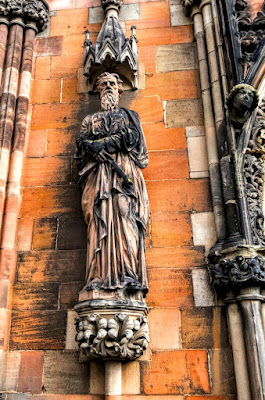
Saint Thomas the Apostle … a sculpture on the west façade of Lichfield Cathedral (Photograph: Patrick Comerford, 2021)

This day in Advent [21 December] was once marked in the calendars of the Western Church, including the Book of Common Prayer, as the feast day of Saint Thomas the Apostle and was once a major feast day in the Church.

This commemoration was moved long ago to 3 July, the date given in the Martyrology of Saint Jerome and the day on which his relics are said to have been moved from Mylapore, near Madras, on the coast of India, to Edessa in Mesopotamia. After a short stay on the Greek island of Chios, the relics were moved in September 1258 to the West, and are now said to be in Ortona in Italy.

In the Orthodox Churches, Saint Thomas is remembered each year on Saint Thomas Sunday, or the Sunday after Easter, and on 6 October. He is now celebrated on 3 July in the Book of Common Prayer (2004) in the Church of Ireland and Common Worship in the Church of England, although he is still commemorated on 21 December in the Episcopal Church (TEC).

I think of Saint Thomas as an appropriate apostle to recall in Advent, for he reminds us that all our Christmas celebrations are meaningless without faith in the Resurrection.

In the Gospels, Saint Thomas is named ‘Thomas, also called the Twin (Didymus).’ But the name ‘Thomas’ comes from the Aramaic word for twin, T'oma (תאומא), so there is a tautological wordplay going on here.

Syrian tradition says the apostle’s full name was Judas Thomas, or Jude Thomas, but who was his twin brother (or sister)?

The Temple of Apollo in Didyma … one of the most important shrines and temples in the classical world to Apollo and his twin sister Artemis (Photograph: Patrick Comerford)

I have often visited Didyma on the southern Anatolian coast. There the Didymaion was one of the most important shrines and temples in the classical world to Apollo and his twin sister Artemis. Apollo was the sun-god, the sun of Zeus; he was the patron of shepherds and the guardian of truth, and in Greek and Roman mythology he died and rose again.

Is the story of Saint Thomas’s doubts an invitation to the followers of the cult of Apollo to turn to Christ, the true Son of God the Father, who is the Good Shepherd, who is the way, the truth and the light, who has died and who is truly risen?

We can never be quite sure about Saint Thomas in Saint John’s Gospel. After the death of Lazarus, the disciples resist Christ’s decision to return to Judea, where there had been an attempt to stone Jesus. But Thomas shows he has no idea of the real meaning of death and resurrection when he suggests that the disciples should go to Bethany with Jesus: ‘Let us also go, that we may die with him’ (John 11: 16).

And while Thomas saw the raising of Lazarus, what did he believe in?

Could seeing ever be enough for a doubting Thomas to believe?

The Apostle Thomas also speaks at the Last Supper (John 14: 5). When Christ assures his disciples that they know where he is going, Thomas protests that they do not know at all. He has been with Christ now for three years, and still he does not believe or understand. Seeing and explanations are not enough for him. Christ replies to this and to Philip’s requests with a detailed exposition of his relationship to God the Father.

In the Resurrection story in Saint John’s Gospel, Mary does not recognise the Risen Christ at first. For her, appearances could be deceiving, and she thinks he is the gardener. But when he speaks to her, she recognises his voice, and then wants to hold on to him. From that moment of seeing and believing, she rushes off to tell the Disciples: ‘I have seen the Lord.’

Two of the disciples, John the Beloved and Simon Peter, have already seen the empty tomb, but they fail to make the vital connection between seeing and believing. When they hear Mary’s testimony, they still fail to believe fully. They only believe when they see the Risen Lord standing among them, when he greets them, ‘Peace be with you,’ and when he shows them his pierced hands and side.

They had to see and to hear, they had to have the Master stand over them in their presence, before they could believe.

On the first Easter Day, the Disciples locked themselves away out of fear. But where is Thomas? Is he fearless? Or is he foolish?

For a full week, Thomas is absent and does not join in the Easter experience of the remaining disciples. He has not seen and so he refuses to believe. When they tell him what has happened, Thomas refuses to accept their stories of the Resurrection. For him hearing, even seeing, are not enough.

Thomas wants to see, hear and touch. He wants to use all his learning faculties before he can believe this story. He has heard, but he wants to see. When he sees, he wants to touch … he demands not only to touch the Risen Christ, but to touch his wounds too before being convinced.

And so for a second time within eight days, Christ comes and stands among his disciples, and says: ‘Peace be with you.’

Mary was asked in the garden on Easter morning not to cling on to Christ. But Thomas is invited to touch him in the most intimate way. He is told to place his finger in Christ’s wounded hands and his hand in Christ’s pierced side.

Caravaggio has depicted this scene in his painting, The Incredulity of Saint Thomas. Yet we are never told whether Thomas actually touched those wounds with his fingers. All we are told is that once he has seen the Risen Christ, Thomas simply professes his faith in Jesus: ‘My Lord and my God!’

In that moment, we hear the first expression of faith in the two natures of Christ, that he is both divine and human. For all his doubts, Saint Thomas provides us with an exquisite summary of the apostolic faith.

Too often, perhaps, we talk about ‘Doubting Thomas.’ Instead, we might better call him ‘Believing Thomas.’ His doubting leads him to question. But his questioning leads to listening. And when he hears, he sees, perhaps he even touches. Whatever he does, he learns in his own way, and he comes not only to faith but to faith that for this first time is expressed in that eloquent yet succinct acknowledgment of Christ as both ‘My Lord and My God.’

In our society today, are we easily deceived by appearances?

Do we confuse what pleases me with beauty and with truth?

Do we allow those who have power to define the boundaries of trust and integrity merely to serve their own interests?

Too often, in this world, we are deceived easily by the words of others and deceived by what they want us to see. Seeing is not always believing today. Hearing does not always mean we have heard the truth, as we know in Irish life and politics today. It is easy to deceive and to be deceived by a good presentation and by clever words.

Too often, we accept or judge people by their appearances, and we are easily deceived by the words of others because of their office or their privilege. But there are times when our faith, however simple or sophisticated, must lead us to ask appropriate questions, not to take everything for granted, and not to confuse what looks like being in our own interests with real beauty and truth.

Saint Thomas is a reminder that Christmas points to Easter. His story reminds us that the incarnation is not just a nice occasion for a winter festival and giving thanks after the Winter Solstice that the sun is returning and the days lengthening. It reminds us that Christmas Day has no meaning without Good Friday and Easter Day. Christmas faith is only meaningful when it is faith in the Resurrection.

Saint Thomas’s Church, Dugort, Achill Island (Photograph: Patrick Comerford)

Luke 1: 39-45 (NRSVA):

39 In those days Mary set out and went with haste to a Judean town in the hill country, 40 where she entered the house of Zechariah and greeted Elizabeth. 41 When Elizabeth heard Mary’s greeting, the child leapt in her womb. And Elizabeth was filled with the Holy Spirit 42 and exclaimed with a loud cry, ‘Blessed are you among women, and blessed is the fruit of your womb. 43 And why has this happened to me, that the mother of my Lord comes to me? 44 For as soon as I heard the sound of your greeting, the child in my womb leapt for joy. 45 And blessed is she who believed that there would be a fulfilment of what was spoken to her by the Lord.’

The Prayer in the USPG Prayer Diary today (21 December 2021) invites us to pray:

Let us pray for everyone living with HIV/AIDS. May we help and support them rather than stigmatise them.

Yesterday: Saint Ignatius of Antioch

Tomorrow: Fyodor Dostoevsky

Saint Thomas the Apostle … an icon in the Chapel of Saint Columba House, Woking (Photograph: Patrick Comerford)

Scripture quotations are from the New Revised Standard Version Bible: Anglicised Edition copyright © 1989, 1995, National Council of the Churches of Christ in the United States of America. Used by permission. All rights reserved worldwide. http://nrsvbibles.org

11 April 2021

Sunday intercessions on
11 April 2021, Easter II (Low Sunday)

An icon of Saint Thomas in Saint Columba House retreat centre in Woking (Photograph: Patrick Comerford)

Christ is risen!
The Lord is risen indeed. Alleluia!

Let us pray:

Let peace be with us (John 20: 19, 21, 26):

Heavenly Father,
let the peace of the Risen Christ be with us,
in times of grief and of rejoicing,
in times of rejection and welcome,
in times of defeat and triumph.

We pray for the nations of the world,
for Ireland north and south,
for the Taoiseach and Tanaiste,
the First Minister and Deputy First Minister.

We pray for nations torn by war, strife and division,
we pray for all who defend democracy and human rights,
for all who stand against racism, prejudice and oppression,
and we pray for all peacemakers …

Lord have mercy,
Lord have mercy.

‘If you forgive the sins of any, they are forgiven them’ (John 20: 22):

Lord Jesus Christ,
we pray for the Church,
that we may be a forgiving and forgiven people,
that we may welcome the Risen Christ in word and sacrament.

We pray for our neighbouring churches and parishes
in Co Limerick and Co Kerry,
that we may be blessed in their variety and diversity.

In the Anglican Cycle of Prayer,
we pray for the Church of the Province of the Indian Ocean,
and the Archbishop and Primate, James Wong, Bishop of the Seychelles.

In the Church of Ireland this month,
we pray for the Diocese of Down and Dromore
and Bishop David McClay.

In the Diocesan Cycle of Prayer this week,
we pray for the Aughaval Union of parishes in the Diocese of Tuam,
their priests, Canon Jennifer McWhirter and the Revd Maebh O’Herlihy,
and the congregations of
Holy Trinity Church, Westport,
Christ Church, Castlebar,
Saint Thomas’s Church, Dugort, and Turlough Church.

We pray for our own parishes and people,
and we pray for ourselves …

We pray too for those who doubt and question …
and give thanks for the ways they challenge us …

Christ have mercy,
Christ have mercy.

‘Receive the Holy Spirit’ (John 20: 22):

Holy Spirit,
we pray for one another …
we pray those we love and those who love us …
we pray for family, friends and neighbours …
and we pray for those we promised to pray for …

We pray for those in need and those who seek healing …
for those working for healing …
for those waiting for healing …
for those seeking an end to this Covid crisis …

We pray for those who are sick or isolated,
at home or in hospital …

Una … Ann … Valerie … Daphne … Sylvia … Ajay …
Joey … Ena … George … Louise …

We pray for people who are lonely this Easter,
without their families around them …

We pray for those we have offered to pray for …
and we pray for those who pray for us …

We pray for all who grieve and mourn at this time …
for Joey, Kenneth, Victor, and their families …

We remember and give thanks for those who have died …
especially for Linda Smyth … Nora Hawkes …
for Sidney Laing, Alan Shaw and Norman Lynas,
faithful priests who have died in recent weeks …
for those whose anniversaries are at this time …
May their memories be a blessing to us …

Lord have mercy,
Lord have mercy.

A prayer from the Anglican mission agency USPG (United Society Partners in the Gospel) on the Second Sunday of Easter:

Good and generous God, we thank you
for bestowing on us the constant gifts of your love.
You care for us all. Forgive us we pray for those times
we have not cared for your people as we should.

Christ is risen!
The Lord is risen indeed. Alleluia!

Saint Thomas’s Church, Dugort, Achill Island … in this week’s diocesan cycle of prayer (Photograph: Patrick Comerford)

These intercessions were prepared for use in the Rathkeale and Kilnaughtin Group of Parishes on the Second Sunday of Easter, Sunday 11 April 2021


28 March 2021

Praying in Lent and Easter 2021:
40, Saint Thomas’s Church, Achill Island

Saint Thomas’s Church, Dugort, on Achill Island, Co Mayo (Photograph: Patrick Comerford)

Patrick Comerford

During Lent and Easter this year, I am taking some time each morning to reflect in these ways:

1, photographs of a church or place of worship that has been significant in my spiritual life;

2, the day’s Gospel reading;

3, a prayer from the prayer diary of the Anglican mission agency USPG (United Society Partners in the Gospel).

Today is Palm Sunday (28 March 2021), and we are moving into Holy Week, the last week in Lent. This week I am offering photographs from seven churches that I think of as places of pilgrimage and spiritual refreshment (I have reflected earlier this Lent on the place of the chapel of Saint John’s Hospital, Lichfield, and of Lichfield Cathedral, in my spiritual life).

My photographs this morning (28 March 2021) are from Saint Thomas’s Church in Dugort on Achill Island, off the coast of Mayo.

I first visited Achill Island in 1974, and for many years we spent days on end – even weeks on end – on Achill Island, as a retreat from the pressures of daily life, whether those were the demands of work, campaigning or study. When Achill provided safe space for reflection, and this church was a place for prayer and spiritual reflection.

Saint Thomas’s Church, Dugort, has been a place for prayer and spiritual reflection (Photograph: Patrick Comerford)

Mark 11: 1-11 (NRSVA):

1 When they were approaching Jerusalem, at Bethphage and Bethany, near the Mount of Olives, he sent two of his disciples 2 and said to them, ‘Go into the village ahead of you, and immediately as you enter it, you will find tied there a colt that has never been ridden; untie it and bring it. 3 If anyone says to you, “Why are you doing this?” just say this, “The Lord needs it and will send it back here immediately”.’ 4 They went away and found a colt tied near a door, outside in the street. As they were untying it, 5 some of the bystanders said to them, ‘What are you doing, untying the colt?’ 6 They told them what Jesus had said; and they allowed them to take it. 7 Then they brought the colt to Jesus and threw their cloaks on it; and he sat on it. 8 Many people spread their cloaks on the road, and others spread leafy branches that they had cut in the fields. 9 Then those who went ahead and those who followed were shouting,

‘Hosanna!
Blessed is the one who comes in the name of the Lord!
10 Blessed is the coming kingdom of our ancestor David!
Hosanna in the highest heaven!’

11 Then he entered Jerusalem and went into the temple; and when he had looked around at everything, as it was already late, he went out to Bethany with the twelve.

Prayer in the USPG Prayer Diary:

The Prayer in the USPG Prayer Diary today (28 March 2021), Palm Sunday, prays:

Holy God, as your Son entered his own city
on a colt, the foal of a donkey,
may we in humility, yet with your confidence,
work to transform our communities, through your Son.

Yesterday’s reflection

Continued tomorrow

The beach below Slievemore at Dugort, Achill Island … safe space for reflection (Photograph: Patrick Comerford)

Scripture quotations are from the New Revised Standard Version Bible: Anglicised Edition copyright © 1989, 1995, National Council of the Churches of Christ in the United States of America. Used by permission. All rights reserved worldwide. http://nrsvbibles.org

01 November 2020

Genealogical fantasies satisfy
needs for a sense of belonging

The ‘Bridge of Sighs’ at Saint John’s College, Cambridge … an obscure family connection was uncovered in an Irish bar in Crete (Photograph: Patrick Comerford)

Patrick Comerford

Genealogy and family trees are always dependent on collective imaginations and identities. In any family tree, some ancestors are counted in and some are counted out. Even if we knew all our ancestors from 600 years ago, it would be impossible to include 1 million people in any one family tree.

Dr Adam Rutherford points out in his new book, How to argue with a racist, that in every generation back through time the number of ancestors you have doubles. Over a 500-year period, I have 1,048,576 ancestors. By 1,000 years ago, I have an impossible number of 1,099,511,627,776 ancestors – that is, over a trillion people, a number that is about 10 times the number of people that ever existed.

And so, all genealogists make choices that are based on the needs of a family or an individual to provide a colourful illustration of their sense of identity with community and place across generations and down through the centuries.

One rainy afternoon, as I whiled away an hour or two in an Irish bar in Crete, I found myself rummaging through the bookshelves and an eclectic collection of books bought for decoration rather than broadening the minds of the clientele.

Stuck in one shelf, side-by-side, was Thomas Baker’s two volume History of the College of St John the Evangelist, Cambridge, published in Cambridge in 1869. Many of the pages had not been cut since they were published, indicating they had not been read too carefully by their owners over the previous century and a half.

Unusual books to find in a bar in Crete … and unopened since 1869 (Photograph: Patrick Comerford)

* * *

In those idle moments in McGinty’s Irish Bar in Georgioupoli, I took down both volumes, knowing there held family memories and stories. Here were the college records of Henry ‘Comberforth’ (1499-1586), later Precentor of Lichfield Cathedral (1555). He graduated BA (1533), MA (1536) and BD (1545), and went on to become a Fellow of Saint John’s College and a Proctor of Cambridge University. He was still a Fellow of Saint John’s in 1542.

Here too was Henry’s brother, Richard Comberford, often confused by later genealogists with my direct ancestor, Richard Comerford of Ballybur Castle, Co Kilkenny. Richard was admitted to Saint John’s in 1534, was a Fellow in 1538, and was the Senior Bursar in 1542-1544.

Richard Comberford and his brother John both leased lands at Much Bradley in Staffordshire from Saint John’s College. Perhaps these appear to be absurd links for someone to become engrossed with during a holiday on a Greek island. But the leases on the lands in Much Bradley pushed the family connection back a generation earlier than I had realised.

They were discoveries of the type that would delight Aunt Dot in The Towers of Trebizond, where she says ‘Cambridge was our university’ and she describes her family’s High Church Anglicanism approving ‘the improvements in the chapel of St. John’s College, Cambridge under Dr. Beale.’

Dave Hartley and Clare Walshe decided I should take the books home with me, and revel a little longer in their unread stories.

Saint John the Evangelist at Saint John’s College, Cambridge … Aunt Dot in ‘The Towers of Trebizond’ approved of ‘the improvements in the chapel’ (Photograph: Patrick Comerford)

The O’Hanlon clan and clergy titles

It seems Victorian and Edwardian clergy in the Church of Ireland were all too susceptible to genealogical claims and deceptions. I came across not just one but two rectors who were near contemporaries and who claimed the curious title of ‘The O’Hanlon,’ an ancient title for the head of a Gaelic Irish clan. Yet, despite their claims, they do not seem to share any close ties of kinship.

The Revd Dr Alexander Patrick Hanlon (1814-1898), who called himself ‘The O’Hanlon,’ was born at Miltown Malbay, Co Clare, the son of Patrick Hanlon, a local Roman Catholic farmer, and was ordained deacon in the Church of Ireland in 1846 by the Bishop of Killaloe and priest in 1847.

During the Famine, he was praised for his ‘unremitting’ and ‘constant’ work with local people and for his ‘genuine charity.’ He freely distributed milk, bread and medicine, working with orphans and the elderly, and it was said: ‘Not a house in which fever is to be found (and they are the greater in number), but he visits in person.’

He seems to have been considering an appointment to Dingle during the vacancy in 1864, when his wife suffered an epileptic attack while bathing in Dingle Harbour and died soon after. Hanlon continued to work with the Irish Society and the Irish Church Missions, and in 1889 was feted at a garden party in Dugort organised by the Achill Mission. He died in Tallow, Co Waterford, at the age of 84 in 1898.

* * *

The French Church, Portarlington … William Hanlon was born in Portarlington in 1849 (Photograph: Patrick Comerford)

His younger, near contemporary, the Revd William Hanlon (1849-1916), also claimed the title of The O’Hanlon. He was born in Portarlington, the son of a local doctor. He was the Rector of Rector of Innishannon, Co Cork (1879-1916), when he assumed the title of ‘The O’Hanlon’ in 1907. He also claimed to be the Hereditary Standard Bearer of the King in Ulster. In the pedigree he compiled to support his claims, Hanlon said his lineal ancestor had given Saint Patrick the site in Armagh for his first cathedral.

It all sounds like myth and fable – and probably is. Both men ignored the minor detail in the family trees that the last person before either of them to have been accepted generally as the head of the family was the rapparee Redmond O’Hanlon.

After the Caroline Restoration, Redmond O’Hanlon installed himself as clan chief and called himself ‘the Count.’ He was declared an outlaw in 1674 and became a rapparee around Newry and Carlingford Lough. A £200 reward was offered for his apprehension. He was shot at night in 1681 and his severed head was put on display at Downpatrick prison.

Family lore says his son, also Redmond O’Hanlon, exhumed his body, and reburied him in the Church of Ireland churchyard at Conwal Parish in Letterkenny, Co Donegal.

Saint Thomas’s Church, Dugort … Alexander Hanlon was feted by the Achill Mission at a tea party in Dugort in 1889 (Photograph: Patrick Comerford)

A fake Limerick title in Lichfield

Spurious claims to family titles were not confined to Victorian clergy in the Church of Ireland. The Roman Catholic population of Staffordshire had a long history of English Recusancy. But the demographics of Catholic Staffordshire changed with the arrival of French prisoners of war, followed by new Irish arrivals seeking work. In 1841, Father John Kirk described his congregation in Lichfield as ‘very poor’ – one of the few exceptions was Lady Fitzgerald, a widow living near Lichfield.

Lady Fitzgerald’s name stood out as I read Michael Greenslade’s Catholic Staffordshire: she could hardly be a poor, Irish, Famine migrant. I was surprised, with a little further research, to find that her husband, Sir James Fitzgerald, was no true baronet, although his claimed title has interesting links with the part of Co Limerick where I live.

In all, four titles of baronet were given to members of the Fitzgerald family. The oldest of these was given in 1644 to Sir Edmond Fitzgerald of Clenglish Castle, now Springfield Castle, near Dromcollogher, Co Limerick. His son, Sir John Fitzgerald, was the patron of the poet Dáibhí Ó Bruadair (1625-1698). He was linked with the Titus Oates plot and was deprived of his title in 1691. No more was heard of these Fitzgerald baronets, or Sir John’s four brothers who might have claimed their father’s title.

However, a fanciful family tree was produced in 1780, without any convincing dates, biographical details or supporting evidence, claiming a Sir Maurice Fitzgerald moved from Co Limerick to Castle Ishen, Co Cork, but decided not to use the title of baronet because of his poverty. It goes through six generations of only sons for almost a century, until Sir Richard Fitzgerald, who claimed the title as sixth baronet in 1780.

* * *

Springfield Castle, Co Limerick … stands on the site of the caste owned by Sir Edmond Fitzgerald in the 1640s (Photograph: Patrick Comerford)

The Castle Ishen Fitzgeralds had no links with the Springfield family, yet their claims to the title were facilitated by Ireland’s leading genealogical authority, Sir William Hawkins. Those claims were dismissed in 1829 by Sir William Betham, a successor of Hawkins. He found that the Castle Ishen family was descended from another, different Sir Edmond Fitzgerald, who was knighted but was never a baronet.

Yet Sir Richard Fitzgerald convinced society he was the sixth baronet. His only son, Sir James Fitzgerald, who called himself the seventh baronet, married Bridget Anne Dalton, whose mother claimed she was the last lineal descendant of Sir Thomas More.

Their only son, Sir James Fitzgerald (1791-1839), married Augusta Henrietta Fremantle (1803-1863), a daughter of one of Nelson’s admirals. They lived at Maple Hayes Hall, near Lichfield, although James was living at Wolseley Hall when died on his way to Nice in 1839.

The widowed Augusta died in 1863, and their children returned to Ireland. Some family members became nuns, and the claimed family title, if it ever existed, died out with the death of Sir Gerald Richard Dalton-Fitzgerald (1832-1894), the ‘tenth baronet.’

Perhaps you and I have as much right to this title as anyone else who used it.

The doorway of Holy Cross Church, Lichfield … the widowed Lady Fitzgerald stood out from the poorer parishioners in the 1840s (Photograph: Patrick Comerford)

This two-page feature was first published in November 2020 in the ‘Church Review,’ the Dublin and Glendalough diocesan magazineCanon Patrick Comerford blogs at www.patrickcomerford.com

27 June 2020

A lockdown ‘virtual
tour’ of a dozen
hotels in Ireland

Sunrise at the mouth of the River Slaney at the Ferrycarrig Hotel in Wexford (Photograph: Patrick Comerford; click on image for full-screen view)

Patrick Comerford

The lockdown introduced in response to Covid-19 pandemic is beginning to be eased, and many of us are probably beginning to think about – if not planning – staycations in Ireland as soon as the opportunity arises.

When I was in my late teens, I hitched hiked all over Ireland and England, staying in youth hostels, over pubs and in bed and breakfast guesthouses.

It is left me with a taste for ‘cheap and cheerful’ hotels, rather than the expensive plush hotels I have sometimes found myself staying in during working trips.

But there are some hotels I have stayed in that I have come to regard as worth staying in, no matter where they are, simply because of themselves. And at the tope of this list in Ireland is the Ferrycarrig Hotel in Wexford.

In the spirit of my recent ‘virtual tours’ during this lockdown, I offer this ‘virtual tour’ of a dozen of my favourite hotels in Ireland. Perhaps it might help readers as they think about a ‘staycation’ later this year.

1, The Ferrycarrig Hotel, Wexford:

All bedrooms in the Ferrycarrig Hotel look out onto the River Slaney (Photograph: Patrick Comerford)

If there is one hotel in Ireland that I would stay in just for its own sake, then it has to be the Ferrycarrig Hotel, is just 3 km from Wexford Town.

I lived in Wexford almost 50 years ago, and still feel that I am part of Wexford and that Wexford is part of me. In the past, when I returned to Wexford, I wanted to stay in the town, staying with friends or in a variety of hotels and guesthouses. Ferrycarrig seemed to be far out, even though I walked there regularly in my early 20s.

Now I know it is actually very convenient to the town, and I have stayed in the Ferrycarrig Hotel on a number of occasions in recent years. and before dinner last night two of walked around the streets of the old town.

All the bedrooms in the Ferrycarrig Hotel look out onto the River Slaney, and there is nothing comparable to waking up to this sight any morning, any time of the year.

In the corridors of the Ferrycarrig Hotel in Wexford (Photograph: Patrick Comerford)

In the morning, the colours on the Slaney and in the skies slowly can change from greys and dull blues to contrasts of bright orange and silver sparkle and then to bright blues and reflections of the landscape in the water. Time moves on – in history, in life and on river – and each passing phase brings new opportunities and new blessings.

in one of the corridors of the hotel, among a large collection of posters from the Wexford Festival, I came across a poster from the 1994 festival, that is the same as a block-mounted poster in the my house in Knocklyon.

However, unlike my own poster in Dublin, the hotel’s copy is not fading, a reminder of my continuing, harboured and cherished memories of Wexford that never fade.

2, Castle Leslie, Co Monaghan:

Castle Leslie exudes old-world grandeur and hospitality(Photograph: Patrick Comerford)

I stayed many years ago in Castle Leslie, Co Monaghan, while I was attending the ordination of four former students. Castle Leslie, at the village of Glaslough, is a country house hotel exuding old-world grandeur and hospitality, and is free from distractions and intrusions.

The 1,000-acre Castle Leslie Estate includes the charming and eccentric Castle Leslie with its own equestrian centre and hunting lodge set in unspoiled countryside, with ancient forests, rolling hills, green fields, lakes and streams. Castle Leslie stands on the site of an earlier castle, and was designed in 1870 by Charles Lanyon and WH Lynn for Sir John Leslie in the Scottish baronial style.

Castle Leslie is beside the pretty village of Glaslough (Photograph: Patrick Comerford)

The colourful history of the Castle Leslie Estate is a story that is bedecked with politics, royalty and war, with a family that includes much-married bishops, exiled opponents of William of Orange, a woman said to be the granddaughter of George IV and his mistress, cousins of Winston Churchill, prisoners-of-war, and eccentrics who believe we are about to be invaded by flying saucers and UFOs.

Swift wrote many verses about the Leslies, not all of them complimentary:

With rows and rows of books upon the shelves
Written by the Leslies
All about themselves.


3, The Zuni Hotel, Kilkenny:

The Zuni Hotel is close to all the attractions of Kilkenny

I have stayed in many hotels in Kilkenny, at clergy conferences, church meetings, eating in some of my favourite restaurants, or visiting some of my favourite places, including Saint Canice’s Cathedral, Kilkenny Castle, Rothe House and Ballybur Caste, or exploring the streets, lanes and churches of Kilkenny.

But one of my favourite places to stay in Kilkenny is the Zuni Hotel on Patrick Street, a short walk from Kilkenny Castle, Kilkenny Design Centre and Kilkenny’s main shopping district and many fine restaurants and bars.

The Zuni Hotel has its own award-winning restaurant

But, despite all these attractions so close at hand, the Zuni Hotel is a boutique hotel with its own award-winning restaurant.

4, Markree Castle, Co Sligo:

Markree Castle, near Collooney, Co Sligo … this was once the coldest place in Ireland (Photograph: Patrick Comerford)

I stayed at Markree Castle, near Collooney, Co Sligo, during a family wedding in Sligo Cathedral. Markree Castle is a small family-run hotel, owned by the Corscadden family who also own Cabra Castle Hotel, Co Cavan, Ballyseede Castle Hotel, Co Kerry, and Bellingham Castle, Co Louth.

The hymn-writer Cecil Frances Alexander (1818-1895) is said to have written the hymn All Things Bright and Beautiful while she was a guest there of the Cooper family in 1848.

The staircase leading into Markree Castle (Photograph: Patrick Comerford)

Markree Castle, which is partially moated by the River Unshin, is the ancestral seat of the Cooper family. The castle, as we see it today, dates from 1802 with exterior changes by the architect Francis Johnston. Some later changes, mainly to the interior, were made in in the late 1860s and in the 1890s.

Charles Cooper transformed his ancestral castle into a hotel in 1989. The castle’s restoration was featured in a television documentary, and the renewed facilities included a hotel and restaurant.

Markree Castle was run as a hotel by Charles and Mary Cooper, the tenth generation of the family to live there. After four centuries, the castle finally changed hands in 2015 when it was sold for an undisclosed sum after being on the market with an asking price of €3.12 million. The hotel is now run by the Corscadden family.

5, Castle Durrow, Co Laois:

Castle Durrow was built over 300 years ago by the Flower family (Photograph: Patrick Comerford)

Castle Durrow, in the Midlands village of Durrow, Co Laois, is a country house hotel on the N8 old Dublin-Cork road, about an hour from Dublin. The house was built over 300 years ago in 1712-1716 as his family home by Captain William Flower, whose family later held the title of Viscount Ashbrook.

The pre-Palladian design and formal gardens were the height of fashion in those days, and the grey/blue cut stone contrasts with the breath-taking views of the landscape.

In the grounds of Castle Durrow (Photograph: Patrick Comerford)

The banks foreclosed in 1922, and the Flower family were forced to sell up and move to England. The Land Commission divided up the lands and the Forestry department took over many of the woods for plantation, but the great house was left empty. The Parish of Durrow bought the estate for a mere £1,800 and Castle Durrow was transformed into Saint Fintan’s College and Convent.

Peter and Shelly Stokes bought Castle Durrow in the 1990s and began renovating the castle over three years. The Stokes family manage the daily running of the castle and are an intricate part of this charming hotel.

6, Strand Hotel, Dugort, Achill Island:

The Strand Hotel looks out onto the beach at Dugort, below Slievemore, on Achill Island (Photograph: Patrick Comerford)

The Strand Hotel is north coast of Achill Island, Ireland’s largest off-shore island. The hotel is beneath the slopes of Slievemore, Achill's highest mountain, and looks out across the beach at Dugort facing out onto Blacksod Bay.

I first visited Achill Island in 1974, and first stayed in the Strand Hotel around 1979. The proprietor, Billy Scott, was so kind, that in the 1980s it became a regular retreat on occasions when I needed solitude and a place to write in peace and quiet, just a short walk from Saint Thomas’s Church.

On the beach at Dugort, below the Strand Hotel, on Achill Island (Photograph: Patrick Comerford)

This became a regular venue for family holidays in the 1990s. Although I have been back in recent years for summer schools and seminars, I have not stayed in the Strand Hotel for 15 years or more.

However, the location remains inviting, and the view of the beach in Dugort remains inviting.

7, The Station House Hotel, Kilmessan, Co Meath:

The Station House Hotel, Kilmessan, Co Meath … an old railway station with all the charm of a country house hotel (Photograph: Patrick Comerford)

Kilmessan is a quite village off the M3 and just a short distance from Dunshaughlin, Navan, Trim and Ratoath. The Station House Hotel is a country house hotel and restaurant set in acres of woodlands and manicured gardens, providing an idyllic a country escape, away from the bustle of daily life.

This has been run as an hotel for more than 35 years but was once a train station and the hotel grounds retain some of the original fixtures, including the old railway bridge and turntable.

The old signal cabin still stands at one end of the former station (Photograph: Patrick Comerford)

Chris and Thelma Slattery, who also owned the Waterside House Hotel in Donabate, Co Dublin, bought the Station House Hotel in 1981, the third family to own the old train station, and transformed it into a guest house in 1983.

The remains of the old station at the Station House Hotel today include the safe made by Milners Safe Company Ltd, London and Liverpool, fireplaces and the platforms, which stand outside the main door of the hotel. The remainder of the turntable lies at the end of the wooded area near the bridge.

8, Mount Wolseley, Tullow, Co Carlow:

Mount Wolseley House near Tullow, Co Carlow … sold in 1925 for £4,500 (Photograph: Patrick Comerford)

I stayed some years ago in Mount Wolseley on the edges of Tullow, Co Carlow, during a family wedding. Mount Wolseley House is the ancestral home of a branch of the Wolseley family from Wolseley in Staffordshire, and the Irish branch included the famous general Viscount Wolseley and Frederick York Wolseley who gave his name to a stylish car.

Mount Wolseley was bought by the Morrissey family in 1994 and has been developed into a four-star hotel. The house and gardens are private and remain the home of the Morrissey family, but they can be viewed in the near distance from the entrance gate beside the hotel.

The hotel at Mount Wolseley retains many memories of the original family (Photograph: Patrick Comerford)

The hotel and the grounds are now owned by Lismard Properties and Enterprises. One wing of the hotel includes Aaron’s Lounge, a name that comes from a misunderstanding of the name of Mount Arran, first given to the estate by the Butler family, Earls of Arran, in the late 17th century. The name of Frederick’s Restaurant is a tribute to Frederick York Wolseley.

However, as the estate was developed over the past 20 or 30 years, the replica site of the Battle of Waterloo in the grounds was turned into an 18-hole championship golf course, and the Duke of Wellington’s battle plan can no longer be traced in the greens, fairways and the willow-lined ponds.

9, BrookLodge, Macreddin Village, Co Wicklow:

Autumn colours at the BrookLodge Hotel … a country spa hotel near the forgotten borough of Carysfort, Co Wicklow (Photograph: Patrick Comerford)

Another recent family wedding took place in Macreddin Village in south Co Wicklow, when I stayed overnight in BrookLodge Hotel, a country spa hotel 6 km north of the village of Aughrim.

The BrookLodge Hotel and Wells Spa opened in 1999, and the resort includes an equestrian centre, golf course, bakery, smokehouse, pub and microbrewery, and food, wine and craft shops. BrookLodge includes the Strawberry Tree, which claims to be Ireland’s only certified organic restaurant, and La Taverna Armento, an Italian taverna.

Macreddin, once known also as Moycreedin, is said to take its name (‘the Valley of Credin’) from Credin, a fifth century local saint chief who is said to have been killed by his enemies and brought back to life by Saint Kevin of Glendalough.

The Strawberry Tree claims to be Ireland’s only certified organic restaurant (Photograph: Patrick Comerford)

Macreddin was granted to the monastery of Saint Saviour, Glendalough in the 12th century. When the Diocese of Glendalough was merged with the Archdiocese of Dublin, Macreddin was transferred to the Priory of All Hallows in Dublin. On the Dissolution of the Monasteries under Henry VIII, it was transferred to Dublin Corporation.

Co Wicklow was shired in 1606-1607, and so was the last county to be formed in Ireland, taking in the southern part of Dublin (with the exception of three ‘islands’ or enclaves of church property, and the northern part of what was then ‘Catherlough’ or Co Carlow, including Arklow. Two decades later, when Henry Cary, 1st Viscount Falkland, was Lord Deputy of Ireland in 1625-1628, a fort was built at Macreddin and was named Carysfort in his honour.

10, WatersEdge Hotel, Cobh:

The WatersEdge Hotel in Cork is a special venue in every sense of the word (Photograph: Patrick Comerford, 2020)

The last hotel in Ireland I have stayed in is the WatersEdge Hotel in Cork, which is a special venue in every sense of the word. Nestled in the harbour town of Cobh near Cork and situated on the waterfront, we really had a ‘room with a view.’

This is a boutique hotel that commands breath-taking views, with spacious, comfortable accommodation and bistro-style food. It is an hotel to come to time after time.

A view of Cork Harbour from our room in the WatersEdge Hotel, Cobh (Photograph: Patrick Comerford, 2020)

The large balcony rooms are spacious and comfortable with a waterside terrace that is hard to leave.

We had a view right across the harbour with its islands, and we were within walking distance of the see-front museums, restaurants and the sites linked with the stories of the Titanic and the Lusitania.

11, Mustard Seed, Ballingarry, Co Limerick:

The Mustard Seed at Echo Lodge … fine dining in a country house setting in Ballingarry, Co Limerick (Photograph: Patrick Comerford)

The Mustard Seed, an oasis of countryside bliss surrounded by verdant pastures in the heart of Co Limerick. It is within my own parish in West Limerick, but also on the doorstep to Adare.

This boutique hotel with a restaurant that is legendary with superb food and warm hospitality. Sitting on acres of manicured lawns, an orchard and a working kitchen garden, this hideaway is perfect house for a stopover, romantic nights, lazy days and special occasions.

The Library at the Mustard Seed at Echo Lodge in Ballingarry, Co Limerick (Photograph: Patrick Comerford, 2019)

Originally, Echo Lodge was a long, thatched dwelling located in what is now the kitchen garden. This thatched house was a stopping house for the great Daniel O’Connell on his journey from Derrynane to Dublin.

The Revd Timothy Ryan Shanahan built the present Echo Lodge as a parochial house in 1885. Later, it passed to the Sisters of Mercy for one penny. Dan Mullane set up the Mustard Seed restaurant in Adare in 1985, and 10 years later moved the Mustard Seed to Echo Lodge, allowing diners the opportunity to stay overnight.

The Mustard Seed changed hands from Dan to his manager John Edward Joyce in 2016.

12, Charlemont Arms Hotel, Armagh:

The Charlemont Arms Hotel … three and a half centuries of history in Armagh (Photograph: Patrick Comerford, 2011)

In recent years, when I have been in Armagh at General Synod of the Church of Ireland, I have tended to stay in the Charlemont Arms Hotel in English Street, a third-generation, family-run hotel in the centre of the cathedral city.

The motto on the coat-of-arms of the Earls of Charlemont, over the hotel front door, which gives its name to the hotel, proclaims boldly: Deo Duce Ferro Comitante, ‘God is my leader, the sword is my companion.’ The first part of the motto may be appropriate for synod members staying in Armagh – but I have serious problems about the second part.

The hotel, which has thrived throughout the centuries, was originally home to a Dr Atkinson. By the 1760s, it had become a hostelry known as ‘The Caulfeild Arms.’ It was renamed in 1763, when James Caulfeild (1728-1799), fourth Viscount Caulfeild, was given the title Earl of Charlemont.

In the heyday of the Volunteers, there was a Charlemont Arms in every Irish town of note. However, this hotel may be the only one to survive – something that makes the current proprietors very proud.

In Victorian times, the facilities on offer included Turkish, plunge and other baths. It passed to Robert and Elizabeth Forster in 1934. Today, a third generation of the Forster family is involved in running the hotel.

A monument to the Caulfeild or Charlemont family in Saint Patrick’s Cathedral, Armagh (Photograph: Patrick Comerford)

The hotel is perfectly located between the city’s two cathedrals and close to the beautiful Mall, the theatre, city centre shops, the Armagh Planetarium and Observatory, the Armagh County Museum and the old Armagh Women’s Gaol. But it is also a short stroll from the synod venue and many synod members stay here, meaning this is often a place where a lot of back-room synod work is done.

There are many other hotels I could have named. During church and clergy conferences, I have stayed in hotels such as the Dunraven Arms in Adare, Arnold’s in Dunfanaghy, the Skelligs Hotel in Dingle, and other hotels in Athlone, Enniskillen Strandhill, and Kilkenny.

Presents and gifts have allowed me to stay in the Wineport Lodge, the Lough Erne Resort, the Ice House in Ballina, Tinnakilly House in Wicklow and the Maritime Hotel in Bantry.

And, of course, there are many more hotels, as well as the wonderful guesthouses I have stayed in across the island. But I thought I would next look at 12 more hotels in England and across Europe.

Some recent ‘virtual tours’:

A dozen buildings in Tamworth (Part 1);

A dozen buildings in Tamworth (Part 2);

More than a dozen Comberford family homes;

More than a dozen Comerford and Quemerford family homes;

A dozen Wren churches in London;

Ten former Wren churches in London;

More than a dozen churches in Lichfield;

More than a dozen pubs in Lichfield;

A dozen former pubs in Lichfield;

A dozen churches in Rethymnon;

A dozen restaurants in Rethymnon;

A dozen churches in other parts of Crete;

A dozen monasteries in Crete;

A dozen sites on Mount Athos;

A dozen historic sites in Athens;

A dozen historic sites in Thessaloniki;

A dozen churches in Thessaloniki;

A dozen Jewish sites in Thessaloniki.

A dozen churches in Cambridge;

A dozen college chapels in Cambridge;

A dozen Irish islands;

A dozen churches in Corfu;

A dozen churches in Venice.

A dozen churches in Rome.

A dozen churches in Bologna;

A dozen churches in Tuscany.

At the Dunraven Arms in Adare, Co Limerick (Photograph: Patrick Comerford)