Showing posts with label Pusey House. Show all posts

02 November 2026

Daily prayer in the Kingdom Season 2026:
2, Monday 2 November 2026,
All Souls’ Day

All Souls College, Oxford … its full official name is: the Warden and the College of the Souls of All Faithful People deceased in the University of Oxford (Photograph: Patrick Comerford)

Patrick Comerford

We moved in Ordinary Time in the Church Calendar to the Kingdom Season, the time between All Saints’ Day and Advent. The week began with All Saints’ Day (1 November), and today is All Souls’ Day (2 November), also described in Common Worship as the ‘Commemoration of the Faithful Departed’.

I hope to sing with the parish choirs at the All Souls’ Day Eucharist in Saint Mary and Saint Giles Church, Stony Stratford, this evening (2 November).

Meanwhile, before the day begins, before having breakfast, I am taking some quiet time early this morning to give thanks, and for reflection, prayer and reading in these ways:

1, today’s Gospel reading;

2, a short reflection;

3, a prayer from the USPG prayer diary;

4, the Collects and Post-Communion prayer of the day.
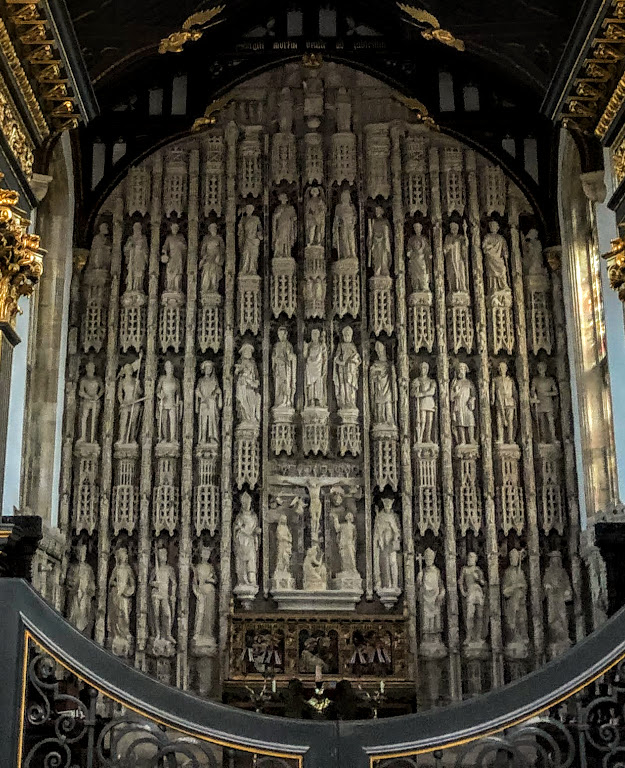
The reredos in the chapel of All Souls College, Oxford … a reminder of the ‘Faithful Departed’ (Photograph: Patrick Comerford)

John 5: 19-25 (NRSVA):

19 Jesus said to them, ‘Very truly, I tell you, the Son can do nothing on his own, but only what he sees the Father doing; for whatever the Father does, the Son does likewise. 20 The Father loves the Son and shows him all that he himself is doing; and he will show him greater works than these, so that you will be astonished. 21 Indeed, just as the Father raises the dead and gives them life, so also the Son gives life to whomsoever he wishes. 22 The Father judges no one but has given all judgement to the Son, 23 so that all may honour the Son just as they honour the Father. Anyone who does not honour the Son does not honour the Father who sent him. 24 Very truly, I tell you, anyone who hears my word and believes him who sent me has eternal life, and does not come under judgement, but has passed from death to life.

25 ‘Very truly, I tell you, the hour is coming, and is now here, when the dead will hear the voice of the Son of God, and those who hear will live.’

‘Very truly, I tell you, the hour is coming … when the dead will hear the voice of the Son of God, and those who hear will live’ (John 5: 25) … an unlabelled carving in All Souls College, Oxford (Photograph: Patrick Comerford)

November is a month when we traditionally remember the saints, the Communion of Saints, those who are blessed, those we love and who are now gathered around the throne of God, those who have died and who we still love.

We do that on All Souls’ Day, we do that on Remembrance Day and Remembrance Sunday, and we do that on All Saints’ Day.

November is a month when we traditionally remember the saints, the Communion of Saints, those we love and who are now gathered around the throne of God, those who have died and who we still love.

As the evenings close in, as the last autumn leaves fall from the trees, it is natural to remember the dead and the fallen, with love and affection.

The special days in November include:

• All Saints’ Day (1 November);

• All Souls’ Day or the ‘Commemoration of the Faithful Departed’ (2 November, Common Worship, p 15);

• in Ireland, All Saints of Ireland (6 November);

• in England, the Saints and Martyrs of England (8 November);

• Remembrance Sunday (8 November 2026);

• Remembrance Day (11 November).

On this day, there are many people in my own family I am remembering, including:

• my mother, Ellen (Murphy) Comerford, who died 12 years ago, on 20 May 2014, and my father, Stephen Edward Comerford, who died 22 years ago on 27 December 2004, both buried in Bohernabreena, Co Dublin;

• my brother, Stephen Edward Comerford, who died in Durham, North Carolina, 56 years ago, on 18 December 1970;

• my foster mother, Peggy Kerr, who died on 27 July 2010, and my foster father George Kerr;

• my foster sister or ‘cousin’, Una Kerr, who died on 11 April 2021

• my grandparents, Stephen Edward Comerford, who died on 21 January 1921, having contracted malaria five years earlier in Thessaloniki, and Bridget (Lynders) Comerford, who died on 25 March 1948, both buried in Portrane, Co Dublin;

• my grandparents, Thomas Michael Murphy, who died in Queensland, Australia, on 10 September 1949, and Maria (Crowley) Murphy, who died on 8 July 1957 and is buried beside Drishane Castle in Millstreet, Co Cork;

• and, at this time of the year, my ‘Gran’, Mary (McCarthy) Hallinan, who died on 6 November 1961; and my ‘Granddad’ Edmond Hallinan, who died on 8 March 1963, both buried in Cappoquin, Co Waterford.

Hallowe’en on 31 October is the day before we remember the Hallowed, not as the dead but as the blessed, the saints, who are model for our lives, our Christian lifestyle today. We believe the dead we love are still caught up in the love of God and are alive in Christ.

Indeed, saints do not need to be dead to be examples of ‘holy living and holy dying’ (Jeremy Taylor). Saint Paul regularly refers in his letters to fellow Christians as ‘saints.’ Saints Alive!

In the past, I have realised how many people and parishes have been shy, reluctant, perhaps even fearful, in the Church of Ireland when it comes to recalling, commemorating and celebrating the saints. A comparison of the calendars of the Church of Ireland and the Church of England is very telling.

Perhaps the people who decided on the calendar in the Church of Ireland were too afraid in the past of being seen to pray to the saints, or to pray for the dead. But, really, these are quite different to finding examples of godly living among Christians from the past, and expressing confidence that the dead we have loved are now committed to God’s love.

Yet the Church of England sees the calendar of saints as a living calendar, something that is added to as we find more appropriate examples of Christian living for today.

Saints do not have to be martyrs. But in recent years Oscar Romero was canonised and there was a major commemoration in Westminster Abbey of Oscar Romero in 2017 to mark his 100th birthday.

Saints do not have to be canonised. Modern martyrs include Dietrich Bonhoeffer and Martin Luther King, or Heather Heyer, the civil rights activist killed by far-right neo-Nazis and racists in Charlottesville, Kentucky, in 2017, and who were absolved of all guilt or blame by Donald Trump.

Many of us know people who handed on the faith to us – teachers, grandparents, perhaps neighbours. Even though many may be long dead, they remain part of our vision of the Communion of Saints.

Saints do not have to live a perfect life; as the Book of Common Prayer reminds us, ‘if we say we have no sin we deceive ourselves’ (I John 1: 8) … none of us is without sin, and none of us is beyond redemption. Some of the saints carved on the West Front of Westminster Abbey might have been very surprised to know they were going to appear there. But their lives in sum total are what we are asked to think about.

They are: Maximilian Kolbe, Manche Masemola, Archbishop Janani Luwum, Grand Duchess Elizabeth, Martin Luther King, Oscar Romero, Dietrich Bonhoeffer, Esther John, Lucian Tapiedi, and Wang Zhiming.

Some years ago, I asked students to share stories of their favourite ‘saints and heroes.’ They included an interesting array of people, some of whom were the still living at the time, including Archbishop Desmond Tutu.

In interviews in the Church Times, people are sometimes asked who they would like to be locked into a church with for a few hours.

Who are your favourite saints?

Who would you like to learn from a little more when it comes to living the Christian life?

Last year marked the 1700th anniversary of the Nicene Creed, in which we express our belief in ‘the resurrection of the dead, and the life of the world to come’. In the Apostles’ Creed, we confess our belief in ‘the communion of saints’ and ‘the resurrection of the body.’

In the introduction to the Church Calendar and this in-between time, the time between All Saints and Advent, the resources for Common Worship remind us that ‘No Christian is solitary. Through baptism we become members one of another in Christ, members of a company of saints whose mutual belonging transcends death’. The resources then quote Charles Wesley:

One family, we dwell in him,
one Church, above, beneath;
though now divided by the stream,
the narrow stream of death.

Who are the saints in your life, in your own personal calendars? Who are those you recall whose souls we have committed to God’s love and who are part of ‘the communion of saints’?

Throughout the month of November, there are opportunities to remember their names as we are reminded in the first reading in the Lectionary today (Wisdom 3: 1-9) that ‘The souls of the righteous are in the hand of God, no torment will ever touch them’ (verse 1).

The Library at All Souls College, Oxford, with a sundial designed by Sir Christopher Wren (Photograph: Patrick Comerford)

Today’s Prayers (Monday 2 November 2026, All Souls’ Day):

The theme this week (1 to 7 November 2026) in Pray with the World Church, the prayer diary of the Anglican mission agency USPG (United Society Partners in the Gospel), is ‘All Saints’ Day’ (pp 52-53). This theme was introduced yesterday with a Reflection by Matthew Anns, Senior Communications and Engagement Manager, USPG.

The USPG Prayer Diary today (Monday 2 November 2026, All Souls’ Day) invites us to pray:

Lord God, we remember all past Christian saints and martyrs who paved the way for future generations worldwide to know God, and who put God’s mission above their own lives in doing so. We pray that we can continue to follow in their footsteps.

The Collect:

Eternal God, our maker and redeemer,
grant us, with all the faithful departed,
the sure benefits of your Son’s saving passion
and glorious resurrection
that, in the last day,
when you gather up all things in Christ,
we may with them enjoy the fullness of your promises;
through Jesus Christ your Son our Lord,
who is alive and reigns with you,
in the unity of the Holy Spirit,
one God, now and for ever.

The Post Communion Prayer:

God of love,
may the death and resurrection of Christ
which we have celebrated in this eucharist
bring us, with all the faithful departed,
into the peace of your eternal home.
We ask this in the name of Jesus Christ,
our rock and our salvation,
to whom be glory for time and for eternity.

Yesterday’s Reflections

Continued Tomorrow

All Souls College, Oxford, founded in 1438 by Henry Chichele, Archbishop of Canterbury, with King Henry VI as its formal co-founder (Photograph: Patrick Comerford)

Scripture quotations are from the New Revised Standard Version Bible: Anglicised Edition copyright © 1989, 1995 National Council of the Churches of Christ in the United States of America. Used by permission. All rights reserved worldwide. http://nrsvbibles.org

A poster for events marking All Saints’ Day and All Souls’ Day in Pusey House, Oxford, this week (Photograph: Patrick Comerford, 2026)

29 October 2026

Making a ‘Good Habit’ of
supporting the work of
Blackfriars while enjoying
good coffee in Oxford

Good Habit, a new café opened last month by Blackfriars at 32 St Giles, Oxford (Photograph: Patrick Comerford, 2026)

Patrick Comerford

I think I may have found my new favourite café in Oxford – and it only opened last month.

Good Habit is a new café that was opened by Blackfriars at 32 St Giles in September 2026. It is now open seven days a week, and it was a good place to have lunch earlier this week immediately after spending a little time browsing through the religions and theology section in the basement of the nearby Oxfam bookshop on the corner of St Giles and Pusey Street.

Good Habit is at the top of St Giles, near Little Clarendon Street, and opposite Saint Giles Church. It has a stylish façade with large picture windows, and the elegant and spacious interior has décor that is inspired by Blackfriars Priory.

Good Habit is managed independently from Blackfriars Priory, and has been created to serve both the general public and the Dominican community at Blackfriars, providing meals and other social events for the student body and the academic staff of Blackfriars, and sometimes you can even bump into one of the Dominican friars there.

Good Habit is run on a profit-sharing basis, meaning that if the café is successful as a business, then this brings a financial benefit to Blackfriars, supporting its work as an educational institution within Oxford University.

Good Habit is a stylish café and events space in a former bank (Photograph: Patrick Comerford, 2026)

Good Habit was created with the generous support of alumni of Blackfriars, friends and grant-makers. The unit, at 33 St Giles was a bank until 2018 and has been transformed into a stylish café and events space billing itself as a spot for ‘coffee and bakery’. Planning permission was secured by the Dominican Order earlier this year, and permission to display signs and install a canopy with café followed soon after.

When it opened, café staff posted on Facebook: ‘Come and visit us at the north end of St Giles in Oxford, just opposite Saint Giles churchyard – we recommend the Guinness cake!’

In the summer, Father John O’Connor, Regent of Blackfriars Priory, said: ‘At long last we have planning permission, we have the workers on site, and things are moving really quickly with a view to an opening during the summer. It’s a great project, it’s going to be a retail café during the day, buzzing with lots of activity, and then in the evening there’ll be opportunities for Blackfriars Hall events, events for the community, and also events for the wider public as well, in what I think is a wonderful part of Oxford that is buzzing in so many different ways.’

The fare at Good Habit … ‘a great café and a great space for everybody’ (Photograph: Patrick Comerford, 2026)

Rich Sewell, manager of the new café, said he had been looking forward to opening Good Habit: ‘I’ve been working with Blackfriars now for the last couple of years and it’s really great to see how this project has been developing.’

He promised ‘a great café and a great space for everybody – the public and for Blackfriars students to enjoy.’

The vegetarian and vegan options are many, the coffee is as could as I expected, and I enjoyed an early lunch this week before heading off to look at some college and hospital chapels and their stained glass windows.

Dropping into Good Habit for coffee or lunch could become a good habit in the weeks and months to come each time I visit Oxford.

Good Habit is run on a profit-sharing basis, supporting the work of Blackfriars as an educational institution within Oxford University (Photograph: Patrick Comerford, 2026)

29 September 2026

Daily prayer in Ordinary Time 2026:
144, Tuesday 29 September 2026,
Saint Michael and All Angels

‘Archangel Michael The Protector’ by Emily Young at Saint Pancras Church, London … today is the Feast of Saint Michael and All Angels (Photograph: Patrick Comerford, 2026)

Patrick Comerford

We are continuing in Ordinary Time in the Church Calendar. This week began with the Seventeenth Sunday after Trinity (Trinity XVII, 27 September 2026) and today is the Feast of Saint Michael and All Angels (29 September 2026). Many churches are holding special events to mark this day. In Pusey House, Oxford, the preacher at Evensong and High Mass this evening is my friend, the Revd Dr Jonathan Lewis-Jong, Vicar of Saint Mary Magdalene Church, Oxford. Later this evening, I plan to write about my visit to the Church of Saint Michael and All Angels in New Marston, Oxford.

Meanwhile, this morning, before this day begins, I am taking some quiet time to give thanks, and for reflection, prayer and reading in these ways:

1, today’s Gospel reading;

2, a reflection on the Gospel reading;

3, a prayer from the USPG prayer diary;

4, the Collects and Post-Communion prayer of the day.

Angel I by Emily Young (2003), Paternoster Square, London (Photograph: Patrick Comerford)

John 4: 47-51 (NRSVA):

47 When Jesus saw Nathanael coming towards him, he said of him, ‘Here is truly an Israelite in whom there is no deceit!’ 48 Nathanael asked him, ‘Where did you come to know me?’ Jesus answered, ‘I saw you under the fig tree before Philip called you.’ 49 Nathanael replied, ‘Rabbi, you are the Son of God! You are the King of Israel!’ 50 Jesus answered, ‘Do you believe because I told you that I saw you under the fig tree? You will see greater things than these.’ 51 And he said to him, ‘Very truly, I tell you, you will see heaven opened and the angels of God ascending and descending upon the Son of Man.’

Angel II by Emily Young (2003), Paternoster Square, London (Photograph: Patrick Comerford)

Today’s Reflections:

Like many people, I never cease to be fascinated by the Caryatids that make Saint Pancras Church facing Euston Station in London a unique and captivating church. But I wonder how many pass by in the daily commute and miss the opportunity to appreciate Emily Young’s ‘Archangel Michael The Protector’ in the church gardens.

I stopped to look again at ‘Archangel Michael The Protector’ yesterday between train journeys to and from Euston when I was meeting a long-standing friend for coffee. This sculpture in onyx and can be viewed in the church grounds from Upper Woburn Place, around the corner from Euston Road. An inscription on a plaque between the sculpture and the railings reads: ‘In memory of the victims of the 7th July 2005 bombings and all victims of violence. ‘I will lift up my eyes unto the hills’ Psalm 121.’

Nothing moves in this image, a silent reminder of what is being commemorated in the sculpture. Because Saint Michael’s face has only one eye, and this is closed, some critics have wondered whether the quotation is ill-chosen. But the full context is provided in Psalm 121: 1-2:

1 I lift up my eyes to the hills –
from where will my help come?
2 My help comes from the Lord,
who made heaven and earth.

The London bombings over 20 years ago on 7 July 2005, often referred to as 7/7, were a series of four co-ordinated suicide attacks that targeted commuters on the public transport system in the morning rush hour.

Three homemade bombs packed into backpacks were detonated in quick succession on Underground trains on the Circle line near Aldgate and at Edgware Road, and on the Piccadilly line near Russell Square; later, a fourth bomb went off on a bus in Tavistock Square, near Upper Woburn Place and Saint Pancras Church.

Apart from the four bombers, 52 people of 18 different nationalities were killed and more than 700 people were injured in the attacks. It was Britain’s deadliest terrorist incident since the 1988 bombing of Pan Am Flight 103 near Lockerbie, and the first Islamist suicide attack in the UK.

Emily Young has been described as ‘Britain’s foremost female stone sculptor’ and ‘Britain’s greatest living stone sculptor.’ On different occasions, as I have strolled through London, I stopped and taken time at an open-air exhibition at ENO Southbank of works by Emily Young.

A number of her works have formed a sculpture trail or garden at the NEO Bankside development on South Bank in ‘Emily Young: Sculptor Trail.’ The exhibition was both a continuation and a broadening of her presence on the South Bank, echoing three large-scale works on long-loan facing the Tate Modern from NEO Bankside.

Emily Young’s sculptures of five angel heads in stone stand on five columns in Saint Paul’s Churchyard, London. The sequence of heads are mounted on columns under the arcade of a new classical-inspired building to the north west side of Saint Paul's, redeveloped as part of the redesign of Paternoster Square at the top of Ludgate Hill.

Her five angels’ heads are placed dramatically on columns in the arcade of Juxon House and almost face the west front of Saint Paul’s Cathedral.

Emily Young’s works are instantly recognisable and accessible. She deals in spectacular lumps of stone – quartzite, onyx, marble, alabaster – to which she gives an identity by carving a face but leaving the remainder of the rock displayed in its raw, craggy intensity, as if the face had grown or evolved organically. The Financial Times says: ‘Her sculptures meditate on time, nature, memory, man’s relationship to the Earth.’

Emily Young was born in London in 1951 into a family of writers, artists and politicians. Her grandmother, the sculptor Kathleen Scott (1878-1947), was a colleague of Auguste Rodin, and the widow of the Polar explorer, Captain Robert Falcon Scott, ‘Scott of the Antarctic’. Her works include a statue of Edward Smith, the captain of the Titanic, now in Beacon Park, Lichfield. She later married Emily Young’s paternal grandfather, the politician and writer Edward Hilton Young, 1st Lord Kennet.

Emily Young’s father, Wayland Hilton Young, 2nd Lord Kennet, was also a politician, conservationist and writer. Her mother was the writer and commentator Elizabeth Young; her uncle was the ornithologist, conservationist and painter, Sir Peter Scott.

She was still a student when she achieved fame (or notoriety) in 1971 as the inspiration for the Pink Floyd song See Emily Play written by Syd Barrett of Pink Floyd. But the song had earlier origins in the 1960s. She was 15 when she met Syd Barrett at the London Free School in 1965. ‘I used to go there because there were a lot of Beat philosophers and poets around,’ she said many years later. ‘There were fundraising concerts with The Pink Floyd Sound, as they were then called. I was more keen on poets than rockers. I was educating myself. I was a seeker. I wanted to meet everyone and take every drug.’

As a young woman, Emily Young worked primarily as a painter while she was studying at Chelsea School of Art in 1968 and later at Central Saint Martins. She travelled around the world in the late 1960s and 1970s, spending time in the US, Afghanistan, Pakistan, India, France, Italy, Africa, South America, the Middle East and China, encountering a variety of cultures and developing her experiences of art.

In the early 1980s, she abandoned painting and turned to carving, sourcing stone from all over the world. Travelling from a London childhood, to a European education, to a life lived as an artist round the world, she began to interact with the timeless quality of stone to produce breath-taking sculptures of luminous intensity and great beauty.

As well as marble, she carves in semi-precious stone – agate, alabaster, lapis lazuli. These not only reflect and refract the light – but glow with a passionate intensity (as Winged Golden Onyx Head), revealing the hidden crystalline structure of the material and the subtle layers the time has laid down, showing the liquid qualities of hard rock.

The primary objective of her sculpture is to bring the natural beauty and energy of stone to the fore. Her sculptures have unique characters because each stone has an individual geological history and geographical source. Her approach allows the viewer to comprehend a deep grounding across time, land and cultures. She combines traditional carving skills with technology to produce work that is both contemporary and ancient, with a unique, serious and poetic presence.

Emily Young now divides her time between her studios in London and Italy. Her permanent installations and public collections can be seen in many places, including Saint Paul’s Churchyard, Saint Pancras Church, NEO Bankside, and the Imperial War Museum in London; La Defense, Paris; Salisbury Cathedral, Wiltshire; the Whitworth Art Gallery, Manchester; and the Cloister of Madonna Dell’Orto, Venice.

After years of being feted as ‘Britain’s foremost female stone sculptor,’ the art critic of the Financial Times called her ‘Britain’s greatest living stone sculptor.’ The Daily Telegraph has written: ‘Emily Young has inherited the mantle as Britain’s greatest female stone sculptor from Dame Barbara Hepworth.’

She recently explained: ‘So my work is a kind of temple activity now, devotional; when I work a piece of stone, the mineral occlusions of the past are revealed, the layers of sediment unpeeled; I may open in one knock something that took millions of years to form: dusts settling, water dripping, forces pushing, minerals growing – material and geological revelations: the story of time on Earth shows here, sometimes startling, always beautiful.’

She told an interviewer: ‘I carve in stone the fierce need in millions of us to retrieve some semblance of dignity for the human race in its place on Earth. We can show ourselves to posterity as a primitive and brutal life form – that what we are best at is rapacity, greed, and wilful ignorance, and we can also show that we are creatures of great love for our whole planet, that everyone of us is a worshipper in her temple of life.’

The American composer Fran Schultz, who lives in Howell, New Jersey, said some years ago that my writing about Emily Young’s angels have inspired her composition and recording, ‘How Many Angels Can Dance on the Head of a Pin.’

Fran describes the composition as in the genre of rock, instrumental and digital electronic music. The musical instruments include a Steinway Grand Piano, Oak Piano Dream Synthesiser, Stutter Stack and Classic D6.

She is generous on her website when she extends ‘special thanks to Patrick Comerford for his writing and his allowing me use of his photos.’ She said she wrote ‘How Many Angels Can Dance on the Head of a Pin’ because of my ‘inspirational writing.’

She added: ‘I also enjoyed reading all the links he provided about the artist, Emily Young, his thoughts and quotes by her. I thank him very much for letting me make use of his photographs for this piece of music and to the artist Emily Young for making them.’

She continued: ‘The connection point for me in his writing was immediate in his succinct and direct insightful recognition of such questions and in my seeing how in social media distracts us into questions that are essentially “A metaphor for wasting time discussing trivial topics that have no practical value, or asking questions whose answers hold no practical value, or asking questions whose answers hold no consequence, at times when we have more urgent concerns to debate”.’

She was unexpectedly generous when she said my ‘writing has many layers of depth to it that I particularly am drawn to in the subjects of architecture, sculptures, history, theology, questions, the deeper meaning of things and the beauty of things we might not have noticed or fully appreciated before. I love his thoughtful responses to the questions and what brought those very questions up upon reflecting the sculptures made by Emily Young as he was taking a walk in London … and taking photos. Hope you enjoy his writing and enjoy my music too!’

She then offered a link to my website and my article of 25 February 2023, ‘Emily Young’s Five Angels on Columns,’ HERE.

You can listen to Fran Schultz’s composition, ‘How Many Angels Can Dance on the Head of a Pin’, HERE.

Angel III by Emily Young (2003), Paternoster Square, London (Photograph: Patrick Comerford)

Today’s Prayers (Tuesday 29 September 2026, Saint Michael and All Angels):

In Pray with the World Church, the prayer diary of the Anglican mission agency USPG (United Society Partners in the Gospel), the theme this week, from 27 September to 3 October 2026 (pp 42-43), is ‘Power of Language’. This theme was introduced on Sunday with a reflection by Rachel Weller, Communications Officer, USPG.

The USPG Prayer Diary today (Tuesday 29 September 2026, Saint Michael and All Angels) invites us to pray:

Lord God, through the example of Saint Michael, defend and guide those who work for reconciliation. Give them courage so every voice may be heard and every community united in peace.

Angel IV by Emily Young (2003), Paternoster Square, London (Photograph: Patrick Comerford)

The Collect:

Everlasting God,
you have ordained and constituted
the ministries of angels and mortals in a wonderful order:
grant that as your holy angels always serve you in heaven,
so, at your command,
they may help and defend us on earth;
through Jesus Christ your Son our Lord,
who is alive and reigns with you,
in the unity of the Holy Spirit,
one God, now and for ever.

The Post Communion Prayer:

Lord of heaven,
in this eucharist you have brought us near
to an innumerable company of angels
and to the spirits of the saints made perfect:
as in this food of our earthly pilgrimage
we have shared their fellowship,
so may we come to share their joy in heaven;
through Jesus Christ our Lord.

Yesterday’s Reflections

Continued Tomorrow

Angel V by Emily Young (2003), Paternoster Square, London (Photograph: Patrick Comerford)

Scripture quotations are from the New Revised Standard Version Bible: Anglicised Edition copyright © 1989, 1995 National Council of the Churches of Christ in the United States of America. Used by permission. All rights reserved worldwide. http://nrsvbibles.org

‘Archangel Michael The Protector’ by Emily Young in the gardens of Saint Pancras Church near Euston Station (Photograph: Patrick Comerford, 2026)

19 October 2025

Saint Clement’s Church was
the first church built in Oxford on
a new site since the Middle Ages

Saint Clement’s Church, built in the 1820s, was the first church in Oxford on a new site since the Middle Ages (Photograph: Patrick Comerford, 2025)

Patrick Comerford

In recent weeks, I have been walking around the St Clement’s area, just east of central Oxford, and I have written about two of the pubs, the Port Mahon and Oranges and Lemons, as well as Saint Ignatius Chapel, the first post-Reformation Roman Catholic place of worship in Oxford, which I was discussing yesterday (18 October 2025).

Saint Ignatius is also associated with John Henry Newman (1801-1890). But for two years Newman was a curate in Saint Clement’s parish, and he was one of the key figures for raising a new Saint Clement’s Church, built in the 1820s and the first church in Oxford built on a new site since the Middle Ages.

Despite these links with Newman, who became a leading figure in the Tractarian or Oxford Movement and was later one of the most prominent Roman Catholics thinker in England, Saint Clement’s Church is now, ironically, one of the prominent evangelical churches in Oxford.

Saint Clement’s Church church dates from the 1820s, but replaced a much older building demolished in 1829 (Photograph: Patrick Comerford, 2025)

The present church dates from the 1820s, but replaced a much older building that was demolished in 1829. Saint Clement’s Church originally stood at what is now the Plain roundabout, where the roads from London and Henley cross the River Cherwell at Magdalen Bridge. It served both the small community of Bruggeset (‘Bridge Settlement’) that surrounded it as well as the largely rural area that eventually became East Oxford.

The first written record mentioning the church was in 1122 when it was one of the royal chapels given to Saint Frideswide’s Priory by Henry I. One source thinks the church may have been built in connection with a Danish garrison sometime between 1016 and the 1050s. This would explain its location close to a bridge and its dedication to Saint Clement which was unusual at inland sites at this time.

Saint Clement’s was one of the royal chapels given to Saint Frideswide’s Priory by Henry I in 1122. The Abbot of Oseney afterwards claimed that Saint Clement’s belonged to his church of Sain George in Oxford Castle, but renounced those claims. The Abbot of Eynsham also claimed Saint Clement’s Church at one time.

Almost nothing is known of the appearance of the earliest church, but recent studies suggests a stone head now in the Ashmolean Museum may have originally been a brightly painted stone corbel from the 13th century church, suggesting a church that was rich in colour and carved stonework.

Funds were granted in 1323 to rebuild ‘the Church of Saint Clement beyond Petty Pont’ (Magdalen Bridge). From 1122 to ca 1534, clergy were presented to Saint Clement’s by Saint Frideswide’s Priory, and from the late 15th century the rectors were usually graduates.

Following the Tudor Reformation in the 1530s, the patronage passed briefly to Cardinal College, now Christ Church, Oxford. The patronage of Saint Clements’s has then held by the crown until the mid-19th century. In 1540 it was reported that the benefice had long been vacant and the parishioners without divine offices. Most of those instituted by the Crown were fellows of Oxford colleges.

John Henry Newman was appointed curate in 1824 to help raise money for a new Saint Clement’s Church (Photograph: Patrick Comerford, 2025)

During the Siege of Oxford (1644-1646) in the English Civil War, the church and parish were on the front line between the Parliamentarian forces on Headington Hill and the Royalists in the city. It was reported that ‘no parish suffered more severely’, with whole streets being demolished to facilitate the building of fortifications. Yet, the 17th century Black Horse Inn and the church were among the few buildings to survive.

Later rectors included Humphrey Prideaux (1679-1682), later Dean of Lincoln; Robert Harsnett (1682-1696), a nonjuror dismissed for not swearing allegiance to William and Mary; and John Conybeare (1724-1734 ), later Dean of Christ Church, Oxford, and Bishop of Bristol.

John Peshall, writing in 1773, describes a church composed of one aisle 13 yards long (exclusive of a chancel) and six yards and 20 inches broad. There were galleries in the north-east and west side and small capped tiled tower with three bells. The churchyard was extended in 1781, and the capped tower was replaced by a square tower in 1816.

With slum clearances in Oxford in the early 1800s, St Clement’s expanded rapidly, with over 300 new houses were built between 1821 and 1824. The old church, with seating for 250, became too small, and plans was drawn up to build a new church on a new site.

, The rector at the time, the Revd John Gutch (1746-1831), the editor of Anthony Wood's History of Oxford University was by then approaching his 80s; he was also chaplain of All Souls College and still holding on as the Registrar of Oxford University. A curate was needed to help him to raise money for a new church.

John Henry Newman, later Cardinal Newman and then Saint John Henry Newman, was the curate in 1824-1826. Although Newman was only at Saint Clement’s for two years, he had an enormous impact on the parish. He visited every home in the parish, started a Sunday school and preached regularly to a packed church. Some suspected him of being a Methodist, but others were happy that at last they had ‘a proper minister’.

Newman added a gallery to accommodate a new Sunday school in 1825, and his friend and later a fellow Tractarian Edward Pusey (1800-1882) provided a stove for the children.

The liturgical east end of Saint Clement’s Church, Oxford, built in 1825-1828 on land donated by Sir Joseph Lock (Photograph: Patrick Comerford, 2025)

Thanks to Newman’s fundraising, a new church was built by John Hudson of Oxford in 1825-1828 on land in Hacklingcroft Meadow, given by Sir Joseph Lock (1760-1844), a local banker and goldsmith. The subscribers to the new building included Keble, Pusey, Heber and Peel.

Initially, a design along the lines of Salisbury Cathedral or a Grecian temple was suggested. But the parish settled on an Anglo-Norman design for reasons of cost.

The architect was Daniel Robertson, who also designed the Clarendon Press buildings on Walton Street. Saint Clement’s is an early example of the Anglo-Norman or Romanesque Revival style. It has been described ‘as an interesting example of an abortive Romanesque revival’. It did not appeal to contemporary taste, and one critic called it ‘the boiled rabbit’. The architectural historian Sir Niklaus Pevsner has described it as ‘patently Georgian Norman’.

Robertson planned the new church could seat up to 1,024 people, and the site was chosen in the hope that new housing would expand along Marston Lane, now Marston Road. The original plans placed the church on Marston Lane, but it was moved to its current location as part of a revised plan, subsequently abandoned, to build streets and houses in the form of a square.

The south porch of Saint Clement’s Church … Niklaus Pevsner describes the church as ‘patently Georgian Norman’ (Photograph: Patrick Comerford, 2025)

Saint Clement’s was the first church in Oxford built on a new site since the Middle Ages. The foundation stone was laid in 1825 by the vice-chancellor of Oxford University, Richard Jenkyns (1782-1854), later Dean of Wells, and the church was consecrated on 14 June 1828.

An unforeseen consequence, however, was that Saint Clement’s did not automatically become the parish church when it was consecrated. This was not realised at the time, and a special Act of Parliament had to be passed in 1836 to ensure the legality of all the marriages in the new church.

Although I was unable to see the inside of Saint Clement’s, I understand the east window (geographical north) shows 10 scenes from the life of Christ. It was commissioned in 1846 and is the work of Isaac Hugh Russell, who lived and worked in St Clement’s. The four north windows (geographical west) depict scenes on the theme of faith. They were made in memory of James Morrell (1810-1863) by A and WH O’Connor for Saint Martin’s Church, Carfax in 1865, and were moved to Saint Clement’s in 1896, when Saint Martin’s was demolished.

The ‘Seven Churches’ window (1908) in the north-west corner was given by Morrell family and is based on the letters to the Seven Churches of Asia (see Revelation 1: 12 to 3: 22). It was designed by Powell & Sons of Whitefriars Glassworks, London, who were closely associated with William Morris and the Arts and Crafts movement.

The interior had a major refurbishment in the 1870s. The original Georgian box-pews and benches were replaced in 1871 by ‘Neo-Norman’ pews, arranged in four blocks divided by a newly tiled nave and two newly positioned side aisles. The West Gallery was taken down in 1876.

The refurbishment was carried out by Edward George Bruton (1826-1899), an Oxford-based architect who specialised in church commissions in Oxfordshire and Buckinghamshire and were largely funded by the Morrell brewing family of Headington Hill Hall.

The liturgical west door of Saint Clement’s … the church has been described ‘as an interesting example of an abortive Romanesque revival’ (Photograph: Patrick Comerford, 2025)

Saint Clement’s first organ was bought in 1846 and installed in the west gallery. It was moved to the south-east corner of the church next to the chancel in 1876 when the gallery was demolished.

A new organ was built by Martin and Coate in 1897-1899, and the old organ was sold to Saint Paul’s Church, Walton Street, later Freud’s nightclub. The new organ was first used at the service for Queen Victoria’s diamond jubilee in 1897, and was rebuilt by Nicholson’s of Worcester in 1952.

The patronage passed to a series of trustees belonging to the evangelical tradition. With a radical change in liturgical style, the organ fell into disuse in the late 20th century and was removed in early 2020. Many of the pipes were installed at the Basilica of Saint Dominic in Valletta, Malta, earlier this year (2025).

Saint Clement’s has three bells, all brought from the old church in the 1820s. One was cast in the 13th century and is the oldest bell in Oxford.

At first, the churchyard at the new church was small, but the Morrell family added 556 sq m of land in 1879, and a further 0.4 ha in 1920, partly to provide a setting for a war memorial erected in 1921.

The old churchyard at the Plain was still in use until the 1870s and it was taken over by the City Council in 1939. The last traces of the old churchyard were destroyed in 1950, when a roundabout was made on the Plain.

The planting scheme of limes along the drive continues into Headington Hill Park where they lined the carriageway up to Headington Hill Hall.

Saint Clement’s Mission Hall at 57A St Clement’s was designed by HW Moore and built in 1887-1891 (Photograph: Patrick Comerford, 2025)

Saint Clement’s was reordered several times in the late 20th and early 21st centuries, with the addition of a crèche and kitchen, a dais in the chancel area and disabled access. The organ and several pews were removed in 2020-2022 to create a different layout.

Saint Clement’s Church is linked to two charities, both chaired by the rector. The Dawson Trust or Dawson’s Charity, established in 1521, owns property in St Clement’s used to relieve poverty and to maintain the church. The Parochial Charities of Saint Clement Oxford was formed in 1958 and recently merged with Dawson’s Charity. It was formed through the consolidation of three earlier charities, including John Pyke’s Charity and William James’s Charity.

Saint Clement’s Mission Hall at 57A St Clement’s was designed by HW Moore and built in 1887-1891. St Clement’s Community Property, formerly St Clement’s Parish Property (1903-2021), owns and maintains a small number of properties including Saint Clement’s Centre, Cross Street, and the Old Mission Hall and former Victoria Café at the corner of St Clement’s Street and Boulter Street.

The parish bought a former Baptist chapel in George Street (now Cave Street) in 1839 and converted it into schools that later moved to Bath Street.

The last traces of the old Saint Clement’s churchyard were destroyed in 1950 when a roundabout was made on the Plain (Photograph: Patrick Comerford, 2025)

• Sunday services at Saint Clements’s are at10:30, with ‘All-Age Worship’ on the first Sunday, Holy Communion on the second and fourth Sundays and Morning Worship on the third and fifth Sundays, and an informal service at 18:30, with Communion on the first and third Sundays. The staff includes the Revd Mark Hay, who has been the Rector since April 2024, and the Assistant Curates, the Revd Dr Joanna Tarassenko and the Revd Dr Oliver Wright.

The planting scheme of limes along the drive of Saint Clement’s Church continues into Headington Hill Park (Photograph: Patrick Comerford, 2025)

03 October 2025

Daily prayer in Ordinary Time 2025:
144, Friday 3 October 2025

‘Whoever listens to you listens to me, and whoever rejects you rejects me’ (Luke 10: 16) … listening ears in street art on Tottenham Court Road, London (Photograph: Patrick Comerford, 2025)

Patrick Comerford

We are continuing in Ordinary Time in the Church Calendar, and the week began with the Fifteenth Sunday after Trinity (Trinity XV, 28 September). Today, the calendar of the Church of England in Common Worship remembers George Bell (1881-1958), Bishop of Chichester, Ecumenist, Peacemaker (3 October).

I may have a lengthy return journey to Heathrow Airport later today. The choir of Saint Mary and Saint Giles Church begins a new term later this evening, with rehearsals in Stony Stratford. But, before today begins, I am taking some quiet time this morning to give thanks, and for reflection, prayer and reading in these ways:

1, today’s Gospel reading;

2, a reflection on the Gospel reading;

3, a prayer from the USPG prayer diary;

4, the Collects and Post-Communion prayer of the day.

‘They would have repented long ago, sitting in sackcloth and ashes’ (Luke 10: 13) … could the disciples have expected the same rejection in Galilean towns and in Phoenician towns? (Photograph: Patrick Comerford)

Luke 10: 13-16 (NRSVA):

[Jesus said:] 13 ‘Woe to you, Chorazin! Woe to you, Bethsaida! For if the deeds of power done in you had been done in Tyre and Sidon, they would have repented long ago, sitting in sackcloth and ashes. 14 But at the judgement it will be more tolerable for Tyre and Sidon than for you. 15 And you, Capernaum,

will you be exalted to heaven?
No, you will be brought down to Hades.

16 ‘Whoever listens to you listens to me, and whoever rejects you rejects me, and whoever rejects me rejects the one who sent me.’

‘Whoever listens to you listens to me, and whoever rejects you rejects me’ (Luke 10: 16) … the Ear of Dionysius, near Syracuse in Sicily, where legend says the tyrant Dionysius I eavesdropped on prisoners (Photograph: Patrick Comerford)

Today’s Reflections:

We have been reading in Saint Luke’s Gospel this week how Jesus set his face to go to Jerusalem, and a Samaritan village had refused to welcome his messengers (Luke 9: 51-62). But Christ rebuked James and John for their response to this rejection, and he then sent out 70 (or 72) disciples on a mission of healing and proclaiming the coming of the Kingdom of God.

In this morning’s readings, Christ tells the Seventy to expect but not to be dejected when they meet hostility, and to leave rejection to God’s own judgment and God’s own time.

The term ‘woe’ (Greek: ου̉̀αὶ, ouai) is often used in prophetic literature to express divine displeasure and impending judgment, and it appears frequently in prophetic writings, such as Isaiah, Jeremiah, and in Christ’s teachings.

Could the disciples could have expected to face rejection in these familiar Galilean town or even similar rejections in the Phoenician towns of Tyre and Sidon?

Chorazin was about 3 km (two miles) north of the Sea of Galilee, and archaeological excavations suggests the small town had a thriving Jewish community. Bethsaida, on the north-east shore of the Sea of Galilee, was the hometown of apostles Peter, Andrew and Philip, and the town where Jesus healed a blind man (Mark 8: 22-26). Capernaum is often called Jesus’ own city (Matthew 9: 1), it served as the centre for his Galilean ministry, and he taught and healed in the synagogue.

Tyre and Sidon were ancient Phoenician coastal cities, known for their wealth and maritime trade. Prophets often denounced them for their pride and wickedness (Ezekiel 26-28, Isaiah 23). Sodom was infamous for its wickedness and destroyed by God in the time of Abraham (Genesis 19), and became a byword for divine judgment and extreme sinfulness among Jews and Christians.

But Jesus and the disciples often retreated to Tyre and Sidon, the Syrophoenician woman in Tyre begged for healing for her daughter (Matthew 15: 21-28; Mark 7: 24-37), and the deaf man was healed in Sidon (Mark 7: 31-36).

The woes serve as both a lament and as a warning, expressing sorrow over the cities’ current state and educating those who are listening about the future consequences of such a state.

They are a challenge too to think of how the very threats we face in life are not always the ones we fear, and those who offer us comfort and support in life may be those we least expect to offer it.

‘Lord God, as we reflect on the history of the Council of Nicaea, renew us afresh with the beautiful truths of who you are’ (USPG Prayer Diary) … ‘Receiving Nicaea’ is a two-day conference at Pusey House, Oxford, on 12-13 November 2025

Today’s Prayers (Friday 3 October 2025):

The theme this week (28 September to 4 October) in Pray with the World Church, the prayer diary of the Anglican mission agency USPG (United Society Partners in the Gospel), is ‘One Faith: Many Voices’ (pp 42-43). This theme was introduced on Sunday with Reflections from Rachel Weller, Communications Officer, USPG.

The USPG Prayer Diary today (Friday 3 October 2025) invites us to pray:

Lord God, as we reflect on the history of the Council of Nicaea, renew us afresh with the beautiful truths of who you are.

The Collect:

God, who in generous mercy sent the Holy Spirit
upon your Church in the burning fire of your love:
grant that your people may be fervent
in the fellowship of the gospel
that, always abiding in you,
they may be found steadfast in faith and active in service;
through Jesus Christ your Son our Lord,
who is alive and reigns with you,
in the unity of the Holy Spirit,
one God, now and for ever.

The Post Communion Prayer:

Keep, O Lord, your Church, with your perpetual mercy;
and, because without you our human frailty cannot but fall,
keep us ever by your help from all things hurtful,
and lead us to all things profitable to our salvation;
through Jesus Christ our Lord.

Additional Collect:

Lord God,
defend your Church from all false teaching
and give to your people knowledge of your truth,
that we may enjoy eternal life
in Jesus Christ our Lord.

Yesterday’s Reflections

Continued Tomorrow

The choir of Saint Mary and Saint Giles Church resumes rehearsals this evening (Photograph: Patrick Comerford)

Scripture quotations are from the New Revised Standard Version Bible: Anglicised Edition copyright © 1989, 1995 National Council of the Churches of Christ in the United States of America. Used by permission. All rights reserved worldwide. http://nrsvbibles.org

16 September 2025

Daily prayer in Ordinary Time 2025:
127, Tuesday 16 September 2025

The Widow of Nain … a window by Hardman at the west end of the south aisle in Saint Mary’s Church, St Neots, Cambridgeshire (Photograph: Patrick Comerford)

Patrick Comerford

We are continuing in Ordinary Time in the Church Calendar and this week began with the Thirteenth Sunday after Trinity (Trinity XIII, 14 September 2025), which was also Holy Cross Day. The calendar of the Church of England in Common Worship today (16 September 2025) remembers Saint Ninian (432), Bishop of Galloway, Apostle of the Picts, and Edward Bouverie Pusey (1823-1882), Priest and Tractarian.

After a lengthy return trip to Heathrow Airport last night, the two of us are back in Stony Stratford. Before today begins, I am taking some quiet time this morning to give thanks, for reflection, prayer and reading in these ways:

1, today’s Gospel reading;

2, a reflection on the Gospel reading;

3, a prayer from the USPG prayer diary;

4, the Collects and Post-Communion prayer of the day.

The resurrection of the young man of Nain, by Lucas Cranach (1569)

Luke 7: 11-17 (NRSVA)

11 Soon afterwards he went to a town called Nain, and his disciples and a large crowd went with him. 12 As he approached the gate of the town, a man who had died was being carried out. He was his mother’s only son, and she was a widow; and with her was a large crowd from the town. 13 When the Lord saw her, he had compassion for her and said to her, ‘Do not weep.’ 14 Then he came forward and touched the bier, and the bearers stood still. And he said, ‘Young man, I say to you, rise!’ 15 The dead man sat up and began to speak, and Jesus[b] gave him to his mother. 16 Fear seized all of them; and they glorified God, saying, ‘A great prophet has risen among us!’ and ‘God has looked favourably on his people!’ 17 This word about him spread throughout Judea and all the surrounding country.

Jesus Raising the Widow’s Son at Nain (James Tissot, ca 1890)

Today’s Reflection:

Funeral stories and the stories of children being raised to life, like the story in the Gospel reading this morning, are not always the most cheerful Bible readings. This reading was particularly difficult when I was preaching one Sunday morning many years ago in Saint Patrick’s Church, Donabate, Co Dublin, when I was baptising a little baby boy.

But at the moment in the lectionary each weekday morning we are working our way through Saint Luke’s Gospel. It is full of stories about healing and wholeness. And I found myself that morning asking who does Jesus bring healing and wholeness to in this reading.

When we look at any Gospel story it is always good to ask a few basic questions, like who, what, where, when and why.

If you want to watch a movie on Netflix this evening, you would probably ask a few basic questions before making your choice:

• What’s the story all about?

• Who are the principal characters, the main actors?

• In other words, is there anything in this for me?

In a similar way, if we are to find anything in a Gospel story that not only makes it interesting but makes it relevant for me, then I suppose I could approach a Gospel reading with the same questions:

• What’s the story all about?

• Who are the main characters?

• Where’s the action?

In today’s Gospel story, there is a lot of action, and a lot of people. In fact, there are two large crowds, and the drama is created in the way they meet each other, in an unexpected and unplanned way.

The first crowd is made up of those following Jesus, who have just arrived after a long, 20-mile walk with him from Capernaum.

This group includes not just those who are his disciples. But a lot of other people too – people are there to see what he is doing, what’s going on. Like Netflix viewers after a hard day’s work, they are looking for the entertainment, looking for the drama, perhaps even hoping for a miracle or too … after all, at Capernaum they have seen him heal the centurion’s servant.

And we ought not to be too dismissive of this crowd following Jesus, or their motives. After all, that is the way a lot of people end up coming to church. They go with the flow, they like what is on offer for their children, it gives them a sense of identity. And, in coming along, they find out who Jesus really is, why it matters to follow him.

Perhaps they were expecting nothing. Perhaps they were just tired, and after a 20-mile walk are anxious about whether there are enough beds in the tiny village of Nain for them all to stay overnight.

And, unexpectedly – in a way that no-one could have planned – this large crowd bumps into another, second large crowd. Nain is called a town here, but it was more like a village, about nine or ten miles south of Nazareth. Until the mid-20th century, it had a population of less than 100 or 200, so we can imagine a tiny place in the days of Jesus.

So, one large crowd bumps into another large crowd. And it is bad news for the large crowd that has been following Jesus.

In a tiny place like Nain, to have a large crowd they must have been drawn from every house and dwelling place, every family in the village. If they are all in mourning, not only are they unlikely to be able to offer anyone bed and breakfast for the night, they probably are ritually unable to do so: a dead body, a corpse, a funeral, a burial, all make a practising, observant Jew ritually unclean.

The disciples and the other people who are following Jesus on the road from Capernaum to Nain must have taken pity on themselves. Where are they going to go tonight? What can they do? Where can they stay?

Perhaps the appeal of following Jesus, waiting for the miracle to happen, suddenly evaporated as this reality dawned on them.

Perhaps they even thought that Jesus should have pity on them, pity on their plight.

But instead, Jesus takes pity, not on them, and not even on the poor young lad who has died either. Instead, he takes pity on the boy’s widowed mother. He has compassion for her, he tells her not to weep.

However, having compassion and doing something about it make two separate sets of demands.

The love of a mother for her young son is incomparable, as people knew too that Sunday morning at the baptism in Donabate.

Jesus recognises, Jesus identifies with, Jesus is consumed with, the love of this widowed, probably young widowed, mother. As a widow, left financially ruined, her only hope of survival in this world may have been in the livelihood her son would eventually attain.

She has already been widowed, now her son has died. She faces not only emotional devastation, but financial destruction and social ruin … she will have no-one to work her fields, no-one to provide an income, no-one to guarantee her safety and security.

Jesus recognises her plight … and he does something about it. First he does something that is shocking in his day, shocking behaviour for a rabbi in those days. He touches the bier, he touches the dead body. It is no wonder the bearers stood still. He has identified so much with the widow’s plight that he too becomes ritually unclean. In Christ, God’s identification with our humanity is so complete that he takes on everything about us. God so identifies with us in Christ that he even identifies with us in birth, in life, and in death.

The miracle is amazing. The fact that God identifies so much with us is even more amazing. God’s compassion should be more amazing than God’s miracles. It is because of his love and compassion in the first place that there are miracles.

No wonder the crowds, the two large crowds, all of them, are seized with fear. It is awesome.

And yet, in telling this story, Luke rises to some of his most poetic language in this Gospel.

He looks back to the words of the pregnant Mary and ageing Zechariah in the canticles Magnificat and Nunc Dimittis, when Saint Luke says they glorified God (7: 16, cf Luke 1: 47-48), when they realised a great prophet had risen among them (cf Luke 1: 69-70), when they said God has looked favourably on his people (cf Luke 1: 48), when they realised a new day had dawned. She has been shown mercy, she has been saved from the hands of her enemies, she has received the tender mercy of God.

Luke looks forward to that moment when the suffering Christ meets the weeping women outside the gates of Jerusalem (Luke 23: 28-29). And he looks forward to that moment on the Cross, in Saint John’s Gospel, when the dying Jesus takes pity on his widowed mother and entrusts her and the Beloved Disciple to the mutual care of each other (John 19: 26-27).

What we are invited to be witnesses to this morning is not some old-fashioned miracle show. That’s what the large crowd was hanging around Jesus for what the large crowd was hanging around the funeral procession for.

What we are being invited to this morning is the realisation that in his compassion, in his actions, in his caring, Jesus shows us that God loves us, each of us individually, as a mother loves her only and precious child.

If you imagine for one moment the love that little boy who was being baptised in Donabate that morning could expect from his parents, then you can catch, just catch, a glimpse of the love that God has for each of us, individually. God loves you and God loves me as if were the only child in the world that matters … and even more than that.

This is a new dawn. That is what the promise of baptism is: it is about dying to sin, to the old ways, rising to new life in Christ, and continuing for ever.

The raising of the son of the widow of Nain … a modern icon in a Greek Orthodox church

Today’s Prayers (Tuesday 16 September 2025):

The theme this week (14 to 20 September) in Pray with the World Church, the prayer diary of the Anglican mission agency USPG (United Society Partners in the Gospel), is ‘Standing in Solidarity with the Church in Myanmar’ (pp 38-39). This theme was introduced on Sunday with a programme update from Rachael Anderson, former Senior Communications and Engagement Manager, USPG.

The USPG Prayer Diary today (Tuesday 16 September 2025) invites us to pray:

Father God, we pray for The Most Revd Stephen Than Myint Oo, Archbishop of Myanmar and Bishop of Yangon, all Bishops, clergy and staff at the Church of the Province of Myanmar. Grant them strength and resolve to shepherd your people.

The Collect:

Almighty and everlasting God,
who called your servant Ninian to preach the gospel
to the people of northern Britain:
raise up in this and every land
heralds and evangelists of your kingdom,
that your Church may make known the immeasurable riches
of your Son our Saviour Jesus Christ,
who is alive and reigns with you,
in the unity of the Holy Spirit,
one God, now and for ever.

The Post Communion Prayer:

Holy Father,
who gathered us here around the table of your Son
to share this meal with the whole household of God:
in that new world where you reveal
the fullness of your peace,
gather people of every race and language
to share with Ninian and all your saints
in the eternal banquet of Jesus Christ our Lord.

Yesterday’s reflection

Continued tomorrow

The Irish-born architect Temple Lushington Moore designed the chapel and college buildings at Pusey House, Oxford … Edward Bouverie Pusey is remembered on 16 October (Photograph: Patrick Comerford, 2025)

Scripture quotations are from the New Revised Standard Version Bible: Anglicised Edition copyright © 1989, 1995 National Council of the Churches of Christ in the United States of America. Used by permission. All rights reserved worldwide. http://nrsvbibles.org

30 August 2025

‘Receiving Nicaea’: a two-day
conference in Pusey House,
Oxford, 1700 years after
the Council of Nicaea in 325

‘Receiving Nicaea’ is a two-day conference at Pusey House, Oxford, on 12 and 13 November 2025

Patrick Comerford

We are continuing in most churches to mark the 1700th anniversary of the Council of Nicaea in the year 325. When I was in Oxford earlier this week, I heard about a two-day conference in Pusey House that I am now thinking of attending later this year.

‘Receiving Nicaea’ takes place in Pusey House on Wednesday and Thursday 12 and 13 November 2025. The conference will look at the Council of Nicaea as a key moment in the Christianisation of the Roman Empire and as a major crucible in the development of orthodox Christian doctrine.

This is a two-day conference will also consider the Council’s later reception in the history of the Church and the continuing vitality of the council’s doctrinal formulae – both in theological academia and in the spiritual life of the Church – today. This will include considering how saying and praying the Creed shapes the life of the Church, forms the Christian’s experience of God, and also equips the Church to engage with the challenges of the current time.

The conference is also being held in memory of Betsy Livingstone (1929-2023), editor of The Oxford Dictionary of the Christian Church and Studia Patristica.

The conference includes a public lecture on Wednesday by the Revd Dr Mark Smith of Clare College, Cambridge: ‘Nicaea Then and Now: the Council after 1700 years’, and a performance of the Symbolum Nicenum (Credo) from Bach's Mass in B Minor BWV 232.

The conference begins on Wednesday 12 November at 2 pm, and the speakers on the first day include:

Professor Johannes Zachhuber, Professor of Historical and Systematic Theology, Trinity College, Oxford, ‘Nicaea between tradition and innovation’

Dr Brendan Wolfe, St Andrews, the Principal Editor of the St Andrews Encyclopaedia of Theology, ‘The Other Side of the Hill: Revisiting Arianism’

The Revd Dr Mark Smith, Dean of Clare College, Cambridge, and Director of Studies in Theology, ‘Nicaea Then and Now: the Council after 1700 years’, a public lecture in memory of Elizabeth Livingstone.

The day concludes with Evensong at 5:30 and a performance of JS Bach’s Credo from the Mass in B Minor at 6:15, followed by a reception in the library and dinner in the Hood Room.

Posters annoouncing upcoming conferences and events at Pusey House in Oxford (Photograph: Patrick Comerford, 2025)

The second day (Thursday 13 November) begins with Morning Prayer and Mass before breakfast.

The speakers on the second day include:

The Revd Dr Joseph Hamilton, Rector of Domus Australia, Rome, ‘The West Responds; Phoebadius and the Rehabilitation of Tertullian’

Professor Mark Edwards, Professor of Early Christian Studies, Christ Church, Oxford, ‘After Nicaea: the Councils of Antioch and Sardica’

The Revd Professor Andrew Louth, University of Durham, ‘Some Neglected Canons of Nicaea I (canons 15, 16, 20)’

Dr Sara Parvis, Senior Lecturer in Patristics, University of Edinburgh, ‘Women and the Reception of Nicaea from 325-381’

The Revd Professor Khaled Anatolios, University of Notre Dame, ‘Revisiting Being as Communion: Ontology and Existential Christology in Athanasius’s Nicene Theology’

Dr Brendan Harris, Departmental Lecturer in Early Christianity at the University of Oxford and Tutor in Theology at Oriel College and Christ Church, ‘The pro-Nicene Grammar of Deification’

The Revd Canon Professor Morwenna Ludlow, Professor of Christian History and Theology, University of Exeter, and Canon Theologian, Exeter Cathedral, ‘What was a Creed for and what does it do now? Thinking about the Nicene Creed from a seat in the pew today’

Archbishop Rowan Williams, former Archbishop of Canterbury, ‘Nicaea and the Theology of Power: a Twentieth Century Debate’

Each session includes an opportunity for Questions and Answers, and the conference concludes with Evensong at 5:30.

More information about Receiving Nicaea is available here.

Tickets (£55/£15 students, etc.) are available here.

Pusey House, Oxford, the venue for the ‘Receiving Nicaea’ conference on 12-13 November 2025 (Photograph: Patrick Comerford, 2025)