The ‘Adoration of the Magi’ (ca 1440/1460) by Fra Angelico and Fra Filippo Lippi
Patrick Comerford
As is so often at this stage in my life, I have sent out very few Christmas cards this year. Indeed, I have handed out very few cards either. In previous years, I always tried to send cards that had a real religious symbolism and designs. But I now feel a little guilty that I have not returned with the same verve or energy to sending out cards that I once had.
The small box of Oxfam cards I bought this year has not been fully used. It may be due to a number of moves in recent years, to the consequent loss of address books, and some reactions that are still delayed following a stroke almost four years ago. Or it may simply be down to bad planning and follow-through on my part.
By way of compensation, I am putting together a collection of images – stained-glass windows, icons, crib scenes and works of art – to post as online Christmas cards, posting one at noon each day on social media throughout the Twelve Days of Christmas. This follows the positive response to my daily ‘Advent Calendar’ postings throughout the month of December.
One image that caught my attention from similar postings in previous years is the Adoration of the Magi, a tondo or circular painting dating from ca 1440-1460 and ascribed to both Fra Angelico and Filippo Lippi. It was recorded in the Palazzo Medici Riccardi in Florence in 1492, and is now in the National Gallery of Art in Washington DC.
In this work, I am particularly struck by a large peacock perches on the roof of the stable, looking over his shoulder, and forming the shape of a cross in the eaves behind him.
A peacock among the heraldic symbols of the Comberford family in the Moat House on Lichfield Street in Tamworth (Photograph: Patrick Comerford)
The peacock may have been given a prominent place in this work because Giovanni di Cosimo de Medici (1421-1463) had adopted a peacock as his heraldic symbol, along with the French motto Regarde-Moi (‘Watch me’).
This may help to explain how the peacock was popularised as a symbol in late mediaeval heraldry, as seen in the coats-of arms of the Comberford and Comerford families, as well as the Arbuthnot family and the Manners family who became the Dukes of Rutland.
The Comberford family may have first adopted the peacock and a ducal coronet as the crest in their coat of arms through a link with the Harcourt family and the two families’ shared connections with the Moat House on Lichfield Street in Tamworth. And, in turn, there may be a connection there that has links in some way with the Battle of Bosworth Field at the end of the Wars of the Roses, or provided a visual link with the swan that provided similar symbolism for the Stafford family, Dukes of Buckingham.
In time, peacocks came to decorate the crests in the coat-of-arms of both the Comerford and Comberford families: a peacock’s head in the case of two branches of the family, and a peacock in his pride in a third branch.
Three peacocks in ‘The Paradise’, a poster in a shopfront in Rethymnon inspired by a Byzantine fresco created by Theophanes of Crete in 1527 in Meteora (Photograph: Patrick Comerford, 2025)
I have long been fascinated by peacocks. When I was living in Wexford in the mid-1970s, I went on a long walk in the sunshine one Sunday afternoon and came across a farm near Piercestown, 6 km south of Wexford town, with a large number of peafowl in the farmyard.
I turned into work at the Wexford People the next morning, enthusiastic about offering a feature on what appeared to be an exotic peacock colony. But everyone else seemed to know about it and was dismissive, and no-one shared my enthusiasm. The feature was never written – but then, it was in the days when newspapers were in black and white, and any photographs could never have done justice to the sight that delighted me that summer afternoon.
That fascination has continued. I have learned how to attract their attention and curiosity without disturbing them, and delighted in feeding them from my hand across Europe, from the gardens of the Royal Alcázar of Seville and vineyards near Perpignan in the south of France to the monastic gardens of Vlatadon on the slopes overlooking Thessaloniki in northern Greece.
A peacock in the gardens at the Royal Alcázar of Seville … happy to eat from a visitor’s hand (Photograph: Patrick Comerford)
In vineyards, peafowl – peacocks and peahens – walk around freely. Peafowl are forest birds that nest on the ground, but roost in trees. They are terrestrial feeders, and domesticated peafowl enjoy protein rich food, including larvae that infest granaries, different kinds of meat and fruit, as well as vegetables, including dark leafy greens, broccoli, carrots, beans, beets, and peas. This makes them appropriate birds to keep in an organic vineyard, acting as a natural protection for the vines.
They are curious birds too, always ready to respond to the presence of people. Despite their innate independence, they can appear to be both disdainful and socially curious at one and the same time.
With this natural curiosity, sociability and their feeding habits, it is easy to entice the peacocks and peahens with nuts and raisins and to have them eating from your hand, like cats seeking to make sense of the attention of visitors.
Peacocks above the doors of Alexandra Kaouki’s former workshop on Melissinou Street in the old town in Rethymnon (Photograph: Patrick Comerford)
The English poet William Blake (1757-1827) wrote in The Marriage of Heaven and Hell (1793): ‘The pride of the peacock is the glory of God.’ But how did the peacock become such an interesting symbol in Christianity? Why is it that peacocks appear so often in Christian art as a symbol of the Resurrection and Eternal Life?
In ancient Persia and Babylon, the peacock was associated with Paradise and the Tree of Life and was seen as a guardian to royalty, and was often engraved upon royal thrones.
These birds were not known to Greeks before the conquests of Alexander the Great. Aristotle, who was Alexander’s tutor, refers to the peacock as ‘the Persian bird.’ In classical Greece, it was believed that the flesh of peafowl did not decay after death, and so the peacock became a symbol of immortality.
This symbolism was adopted in early Christianity, and many early Christian paintings and mosaics show the peacock. The peacock is still used in the Easter season, especially in the east. The ‘eyes’ in the peacock’s tail feathers symbolise the all-seeing God and – in some interpretations – the Church.
A peacock drinking from a vase is used as a symbol of a Christian believer drinking from the waters of eternal life. The peacock can also symbolise the cosmos if one interprets his tail with his many ‘eyes’ as the vault of heaven dotted by the sun, moon, and stars. The peacock is associated with immortality, and in iconography the peacock is often depicted next to the Tree of Life.
Peacocks and peacock feathers as symbols of the Resurrection in the Church of the Four Martyrs in Rethymnon (Photograph: Patrick Comerford)
Some commentators have written that the reference in the Book of Revelation to four living creatures ‘full of eyes in front and behind’ before the throne is inspired by images of the tail of the peacock (see Revelation 4: 6). Other writers also say, ironically, that the peacock is a symbol of humility, since he has great beauty, yet hides it all behind himself.
The peacock has been a symbol of immortality from as early as the 3rd century CE on the walls of the catacombs of Rome. Later, peacocks appear in mediaeval paintings and manuscripts and in decorative motifs on churches and buildings, and even among the animals in the stable at Christ’s nativity.
The peacock in the Adoration of the Magi by Fra Angelico and Filippo Lipp is large and peacock perches on the top of the stable, looking over his shoulder. What is he looking back at, or forward to?
For me, he seems to provide a thematic link between the wooden stable and the wood of the cross, between the incarnation and the resurrection, between Christmas and Easter. There is more to look forward to than Christmas. But, for now, may you have a Happy and a Blessed and a Holy Christmas.
Peacocks on comfortable cushions at Esquires Coffee on West Street, Buckingham (Photograph: Patrick Comerford, 2025)
Showing posts with label Advent 2025. Show all posts
24 December 2025
An Advent Calendar with Patrick Comerford: 25, 24 December 2025
A Nativity image in Saint Laurence’s Church, Winslow, Buckinghamshire (Photograph: Patrick Comerford, 2025)
Patrick Comerford
We have come to the last day of Advent, and today is Christmas Eve. At noon each day throughout Advent this year, I have been offering an image or two as part of my own ‘Advent Calendar’ for 2025, and an Advent or Christmas carol, hymn or song.
My images for my Advent Calendar at noon today, Christmas Eve, are of a Nativity image on the south wall in Saint Laurence’s Church, Winslow, Buckinghamshire, and of the Nativity scenes on the triptych in the Lady Chapel in Lichfield Cathedral.
The carved wooden reredos in the Lady Chapel in Lichfield Cathedral dates from 1895. The triptych or three-part altarpiece with high relief scenes was carved by Oskar Zwink in Oberammergau, the Bavarian town that is better known for its Passion Play. The carvings were designed in England by the Tractarian artist Charles Eamer Kempe (1837-1907), best known for his stained-glass windows, some of which can also be seen in the cathedral. The Church Historian, Owen Chadwick, says Kempe’s work represents ‘the Victorian zenith’ of church decoration and stained glass windows.
My choice of a carol or hymn today, on Christmas Eve, is ‘O Holy Night’, a song about the night of the birth of ‘the dear Saviour’ and frequently sung on Christmas Evel. It is based on the French poem Minuit, chrétiens, written in 1847 by Placide Cappeau and set to music by composer Adolphe Adam.
Cappeau’s poem reflects his socialist and abolitionist views. The most popular English version was translated in 1855 by an American music critic and Unitarian minister, the Revd John Sullivan Dwight (1813-1893), in 1855, with some small changes to the initial melody.
For many years, the song was excluded from Catholic hymnals while critics derided Cappeau as a socialist and a drunk, and spread rumours that he was Jewish.
In the version I am sharing today, the choir of King’s College, Cambridge, sings John Rutter’s arrangement of ‘O Holy Night’.
The Nativity scene on the triptych in the Lady Chapel, Lichfield Cathedral (Photograph: Patrick Comerford / Lichfield Gazette)
O holy night, the stars are brightly shining;
It is the night of the dear Saviour’s birth.
Long lay the world in sin and error pining,
Till he appeared and the soul felt its worth.
A thrill of hope, the weary world rejoices,
For yonder breaks a new and glorious morn!
Fall on your knees! O hear the angel voices!
O night divine, O night when Christ was born!
O night divine! O night, O night divine!
Led by the light of faith serenely beaming,
With glowing hearts by his cradle we stand.
So led by light of a star sweetly gleaming,
Here came the wise men from the orient land.
The King of kings lay thus in lowly manger,
In all our trials born to be our friend.
He knows our need, to our weakness no stranger.
Behold your King, before him lowly bend!
Behold your King, your King, before him lowly bend!
Truly He taught us to love one another;
His law is love and his gospel is peace.
Chains shall he break, for the slave is our brother;
And in his name all oppression shall cease.
Sweet hymns of joy in grateful chorus raise we;
Let all within us praise his holy name.
Christ is the Lord! Then ever, ever praise we!
His power and glory evermore proclaim!
Patrick Comerford
We have come to the last day of Advent, and today is Christmas Eve. At noon each day throughout Advent this year, I have been offering an image or two as part of my own ‘Advent Calendar’ for 2025, and an Advent or Christmas carol, hymn or song.
My images for my Advent Calendar at noon today, Christmas Eve, are of a Nativity image on the south wall in Saint Laurence’s Church, Winslow, Buckinghamshire, and of the Nativity scenes on the triptych in the Lady Chapel in Lichfield Cathedral.
The carved wooden reredos in the Lady Chapel in Lichfield Cathedral dates from 1895. The triptych or three-part altarpiece with high relief scenes was carved by Oskar Zwink in Oberammergau, the Bavarian town that is better known for its Passion Play. The carvings were designed in England by the Tractarian artist Charles Eamer Kempe (1837-1907), best known for his stained-glass windows, some of which can also be seen in the cathedral. The Church Historian, Owen Chadwick, says Kempe’s work represents ‘the Victorian zenith’ of church decoration and stained glass windows.
My choice of a carol or hymn today, on Christmas Eve, is ‘O Holy Night’, a song about the night of the birth of ‘the dear Saviour’ and frequently sung on Christmas Evel. It is based on the French poem Minuit, chrétiens, written in 1847 by Placide Cappeau and set to music by composer Adolphe Adam.
Cappeau’s poem reflects his socialist and abolitionist views. The most popular English version was translated in 1855 by an American music critic and Unitarian minister, the Revd John Sullivan Dwight (1813-1893), in 1855, with some small changes to the initial melody.
For many years, the song was excluded from Catholic hymnals while critics derided Cappeau as a socialist and a drunk, and spread rumours that he was Jewish.
In the version I am sharing today, the choir of King’s College, Cambridge, sings John Rutter’s arrangement of ‘O Holy Night’.
The Nativity scene on the triptych in the Lady Chapel, Lichfield Cathedral (Photograph: Patrick Comerford / Lichfield Gazette)
O holy night, the stars are brightly shining;
It is the night of the dear Saviour’s birth.
Long lay the world in sin and error pining,
Till he appeared and the soul felt its worth.
A thrill of hope, the weary world rejoices,
For yonder breaks a new and glorious morn!
Fall on your knees! O hear the angel voices!
O night divine, O night when Christ was born!
O night divine! O night, O night divine!
Led by the light of faith serenely beaming,
With glowing hearts by his cradle we stand.
So led by light of a star sweetly gleaming,
Here came the wise men from the orient land.
The King of kings lay thus in lowly manger,
In all our trials born to be our friend.
He knows our need, to our weakness no stranger.
Behold your King, before him lowly bend!
Behold your King, your King, before him lowly bend!
Truly He taught us to love one another;
His law is love and his gospel is peace.
Chains shall he break, for the slave is our brother;
And in his name all oppression shall cease.
Sweet hymns of joy in grateful chorus raise we;
Let all within us praise his holy name.
Christ is the Lord! Then ever, ever praise we!
His power and glory evermore proclaim!
Daily prayer in Advent 2025:
25, Wednesday 24 December 2025,
Christmas Eve
‘By the tender mercy of our God, the dawn from on high will break upon us’ (Luke 1: 78) … a December sunrise on Stony Stratford High Street (Photograph: Patrick Comerford, 2025)
Patrick Comerford
We come to the end of Advent today, and this evening is Christmas Eve. Later this evening, I hope to join the choir of Saint Mary and Saint Giles Church, Stony Stratford, singing at the ‘Midnight Mass’ at 9 pm in All Saints’ Church, Calverton, .
Before today begins, I am taking some quiet time this morning to give thanks, to reflect, to pray and to read in these ways:
1, today’s Gospel reading;
2, a short reflection;
3, a prayer from the USPG prayer diary;
4, the Collects and Post-Communion prayer of the day.
‘By the tender mercy of our God, the dawn from on high will break upon us’ (Luke 1: 78) … a December sunrise in Gally Hill in Stony Stratford (Photograph: Patrick Comerford, 2025)
Luke 1: 67-79 (NRSVA):
67 Then his father Zechariah was filled with the Holy Spirit and spoke this prophecy:
68 ‘Blessed be the Lord God of Israel,
for he has looked favourably on his people and redeemed them.
69 He has raised up a mighty saviour for us
in the house of his servant David,
70 as he spoke through the mouth of his holy prophets from of old,
71 that we would be saved from our enemies and from the hand of all who hate us.
72 Thus he has shown the mercy promised to our ancestors,
and has remembered his holy covenant,
73 the oath that he swore to our ancestor Abraham,
to grant us 74 that we, being rescued from the hands of our enemies,
might serve him without fear, 75 in holiness and righteousness
before him all our days.
76 And you, child, will be called the prophet of the Most High;
for you will go before the Lord to prepare his ways,
77 to give knowledge of salvation to his people
by the forgiveness of their sins.
78 By the tender mercy of our God,
the dawn from on high will break upon us,
79 to give light to those who sit in darkness and in the shadow of death,
to guide our feet into the way of peace.’
‘To give light to those who sit in darkness’ (Luke 1: 79) … Christmas lights in winter darkness on the High Street in Stony Stratford (Photograph: Patrick Comerford, 2025)
Today’s Reflections:
In the Gospel reading at the Eucharist this morning (Luke 1: 67-79), we conclude a series of readings before Christmas that draw on the two nativity narratives found in Matthew 1: 1-24 and Luke 1: 5-79.
This reading continues on from the stories of the Visitation of the Virgin Mary to her cousin Saint Elizabeth and the account of the birth of Saint John the Baptist.
After the birth and naming of his son, Zechariah finds his speech is restored, and prophesies in a poetic speech that we have come to know as the canticle Benedictus.
The canticle naturally falls into two parts. Part 1 (verses 68-75) is a song of thanksgiving for the realisation of the Messianic hopes. In Part 2 (verses 76-79), Zechariah addresses his own son, who is to be a prophet, who will go before the Lord to prepare his ways, who will tell people of the good news of their salvation and forgiveness:
‘By the tender mercy of our God,
the dawn from on high will break upon us,
to give light to those who sit in darkness and in the shadow of death,
to guide our feet into the way of peace.’
How many parents could say this with confidence, joy and love about their own children on this Christmas Eve?
As I was meeting and talking to children during Santa’s visit to the Christmas Market in Stony Stratford yesterday, I was reminded how the English Catholic theologian and writer Tina Beattie last year made a plea to parents, priests, teachers and anyone who has dealings with children in the build-up to Christmas. In a posting on Facebook, she asked them: ‘please never tell children that Santa only comes to good children, or that Santa won’t come if they’re naughty.’
‘There are thousands of good children to whom Santa won’t come because they live in poverty, dereliction or neglect,’ she pointed out. ‘But also, children so easily internalise a sense of blame and shame – for parental squabbles and separations, for bad things that happen to their families and friends. They don’t need to be threatened into good behaviour or made fearful that Santa won’t come because they misbehaved.’
And she concluded: ‘If you want them to have a sense of why gifts are given at Christmas, tell them that this is a time of gifts not because we’re good, but because God is good and loves them, whatever they do and whoever they are.’
The theologian Tina Beattie says children ‘don’t need to be threatened into good behaviour or made fearful that Santa won’t come’ … Santa in Christmas decorations at a house in Stony Stratford (Photograph: Patrick Comerford, 2025)
Today’s Prayers (Wednesday 24 December 2025, Christmas Eve):
The theme this week (21 to 27 December 2025) in Pray with the World Church, the prayer diary of the Anglican mission agency USPG (United Society Partners in the Gospel), is ‘Love Brings Life in Tanzania’ (pp 12-13). This theme was introduced on Sunday with a Programme Update by Imran Englefield, Individual Giving Manager, USPG.
The USPG Prayer Diary today (Wednesday 24 December 2025, Christmas Eve) invites us to pray:
As we await the birth of Christ, we remember the expectant mothers at Mvumi Hospital. Protect them, we pray, grant them strength and care, and surround them with hope and love as they await the gift of new life.
The Collect:
Almighty God,
you make us glad with the yearly remembrance
of the birth of your Son Jesus Christ:
grant that, as we joyfully receive him as our redeemer,
so we may with sure confidence behold him
when he shall come to be our judge;
who is alive and reigns with you,
in the unity of the Holy Spirit,
one God, now and for ever.
The Post-Communion Prayer:
Eternal God, for whom we wait,
you have fed us with the bread of eternal life:
keep us ever watchful,
that we may be ready to stand before the Son of man,
Jesus Christ our Lord.
Additional Collect:
Almighty God,
as we prepare with joy
to celebrate the gift of the Christ-child,
embrace the earth with your glory
and be for us a living hope
in Jesus Christ our Lord.
Yesterday’s Reflections
Continued Tomorrow
‘To give light to those who sit in darkness’ (Luke 1: 79) … early morning light on Stowe Pool in Lichfield (Photograph: Patrick Comerford)
Scripture quotations are from the New Revised Standard Version Bible: Anglicised Edition copyright © 1989, 1995 National Council of the Churches of Christ in the United States of America. Used by permission. All rights reserved worldwide. http://nrsvbibles.org
Patrick Comerford
We come to the end of Advent today, and this evening is Christmas Eve. Later this evening, I hope to join the choir of Saint Mary and Saint Giles Church, Stony Stratford, singing at the ‘Midnight Mass’ at 9 pm in All Saints’ Church, Calverton, .
Before today begins, I am taking some quiet time this morning to give thanks, to reflect, to pray and to read in these ways:
1, today’s Gospel reading;
2, a short reflection;
3, a prayer from the USPG prayer diary;
4, the Collects and Post-Communion prayer of the day.
‘By the tender mercy of our God, the dawn from on high will break upon us’ (Luke 1: 78) … a December sunrise in Gally Hill in Stony Stratford (Photograph: Patrick Comerford, 2025)
Luke 1: 67-79 (NRSVA):
67 Then his father Zechariah was filled with the Holy Spirit and spoke this prophecy:
68 ‘Blessed be the Lord God of Israel,
for he has looked favourably on his people and redeemed them.
69 He has raised up a mighty saviour for us
in the house of his servant David,
70 as he spoke through the mouth of his holy prophets from of old,
71 that we would be saved from our enemies and from the hand of all who hate us.
72 Thus he has shown the mercy promised to our ancestors,
and has remembered his holy covenant,
73 the oath that he swore to our ancestor Abraham,
to grant us 74 that we, being rescued from the hands of our enemies,
might serve him without fear, 75 in holiness and righteousness
before him all our days.
76 And you, child, will be called the prophet of the Most High;
for you will go before the Lord to prepare his ways,
77 to give knowledge of salvation to his people
by the forgiveness of their sins.
78 By the tender mercy of our God,
the dawn from on high will break upon us,
79 to give light to those who sit in darkness and in the shadow of death,
to guide our feet into the way of peace.’
‘To give light to those who sit in darkness’ (Luke 1: 79) … Christmas lights in winter darkness on the High Street in Stony Stratford (Photograph: Patrick Comerford, 2025)
Today’s Reflections:
In the Gospel reading at the Eucharist this morning (Luke 1: 67-79), we conclude a series of readings before Christmas that draw on the two nativity narratives found in Matthew 1: 1-24 and Luke 1: 5-79.
This reading continues on from the stories of the Visitation of the Virgin Mary to her cousin Saint Elizabeth and the account of the birth of Saint John the Baptist.
After the birth and naming of his son, Zechariah finds his speech is restored, and prophesies in a poetic speech that we have come to know as the canticle Benedictus.
The canticle naturally falls into two parts. Part 1 (verses 68-75) is a song of thanksgiving for the realisation of the Messianic hopes. In Part 2 (verses 76-79), Zechariah addresses his own son, who is to be a prophet, who will go before the Lord to prepare his ways, who will tell people of the good news of their salvation and forgiveness:
‘By the tender mercy of our God,
the dawn from on high will break upon us,
to give light to those who sit in darkness and in the shadow of death,
to guide our feet into the way of peace.’
How many parents could say this with confidence, joy and love about their own children on this Christmas Eve?
As I was meeting and talking to children during Santa’s visit to the Christmas Market in Stony Stratford yesterday, I was reminded how the English Catholic theologian and writer Tina Beattie last year made a plea to parents, priests, teachers and anyone who has dealings with children in the build-up to Christmas. In a posting on Facebook, she asked them: ‘please never tell children that Santa only comes to good children, or that Santa won’t come if they’re naughty.’
‘There are thousands of good children to whom Santa won’t come because they live in poverty, dereliction or neglect,’ she pointed out. ‘But also, children so easily internalise a sense of blame and shame – for parental squabbles and separations, for bad things that happen to their families and friends. They don’t need to be threatened into good behaviour or made fearful that Santa won’t come because they misbehaved.’
And she concluded: ‘If you want them to have a sense of why gifts are given at Christmas, tell them that this is a time of gifts not because we’re good, but because God is good and loves them, whatever they do and whoever they are.’
The theologian Tina Beattie says children ‘don’t need to be threatened into good behaviour or made fearful that Santa won’t come’ … Santa in Christmas decorations at a house in Stony Stratford (Photograph: Patrick Comerford, 2025)
Today’s Prayers (Wednesday 24 December 2025, Christmas Eve):
The theme this week (21 to 27 December 2025) in Pray with the World Church, the prayer diary of the Anglican mission agency USPG (United Society Partners in the Gospel), is ‘Love Brings Life in Tanzania’ (pp 12-13). This theme was introduced on Sunday with a Programme Update by Imran Englefield, Individual Giving Manager, USPG.
The USPG Prayer Diary today (Wednesday 24 December 2025, Christmas Eve) invites us to pray:
As we await the birth of Christ, we remember the expectant mothers at Mvumi Hospital. Protect them, we pray, grant them strength and care, and surround them with hope and love as they await the gift of new life.
The Collect:
Almighty God,
you make us glad with the yearly remembrance
of the birth of your Son Jesus Christ:
grant that, as we joyfully receive him as our redeemer,
so we may with sure confidence behold him
when he shall come to be our judge;
who is alive and reigns with you,
in the unity of the Holy Spirit,
one God, now and for ever.
The Post-Communion Prayer:
Eternal God, for whom we wait,
you have fed us with the bread of eternal life:
keep us ever watchful,
that we may be ready to stand before the Son of man,
Jesus Christ our Lord.
Additional Collect:
Almighty God,
as we prepare with joy
to celebrate the gift of the Christ-child,
embrace the earth with your glory
and be for us a living hope
in Jesus Christ our Lord.
Yesterday’s Reflections
Continued Tomorrow
‘To give light to those who sit in darkness’ (Luke 1: 79) … early morning light on Stowe Pool in Lichfield (Photograph: Patrick Comerford)
Scripture quotations are from the New Revised Standard Version Bible: Anglicised Edition copyright © 1989, 1995 National Council of the Churches of Christ in the United States of America. Used by permission. All rights reserved worldwide. http://nrsvbibles.org
23 December 2025
An Advent Calendar with Patrick Comerford: 24, 23 December 2025
‘Snow had fallen, snow on snow … in the bleak midwinter’ … snow in Cloister Court, Sidney Sussex College, Cambridge, some years ago (Photograph: Patrick Comerford)
Patrick Comerford
We are in the last days of Advent, and tomorrow is Christmas Eve. At noon each day this Advent, I am offering an image or two as part of my own ‘Advent Calendar’ for 2025, and an Advent or Christmas carol, hymn or song.
I have been involved all morning with Santa's visit to the Christmas Market in Stony Stratford. It is great fun, and I am thankful it is not snowing. But in this cold winter weather and this costume, it feels like the bleak mid-winter despite all the warm responses of children and adults alike. So, my images for my Advent Calendar at noon today are of snow some years ago in Sidney Sussex College, Cambridge, on a bleak mid-winter morning during a weekend when I had been invited to preach in the college chapel.
My choice of a carol or hymn today is ‘In the Bleak Mid-Winter,’ by Christina Rossetti (1830-1894). For many it is closely associated with the Service of Nine Lessons with Carols, broadcast each Christmas Eve from the Chapel of King’s College, Cambridge.
Christina Rossetti’s poem, ‘In the Bleak Mid-Winter,’ became popular among choirs after it was included it in the BBC broadcasts of the Service of Nine Lessons with Carols by the Choir of King’s College, Cambridge, using the 1911 setting by Harold Edwin Darke (1888-1976). He had once been the conductor of the choir, and his setting of the poem as a carol included his beautiful and delicate organ accompaniment.
But the tune most often associated with ‘In the Bleak Midwinter’ is Cranham, composed in 1906 by Gustav Holst (1874-1934).
The poem had been published for the first time seven years earlier in Christina Rossetti’s Poetic Works, 10 years after her death. It was republished in 1906 The English Hymnal, edited by Percy Dearmer and Ralph Vaughan Williams, with Holst’s setting, and it quickly became a popular Christmas carol. Today ‘In the Bleak Midwinter’ is one of the most popular and best-loved carols.
Christina Rossetti was part of the Victorian arts-and-crafts movement and the pre-Raphaelite movement. She was a leading advocate of women’s rights, a campaigner against slavery and war, and a prominent member of the Anglo-Catholic movement. She wrote ‘In the Bleak Midwinter’ in 1872 in answer to a request from a magazine. But, like a lot of writers, she must have been frustrated that she never saw its publication.
So it took over 30 years, more than a generation, before this poem was first sung as a Christmas carol. Ever since then, though, it has been a firm Christmas favourite, and has been recorded by the King’s Singers, Julie Andrews, the Moody Blues, the Pet Shop Boys, James Taylor, Alison Crowe, Moya Brennan, Celtic Woman, Sarah McLachlan, Sarah Brightman and Loreena McKennitt.
But I still find this popularity surprising, because this is no popular, cosy, comfortable Christmas carol. Instead its images are harsh and bleak, and in the uncomfortable political climate in the world today tey are challenging and demanding once again.
‘In the bleak midwinter … snow had fallen, snow on snow’ … snow on Sidney Street, Cambridge, in front of the chapel of Sidney Sussex College (Photograph: Patrick Comerford)
In the bleak midwinter
frosty wind made moan,
earth stood hard as iron,
water like a stone:
snow had fallen, snow on snow,
snow on snow,
in the bleak midwinter,
long ago.
Our God, heav’n cannot hold him,
nor earth sustain;
heav’n and earth shall flee away
when he comes to reign:
in the bleak midwinter
a stable place sufficed
the Lord God almighty,
Jesus Christ.
Enough for him, whom cherubim
worship night and day,
a breast full of milk
and a manger-ful of hay;
enough for him, whom angels
fall down before,
the ox and ass and camel
which adore.
Angels and archangels
May have gathered there,
cherubim and seraphim
thronged the air;
but his mother only,
in her maiden bliss,
worshipped the beloved
with a kiss.
What can I give him,
poor as I am?
If I were a shepherd,
I would bring a lamb;
if I were a wise man
I would do my part;
yet what I can I give him —
give my heart.
Patrick Comerford
We are in the last days of Advent, and tomorrow is Christmas Eve. At noon each day this Advent, I am offering an image or two as part of my own ‘Advent Calendar’ for 2025, and an Advent or Christmas carol, hymn or song.
I have been involved all morning with Santa's visit to the Christmas Market in Stony Stratford. It is great fun, and I am thankful it is not snowing. But in this cold winter weather and this costume, it feels like the bleak mid-winter despite all the warm responses of children and adults alike. So, my images for my Advent Calendar at noon today are of snow some years ago in Sidney Sussex College, Cambridge, on a bleak mid-winter morning during a weekend when I had been invited to preach in the college chapel.
My choice of a carol or hymn today is ‘In the Bleak Mid-Winter,’ by Christina Rossetti (1830-1894). For many it is closely associated with the Service of Nine Lessons with Carols, broadcast each Christmas Eve from the Chapel of King’s College, Cambridge.
Christina Rossetti’s poem, ‘In the Bleak Mid-Winter,’ became popular among choirs after it was included it in the BBC broadcasts of the Service of Nine Lessons with Carols by the Choir of King’s College, Cambridge, using the 1911 setting by Harold Edwin Darke (1888-1976). He had once been the conductor of the choir, and his setting of the poem as a carol included his beautiful and delicate organ accompaniment.
But the tune most often associated with ‘In the Bleak Midwinter’ is Cranham, composed in 1906 by Gustav Holst (1874-1934).
The poem had been published for the first time seven years earlier in Christina Rossetti’s Poetic Works, 10 years after her death. It was republished in 1906 The English Hymnal, edited by Percy Dearmer and Ralph Vaughan Williams, with Holst’s setting, and it quickly became a popular Christmas carol. Today ‘In the Bleak Midwinter’ is one of the most popular and best-loved carols.
Christina Rossetti was part of the Victorian arts-and-crafts movement and the pre-Raphaelite movement. She was a leading advocate of women’s rights, a campaigner against slavery and war, and a prominent member of the Anglo-Catholic movement. She wrote ‘In the Bleak Midwinter’ in 1872 in answer to a request from a magazine. But, like a lot of writers, she must have been frustrated that she never saw its publication.
So it took over 30 years, more than a generation, before this poem was first sung as a Christmas carol. Ever since then, though, it has been a firm Christmas favourite, and has been recorded by the King’s Singers, Julie Andrews, the Moody Blues, the Pet Shop Boys, James Taylor, Alison Crowe, Moya Brennan, Celtic Woman, Sarah McLachlan, Sarah Brightman and Loreena McKennitt.
But I still find this popularity surprising, because this is no popular, cosy, comfortable Christmas carol. Instead its images are harsh and bleak, and in the uncomfortable political climate in the world today tey are challenging and demanding once again.
‘In the bleak midwinter … snow had fallen, snow on snow’ … snow on Sidney Street, Cambridge, in front of the chapel of Sidney Sussex College (Photograph: Patrick Comerford)
In the bleak midwinter
frosty wind made moan,
earth stood hard as iron,
water like a stone:
snow had fallen, snow on snow,
snow on snow,
in the bleak midwinter,
long ago.
Our God, heav’n cannot hold him,
nor earth sustain;
heav’n and earth shall flee away
when he comes to reign:
in the bleak midwinter
a stable place sufficed
the Lord God almighty,
Jesus Christ.
Enough for him, whom cherubim
worship night and day,
a breast full of milk
and a manger-ful of hay;
enough for him, whom angels
fall down before,
the ox and ass and camel
which adore.
Angels and archangels
May have gathered there,
cherubim and seraphim
thronged the air;
but his mother only,
in her maiden bliss,
worshipped the beloved
with a kiss.
What can I give him,
poor as I am?
If I were a shepherd,
I would bring a lamb;
if I were a wise man
I would do my part;
yet what I can I give him —
give my heart.
Daily prayer in Advent 2025:
24, Tuesday 23 December 2025
Saint John the Baptist with his parents, Saint Zechariah and Saint Elizabeth, in a mosaic at the Monastery of Saint John the Baptist in Tolleshunt Knights, Essex (Photograph: Patrick Comerford)
Patrick Comerford
We are drawing near to the end of Advent and tomorrow is Christmas Eve. Later this morning I am involved in Santa’s visit to the Christmas Fayre and Farmers’ Market in Stoy Stratford. But, before today begins, I am taking some quiet time this morning to give thanks, to reflect, to pray and to read in these ways:
1, today’s Gospel reading;
2, a short reflection;
3, a prayer from the USPG prayer diary;
4, the Collects and Post-Communion prayer of the day.
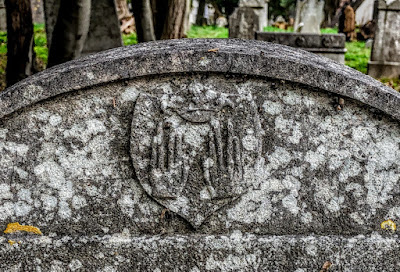
A priest’s hands raised for the blessing of the cohanim … a gravestone in the new Jewish cemetery on the Lido in Venice (Photograph: Patrick Comerford)
Luke 1: 57-66 (NRSVA):
57 Now the time came for Elizabeth to give birth, and she bore a son. 58 Her neighbours and relatives heard that the Lord had shown his great mercy to her, and they rejoiced with her.
59 On the eighth day they came to circumcise the child, and they were going to name him Zechariah after his father. 60 But his mother said, ‘No; he is to be called John.’ 61 They said to her, ‘None of your relatives has this name.’ 62 Then they began motioning to his father to find out what name he wanted to give him. 63 He asked for a writing-tablet and wrote, ‘His name is John.’ And all of them were amazed. 64 Immediately his mouth was opened and his tongue freed, and he began to speak, praising God. 65 Fear came over all their neighbours, and all these things were talked about throughout the entire hill country of Judea. 66 All who heard them pondered them and said, ‘What then will this child become?’ For, indeed, the hand of the Lord was with him.
Dreidels in a synagogue in Prague, part of children’s games at Hanukkah … did John the Baptist and Jesus spin dredels together at Hanukkah? (Photograph: Patrick Comerford)
Today’s Reflections:
In the Gospel reading at the Eucharist today (Luke 1: 57-66), we continue a series of readings before Christmas that draw on the two nativity narratives found in Matthew 1: 1-24 and Luke 1: 5-79.
During the week before Christmas, the great canticle Magnificat at Evensong traditionally has a refrain or antiphon attached to it proclaiming the ascriptions or ‘names’ given to God through the Old Testament. Each name develops into a prophecy of the coming of the Messiah.
O Sapientia, or O Wisdom, is the first of these days, and was marked on Wednesday (17 December). It was followed on Thursday (18 December) by O Adonai, by O Root of Jesse on Friday (19 December), O Key of David on Saturday (20 December), O Dayspring on Sunday (21 December), O King of the Nations yesterday (22 December), and, finally O Emmanuel today (23 December).
The seven majestic Messianic titles for Christ are based on Biblical prophecies, and they help the Church to recall the variety of the ills of humanity before the coming of the Redeemer as each antiphon in turn pleads with mounting impatience for Christ to save his people.
The Gospel reading at the Eucharist today (Luke 1: 57-66) continues on from the story of the Visitation of the Virgin Mary to her cousin Saint Elizabeth, with the only Gospel account of the birth, circumcision and naming of Saint John the Baptist.
Zechariah (זְכַרְיָה or Ζαχαρίας), also named in translations as Zacharias, Zachariah and Zachary, the husband of Elizabeth and the father of John the Baptist, is a priest, one of the cohanim descended from the sons of Aaron. Origen suggests that the Zechariah mentioned in Matthew 23: 35 as being killed between the temple and the altar may be the father of John the Baptist.
His name means ‘remember Yah’ or ‘remember God’ or ‘God remembers’. There are several Biblical figures with the name, including the Prophet Zachariah in Judah, a martyred son of a high priest, a king who reigned in Judah for six months, and several minor characters.
On the other hand, the Greek name Ἰωάννης (Ioannes) is a rendering of the Hebrew name Yohanan (יוֹחָנָן), a shorter form of the name Yəhôḥānān (יְהוֹחָנָן), which means ‘God is gracious’.
In the Hebrew Bible, Yohanan was the son of King Josiah of Judah (7th century BCE); Yohanan, son of Kareah, was a leader of the army who led the remnant of the population of Judah to Egypt for safety after the Babylonian dismantling of the kingdom in 586 BCE; Yohanan ben Yehoyada is a high priest named in the Book of Nehemiah and was the fourth in the line of high priests after Joshua the High Priest, who returned from the Babylonian captivity with Zerubbabel.
During the Hasmonean or Maccabean period, Yohanan was the father of Matityahu; John Gaddi, the eldest of the sons of Mattathias and brother of Judas Maccabeus, was one of the leaders of the revolt of the Maccabees in the 2nd century BCE; John Hyrcanus was a Maccabean leader and Jewish high priest from 134 BCE until his death in 104 BCE; and John Hyrcanus II (1st century BCE) was a member of the Hasmonean dynasty, High Priest, King, and ethnarch of Judea.
So, the name John, in its variant forms, was both a priestly and a royal name, and was associated with the leaders of resistance to occupation and resistance.
In idle moments, I sometimes wonder whether Jesus and John grew up knowing each other.
Did Mary and Joseph regularly visit Zechariah and Elizabeth?
Was Zechariah present as a priest in the Temple at the Presentation, or when the teenage Jesus was lost in the Temple?
Did Jesus and John send birthday greetings to one another?
Did they go to each other’s bar mitzvah?
Did they celebrate and major holidays of Holy Days together … Purim, Passover, Shavuot, Sukkot, Rosh Hashanah, Yom Kippur, Simchat Torah, Hanukkah … ?
Did they dress up together at Purim?
Did they spin dreidels with each other and play games together at Hanukkah? – Incidentally, yesterday (Monday) was the last day of Hanukkah this year, but Christmas Day and the first day of Hanukkah fell on the same day last year, for the first time in 19 years.
Did John the Baptist ever take up his duties and responsibilities as a priest in the Temple before going out into the Wilderness?
Was he in the Temple when Jesus visited, healed, taught, debated Caesar’s coins, or overturned the tables of the moneychangers?
Did John offer Jesus the priestly blessing that the cohanim alone impart?
The priestly blessing (Numbers 6: 24-26) that Zechariah and John would have pronounced, with their hands outstretched in the traditional way, is:
May the Lord bless and protect you.
May the Lord make his face shine on you and be gracious to you
May the Lord turn his face toward you, and give you peace.
The Priestly Blessing (ברכת כהנים, birkat cohanim) is known in rabbinic literature as raising the hands or rising to the platform because the blessing is given from a raised rostrum.
The Jewish Sages stressed that although the priests are the ones carrying out the blessing, it is not them or the ceremonial practice of raising their hands that results in the blessing, but rather it is God’s desire that his blessing should be symbolised by the hands of the cohanim.
The former Chief Rabbi, the late Lord (Jonathan) Sacks, says the Torah explicitly says that while the cohanim say the words, it is God who sends the blessing: ‘When the cohanim bless the people, they are not doing anything in and of themselves. Instead they are acting as channels through which God’s blessing flows into the world and into our lives.’
He adds, ‘Only love does this. Love means that we are focused not on ourselves but on another. Love is selflessness. And only selflessness allows us to be a channel through which flows a force greater than ourselves, the love that as Dante said, “moves the sun and the other stars”, the love that brings new life into the world.’
Hands raised in the priestly blessing on a gravestone in the Jewish cemetery in Kraków (Photograph: Patrick Comerford)
Today’s Prayers (Tuesday 23 December 2025):
The theme this week (21 to 27 December 2025) in Pray with the World Church, the prayer diary of the Anglican mission agency USPG (United Society Partners in the Gospel), is ‘Love Brings Life in Tanzania’ (pp 12-13). This theme was introduced on Sunday with a Programme Update by Imran Englefield, Individual Giving Manager, USPG.
The USPG Prayer Diary today (Tuesday 23 December 2025) invites us to pray:
Gracious Lord, we give thanks for the success of the Prevention of Mother-to-Child Transmission programme. Strengthen those who care, comfort those who suffer, and let hope, healing, and life flourish in this place.
The Collect:
God our redeemer,
who prepared the Blessed Virgin Mary
to be the mother of your Son:
grant that, as she looked for his coming as our saviour,
so we may be ready to greet him
when he comes again as our judge;
who is alive and reigns with you,
in the unity of the Holy Spirit,
one God, now and for ever.
The Post-Communion Prayer:
Heavenly Father,
who chose the Blessed Virgin Mary
to be the mother of the promised saviour
: fill us your servants with your grace,
that in all things we may embrace your holy will
and with her rejoice in your salvation;
through Jesus Christ our Lord.
Additional Collect:
Eternal God,
as Mary waited for the birth of your Son,
so we wait for his coming in glory;
bring us through the birth pangs of this present age
to see, with her, our great salvation
in Jesus Christ our Lord.
Yesterday’s Reflections
Continued Tomorrow
Hands raised in the priestly blessing on a Holocaust memorial in Berlin (Photograph: Patrick Comerford)
Scripture quotations are from the New Revised Standard Version Bible: Anglicised Edition copyright © 1989, 1995 National Council of the Churches of Christ in the United States of America. Used by permission. All rights reserved worldwide. http://nrsvbibles.org
Patrick Comerford
We are drawing near to the end of Advent and tomorrow is Christmas Eve. Later this morning I am involved in Santa’s visit to the Christmas Fayre and Farmers’ Market in Stoy Stratford. But, before today begins, I am taking some quiet time this morning to give thanks, to reflect, to pray and to read in these ways:
1, today’s Gospel reading;
2, a short reflection;
3, a prayer from the USPG prayer diary;
4, the Collects and Post-Communion prayer of the day.
A priest’s hands raised for the blessing of the cohanim … a gravestone in the new Jewish cemetery on the Lido in Venice (Photograph: Patrick Comerford)
Luke 1: 57-66 (NRSVA):
57 Now the time came for Elizabeth to give birth, and she bore a son. 58 Her neighbours and relatives heard that the Lord had shown his great mercy to her, and they rejoiced with her.
59 On the eighth day they came to circumcise the child, and they were going to name him Zechariah after his father. 60 But his mother said, ‘No; he is to be called John.’ 61 They said to her, ‘None of your relatives has this name.’ 62 Then they began motioning to his father to find out what name he wanted to give him. 63 He asked for a writing-tablet and wrote, ‘His name is John.’ And all of them were amazed. 64 Immediately his mouth was opened and his tongue freed, and he began to speak, praising God. 65 Fear came over all their neighbours, and all these things were talked about throughout the entire hill country of Judea. 66 All who heard them pondered them and said, ‘What then will this child become?’ For, indeed, the hand of the Lord was with him.
Dreidels in a synagogue in Prague, part of children’s games at Hanukkah … did John the Baptist and Jesus spin dredels together at Hanukkah? (Photograph: Patrick Comerford)
Today’s Reflections:
In the Gospel reading at the Eucharist today (Luke 1: 57-66), we continue a series of readings before Christmas that draw on the two nativity narratives found in Matthew 1: 1-24 and Luke 1: 5-79.
During the week before Christmas, the great canticle Magnificat at Evensong traditionally has a refrain or antiphon attached to it proclaiming the ascriptions or ‘names’ given to God through the Old Testament. Each name develops into a prophecy of the coming of the Messiah.
O Sapientia, or O Wisdom, is the first of these days, and was marked on Wednesday (17 December). It was followed on Thursday (18 December) by O Adonai, by O Root of Jesse on Friday (19 December), O Key of David on Saturday (20 December), O Dayspring on Sunday (21 December), O King of the Nations yesterday (22 December), and, finally O Emmanuel today (23 December).
The seven majestic Messianic titles for Christ are based on Biblical prophecies, and they help the Church to recall the variety of the ills of humanity before the coming of the Redeemer as each antiphon in turn pleads with mounting impatience for Christ to save his people.
The Gospel reading at the Eucharist today (Luke 1: 57-66) continues on from the story of the Visitation of the Virgin Mary to her cousin Saint Elizabeth, with the only Gospel account of the birth, circumcision and naming of Saint John the Baptist.
Zechariah (זְכַרְיָה or Ζαχαρίας), also named in translations as Zacharias, Zachariah and Zachary, the husband of Elizabeth and the father of John the Baptist, is a priest, one of the cohanim descended from the sons of Aaron. Origen suggests that the Zechariah mentioned in Matthew 23: 35 as being killed between the temple and the altar may be the father of John the Baptist.
His name means ‘remember Yah’ or ‘remember God’ or ‘God remembers’. There are several Biblical figures with the name, including the Prophet Zachariah in Judah, a martyred son of a high priest, a king who reigned in Judah for six months, and several minor characters.
On the other hand, the Greek name Ἰωάννης (Ioannes) is a rendering of the Hebrew name Yohanan (יוֹחָנָן), a shorter form of the name Yəhôḥānān (יְהוֹחָנָן), which means ‘God is gracious’.
In the Hebrew Bible, Yohanan was the son of King Josiah of Judah (7th century BCE); Yohanan, son of Kareah, was a leader of the army who led the remnant of the population of Judah to Egypt for safety after the Babylonian dismantling of the kingdom in 586 BCE; Yohanan ben Yehoyada is a high priest named in the Book of Nehemiah and was the fourth in the line of high priests after Joshua the High Priest, who returned from the Babylonian captivity with Zerubbabel.
During the Hasmonean or Maccabean period, Yohanan was the father of Matityahu; John Gaddi, the eldest of the sons of Mattathias and brother of Judas Maccabeus, was one of the leaders of the revolt of the Maccabees in the 2nd century BCE; John Hyrcanus was a Maccabean leader and Jewish high priest from 134 BCE until his death in 104 BCE; and John Hyrcanus II (1st century BCE) was a member of the Hasmonean dynasty, High Priest, King, and ethnarch of Judea.
So, the name John, in its variant forms, was both a priestly and a royal name, and was associated with the leaders of resistance to occupation and resistance.
In idle moments, I sometimes wonder whether Jesus and John grew up knowing each other.
Did Mary and Joseph regularly visit Zechariah and Elizabeth?
Was Zechariah present as a priest in the Temple at the Presentation, or when the teenage Jesus was lost in the Temple?
Did Jesus and John send birthday greetings to one another?
Did they go to each other’s bar mitzvah?
Did they celebrate and major holidays of Holy Days together … Purim, Passover, Shavuot, Sukkot, Rosh Hashanah, Yom Kippur, Simchat Torah, Hanukkah … ?
Did they dress up together at Purim?
Did they spin dreidels with each other and play games together at Hanukkah? – Incidentally, yesterday (Monday) was the last day of Hanukkah this year, but Christmas Day and the first day of Hanukkah fell on the same day last year, for the first time in 19 years.
Did John the Baptist ever take up his duties and responsibilities as a priest in the Temple before going out into the Wilderness?
Was he in the Temple when Jesus visited, healed, taught, debated Caesar’s coins, or overturned the tables of the moneychangers?
Did John offer Jesus the priestly blessing that the cohanim alone impart?
The priestly blessing (Numbers 6: 24-26) that Zechariah and John would have pronounced, with their hands outstretched in the traditional way, is:
May the Lord bless and protect you.
May the Lord make his face shine on you and be gracious to you
May the Lord turn his face toward you, and give you peace.
The Priestly Blessing (ברכת כהנים, birkat cohanim) is known in rabbinic literature as raising the hands or rising to the platform because the blessing is given from a raised rostrum.
The Jewish Sages stressed that although the priests are the ones carrying out the blessing, it is not them or the ceremonial practice of raising their hands that results in the blessing, but rather it is God’s desire that his blessing should be symbolised by the hands of the cohanim.
The former Chief Rabbi, the late Lord (Jonathan) Sacks, says the Torah explicitly says that while the cohanim say the words, it is God who sends the blessing: ‘When the cohanim bless the people, they are not doing anything in and of themselves. Instead they are acting as channels through which God’s blessing flows into the world and into our lives.’
He adds, ‘Only love does this. Love means that we are focused not on ourselves but on another. Love is selflessness. And only selflessness allows us to be a channel through which flows a force greater than ourselves, the love that as Dante said, “moves the sun and the other stars”, the love that brings new life into the world.’
Hands raised in the priestly blessing on a gravestone in the Jewish cemetery in Kraków (Photograph: Patrick Comerford)
Today’s Prayers (Tuesday 23 December 2025):
The theme this week (21 to 27 December 2025) in Pray with the World Church, the prayer diary of the Anglican mission agency USPG (United Society Partners in the Gospel), is ‘Love Brings Life in Tanzania’ (pp 12-13). This theme was introduced on Sunday with a Programme Update by Imran Englefield, Individual Giving Manager, USPG.
The USPG Prayer Diary today (Tuesday 23 December 2025) invites us to pray:
Gracious Lord, we give thanks for the success of the Prevention of Mother-to-Child Transmission programme. Strengthen those who care, comfort those who suffer, and let hope, healing, and life flourish in this place.
The Collect:
God our redeemer,
who prepared the Blessed Virgin Mary
to be the mother of your Son:
grant that, as she looked for his coming as our saviour,
so we may be ready to greet him
when he comes again as our judge;
who is alive and reigns with you,
in the unity of the Holy Spirit,
one God, now and for ever.
The Post-Communion Prayer:
Heavenly Father,
who chose the Blessed Virgin Mary
to be the mother of the promised saviour
: fill us your servants with your grace,
that in all things we may embrace your holy will
and with her rejoice in your salvation;
through Jesus Christ our Lord.
Additional Collect:
Eternal God,
as Mary waited for the birth of your Son,
so we wait for his coming in glory;
bring us through the birth pangs of this present age
to see, with her, our great salvation
in Jesus Christ our Lord.
Yesterday’s Reflections
Continued Tomorrow
Hands raised in the priestly blessing on a Holocaust memorial in Berlin (Photograph: Patrick Comerford)
Scripture quotations are from the New Revised Standard Version Bible: Anglicised Edition copyright © 1989, 1995 National Council of the Churches of Christ in the United States of America. Used by permission. All rights reserved worldwide. http://nrsvbibles.org
Labels:
Advent 2025,
Berlin,
Christmas 2025,
Hanukkah,
Kraków,
Lido,
Mission,
Prague,
Prayer,
Saint John the Baptist,
Saint Luke's Gospel,
Stony Stratford,
Tanzania,
Tolleshunt Knights,
USPG,
Venice
22 December 2025
An Advent Calendar with Patrick Comerford: 23, 22 December 2025
Snow some years ago at the Moat House, the former Comberford family home on Lichfield Street in Tamworth
Patrick Comerford
We are in the last days of Advent, and Christmas Day is next Thursday. At noon each day this Advent, I am offering an image or two as part of my own ‘Advent Calendar’ for 2025, and an Advent or Christmas carol, hymn or song.
My images for my Advent Calendar today is of snow some years ago at the Moat House, the former Comberford family home on Lichfield Street in Tamworth and a Christmas card with the former Church of Saint Mary and Saint George in Comberford, near Lichfield and Tamworth in a watercolour by Freda Morgan (2008).
My choice of a carol or hymn today is ‘While shepherds watched their flocks’, a traditional Christmas carol said to have been written by the Irish hymn-writer and England’s Poet Laureate, the Dublin-born Nahum Tate (1652-1715). It is one of the carols we sang yesterday afternoon at the Carol Service in Saunt Mary and Saint Giles Church in Stony Stratford.
The words were first published by Nahum Tate and Nicholas Brady in 1700 in their supplement to their New Version of the Psalms of David of 1696. It is based on the Gospel story of the angels appearing to the shepherds (see Luke 2: 8-14).
A Christmas card with the Church of Saint Mary and Saint George, Comberford, in a watercolour by Freda Morgan (2008)
While shepherds watched their flocks by night,
all seated on the ground,
the angel of the Lord came down,
And glory shone around.
‘Fear not,’ said he (for mighty dread
had seized their troubled mind);
‘Glad tidings of great joy I bring
to you and all mankind.
‘To you in David’s town this day
is born of David’s line
a Saviour, who is Christ the Lord;
And this shall be the sign:
‘The heav’nly Babe you there shall find
to human view displayed,
all meanly wrapped in swathing bands,
and in a manger laid.’
Thus spake the seraph; and forthwith
appeared a shining throng
of angels praising God, who thus
addressed their joyful song:
‘All glory be to God on high,
and to the earth be peace;
Goodwill henceforth from heav’n to men
begin and never cease.
Patrick Comerford
We are in the last days of Advent, and Christmas Day is next Thursday. At noon each day this Advent, I am offering an image or two as part of my own ‘Advent Calendar’ for 2025, and an Advent or Christmas carol, hymn or song.
My images for my Advent Calendar today is of snow some years ago at the Moat House, the former Comberford family home on Lichfield Street in Tamworth and a Christmas card with the former Church of Saint Mary and Saint George in Comberford, near Lichfield and Tamworth in a watercolour by Freda Morgan (2008).
My choice of a carol or hymn today is ‘While shepherds watched their flocks’, a traditional Christmas carol said to have been written by the Irish hymn-writer and England’s Poet Laureate, the Dublin-born Nahum Tate (1652-1715). It is one of the carols we sang yesterday afternoon at the Carol Service in Saunt Mary and Saint Giles Church in Stony Stratford.
The words were first published by Nahum Tate and Nicholas Brady in 1700 in their supplement to their New Version of the Psalms of David of 1696. It is based on the Gospel story of the angels appearing to the shepherds (see Luke 2: 8-14).
A Christmas card with the Church of Saint Mary and Saint George, Comberford, in a watercolour by Freda Morgan (2008)
While shepherds watched their flocks by night,
all seated on the ground,
the angel of the Lord came down,
And glory shone around.
‘Fear not,’ said he (for mighty dread
had seized their troubled mind);
‘Glad tidings of great joy I bring
to you and all mankind.
‘To you in David’s town this day
is born of David’s line
a Saviour, who is Christ the Lord;
And this shall be the sign:
‘The heav’nly Babe you there shall find
to human view displayed,
all meanly wrapped in swathing bands,
and in a manger laid.’
Thus spake the seraph; and forthwith
appeared a shining throng
of angels praising God, who thus
addressed their joyful song:
‘All glory be to God on high,
and to the earth be peace;
Goodwill henceforth from heav’n to men
begin and never cease.
Daily prayer in Advent 2025:
23, Monday 22 December 2025
An image of the Virgin Mary in a quiet corner at the High Leigh Conference Centre in Hoddesdon, Hertfordshire (Photograph: Patrick Comerford)
Patrick Comerford
We are in the final days of the Season of Advent, yesterday was the Fourth Sunday of Advent (Advent IV, 21 December 2025), today is the last of the eight days of Hanukkah this year, and Christmas Day is just a few days away.
Before today begins, I am taking some quiet time this morning to give thanks, to reflect, to pray and to read in these ways:
1, today’s Gospel reading;
2, a short reflection;
3, a prayer from the USPG prayer diary;
4, the Collects and Post-Communion prayer of the day.
The words of the canticle Magnificat carved on a wooden screen in Mount Melleray Abbey, Cappoquin, Co Waterford (Photograph: Patrick Comerford)
Luke 1: 46-56 (NRSVA):
46 And Mary said,
‘My soul magnifies the Lord,
47 and my spirit rejoices in God my Saviour,
48 for he has looked with favour on the lowliness of his servant.
Surely, from now on all generations will call me blessed;
49 for the Mighty One has done great things for me,
and holy is his name.
50 His mercy is for those who fear him
from generation to generation.
51 He has shown strength with his arm;
he has scattered the proud in the thoughts of their hearts.
52 He has brought down the powerful from their thrones,
and lifted up the lowly;
53 he has filled the hungry with good things,
and sent the rich away empty.
54 He has helped his servant Israel,
in remembrance of his mercy,
55 according to the promise he made to our ancestors,
to Abraham and to his descendants for ever.’
56 And Mary remained with her for about three months and then returned to her home.
The Virgin Mary with the Crown of Thorns depicted in a church window in Bansha, Co Tipperary (Photograph: Patrick Comerford)
Today’s Reflections:
In the Gospel reading at the Eucharist today (Luke 1: 46-56), we continue a series of readings before Christmas that draw on the two nativity narratives found in Matthew 1: 1-24 and Luke 1: 5-79.
During the days before Christmas, the great canticle Magnificat at Evensong traditionally has a refrain or antiphon attached to it proclaiming the ascriptions or ‘names’ given to God through the Old Testament. Each name develops into a prophecy of the coming of the Messiah.
O Sapientia, or O Wisdom, is the first of these days, and was marked on Wednesday (17 December). It was followed on Thursday (18 December) by O Adonai, by O Root of Jesse on Friday (19 December), O Key of David on Saturday (20 December), O Dayspring yesterday (21 December), and by O King of the Nations today (22 December), and, finally O Emmanuel tomorrow (23 December).
The seven majestic Messianic titles for Christ are based on Biblical prophecies, and they help the Church to recall the variety of the ills of humanity before the coming of the Redeemer as each antiphon in turn pleads with mounting impatience for Christ to save his people.
The Gospel reading at the Eucharist today is set withing the story of the Visitation of the Virgin Mary to her cousin Saint Elizabeth.
This Advent has been a time of waiting, a time of preparation, a time of anticipation. Since 30 November, in our time of waiting, preparation and anticipation, we have been preparing ourselves in the liturgy and the music, with carol services and quiet days, with Christmas Markets and Santa’s grotto, with the Advent Wreath and the Crib.
The four candles on the Advent wreath have reminded us, week-after-week, of those who prepared us in the past for the Coming of the Christ Child: first the Patriarchs and Matriarchs, our ancestors in faith, including Abraham and Sarah, Isaac and Jacob; then the prophets, including Isaiah, Jeremiah, and Micah; then Saint John the Baptist; and yesterday, the fourth and final candle reminded us of the Virgin Mary. This fourth candle connects with the Gospel reading yesterday, telling the story of Joseph’s response to Mary’s pregnancy, and today’s reading from the Canticle Magnificat (Luke 1: 46-55), so often heard at Evening Prayer.
The great German theologian and martyr, Dietrich Bonhoeffer (1906-1945), in an Advent sermon in London 92 years ago (17 December 1933), said Magnificat ‘is the oldest Advent hymn,’ and he spoke of how Mary knows better than anyone else what it means to wait for Christ’s coming:
‘In her own body she is experiencing the wonderful ways of God with humankind: that God does not arrange matters to suit our opinions and views, does not follow the path that humans would like to prescribe. God’s path is free and original beyond all our ability to understand or to prove.’
The Virgin Mary of the Visitation and of the canticle Magnificat is a strong and revolutionary woman, unlike the Virgin Mary of the plaster-cast statues and the Rosary.
The Mary I see as a role model for belief and discipleship is the Mary who sets off in a hurry and a flurry to visit her cousin Elizabeth, the Mary with a gob on her who speaks out of turn when she comes out with those wonderful words we hear in this Gospel reading, the Mary who sings the Canticle Magnificat.
This Mary is a wonderful, feisty person. She is what the red-top tabloid newspapers today might describe ‘a gymslip Mum.’ But, instead of hiding herself away from her family, from her cousins, from the woman in her family who is married to a priest, she rushes off to her immediately, to share her good news with her.
And she challenges so many of our prejudices and our values and our presumptions today. Not just about gymslip mums and unexpected or unplanned pregnancies, but about what the silent and the marginalised have to say about our values in society today.
And Mary declares:
He has shown strength with his arm;
he has scattered the proud in the thoughts of their hearts.
He has brought down the powerful from their thrones,
and lifted up the lowly;
he has filled the hungry with good things,
and sent the rich away empty.
He has helped his servant Israel,
in remembrance of his mercy,
according to the promise he made to our ancestors,
to Abraham and to his descendants for ever.’
It is almost like this is the programme or the agenda we can expect when the Christ Child is born, a programme and agenda that the world so desparately needs to hear the promise of today.
An icon of the Virgin Mary in an antique shop in Rethymnon (Photograph: Patrick Comerford)
Today’s Prayers (Monday 22 December 2024):
The theme this week (21 to 27 December 2025) in Pray with the World Church, the prayer diary of the Anglican mission agency USPG (United Society Partners in the Gospel), is ‘Love Brings Life in Tanzania’ (pp 12-13). This theme was introduced yesterday with a Programme Update by Imran Englefield, Individual Giving Manager, USPG.
The USPG Prayer Diary today (Monday 22 December 2025) invites us to pray:
Loving God, we give thanks for Dr Chalinzee and his devoted service at Mvumi Hospital. Strengthen him with wisdom, patience, and compassion as he cares for mothers and children.
The Collect:
God our redeemer,
who prepared the Blessed Virgin Mary
to be the mother of your Son:
grant that, as she looked for his coming as our saviour,
so we may be ready to greet him
when he comes again as our judge;
who is alive and reigns with you,
in the unity of the Holy Spirit,
one God, now and for ever.
The Post-Communion Prayer:
Heavenly Father,
who chose the Blessed Virgin Mary
to be the mother of the promised saviour:
fill us your servants with your grace,
that in all things we may embrace your holy will
and with her rejoice in your salvation;
through Jesus Christ our Lord.
Additional Collect:
Eternal God,
as Mary waited for the birth of your Son,
so we wait for his coming in glory;
bring us through the birth pangs of this present age
to see, with her, our great salvation
in Jesus Christ our Lord.
Yesterday’s Reflections
Continued Tomorrow
Scripture quotations are from the New Revised Standard Version Bible: Anglicised Edition copyright © 1989, 1995 National Council of the Churches of Christ in the United States of America. Used by permission. All rights reserved worldwide. http://nrsvbibles.org
Patrick Comerford
We are in the final days of the Season of Advent, yesterday was the Fourth Sunday of Advent (Advent IV, 21 December 2025), today is the last of the eight days of Hanukkah this year, and Christmas Day is just a few days away.
Before today begins, I am taking some quiet time this morning to give thanks, to reflect, to pray and to read in these ways:
1, today’s Gospel reading;
2, a short reflection;
3, a prayer from the USPG prayer diary;
4, the Collects and Post-Communion prayer of the day.
The words of the canticle Magnificat carved on a wooden screen in Mount Melleray Abbey, Cappoquin, Co Waterford (Photograph: Patrick Comerford)
Luke 1: 46-56 (NRSVA):
46 And Mary said,
‘My soul magnifies the Lord,
47 and my spirit rejoices in God my Saviour,
48 for he has looked with favour on the lowliness of his servant.
Surely, from now on all generations will call me blessed;
49 for the Mighty One has done great things for me,
and holy is his name.
50 His mercy is for those who fear him
from generation to generation.
51 He has shown strength with his arm;
he has scattered the proud in the thoughts of their hearts.
52 He has brought down the powerful from their thrones,
and lifted up the lowly;
53 he has filled the hungry with good things,
and sent the rich away empty.
54 He has helped his servant Israel,
in remembrance of his mercy,
55 according to the promise he made to our ancestors,
to Abraham and to his descendants for ever.’
56 And Mary remained with her for about three months and then returned to her home.
The Virgin Mary with the Crown of Thorns depicted in a church window in Bansha, Co Tipperary (Photograph: Patrick Comerford)
Today’s Reflections:
In the Gospel reading at the Eucharist today (Luke 1: 46-56), we continue a series of readings before Christmas that draw on the two nativity narratives found in Matthew 1: 1-24 and Luke 1: 5-79.
During the days before Christmas, the great canticle Magnificat at Evensong traditionally has a refrain or antiphon attached to it proclaiming the ascriptions or ‘names’ given to God through the Old Testament. Each name develops into a prophecy of the coming of the Messiah.
O Sapientia, or O Wisdom, is the first of these days, and was marked on Wednesday (17 December). It was followed on Thursday (18 December) by O Adonai, by O Root of Jesse on Friday (19 December), O Key of David on Saturday (20 December), O Dayspring yesterday (21 December), and by O King of the Nations today (22 December), and, finally O Emmanuel tomorrow (23 December).
The seven majestic Messianic titles for Christ are based on Biblical prophecies, and they help the Church to recall the variety of the ills of humanity before the coming of the Redeemer as each antiphon in turn pleads with mounting impatience for Christ to save his people.
The Gospel reading at the Eucharist today is set withing the story of the Visitation of the Virgin Mary to her cousin Saint Elizabeth.
This Advent has been a time of waiting, a time of preparation, a time of anticipation. Since 30 November, in our time of waiting, preparation and anticipation, we have been preparing ourselves in the liturgy and the music, with carol services and quiet days, with Christmas Markets and Santa’s grotto, with the Advent Wreath and the Crib.
The four candles on the Advent wreath have reminded us, week-after-week, of those who prepared us in the past for the Coming of the Christ Child: first the Patriarchs and Matriarchs, our ancestors in faith, including Abraham and Sarah, Isaac and Jacob; then the prophets, including Isaiah, Jeremiah, and Micah; then Saint John the Baptist; and yesterday, the fourth and final candle reminded us of the Virgin Mary. This fourth candle connects with the Gospel reading yesterday, telling the story of Joseph’s response to Mary’s pregnancy, and today’s reading from the Canticle Magnificat (Luke 1: 46-55), so often heard at Evening Prayer.
The great German theologian and martyr, Dietrich Bonhoeffer (1906-1945), in an Advent sermon in London 92 years ago (17 December 1933), said Magnificat ‘is the oldest Advent hymn,’ and he spoke of how Mary knows better than anyone else what it means to wait for Christ’s coming:
‘In her own body she is experiencing the wonderful ways of God with humankind: that God does not arrange matters to suit our opinions and views, does not follow the path that humans would like to prescribe. God’s path is free and original beyond all our ability to understand or to prove.’
The Virgin Mary of the Visitation and of the canticle Magnificat is a strong and revolutionary woman, unlike the Virgin Mary of the plaster-cast statues and the Rosary.
The Mary I see as a role model for belief and discipleship is the Mary who sets off in a hurry and a flurry to visit her cousin Elizabeth, the Mary with a gob on her who speaks out of turn when she comes out with those wonderful words we hear in this Gospel reading, the Mary who sings the Canticle Magnificat.
This Mary is a wonderful, feisty person. She is what the red-top tabloid newspapers today might describe ‘a gymslip Mum.’ But, instead of hiding herself away from her family, from her cousins, from the woman in her family who is married to a priest, she rushes off to her immediately, to share her good news with her.
And she challenges so many of our prejudices and our values and our presumptions today. Not just about gymslip mums and unexpected or unplanned pregnancies, but about what the silent and the marginalised have to say about our values in society today.
And Mary declares:
He has shown strength with his arm;
he has scattered the proud in the thoughts of their hearts.
He has brought down the powerful from their thrones,
and lifted up the lowly;
he has filled the hungry with good things,
and sent the rich away empty.
He has helped his servant Israel,
in remembrance of his mercy,
according to the promise he made to our ancestors,
to Abraham and to his descendants for ever.’
It is almost like this is the programme or the agenda we can expect when the Christ Child is born, a programme and agenda that the world so desparately needs to hear the promise of today.
An icon of the Virgin Mary in an antique shop in Rethymnon (Photograph: Patrick Comerford)
Today’s Prayers (Monday 22 December 2024):
The theme this week (21 to 27 December 2025) in Pray with the World Church, the prayer diary of the Anglican mission agency USPG (United Society Partners in the Gospel), is ‘Love Brings Life in Tanzania’ (pp 12-13). This theme was introduced yesterday with a Programme Update by Imran Englefield, Individual Giving Manager, USPG.
The USPG Prayer Diary today (Monday 22 December 2025) invites us to pray:
Loving God, we give thanks for Dr Chalinzee and his devoted service at Mvumi Hospital. Strengthen him with wisdom, patience, and compassion as he cares for mothers and children.
The Collect:
God our redeemer,
who prepared the Blessed Virgin Mary
to be the mother of your Son:
grant that, as she looked for his coming as our saviour,
so we may be ready to greet him
when he comes again as our judge;
who is alive and reigns with you,
in the unity of the Holy Spirit,
one God, now and for ever.
The Post-Communion Prayer:
Heavenly Father,
who chose the Blessed Virgin Mary
to be the mother of the promised saviour:
fill us your servants with your grace,
that in all things we may embrace your holy will
and with her rejoice in your salvation;
through Jesus Christ our Lord.
Additional Collect:
Eternal God,
as Mary waited for the birth of your Son,
so we wait for his coming in glory;
bring us through the birth pangs of this present age
to see, with her, our great salvation
in Jesus Christ our Lord.
Yesterday’s Reflections
Continued Tomorrow
Scripture quotations are from the New Revised Standard Version Bible: Anglicised Edition copyright © 1989, 1995 National Council of the Churches of Christ in the United States of America. Used by permission. All rights reserved worldwide. http://nrsvbibles.org
Labels:
Advent 2025,
Bansha,
Bonhoeffer,
Canticles,
Cappoquin,
Christmas 2025,
Crete 2025,
Greece 2025,
Hanukkah,
High Leigh,
Icons,
Mission,
Mount Melleray,
Prayer,
Rethymnon,
Saint Luke's Gospel,
Tanzania,
USPG
21 December 2025
An Advent Calendar with Patrick Comerford: 22, 21 December 2025
Christmas lights in the churchyard at Saint Mary and Saint Giles Church in Stony Stratford (Photograph: Patrick Comerford, 2025)
Patrick Comerford
We are in the last week of Advent, and Christmas Day is next Thursday. At noon each day this Advent, I am offering an image as part of my own ‘Advent Calendar’ for 2025, and an Advent or Christmas carol, hymn or song.
My image for my Advent Calendar today is of the Christmas lights in the churchyard at Saint Mary and Saint Giles Church in Stony Stratford.
My choice of a carol or hymn today is ‘O come all ye faithful’, our closing carol at the Carol Service in Saint Mary and Saint Giles Church, Stony Stratford, this afternoon (4 pm, Sunday 21 December 2025).
This is one of the best-loved Christmas carols, and is sometimes known by its Latin name (Adeste Fideles), and this probably explains why it is often described as a mediaeval hymn. But while, the original author is unknown, the writer who made it popular in English was Frederick Oakeley (1802-1880), a priest in the Church of England, a canon of Lichfield Cathedral and an Oxford don for many years before following John Henry Newman into the Roman Catholic Church and becoming a canon of Westminster Cathedral.
O come, all ye faithful,
Joyful and triumphant,
O come ye, O come ye to Bethlehem;
Come and behold him
Born the King of Angels:
O come, let us adore him,
Christ the Lord.
God of God,
Light of Light,
Lo! he abhors not the Virgin’s womb;
Very God,
Begotten, not created:
Refrain
Sing, choirs of angels,
Sing in exultation,
Sing, all ye citizens of heav’n above;
Glory to God
In the highest:
Refrain
Yea, Lord, we greet thee,
Born that happy morning,
Jesu, to thee be glory giv’n!
Word of the Father,
Now in flesh appearing:
Refrain
Patrick Comerford
We are in the last week of Advent, and Christmas Day is next Thursday. At noon each day this Advent, I am offering an image as part of my own ‘Advent Calendar’ for 2025, and an Advent or Christmas carol, hymn or song.
My image for my Advent Calendar today is of the Christmas lights in the churchyard at Saint Mary and Saint Giles Church in Stony Stratford.
My choice of a carol or hymn today is ‘O come all ye faithful’, our closing carol at the Carol Service in Saint Mary and Saint Giles Church, Stony Stratford, this afternoon (4 pm, Sunday 21 December 2025).
This is one of the best-loved Christmas carols, and is sometimes known by its Latin name (Adeste Fideles), and this probably explains why it is often described as a mediaeval hymn. But while, the original author is unknown, the writer who made it popular in English was Frederick Oakeley (1802-1880), a priest in the Church of England, a canon of Lichfield Cathedral and an Oxford don for many years before following John Henry Newman into the Roman Catholic Church and becoming a canon of Westminster Cathedral.
O come, all ye faithful,
Joyful and triumphant,
O come ye, O come ye to Bethlehem;
Come and behold him
Born the King of Angels:
O come, let us adore him,
Christ the Lord.
God of God,
Light of Light,
Lo! he abhors not the Virgin’s womb;
Very God,
Begotten, not created:
Refrain
Sing, choirs of angels,
Sing in exultation,
Sing, all ye citizens of heav’n above;
Glory to God
In the highest:
Refrain
Yea, Lord, we greet thee,
Born that happy morning,
Jesu, to thee be glory giv’n!
Word of the Father,
Now in flesh appearing:
Refrain
Daily prayer in Advent 2025:
22, Sunday 21 December 2025,
Fourth Sunday of Advent (Advent IV)
Saint Joseph with the Christ Child and the Virgin Mary in a window in Saint Mary and Saint Giles Church, Stony Stratford (Photograph: Patrick Comerford, 2025)
Patrick Comerford
We are in the last week of Advent, and just days away from Christmas. Today is week the Fourth Sunday of Advent (Advent IV, 21 December 2025). In addition, tonight in the Jewish calendar is also the last night in Hanukkah, which began last Sunday night (21 December 2025).
Later this morning, I hope to be involved in the Parish Eucharist in Saint Mary and Saint Giles Church, Stony Stratford (9:30 am), to read one of the lessons at the Service of Nine Lessons and Carols (4 pm), and to sing with the choir at the carol service. Meanwhile, before this busy day begins, I am taking some quiet time this early morning to give thanks, to reflect, to pray and to read in these ways:
The Fourth Sunday of Advent (Advent IV, 21 December 2025)
A statue of Saint Joseph on the façade of Saint Joseph’s Church, Terenure, Dublin (Photograph: Patrick Comerford, 2024)
Matthew 1: 18-25 (NRSVA):
18 Now the birth of Jesus the Messiah took place in this way. When his mother Mary had been engaged to Joseph, but before they lived together, she was found to be with child from the Holy Spirit. 19 Her husband Joseph, being a righteous man and unwilling to expose her to public disgrace, planned to dismiss her quietly. 20 But just when he had resolved to do this, an angel of the Lord appeared to him in a dream and said, ‘Joseph, son of David, do not be afraid to take Mary as your wife, for the child conceived in her is from the Holy Spirit. 21 She will bear a son, and you are to name him Jesus, for he will save his people from their sins.’ 22 All this took place to fulfil what had been spoken by the Lord through the prophet:
23 ‘Look, the virgin shall conceive and bear a son,
and they shall name him Emmanuel’,
which means, ‘God is with us.’ 24 When Joseph awoke from sleep, he did as the angel of the Lord commanded him; he took her as his wife, 25 but had no marital relations with her until she had borne a son; and he named him Jesus.
A statue of Saint Joseph in the grounds of Saint Joseph’s Church, Singapore (Photograph: Patrick Comerford, 2024)
Today’s Reflections:
Christmas is upon us, the last of the purple candles on the Advent Wreath, the one representing the Virgin Mary, is lit this morning. Indeed, the Virgin Mary is likely to be the main figure in many sermons today focusing on the Gospel reading.
The readings this Sunday are about choices, about obedience to God’s plans, and about the fulfilment of God’s plans for all nations. They bring us into the last week of Advent.
So often we talk about the Virgin Mary and her obedience, about Mary’s ‘Yes’ to the birth of Christ But it means Joseph is often pushed to the side of the stage.
Joseph says ‘Yes’ too, but he says it silently; he has no scripted lines; he has no dramatic part or role; he is mute; but he is obedient.
And, like the earlier Joseph, his Biblical namesake who is named in this morning’s psalm (Psalm 80: 1-7, 17-19), he too is dreamer of dreams and a doer of deeds.
As I recalled when we had a similar reading last Thursday (Matthew 1: 18-24, 18 December 2025), Saint Matthew’s nativity story lacks the romantic imagery of Saint Luke’s account, whose heady mixture of heavenly angels with earthy shepherds is missing here. Instead, the hope of all the earth takes shape under the sign of arrangements being made for a betrothal that is apparently violated. The gifts of God’s grace and the promise of God’s reign are hidden, are to be searched for and to be found in the midst of what appears be a tawdry story.
The Virgin Mary may have been a mere teenager at the time, just 14 or 15. And, like so many other teenage brides, she turns up for her wedding – pregnant! Joseph knows he could not possibly be the father. He decides to do the right thing and take off, quietly dropping out of the arrangement.
If Joseph goes ahead, then this child is going to be known in his family, among his neighbours, perhaps by everyone who needs to know, as illegitimate for the rest of his life. His critics indelicately remind him of this in Saint John’s Gospel: ‘You are indeed doing what your father does.’ They said to him, ‘We are not illegitimate children; we have one father, God himself’ (John 8: 41). The original Greek is more direct, crude and blunt: they taunt him that they were not conceived through illicit intercourse.
These fears and sneers, those social judgments and wagging fingers, must have been confronting Joseph like a nightmare. Yet the angel of Joseph’s dream makes a startling suggestion. He tells him to marry Mary, and then he is to name the child. To take on naming the child means becoming his father. And this is suggested not as a nice thing to do, a courteous thing to do, a gallant or gentlemanly sort of thing to do. Joseph is told why: ‘You are to name him Jesus, for he will save his people from their sins’ (verse 21).
It is not a promise of immediate reward. Joseph is not promised that if he does this he is going to earn points towards the forgiveness of his own sins; that God will see him as a nice guy; or even that if he lives long enough, this child may grow up, be apprenticed to him, take over the family business, and act as a future pension plan.
If Joseph is not the father of the Child Jesus, he must have wondered what the angel meant by ‘his people’ and ‘their sins.’
But the forgiveness here is spoken of in apocalyptic terms. It is the declaration of a new future. To be forgiven is to receive a future. Forgiveness breaks the simple link between cause and effect, action and reaction, failure and disaster, rebellion and recrimination.
Advent is a time of, repentance, forgiveness and expectation. It is a time of preparation, anticipation and hope. It is a time for dreaming dreams, and putting behind us all our nightmares.
Joseph dreams something wonderful. God would enter the world; God would be born to his new, young wife, Mary. But to believe this, Joseph had to trust not only his dream, but to trust Mary, to trust the future child, to trust God.
Do you love the people you trust and trust the people you love?
To trust the Virgin Mary, Joseph must have truly loved her. But trust in this predicament must have gone beyond trust. Joseph must have truly glimpsed what it is to trust God, to have hope in God, to love God, to have faith in God.
Joseph dreams a dream not of his own salvation, but of the salvation of the world.
Sometimes, like Joseph, we are supposed to trust God and then get out of the way. Do you trust that God is working through the people you love? Do you trust that God is working through people you find it difficult not to love but merely to like … working through God’s people for their salvation?
Too often we forget about poor Joseph. Every year, we tend to focus on the story of the Virgin Mary. But this year, Year A, the Lectionary asks us to focus on Saint Joseph. The annunciation occurs not just to Mary, but to Joseph too. And they both say ‘Yes.’
And Joseph says a second ‘Yes’ too later in this Gospel, when he agrees to the angel’s prompting to flee with Mary and the Christ Child to Egypt.
Joseph listens, God sends a messenger again, Joseph dreams again, and he remains true to God, he answers God’s call.
Joseph has no speaking part; he just has a walk-on part in this drama. But his actions, his obedience to God’s call, speak louder than words.
Yes, God appears over and over again, to men, women, to ‘all sorts and conditions of people.’
Joseph’s ‘Yes’ is not only a ‘Yes’ to the Christ Child but a ‘Yes’ to all children who seem unwanted and who are easily pushed to one side. Joseph’s ‘Yes’ is not only a ‘Yes’ to the Christ Child but a ‘Yes’ to the promises the Coming Christ brings to all who are marginalised and in danger today, for because of his ‘Yes’ God is among us.
We have an opportunity to echo that ‘Yes’ this Advent and this Christmas and to say ‘Yes’ to the people who cross borders, who face a dangerous ‘No’ along the way, who face violence and the dangers of human trafficking, who face racism and rejection.
This is one way we can say ‘Yes’ to the coming Christ and the coming Christmas this Advent. In saying ‘Yes’ like this, we become signs of our faith, our hope, in the promises of the coming kingdom and the promises of Christ’s coming in Advent.
The Death of Saint Joseph depicted in a tableau in a side chapel in Saint Francis Xavier Church, Gardiner Street, Dublin (Photograph: Patrick Comerford, 2025)
Today’s Prayers (Sunday 21 December 2025, Advent IV):
The theme this week (21 to 27 December 2025) in Pray with the World Church, the prayer diary of the Anglican mission agency USPG (United Society Partners in the Gospel), is ‘Love Brings Life in Tanzania’ (pp 12-13). This theme is introduced today with a Programme Update by Imran Englefield, Individual Giving Manager, USPG:
‘As we edge towards Christmas, a season of hope, waiting, and light, we will focus on the Anglican Church of Tanzania and its impactful work of bringing care, protection, and hope to mothers and babies.
‘When I met Dr Albert Chalinzee, the Medical Officer in Charge, I was immediately struck by his quiet strength. Mvumi Hospital serves a vast rural area with very limited resources, yet the atmosphere is one of focus and dedication. Dr Chalinzee told me how, not long ago, infection rates among mothers living with HIV were close to 50 per cent. Through the Prevention of Mother-to-Child Transmission programme, that figure has now dropped to just 0.3 per cent.
‘He spoke with pride about the mothers who now come early for care following advice led by the church, and leave holding HIV-free babies. “It has changed everything,” he said. “We are now able to treat mothers and share our stories of success.”
‘Much of the equipment is old, and the staff are stretched thin, but what keeps Mvumi going is not machinery or funding, it’s faith. Every hospital staff member I met there serves out of love for their community. As I left, I realised that Mvumi is more than a hospital; it is a backbone and safety net for a community who need it most.’
The USPG Prayer Diary today (Sunday 21 December 2025, Advent IV) invites us to pray by reading and meditating on Matthew 1: 18-25.
The Collect:
God our redeemer,
who prepared the Blessed Virgin Mary
to be the mother of your Son:
grant that, as she looked for his coming as our saviour,
so we may be ready to greet him
when he comes again as our judge;
who is alive and reigns with you,
in the unity of the Holy Spirit,
one God, now and for ever.
The Post-Communion Prayer:
Heavenly Father,
who chose the Blessed Virgin Mary
to be the mother of the promised saviour:
fill us your servants with your grace,
that in all things we may embrace your holy will
and with her rejoice in your salvation;
through Jesus Christ our Lord.
Additional Collect:
Eternal God,
as Mary waited for the birth of your Son,
so we wait for his coming in glory;
bring us through the birth pangs of this present age
to see, with her, our great salvation
in Jesus Christ our Lord.
Yesterday’s Reflections
Continued Tomorrow
Saint Joseph with the Christ Child depicted in a mosaic in the pediment of Saint Joseph’s Church, Limerick (Photograph: Patrick Comerford)
Scripture quotations are from the New Revised Standard Version Bible: Anglicised Edition copyright © 1989, 1995 National Council of the Churches of Christ in the United States of America. Used by permission. All rights reserved worldwide. http://nrsvbibles.org
Patrick Comerford
We are in the last week of Advent, and just days away from Christmas. Today is week the Fourth Sunday of Advent (Advent IV, 21 December 2025). In addition, tonight in the Jewish calendar is also the last night in Hanukkah, which began last Sunday night (21 December 2025).
Later this morning, I hope to be involved in the Parish Eucharist in Saint Mary and Saint Giles Church, Stony Stratford (9:30 am), to read one of the lessons at the Service of Nine Lessons and Carols (4 pm), and to sing with the choir at the carol service. Meanwhile, before this busy day begins, I am taking some quiet time this early morning to give thanks, to reflect, to pray and to read in these ways:
The Fourth Sunday of Advent (Advent IV, 21 December 2025)
A statue of Saint Joseph on the façade of Saint Joseph’s Church, Terenure, Dublin (Photograph: Patrick Comerford, 2024)
Matthew 1: 18-25 (NRSVA):
18 Now the birth of Jesus the Messiah took place in this way. When his mother Mary had been engaged to Joseph, but before they lived together, she was found to be with child from the Holy Spirit. 19 Her husband Joseph, being a righteous man and unwilling to expose her to public disgrace, planned to dismiss her quietly. 20 But just when he had resolved to do this, an angel of the Lord appeared to him in a dream and said, ‘Joseph, son of David, do not be afraid to take Mary as your wife, for the child conceived in her is from the Holy Spirit. 21 She will bear a son, and you are to name him Jesus, for he will save his people from their sins.’ 22 All this took place to fulfil what had been spoken by the Lord through the prophet:
23 ‘Look, the virgin shall conceive and bear a son,
and they shall name him Emmanuel’,
which means, ‘God is with us.’ 24 When Joseph awoke from sleep, he did as the angel of the Lord commanded him; he took her as his wife, 25 but had no marital relations with her until she had borne a son; and he named him Jesus.
A statue of Saint Joseph in the grounds of Saint Joseph’s Church, Singapore (Photograph: Patrick Comerford, 2024)
Today’s Reflections:
Christmas is upon us, the last of the purple candles on the Advent Wreath, the one representing the Virgin Mary, is lit this morning. Indeed, the Virgin Mary is likely to be the main figure in many sermons today focusing on the Gospel reading.
The readings this Sunday are about choices, about obedience to God’s plans, and about the fulfilment of God’s plans for all nations. They bring us into the last week of Advent.
So often we talk about the Virgin Mary and her obedience, about Mary’s ‘Yes’ to the birth of Christ But it means Joseph is often pushed to the side of the stage.
Joseph says ‘Yes’ too, but he says it silently; he has no scripted lines; he has no dramatic part or role; he is mute; but he is obedient.
And, like the earlier Joseph, his Biblical namesake who is named in this morning’s psalm (Psalm 80: 1-7, 17-19), he too is dreamer of dreams and a doer of deeds.
As I recalled when we had a similar reading last Thursday (Matthew 1: 18-24, 18 December 2025), Saint Matthew’s nativity story lacks the romantic imagery of Saint Luke’s account, whose heady mixture of heavenly angels with earthy shepherds is missing here. Instead, the hope of all the earth takes shape under the sign of arrangements being made for a betrothal that is apparently violated. The gifts of God’s grace and the promise of God’s reign are hidden, are to be searched for and to be found in the midst of what appears be a tawdry story.
The Virgin Mary may have been a mere teenager at the time, just 14 or 15. And, like so many other teenage brides, she turns up for her wedding – pregnant! Joseph knows he could not possibly be the father. He decides to do the right thing and take off, quietly dropping out of the arrangement.
If Joseph goes ahead, then this child is going to be known in his family, among his neighbours, perhaps by everyone who needs to know, as illegitimate for the rest of his life. His critics indelicately remind him of this in Saint John’s Gospel: ‘You are indeed doing what your father does.’ They said to him, ‘We are not illegitimate children; we have one father, God himself’ (John 8: 41). The original Greek is more direct, crude and blunt: they taunt him that they were not conceived through illicit intercourse.
These fears and sneers, those social judgments and wagging fingers, must have been confronting Joseph like a nightmare. Yet the angel of Joseph’s dream makes a startling suggestion. He tells him to marry Mary, and then he is to name the child. To take on naming the child means becoming his father. And this is suggested not as a nice thing to do, a courteous thing to do, a gallant or gentlemanly sort of thing to do. Joseph is told why: ‘You are to name him Jesus, for he will save his people from their sins’ (verse 21).
It is not a promise of immediate reward. Joseph is not promised that if he does this he is going to earn points towards the forgiveness of his own sins; that God will see him as a nice guy; or even that if he lives long enough, this child may grow up, be apprenticed to him, take over the family business, and act as a future pension plan.
If Joseph is not the father of the Child Jesus, he must have wondered what the angel meant by ‘his people’ and ‘their sins.’
But the forgiveness here is spoken of in apocalyptic terms. It is the declaration of a new future. To be forgiven is to receive a future. Forgiveness breaks the simple link between cause and effect, action and reaction, failure and disaster, rebellion and recrimination.
Advent is a time of, repentance, forgiveness and expectation. It is a time of preparation, anticipation and hope. It is a time for dreaming dreams, and putting behind us all our nightmares.
Joseph dreams something wonderful. God would enter the world; God would be born to his new, young wife, Mary. But to believe this, Joseph had to trust not only his dream, but to trust Mary, to trust the future child, to trust God.
Do you love the people you trust and trust the people you love?
To trust the Virgin Mary, Joseph must have truly loved her. But trust in this predicament must have gone beyond trust. Joseph must have truly glimpsed what it is to trust God, to have hope in God, to love God, to have faith in God.
Joseph dreams a dream not of his own salvation, but of the salvation of the world.
Sometimes, like Joseph, we are supposed to trust God and then get out of the way. Do you trust that God is working through the people you love? Do you trust that God is working through people you find it difficult not to love but merely to like … working through God’s people for their salvation?
Too often we forget about poor Joseph. Every year, we tend to focus on the story of the Virgin Mary. But this year, Year A, the Lectionary asks us to focus on Saint Joseph. The annunciation occurs not just to Mary, but to Joseph too. And they both say ‘Yes.’
And Joseph says a second ‘Yes’ too later in this Gospel, when he agrees to the angel’s prompting to flee with Mary and the Christ Child to Egypt.
Joseph listens, God sends a messenger again, Joseph dreams again, and he remains true to God, he answers God’s call.
Joseph has no speaking part; he just has a walk-on part in this drama. But his actions, his obedience to God’s call, speak louder than words.
Yes, God appears over and over again, to men, women, to ‘all sorts and conditions of people.’
Joseph’s ‘Yes’ is not only a ‘Yes’ to the Christ Child but a ‘Yes’ to all children who seem unwanted and who are easily pushed to one side. Joseph’s ‘Yes’ is not only a ‘Yes’ to the Christ Child but a ‘Yes’ to the promises the Coming Christ brings to all who are marginalised and in danger today, for because of his ‘Yes’ God is among us.
We have an opportunity to echo that ‘Yes’ this Advent and this Christmas and to say ‘Yes’ to the people who cross borders, who face a dangerous ‘No’ along the way, who face violence and the dangers of human trafficking, who face racism and rejection.
This is one way we can say ‘Yes’ to the coming Christ and the coming Christmas this Advent. In saying ‘Yes’ like this, we become signs of our faith, our hope, in the promises of the coming kingdom and the promises of Christ’s coming in Advent.
The Death of Saint Joseph depicted in a tableau in a side chapel in Saint Francis Xavier Church, Gardiner Street, Dublin (Photograph: Patrick Comerford, 2025)
Today’s Prayers (Sunday 21 December 2025, Advent IV):
The theme this week (21 to 27 December 2025) in Pray with the World Church, the prayer diary of the Anglican mission agency USPG (United Society Partners in the Gospel), is ‘Love Brings Life in Tanzania’ (pp 12-13). This theme is introduced today with a Programme Update by Imran Englefield, Individual Giving Manager, USPG:
‘As we edge towards Christmas, a season of hope, waiting, and light, we will focus on the Anglican Church of Tanzania and its impactful work of bringing care, protection, and hope to mothers and babies.
‘When I met Dr Albert Chalinzee, the Medical Officer in Charge, I was immediately struck by his quiet strength. Mvumi Hospital serves a vast rural area with very limited resources, yet the atmosphere is one of focus and dedication. Dr Chalinzee told me how, not long ago, infection rates among mothers living with HIV were close to 50 per cent. Through the Prevention of Mother-to-Child Transmission programme, that figure has now dropped to just 0.3 per cent.
‘He spoke with pride about the mothers who now come early for care following advice led by the church, and leave holding HIV-free babies. “It has changed everything,” he said. “We are now able to treat mothers and share our stories of success.”
‘Much of the equipment is old, and the staff are stretched thin, but what keeps Mvumi going is not machinery or funding, it’s faith. Every hospital staff member I met there serves out of love for their community. As I left, I realised that Mvumi is more than a hospital; it is a backbone and safety net for a community who need it most.’
The USPG Prayer Diary today (Sunday 21 December 2025, Advent IV) invites us to pray by reading and meditating on Matthew 1: 18-25.
The Collect:
God our redeemer,
who prepared the Blessed Virgin Mary
to be the mother of your Son:
grant that, as she looked for his coming as our saviour,
so we may be ready to greet him
when he comes again as our judge;
who is alive and reigns with you,
in the unity of the Holy Spirit,
one God, now and for ever.
The Post-Communion Prayer:
Heavenly Father,
who chose the Blessed Virgin Mary
to be the mother of the promised saviour:
fill us your servants with your grace,
that in all things we may embrace your holy will
and with her rejoice in your salvation;
through Jesus Christ our Lord.
Additional Collect:
Eternal God,
as Mary waited for the birth of your Son,
so we wait for his coming in glory;
bring us through the birth pangs of this present age
to see, with her, our great salvation
in Jesus Christ our Lord.
Yesterday’s Reflections
Continued Tomorrow
Saint Joseph with the Christ Child depicted in a mosaic in the pediment of Saint Joseph’s Church, Limerick (Photograph: Patrick Comerford)
Scripture quotations are from the New Revised Standard Version Bible: Anglicised Edition copyright © 1989, 1995 National Council of the Churches of Christ in the United States of America. Used by permission. All rights reserved worldwide. http://nrsvbibles.org
Labels:
Advent 2025,
Carols,
Dublin Churches,
Limerick Churches,
Mission,
Prayer,
Saint Joseph,
Saint Matthew's Gospel,
Sculpture,
Singapore,
Stained Glass,
Stony Stratford,
Tanzania,
Terenure,
USPG
20 December 2025
The Greeks have a word for it:
57, Χριστούγεννα (Christougenna), Christmas
A traditional Christmas boat lit up on the seafront in Rethymnon in Crete (Photograph: Peek Travel, 2025)
Many years ago, while I was working in Athens and the Peloponnese in the weeks before Christmas, the request came to bring some Greek Christmas decorations back with me. It was an unusual ask, because Christmas is celebrated in such a different way in Greece, and it is only in the years since that it has become such a major holiday celebration.
Our celebrations, even our vocabulary surrounding Christmas, are different in each European language. Christmas is Noël in French, Natale in Italian, Natal in Portuguese, and Navidad in Spanish and Weihnachten in German.
The Greek word for Christmas is Χριστούγεννα (Christougenna ), which means ‘Christ’s birth,’ a combination of Χριστός (Christos), Christ, and γέννα (génna), meaning birth. So, to say ‘Merry Christmas’ or Happy Christmas, Greeks say Καλά Χριστούγεννα (Kala Christougenna).
So, here are some more Greek words and phrases to add to any vocabulary:
• Η παραμονή των Χριστουγέννων (i paramoni ton Christouyennon), Christmas Eve
• Ημέρα των Χριστουγέννων ( Imera ton Christouyennon), Christmas Day
• Η Χριστουγεννιάτικη κάρτα (i Christouyenniatiki karta), Christmas card
• Το Xριστουγεννιάτικο Δέντρο (to Christouyenniatiko thendro), the Christmas tree
• Χριστουγεννιάτικα κάλαντα (Christouyenniatika kalanda), Christmas carols
• Τα Κάλαντα (to kalanda), the carols
• Σας εύχομαι καλά Χριστούγεννα (Sas efkoma kala christouenna), I wish you Merry Christmas
• Χρόνια πολλά (chronia polla), a phrase we use to wish you many years of good health, said on your birthday, name day, major holidays – and said at Christmas too
• Καλές γιορτές (kales yortes), ‘Good Holidays’ or ‘Happy Holidays’
• Η Παραμονή της Πρωτοχρονιάς (i paramoni paramoni protohronias), New Year’s Eve
• Καλή Πρωτοχρονιά (Kali protohronia), Happy New Year’s Eve
• Καλή Χρονιά (Kali Chronia), Happy New Year
• Ευτυχισμένο το Νέο Έτος ( Eftihsmeno to neo etos), a more formal way of saying ‘Happy New Year’
• Άγιος Βασίλης (Ayios Vasilis), Saint Basil, I suppose the Greek equivalent of Santa Claus
Christmas lights on Tsouderon Street in Rethymnon
Some Orthodox Christians may fast for 40 days before Christmas, which is a little longer than Advent in the Western churches, abstaining from meat, eggs or butter.
For most Greeks, Christmas has become a month-long season, starting on Saint Nicholas Day on 6 December and ending with Epiphany on 6 January. Saint Nicholas has a particular significance in maritime Greece, and his day honours the patron saint of sailors, with special ceremonies in coastal communities and aboard decorated boats.
Traditionally, Christmas in Greece has featured festive boats or καραβάκια (karavakia) rather than Christmas trees, and these decorative vessels range from tiny mantelpiece displays to massive installations in city squares, symbolise a welcome and safe homecoming for seafaring family members.
Children used to make their own boats, using wood and paper and then decorate them with colourful fabrics, cotton and twigs. Then, on Christmas Eve, they would go door-to-door in groups from early morning, singing carols, bringing their hand-made boats to fill with sweets and coins.
The first Christmas tree in Greece was introduced by the Bavarian King Otto in 1833. In recent years, Christmas trees often replaced the boat. But the boat has regained its popularity in many places as a Christmas decoration.
Modern Greek families often combine both traditions, displaying Christmas trees alongside traditional boats, creating unique festive environments that honour both ancient customs and contemporary practices. In Thessaloniki, the Christmas celebrations and displays include a famous three-masted ship in Aristotelous Square.
A traditional food is Χριστόψωμο ( Christopsomo), literally ‘Christ’s Bread’, the sweet Christmas bread that is served traditionally on Christmas Eve or Christmas Day. Some flavour the bread with nuts and dried fruit, others with spices and dried herbs, and a small amount of olive oil is added to the dough to help with the texture. The design varies too, but traditional christopsomo is adorned with either a cross or the Greek letter X (chi), the initial for Christ.
Christmas Day in Greece focuses on family gatherings rather than gift-giving. Instead, children traditionally received their seasonal gifts on New Year’s Day, 1 January, Saint Basil’s Day, delivered by the kindly Saint Basil rather than Santa Claus.
Part of the tradition for Saint Basil’s Day is the Βασιλόπιτα (vasilopita a circular sweet bread decorated with almonds, and with a hidden coin is hidden. This bread is always cut on New Year’s Day: the first piece is cut for Christ, and the rest of the pieces are distributed starting with the eldest member of the family.
Epiphany Day, Θεοφάνεια (Theophania) on 6 January brings the Christmas celebrations to a conclusion. People gather at the nearest seaside, lake or river. There the priest blesses a cross, throws it into the water, and young men dive in to retrieve the cross.
A Greek way of saying Merry Christmas, with a festive boat or karavaki (καραβάκι)
Previous words in this series:
1, Neologism, Νεολογισμός.
2, Welcoming the stranger, Φιλοξενία.
3, Bread, Ψωμί.
4, Wine, Οίνος and Κρασί.
5, Yogurt, Γιαούρτι.
6, Orthodoxy, Ορθοδοξία.
7, Sea, Θᾰ́λᾰσσᾰ.
8,Theology, Θεολογία.
9, Icon, Εἰκών.
10, Philosophy, Φιλοσοφία.
11, Chaos, Χάος.
12, Liturgy, Λειτουργία.
13, Greeks, Ἕλληνες or Ρωμαίοι.
14, Mañana, Αύριο.
15, Europe, Εὐρώπη.
16, Architecture, Αρχιτεκτονική.
17, The missing words.
18, Theatre, θέατρον, and Drama, Δρᾶμα.
19, Pharmacy, Φᾰρμᾰκείᾱ.
20, Rhapsody, Ραψῳδός.
21, Holocaust, Ολοκαύτωμα.
22, Hygiene, Υγιεινή.
23, Laconic, Λακωνικός.
24, Telephone, Τηλέφωνο.
25, Asthma, Ασθμα.
26, Synagogue, Συναγωγή.
27, Diaspora, Διασπορά.
28, School, Σχολείο.
29, Muse, Μούσα.
30, Monastery, Μοναστήρι.
31, Olympian, Ολύμπιος.
32, Hypocrite, Υποκριτής.
33, Genocide, Γενοκτονία.
34, Cinema, Κινημα.
35, autopsy and biopsy
36, Exodus, ἔξοδος
37, Bishop, ἐπίσκοπος
38, Socratic, Σωκρατικὸς
39, Odyssey, Ὀδύσσεια
40, Practice, πρᾶξις
41, Idiotic, Ιδιωτικός
42, Pentecost, Πεντηκοστή
43, Apostrophe, ἀποστροφή
44, catastrophe, καταστροφή
45, democracy, δημοκρατία
46, ‘Αρχή, beginning, Τέλος, end
47, ‘Αποκάλυψις, Apocalypse
48, ‘Απόκρυφα, Apocrypha
49, Ἠλεκτρον (Elektron), electric
50, Metamorphosis, Μεταμόρφωσις
51, Bimah, βῆμα
52, ἰχθύς (ichthýs) and ψάρι (psari), fish.
53, Τὰ Βιβλία (Ta Biblia), The Bible
54, Φῐλοξενῐ́ᾱ (Philoxenia), true hospitality
55, εκκλησία (ekklesia), the Church
56, ναός (naos) and ἱερός (ieros), a church
57, Χριστούγεννα (Christougenna), Christmas
58, ἐπιφάνεια (epipháneia), θεοφάνεια, (theopháneia), Epiphany and Theophany
59, Ζέφυρος (Zéphuros), the West Wind
60, Αύριο (Avrio), Tomorrow.
61, καλημέρα (κaliméra), ‘Good Morning’, and καλαμάρι, κalamári, ‘squid’.
Series to be continued
The Christmas Tree in Syntagma Square in the centre of Athens (Photograph: Athens Municipality)
Many years ago, while I was working in Athens and the Peloponnese in the weeks before Christmas, the request came to bring some Greek Christmas decorations back with me. It was an unusual ask, because Christmas is celebrated in such a different way in Greece, and it is only in the years since that it has become such a major holiday celebration.
Our celebrations, even our vocabulary surrounding Christmas, are different in each European language. Christmas is Noël in French, Natale in Italian, Natal in Portuguese, and Navidad in Spanish and Weihnachten in German.
The Greek word for Christmas is Χριστούγεννα (Christougenna ), which means ‘Christ’s birth,’ a combination of Χριστός (Christos), Christ, and γέννα (génna), meaning birth. So, to say ‘Merry Christmas’ or Happy Christmas, Greeks say Καλά Χριστούγεννα (Kala Christougenna).
So, here are some more Greek words and phrases to add to any vocabulary:
• Η παραμονή των Χριστουγέννων (i paramoni ton Christouyennon), Christmas Eve
• Ημέρα των Χριστουγέννων ( Imera ton Christouyennon), Christmas Day
• Η Χριστουγεννιάτικη κάρτα (i Christouyenniatiki karta), Christmas card
• Το Xριστουγεννιάτικο Δέντρο (to Christouyenniatiko thendro), the Christmas tree
• Χριστουγεννιάτικα κάλαντα (Christouyenniatika kalanda), Christmas carols
• Τα Κάλαντα (to kalanda), the carols
• Σας εύχομαι καλά Χριστούγεννα (Sas efkoma kala christouenna), I wish you Merry Christmas
• Χρόνια πολλά (chronia polla), a phrase we use to wish you many years of good health, said on your birthday, name day, major holidays – and said at Christmas too
• Καλές γιορτές (kales yortes), ‘Good Holidays’ or ‘Happy Holidays’
• Η Παραμονή της Πρωτοχρονιάς (i paramoni paramoni protohronias), New Year’s Eve
• Καλή Πρωτοχρονιά (Kali protohronia), Happy New Year’s Eve
• Καλή Χρονιά (Kali Chronia), Happy New Year
• Ευτυχισμένο το Νέο Έτος ( Eftihsmeno to neo etos), a more formal way of saying ‘Happy New Year’
• Άγιος Βασίλης (Ayios Vasilis), Saint Basil, I suppose the Greek equivalent of Santa Claus
Christmas lights on Tsouderon Street in Rethymnon
Some Orthodox Christians may fast for 40 days before Christmas, which is a little longer than Advent in the Western churches, abstaining from meat, eggs or butter.
For most Greeks, Christmas has become a month-long season, starting on Saint Nicholas Day on 6 December and ending with Epiphany on 6 January. Saint Nicholas has a particular significance in maritime Greece, and his day honours the patron saint of sailors, with special ceremonies in coastal communities and aboard decorated boats.
Traditionally, Christmas in Greece has featured festive boats or καραβάκια (karavakia) rather than Christmas trees, and these decorative vessels range from tiny mantelpiece displays to massive installations in city squares, symbolise a welcome and safe homecoming for seafaring family members.
Children used to make their own boats, using wood and paper and then decorate them with colourful fabrics, cotton and twigs. Then, on Christmas Eve, they would go door-to-door in groups from early morning, singing carols, bringing their hand-made boats to fill with sweets and coins.
The first Christmas tree in Greece was introduced by the Bavarian King Otto in 1833. In recent years, Christmas trees often replaced the boat. But the boat has regained its popularity in many places as a Christmas decoration.
Modern Greek families often combine both traditions, displaying Christmas trees alongside traditional boats, creating unique festive environments that honour both ancient customs and contemporary practices. In Thessaloniki, the Christmas celebrations and displays include a famous three-masted ship in Aristotelous Square.
A traditional food is Χριστόψωμο ( Christopsomo), literally ‘Christ’s Bread’, the sweet Christmas bread that is served traditionally on Christmas Eve or Christmas Day. Some flavour the bread with nuts and dried fruit, others with spices and dried herbs, and a small amount of olive oil is added to the dough to help with the texture. The design varies too, but traditional christopsomo is adorned with either a cross or the Greek letter X (chi), the initial for Christ.
Christmas Day in Greece focuses on family gatherings rather than gift-giving. Instead, children traditionally received their seasonal gifts on New Year’s Day, 1 January, Saint Basil’s Day, delivered by the kindly Saint Basil rather than Santa Claus.
Part of the tradition for Saint Basil’s Day is the Βασιλόπιτα (vasilopita a circular sweet bread decorated with almonds, and with a hidden coin is hidden. This bread is always cut on New Year’s Day: the first piece is cut for Christ, and the rest of the pieces are distributed starting with the eldest member of the family.
Epiphany Day, Θεοφάνεια (Theophania) on 6 January brings the Christmas celebrations to a conclusion. People gather at the nearest seaside, lake or river. There the priest blesses a cross, throws it into the water, and young men dive in to retrieve the cross.
A Greek way of saying Merry Christmas, with a festive boat or karavaki (καραβάκι)
Previous words in this series:
1, Neologism, Νεολογισμός.
2, Welcoming the stranger, Φιλοξενία.
3, Bread, Ψωμί.
4, Wine, Οίνος and Κρασί.
5, Yogurt, Γιαούρτι.
6, Orthodoxy, Ορθοδοξία.
7, Sea, Θᾰ́λᾰσσᾰ.
8,Theology, Θεολογία.
9, Icon, Εἰκών.
10, Philosophy, Φιλοσοφία.
11, Chaos, Χάος.
12, Liturgy, Λειτουργία.
13, Greeks, Ἕλληνες or Ρωμαίοι.
14, Mañana, Αύριο.
15, Europe, Εὐρώπη.
16, Architecture, Αρχιτεκτονική.
17, The missing words.
18, Theatre, θέατρον, and Drama, Δρᾶμα.
19, Pharmacy, Φᾰρμᾰκείᾱ.
20, Rhapsody, Ραψῳδός.
21, Holocaust, Ολοκαύτωμα.
22, Hygiene, Υγιεινή.
23, Laconic, Λακωνικός.
24, Telephone, Τηλέφωνο.
25, Asthma, Ασθμα.
26, Synagogue, Συναγωγή.
27, Diaspora, Διασπορά.
28, School, Σχολείο.
29, Muse, Μούσα.
30, Monastery, Μοναστήρι.
31, Olympian, Ολύμπιος.
32, Hypocrite, Υποκριτής.
33, Genocide, Γενοκτονία.
34, Cinema, Κινημα.
35, autopsy and biopsy
36, Exodus, ἔξοδος
37, Bishop, ἐπίσκοπος
38, Socratic, Σωκρατικὸς
39, Odyssey, Ὀδύσσεια
40, Practice, πρᾶξις
41, Idiotic, Ιδιωτικός
42, Pentecost, Πεντηκοστή
43, Apostrophe, ἀποστροφή
44, catastrophe, καταστροφή
45, democracy, δημοκρατία
46, ‘Αρχή, beginning, Τέλος, end
47, ‘Αποκάλυψις, Apocalypse
48, ‘Απόκρυφα, Apocrypha
49, Ἠλεκτρον (Elektron), electric
50, Metamorphosis, Μεταμόρφωσις
51, Bimah, βῆμα
52, ἰχθύς (ichthýs) and ψάρι (psari), fish.
53, Τὰ Βιβλία (Ta Biblia), The Bible
54, Φῐλοξενῐ́ᾱ (Philoxenia), true hospitality
55, εκκλησία (ekklesia), the Church
56, ναός (naos) and ἱερός (ieros), a church
57, Χριστούγεννα (Christougenna), Christmas
58, ἐπιφάνεια (epipháneia), θεοφάνεια, (theopháneia), Epiphany and Theophany
59, Ζέφυρος (Zéphuros), the West Wind
60, Αύριο (Avrio), Tomorrow.
61, καλημέρα (κaliméra), ‘Good Morning’, and καλαμάρι, κalamári, ‘squid’.
Series to be continued
The Christmas Tree in Syntagma Square in the centre of Athens (Photograph: Athens Municipality)
Subscribe to:
Posts (Atom)