Showing posts with label Armagh. Show all posts

27 April 2026

Daily prayer in Easter 2026:
23, Monday 27 April 2026

Christ as the Good Shepherd … a mosaic in the Mausoleum of Galla Placidia in Ravenna (Photograph: Patrick Comerford)

Patrick Comerford

Easter is a 50-day season, beginning on Easter Day (5 April 2026) and continuing until the Day of Pentecost (24 May 2026), or Whit Sunday. This week began with the Fourth Sunday of Easter (Easter IV, 26 April 2026), sometimes known as ‘Good Shepherd Sunday’.

The calendar of the Church of England in Common Worship today remembers the poet Christina Rossetti (1830-1894). Later this evening, I hope to take part in a meeting of the trustees of a local charity in Stony Stratford. But, before today begins, I am taking some quiet time this morning to give thanks, to reflect, to pray and to read in these ways:

1, reading today’s Gospel reading;

2, a short reflection;

3, a prayer from the USPG prayer diary;

4, the Collects and Post-Communion prayer of the day.

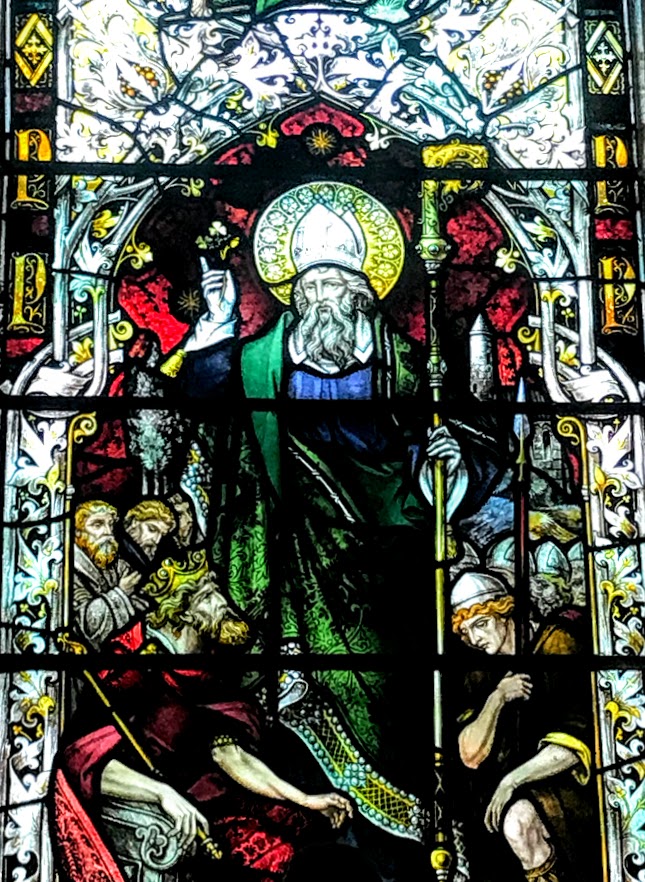
The Good Shepherd … a stained glass window in Saint Mark’s Church, Armagh (Photograph: Patrick Comerford)

John 10: 11-18 (NRSVA):

[Jesus said:] 11 ‘I am the good shepherd. The good shepherd lays down his life for the sheep. 12 The hired hand, who is not the shepherd and does not own the sheep, sees the wolf coming and leaves the sheep and runs away – and the wolf snatches them and scatters them. 13 The hired hand runs away because a hired hand does not care for the sheep. 14 I am the good shepherd. I know my own and my own know me, 15 just as the Father knows me and I know the Father. And I lay down my life for the sheep. 16 I have other sheep that do not belong to this fold. I must bring them also, and they will listen to my voice. So there will be one flock, one shepherd. 17 For this reason the Father loves me, because I lay down my life in order to take it up again. 18 No one takes it from me, but I lay it down of my own accord. I have power to lay it down, and I have power to take it up again. I have received this command from my Father.’

Ἐγώ εἰμι ὁ ποιμὴν ὁ καλός

Today’s Reflections:

This morning’s Gospel reading continues the Good Shepherd passage we were reading yesterday (John 10: 1-10).

In Saint John’s Gospel, there are seven I AM sayings in which Christ says who he is. The Dominican author and theologian, Cardinal Timothy Radcliffe, points out that that in the Bible, seven is the number of perfection. We know of the six days of creation and how God rested on the seventh. In Saint John’s Gospel, we have seven signs and seven “I AM” sayings disclosing for us who Christ truly is.

The seven signs in Saint John’s Gospel are:

• Turning water into wine in Cana (John 2: 1-11);
• Healing with a word (John 4: 46-51);
• Healing a crippled man at Bethesda (John 5: 1-9);
• The feeding of 5,000 (John 6: 1-14);
• Walking on water (John 6: 16-21);
• The healing of the man born blind (John 9: 1-7);
• The Raising of Lazarus from the dead (John 11: 1-46).

The seven ‘I AM’ sayings In Saint John’s Gospel, disclosing for us who Christ truly is, are:

• I am the Bread of Life (John 6: 35, 41, 48-51);
• I am the Light of the World (John 8: 12, 9: 5);
• I am the Door of the Sheepfold (John 10: 7, 9);
• I am the Good Shepherd (John 10: 11, 14);
• I am the Resurrection and the Life (John 11: 25);
• I am the Way, the Truth and the Life (John 14: 6);
• I am the True Vine (John 15:1, 5).

In the book of Revelation, we have the seven churches and the seven seals. And I could go on.

Today’s Gospel reading presents us with the best-known and best-loved ‘I AM’ sayings, which is repeated twice in this passage: ‘I am the Good Shepherd’ (John 10: 11, 14).

This is such a popular image – one that has been with many of us since our Sunday School and childhood days. I think, perhaps, that the image of the Good Shepherd is one of the most popular images to fill stained-glass windows in our church buildings, surpassed in popularity only by windows showing the Crucifixion or the Last Supper.

But sometimes I have problems with our cosy, comfortable image of the Good Shepherd. Christ is so often portrayed in clean, spick-and-span, neatly tailored, nicely dry-cleaned, red and white robes, complete with a golden clasp to hold all those robes together.

And the lost sheep is a huggable, lovable, white fluffy Little Lamb, a little pet, no different from the Little Lamb that Mary had in the nursery rhyme and that followed her to school.

But shepherds and sheep, in real life, are not like that.

I remember once, on Achill Island, hearing about a shepherd who went down a rock-face looking for a lost sheep, and who lost his life. Local people were shocked – lambs don’t fetch a price in the mart that makes them worth losing your life for.

The sheep survived. But as you can imagine, in the process of being lost, it had been torn by brambles, had lost a lot of its wool, was bleeding and messy. Any shepherd going down after a lost sheep will get torn by brambles too, covered in sheep droppings, slip on the rocks, risk his life. And all for what?

And yet Christ says he is the Good Shepherd who seeks out the lost sheep, in the face of great risks from wolves and from the terrain, and against all common wisdom, as the hired hands would know.

Christ, against all the prevailing wisdom, identifies with those who are lost, those who are socially on the margins, who are smelly and dirty, injured and broken, regarded by everyone else as worthless, as simply not worth the bother.

God sees us – all of us – in our human condition, with all our collective and individual faults and failings, and in Christ totally identifies with us.

Christ has already told those who are listening: ‘I am the gate. Whoever enters by me will be saved … and find pasture … the thief comes only to steal and kill and destroy. I came that they may have [spiritual] life, and have it abundantly’ (verse 9-10). Now when he speaks of himself as the good shepherd, the image is one that is familiar to those who hear him. True followers, he tells them, recognise the good shepherd.

Perhaps they are prompted to recall that David too had been a good shepherd (I Samuel 17: 34-35), but this was when he lived on the margins, and before he became king. Would they recall the many Old Testament promises that God would come to shepherd his people (Isaiah 40: 11; Jeremiah 23: 1-6; Ezekiel 34: 11)?

When Moses, Aaron and Miriam led the ex-slaves out of Egypt and into freedom, the people learned as they went to appreciate the value of a nomadic life.

They learned, first, that everything is a gift from God, symbolised by the manna, the first Bread of Life. And they learned, too, that worship need not be centred in one place. They came to value Tent over Temple and sheep over settled land. To be a shepherd was a noble occupation – a continuing theme in Jewish history.

Entering the Promised Land, these nomads found themselves surrounded by nations whose powerful elites ruled by subjugating the poor and weak. Yet this new community understood themselves to be completely differently. They were equal partners with each other. And they were equal partners because – as they learned in their wilderness – they were partners with God, the true owner of the land, with God who, as with the manna in the wilderness, called them to share in common all they had.

They had come to value equality and mutual respect. From the beginning, these ex-slaves understood themselves as one people, who lived in an equal partnership with each other and with God by holding fast to the values of the Exodus, when they shared the manna in the wilderness.

But by the time of Christ, however, all this had changed. With the development of a royal aristocracy and the adoption of Temple worship under King Solomon, nomadic values faded and social divisions appeared.

Social strife and class warfare appeared, and any understanding of the land as an equally shared resource belonging to God disappeared.

The kingdom then split into two nations, Israel and Judah, and Judaism split into rival branches. Some were centred on the Temple in Jerusalem, while Samaritan Judaism had its own rival temple on Mount Gerizim. Two kingdoms, two Temples, fear and hatred, injustice and inequality, were in sharp contrast to Christ’s message of radical inclusion, symbolised in Saint Luke’s image of the Good Samaritan and Saint John’s image of the Good Shepherd.

In Christ’s time, shepherds are the dispossessed, the lowest rung of society. They no longer own their own land. And when they longer owned their own sheep they often ended up as the hired hands of the wealthy urban dwellers, the absentee landlords who feature in so many of the Gospel parables.

These hired shepherd-servants depend for their livelihood on work that requires them to be out in the fields and away from their mothers, wives, sisters, and daughters, the family members any honourable man would have stayed home to protect. As a result, shepherds were considered to be men without honour. At best, they were unreliable; at worst they were borderline bandits. Shepherds are despised as much as Samaritans. In this context, a good shepherd, like a good Samaritan, is a contradiction in terms.

As with Saint Luke’s story of the Good Samaritan, Christ uses the image of the Good Shepherd, a despised external ‘other,’ to challenge our preconceptions about others. The invitation is to think about what is really important in human relationships. And Christ’s answer is always the same: compassion, individual moral character, and generous, inclusive action. We are not to condemn by assigning human beings to hated categories.

Christ constantly challenges his followers to live out the Gospel on the margins as he consistently placed himself among those who society had rejected: tax collectors, sinners, Samaritans, shepherds …

He says that he is the ‘good’, the real or proper ‘shepherd’, the one who dies for his ‘sheep’, his flock (verse 11).

But the ‘hired hand’ (verse 12) does not care enough to save the sheep from the ‘wolf’. Old Testament prophets spoke of leaders of Israel in these terms, so Jesus probably speaks of them here – shepherds who are not worthy of the name.

Christ’s relationship to people is like the Father’s relationship with him (verse 15).

Who are the ‘other sheep’ in verse 16? Are they the Samaritans? Are they non-Jews, the gentiles, the nations? They will have equal status with those who already follow Christ, as part of one Church.

Christ has been given the authority to choose to die and the power to rise again from the dead (verse 18). He is in control of his own death and resurrection. A truly Easter theme in the week of the Fourth Sunday of Easter.

Christ the Good Shepherd … a window in Christ Church, Leamonsley, Lichfield (Photograph: Patrick Comerford)

Today’s Prayers (Monday 27 April 2026):

‘Prayer and Action in Pakistan’ provides the theme this week (26 April to 2 May 2026) in ‘Pray With the World Church’, the Prayer Diary of the Anglican mission agency USPG (United Society Partners in the Gospel), pp 50-51. This theme was introduced yesterday with Reflections from the Revd Davidson Solanki, Senior Regional Manager for Asia and the Middle East.

The USPG Prayer Diary today (Monday 27 April 2026) invites us to pray:

Lord, we lift up Pakistan and all who continue to recover from recent floods. Bless the frailest and most vulnerable, and may your presence bring comfort and renewed hope to those rebuilding their lives.

The Collect:

Almighty God,
whose Son Jesus Christ is the resurrection and the life:
raise us, who trust in him,
from the death of sin to the life of righteousness,
that we may seek those things which are above,
where he reigns with you
in the unity of the Holy Spirit,
one God, now and for ever.

The Post-Communion Prayer:

Merciful Father,
you gave your Son Jesus Christ to be the good shepherd,
and in his love for us to lay down his life and rise again:
keep us always under his protection,
and give us grace to follow in his steps;
through Jesus Christ our Lord.

Additional Collect:

Risen Christ,
faithful shepherd of your Father’s sheep:
teach us to hear your voice
and to follow your command,
that all your people may be gathered into one flock,
to the glory of God the Father.

Yesterday’s Reflections

Continued Tomorrow

Christina Rossetti, by her brother Dante Gabriel Rossetti … she is remembered in the Church of England on 27 April 2026

Scripture quotations are from the New Revised Standard Version Bible: Anglicised Edition copyright © 1989, 1995 National Council of the Churches of Christ in the United States of America. Used by permission. All rights reserved worldwide. http://nrsvbibles.org

16 September 2023

Friars Entry and
Gloucester Green are
reminders of monastic
life in mediaeval Oxford

Friars’ Entry … the only direct route from Gloucester Green into the centre of Oxford until Beaumont Street was laid out in 1822 (Photograph: Patrick Comerford, 2023)

Patrick Comerford

As I make my way regularly from Gloucester Green bus station along Friars’ Entry to the centre of Oxford, the name of Friars’ Entry and the area around Gloucester Green and Gloucester Street remind me each time of the mediaeval Carmelite Friary in Oxford and of mediaeval Gloucester College, founded by the Benedictine monks of Gloucester Abbey.

The first building of significance in this part of Oxford was Beaumont Palace, at the end of Beaumont Street. It was built as a royal residence ca 1130 for Henry I to use as a stopping point on his visits to the royal hunting-grounds at Woodstock.

Beaumont Palace was the birthplace of two kings: Richard the Lion-Heart and King John. The palace was a royal residence until 1275, but nothing remains of the building, although some of its stones are said to have been used to build Saint John’s College.

People were living near Beaumont Palace in the 12th and 13th centuries, and George Street was first recorded as Irishman’s Street in 1251. But it was abandoned after the Black Death killed about a quarter of Oxford’s population in 1348, and fell into a derelict state.

Nicholas de Meules or de Molis, formerly custodian of Oxford Castle, granted the Carmelite friars a place near the hospital in Stockwell Street, in the parish of Saint George, in 1256. The provincial prior sent a friar John of Rochester to take possession of the site and make arrangements for the new friary. Nicholas de Stockwell, sometime mayor of Oxford, gave the Carmelites an adjacent plot towards the highway.

The Bishop of Lincoln and the Abbot of Osney permitted the Carmelites to build an oratory. In return, the friars agreed not to admit the parishioners of the abbey and to any sacraments without his consent. However, the Carmelites did not refrain from hearing confessions, and paid no attention to Archbishop Peckham when he prohibited them from doing this in 1280.

The Carmelites continued to expand their property holdings in the area, and built their church and houses with gifts of oaks from Henry III and Edward I.

At the junction of Gloucester Green, Gloucester Street and Friars Entry, looking towards Beaumont Street (Photograph: Patrick Comerford, 2023)

The Benedictine monks of Saint Peter’s Abbey, Gloucester (now Gloucester Cathedral), founded Gloucester College in Oxford in 1283 on land claimed by the Carmelites. That year, the Carmelite friary was attacked, its doors were broken down and the friars, beaten were wounded and ill-treated crimes. The two events may have been connected.

The Chapter of the Carmelite Province in England met in Oxford in 1264 and 1289. Although the early history of the Carmelite school in Oxford is obscure, Peter de Swaynton is said to have been the first Carmelite to receive the doctor’s degree at Oxford, and perhaps John Chelmeston, William of Littlington and William de Paul or Pagham studied there too before the end of the 13th century.

A meeting of the general chapter of the order in London in 1312 passed many statutes referring to the stadium at Oxford. At the king’s request, the canons of Osney, as patrons of the Church of Saint Mary Magdalen, gave the Carmelites permission to celebrate divine service and the right of free burial in 1312.

When Edward II was put to flight at the Battle of Bannockburn in 1314, he invoked the Virgin Mary and vowed to found a monastery for the poor Carmelites if he escaped in safety. In fulfilment of his vow, he granted Beaumont Palace to the Carmelites of Oxford. The gift was confirmed by Pope John XXII and by Parliament in 1318. The king also gave a further grant a land at Stockwell Street.

Edward III confirmed the friars in their possession of the royal palace in 1327. However, the neighbourhood was not suitable for a religious house. The mayor and bailiffs of Oxford and other officials were commanded in 1328 to remove harlots and other women of bad character from the neighbourhood of the house of the Carmelite Friars, and to prevent houses being let to such women. It was said the friars were hindered in performing divine service by the clamour, night and day, caused by the men visiting the prostitutes and brothels.

The students of Robert of Walsingham, master of the Whitefriars, included John Baconthorpe, ‘the resolute doctor’ and ‘prince of the Averroists,’ who became the doctor of the Carmelite order as Thomas Aquinas was the doctor of the Dominicans and Duns Scotus of the Franciscans.

Baconthorpe studied in Paris and returned to Oxford, where he influenced Richard FitzRalph (1300-1360) of Dundalk, later Vice-Chancellor of Oxford (1333-1336), Dean of Lichfield (1335-1346) and Archbishop of Armagh (1346-1360). Baconthorpe was the Carmelite provincial prior in 1329-1333, and died in 1346.

The name of Friars’ Entry keeps alive the memory of the presence of the Carmelites in mediaeval Oxford (Photograph: Patrick Comerford, 2023)

It was decreed in 1336 that no friar of the English province should be sent to Oxford or Cambridge unless six brethren, some of whom must be priors, testified from personal knowledge to his good character. In the late 14th century the province was divided into four ‘distinctions’ or sections, based at London, York, Norwich, and Oxford. To avoid local rivalries, it was arranged a friar should be chosen from each of these sections in turn to proceed to the degrees of bachelor and master in theology.

John de Norton, a Carmelite, was summoned before the chancellor’s court in 1360 for breaches of the peace, and when he refused to appear he was punished. With the support of his order, he appealed to the Pope. Edward III then came to the help of the university and ordered the provincial prior to stop all appeals against the chancellor’s jurisdiction.

The mendicant friars were accused of stirring up the Peasant Revolt in 1381, and the prior of the Oxford Carmelites joined with the heads of the other mendicant convents in Oxford in an appeal for protection to John of Gaunt.

The Carmelites in Oxford had a prominent part in opposing John Wycliffe and his followers. Peter Stokes was commissioned to publish the condemnation of Wycliffe’s doctrine at Oxford in 1382. Stephen Patrington, who became provincial prior in 1399, was a commissary at Oxford against the Lollards in 1414. Thomas Netter of Walden, who was engaged in controversies with the Lollards, was confessor to both Henry V and Henry VI, and succeeded as provincial prior in 1417.

Walter Hunt is said to have been one of the chief exponents of the Latin view in the negotiations with the Greek Church at the Council of Florence in 1439. He returned to Oxford and there he spent the remaining 40 years of his life.

Henry VI would stay in the Carmelite house at Oxford ‘as in his own palace.’ The future Cardinal Reginald Pole, a member of the royal family, lodged at the White Friars when he was a student at Oxford.

On the eve of the dissolution of the monastic houses, however, the moral, intellectual and material condition of the White Friars came under public scrutiny. A Carmelite friar was jailed for ‘incontinence’ in 1502. A girl of 13 disguised as a boy was found at the White Friars in 1533 ‘in the cubicle of one Browne scholar,’ perhaps a secular student having rooms in the friary. The long-standing hostility between the White Friars and the Benedictine monks of Gloucester College broke out 1534-1535, and both were bound over to keep the peace.

The 24 Carmelite friars whose names are in the university register from 1505 to 1538 include three who were DDs of Cambridge and who requested incorporation at Oxford. The friar who last who proceeded to a degree was John Hurlyston, BD, of Cologne, who applied for the degree of DD in 1534. After that, no Carmelite appears in the university register.

When John London visited the Oxford friaries in 1538, he reported that the Carmelite and Augustinian friars were living in such poverty that ‘if they do not forsake their houses, their houses will forsake them.’

The White Friars’ house was in ruins, they were selling off property and sources of income, the elms that grew about their house, almost all the jewels and plate, and copes and vestments. They petitioned Thomas Cromwell for permission to change their habits and to surrender their house ‘in consideration of their poverty, which compels them to sell their jewels, plate, and wood; and will, if they continue, compel them to sell the stones and slates of their house.’ The plate sent to London included three chalices, a silver ship, two silver cruets, a silver-gilt pax, and a silver-gilt censer. There was little or no lead.

Worcester College was built on the site of Gloucester College and Gloucester Hall (Photograph: Patrick Comerford, 2023)

Edmund Powell of Sandford, Oxfordshire, was granted the site of the White Friars in 1541. It included the house itself, tenements and gardens, a stable, a timber yard, 3½ acres of land called Gloucester College Close, and a passageway called the Entry that led from Saint Mary Magdalen Church to the friary.

The greater part of the buildings was pulled down by Powell and his children, and much of the stone was carried to Saint Frideswide’s in 1546. The refectory remained standing until 1596, and was used as a poor-house for the parish of Saint Mary Magdalen. It was then demolished and the materials were used to enlarge the library of Saint John’s College.

As for Gloucester College, the Benedictine house in Oxford, after the dissolution it became Gloucester Hall, an academic hall and annexe of St John’s College. It was re-founded as Worcester College by Sir Thomas Cookes in 1714. Gloucester Green, which was opposite the old college, and the Gloucester House building within Worcester College preserve the name of Gloucester College.

Because Friars’ Entry was once the most direct route to Worcester College, it contributed to the idea that the college was ‘out of Oxford.’ Until modern times, the footway was lined with houses, and solemn processions ran the risk of ‘stumbling over buckets, knocking over children, catching the rinsings of basins, and ducking under linen-lines.’

the White Rabbit on the corner of Friars’ Entry and Gloucester Street … a reminder of the White Rabbit in the stories of Alice and of the White Friars (Photograph: Patrick Comerford, 2023)

The name of Friars’ Entry has survived through the centuries and keeps alive the memory of the presence of the Carmelites in mediaeval Oxford. Perhaps the name of the White Rabbit on the corner of Friars’ Entry and Gloucester Street is a play not only on the White Rabbit in Lewis Carroll’s stories of Alice but also on the name of the White Friars.

Gloucester Green was laid out as a bowling green in 1631, and later became a public square. A plaque on a modern building facing onto Gloucester Green is ‘to the memory of Private Biggs and Private Piggen, executed like their Leveller colleagues at Burford by forces loyal to Cromwell. They were shot near this place for their part in the second mutiny of the Oxford garrison on 18th September 1649.’

Gloucester Green became the site of the City Gaol in 1786. Although Friars’ Entry was still a mere footway, it remained the only direct route from Gloucester Green into the city centre until Beaumont Street was laid out in 1822. Beaumont Street provided a grander approach to Worcester College and a new site for the Ashmolean Museum, the oldest public museum in Britain, which was founded in Broad Street in 1683.

Gloucester Green was the location for Oxford’s cattle market from 1835 until 1932 before the area was converted into a bus station. More recently, there were proposals to build a multi-storey car park there. But, with public support, the council chose instead to create today’s exuberant market place, opened in 1990. I have enjoyed the food market there on Wednesdays and the antiques market on Thursdays.

Gloucester Green now has colourful food and antiques markets (Photograph: Patrick Comerford, 2023)

25 May 2023

Morning prayers in Easter
with USPG: (47) 25 May 2023

The Ascension depicted in the East Window in Saint Patrick’s Cathedral (Church of Ireland), Armagh (Photograph: Patrick Comerford)

Patrick Comerford

Eastertide and Ascensiontide continue throughout this week, until the Day of Pentecost next Sunday (28 May 2023).

Today, the calendar of the Church of England in Common Worship remembers the Venerable Bede (735), Monk at Jarrow, Scholar, Historian, and Aldhelm (709), Bishop of Sherborne. Before this day gets busy, I am taking some time this morning for prayer and reflection.

I am reflecting each morning during Ascensiontide in these ways:

1, Looking at a depiction of the Ascension in images or stained glass windows in a church or cathedral I know;

2, the Gospel reading of the day in the Church of England lectionary;

3, a prayer from the USPG prayer diary.

The East window in Saint Patrick’s Cathedral, Armagh, was designed by Sir Thomas Drew and executed by Heaton, Butler and Bayne (Photograph: Patrick Comerford)

The East Window, Saint Patrick’s Cathedral, Armagh:

Saint Patrick’s Cathedral, Armagh, is the seat of the Church of Ireland Archbishop of Armagh and the Diocese of Armagh. The origins of the site are said to date back to the fifth century and the foundation of a monastery by Saint Patrick.

When Brian Boru, High King of Ireland, visited Armagh in 1004, he acknowledging it as the head cathedral of Ireland. He was buried at Armagh cathedral after his death at the Battle of Clontarf in 1014. However, Armagh’s claim to the primacy of Ireland was not formally acknowledged until the Synod of Ráth Breasail in 1111.

Throughout the Middle Ages, the cathedral was one of the most important churches in Ireland, although the archbishops of Armagh sometimes lived, at various time in Dundalk, Drogheda or Termonfeckin in Co Louth.

The East window in Saint Patrick’s Cathedral depicts the Ascension. It was designed by Sir Thomas Drew and executed by Heaton, Butler and Bayne in 1903. It replaced a Warrington window of 1849.

Four of the lower panels with the exception of the centre panel quote Psalm 68: 18 from left to right: ‘Thou art gone up on high’, ‘Thou hast led captivity captive’, ‘and received gifts for men’, ‘yea: even for thine enemies’ – probably a reference to Archbishop Marcus Gervais Beresford’s role in negotiations during the disestablishment of the Church of Ireland.

The centre panel in the lower row depicts Saint Patrick with the coat of arms of the Archbishops of Armagh and a reference to the year 445 when Saint Patrick supposedly built the first church at Armagh.

The window has five lancets, measuring 5580 mm tall, the four side panels 820 mm wide, and the centre panels 920 mm, and 16 tracery-lights.

The window is in memory of Archbishop John George Beresford, Archbishop Marcus Gervais Beresford and Alexander James Beresford-Hope.

Lord John George de la Poer Beresford (1773-1862), a younger son of the 1st Marquess of Waterford, was Archbishop of Armagh for 40 years (1822-1862).

The window also commemorates his immediate successor as archbishop and first cousin once removed, Marcus Gervais Beresford (1801-1885), who was Archbishop of Armagh (1862-1885) at the time of the disestablishment of the Church of Ireland.

Their kinsman, Sir Alexander James Beresford Beresford Hope (1820-1887), was, along with John Mason Neale and Benjamin Webb, a founder of the Cambridge Camden Society, later the Ecclesiological Society. He also supervised the commissioning and construction of All Saints’ Church, Margaret Street, London, to the designs of William Butterfield on behalf of the Ecclesiological Society.

The East Window and the chancel in Saint Patrick’s Cathedral, Armagh (Photograph: Patrick Comerford)

Matthew 9: 35-10: 20 (NRSVA):

35 Then Jesus went about all the cities and villages, teaching in their synagogues, and proclaiming the good news of the kingdom, and curing every disease and every sickness. 36 When he saw the crowds, he had compassion for them, because they were harassed and helpless, like sheep without a shepherd. 37 Then he said to his disciples, ‘The harvest is plentiful, but the labourers are few; 38 therefore ask the Lord of the harvest to send out labourers into his harvest.’

10 Then Jesus summoned his twelve disciples and gave them authority over unclean spirits, to cast them out, and to cure every disease and every sickness. 2 These are the names of the twelve apostles: first, Simon, also known as Peter, and his brother Andrew; James son of Zebedee, and his brother John; 3 Philip and Bartholomew; Thomas and Matthew the tax-collector; James son of Alphaeus, and Thaddaeus; 4 Simon the Cananaean, and Judas Iscariot, the one who betrayed him.

5 These twelve Jesus sent out with the following instructions: ‘Go nowhere among the Gentiles, and enter no town of the Samaritans, 6 but go rather to the lost sheep of the house of Israel. 7 As you go, proclaim the good news, “The kingdom of heaven has come near.” 8 Cure the sick, raise the dead, cleanse the lepers, cast out demons. You received without payment; give without payment. 9 Take no gold, or silver, or copper in your belts, 10 no bag for your journey, or two tunics, or sandals, or a staff; for labourers deserve their food. 11 Whatever town or village you enter, find out who in it is worthy, and stay there until you leave. 12 As you enter the house, greet it. 13 If the house is worthy, let your peace come upon it; but if it is not worthy, let your peace return to you. 14 If anyone will not welcome you or listen to your words, shake off the dust from your feet as you leave that house or town. 15 Truly I tell you, it will be more tolerable for the land of Sodom and Gomorrah on the day of judgement than for that town.

16 ‘See, I am sending you out like sheep into the midst of wolves; so be wise as serpents and innocent as doves. 17 Beware of them, for they will hand you over to councils and flog you in their synagogues; 18 and you will be dragged before governors and kings because of me, as a testimony to them and the Gentiles. 19 When they hand you over, do not worry about how you are to speak or what you are to say; for what you are to say will be given to you at that time; 20 for it is not you who speak, but the Spirit of your Father speaking through you.’

The window is in memory of Archbishop John George Beresford, Archbishop Marcus Gervais Beresford and Alexander Beresford-Hope (Photograph: Patrick Comerford)

Today’s prayer:

The theme in the prayer diary of the Anglican mission agency USPG (United Society Partners in the Gospel) this week is ‘Accountability and Care.’ USPG’s Research and Learning Advisor, Jo Sadgrove, introduced this theme on Sunday, when she reflected on accountability on the anniversary of George Floyd’s death today (25 May 2023).

The USPG Prayer invites us to pray this morning (Thursday 25 May 2023):

Let us pray for the Black Lives Matter movement. May we work towards a world free from prejudice and may all who seek racial justice be upheld by the power of solidarity.

Collect:

God our maker,
whose Son Jesus Christ gave to your servant Bede
grace to drink in with joy the word
that leads us to know you and to love you:
in your goodness
grant that we also may come at length to you,
the source of all wisdom,
and stand before your face;
through Jesus Christ your Son our Lord,
who is alive and reigns with you,
in the unity of the Holy Spirit,
one God, now and for ever.

Post Communion:

Merciful God,
who gave such grace to your servant Bede
that he served you with singleness of heart
and loved you above all things:
help us, whose communion with you
has been renewed in this sacrament,
to forsake all that holds us back from following Christ
and to grow into his likeness from glory to glory;
through Jesus Christ our Lord.

Saint Patrick’s Cathedral, Armagh, is the seat of the Church of Ireland Archbishop of Armagh and the Diocese of Armagh (Photograph: Patrick Comerford)

Yesterday’s reflection

Continued tomorrow

Scripture quotations are from the New Revised Standard Version Bible: Anglicised Edition copyright © 1989, 1995, National Council of the Churches of Christ in the United States of America. Used by permission. All rights reserved worldwide. http://nrsvbibles.org

16 March 2023

A ‘virtual tour’ of a dozen
churches and cathedrals to
celebrate Saint Patrick’s Day

Saint Patrick depicted in a window in Saint Patrick’s Church, Waterford (Photograph: Patrick Comerford)

Patrick Comerford

Tomorrow is Saint Patrick’s Day [17 March], and I am allowing my mind’s eye to travel back to Ireland this evening for a ‘virtual tour’ and to revisit a dozen cathedrals and churches dedicated to Saint Patrick.

1, Saint Patrick’s Cathedral, Dublin:

Saint Patrick’s Cathedral, Dublin, is the largest cathedral in Ireland (Photograph: Patrick Comerford)

Saint Patrick’s Cathedral, Dublin, is the largest cathedral and one of the most important pilgrimage sites in Ireland. Saint Patrick’s has been at the heart of Dublin’s history and culture for over 800 years, and the cathedral claims that its ‘story is a microcosm of the story of Ireland.’

The cathedral was founded in 1191 and is the national cathedral of the Church of Ireland, while Christ Church Cathedral is the diocesan cathedral for Dublin and Glendalough.

The chapter members of Saint Patrick’s represent from each of the dioceses in the Church of Ireland. The dean is the ordinary of the cathedral, and the most famous dean was Jonathan Swift.

Inside Saint Patrick’s Cathedral, Dublin (Photograph: Patrick Comerford)

The cathedral hosts a number of public national ceremonies and services, and the funerals of two Presidents, Douglas Hyde and Erskine Childers, were held there in 1949 and 1974. The Service of Nine Lessons and Carols takes place twice in December.

The present Dean of Saint Patrick’s is the Very Revd William Morton.

2, Saint Patrick’s Cathedral (Church of Ireland), Armagh:

Saint Patrick’s Cathedral, Armagh, stands on the hill that gives Armagh its name (Photograph: Patrick Comerford)

Saint Patrick’s Church of Ireland Cathedral in Armagh stands on the hill that gives Armagh its name – Ard Mhacha, the ‘Hill of Macha’. On the neighbouring hill stands Saint Patrick’s Roman Catholic Cathedral.

Macha was a legendary pre-Christian tribal princess associated with nearby Eamhain Mhacha, or Navan Fort, a major ritual site occupied from the late Neolithic and early Bronze Age, and thought to have been the centre of Iron Age Ulster. Eamhain Mhacha is associated with the epic Ulster cycle, the Táin Bó Cúailnge (‘The Cattle Raid of Cooley’) and its doomed hero, Cú Chulainn, the ‘Hound of Ulster.’

Saint Patrick is said to have acquired this hilltop enclosure and in the year 445 he built his first ‘Great Stone Church,’ the Church of the Relics, on the Druim Saileach (Sallow Ridge) Hill, a site close to Scotch Street, below the Hill of Armagh.

The monastic community that developed around Saint Patrick’s Church produced the Book of Armagh, a ninth century Irish manuscript now in the Library in Trinity College Dublin, and containing some of the earliest surviving examples of Old Irish.

The Vikings raised the monastery in Armagh on at least two occasions in the ninth century – in 839 and in 869. The church was also damaged in a lightning strike in 995. Brian Boru, who defeated the Vikings at the Battle of Clontarf on Good Friday 1014 – only to be executed as he prayed in his tent that evening – is said to be buried beside the north wall of the cathedral.

However, the church remained in ruins until 1125 when it was repaired and re-roofed by Bishop Cellach or Celsus. After his death, the see remained vacant for five years until he was succeeded by Saint Malachy in 1134. The most far-reaching work of restoration was carried out by Archbishop Patrick O’Scanlon (1261-1270). Further damage required major rebuilding by Archbishop Milo Sweetman in the 1360s and by Archbishop John Swayne in the 1420s.

In the 1560s, the Earl of Sussex fortified the cathedral against Shane O’Neill, but in 1566 O’Neill ‘utterly destroyed the cathedral by fire, lest the English should again lodge in it.’ A century later, in 1641, Sir Phelim O’Neill burned down the cathedral.

Archbishop James Margetson carried out repair work in the 1660s, and further restorations were undertaken in 1727, 1765, 1802, 1834, 1888, 1903, 1950, 1970, and most recently in 2004 under Dean Herbert Cassidy.

Inside Saint Patrick’s Cathedral, Armagh (Photograph: Patrick Comerford)

The extensive restoration carried out between 1834 and 1837 was commissioned and largely paid for by Archbishop John George Beresford. The architect Lewis Nockalls Cottingham (1787-1847) addressed the structural vulnerability of the cathedral by restoring the nave walls to the perpendicular and removing the short wooden spire that can be seen on the cathedral seal. He also reopened the clerestory windows that had been blocked by Archbishop Margetson and restyled them in decorated Gothic, enlarged the choir windows and overlaid the timber vaulting with plasterwork.

The stone screen separating the nave from the choir shows how Cottingham was influenced by the ideas of AWN Pugin and the early Gothic Revival. These influences can be seen too in his restoration of the High Altar from the west end, where it had been relegated by Archbishop William Stewart at the beginning of the 19th century, to its proper eastward position in the form of a stone altar backed by a reredos of canopied niches.

According to William Makepeace Thackeray, Cottingham’s cathedral was ‘too complete … not the least venerable. It is as neat and trim as a lady’s drawing-room.’

Although the rood screen was removed in 1888, much of Cottingham’s work remains, although the basic shape of the cathedral is still as it was conceived by Archbishop O’Scanlon in the 13th century.

3, Saint Patrick’s Cathedral (Roman Catholic), Armagh:

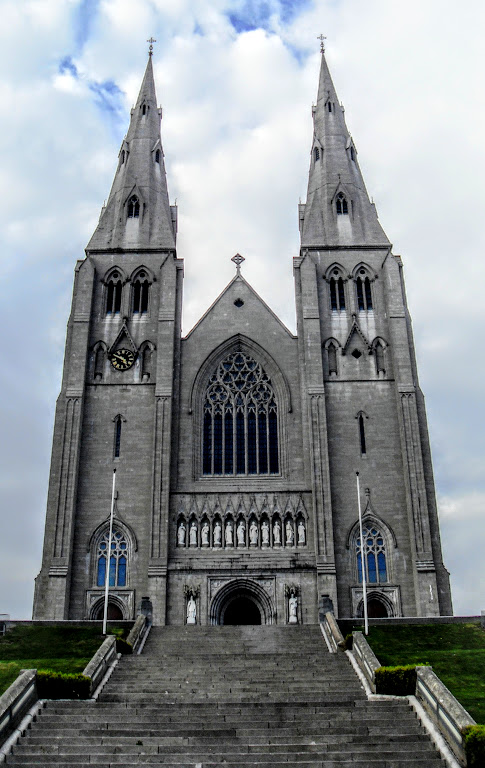
Saint Patrick’s Cathedral, Armagh, has a spectacular mixing of styles by two clashing architects (Photograph: Patrick Comerford)

Saint Patrick’s Roman Catholic Cathedral in Armagh which is an important architectural essay in Gothic Revival, and a spectacular mixing of styles by two clashing architects, with ‘fourteenth-century’ works standing on top of ‘sixteenth-century’ works.

The cathedral is fascinating – for while it was being built the architects changed, and the change of architects resulted in a decision to change the architectural style, just as the walls were half-way up.

The bottom half of Saint Patrick’s Cathedral was designed in 1838 in the English Perpendicular Gothic style by Thomas Duff of Newry, who also designed Saint Patrick’s Cathedral, Dundalk, and Saint Colman’s Cathedral, Newry.

Archbishop William Crolly (1835-1839) acquired the site from Richard Dawson (1817-1897), 1st Earl of Dartrey, a Liberal Unionist whose family gave their name to Dawson Street in Dublin.

In Dundalk, Duff had modelled his cathedral on the Chapel of King’s College, Cambridge. In Armagh, he drew on York Minster for his plans for Saint Patrick’s, which he wanted to build in the Perpendicular Gothic style.

The foundation stone was laid and blessed on Saint Patrick’s Day, 17 March 1840. But by the time work had begun on Duff’s cathedral, an architectural renaissance had taken place under the influence of Pugin. In 1853 a new building committee appointed JJ McCarthy as architect and he drew up was a continuation design in the 14th century, French Decorated Gothic style.

McCarthy began working in 1854, and Archbishop Joseph Dixon (1852-1866) declared Easter Monday 1854 ‘Resumption Monday.’

The architectural historian Jeanne Sheehy points out that McCarthy ‘completely changed the appearance of Duff’s design by getting rid of the pinnacles on the buttresses, the battlemented parapets on the nave and aisles, and by making the pitch of the roof steeper.’ However, Maurice Craig concludes that ‘in most ways it is a very successful building.’

Archbishop Dixon organised a great bazaar in 1865 that raised over £7,000 for the building project, and items for sale were donated by Pope Pius IX, the Emperor of Austria and Napoleon III. The cathedral was completed under Archbishop Daniel McGettigan (1870-1887) and was dedicated on 24 August 1873. The sacristy, synod hall, grand entrance, gates and sacristan’s lodge were built later to designs by William Hague, who was working on designs for a great rood screen when he died in March 1899. The solemn consecration of the cathedral took place in 1904.

The interior of Saint Patrick’s Cathedral, Armagh, was originally decorated by Ashlin and Coleman (Photograph: Patrick Comerford)

The interior decoration of the cathedral is also the work of different teams. The 1904 designs were the work of Ashlin and Coleman of Dublin, who were the heirs to Pugin’s style of work, but a great deal of this work has been removed in the wake of the liturgical reforms introduced by the Second Vatican Council.

An exquisite example of artistic workmanship – a magnificent, marble Gothic altar with a replica of Leonardo Da Vinci’s Last Supper carved by the Roman sculptor, Cesare Aureli, was moved to Saint Patrick’s Church, Stonebridge.

What was a fine late Gothic revival chancel has been replaced in with chunks of granite, brass screens were removed and then welded together to form a screen in front of the reredos of McCarthy’s Lady Chapel, modern tiling was laid on the floor of the entire sanctuary area and a new tabernacle was placed in the Sacred Heart Chapel which had been designed by Ashlin and Coleman. Nevertheless, Saint Patrick’s retains much of the majesty – and eccentricity – of Duff’s and McCarthy’s designs.

4, Saint Patrick’s Cathedral, Trim, Co Meath:

Saint Patrick’s Cathedral, Loman Street, Trim, is the Church of Ireland cathedral for the Diocese of Meath (Photograph: Patrick Comerford)

Saint Patrick’s Cathedral on Loman Street, on the north side of Trim, is the Church of Ireland cathedral for the Diocese of Meath. It claims to be the oldest Anglican church in Ireland – although this claim is disputed by a church in Armagh that says it is 20 years older than the cathedral in Trim.

The tower is part of the remains of the mediaeval parish church of Trim, and further ruins of this earlier church lie behind the cathedral.

Although the Diocese of Meath was without a cathedral after the dissolution of the monasteries in the 16th century, the Bishops of Meath have been enthroned in Saint Patrick’s since 1536. However, Saint Patrick’s did not become a cathedral until Saint Patrick’s Day 1955, and the deans continue to called Dean of Clonmacnoise. The tower clock at Saint Patrick’s commemorates Dean Richard Butler, the historian of Trim, who is buried on the south side of the cathedral.

The Dean of Saint Patrick’s is the Very Revd Paul Bogle.

5, Saint Patrick’s Cathedral, Cavan:

The Cathedral of Saint Patrick and Saint Felim stands on a hill at the end of Farnham Street in Cavan (Photograph: Patrick Comerford)

The Roman Catholic Cathedral of Saint Patrick and Saint Felim is the tallest and most prominent building in Cavan Town and stands at the end of Farnham Street, across the street from the older Church of Ireland parish church, which was completed in 1815.

Cavan Cathedral is a relatively modern cathedral, designed by the architect Ralph Henry Byrne (1877-1946) and built in neo-classical style between 1938 and 1947. However, the story of Cavan Cathedral dates back to the mid-18th century, when a small thatched chapel, without seating, was built in the town, on a site donated by the Maxwell family of Farnham Estate.

The small chapel continued in use until 1823, when it was replaced by a new church built on the same site in Farnham Street. At the time, the seat of the Roman Catholic Diocese of Kilmore was in Cootehill. But 20 years later, in 1843, Bishop James Brown of Kilmore (1829-1865) moved the seat of the diocese of Kilmore from Cootehill to Cavan.

The church was renovated in 1862 and Bishop Browne raised it to the status of a cathedral, dedicated to Saint Patrick. A decision was made in 1919 to build a larger cathedral on the site behind the old cathedral. Building work began in 1938, but was interrupted by World War II. Although the cathedral was completed in 1942 it was not consecrated until 1947.

Cavan Cathedral was designed in the style of a Roman basilica by Ralph Byrne (Photograph: Patrick Comerford)

For a short time, the old Gothic cathedral and the new Classical cathedral stood side-by-side. Then old Saint Patrick’s Cathedral was taken down, stone-by-stone, and was rebuilt, without its transepts, in Ballyhaise. There it stood for only a short time, and was demolished around 1952, when its stones were used to build a new church in Castletara.

The new cathedral was designed by Byrne along the lines of a Roman basilica with a Corinthian portico. His choice of the classical style was a deliberate rejection of the Gothic style popularised in Ireland by AWN Pugin and JJ McCarthy in the previous century, and a return to a style that had long been forgotten. No Roman Catholic cathedral had been built in the classical style since Saint Mel’s Cathedral was built in Longford in 1840.

Cavan Cathedral is oriented West-East rather than East-West. It is built of Wicklow granite and some limestone, with Portland stone details. The West Front (at the east) was inspired by Francis Johnston’s design for Saint George’s Church (Church of Ireland) in Hardwicke Street, Dublin (1802-1813).

The cathedral is cruciform in shape, designed like a Roman basilica, with a narthex, aisled nave, clerestory and apse. The portico has four Corinthian columns, and the dome over the crossing is supported by four marble columns. The cathedral also has six stained-glass windows in the nave and one in the south transept that come from the studios of Harry Clarke (1889-1931 and that were added in 1994.

6, Saint Patrick’s Church (Roman Catholic), Donabate, Co Dublin:

Saint Patrick’s Church, Donabate … George Luke O’Connor was inspired by Pugin’s cathedral in Birmingham (Photograph: Patrick Comerford)

My grandparents, Stephen Comerford (1867-1921) of Rathmines and Bridget Lynders (1875-1948) of Portrane, were married in Saint Patrick’s Church, Donabate, on 7 February 1905. The witnesses at their wedding were her cousin Lawrence McMahon and her younger sister Mary Anne Lynders (1879-1956), who later married John Sheehan.

Saint Patrick’s Church, Donabate, was designed by the Dublin architect George Luke O’Connor, for the Very Revd W Magill, PP, and was consecrated by Archbishop Walsh of Dublin on 9 August 1903.

O’Connor designed many churches, schools and cinemas, and it always strikes me that his church in Donabate is strongly influenced by Pugin’s designs for Birmingham Cathedral.

Inside Saint Patrick’s Church, Donabate, Co Dublin (Photograph: Patrick Comerford)

This is a Gothic, gable-fronted cruciform church with an apse and tower. The family tradition is that much of the work in the church interior is my grandfather’s work. The high altar, erected in 1906, is the work of Patrick Tomlin & Sons of Grantham Place. The canted apse has a painted ceiling.

This red brick church is built in English garden wall bond. The features include decorative buttressing, limestone dressing and string courses, terracotta details in the eaves, pointed arched doors with limestone surrounds, the exposed timber truss, barrel vaulted ceiling, tongue and grooved timber doors with elaborate cast-iron hinges, cast-iron pillars, marble columns, encaustic tiles, the ornate rose west window, lancet windows and the Harry Clarke stained glass.

7, Saint Patrick’s Church (Church of Ireland), Donabate, Co Dublin:

The sundial above the porch of Saint Patrick’s Church, Donabate (Photograph: Patrick Comerford)

Saint Patrick’s Church, on The Square, Church Road, Donabate, is centuries-old and stands on an ecclesiastical site that is even more ancient. The first stone church was built there in the 13th century on a foundation that was even older. The only remnant of that first stone church is the square tower, which served as the monastic watch tower and belfry.

The present church was built in the late 17th century and extended in the 18th century. An unusual feature is the sundial above the church door. The church has ornate plasterwork ceilings, and fine brass and stone monuments. The newest part of the church is the East end, where the sanctuary is lit by a fine stained glass window.

The Cobbe family of nearby Newbridge House were the principal benefactors of the church. The Cobbe family used the tower attached to the north-east end of the church as their private crypt.

When the church was extended in the 18th century, the Cobbes had their own private pew built in the gallery at the west end and had the gallery's ceiling lavishly decorated in stucco plasterwork by the same Italian stuccodores who designed the elaborate ceilings of Newbridge House. The Cobbe gallery had its own fireplace and seating.

Inside Saint Patrick’s Church, Donabate (Photograph: Patrick Comerford)

The chancel was added in 1874, and the stained glass window behind the altar commemorates James Henry Edward Arcedeckne-Butler (1838-1871) – a grandson of the 23rd Lord Dunboyne – who lived at Portrane House and farmed the former Evans estate. His widow erected the Butler vault and was responsible for the East Window (1874) depicting the Raising of Lazarus.

The window and the new chancel were dedicated in 1874 by Archbishop Beresford of Armagh. The four ornamental angels in gilt gold on the chancel ceiling are said to have been found during ploughing on Lancelot Smith’s farm. The oak communion rails, which came from the Lady Chapel in Saint Patrick’s Cathedral, were a gift of the Cobbe family.

8, Saint Patrick’s Church (Church of Ireland), Dalkey, Co Dublin:

Saint Patrick’s Church, Dalkey, was designed by Jacob Owen (Photograph: Patrick Comerford)

Saint Patrick’s Church is the Church of Ireland parish church in the heritage town of Dalkey, in South County Dublin and dominates the granite outcrop above Bulloch Harbour.

The old church in Dalkey was in ruins by the 17th century, and Dalkey was part of Monkstown parish until the 19th century. With the increased travel opportunities and mobility offered by the railways and buses, large villas were built in Dalkey for summer accommodation, and new houses were built along the coast at Coliemore Road and part of the north end of Vico Road.

Saint Patrick’s Church, Dalkey, looks out across Bulloch Harbour (Photograph: Patrick Comerford)

The needs for a church in Dalkey led to formation of trustees to build a new church first known as Dalkey Episcopal Chapel of Ease, within the Parish of Monkstown. The site was offered free by the Ballast Board of Dublin Port, later Dublin Port Company.

The church was designed by the Welsh-born architect Jacob Owen (1778-1856) and was consecrated by Archbishop Richard Whately of Dublin on Sunday 5 March 1843.

The Revd Ruth Elmes became the Rector of Dalkey earlier this year.

9, Saint Patrick’s Church, Wicklow:

Saint Patrick’s Church, the Church of Ireland parish church overlooking the town and harbour in Wicklow (Photograph: Patrick Comerford)

Wicklow parish traces its origins back to the time of Saint Patrick, and both the Church of Ireland Roman Catholic parish churches in the town are named Saint Patrick’s. The arly name of the area was Kilmantan, or the Church of Mantan, who was a disciple of Saint Patrick. The old church was on the site of the Church of Ireland parish church on Church Hill.

Archdeacon Andrew O’Toole, Parish Priest in 1788-1799, built a Roman Catholic church in 1797, sited opposite the site of the present church. It was rebuilt in the 1950s as a parish hall, and it later became a youth centre.

Saint Patrick’s Roman Catholic parish church in Wicklow … built in 1840-1844 (Photograph: Patrick Comerford)

Archdeacon John Grant, Parish Priest in 1826-1863, set about building a new parish church overlooking the town and bay. The Fitzwilliam family presented the site for the new church to the parish, but the name of the architect and the builders have not survived.

The foundation stone was laid in 1840 and Archbishop Daniel Murray of Dublin celebrated the first Mass in Saint Patrick’s Church on Sunday 13 October 1844. The High Altar of Caen stone is in memory of Archdeacon Grant who is buried in the vault in front of the high altar.

The stained glass windows include a window in the west transept from the Harry Clarke studio depicting the Birth of Christ.

10, Saint Patrick’s Church, Ballysteen, Co Limerick:

Saint Patrick’s Church in Ballysteen, Co Limerick, was built in 1861 on land donated by the Earl of Dunraven (Photograph: Patrick Comerford)

Saint Patrick’s Church in Ballysteen, Co Limerick, was one of my neighbouring churches while I was priest-in-charge of the Rathkeale and Kilnaughtin Group of Parishes until last March. The church was built in 1861 on a site donated by Edwin Richard Wyndham-Quin (1812-1871), 3rd Earl of Dunraven, who lived at Adare Manor and who had become a Roman Catholic in 1855.

A few years earlier, in 1859, Lord Dunraven has subscribed £50 towards building a new school in Ballysteen, promising to match £1 for £1 every donation that had been raised by other subscribers.

Saint Patrick’s Church, Ballysteen, seen from the south-west (Photograph: Patrick Comerford)

When the church was built, it replaced an earlier, thatched Mass house, dating back to the 1790s. The date of the church is inscribed on the church bell, and the church was consecrated in 1862.

Since then, it has retained its modest form and size, and its long axis runs parallel with the main road through Ballysteen and the expansive green areas in front.

11, Saint Patrick’s Church, Waterford:

Inside Saint Patrick’s Church, Waterford … said to be the oldest post-Reformation Roman Catholic in Ireland (Photograph: Patrick Comerford)

Saint Patrick’s Church in Waterford is said to be the oldest post-Reformation Roman Catholic in Ireland. There are records of Mass being celebrated on the site of Saint Patrick’s Church as early as 1704, and the present building dates from 1750. People in Waterford claim this is the oldest post-Reformation Roman Catholic church in Ireland. It predates Holy Trinity Roman Catholic Cathedral nearby on Barronstrand Street, and it is a rare example in Ireland of a Catholic church that survives from the first half of the 18th century, almost a century before Catholic Emancipation.

From the outside, the building looks like a large storehouse. The interior is a single cell with a horseshoe shaped gallery. Saint Patricks Church has considerable charm and is vividly evocative of the period in which it was built.

The church is in a narrow, closed alley between Great George’s Street and Jenkin’s Lane. The gateway on George’s Street is permanently locked, so it is easy to miss a building that is one of the hidden gems of Waterford.

This is five-bay two-storey Catholic church, built in the mid-18th century. It was renovated and extended around 1840, with the addition of a two-bay double-height chancel at the south-west (liturgical east) end and a round-headed door opening in a fluted pilaster doorcase, with pediment, moulded archivolt with a keystone, and timber panelled double doors with an over-panel.

The church was extended around 1890, with the addition of a two-bay single-storey sacristy at the south-east.

Because it has been comprehensively renovated and extended over the years, the church retains little of its original exterior fabric. But inside, much of the early form of this church remains intact.

12, Saint Patrick’s Church, High Street, Wexford:

Saint Patrick’s Church on Saint Patrick’s Square at the south end of High Street, Wexford (Photograph: Patrick Comerford)

When I was living on High Street, Wexford, in the early 1970s, the street was ‘bookended’ by two churches at one end and church ruins at the other end: Rowe Street Church, or the Church of the Immaculate Conception, and the Methodist Church on Rowe Street at the north or west end, and the ruins of the mediaeval Saint Patrick’s Church fronting onto Saint Patrick’s Square at the south or east end of the street.

In between these three churches was the former Quaker meeting house, which by then had been closed for almost half a century and was being used as a band room.

Saint Patrick’s is one of the best preserved of the ruined mediaeval churches in Wexford, and its walls form one side of Saint Patrick’s, which remains a quiet and quaint corner in the narrow streets of the old town, near the top of Allen Street and Patrick’s Lane and sloe to the top of Keyser’s Lane.

Saint Patrick’s Church was one of the five parishes that existed inside the walls of Norse-Irish town of Wexford. It is said that as a building the church was a miniature reproduction of the abbey church in Selskar, without the tower.

Saint Patrick’s Church stood at the south end of the mediaeval town and part of the town wall also formed the boundary wall of the church and churchyard. This is the largest pre-Cromwellian Church in Wexford town and, alongside Selskar Abbey, it is the best preserved of the old church ruins and sites in Wexford Town.

At the beginning of the Tudor Reformation in Ireland, the Revd John Heztherne was the Vicar of Saint Patrick’s in 1543, when Francis Canton is named as the chaplain of the Chantry of ‘the Cathedral Church of Saint Patrick’s, Wexford,’ and Nicholas Hay as a Proctor of the Chantry.

Some accounts say the church was in ruins in 1603, but it was certainly standing in 1615. It may closed finally some time after the 1660s and certainly by the 1680s. The sale of Saint Patrick’s Glebe in 1821 was used to fund building a parish school in Saint Patrick’s Square. The parish school moved to new premises on Davitt Road in 1963.

The graveyard contains the mass graves of people killed when Cromwell sacked the town in October 1649, and is also the burial place for many of the dead of both sides in the 1798 Rising.

Saint Patrick’s Churchyard in Wexford is the burial place for many of the dead from the Cromwellian massacres and the 1798 Rising (Photograph: Patrick Comerford)

12 August 2021

Praying in Ordinary Time 2021:
75, Gonville and Caius College, Cambridge

The chapel in Gonville and Caius College claims to be the oldest purpose-built college chapel in Cambridge (Photograph: Patrick Comerford)

Patrick Comerford

Before the day gets busy, I am taking a little time this morning for prayer, reflection and reading. During this time in the Church Calendar known as Ordinary Time, I am taking some time each morning to reflect in these ways:

1, photographs of a church or place of worship;

2, the day’s Gospel reading;

3, a prayer from the USPG prayer diary.

My theme this week is seven college chapels in Cambridge, and my photographs this morning (12 August 2021) are from Gonville and Caius College.

Gonville and Caius College dates from Gonville Hall, founded in 1348 (Photograph: Patrick Comerford)

The chapel in Gonville and Caius College claims to be the oldest purpose-built college chapel in Cambridge that is still in use. The core of its walls dates from ca 1390 and every century since has contributed something to the building.

Gonville and Caius (pronounced “Keys”) is the fourth oldest college in Cambridge. It is said to own or have rights to much of the land in Cambridge, and several streets, such as Harvey Road, Glisson Road and Gresham Road, are named after alumni.

Gonville Hall was founded in 1348 and dedicated to the Annunciation of the Blessed Virgin Mary by Edmund Gonville. A permanent licence to celebrate the Divine Offices was granted by Pope Boniface IX in 1393, when the chapel was first completed.

The first Master was John Colton, or John of Tyrington. He was born in Terrington St Clement in Norfolk ca 1320, and began his career working for William Bateman, Bishop of Norwich. Some sources say he had a degree in theology from the University of Cambridge, and that in 1348 he received a degree of Doctor of Canon Law (DCL) when he became the first ever Master of the new Gonville Hall.

John Colton first came to Ireland as Treasurer, in 1373, and became Dean of Saint Patrick’s Cathedral the following year, although the Patent Roll shows he was still only a deacon. Colton was also Vicar of Saint Mary’s, Wood Street, London, and in 1377 he was also appointed a Prebendary of York Minster, although he appears to have held that office for only a year.

He was Lord Chancellor of Ireland in 1379-1382, and became Archbishop of Armagh in 1383. He accompanied the Justiciar of Ireland, Edmund Mortimer, 3rd Earl of March, on an expedition to Cork in 1381. Mortimer died on that expedition and Colton briefly replaced him as Justiciar.

Colton is remembered for writing or commissioning the Visitation of Derry, although the actual author was probably his secretary, Richard Kenmore. This is an account of his ten-day tour of the Diocese of Derry when the see was vacant.

Colton was busy as archbishop, reconsecrating churches and graveyards, settling a bitter property dispute and hearing matrimonial causes. His most colourful action may have been his injunction to the Abbot of Derry instructing him to refrain from cohabitating with his mistress ‘or any other woman.’

Archbishop Colton died in Drogheda on 27 April 1404 and was buried in Saint Peter’s Church, Drogheda. He was described as ‘a man of great talent and activity, of high reputation for virtue and learning, dear to all ranks of people for his affability and sweetness of temper.’

The college was re-founded as Gonville and Caius College In 1557-1558 by Dr John Caius with by a charter from Philip and Mary.

The original chapel was extended in 1637, and a fund was opened in 1716 for its repair and improvement. The stone facing on the exterior walls dates from this period and from 1870, when the east end was substantially rebuilt in Byzantine style and the whole building was extensively refurbished by Alfred Waterhouse. The Byzantine style of the apse contrasts with the rest of the chapel.

The organ gallery was once the Master’s private oratory. The admission of a Master or of Fellows or Scholars always takes place in the Chapel.

Charles Wood was born in Armagh in 1866 and studied composition under Charles Villiers Stanford before going on to study music in Cambridge. He became an organ scholar at Gonville and Caius College in 1889, became organist in 1891, and was elected a Fellow in 1894, the first fellow in music to be elected by a Cambridge college.

He succeeded Stanford as Professor of Music in Cambridge in 1924, but died two years later in 1926. His students included some of the great composers of the 20th century, including Ralph Vaughan Williams, Herbert Howells, Michael Tippett and Thomas Beecham.

As for Archbishop Colton, his statue, with the angel holding his coat-of-arms stands as Archbishop of Armagh, can be seen on the side of Saint Michael’s Court, owned by Gonville and Caius. Saint Michael’s Court stands opposite the main college building and Trinity Lane on the corner of Rose Crescent and Trinity Street, once the High Street of Cambridge, on land surrounding Saint Michael’s Church.

Saint Michael’s Court was built in 1903 by the architect Aston Webb, and was completed in the 1930s.

Gonville and Caius College is the fourth oldest college in Cambridge (Photograph: Patrick Comerford)

Matthew 18: 21 to 19: 1 (NRSVA):

Matthew 18: 21 - 19: 1 21 Then Peter came and said to him, ‘Lord, if another member of the church sins against me, how often should I forgive? As many as seven times?’ 22 Jesus said to him, ‘Not seven times, but, I tell you, seventy-seven times.

23 ‘For this reason the kingdom of heaven may be compared to a king who wished to settle accounts with his slaves. 24 When he began the reckoning, one who owed him ten thousand talents was brought to him; 25 and, as he could not pay, his lord ordered him to be sold, together with his wife and children and all his possessions, and payment to be made. 26 So the slave fell on his knees before him, saying, “Have patience with me, and I will pay you everything.” 27 And out of pity for him, the lord of that slave released him and forgave him the debt. 28 But that same slave, as he went out, came upon one of his fellow-slaves who owed him a hundred denarii; and seizing him by the throat, he said, “Pay what you owe.” 29 Then his fellow-slave fell down and pleaded with him, “Have patience with me, and I will pay you.” 30 But he refused; then he went and threw him into prison until he should pay the debt. 31 When his fellow-slaves saw what had happened, they were greatly distressed, and they went and reported to their lord all that had taken place. 32 Then his lord summoned him and said to him, “You wicked slave! I forgave you all that debt because you pleaded with me. 33 Should you not have had mercy on your fellow-slave, as I had mercy on you?” 34 And in anger his lord handed him over to be tortured until he should pay his entire debt. 35 So my heavenly Father will also do to every one of you, if you do not forgive your brother or sister from your heart.’

1 When Jesus had finished saying these things, he left Galilee and went to the region of Judea beyond the Jordan.

Archbishop John Colton and an angel with the coat-of-arms of Armagh on the side of Saint Michael’s Court in Trinity Street, Cambridge (Photograph: Patrick Comerford)

Prayer in the USPG Prayer Diary:

The Prayer in the USPG Prayer Diary today (12 August 2021, International Youth Day) invites us to pray:

Let us pray for young people across the world. May we listen to their concerns and ideas, as they face an uncertain and challenging future.

Yesterday’s reflection

Continued tomorrow

The Gate of Honour at Gonville and Caius College, Cambridge (Photograph: Patrick Comerford)

Scripture quotations are from the New Revised Standard Version Bible: Anglicised Edition copyright © 1989, 1995, National Council of the Churches of Christ in the United States of America. Used by permission. All rights reserved worldwide. http://nrsvbibles.org

Tree Court is the largest of the Old Courts … it is so named because John Caius planted an avenue of trees there (Photograph: Patrick Comerford)