Saint George’s flag flying from the church tower in Stony Stratford … how can the Church of England find a healthy way to challenge the misuse and hijacking of this sacred symbol? (Photograph: Patrick Comerford, 2026)
Patrick Comerford
Easter is a 50-day season that continues until the Day of Pentecost, and this week began with the Third Sunday of Easter (Easter III, 19 April 2026). Today (23 April) is the feast of Saint George (Martyr, Patron of England, ca 304). Saint George’s Day continued is being celebrated in many ways today, including Saint George’s flag flying from the tower of Saint Mary and Saint Giles in Stony Stratford throughout the day, a Saint George’s Day Eucharist in All Saints’ Church, Calverton, this morning, celebrations in Saint George’s Church, Wolverton, at 7 pm, and the traditional Saint George’s Court at Noon in the Guildhall in Lichfield, now held in a light-hearted manner but which still appoints the ancient officers of the Manor.
Meanwhile, before today begins, I am taking some quiet time this morning to give thanks, to reflect, to pray and to read in these ways:
1, reading today’s Gospel reading;
2, a short reflection;
3, a prayer from the USPG prayer diary;
4, the Collects and Post-Communion prayer of the day.
Saint George depicted in an icon by Alexandra Kaouki in Rethymnon (Photograph © Alexandra Kaokui)
John 15: 18-21 (NRSVA):
[Jesus said:] 18 ‘If the world hates you, be aware that it hated me before it hated you. 19 If you belonged to the world, the world would love you as its own. Because you do not belong to the world, but I have chosen you out of the world – therefore the world hates you. 20 Remember the word that I said to you, “Servants are not greater than their master.” If they persecuted me, they will persecute you; if they kept my word, they will keep yours also. 21 But they will do all these things to you on account of my name, because they do not know him who sent me.’
An icon of Saint George by Hanna-Leena Ward in her recent exhibition in Lichfield Cathedral (Photograph: Patrick Comerford, 2026)
Today’s Reflection:
Saint George may be the patron saint of England, but it seems that every town in Greece has a church dedicated to Saint George, and Rethymnon has at least two.
The Greek name Georgios means ‘farmer’ or ‘worker of the land’. Saint George was the son of a rich and aristocratic family in Cappadocia in Asia Minor. He became an officer in the Roman army at the end of the third century and lived during the reign of the Emperor Diocletian in the early fourth century. After his father Gerondios died, his mother Polychronia, who was from Lydda in Syria Palaestina, returned with George to her hometown, present-day Lod between Jerusalem and Tel Aviv in Israel.
The story of Saint George rescuing the princess from the dragon is set in the city of Silene in Libya. In later Greek tellings of the story of Saint George, the dragon came to symbolise Turkey and the princess he rescues symbolised a Greece that was struggling for liberation.
Saint George is revered by many Muslims too, especially in the Balkan region, Turkey and parts of Lebanon and Syria. According to some Muslim traditions, Saint George is associated or confused with a Muslim saint who died multiple times. Turks have known him as Hidir Elez, and there are traditions that Hidir or Hizir was a prophet contemporary with Moses.
Over the past four decades, I have visited many churches in Greece dedicated to Saint George, including two contrasting churches in Rethymnon: a tiny, ancient church in a hidden corner off Patriárchou Grigroíou Street, and a large modern church on Egeou Street in the eastern suburbs, close to the landmark tower of the former Bio olive oil factory and facing onto an open, expansive square.
Among the other churches in the Rethymnon area named in honour of Saint George, the one I am most familiar with is the modern church dedicated to the Ascension and Saint George.
Saint George is also the patron saint of Portugal, Bosnia and Herzegovina, Georgia, Ukraine, Malta, Ethiopia, as well as Catalonia, Aragon and Moscow. The Council of Oxford in 1222 declared Saint George’s Day a public holiday in England, but his feast day only became truly popular after the Battle of Agincourt in 1415, and the Saint George cross was not used to represent England until the reign of Henry VIII.
In recent months, many far-right extremists in England hijacked the flag of Saint George in a particularly nasty expression of nationalism, hatred and racism. In their feigned zeal, they fail to realise how inappropriate is their use of Saint George’s flag.
Saint George was born a Greek-speaker, spent his early childhood in what we now call Turkey and his later childhood in Israel or Palestine, spent much of his military career in Egypt, the story most associated with him is set in Libya, and he was executed and buried in the Middle East.
Should Saint George come to England today, many of those who wave Saint George flags as they play around with dangerous slogans such as ‘Stop the Boats,’ I imagine, would want to send George and the princess back, and probably keep the Dragon in England.
Saint George flags popped up everywhere last summer, on lampposts, street crossings and roundabouts and in windows, and the flag became part of the far-right protests outside asylum hotels. Against this backdrop, many church leaders are wondering whether they should fly the flag for Saint George’s Day.
Saint George’s Day should be used to consider how to foster a healthy kind of patriotism, the Bishop of Leicester, Martyn Snow, wrote in the Church Times last week (17 April 2026). He suggested the day and the flag should be used as an opportunity to reflect on how the Church of England can foster a healthy kind of patriotism. Healthy patriotism, he argues, has three marks: honesty, particularity without exclusion, and an orientation towards the common good.
A patriotism that is healthy, he writes, is willing to look at wrongdoing carried out in the nation’s name as well as its genuine achievements, it refuses to draw hard lines around who truly belongs, and it is oriented towards the common good and the responsibilities the nation has to the wider world, serving the well-being of creation and people around the world who are suffering.
He identifies what he describes as ‘two characteristic pathologies of nationalism’: nostalgia or the mythologising of a golden past that never quite existed, which underwrites a politics of grievance and loss; and a rootless progressivism that severs a people from its history and leaves it without the resources of memory.
He agrees that if a church raises the flag without explanation, some people will read it as a statement that they find troubling. ‘Church leaders, in this political climate, will need to speak about this directly to both their congregation and the wider community, explaining that love of place is a gift to be received with gratitude and held with humility; that it goes alongside, not against, the welcome of the stranger; and that the cross at the centre of the flag speaks not of national superiority, but of sacrifice, suffering, and the redemption of all things.’
‘If the world hates you, be aware that it hated me before it hated you … If they persecuted me, they will persecute you’ (see John 15: 18, 20).
Χριστὸς ἀνέστη!
Christ is Risen!
Saint George depicted on the sign outside the George and Dragon on Beacon Street in Lichfield (Photograph: Patrick Comerford)
Today’s Prayers (Thursday 23 April 2026, Saint George):
‘Turning Waste into Wonder’ provides the theme this week (19-25 April 2026) in ‘Pray With the World Church’, the Prayer Diary of the Anglican mission agency USPG (United Society Partners in the Gospel), pp 48-49. This theme was introduced on Sunday with a Programme Update from Linet Musasa, team member of the Partners in the Gospel Comprehensive Climate Change initiative of the Anglican Council of Zimbabwe.
The USPG Prayer Diary today (Thursday 23 April 2026, Saint George) invites us to pray:
Lord, we pray for the Anglican Church in Zimbabwe in its wider work combatting HIV stigma. Bless the dioceses and programmes that restore dignity, offer support, and educate communities with compassion.
The Collect:
God of hosts,
who so kindled the flame of love
in the heart of your servant George
that he bore witness to the risen Lord
by his life and by his death:
give us the same faith and power of love
that we who rejoice in his triumphs
may come to share with him the fullness of the resurrection;
through Jesus Christ your Son our Lord,
who is alive and reigns with you,
in the unity of the Holy Spirit,
one God, now and for ever.
Post Communion Prayer:
God our redeemer,
whose Church was strengthened
by the blood of your martyr George:
so bind us, in life and death, to Christ’s sacrifice
that our lives, broken and offered with his,
may carry his death and proclaim his resurrection in the world;
through Jesus Christ our Lord.
Yesterday’s Reflections
Continued Tomorrow
Saint George depicted on the sign outside the George and Dragon in Eaton Socon in Huntingdonshire, Cambridgeshire (Photograph: Patrick Comerford)
Scripture quotations are from the New Revised Standard Version Bible: Anglicised Edition copyright © 1989, 1995 National Council of the Churches of Christ in the United States of America. Used by permission. All rights reserved worldwide. http://nrsvbibles.org
Showing posts with label Flags. Show all posts
23 April 2026
Daily prayer in Easter 2026:
19, Thursday 23 April 2026,
Saint George
Labels:
Church Times,
Crete 2026,
Diversity and Pluralism,
Easter 2026,
Eaton Socon,
Flags,
Greece 2026,
Icons,
Lichfield,
Lichfield Cathedral,
Mission,
Prayer,
Rethymnon,
Saint George,
Saint John's Gospel,
Stony Stratford,
USPG
20 June 2022
Praying with the Psalms in Ordinary Time:
20 June 2022 (Psalm 117)
‘Praise the Lord, all you nations!’ (Psalm 117: 1) … flags of the nations at a shop in Kalambaka near Meteora in central Greece (Photograph: Patrick Comerford)
Patrick Comerford
In the Calendar of the Church, we are in Ordinary Time. Before today begins, I am taking some time this morning to continue my reflections drawing on the Psalms.
In my blog, I am reflecting each morning in this Prayer Diary in these ways:
1, Short reflections on a psalm or psalms;
2, reading the psalm or psalms;
3, a prayer from the USPG prayer diary.
Psalm 117:
Psalm 117 is the shortest psalm and also the shortest chapter in the Bible. In the slightly different numbering system in the Greek Septuagint and the Latin Vulgate, this is counted as Psalm 116. It is often known by the Latin name it takes from its opening words, Laudate Dominum.
Psalm 117 is the fifth of the six psalms (Psalms 113-118) comprising the Hallel (הַלֵּל, ‘Praise’). Psalms 113-118 are among the earliest prayers written to be recited in the Temple on days of national celebration. They were sung as accompaniment to the Pesach or Passover sacrifice. Early rabbinic sources suggest that these psalms were said on the pilgrimage festivals – Pesach, Shavuot and Sukkot.
These psalms are known as the ‘Egyptian Hallel’ because of the references in Psalm 114 to the Exodus from Egypt.
Psalm 117 consists of only two verses, and it is the shortest psalm and also the shortest chapter in the Bible. In Hebrew, it is an acrostic poem.
In Psalm 117, the Psalmist speaks of the universal significance of Israel’s history. It is not Israel alone, but all the nations who will see in the story of the people, something beyond history.
The Gentiles, all nations and peoples, are invited to join in praise of God. God’s love is steadfast and endures for ever.
‘The faithfulness of the Lord endures for ever’ (Psalm 117: 2) … birds of the air at sunset at Malahide Castle, Co Dublin (Photograph: Patrick Comerford)
Psalm 117 (NRSVA):
1 Praise the Lord, all you nations!
Extol him, all you peoples!
2 For great is his steadfast love towards us,
and the faithfulness of the Lord endures for ever.
Praise the Lord!
Today’s Prayer:
The theme this week in the prayer diary of the Anglican mission agency USPG (United Society Partners in the Gospel) is the Swarupantor programme in the Church of Bangladesh. This theme was introduced yesterday.
Monday 20 June 2022:
The USPG Prayer invites us to pray today in these words:
Let us pray for those running the Swarapuntor programme. May more communities in Bangladesh become self-sufficient and economically empowered.
Yesterday’s reflection
Continued tomorrow
Scripture quotations are from the New Revised Standard Version Bible: Anglicised Edition copyright © 1989, 1995, National Council of the Churches of Christ in the United States of America. Used by permission. All rights reserved worldwide. http://nrsvbibles.org
Patrick Comerford
In the Calendar of the Church, we are in Ordinary Time. Before today begins, I am taking some time this morning to continue my reflections drawing on the Psalms.
In my blog, I am reflecting each morning in this Prayer Diary in these ways:
1, Short reflections on a psalm or psalms;
2, reading the psalm or psalms;
3, a prayer from the USPG prayer diary.
Psalm 117:
Psalm 117 is the shortest psalm and also the shortest chapter in the Bible. In the slightly different numbering system in the Greek Septuagint and the Latin Vulgate, this is counted as Psalm 116. It is often known by the Latin name it takes from its opening words, Laudate Dominum.
Psalm 117 is the fifth of the six psalms (Psalms 113-118) comprising the Hallel (הַלֵּל, ‘Praise’). Psalms 113-118 are among the earliest prayers written to be recited in the Temple on days of national celebration. They were sung as accompaniment to the Pesach or Passover sacrifice. Early rabbinic sources suggest that these psalms were said on the pilgrimage festivals – Pesach, Shavuot and Sukkot.
These psalms are known as the ‘Egyptian Hallel’ because of the references in Psalm 114 to the Exodus from Egypt.
Psalm 117 consists of only two verses, and it is the shortest psalm and also the shortest chapter in the Bible. In Hebrew, it is an acrostic poem.
In Psalm 117, the Psalmist speaks of the universal significance of Israel’s history. It is not Israel alone, but all the nations who will see in the story of the people, something beyond history.
The Gentiles, all nations and peoples, are invited to join in praise of God. God’s love is steadfast and endures for ever.
‘The faithfulness of the Lord endures for ever’ (Psalm 117: 2) … birds of the air at sunset at Malahide Castle, Co Dublin (Photograph: Patrick Comerford)
Psalm 117 (NRSVA):
1 Praise the Lord, all you nations!
Extol him, all you peoples!
2 For great is his steadfast love towards us,
and the faithfulness of the Lord endures for ever.
Praise the Lord!
Today’s Prayer:
The theme this week in the prayer diary of the Anglican mission agency USPG (United Society Partners in the Gospel) is the Swarupantor programme in the Church of Bangladesh. This theme was introduced yesterday.
Monday 20 June 2022:
The USPG Prayer invites us to pray today in these words:
Let us pray for those running the Swarapuntor programme. May more communities in Bangladesh become self-sufficient and economically empowered.
Yesterday’s reflection
Continued tomorrow
Scripture quotations are from the New Revised Standard Version Bible: Anglicised Edition copyright © 1989, 1995, National Council of the Churches of Christ in the United States of America. Used by permission. All rights reserved worldwide. http://nrsvbibles.org
Labels:
Bangladesh,
Flags,
Greece 2022,
Malahide,
Meteora,
Mission,
Prayer,
Psalms,
USPG
01 May 2022
Praying with the Psalms in Easter:
1 May 2022 (Psalm 67)
‘The earth has yielded its increase; God, our God, has blessed us’ (Psalm 67: 6) … the earth and the landscape at Old Wolverton near Milton Keynes (Photograph: Patrick Comerford, 2022)
Patrick Comerford
Today is the Third Sunday of Easter (1 May 2022). During this season of Easter, I am reflecting each morning on the Psalms.
Later this morning, I hope to attend the Parish Eucharist in the Church of Saint Mary and Saint Giles in Stony Stratford. But, before this day begins, I am taking some time this morning to reflect in this Prayer Diary on my blog in these ways:
1, Short reflections on a psalm or psalms;
2, reading the psalm or psalms;
3, a prayer from the USPG prayer diary.
Psalm 67:
Psalm 67 is often known by its opening words in Latin, Deus misereatur. In Jewish tradition, this is one of the psalms recited at the Service for the Conclusion of the Shabbat. In the variation in numbering in the Greek Septuagint and Latin Vulgate, this is known as Psalm 66.
Psalm 67 an be divided it into three sections:
1 and 2,, verses 1-3 and 4-5: two broadly parallel sections in that seek God’s favour and blessing;
3, verses 6-7: this third section express universal joy as ‘all the nations’ experience God’s blessing.
Verses 3 and 5 are a repeated refrain:
Let the peoples praise you, O God;
let all the peoples praise you.
Psalm 67 shows how embracing and inclusive is God’s vision, God’s mission, God’s love. It is a psalm of thanksgiving whose key phrase is ‘The earth has yielded its increase’ or ‘The earth has yielded its harvest’ (verse 6).
The word ‘earth’ appears four times throughout this psalm in a variety of senses, suggesting that when we do God’s will on earth, the earth yields its blessings with the result that God is recognised by all nations of the earth.
The opening verse is reminiscent of the priestly blessing of the Cohanim: ‘May God be gracious to us and bless us and make his face to shine upon us’ (verse 1):
May the Lord bless and protect you.
May the Lord make his face shine on you and be gracious to you
May the Lord turn his face toward you, and give you peace (Numbers 6: 24-26)
This psalm is a plea for the mercy of God, for his ‘saving health’ to be seen in all nations, for his righteous judgment, and for his governance of the world. When all of that is in place, ‘Then shall the earth bring forth her increase, and God, our own God, will bless us. God will bless us, and all the ends of the world shall fear him.’
God raises up his own, in the face of popular prejudice, and in spite of our prejudices, so that his saving health may be received and may be a blessing in all nations.
This psalm can be read as thanksgiving for an abundant harvest or a prayer for a good harvest. The blessing God gave to the people is extended to all nations, for he is the universal just ruler and guide and all people everywhere may hold God in awe.
When Adam was exiled from Eden, it was said, ‘Cursed be the ground because of you.’ This is reversed in this psalm, as we pray for the earth to be blessed.
In Jewish tradition, Psalm 67 is read during these evenings of ‘Counting of the Omer,’ the 49 evenings or seven complete weeks between the festivals of Pesach or Passover and Shavout or Pentecost. In the original Hebrew text, excluding the superscription, this psalm contains 49 words, corresponding to the days of Counting of the Omer.
Psalm 67 as Deus Misereatur was introduced into the Book of Common Prayer by Thomas Cranmer as a Canticle for Evening Prayer, as an alternative to the main canticles.
This one of only four canticles that are provided in the traditional language in the Book of Common Prayer (2004) of the Church of Ireland [see p 134] – the others are Urbs Fortitudinis, Cantate Domino, and A Song of the Light, although modern language versions may be found either in the Psalms in the Book of Common Prayer or in the Irish Church Hymnal.
Thomas Tallis, Samuel Adler and Charles Ives composed musical settings of Psalm 67. The Revd Henry Francis Lyte, the author of ‘Abdie with me’ and a former curate of Taghmon, Co Wexford, wrote an English hymn paraphrase of this psalm, ‘God of mercy, God of grace,’ generally sung to the tune ‘Heathlands’ by Henry Smart.
‘Let the nations be glad and sing for joy’ (Psalm 67: 4) … flags of the nations at a shop in Kalambaka near the monasteries of Meteora in central Greece (Photograph: Patrick Comerford)
Psalm 67 (NRSVA):
To the leader: with stringed instruments. A Psalm. A Song.
1 May God be gracious to us and bless us
and make his face to shine upon us,
Selah
2 that your way may be known upon earth,
your saving power among all nations.
3 Let the peoples praise you, O God;
let all the peoples praise you.
4 Let the nations be glad and sing for joy,
for you judge the peoples with equity
and guide the nations upon earth.
Selah
5 Let the peoples praise you, O God;
let all the peoples praise you.
6 The earth has yielded its increase;
God, our God, has blessed us.
7 May God continue to bless us;
let all the ends of the earth revere him.
Today’s Prayer:
The theme in this week’s prayer diary of the Anglican mission agency USPG (United Society Partners in the Gospel) is ‘Truth Telllers,’ and is introduced this morning by Steve Cox, Chair of Christians in the Media. He writes:
Edmund Burke, the 18th Century Anglo-Irish statesman, was reported to have said; ‘There are Three Estates in Parliament; but, in the Reporters’ Gallery yonder, there sits a Fourth Estate more important far than they all.’
This respect for the media has been severely shaken in recent years. Yet, at its very best, the media continues to hold those in power to account, to call out injustice where it is seen, and unseen, and to be a voice to the voiceless.
It is crucial we support a free and independent press, while maintaining strong regulatory oversight. In a world of powerful, and quickly emerging, media platforms, Christians in Media will always be objective, and question where necessary, but not be afraid to highlight a media that brings us facts, information and truth.
As Christians, we pray for those in the media to uncover the beauty of hope, love and renewal that blossom in the debris of conflict, greed and exploitation. We pray that everyone in the media turn their weapons of word and image into ploughshares of peace and reconciliation.
We pray World Press Freedom Day continues to support the ‘Truth Tellers’ and uphold freedom of expression and information as a public good.
The USPG Prayer Diary this morning (1 May 2022) invites us to pray:
Amazing God,
you reach the stubborn and the cynical.
Teach us to be empathetic and understanding
as we seek to spread the Word.
Yesterday’s reflection
Continued tomorrow
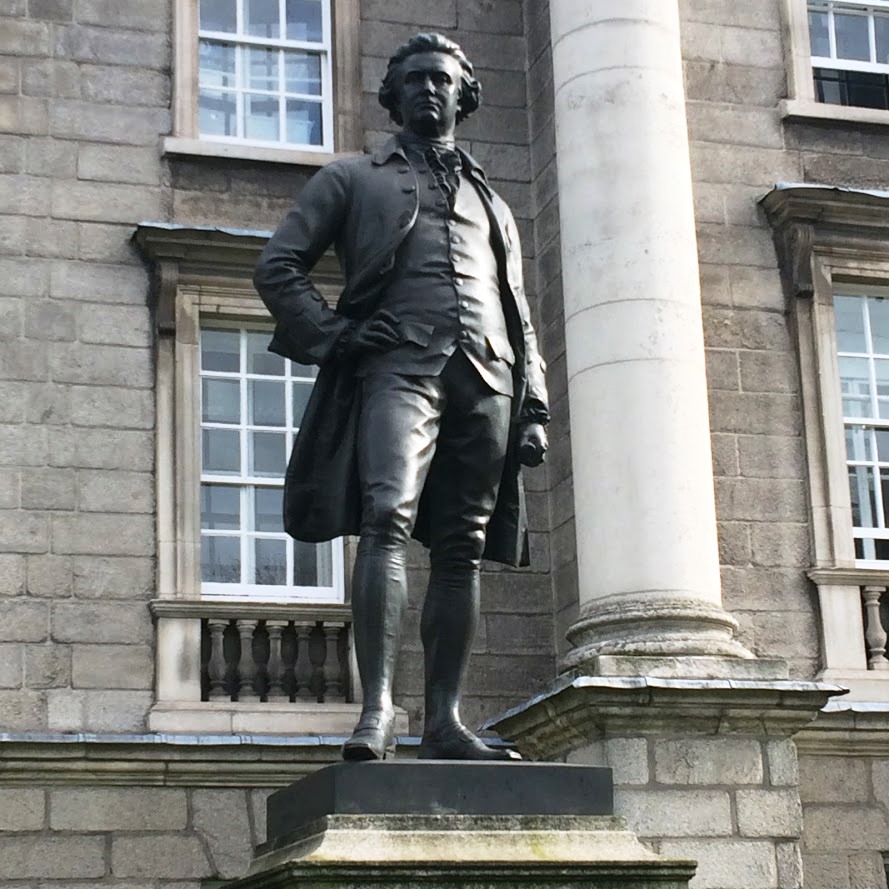
‘There are Three Estates in Parliament; but, in the Reporters’ Gallery yonder, there sits a Fourth Estate more important far than they all’ … Edmund Burke’s statue outside Trinity College Dublin (Photograph: Patrick Comerford)
Scripture quotations are from the New Revised Standard Version Bible: Anglicised Edition copyright © 1989, 1995, National Council of the Churches of Christ in the United States of America. Used by permission. All rights reserved worldwide. http://nrsvbibles.org
Patrick Comerford
Today is the Third Sunday of Easter (1 May 2022). During this season of Easter, I am reflecting each morning on the Psalms.
Later this morning, I hope to attend the Parish Eucharist in the Church of Saint Mary and Saint Giles in Stony Stratford. But, before this day begins, I am taking some time this morning to reflect in this Prayer Diary on my blog in these ways:
1, Short reflections on a psalm or psalms;
2, reading the psalm or psalms;
3, a prayer from the USPG prayer diary.
Psalm 67:
Psalm 67 is often known by its opening words in Latin, Deus misereatur. In Jewish tradition, this is one of the psalms recited at the Service for the Conclusion of the Shabbat. In the variation in numbering in the Greek Septuagint and Latin Vulgate, this is known as Psalm 66.
Psalm 67 an be divided it into three sections:
1 and 2,, verses 1-3 and 4-5: two broadly parallel sections in that seek God’s favour and blessing;
3, verses 6-7: this third section express universal joy as ‘all the nations’ experience God’s blessing.
Verses 3 and 5 are a repeated refrain:
Let the peoples praise you, O God;
let all the peoples praise you.
Psalm 67 shows how embracing and inclusive is God’s vision, God’s mission, God’s love. It is a psalm of thanksgiving whose key phrase is ‘The earth has yielded its increase’ or ‘The earth has yielded its harvest’ (verse 6).
The word ‘earth’ appears four times throughout this psalm in a variety of senses, suggesting that when we do God’s will on earth, the earth yields its blessings with the result that God is recognised by all nations of the earth.
The opening verse is reminiscent of the priestly blessing of the Cohanim: ‘May God be gracious to us and bless us and make his face to shine upon us’ (verse 1):
May the Lord bless and protect you.
May the Lord make his face shine on you and be gracious to you
May the Lord turn his face toward you, and give you peace (Numbers 6: 24-26)
This psalm is a plea for the mercy of God, for his ‘saving health’ to be seen in all nations, for his righteous judgment, and for his governance of the world. When all of that is in place, ‘Then shall the earth bring forth her increase, and God, our own God, will bless us. God will bless us, and all the ends of the world shall fear him.’
God raises up his own, in the face of popular prejudice, and in spite of our prejudices, so that his saving health may be received and may be a blessing in all nations.
This psalm can be read as thanksgiving for an abundant harvest or a prayer for a good harvest. The blessing God gave to the people is extended to all nations, for he is the universal just ruler and guide and all people everywhere may hold God in awe.
When Adam was exiled from Eden, it was said, ‘Cursed be the ground because of you.’ This is reversed in this psalm, as we pray for the earth to be blessed.
In Jewish tradition, Psalm 67 is read during these evenings of ‘Counting of the Omer,’ the 49 evenings or seven complete weeks between the festivals of Pesach or Passover and Shavout or Pentecost. In the original Hebrew text, excluding the superscription, this psalm contains 49 words, corresponding to the days of Counting of the Omer.
Psalm 67 as Deus Misereatur was introduced into the Book of Common Prayer by Thomas Cranmer as a Canticle for Evening Prayer, as an alternative to the main canticles.
This one of only four canticles that are provided in the traditional language in the Book of Common Prayer (2004) of the Church of Ireland [see p 134] – the others are Urbs Fortitudinis, Cantate Domino, and A Song of the Light, although modern language versions may be found either in the Psalms in the Book of Common Prayer or in the Irish Church Hymnal.
Thomas Tallis, Samuel Adler and Charles Ives composed musical settings of Psalm 67. The Revd Henry Francis Lyte, the author of ‘Abdie with me’ and a former curate of Taghmon, Co Wexford, wrote an English hymn paraphrase of this psalm, ‘God of mercy, God of grace,’ generally sung to the tune ‘Heathlands’ by Henry Smart.
‘Let the nations be glad and sing for joy’ (Psalm 67: 4) … flags of the nations at a shop in Kalambaka near the monasteries of Meteora in central Greece (Photograph: Patrick Comerford)
Psalm 67 (NRSVA):
To the leader: with stringed instruments. A Psalm. A Song.
1 May God be gracious to us and bless us
and make his face to shine upon us,
Selah
2 that your way may be known upon earth,
your saving power among all nations.
3 Let the peoples praise you, O God;
let all the peoples praise you.
4 Let the nations be glad and sing for joy,
for you judge the peoples with equity
and guide the nations upon earth.
Selah
5 Let the peoples praise you, O God;
let all the peoples praise you.
6 The earth has yielded its increase;
God, our God, has blessed us.
7 May God continue to bless us;
let all the ends of the earth revere him.
Today’s Prayer:
The theme in this week’s prayer diary of the Anglican mission agency USPG (United Society Partners in the Gospel) is ‘Truth Telllers,’ and is introduced this morning by Steve Cox, Chair of Christians in the Media. He writes:
Edmund Burke, the 18th Century Anglo-Irish statesman, was reported to have said; ‘There are Three Estates in Parliament; but, in the Reporters’ Gallery yonder, there sits a Fourth Estate more important far than they all.’
This respect for the media has been severely shaken in recent years. Yet, at its very best, the media continues to hold those in power to account, to call out injustice where it is seen, and unseen, and to be a voice to the voiceless.
It is crucial we support a free and independent press, while maintaining strong regulatory oversight. In a world of powerful, and quickly emerging, media platforms, Christians in Media will always be objective, and question where necessary, but not be afraid to highlight a media that brings us facts, information and truth.
As Christians, we pray for those in the media to uncover the beauty of hope, love and renewal that blossom in the debris of conflict, greed and exploitation. We pray that everyone in the media turn their weapons of word and image into ploughshares of peace and reconciliation.
We pray World Press Freedom Day continues to support the ‘Truth Tellers’ and uphold freedom of expression and information as a public good.
The USPG Prayer Diary this morning (1 May 2022) invites us to pray:
Amazing God,
you reach the stubborn and the cynical.
Teach us to be empathetic and understanding
as we seek to spread the Word.
Yesterday’s reflection
Continued tomorrow
‘There are Three Estates in Parliament; but, in the Reporters’ Gallery yonder, there sits a Fourth Estate more important far than they all’ … Edmund Burke’s statue outside Trinity College Dublin (Photograph: Patrick Comerford)
Scripture quotations are from the New Revised Standard Version Bible: Anglicised Edition copyright © 1989, 1995, National Council of the Churches of Christ in the United States of America. Used by permission. All rights reserved worldwide. http://nrsvbibles.org
Labels:
Canticles,
Easter 2022,
Flags,
Hymns,
Jewish Spirituality,
Journalism,
Justice,
media interviews,
Meteora,
Milton Keynes,
Mission,
Prayer,
Psalms,
Sabbath,
Taghmon,
TCD,
USPG,
Wolverton
07 July 2016
Football hooligans and extremists
do not hijack flying the flag in Greece
The flags of the UK, the EU and Greece together in Tsesmes near Rethymnon … how long shall they continue flying like this? (Photograph: Patrick Comerford, 2016)
Patrick Comerford
The ‘Leave’ vote in the Brexit referendum is in danger of tearing the United Kingdom apart. And in the process, the Union flag is in danger of being torn apart too.
Without the combination of the blue and white of the Cross of Saint Andrew, the red and white of the crosses of Saint George and Saint Patrick alone is going to look a messy effort by a young child playing with pencils or crayons.
The Cross of Saint George on its own was proudly flown throughout England until that ignominious defeat at the hands of Iceland. But apart from season football enthusiasm, the English flag is often hijacked by extreme nationalists.
I am often ashamed of how the Tricolour has been hijacked and abused by political extremists in Ireland, and embarrassed by the way the Union Flag is abused by extremists in Ukip or in Northern Ireland too. Yet there is nothing to be ashamed of in either flag: they represent peace and harmony between different traditions and culture, and bring together the different traditions on two islands.
The flags of Greece, the UK, and other European countries in a bar near Rethymnon (Photograph: Patrick Comerford, 2016)
On the other hand, Greeks are never ashamed of their national flag and what it represents. Flags fly outside homes and churches, in bars and on office desks, and are proudly displayed at every opportunity.
The flag is known popularly in Greek as Γαλανόλευκη or Κυανόλευκη, the ‘sky-blue-white’ or the ‘blue-white.’ It has nine equal horizontal stripes of blue alternating with white, and a blue canton with a white cross.
The cross symbolises Greek Orthodoxy, and tradition says the nine stripes represent the nine syllables of the phrase Ελευθερία ή Θάνατος (Freedom or Death): the five blue stripes for the syllables Έλευθερία and the four white stripes ή Θάνατος. Anoter tradition says the nine stripes also represent the nine letters in the word Ελευθερία (freedom).
The symbolism of blue and white has many interpretations, but they are usually seen as the colours of the Greek sky and sea. The shade of blue on the flag has varied over time, from light blue to dark blue.
The flag was first adopted by the Greek National Assembly at Epidaurus in 1822. Some Greek historians claim it is derived from coat of arms of the Kallergis family, a powerful political family in Crete who were descended from the Byzantine Emperor Nicephorus II Phocas (963–969 AD). However, it is more likely that the design was influenced by the stars and stripes flag of the newly independent United State of America.
Greeks have used several flags in the past
Under Ottoman domination, Greeks used several unofficial flags, usually the Byzantine double-headed eagle. But the closest thing to a national flag that Greeks had under Ottoman rule was a flag used by Greek shipping merchants that combined red stripes for the Ottoman Empire and blue stripes for Orthodoxy. This flag was abandoned when a treaty allowed Greek-owned merchant ships to fly the Russian flag.
From the late 18th century, a blue cross on a white background became the most popular revolutionary flag among Greeks, and almost became the national flag at independence.
The flag featuring the present design was created and first flown at the Evangelistria monastery in Skiathos in 1807, when several revolutionary leaders, including Theodoros Kolokotronis and Andreas Miaoulis, gathered there to plan an uprising, and were sworn to this flag by the local bishop. But a large variety of flags were used during the early days of the Greek War of Independence (1821-1829).
The First Greek National Assembly in 1822 abolished all revolutionary flags and adopted a new flag. No-one knows why they selected a white cross on a blue background rather than the more popular blue cross on a white background – it may even have been a mistake, but the design became immediately popular with Greeks everywhere.
At times, kings of Greece have tried to add their royal coats of arms or royal crowns to various versions of the flag and tried to change its shape. When the Second Hellenic Republic was formed in 1924, the crowns were removed from all flags. The crowns returned again with the restoration of the monarchy in 1935, only to be removed once more by the colonels in 1967.
Greek law regulates the use of the flag, but does not specify the shade of blue (Photograph: Patrick Comerford, 2016)
Since 1978, Greek law has specified that no other designs or emblems can be shown on the flag. But the law does not specify the exact shade of blue on the flag, so that hues may vary from very light to very dark blue.
Indeed, the ancient Greeks classified colours by whether they were light or dark, rather than by their hue. The Greek word for dark blue, kyaneos, could also mean dark green, violet, black or brown. The ancient Greek word for a light blue, glaukos, also could mean light green, grey, or yellow.
The terms for blue and green have changed completely in the transition from Ancient Greek to Modern Greek. Ancient Greek had γλαυκός (glaukos) for clear light blue, contrasting with χλωρός (chloros) for bright green. Kυανός, which became cyan in English, means either a dark blue substance or just blue. Modern Greek has πράσινο (prásino) for green and γαλάζιο (galázio) or θαλασσί (thalassí, sea coloured) for light blue or sea blue. The recent loan μπλε (ble, French bleu) is also used for blue.
In the Modern Greek language, there are additional names for light and dark blues/greens:
● τυρκουάζ (tyrkouáz) for turquoise;
● κυανό (kyanó) for azure;
● λαχανί (lachaní, cabbage coloured) for lime green;
● λαδί (ladí) for olive;
● χακί (chakí) for dark khaki;
● κυπαρισσί (kyparissí, cypress coloured) for brownish green.
As a rule, the first two words of the list are accepted as shades of blue, and the rest as shades of green. Also βιολέ (violé or βιολετί (violetí) for violet blue, which is, however, usually considered as a shade of purple, rather than blue.
The former flag of Crete is making an occasional reappearance on the island
Officially, the flag should fly from 8 a.m. until sunset, from a white mast topped with a white cross on top of a white sphere. It should never be defaced by writing or symbols upon it, hung from windows or balconies, or used for commercial purposes or as a corporate logo.
The main national flag days are 25 March, the anniversary of the start date for the Greek War of Independence; 28 October, Ochi Day, the anniversary of the refusal to accept the Italian ultimatum in 1940; and 17 November, the anniversary of the Athens Polytechnic uprising against the colonels.
One flag I occasionally see flying here is the old flag of Crete. From 1898 to 1908, the flag of the Principality of Crete was blue with a white cross and a red canton charged with a white star. The five-pointed star on the flag symbolised Ottoman suzerainty, and so the flag was not popular when it was used. It was officially abolished with the island’s unilateral proclamation of union with Greece in September 1908.
It can be seen from Vodafone TV ads, to number plates on cars, to notices selling the Cretan flag on e-bay. The flag is sometimes seen flying in Crete today, but not officially, and it seems to be associated with groups seeking greater autonomy for Crete.
But then all flags are in danger of being hijacked and manipulated by political extremists and football hooligans in equal measure.
Patrick Comerford
The ‘Leave’ vote in the Brexit referendum is in danger of tearing the United Kingdom apart. And in the process, the Union flag is in danger of being torn apart too.
Without the combination of the blue and white of the Cross of Saint Andrew, the red and white of the crosses of Saint George and Saint Patrick alone is going to look a messy effort by a young child playing with pencils or crayons.
The Cross of Saint George on its own was proudly flown throughout England until that ignominious defeat at the hands of Iceland. But apart from season football enthusiasm, the English flag is often hijacked by extreme nationalists.
I am often ashamed of how the Tricolour has been hijacked and abused by political extremists in Ireland, and embarrassed by the way the Union Flag is abused by extremists in Ukip or in Northern Ireland too. Yet there is nothing to be ashamed of in either flag: they represent peace and harmony between different traditions and culture, and bring together the different traditions on two islands.
The flags of Greece, the UK, and other European countries in a bar near Rethymnon (Photograph: Patrick Comerford, 2016)
On the other hand, Greeks are never ashamed of their national flag and what it represents. Flags fly outside homes and churches, in bars and on office desks, and are proudly displayed at every opportunity.
The flag is known popularly in Greek as Γαλανόλευκη or Κυανόλευκη, the ‘sky-blue-white’ or the ‘blue-white.’ It has nine equal horizontal stripes of blue alternating with white, and a blue canton with a white cross.
The cross symbolises Greek Orthodoxy, and tradition says the nine stripes represent the nine syllables of the phrase Ελευθερία ή Θάνατος (Freedom or Death): the five blue stripes for the syllables Έλευθερία and the four white stripes ή Θάνατος. Anoter tradition says the nine stripes also represent the nine letters in the word Ελευθερία (freedom).
The symbolism of blue and white has many interpretations, but they are usually seen as the colours of the Greek sky and sea. The shade of blue on the flag has varied over time, from light blue to dark blue.
The flag was first adopted by the Greek National Assembly at Epidaurus in 1822. Some Greek historians claim it is derived from coat of arms of the Kallergis family, a powerful political family in Crete who were descended from the Byzantine Emperor Nicephorus II Phocas (963–969 AD). However, it is more likely that the design was influenced by the stars and stripes flag of the newly independent United State of America.
Greeks have used several flags in the past
Under Ottoman domination, Greeks used several unofficial flags, usually the Byzantine double-headed eagle. But the closest thing to a national flag that Greeks had under Ottoman rule was a flag used by Greek shipping merchants that combined red stripes for the Ottoman Empire and blue stripes for Orthodoxy. This flag was abandoned when a treaty allowed Greek-owned merchant ships to fly the Russian flag.
From the late 18th century, a blue cross on a white background became the most popular revolutionary flag among Greeks, and almost became the national flag at independence.
The flag featuring the present design was created and first flown at the Evangelistria monastery in Skiathos in 1807, when several revolutionary leaders, including Theodoros Kolokotronis and Andreas Miaoulis, gathered there to plan an uprising, and were sworn to this flag by the local bishop. But a large variety of flags were used during the early days of the Greek War of Independence (1821-1829).
The First Greek National Assembly in 1822 abolished all revolutionary flags and adopted a new flag. No-one knows why they selected a white cross on a blue background rather than the more popular blue cross on a white background – it may even have been a mistake, but the design became immediately popular with Greeks everywhere.
At times, kings of Greece have tried to add their royal coats of arms or royal crowns to various versions of the flag and tried to change its shape. When the Second Hellenic Republic was formed in 1924, the crowns were removed from all flags. The crowns returned again with the restoration of the monarchy in 1935, only to be removed once more by the colonels in 1967.
Greek law regulates the use of the flag, but does not specify the shade of blue (Photograph: Patrick Comerford, 2016)
Since 1978, Greek law has specified that no other designs or emblems can be shown on the flag. But the law does not specify the exact shade of blue on the flag, so that hues may vary from very light to very dark blue.
Indeed, the ancient Greeks classified colours by whether they were light or dark, rather than by their hue. The Greek word for dark blue, kyaneos, could also mean dark green, violet, black or brown. The ancient Greek word for a light blue, glaukos, also could mean light green, grey, or yellow.
The terms for blue and green have changed completely in the transition from Ancient Greek to Modern Greek. Ancient Greek had γλαυκός (glaukos) for clear light blue, contrasting with χλωρός (chloros) for bright green. Kυανός, which became cyan in English, means either a dark blue substance or just blue. Modern Greek has πράσινο (prásino) for green and γαλάζιο (galázio) or θαλασσί (thalassí, sea coloured) for light blue or sea blue. The recent loan μπλε (ble, French bleu) is also used for blue.
In the Modern Greek language, there are additional names for light and dark blues/greens:
● τυρκουάζ (tyrkouáz) for turquoise;
● κυανό (kyanó) for azure;
● λαχανί (lachaní, cabbage coloured) for lime green;
● λαδί (ladí) for olive;
● χακί (chakí) for dark khaki;
● κυπαρισσί (kyparissí, cypress coloured) for brownish green.
As a rule, the first two words of the list are accepted as shades of blue, and the rest as shades of green. Also βιολέ (violé or βιολετί (violetí) for violet blue, which is, however, usually considered as a shade of purple, rather than blue.
The former flag of Crete is making an occasional reappearance on the island
Officially, the flag should fly from 8 a.m. until sunset, from a white mast topped with a white cross on top of a white sphere. It should never be defaced by writing or symbols upon it, hung from windows or balconies, or used for commercial purposes or as a corporate logo.
The main national flag days are 25 March, the anniversary of the start date for the Greek War of Independence; 28 October, Ochi Day, the anniversary of the refusal to accept the Italian ultimatum in 1940; and 17 November, the anniversary of the Athens Polytechnic uprising against the colonels.
One flag I occasionally see flying here is the old flag of Crete. From 1898 to 1908, the flag of the Principality of Crete was blue with a white cross and a red canton charged with a white star. The five-pointed star on the flag symbolised Ottoman suzerainty, and so the flag was not popular when it was used. It was officially abolished with the island’s unilateral proclamation of union with Greece in September 1908.
It can be seen from Vodafone TV ads, to number plates on cars, to notices selling the Cretan flag on e-bay. The flag is sometimes seen flying in Crete today, but not officially, and it seems to be associated with groups seeking greater autonomy for Crete.
But then all flags are in danger of being hijacked and manipulated by political extremists and football hooligans in equal measure.
Subscribe to:
Posts (Atom)