A traditional fishing boat by the old Venetian Harbour in Rethymnon … Izaak Walton points out that fishing can teach us patience and discipline (Photograph: Patrick Comerford)
Patrick Comerford
We are continuing in Ordinary Time in the Church Calendar and the week began with the Tenth Sunday after Trinity (Trinity X, 9 August 2026). The calendar of the Church of England in Common Worship today remembers Saint Laurence (258), Deacon at Rome, Martyr.
Later today, I have GP appointments for my regular injections needed because of my severe Vitamin B12 deficiency, for my sarcoidosis symtoms, and to follow up on my stroke four years ago. But, before the day begins, I am taking some quiet time this morning to give thanks, for reflection, prayer and reading in these ways:
1, today’s Gospel reading;
2, a reflection on the Gospel reading;
3, a prayer from the USPG prayer diary;
4, the Collects and Post-Communion prayer of the day.
‘Go to the lake and cast a hook; take the first fish that comes up’ (Matthew 17: 27) … a variety of fish on display in a seafood restaurant at the harbour in Rethymnon in Crete (Photograph: Patrick Comerford)
Matthew 17: 22-27 (NRSVA):
22 As they were gathering in Galilee, Jesus said to them, ‘The Son of Man is going to be betrayed into human hands, 23 and they will kill him, and on the third day he will be raised.’ And they were greatly distressed.
24 When they reached Capernaum, the collectors of the temple tax came to Peter and said, ‘Does your teacher not pay the temple tax?’ 25 He said, ‘Yes, he does.’ And when he came home, Jesus spoke of it first, asking, ‘What do you think, Simon? From whom do kings of the earth take toll or tribute? From their children or from others?’ 26 When Peter said, ‘From others’, Jesus said to him, ‘Then the children are free. 27 However, so that we do not give offence to them, go to the lake and cast a hook; take the first fish that comes up; and when you open its mouth, you will find a coin; take that and give it to them for you and me.’
‘Fishing Trips’ … fishing boats and tourist trips in Georgioupoli in Crete (Photograph: Patrick Comerford)
Today’s Reflections:
I have been a vegetarian most of my life, which has contributed to the health issues surrounding my severe B12 deficiency. But I still find the rewards of fishing at the Lake in Capernaum in this morning’s Gospel reading are worth working with. Ernest Hemingway, in The Old Man and The Sea, says ‘Il faut (d’abord) durer … It is necessary, above all else, to endure. It is necessary to endure.’
Over half a century ago, when I hitchhiking in the Peaks on the borders of Staffordshire and Derbyshire in my late teens, and staying in Ilam Hall, I came across the work of the great Anglican writer Izaak Walton (1593-1683), known for his biographies of John Donne, George Herbert and Richard Hooker, and also as the author of The Compleat Angler.
In The Compleat Angler, Izaak Walton points out that fishing can teach us patience and discipline. Fishing takes practice, preparation, discipline; like discipleship, it has to be learned, and learning requires practice before there are any results. And sometimes, whether it is fishing in a river, fishing in a lake or fishing in the sea, the best results can come from going against the current.
Walking along the piers in coastal fishing towns and villages or on holidays on Greek islands, I sometimes watch the careful early morning work of the crews in the trawlers and fishing boats, and I am reminded that good fishing does not come about by accident. It also requires paying attention to the nets, moving them carefully, mending them, cleaning them after each and every use, hanging them out to dry.
And fishing is also about noticing the weather, watching the wind and the clouds. Good fishing takes account of contexts … it is incarnational.
Time and again in the Gospels, the Kingdom of God is compared to a huge net cast over different numbers of people and species. We are the ones called to cast that net, and we cannot hang any sign outside on our office doors saying: ‘Gone Fishin’.
Nor can we stand by the bank or on the shore, content with two sizes of fish. We are called to go after the ones that others let get away, not just those who come to Church regularly, but also those people who sit in darkness and in the region of the shadow of death.
Peter is sent to go fishing in the lake. He is told to take the first fish that comes up and that he is going to find a treasure beyond his expectations. It is an image of what working for the kingdom of God can be like.
There are days when fishing seems pointless, and there will be days when we are happy with our work together. And as we work together, hopefully, there will be days when we are surprised with what we can achieve together, all in Christ’s name and all for the sake of the one that otherwise might get away.
A fishing boat and fishing nets on the Greek island of Samos (Photograph: Patrick Comerford)
Today’s Prayers (Monday 10 August 2026):
In Pray with the World Church, the prayer diary of the Anglican mission agency USPG (United Society Partners in the Gospel), the theme this week (9-15 August 2026, pp 28-29), is ‘Mission to the Mangyans’. This theme was introduced yesterday with a Programme Update by the Revd Jewel B Tumaliuan, Programme Director, Iglesia Filipina Independiente (IFI).
The USPG Prayer Diary today (Monday 10 August 2026) invites us to pray:
Lord, we pray for communities in remote areas where distance shapes daily life. May connection, support, and opportunity grow, and may your presence bring encouragement and hope.
The Collect of the Day:
Almighty God,
who made Laurence a loving servant of your people
and a wise steward of the treasures of your Church:
fire us with his example to love as he loved
and to walk in the way that leads to eternal life;
through Jesus Christ your Son our Lord,
who is alive and reigns with you,
in the unity of the Holy Spirit,
one God, now and for ever.
The Post-Communion Prayer:
Eternal God,
who gave us this holy meal
in which we have celebrated the glory of the cross
and the victory of your martyr Laurence:
by our communion with Christ
in his saving death and resurrection,
give us with all your saints the courage to conquer evil
and so to share the fruit of the tree of life;
through Jesus Christ our Lord.
Yesterday’s reflectionss
Continued tomorrow
‘Gone Fishin’ … fishing boats and nets by the harbour in Iraklion (Photograph: Patrick Comerford, 2025)
Scripture quotations are from the New Revised Standard Version Bible: Anglicised Edition copyright © 1989, 1995, National Council of the Churches of Christ in the United States of America. Used by permission. All rights reserved worldwide. http://nrsvbibles.org
Showing posts with label B12. Show all posts
10 August 2026
Daily prayer in Ordinary Time 2026:
95, Monday 10 August 2026
Labels:
B12,
Crete 2026,
Derbyshire,
Georgioupoli,
Greece 2026,
Ilam,
Iraklion,
Living with sarcoidosis,
Mission,
Philippines,
Prayer,
Rethymnon,
Saint Matthew's Gospel,
Samos,
Stony Stratford,
Stroke,
USPG
02 July 2026
Daily prayer in Ordinary Time 2026:
56, Thursday 2 July 2026
The healing of the paralytic man … a fresco in Analipsi Church in Georgioupoli in Crete (Photograph: Patrick Comerford)
Patrick Comerford
We are in Ordinary Time in the Church Calendar and the week began with the Fourth Sunday after Trinity (Trinity IV, 28 June 2026) and the Feast of Saint Peter and Saint Paul (29 June 2026). We are still in the time known as Peter-tide, a time when many ordinations to the diaconate and priesthood take place.
Later this evening, I hope to take part in the rehearsals with a playreading group in the Library in Stony Stratford. But, before this day begins, I am taking some quiet time this morning to give thanks, to reflect, to pray and to read in these ways:
1, reading today’s Gospel reading;
2, a short reflection;
3, a prayer from the USPG prayer diary;
4, the Collects and Post-Communion prayer of the day.
A blessing in the Chapel of the John Radcliffe Hospital, Oxford (Photograph: Patrick Comerford)
Matthew 9: 1-8 (NRSVA):
1 And after getting into a boat he crossed the water and came to his own town.
2 And just then some people were carrying a paralysed man lying on a bed. When Jesus saw their faith, he said to the paralytic, ‘Take heart, son; your sins are forgiven.’ 3 Then some of the scribes said to themselves, ‘This man is blaspheming.’ 4 But Jesus, perceiving their thoughts, said, ‘Why do you think evil in your hearts? 5 For which is easier, to say, “Your sins are forgiven”, or to say, “Stand up and walk”? 6 But so that you may know that the Son of Man has authority on earth to forgive sins’ – he then said to the paralytic – ‘Stand up, take your bed and go to your home.’ 7 And he stood up and went to his home. 8 When the crowds saw it, they were filled with awe, and they glorified God, who had given such authority to human beings.
Inside the Chapel in the John Radcliffe Hospital, Oxford (Photograph: Patrick Comerford)
Today’s Reflections:
This morning’s Gospel reading at the Eucharist (Matthew 9: 1-8) is a healing story that has its synoptic parallels in Mark 2: 1-12 and Luke 5: 18-26.
I have regular appointments with my local GP practice for injections for my B12 deficiency, and I continue to have regular hospital appointments monitoring my pulmonary sarcoidosis and as part of the care and attention I continue to receive as a follow-up to my stroke almost over four years ago in March 2022.
I remain truly grateful for the caring and attentive treatment I receive in hospitals in Milton Keynes, Oxford and Sheffield, and I am even more grateful for the way Charlotte Hunter recognised I was having a stroke, brought me to hospital, ensured I received the attention I needed, visited me every day, and brought me back to Stony Stratford.
Some years ago, at an event in Saint Martin-in-the-Fields Church, Trafalgar Square, when people were asked to bring along their favourite poems, Charlotte brought Seamus Heaney’s poem ‘Miracle’, from his collection Human Chain (2010).
In these poems, written after his stroke in 2005, Seamus Heaney speaks of suffering and mortality. This poem ‘Miracle’ retells the story of the miraculous healing of the man variously described as a paralytic man and a man with palsy. The story is told in all three synoptic Gospels, including this morning’s Gospel reading (Matthew 9: 1-8), and – like Seamus Heaney, I suppose – my situation makes me wonder whether this man was also suffering after a stroke.
It is interesting how Seamus Heaney tells the story of this man’s healing from the perspective of the man’s friends. In this way, his poem becomes an expression of gratitude by the poet to all who helped his recovery after his stroke.
When Jesus looks at the paralysed man brought to him by his friends, he sees not just the faith of the man, but the faith of his friends too. In other words, this is a story of the blessing of friendship and the miracle of community as much as it is a story of miraculous healing.
The poet’s focus is on neither Christ as the healer nor the invalid, but on the friends who in the other synoptic accounts helped this sick man to reach Jesus by lowering him through a skylight in the roof. The title of the poem refers to the miracle in the Gospel story, but for the poet the miracle is found in the opening lines:
Not the one who takes up his bed and walks
But the ones who have known him all along
And carry him in.
The friends of this man love him and seek his healing, no matter what it takes for them to do, and so they become the true miracle in this moment. They are there when no one else is, they care for their friend, and they give him the priceless gift of friendship.
When they hear in Capernaum that Jesus is healing the sick, they give their friend one more gift. They carry him to Jesus. And when they cannot get him through the door, they then lower him through the roof.
What persistent love they show their friend, like the persistent love of one who calls a taxi, packs all my bags, brings me to the A&E unit, stays with me while I am admitted, as I am transferred to the emergency unit, and then, late at night, when I am moved to a ward.
This poem sees the Gospel story through the eyes of this man’s faithful friends. So often, I read this story through the eyes of the paralysed man, through the eyes of the crowd, or even through the eyes of the Pharisees and teachers. But Seamus Heaney invites me to join the man’s friends, who stand with
their shoulders numb, the ache and stoop deeplocked
In their backs, the stretcher handles
Slippery with sweat.
We are invited to stand with those friends, with the hope and the faith and the love that brings them there, to stand with them on behalf of all who hurt, to feel the burns in their hands from the paid-out rope, the ache in their backs from the burden they have carried, to see the gift of this miracle, this grace, that was all gift, but that required something extra of them.
There are many miracles in this story and many lessons. This poem reminds us how sometimes we need to be carried by our friends, while at other times we are the ones who need to help ‘bear one another’s burdens’ (Galatians 6: 2).
Miracle, by Seamus Heaney (1939-2013)
Not the one who takes up his bed and walks
But the ones who have known him all along
And carry him in —
Their shoulders numb, the ache and stoop deeplocked
In their backs, the stretcher handles
Slippery with sweat. And no let up
Until he’s strapped on tight, made tiltable
and raised to the tiled roof, then lowered for healing.
Be mindful of them as they stand and wait
For the burn of the paid out ropes to cool,
Their slight lightheadedness and incredulity
To pass, those who had known him all along.
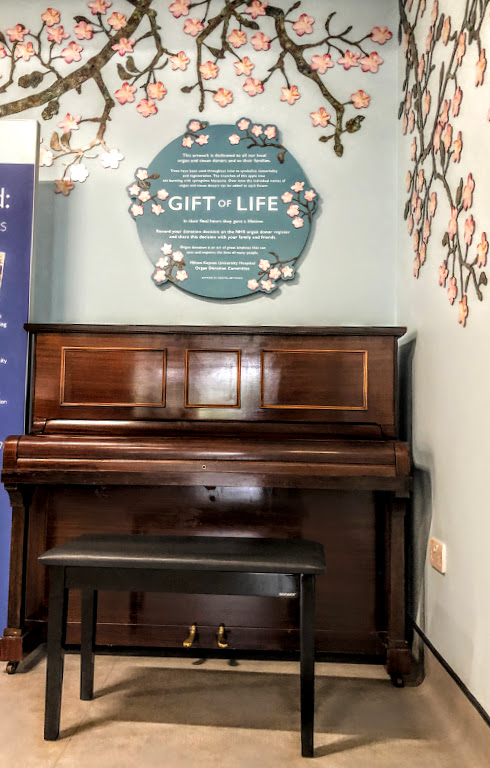
‘The Gift of Life’ … art and music in the outpatients reception area in Milton Keynes University Hospital (Photograph: Patrick Comerford)
Today’s Prayers (Thursday 2 July 2026):
In Pray with the World Church, the prayer diary of the Anglican mission agency USPG (United Society Partners in the Gospel), the theme this week, from 28 June to 4 July 2026 (pp 14-15), is ‘Living Stones’. This theme was introduced on Sunday with a reflection by the Very Revd Lydia Kelsey Bucklin, President and Dean of Episcopal Divinity School.
The USPG prayer diary today (Thursday 2 July 2026) invites us to pray:
Creator God, remind us of our deep interconnection. Strengthen us to seek the liberation of all people, knowing none of us are free while violence and injustice persist.
The Collect of the Day:
O God, the protector of all who trust in you,
without whom nothing is strong, nothing is holy:
increase and multiply upon us your mercy;
that with you as our ruler and guide
we may so pass through things temporal
that we lose not our hold on things eternal;
grant this, heavenly Father,
for our Lord Jesus Christ’s sake,
who is alive and reigns with you,
in the unity of the Holy Spirit,
one God, now and for ever.
The Post-Communion Prayer:
Eternal God,
comfort of the afflicted and healer of the broken,
you have fed us at the table of life and hope:
teach us the ways of gentleness and peace,
that all the world may acknowledge
the kingdom of your Son Jesus Christ our Lord.
Additional Collect:
Gracious Father,
by the obedience of Jesus
you brought salvation to our wayward world:
draw us into harmony with your will,
that we may find all things restored in him,
our Saviour Jesus Christ.
The Collect on the Eve of Saint Thomas:
Almighty and eternal God,
who, for the firmer foundation of our faith,
allowed your holy apostle Thomas
to doubt the resurrection of your Son
till word and sight convinced him:
grant to us, who have not seen, that we also may believe
and so confess Christ as our Lord and our God;
who is alive and reigns with you,
in the unity of the Holy Spirit,
one God, now and for ever.
Yesterday’s reflections
Continued tomorrow
The magnolia tree in a courtyard in the hospital in Milton Keynes (Photograph: Patrick Comerford)
Scripture quotations are from the New Revised Standard Version Bible: Anglicised Edition copyright © 1989, 1995 National Council of the Churches of Christ in the United States of America. Used by permission. All rights reserved worldwide. http://nrsvbibles.org
Patrick Comerford
We are in Ordinary Time in the Church Calendar and the week began with the Fourth Sunday after Trinity (Trinity IV, 28 June 2026) and the Feast of Saint Peter and Saint Paul (29 June 2026). We are still in the time known as Peter-tide, a time when many ordinations to the diaconate and priesthood take place.
Later this evening, I hope to take part in the rehearsals with a playreading group in the Library in Stony Stratford. But, before this day begins, I am taking some quiet time this morning to give thanks, to reflect, to pray and to read in these ways:
1, reading today’s Gospel reading;
2, a short reflection;
3, a prayer from the USPG prayer diary;
4, the Collects and Post-Communion prayer of the day.
A blessing in the Chapel of the John Radcliffe Hospital, Oxford (Photograph: Patrick Comerford)
Matthew 9: 1-8 (NRSVA):
1 And after getting into a boat he crossed the water and came to his own town.
2 And just then some people were carrying a paralysed man lying on a bed. When Jesus saw their faith, he said to the paralytic, ‘Take heart, son; your sins are forgiven.’ 3 Then some of the scribes said to themselves, ‘This man is blaspheming.’ 4 But Jesus, perceiving their thoughts, said, ‘Why do you think evil in your hearts? 5 For which is easier, to say, “Your sins are forgiven”, or to say, “Stand up and walk”? 6 But so that you may know that the Son of Man has authority on earth to forgive sins’ – he then said to the paralytic – ‘Stand up, take your bed and go to your home.’ 7 And he stood up and went to his home. 8 When the crowds saw it, they were filled with awe, and they glorified God, who had given such authority to human beings.
Inside the Chapel in the John Radcliffe Hospital, Oxford (Photograph: Patrick Comerford)
Today’s Reflections:
This morning’s Gospel reading at the Eucharist (Matthew 9: 1-8) is a healing story that has its synoptic parallels in Mark 2: 1-12 and Luke 5: 18-26.
I have regular appointments with my local GP practice for injections for my B12 deficiency, and I continue to have regular hospital appointments monitoring my pulmonary sarcoidosis and as part of the care and attention I continue to receive as a follow-up to my stroke almost over four years ago in March 2022.
I remain truly grateful for the caring and attentive treatment I receive in hospitals in Milton Keynes, Oxford and Sheffield, and I am even more grateful for the way Charlotte Hunter recognised I was having a stroke, brought me to hospital, ensured I received the attention I needed, visited me every day, and brought me back to Stony Stratford.
Some years ago, at an event in Saint Martin-in-the-Fields Church, Trafalgar Square, when people were asked to bring along their favourite poems, Charlotte brought Seamus Heaney’s poem ‘Miracle’, from his collection Human Chain (2010).
In these poems, written after his stroke in 2005, Seamus Heaney speaks of suffering and mortality. This poem ‘Miracle’ retells the story of the miraculous healing of the man variously described as a paralytic man and a man with palsy. The story is told in all three synoptic Gospels, including this morning’s Gospel reading (Matthew 9: 1-8), and – like Seamus Heaney, I suppose – my situation makes me wonder whether this man was also suffering after a stroke.
It is interesting how Seamus Heaney tells the story of this man’s healing from the perspective of the man’s friends. In this way, his poem becomes an expression of gratitude by the poet to all who helped his recovery after his stroke.
When Jesus looks at the paralysed man brought to him by his friends, he sees not just the faith of the man, but the faith of his friends too. In other words, this is a story of the blessing of friendship and the miracle of community as much as it is a story of miraculous healing.
The poet’s focus is on neither Christ as the healer nor the invalid, but on the friends who in the other synoptic accounts helped this sick man to reach Jesus by lowering him through a skylight in the roof. The title of the poem refers to the miracle in the Gospel story, but for the poet the miracle is found in the opening lines:
Not the one who takes up his bed and walks
But the ones who have known him all along
And carry him in.
The friends of this man love him and seek his healing, no matter what it takes for them to do, and so they become the true miracle in this moment. They are there when no one else is, they care for their friend, and they give him the priceless gift of friendship.
When they hear in Capernaum that Jesus is healing the sick, they give their friend one more gift. They carry him to Jesus. And when they cannot get him through the door, they then lower him through the roof.
What persistent love they show their friend, like the persistent love of one who calls a taxi, packs all my bags, brings me to the A&E unit, stays with me while I am admitted, as I am transferred to the emergency unit, and then, late at night, when I am moved to a ward.
This poem sees the Gospel story through the eyes of this man’s faithful friends. So often, I read this story through the eyes of the paralysed man, through the eyes of the crowd, or even through the eyes of the Pharisees and teachers. But Seamus Heaney invites me to join the man’s friends, who stand with
their shoulders numb, the ache and stoop deeplocked
In their backs, the stretcher handles
Slippery with sweat.
We are invited to stand with those friends, with the hope and the faith and the love that brings them there, to stand with them on behalf of all who hurt, to feel the burns in their hands from the paid-out rope, the ache in their backs from the burden they have carried, to see the gift of this miracle, this grace, that was all gift, but that required something extra of them.
There are many miracles in this story and many lessons. This poem reminds us how sometimes we need to be carried by our friends, while at other times we are the ones who need to help ‘bear one another’s burdens’ (Galatians 6: 2).
Miracle, by Seamus Heaney (1939-2013)
Not the one who takes up his bed and walks
But the ones who have known him all along
And carry him in —
Their shoulders numb, the ache and stoop deeplocked
In their backs, the stretcher handles
Slippery with sweat. And no let up
Until he’s strapped on tight, made tiltable
and raised to the tiled roof, then lowered for healing.
Be mindful of them as they stand and wait
For the burn of the paid out ropes to cool,
Their slight lightheadedness and incredulity
To pass, those who had known him all along.
‘The Gift of Life’ … art and music in the outpatients reception area in Milton Keynes University Hospital (Photograph: Patrick Comerford)
Today’s Prayers (Thursday 2 July 2026):
In Pray with the World Church, the prayer diary of the Anglican mission agency USPG (United Society Partners in the Gospel), the theme this week, from 28 June to 4 July 2026 (pp 14-15), is ‘Living Stones’. This theme was introduced on Sunday with a reflection by the Very Revd Lydia Kelsey Bucklin, President and Dean of Episcopal Divinity School.
The USPG prayer diary today (Thursday 2 July 2026) invites us to pray:
Creator God, remind us of our deep interconnection. Strengthen us to seek the liberation of all people, knowing none of us are free while violence and injustice persist.
The Collect of the Day:
O God, the protector of all who trust in you,
without whom nothing is strong, nothing is holy:
increase and multiply upon us your mercy;
that with you as our ruler and guide
we may so pass through things temporal
that we lose not our hold on things eternal;
grant this, heavenly Father,
for our Lord Jesus Christ’s sake,
who is alive and reigns with you,
in the unity of the Holy Spirit,
one God, now and for ever.
The Post-Communion Prayer:
Eternal God,
comfort of the afflicted and healer of the broken,
you have fed us at the table of life and hope:
teach us the ways of gentleness and peace,
that all the world may acknowledge
the kingdom of your Son Jesus Christ our Lord.
Additional Collect:
Gracious Father,
by the obedience of Jesus
you brought salvation to our wayward world:
draw us into harmony with your will,
that we may find all things restored in him,
our Saviour Jesus Christ.
The Collect on the Eve of Saint Thomas:
Almighty and eternal God,
who, for the firmer foundation of our faith,
allowed your holy apostle Thomas
to doubt the resurrection of your Son
till word and sight convinced him:
grant to us, who have not seen, that we also may believe
and so confess Christ as our Lord and our God;
who is alive and reigns with you,
in the unity of the Holy Spirit,
one God, now and for ever.
Yesterday’s reflections
Continued tomorrow
The magnolia tree in a courtyard in the hospital in Milton Keynes (Photograph: Patrick Comerford)
Scripture quotations are from the New Revised Standard Version Bible: Anglicised Edition copyright © 1989, 1995 National Council of the Churches of Christ in the United States of America. Used by permission. All rights reserved worldwide. http://nrsvbibles.org
06 May 2026
Daily prayer in Easter 2026:
32, Wednesday 6 May 2026
‘I am the true vine’ (John 15: 1) … an icon of Christ the True Vine in in the parish church in Piskopianó in the mountains east of Iraklion in Crete (Photograph: Patrick Comerford)
Patrick Comerford
Easter is a 50-day season, beginning on Easter Day (5 April 2026) and continuing until the Day of Pentecost (24 May 2026), or Whit Sunday. This week began with the Fifth Sunday of Easter (Easter V, 3 May 2026).
I have an early appointment this morning for a B12 injection, a regular injection that helps me to manage my Vitamin B12 deficiency. Later in the day, I hope to take part in the choir rehearsal in Saint Mary and Saint Giles Church, Stony Stratford, this evening. But before today begins I am taking some quiet time this morning to give thanks, to reflect, to pray and to read in these ways:
1, reading today’s Gospel reading;
2, a short reflection;
3, a prayer from the USPG prayer diary;
4, the Collects and Post-Communion prayer of the day.
‘I am the true vine, and my Father is the vine-grower’ (John 15: 1) … summer grapes on a vine in Panormos, near Rethymnon (Photograph: Patrick Comerford)
John 15: 1-8 (NRSVA):
[Jesus said:] 1 ‘I am the true vine, and my Father is the vine-grower. 2 He removes every branch in me that bears no fruit. Every branch that bears fruit he prunes to make it bear more fruit. 3 You have already been cleansed by the word that I have spoken to you. 4 Abide in me as I abide in you. Just as the branch cannot bear fruit by itself unless it abides in the vine, neither can you unless you abide in me. 5 I am the vine, you are the branches. Those who abide in me and I in them bear much fruit, because apart from me you can do nothing. 6 Whoever does not abide in me is thrown away like a branch and withers; such branches are gathered, thrown into the fire, and burned. 7 If you abide in me, and my words abide in you, ask for whatever you wish, and it will be done for you. 8 My Father is glorified by this, that you bear much fruit and become my disciples.’
‘Every branch that bears fruit he prunes to make it bear more fruit’ (John 15: 2) … grapes on the vines at the Hedgehog Vintage Inn in Lichfield (Photograph: Patrick Comerford, 2025)
Today’s Reflections:
Today’s Gospel reading provided in the Lectionary at the Eucharist (John 15: 1-8) continues our readings from the ‘Farewell Discourse’ in Saint John’s Gospel.
One Sunday morning, when I was preaching on this reading, I held up two bunches of grapes, and invited the children to offer or distribute to each person in church one individual, single grape.
One grape in your hand looks fine, but the stem of the vine that is left looks dishevelled and grotty – a sign of things once promised, but no good on its own. Grapes on their own as individuals are small fruit. A vine on its own without fruit looks forlorn and wilting, if not dead.
Many years ago, a friend in Greece was very excited when he realised I was returning to his village in the mountains in Crete that summer on holidays. He rang me with gushing enthusiasm and delight. I must come and see what he had done with the ‘graveyard’ in his village, Piskopianó.
‘The graveyard?’
Naturally I am interested in visiting churches and churchyards, and graveyards and gravestones provide rich material for social, local and family history. But a graveyard is not the first place you think your friends want you to visit on a holiday in the Mediterranean.
So, I asked again: ‘The graveyard?’
‘Yes, you’re going to be delighted to see how the vines are growing with new life. You remember how I trimmed back the vines and the branches and how I built new trellises. Now there is a rich crop in the grapeyard this year.’
The grapeyard! Of course. Now it makes sense.
I had shown an interest in his grapes, his vineyard … and a healthy interest in the local wine. Now a new lesson awaited me on how to grow grapes, how to trim the vines, and how vines, like people, only make sense in clusters.
The grapes on the bunch, and the clusters on the vine, produce better fruit and better wine when they are together, working together, abiding in and with each other.
In today’s Gospel story this morning, Christ talks about himself as the true vine, and he invites us to abide in him as he abides in us. The Prayer of Humble Access prays ‘that we may evermore dwell in him and he in us.’
In our Gospel reading this morning (John 15: 1-8), he tells us: ‘I am the true vine.’ This is the seventh and last of the seven ‘I AM’ (ἐγώ εἰμι, ego eimi) sayings in Saint John’s Gospel. They begin with ‘I am the bread of life’ (John 6: 35) and end with ‘I am the true vine’ (John 15: 1). It is as though our experience of meeting Christ together in the Eucharist, in sharing the bread and wine together, collectively, encloses our experiences of Christ as the light of the world (John 8:12), the gate for the sheep (John 10: 7), the good shepherd (John 10: 11), the resurrection and the life (John 11: 25), and the way, and the truth, and the life (John 14: 6).
Poetically, the bread and the vine open and close these seven ‘I AM’ sayings.
At the celebrations of the Eucharist, and I notice how traditional Jewish table-blessings, drawn in turn from the Bible, are adapted at the Taking of the Bread and Wine:
Priest: Blessed are you Lord, God of all creation:
through your goodness we have this bread to offer,
which earth has given and human hands have made (Ecclesiastes 3: 13-14).
It will become for us the bread of life (John 6: 35).
All: Blessed be God forever (Psalm 68: 36).
Priest: Blessed are you Lord, God of all creation:
through your goodness we have this wine to offer,
fruit of the vine and work of human hands.
It will become our spiritual drink (Luke 22: 17-18).
All: Blessed be God forever (Psalm 68: 36).
[See also Common Worship, p 291.]
Our openness to Christ present in the bread and the wine of the Eucharist is at the beginning and the end of our acceptance of who Christ is for us.
The image in today’s reading is of God the vine grower and the gardener. Christ is the vine and we are branches bearing fruit.
The vine is trimmed so that it can grow new fruit. But this is not the heart of the teaching here. Instead, the image offered here is one of abiding and remaining. The image of the vine grower, the vineyard, the vine and the branches is one about the living Word existing as the life blood of those who belong to Christ.
The Johannine scholar Raymond Brown says this passage is about the disciples remaining in Christ. Many people in the Church talk about following Jesus and leading a virtuous life. But here, the image of abiding is about being, not about becoming. If we are abiding in Christ, then God is central, not the desires of our egos.
And so, when we are invited to the Holy Table, to the Altar, the Holy Communion, the Eucharist, it is not because we lead a virtuous life, and we should not be afraid to come to the Eucharist, fretting that others think we live lives that are not virtuous.
Instead, the words of the Prayer of Humble Access remind us:
We do not presume to come to this your table,
merciful Lord,
trusting in our own righteousness
but in your manifold and great mercies.
We are not worthy so much as to gather up the crumbs under your table.
But you are the same Lord,
whose nature is always to have mercy.
Grant us, therefore, gracious Lord,
so to eat the flesh of your dear Son Jesus Christ,
and to drink his blood,
that our sinful bodies may be made clean by his body,
and our souls washed through his most precious blood,
and that we may evermore dwell in him and he in us. Amen.
Christ is risen!
The Lord is risen indeed. Alleluia!
‘Fruit of the vine and work of human hands. It will become our spiritual drink’ … grapes ripening on a vine in Platanias, near Rethymnon in Crete (Photograph: Patrick Comerford)
Today’s Prayers (Wednesday 6 May 2026):
‘Following God’s Lead’ provides the theme this week (3-9 May 2026) in ‘Pray With the World Church’, the Prayer Diary of the Anglican mission agency USPG (United Society Partners in the Gospel), pp 52-53. This theme was introduced on Sunday with a programme update from Father Thanduxolo Noketshe, Vicar of Saint Mary’s and Christ Church in Cayon, St Kitts & Nevis.
The USPG Prayer Diary today (Wednesday 6 May 2026) invites us to pray:
Creator God, thank you for the gift of your creation. Bless Fr Thanduxolo as he serves on the St Mary’s Biosphere Reserve Committee and use it to inspire us to protect the earth wherever we may be.
The Collect:
Almighty God,
who through your only-begotten Son Jesus Christ
have overcome death and opened to us the gate of everlasting life:
grant that, as by your grace going before us
you put into our minds good desires,
so by your continual help
we may bring them to good effect;
through Jesus Christ our risen Lord,
who is alive and reigns with you,
in the unity of the Holy Spirit,
one God, now and for ever.
The Post-Communion Prayer:
Eternal God,
whose Son Jesus Christ is the way, the truth, and the life:
grant us to walk in his way,
to rejoice in his truth,
and to share his risen life;
who is alive and reigns, now and for ever.
Additional Collect:
Risen Christ,
your wounds declare your love for the world
and the wonder of your risen life:
give us compassion and courage
to risk ourselves for those we serve,
to the glory of God the Father.
Yesterday’s Reflections
Continued Tomorrow
A Benedictine icon of the True Vine by Sister Marie-Paul OSB
Scripture quotations are from the New Revised Standard Version Bible: Anglicised Edition copyright © 1989, 1995 National Council of the Churches of Christ in the United States of America. Used by permission. All rights reserved worldwide. http://nrsvbibles.org
Patrick Comerford
Easter is a 50-day season, beginning on Easter Day (5 April 2026) and continuing until the Day of Pentecost (24 May 2026), or Whit Sunday. This week began with the Fifth Sunday of Easter (Easter V, 3 May 2026).
I have an early appointment this morning for a B12 injection, a regular injection that helps me to manage my Vitamin B12 deficiency. Later in the day, I hope to take part in the choir rehearsal in Saint Mary and Saint Giles Church, Stony Stratford, this evening. But before today begins I am taking some quiet time this morning to give thanks, to reflect, to pray and to read in these ways:
1, reading today’s Gospel reading;
2, a short reflection;
3, a prayer from the USPG prayer diary;
4, the Collects and Post-Communion prayer of the day.
‘I am the true vine, and my Father is the vine-grower’ (John 15: 1) … summer grapes on a vine in Panormos, near Rethymnon (Photograph: Patrick Comerford)
John 15: 1-8 (NRSVA):
[Jesus said:] 1 ‘I am the true vine, and my Father is the vine-grower. 2 He removes every branch in me that bears no fruit. Every branch that bears fruit he prunes to make it bear more fruit. 3 You have already been cleansed by the word that I have spoken to you. 4 Abide in me as I abide in you. Just as the branch cannot bear fruit by itself unless it abides in the vine, neither can you unless you abide in me. 5 I am the vine, you are the branches. Those who abide in me and I in them bear much fruit, because apart from me you can do nothing. 6 Whoever does not abide in me is thrown away like a branch and withers; such branches are gathered, thrown into the fire, and burned. 7 If you abide in me, and my words abide in you, ask for whatever you wish, and it will be done for you. 8 My Father is glorified by this, that you bear much fruit and become my disciples.’
‘Every branch that bears fruit he prunes to make it bear more fruit’ (John 15: 2) … grapes on the vines at the Hedgehog Vintage Inn in Lichfield (Photograph: Patrick Comerford, 2025)
Today’s Reflections:
Today’s Gospel reading provided in the Lectionary at the Eucharist (John 15: 1-8) continues our readings from the ‘Farewell Discourse’ in Saint John’s Gospel.
One Sunday morning, when I was preaching on this reading, I held up two bunches of grapes, and invited the children to offer or distribute to each person in church one individual, single grape.
One grape in your hand looks fine, but the stem of the vine that is left looks dishevelled and grotty – a sign of things once promised, but no good on its own. Grapes on their own as individuals are small fruit. A vine on its own without fruit looks forlorn and wilting, if not dead.
Many years ago, a friend in Greece was very excited when he realised I was returning to his village in the mountains in Crete that summer on holidays. He rang me with gushing enthusiasm and delight. I must come and see what he had done with the ‘graveyard’ in his village, Piskopianó.
‘The graveyard?’
Naturally I am interested in visiting churches and churchyards, and graveyards and gravestones provide rich material for social, local and family history. But a graveyard is not the first place you think your friends want you to visit on a holiday in the Mediterranean.
So, I asked again: ‘The graveyard?’
‘Yes, you’re going to be delighted to see how the vines are growing with new life. You remember how I trimmed back the vines and the branches and how I built new trellises. Now there is a rich crop in the grapeyard this year.’
The grapeyard! Of course. Now it makes sense.
I had shown an interest in his grapes, his vineyard … and a healthy interest in the local wine. Now a new lesson awaited me on how to grow grapes, how to trim the vines, and how vines, like people, only make sense in clusters.
The grapes on the bunch, and the clusters on the vine, produce better fruit and better wine when they are together, working together, abiding in and with each other.
In today’s Gospel story this morning, Christ talks about himself as the true vine, and he invites us to abide in him as he abides in us. The Prayer of Humble Access prays ‘that we may evermore dwell in him and he in us.’
In our Gospel reading this morning (John 15: 1-8), he tells us: ‘I am the true vine.’ This is the seventh and last of the seven ‘I AM’ (ἐγώ εἰμι, ego eimi) sayings in Saint John’s Gospel. They begin with ‘I am the bread of life’ (John 6: 35) and end with ‘I am the true vine’ (John 15: 1). It is as though our experience of meeting Christ together in the Eucharist, in sharing the bread and wine together, collectively, encloses our experiences of Christ as the light of the world (John 8:12), the gate for the sheep (John 10: 7), the good shepherd (John 10: 11), the resurrection and the life (John 11: 25), and the way, and the truth, and the life (John 14: 6).
Poetically, the bread and the vine open and close these seven ‘I AM’ sayings.
At the celebrations of the Eucharist, and I notice how traditional Jewish table-blessings, drawn in turn from the Bible, are adapted at the Taking of the Bread and Wine:
Priest: Blessed are you Lord, God of all creation:
through your goodness we have this bread to offer,
which earth has given and human hands have made (Ecclesiastes 3: 13-14).
It will become for us the bread of life (John 6: 35).
All: Blessed be God forever (Psalm 68: 36).
Priest: Blessed are you Lord, God of all creation:
through your goodness we have this wine to offer,
fruit of the vine and work of human hands.
It will become our spiritual drink (Luke 22: 17-18).
All: Blessed be God forever (Psalm 68: 36).
[See also Common Worship, p 291.]
Our openness to Christ present in the bread and the wine of the Eucharist is at the beginning and the end of our acceptance of who Christ is for us.
The image in today’s reading is of God the vine grower and the gardener. Christ is the vine and we are branches bearing fruit.
The vine is trimmed so that it can grow new fruit. But this is not the heart of the teaching here. Instead, the image offered here is one of abiding and remaining. The image of the vine grower, the vineyard, the vine and the branches is one about the living Word existing as the life blood of those who belong to Christ.
The Johannine scholar Raymond Brown says this passage is about the disciples remaining in Christ. Many people in the Church talk about following Jesus and leading a virtuous life. But here, the image of abiding is about being, not about becoming. If we are abiding in Christ, then God is central, not the desires of our egos.
And so, when we are invited to the Holy Table, to the Altar, the Holy Communion, the Eucharist, it is not because we lead a virtuous life, and we should not be afraid to come to the Eucharist, fretting that others think we live lives that are not virtuous.
Instead, the words of the Prayer of Humble Access remind us:
We do not presume to come to this your table,
merciful Lord,
trusting in our own righteousness
but in your manifold and great mercies.
We are not worthy so much as to gather up the crumbs under your table.
But you are the same Lord,
whose nature is always to have mercy.
Grant us, therefore, gracious Lord,
so to eat the flesh of your dear Son Jesus Christ,
and to drink his blood,
that our sinful bodies may be made clean by his body,
and our souls washed through his most precious blood,
and that we may evermore dwell in him and he in us. Amen.
Christ is risen!
The Lord is risen indeed. Alleluia!
‘Fruit of the vine and work of human hands. It will become our spiritual drink’ … grapes ripening on a vine in Platanias, near Rethymnon in Crete (Photograph: Patrick Comerford)
Today’s Prayers (Wednesday 6 May 2026):
‘Following God’s Lead’ provides the theme this week (3-9 May 2026) in ‘Pray With the World Church’, the Prayer Diary of the Anglican mission agency USPG (United Society Partners in the Gospel), pp 52-53. This theme was introduced on Sunday with a programme update from Father Thanduxolo Noketshe, Vicar of Saint Mary’s and Christ Church in Cayon, St Kitts & Nevis.
The USPG Prayer Diary today (Wednesday 6 May 2026) invites us to pray:
Creator God, thank you for the gift of your creation. Bless Fr Thanduxolo as he serves on the St Mary’s Biosphere Reserve Committee and use it to inspire us to protect the earth wherever we may be.
The Collect:
Almighty God,
who through your only-begotten Son Jesus Christ
have overcome death and opened to us the gate of everlasting life:
grant that, as by your grace going before us
you put into our minds good desires,
so by your continual help
we may bring them to good effect;
through Jesus Christ our risen Lord,
who is alive and reigns with you,
in the unity of the Holy Spirit,
one God, now and for ever.
The Post-Communion Prayer:
Eternal God,
whose Son Jesus Christ is the way, the truth, and the life:
grant us to walk in his way,
to rejoice in his truth,
and to share his risen life;
who is alive and reigns, now and for ever.
Additional Collect:
Risen Christ,
your wounds declare your love for the world
and the wonder of your risen life:
give us compassion and courage
to risk ourselves for those we serve,
to the glory of God the Father.
Yesterday’s Reflections
Continued Tomorrow
A Benedictine icon of the True Vine by Sister Marie-Paul OSB
Scripture quotations are from the New Revised Standard Version Bible: Anglicised Edition copyright © 1989, 1995 National Council of the Churches of Christ in the United States of America. Used by permission. All rights reserved worldwide. http://nrsvbibles.org
26 March 2026
Daily prayer in Lent 2026:
37, Thursday 26 March 2026
‘Very truly, I tell you, before Abraham was, I am’ (John 8: 58) … ‘Abraham, our Father in Faith’ by Sean Rice (1931-1997), in the west apse of the Cathedral of Christ the King, Liverpool (Photograph: Patrick Comerford)
Patrick Comerford
We are in the last two weeks of Lent, and this week began with the Fifth Sunday in Lent (Lent V), sometimes still known as Passion Sunday. The Church Calendar of the Church of England in Common Worship today remembers the life and witness of Harriet (O’Brien) Monsell (1811-1883), the Limerick-born founder of and first Superior of the Community of Saint John the Baptist or Clewer Sisters.
I have been on a 24-hour fast in preparation for an appointment this morning for blood tests as part of the continuing monitoring of my post-stroke condition, my sarcoidosis and my low levels of Vitamin B12. But, before the day begins, I am taking some quiet time this morning to give thanks, to reflect, to pray and to read in these ways:
1, reading today’s Gospel reading;
2, a short reflection;
3, a prayer from the USPG prayer diary;
4, the Collects and Post-Communion prayer of the day.
The Sacrifice of Abraham depicted in the East Window in Holy Trinity Church, Old Wolverton (Photograph: Patrick Comerford)
John 8: 51-58 (NRSVA):
[Jesus said:] 51 ‘Very truly, I tell you, whoever keeps my word will never see death.’ 52 The Jews said to him, ‘Now we know that you have a demon. Abraham died, and so did the prophets; yet you say, “Whoever keeps my word will never taste death.” 53 Are you greater than our father Abraham, who died? The prophets also died. Who do you claim to be?’ 54 Jesus answered, ‘If I glorify myself, my glory is nothing. It is my Father who glorifies me, he of whom you say, “He is our God”, 55 though you do not know him. But I know him; if I were to say that I do not know him, I would be a liar like you. But I do know him and I keep his word. 56 Your ancestor Abraham rejoiced that he would see my day; he saw it and was glad.’ 57 Then the Jews said to him, ‘You are not yet fifty years old, and have you seen Abraham?’ 58 Jesus said to them, ‘Very truly, I tell you, before Abraham was, I am.’ 59 So they picked up stones to throw at him, but Jesus hid himself and went out of the temple.
Abraham depicted in a stained glass window in Saint John’s Church, Wall, near Lichfield (Photograph: Patrick Comerford)
Today’s Reflection:
The conflict between Jesus and the religious leaders in Jerusalem continues in the Gospel reading at the Eucharist (John 8: 51-58) today. Today’s reading opens with Jesus promising that ‘whoever keeps my word will never see death’ (verse 51), but ends with him being threatened with death himself as his interlocutors picked up stones to throw at him (verse 59), threatening him with the very same form of execution that faced the woman who had been caught in adultery and was brought before Jesus by scribes and Pharisees at the beginning of this chapter (John 8: 1-11), which we read about on Monday (23 April 2026).
That woman escaped being stoned to death when Jesus challenged her accusers, ‘Let anyone among you who is without sin be the first to throw a stone at her’, and then wrote on the ground (verse 7-8).
Jesus escapes death this time, hiding himself and going out of the temple (verse 59). But we know his death is inevitable, and we shall focus on his passion and his death, not by stoning but on the Rock of Golgotha, next week throughout Holy Week.
Harriet Monsell (1811-1883), who is remembered today, is one of the few Irish-born women in the Calendar of Saints in Common Worship in the Church of England. She was the daughter of Sir Edward O’Brien (1773-1826) of Dromoland Castle, Co Clare, and a sister of the Irish patriot William Smith O’Brien (1803-1864).
Harriet and her Irish-born husband Canon Charles Henry Monsell (1815-1850) were closely identified with the Oxford Movement. After he died in 1850, she began working in the railroad and army village of Clewer among former prostitutes and unmarried mothers at a House of Mercy. The house had been founded some years earlier by Mrs Mariquita Tennant, who was a Spanish refugee, a convert to Anglicanism and a clergyman’s widow.
Harriet Monsell moved to Clewer with her sister Catherine and her husband, Canon Charles Harris, later Bishop of Gibraltar. Harriet Monsell professed religious vows with two other women, and became Mother Superior of one of the first Anglican religious orders since the Reformation 300 years earlier.
The women lived according to a rule attributed to Saint Augustine of Hippo. At first, they were called the Sisters of Mercy. They later changed their name to reflect their inspiration from Saint John the Baptist’s call to penitence. During the order’s first five years, it expanded from assisting about 30 marginalised women to dedicating a building to serve about 80 women.
The foundation of the sisterhood was viewed with alarm, but the Bishop of Oxford, Samuel Wilberforce, despite his misgivings, acted as Visitor to the Community until he moved to Winchester in 1869.
As the Community of Saint John Baptist, the nuns were guided by Mother Harriet, with her energy and humour. They extended their original mission to running about 40 institutions, including mission houses in parishes, as well as orphanages, schools and hospitals. Mother Harriet retired to Folkestone, Kent, in 1875 for health reasons, although she was occasionally able to visit the communities she founded.
She died in Folkestone on the morning of 25 March 1883, which that year was both the Feast of the Annunciation and Easter Day. Because of this coincidence, her commemoration in the Calendar of the Church of England has been moved to the following day, 26 March.
So they picked up stones to throw at him, but Jesus hid himself (John 8: 59) … stones and pebbles on the beach in Portrane, Co Dublin (Photograph: Patrick Comerford)
Today’s Prayers (Thursday 26 March 2026):
The theme this week (22-28 March 2026) in ‘Pray With the World Church,’ the Prayer Diary of the Anglican mission agency USPG (United Society Partners in the Gospel), is ‘Myanmar Earthquake: One Year On’ (pp 40-41). This theme was introduced on Sunday with a programme update by the Revd Davidson Solanki, the USPG Senior Regional Manager for Asia and the Middle East.
The USPG Prayer Diary today (Thursday 26 March 2026) invites us to pray:
Lord, we thank you for those who have provided support over the past year; church workers, volunteers, aid workers, and faithful supporters.
The Collect:
Most merciful God,
who by the death and resurrection of your Son Jesus Christ
delivered and saved the world:
grant that by faith in him who suffered on the cross
we may triumph in the power of his victory;
through Jesus Christ your Son our Lord,
who is alive and reigns with you,
in the unity of the Holy Spirit,
one God, now and for ever.
The Post Communion Prayer:
Lord Jesus Christ,
you have taught us
that what we do for the least of our brothers and sisters
we do also for you:
give us the will to be the servant of others
as you were the servant of all,
and gave up your life and died for us,
but are alive and reign, now and for ever.
Additional Collect:
Gracious Father,
you gave up your Son
out of love for the world:
lead us to ponder the mysteries of his passion,
that we may know eternal peace
through the shedding of our Saviour’s blood,
Jesus Christ our Lord.
Yesterday’s Reflections
Continued Tomorrow
Mother Harriet Monsell (1811-1883), founder of the Community of Saint John Baptist, the ‘Clewer Sisters’
Scripture quotations are from the New Revised Standard Version Bible: Anglicised Edition copyright © 1989, 1995 National Council of the Churches of Christ in the United States of America. Used by permission. All rights reserved worldwide. http://nrsvbibles.org
Patrick Comerford
We are in the last two weeks of Lent, and this week began with the Fifth Sunday in Lent (Lent V), sometimes still known as Passion Sunday. The Church Calendar of the Church of England in Common Worship today remembers the life and witness of Harriet (O’Brien) Monsell (1811-1883), the Limerick-born founder of and first Superior of the Community of Saint John the Baptist or Clewer Sisters.
I have been on a 24-hour fast in preparation for an appointment this morning for blood tests as part of the continuing monitoring of my post-stroke condition, my sarcoidosis and my low levels of Vitamin B12. But, before the day begins, I am taking some quiet time this morning to give thanks, to reflect, to pray and to read in these ways:
1, reading today’s Gospel reading;
2, a short reflection;
3, a prayer from the USPG prayer diary;
4, the Collects and Post-Communion prayer of the day.
The Sacrifice of Abraham depicted in the East Window in Holy Trinity Church, Old Wolverton (Photograph: Patrick Comerford)
John 8: 51-58 (NRSVA):
[Jesus said:] 51 ‘Very truly, I tell you, whoever keeps my word will never see death.’ 52 The Jews said to him, ‘Now we know that you have a demon. Abraham died, and so did the prophets; yet you say, “Whoever keeps my word will never taste death.” 53 Are you greater than our father Abraham, who died? The prophets also died. Who do you claim to be?’ 54 Jesus answered, ‘If I glorify myself, my glory is nothing. It is my Father who glorifies me, he of whom you say, “He is our God”, 55 though you do not know him. But I know him; if I were to say that I do not know him, I would be a liar like you. But I do know him and I keep his word. 56 Your ancestor Abraham rejoiced that he would see my day; he saw it and was glad.’ 57 Then the Jews said to him, ‘You are not yet fifty years old, and have you seen Abraham?’ 58 Jesus said to them, ‘Very truly, I tell you, before Abraham was, I am.’ 59 So they picked up stones to throw at him, but Jesus hid himself and went out of the temple.
Abraham depicted in a stained glass window in Saint John’s Church, Wall, near Lichfield (Photograph: Patrick Comerford)
Today’s Reflection:
The conflict between Jesus and the religious leaders in Jerusalem continues in the Gospel reading at the Eucharist (John 8: 51-58) today. Today’s reading opens with Jesus promising that ‘whoever keeps my word will never see death’ (verse 51), but ends with him being threatened with death himself as his interlocutors picked up stones to throw at him (verse 59), threatening him with the very same form of execution that faced the woman who had been caught in adultery and was brought before Jesus by scribes and Pharisees at the beginning of this chapter (John 8: 1-11), which we read about on Monday (23 April 2026).
That woman escaped being stoned to death when Jesus challenged her accusers, ‘Let anyone among you who is without sin be the first to throw a stone at her’, and then wrote on the ground (verse 7-8).
Jesus escapes death this time, hiding himself and going out of the temple (verse 59). But we know his death is inevitable, and we shall focus on his passion and his death, not by stoning but on the Rock of Golgotha, next week throughout Holy Week.
Harriet Monsell (1811-1883), who is remembered today, is one of the few Irish-born women in the Calendar of Saints in Common Worship in the Church of England. She was the daughter of Sir Edward O’Brien (1773-1826) of Dromoland Castle, Co Clare, and a sister of the Irish patriot William Smith O’Brien (1803-1864).
Harriet and her Irish-born husband Canon Charles Henry Monsell (1815-1850) were closely identified with the Oxford Movement. After he died in 1850, she began working in the railroad and army village of Clewer among former prostitutes and unmarried mothers at a House of Mercy. The house had been founded some years earlier by Mrs Mariquita Tennant, who was a Spanish refugee, a convert to Anglicanism and a clergyman’s widow.
Harriet Monsell moved to Clewer with her sister Catherine and her husband, Canon Charles Harris, later Bishop of Gibraltar. Harriet Monsell professed religious vows with two other women, and became Mother Superior of one of the first Anglican religious orders since the Reformation 300 years earlier.
The women lived according to a rule attributed to Saint Augustine of Hippo. At first, they were called the Sisters of Mercy. They later changed their name to reflect their inspiration from Saint John the Baptist’s call to penitence. During the order’s first five years, it expanded from assisting about 30 marginalised women to dedicating a building to serve about 80 women.
The foundation of the sisterhood was viewed with alarm, but the Bishop of Oxford, Samuel Wilberforce, despite his misgivings, acted as Visitor to the Community until he moved to Winchester in 1869.
As the Community of Saint John Baptist, the nuns were guided by Mother Harriet, with her energy and humour. They extended their original mission to running about 40 institutions, including mission houses in parishes, as well as orphanages, schools and hospitals. Mother Harriet retired to Folkestone, Kent, in 1875 for health reasons, although she was occasionally able to visit the communities she founded.
She died in Folkestone on the morning of 25 March 1883, which that year was both the Feast of the Annunciation and Easter Day. Because of this coincidence, her commemoration in the Calendar of the Church of England has been moved to the following day, 26 March.
So they picked up stones to throw at him, but Jesus hid himself (John 8: 59) … stones and pebbles on the beach in Portrane, Co Dublin (Photograph: Patrick Comerford)
Today’s Prayers (Thursday 26 March 2026):
The theme this week (22-28 March 2026) in ‘Pray With the World Church,’ the Prayer Diary of the Anglican mission agency USPG (United Society Partners in the Gospel), is ‘Myanmar Earthquake: One Year On’ (pp 40-41). This theme was introduced on Sunday with a programme update by the Revd Davidson Solanki, the USPG Senior Regional Manager for Asia and the Middle East.
The USPG Prayer Diary today (Thursday 26 March 2026) invites us to pray:
Lord, we thank you for those who have provided support over the past year; church workers, volunteers, aid workers, and faithful supporters.
The Collect:
Most merciful God,
who by the death and resurrection of your Son Jesus Christ
delivered and saved the world:
grant that by faith in him who suffered on the cross
we may triumph in the power of his victory;
through Jesus Christ your Son our Lord,
who is alive and reigns with you,
in the unity of the Holy Spirit,
one God, now and for ever.
The Post Communion Prayer:
Lord Jesus Christ,
you have taught us
that what we do for the least of our brothers and sisters
we do also for you:
give us the will to be the servant of others
as you were the servant of all,
and gave up your life and died for us,
but are alive and reign, now and for ever.
Additional Collect:
Gracious Father,
you gave up your Son
out of love for the world:
lead us to ponder the mysteries of his passion,
that we may know eternal peace
through the shedding of our Saviour’s blood,
Jesus Christ our Lord.
Yesterday’s Reflections
Continued Tomorrow
Mother Harriet Monsell (1811-1883), founder of the Community of Saint John Baptist, the ‘Clewer Sisters’
Scripture quotations are from the New Revised Standard Version Bible: Anglicised Edition copyright © 1989, 1995 National Council of the Churches of Christ in the United States of America. Used by permission. All rights reserved worldwide. http://nrsvbibles.org
Labels:
Abraham,
B12,
Co Clare,
Co Limerick,
Lent 2026,
Liverpool,
Living with sarcoidosis,
Mission,
Myanmar,
Portrane,
Prayer,
Saint John's Gospel,
Saints,
Sculpture,
Stroke,
USPG,
Wall,
Wolverton
19 January 2026
Daily prayer in Christmas 2025-2026:
26, Monday 19 January 2026
Feasting and fasting are important topics in all three Abrahamic faiths (Photograph: Patrick Comerford)
Patrick Comerford
The 40-day season of Christmas continues until Candlemas or the Feast of the Presentation (2 February). This week began with the Second Sunday of Epiphany (Epiphany II), with readings that continue to focus on the Baptism of Christ by Saint John the Baptist, one of the three great Epiphany themes, alongside the Visit of the Magi and the Wedding at Cana.
Today is the Second Day of the Week of Prayer for Christian Unity, from 18 to 25 January. This year’s theme is ‘One Body, One Spirit’ – from Ephesians 4: 1-13 – which was prepared by the Armenian Apostolic Church, along with the Armenian Catholic and Evangelical Churches. The calendar of the Church of England in Common Worship today remembers Saint Wulfstan (1095), Bishop of Worcester in 1062-1095.
I have an appointment this afternoon for a regular injection that helps me to cope with my B12 deficiency. Before today begins, however, I am taking some quiet time this morning to give thanks, to reflect, to pray and to read in these ways:
1, today’s Gospel reading;
2, a short reflection;
3, a prayer from the USPG prayer diary;
4, the Collects and Post-Communion prayer of the day.
‘No one sews a piece of unshrunk cloth on an old cloak’ … the HIV+ Women’s Group Quilt at Open Heart House at an exhibition in Dublin (Photograph: Patrick Comerford)
Mark 2: 18-22 (NRSVA):
18 Now John’s disciples and the Pharisees were fasting; and people came and said to him, ‘Why do John’s disciples and the disciples of the Pharisees fast, but your disciples do not fast?’ 19 Jesus said to them, ‘The wedding-guests cannot fast while the bridegroom is with them, can they? As long as they have the bridegroom with them, they cannot fast. 20 The days will come when the bridegroom is taken away from them, and then they will fast on that day.
21 ‘No one sews a piece of unshrunk cloth on an old cloak; otherwise, the patch pulls away from it, the new from the old, and a worse tear is made. 22 And no one puts new wine into old wineskins; otherwise, the wine will burst the skins, and the wine is lost, and so are the skins; but one puts new wine into fresh wineskins.’
Ramadan bread on sale as sunset draws in Kuşadasi (Photograph: Patrick Comerford)
Today’s Reflections:
The story of the Wedding at Cana (John 2: 1-11), The Gospel reading in two weeks’ time (Epiphany IV, 1 February 2026), is one of the three great Epiphany themes, along with the Visit of the Magi (Matthew 2: 1-12, 6 January 2026, The Epiphany), and the story of the Baptism of Christ by Saint John the Baptist (Matthew 3: 13-17, 11 January 2025, Epiphany I). These three themes at Epiphany tell us who Christ truly is: truly God and truly human.
That wedding theme in Gospel reading on Epiphany IV is also found in today’s reading, with a wedding feast used to illustrate a debate about feasting and fasting.
Saint Wulfstan, who is remembered in the church calendar today, was known for his guilelessness, his remarkable simplicity and humility, and his campaigning to abolish 11th century slave trading. Wulstan, together with Lanfranc, was mainly responsible for ending the 11th century slave trade between Bristol and Ireland. He was canonised by Pope Innocent III in 1203 on the testimony of Archbishop John Comyn of Dublin. His views on feasting and fasting have made him the patron saint of vegetarians and dieters.
Feasting and fasting are important themes in the three Abrahamic faiths – Judaism, Christianity and Islam.
For many Jews, the central act of worship and prayer is not what takes place in a synagogue on a Saturday morning, but the shared family meal in the home on Friday evening, when the candles are lit and blessings are said over the shared wine and bread.
Passover or Pesach begins this year on the evening of Wednesday 1 April 2026, and ends after nightfall on 9 April. Passover involves elements of both feasting and fasting, with the Seder meals but removing all leavened foods or chametz and abstaining from all food and drink that includes anything leavened or fermented, such as bread, crackers, cookies, pretzels and pasta, and most brands of beer, whiskey, vodka and gin.
The Eucharist is the central act of worship for Christians. The Church of Ireland, for example, teaches that ‘Holy Communion is the central act of worship’ and ‘warmly’ invites ‘all communicant members of Christian churches to join us at the Lord’s Table.’
The Iftar meals are shared, communal and spiritual experiences for Muslims.
Fasting is not only a Christian tradition, but is a form of spiritual discipline in all the great religious traditions: think of Yom Kippur, the great Jewish fast, or of Ramadan, a whole month of fasting for Muslims.
The association between feasting and fasting and the quest for justice are emphasised by Orthodox Christians in the prayers and readings on Clean Monday (Καθαρή Δευτέρα), which marks the beginning of Lent and which falls on 23 February this year (2026).
Greeks traditionally mark Clean Monday (Καθαρή Δευτέρα) by gathering for a traditional κούλουμα (koulouma) celebration, flying kites and eating halva. A special kind of azyme bread (λαγάνα, lagana) is baked only on this day. Some Orthodox Christians abstain from eating meat, eggs and dairy products throughout Lent, eating fish only on major feast days.
Liturgically, Clean Monday – and Lent itself – begins with a special service called Forgiveness Vespers, which ends with the Ceremony of Mutual Forgiveness, when those present bow down before each other and ask for forgiveness. In this way, they begin Lent with a clean conscience, with forgiveness, and with renewed Christian love.
The theme of Clean Monday is set by the reading appointed for the Sixth Hour (Isaiah 1: 1-20), which says in part:
Wash yourselves; make yourselves clean;
remove the evil of your doings
from before my eyes;
cease to do evil,
learn to do good;
seek justice,
rescue the oppressed,
defend the orphan,
plead for the widow.
Come now, let us argue it out,
says the Lord:
though your sins are like scarlet,
they shall be like snow;
though they are red like crimson,
they shall become like wool (verses 16-18).
In the first week of Lent, the Orthodox Church celebrates the hope that, as the Vespers that Wednesday say, ‘the springtime of the Fast has dawned, the flower of repentance has begun to open.’
Ramadan this year begins on Tuesday 17 February and cotinues until the evening of Wednesday 18 March 2026. I have visited in Egypt, Pakistan and Turkey during the month of Ramadan, or Ramazan as it is known in Turkey, and I have found it is a very spiritual time to be in a country with a predominantly Muslim population.
In Kuşadasi, a resort town on the Aegean coast, I have noticed how among tourists no-one is affected by Ramadan – the cafés, bars and restaurants stay open and life goes on as normal. But during Ramadan, practising Muslims are taught not to eat, drink, or have sexual relations between dawn and sunset. I realised there how it must be tough on the cooks and waiters in hotels, restaurants and bars as they cook and serve food and watch the tourists eating and drinking throughout the day.
One tradition in many places in Turkey is the ‘Ramazan Drummer,’ a ‘human alarm clock’ who starts to stroll and beat his drum in the streets around 3 am to wake up those who are fasting so that they can rise and prepare the Sahur, the morning meal before sunrise.
The fast of Ramadan is broken each evening with Itfar, which is a celebration and a sharing with the community. In the evening, a cannon booms out to announce the end of the fast and the beginning of darkness.
Stewed fruits are indispensable foods at both iftar dinners and sahur breakfasts. Stuffed bagels are associated with sahur, while Turkish bread is preferred at the evening meal.
But, before the evening meal, the fast is traditionally broken with olives and water firstly, with the main meal following later. It is unhealthy to fill empty stomachs with heavy foods, and – in any case – for centuries the olive has been considered a holy food by every religious tradition in the Eastern Mediterranean.
Once the sun goes down, many restaurants become busy with local people who come out to eat with their family members. Or people rush home to be with their families to enjoy the Iftar, or the breaking of the fast.
Many young people use those evenings to meet and visit their friends, and there is often a party atmosphere … although most of this passes unnoticed by the many young Turks in Kuşadasi working until well into the night in the hotels, tourist shops and bars, and the young tourists who know little about the spiritual values of feasting and fasting and of tolerance and justice, and how they are intertwined.
I find it interesting that there is going to be a partial overlap this year between Lent and Easter, Passover and Ramadan.
‘The springtime of the Fast has dawned, the flower of repentance has begun to Open’ … an image in the journal Koinonia, Lent 2011, Vol 4, Issue 13, Kansas City, MO
Today’s Prayers (Monday 19 January 2026):
The theme this week (18-24 January 2026) in Pray with the World Church, the prayer diary of the Anglican mission agency USPG (United Society Partners in the Gospel), is ‘Freedom Theologies’ (pp 20-21). This theme was introduced yesterday with Reflections from Dr Thandi Gamedze, poet, theologian, and senior researcher at the Desmond Tutu Centre for Religion and Social Justice.
The USPG Prayer Diary today (Monday 19 January 2026) invites us to pray:
Lord, we thank you for the stories of courage in South Africa’s history and for the Kairos Document that called the Church to justice. Help us to learn from this witness and act with boldness in our own faith.
The Collect:
Almighty God,
in Christ you make all things new:
transform the poverty of our nature by the riches of your grace,
and in the renewal of our lives
make known your heavenly glory;
through Jesus Christ your Son our Lord,
who is alive and reigns with you,
in the unity of the Holy Spirit,
one God, ow and for ever.
The Post-Communion Prayer:
God of glory,
you nourish us with your Word
who is the bread of life:
fill us with your Holy Spirit
that through us the light of your glory
may shine in all the world.
We ask this in the name of Jesus Christ our Lord.
Additional Collect:
Eternal Lord,
our beginning and our end:
bring us with the whole creation
to your glory, hidden through past ages
and made known
in Jesus Christ our Lord.
Yesterday’s Reflections
Continued Tomorrow
Sunset in the Aegean at Ladies Beach in Kuşadasi … practising Muslims are expected to fast from sunrise to sunset each day during Ramadan (Photograph: Patrick Comerford)
Scripture quotations are from the New Revised Standard Version Bible: Anglicised Edition copyright © 1989, 1995 National Council of the Churches of Christ in the United States of America. Used by permission. All rights reserved worldwide. http://nrsvbibles.org
Patrick Comerford
The 40-day season of Christmas continues until Candlemas or the Feast of the Presentation (2 February). This week began with the Second Sunday of Epiphany (Epiphany II), with readings that continue to focus on the Baptism of Christ by Saint John the Baptist, one of the three great Epiphany themes, alongside the Visit of the Magi and the Wedding at Cana.
Today is the Second Day of the Week of Prayer for Christian Unity, from 18 to 25 January. This year’s theme is ‘One Body, One Spirit’ – from Ephesians 4: 1-13 – which was prepared by the Armenian Apostolic Church, along with the Armenian Catholic and Evangelical Churches. The calendar of the Church of England in Common Worship today remembers Saint Wulfstan (1095), Bishop of Worcester in 1062-1095.
I have an appointment this afternoon for a regular injection that helps me to cope with my B12 deficiency. Before today begins, however, I am taking some quiet time this morning to give thanks, to reflect, to pray and to read in these ways:
1, today’s Gospel reading;
2, a short reflection;
3, a prayer from the USPG prayer diary;
4, the Collects and Post-Communion prayer of the day.
‘No one sews a piece of unshrunk cloth on an old cloak’ … the HIV+ Women’s Group Quilt at Open Heart House at an exhibition in Dublin (Photograph: Patrick Comerford)
Mark 2: 18-22 (NRSVA):
18 Now John’s disciples and the Pharisees were fasting; and people came and said to him, ‘Why do John’s disciples and the disciples of the Pharisees fast, but your disciples do not fast?’ 19 Jesus said to them, ‘The wedding-guests cannot fast while the bridegroom is with them, can they? As long as they have the bridegroom with them, they cannot fast. 20 The days will come when the bridegroom is taken away from them, and then they will fast on that day.
21 ‘No one sews a piece of unshrunk cloth on an old cloak; otherwise, the patch pulls away from it, the new from the old, and a worse tear is made. 22 And no one puts new wine into old wineskins; otherwise, the wine will burst the skins, and the wine is lost, and so are the skins; but one puts new wine into fresh wineskins.’
Today’s Reflections:
The story of the Wedding at Cana (John 2: 1-11), The Gospel reading in two weeks’ time (Epiphany IV, 1 February 2026), is one of the three great Epiphany themes, along with the Visit of the Magi (Matthew 2: 1-12, 6 January 2026, The Epiphany), and the story of the Baptism of Christ by Saint John the Baptist (Matthew 3: 13-17, 11 January 2025, Epiphany I). These three themes at Epiphany tell us who Christ truly is: truly God and truly human.
That wedding theme in Gospel reading on Epiphany IV is also found in today’s reading, with a wedding feast used to illustrate a debate about feasting and fasting.
Saint Wulfstan, who is remembered in the church calendar today, was known for his guilelessness, his remarkable simplicity and humility, and his campaigning to abolish 11th century slave trading. Wulstan, together with Lanfranc, was mainly responsible for ending the 11th century slave trade between Bristol and Ireland. He was canonised by Pope Innocent III in 1203 on the testimony of Archbishop John Comyn of Dublin. His views on feasting and fasting have made him the patron saint of vegetarians and dieters.
Feasting and fasting are important themes in the three Abrahamic faiths – Judaism, Christianity and Islam.
For many Jews, the central act of worship and prayer is not what takes place in a synagogue on a Saturday morning, but the shared family meal in the home on Friday evening, when the candles are lit and blessings are said over the shared wine and bread.
Passover or Pesach begins this year on the evening of Wednesday 1 April 2026, and ends after nightfall on 9 April. Passover involves elements of both feasting and fasting, with the Seder meals but removing all leavened foods or chametz and abstaining from all food and drink that includes anything leavened or fermented, such as bread, crackers, cookies, pretzels and pasta, and most brands of beer, whiskey, vodka and gin.
The Eucharist is the central act of worship for Christians. The Church of Ireland, for example, teaches that ‘Holy Communion is the central act of worship’ and ‘warmly’ invites ‘all communicant members of Christian churches to join us at the Lord’s Table.’
The Iftar meals are shared, communal and spiritual experiences for Muslims.
Fasting is not only a Christian tradition, but is a form of spiritual discipline in all the great religious traditions: think of Yom Kippur, the great Jewish fast, or of Ramadan, a whole month of fasting for Muslims.
The association between feasting and fasting and the quest for justice are emphasised by Orthodox Christians in the prayers and readings on Clean Monday (Καθαρή Δευτέρα), which marks the beginning of Lent and which falls on 23 February this year (2026).
Greeks traditionally mark Clean Monday (Καθαρή Δευτέρα) by gathering for a traditional κούλουμα (koulouma) celebration, flying kites and eating halva. A special kind of azyme bread (λαγάνα, lagana) is baked only on this day. Some Orthodox Christians abstain from eating meat, eggs and dairy products throughout Lent, eating fish only on major feast days.
Liturgically, Clean Monday – and Lent itself – begins with a special service called Forgiveness Vespers, which ends with the Ceremony of Mutual Forgiveness, when those present bow down before each other and ask for forgiveness. In this way, they begin Lent with a clean conscience, with forgiveness, and with renewed Christian love.
The theme of Clean Monday is set by the reading appointed for the Sixth Hour (Isaiah 1: 1-20), which says in part:
Wash yourselves; make yourselves clean;
remove the evil of your doings
from before my eyes;
cease to do evil,
learn to do good;
seek justice,
rescue the oppressed,
defend the orphan,
plead for the widow.
Come now, let us argue it out,
says the Lord:
though your sins are like scarlet,
they shall be like snow;
though they are red like crimson,
they shall become like wool (verses 16-18).
In the first week of Lent, the Orthodox Church celebrates the hope that, as the Vespers that Wednesday say, ‘the springtime of the Fast has dawned, the flower of repentance has begun to open.’
Ramadan this year begins on Tuesday 17 February and cotinues until the evening of Wednesday 18 March 2026. I have visited in Egypt, Pakistan and Turkey during the month of Ramadan, or Ramazan as it is known in Turkey, and I have found it is a very spiritual time to be in a country with a predominantly Muslim population.
In Kuşadasi, a resort town on the Aegean coast, I have noticed how among tourists no-one is affected by Ramadan – the cafés, bars and restaurants stay open and life goes on as normal. But during Ramadan, practising Muslims are taught not to eat, drink, or have sexual relations between dawn and sunset. I realised there how it must be tough on the cooks and waiters in hotels, restaurants and bars as they cook and serve food and watch the tourists eating and drinking throughout the day.
One tradition in many places in Turkey is the ‘Ramazan Drummer,’ a ‘human alarm clock’ who starts to stroll and beat his drum in the streets around 3 am to wake up those who are fasting so that they can rise and prepare the Sahur, the morning meal before sunrise.
The fast of Ramadan is broken each evening with Itfar, which is a celebration and a sharing with the community. In the evening, a cannon booms out to announce the end of the fast and the beginning of darkness.
Stewed fruits are indispensable foods at both iftar dinners and sahur breakfasts. Stuffed bagels are associated with sahur, while Turkish bread is preferred at the evening meal.
But, before the evening meal, the fast is traditionally broken with olives and water firstly, with the main meal following later. It is unhealthy to fill empty stomachs with heavy foods, and – in any case – for centuries the olive has been considered a holy food by every religious tradition in the Eastern Mediterranean.
Once the sun goes down, many restaurants become busy with local people who come out to eat with their family members. Or people rush home to be with their families to enjoy the Iftar, or the breaking of the fast.
Many young people use those evenings to meet and visit their friends, and there is often a party atmosphere … although most of this passes unnoticed by the many young Turks in Kuşadasi working until well into the night in the hotels, tourist shops and bars, and the young tourists who know little about the spiritual values of feasting and fasting and of tolerance and justice, and how they are intertwined.
I find it interesting that there is going to be a partial overlap this year between Lent and Easter, Passover and Ramadan.
‘The springtime of the Fast has dawned, the flower of repentance has begun to Open’ … an image in the journal Koinonia, Lent 2011, Vol 4, Issue 13, Kansas City, MOToday’s Prayers (Monday 19 January 2026):
The theme this week (18-24 January 2026) in Pray with the World Church, the prayer diary of the Anglican mission agency USPG (United Society Partners in the Gospel), is ‘Freedom Theologies’ (pp 20-21). This theme was introduced yesterday with Reflections from Dr Thandi Gamedze, poet, theologian, and senior researcher at the Desmond Tutu Centre for Religion and Social Justice.
The USPG Prayer Diary today (Monday 19 January 2026) invites us to pray:
Lord, we thank you for the stories of courage in South Africa’s history and for the Kairos Document that called the Church to justice. Help us to learn from this witness and act with boldness in our own faith.
The Collect:
Almighty God,
in Christ you make all things new:
transform the poverty of our nature by the riches of your grace,
and in the renewal of our lives
make known your heavenly glory;
through Jesus Christ your Son our Lord,
who is alive and reigns with you,
in the unity of the Holy Spirit,
one God, ow and for ever.
The Post-Communion Prayer:
God of glory,
you nourish us with your Word
who is the bread of life:
fill us with your Holy Spirit
that through us the light of your glory
may shine in all the world.
We ask this in the name of Jesus Christ our Lord.
Additional Collect:
Eternal Lord,
our beginning and our end:
bring us with the whole creation
to your glory, hidden through past ages
and made known
in Jesus Christ our Lord.
Yesterday’s Reflections
Continued Tomorrow
Scripture quotations are from the New Revised Standard Version Bible: Anglicised Edition copyright © 1989, 1995 National Council of the Churches of Christ in the United States of America. Used by permission. All rights reserved worldwide. http://nrsvbibles.org
Labels:
B12,
Beach Walks,
Christmas 2025,
Ecumenism,
Epiphany 2026,
Food,
Inter-Faith Dialogue,
Koinonia,
Kuşadasi,
Lent,
Mission,
Orthodoxy,
Passover,
Prayer,
Ramadan,
Saint Mark's Gospel,
South Africa,
USPG,
Worcester
16 October 2025
Daily prayer in Ordinary Time 2025:
157, Thursday 16 October 2025
‘Therefore also the Wisdom of God said …’ (Luke 11: 48) … Holy Wisdom as the mother of Faith, Hope and Love, seen in a fresco in the Church of the Transfiguration in Piskopianó in Crete (Photograph: Patrick Comerford, 2024)
Patrick Comerford
We are continuing in Ordinary Time in the Church Calendar, and this week began with the Seventeenth Sunday after Trinity (Trinity XVII, 12 October 2025). Today the Calendar of the Church of England in Common Worship and Exciting Holiness remembers Nicholas Ridley, Bishop of London, and Hugh Latimer, Bishop of Worcester, Reformation Martyrs, 1555.
Later today I have a GP’s appointment for my regular injections for my Vitamin B12 deficiency. Later in the evening, I am involved with an amateur dramatic and play reading group in Stony Stratford. In the meantime, I am taking some quiet time this morning to give thanks, and for reflection, prayer and reading in these ways:
1, today’s Gospel reading;
2, a short reflection;
3, a prayer from the USPG prayer diary;
4, the Collects and Post-Communion prayer of the day.
‘Therefore also the Wisdom of God said …’ (Luke 11: 48) … limited visiting hours at the Cave of the Wisdom of God near the village of Topoli in western Crete … but where do we find wisdom? (Photograph: Patrick Comerford)
Luke 11: 47-54 (NRSVA):
47[Jesus said to the lawyer,] 47 ‘Woe to you! For you build the tombs of the prophets whom your ancestors killed. 48 So you are witnesses and approve of the deeds of your ancestors; for they killed them, and you build their tombs. 49 Therefore also the Wisdom of God said, “I will send them prophets and apostles, some of whom they will kill and persecute”, 50 so that this generation may be charged with the blood of all the prophets shed since the foundation of the world, 51 from the blood of Abel to the blood of Zechariah, who perished between the altar and the sanctuary. Yes, I tell you, it will be charged against this generation. 52 Woe to you lawyers! For you have taken away the key of knowledge; you did not enter yourselves, and you hindered those who were entering.’
53 When he went outside, the scribes and the Pharisees began to be very hostile towards him and to cross-examine him about many things, 54 lying in wait for him, to catch him in something he might say.
‘Woe to you! For you build the tombs of the prophets whom your ancestors killed’ (Luke 11: 47) … Lycian rock tombs hewn into the hillsides near Fethiye in south-west Turkey (Photograph: Patrick Comerford)
Today’s Reflection:
In this morning’s Gospel reading at the Eucharist, Jesus continues his debate with the lawyers and the Pharisees, using hyperbole as he challenges one of the lawyers that their attitudes are the sort of attitudes that led to the murder of the prophets in the past, and telling them they have ‘taken away the key of knowledge.’
Where do we find the Wisdom of God and ‘the key of knowledge’?
The multi-layered descriptions of Christ in the ‘O Antiphons’ sung during Advent include the ‘Key of David’, and there it is said it is he ‘who opens and no one can shut, who shuts and no one can open’ (c.f. Isaiah 22: 22; 42: 7; Jeremiah 51: 19; Revelation 3: 7).
Isaiah prophesied: ‘I will place on his shoulder the key of the house of David; he shall open, and no one shall shut; he shall shut, and no one shall open’ (Isaiah 22: 22). ‘His authority shall grow continually, and there shall be endless peace for the throne of David and his kingdom. He will establish and uphold it with justice and with righteousness from this time onwards and for evermore’ (Isaiah 9: 7).
He is ‘to open the blind eyes, to bring out the prisoners from the prison, and them that sit in darkness out of the prison house’ (Isaiah 42: 7).
As for Wisdom, the Psalmist reminds us that God ‘provides food for those who fear him,’ and that ‘the fear of the Lord is the beginning of wisdom’ (see Psalm 111: 5, 10). But the purpose of wisdom, which Solomon asks for alone, is so that good and evil can be distinguished, especially when it comes to the needs of the people.
Solomon asks not for a long life or riches, or the lives of his enemies, but for the gift of wisdom or an ‘understanding mind.’ God grants this request, and then adds on riches and honours, and also promises long life if Solomon follows God’s ways.
In the Book of Proverbs, Wisdom is presented personified as Lady Wisdom, who invites the unwise or ‘simple’ to her banquet (see Proverbs 9: 1-6).
In popular Greek iconography, Wisdom is often depicted as the mother of Faith, Hope and Love.
Some years ago, I stayed in Saint Matthew’s Vicarage in Westminster, where Bishop Frank Weston (1871-1924) is said to have written a key, influential speech. He held together in a creative combination his incarnational and sacramental theology with his radical social concerns, and these formed the keynote of his address to the Anglo-Catholic Congress in 1923. He believed that the sacramental focus gave a reality to Christ’s presence and power that nothing else could. ‘The one thing England needs to learn is that Christ is in and amid matter, God in flesh, God in sacrament.’
And so he concluded: ‘But I say to you, and I say it with all the earnestness that I have, if you are prepared to fight for the right of adoring Jesus in His Blessed Sacrament, then, when you come out from before your tabernacles, you must walk with Christ, mystically present in you through the streets of this country, and find the same Christ in the peoples of your cities and villages. You cannot claim to worship Jesus in the tabernacle, if you do not pity Jesus in the slums … It is folly – it is madness – to suppose that you can worship Jesus in the Sacraments and Jesus on the throne of glory, when you are sweating him in the souls and bodies of his children.’
He declared: ‘Go out and look for Jesus in the ragged, in the naked, in the oppressed and sweated, in those who have lost hope, in those who are struggling to make good. Look for Jesus. And when you see him, gird yourselves with his towel and try to wash their feet.’
Excerpts from his address are pinned to the west door of Saint Mary and Saint Giles Church in Stony Stratford.
Something similar was said in a letter in The Tablet some years ago [4 August 2018] by Derek P Reeve, a retired parish priest in Portsmouth: ‘The … Lord whom we receive at the Eucharist is the one whom we go out to serve, and, dare I say it, to adore in our neighbour …’
So sacramental life, and accepting Christ as the ‘Bread of Life’ are wonderful concepts in my faith and in my Christian discipleship. But they are meaningless unless I live this out in the way I try to care for those who are hungry, suffering and marginalised.
And that, for me is a very concise understanding of the wisdom of God and its impact on my life.
‘For you have taken away the key of knowledge; you did not enter yourselves, and you hindered those who were entering’ (Luke 11: 52) … an old key in Dr Milley’s Hospital on Beacon Street, Lichfield (Photograph: Patrick Comerford)
Today’s Prayers (Thursday 16 October 2025):
The theme this week (12 to 18 October) in Pray with the World Church, the prayer diary of the Anglican mission agency USPG (United Society Partners in the Gospel), is ‘A Life Dedicated to Care’ (pp 46-47). This theme was introduced on Sunday with a programme update on Sister Gillian Rose of the Bollobhpur Mission Hospital, Church of Bangladesh.
The USPG Prayer Diary today (Thursday 16 October 2025) invites us to pray:
Father, we give thanks for the long-standing partnership between USPG, the Bollobhpur Mission Hospital and the Church of Bangladesh. Please strengthen and bless it for your glory.
The Collect:
Almighty God,
you have made us for yourself,
and our hearts are restless till they find their rest in you:
pour your love into our hearts and draw us to yourself,
and so bring us at last to your heavenly city
where we shall see you face to face;
through Jesus Christ your Son our Lord,
who is alive and reigns with you,
in the unity of the Holy Spirit,
one God, now and for ever.
The Post Communion Prayer:
Lord, we pray that your grace
may always precede and follow us,
and make us continually to be given to all good works;
through Jesus Christ our Lord.
Additional Collect:
Gracious God,
you call us to fullness of life:
deliver us from unbelief
and banish our anxieties
with the liberating love of Jesus Christ our Lord.
Yesterday’s Reflections
Continued Tomorrow
‘For you have taken away the key of knowledge; you did not enter yourselves, and you hindered those who were entering’ (Luke 11: 52) … the sign of the Old Cross Keys on Stony Stratford High Street (Photograph: Patrick Comerford)
Scripture quotations are from the New Revised Standard Version Bible: Anglicised Edition copyright © 1989, 1995 National Council of the Churches of Christ in the United States of America. Used by permission. All rights reserved worldwide. http://nrsvbibles.org
Patrick Comerford
We are continuing in Ordinary Time in the Church Calendar, and this week began with the Seventeenth Sunday after Trinity (Trinity XVII, 12 October 2025). Today the Calendar of the Church of England in Common Worship and Exciting Holiness remembers Nicholas Ridley, Bishop of London, and Hugh Latimer, Bishop of Worcester, Reformation Martyrs, 1555.
Later today I have a GP’s appointment for my regular injections for my Vitamin B12 deficiency. Later in the evening, I am involved with an amateur dramatic and play reading group in Stony Stratford. In the meantime, I am taking some quiet time this morning to give thanks, and for reflection, prayer and reading in these ways:
1, today’s Gospel reading;
2, a short reflection;
3, a prayer from the USPG prayer diary;
4, the Collects and Post-Communion prayer of the day.
‘Therefore also the Wisdom of God said …’ (Luke 11: 48) … limited visiting hours at the Cave of the Wisdom of God near the village of Topoli in western Crete … but where do we find wisdom? (Photograph: Patrick Comerford)
Luke 11: 47-54 (NRSVA):
47[Jesus said to the lawyer,] 47 ‘Woe to you! For you build the tombs of the prophets whom your ancestors killed. 48 So you are witnesses and approve of the deeds of your ancestors; for they killed them, and you build their tombs. 49 Therefore also the Wisdom of God said, “I will send them prophets and apostles, some of whom they will kill and persecute”, 50 so that this generation may be charged with the blood of all the prophets shed since the foundation of the world, 51 from the blood of Abel to the blood of Zechariah, who perished between the altar and the sanctuary. Yes, I tell you, it will be charged against this generation. 52 Woe to you lawyers! For you have taken away the key of knowledge; you did not enter yourselves, and you hindered those who were entering.’
53 When he went outside, the scribes and the Pharisees began to be very hostile towards him and to cross-examine him about many things, 54 lying in wait for him, to catch him in something he might say.
‘Woe to you! For you build the tombs of the prophets whom your ancestors killed’ (Luke 11: 47) … Lycian rock tombs hewn into the hillsides near Fethiye in south-west Turkey (Photograph: Patrick Comerford)
Today’s Reflection:
In this morning’s Gospel reading at the Eucharist, Jesus continues his debate with the lawyers and the Pharisees, using hyperbole as he challenges one of the lawyers that their attitudes are the sort of attitudes that led to the murder of the prophets in the past, and telling them they have ‘taken away the key of knowledge.’
Where do we find the Wisdom of God and ‘the key of knowledge’?
The multi-layered descriptions of Christ in the ‘O Antiphons’ sung during Advent include the ‘Key of David’, and there it is said it is he ‘who opens and no one can shut, who shuts and no one can open’ (c.f. Isaiah 22: 22; 42: 7; Jeremiah 51: 19; Revelation 3: 7).
Isaiah prophesied: ‘I will place on his shoulder the key of the house of David; he shall open, and no one shall shut; he shall shut, and no one shall open’ (Isaiah 22: 22). ‘His authority shall grow continually, and there shall be endless peace for the throne of David and his kingdom. He will establish and uphold it with justice and with righteousness from this time onwards and for evermore’ (Isaiah 9: 7).
He is ‘to open the blind eyes, to bring out the prisoners from the prison, and them that sit in darkness out of the prison house’ (Isaiah 42: 7).
As for Wisdom, the Psalmist reminds us that God ‘provides food for those who fear him,’ and that ‘the fear of the Lord is the beginning of wisdom’ (see Psalm 111: 5, 10). But the purpose of wisdom, which Solomon asks for alone, is so that good and evil can be distinguished, especially when it comes to the needs of the people.
Solomon asks not for a long life or riches, or the lives of his enemies, but for the gift of wisdom or an ‘understanding mind.’ God grants this request, and then adds on riches and honours, and also promises long life if Solomon follows God’s ways.
In the Book of Proverbs, Wisdom is presented personified as Lady Wisdom, who invites the unwise or ‘simple’ to her banquet (see Proverbs 9: 1-6).
In popular Greek iconography, Wisdom is often depicted as the mother of Faith, Hope and Love.
Some years ago, I stayed in Saint Matthew’s Vicarage in Westminster, where Bishop Frank Weston (1871-1924) is said to have written a key, influential speech. He held together in a creative combination his incarnational and sacramental theology with his radical social concerns, and these formed the keynote of his address to the Anglo-Catholic Congress in 1923. He believed that the sacramental focus gave a reality to Christ’s presence and power that nothing else could. ‘The one thing England needs to learn is that Christ is in and amid matter, God in flesh, God in sacrament.’
And so he concluded: ‘But I say to you, and I say it with all the earnestness that I have, if you are prepared to fight for the right of adoring Jesus in His Blessed Sacrament, then, when you come out from before your tabernacles, you must walk with Christ, mystically present in you through the streets of this country, and find the same Christ in the peoples of your cities and villages. You cannot claim to worship Jesus in the tabernacle, if you do not pity Jesus in the slums … It is folly – it is madness – to suppose that you can worship Jesus in the Sacraments and Jesus on the throne of glory, when you are sweating him in the souls and bodies of his children.’
He declared: ‘Go out and look for Jesus in the ragged, in the naked, in the oppressed and sweated, in those who have lost hope, in those who are struggling to make good. Look for Jesus. And when you see him, gird yourselves with his towel and try to wash their feet.’
Excerpts from his address are pinned to the west door of Saint Mary and Saint Giles Church in Stony Stratford.
Something similar was said in a letter in The Tablet some years ago [4 August 2018] by Derek P Reeve, a retired parish priest in Portsmouth: ‘The … Lord whom we receive at the Eucharist is the one whom we go out to serve, and, dare I say it, to adore in our neighbour …’
So sacramental life, and accepting Christ as the ‘Bread of Life’ are wonderful concepts in my faith and in my Christian discipleship. But they are meaningless unless I live this out in the way I try to care for those who are hungry, suffering and marginalised.
And that, for me is a very concise understanding of the wisdom of God and its impact on my life.
‘For you have taken away the key of knowledge; you did not enter yourselves, and you hindered those who were entering’ (Luke 11: 52) … an old key in Dr Milley’s Hospital on Beacon Street, Lichfield (Photograph: Patrick Comerford)
Today’s Prayers (Thursday 16 October 2025):
The theme this week (12 to 18 October) in Pray with the World Church, the prayer diary of the Anglican mission agency USPG (United Society Partners in the Gospel), is ‘A Life Dedicated to Care’ (pp 46-47). This theme was introduced on Sunday with a programme update on Sister Gillian Rose of the Bollobhpur Mission Hospital, Church of Bangladesh.
The USPG Prayer Diary today (Thursday 16 October 2025) invites us to pray:
Father, we give thanks for the long-standing partnership between USPG, the Bollobhpur Mission Hospital and the Church of Bangladesh. Please strengthen and bless it for your glory.
The Collect:
Almighty God,
you have made us for yourself,
and our hearts are restless till they find their rest in you:
pour your love into our hearts and draw us to yourself,
and so bring us at last to your heavenly city
where we shall see you face to face;
through Jesus Christ your Son our Lord,
who is alive and reigns with you,
in the unity of the Holy Spirit,
one God, now and for ever.
The Post Communion Prayer:
Lord, we pray that your grace
may always precede and follow us,
and make us continually to be given to all good works;
through Jesus Christ our Lord.
Additional Collect:
Gracious God,
you call us to fullness of life:
deliver us from unbelief
and banish our anxieties
with the liberating love of Jesus Christ our Lord.
Yesterday’s Reflections
Continued Tomorrow
‘For you have taken away the key of knowledge; you did not enter yourselves, and you hindered those who were entering’ (Luke 11: 52) … the sign of the Old Cross Keys on Stony Stratford High Street (Photograph: Patrick Comerford)
Scripture quotations are from the New Revised Standard Version Bible: Anglicised Edition copyright © 1989, 1995 National Council of the Churches of Christ in the United States of America. Used by permission. All rights reserved worldwide. http://nrsvbibles.org
22 July 2025
Daily prayer in Ordinary Time 2025:
74, Tuesday 22 July 2025,
Saint Mary Magdalene
Saint Mary Magdalene at Easter Morning … a sculpture by Mary Grant at the west door of Lichfield Cathedral (Photograph: Patrick Comerford)
Patrick Comerford
We are continuing in Ordinary Time in the Church and this week began with the Fifth Sunday after Trinity (Trinity V, 20 July 2025). Today, the Church Calendar celebrates the Feast of Saint Mary Magdalene.
I have yet another medical appointment later this morning, this time for my regular B12 injection that helps me to cope with my Vitamin B12 deficiency. But, before today begins, I am taking some quiet time this morning to give thanks, for reflection, prayer and reading in these ways:
1, today’s Gospel reading;
2, a reflection on the Gospel reading;
3, a prayer from the USPG prayer diary;
4, the Collects and Post-Communion prayer of the day.
Μη μου άπτου, ‘Noli me Tangere,’ an icon by Mikhail Damaskinos in the Museum of Christian Art in the former church of Saint Catherine of Sinai in Iraklion (Photograph: Patrick Comerford)
John 20: 1-2, 11-18 (NRSVA):
1 Early on the first day of the week, while it was still dark, Mary Magdalene came to the tomb and saw that the stone had been removed from the tomb. 2 So she ran and went to Simon Peter and the other disciple, the one whom Jesus loved, and said to them, ‘They have taken the Lord out of the tomb, and we do not know where they have laid him.’
11 But Mary stood weeping outside the tomb. As she wept, she bent over to look[a] into the tomb; 12 and she saw two angels in white, sitting where the body of Jesus had been lying, one at the head and the other at the feet. 13 They said to her, ‘Woman, why are you weeping?’ She said to them, ‘They have taken away my Lord, and I do not know where they have laid him.’ 14 When she had said this, she turned round and saw Jesus standing there, but she did not know that it was Jesus. 15 Jesus said to her, ‘Woman, why are you weeping? For whom are you looking?’ Supposing him to be the gardener, she said to him, ‘Sir, if you have carried him away, tell me where you have laid him, and I will take him away.’ 16 Jesus said to her, ‘Mary!’ She turned and said to him in Hebrew, ‘Rabbouni!’ (which means Teacher). 17 Jesus said to her, ‘Do not hold on to me, because I have not yet ascended to the Father. But go to my brothers and say to them, “I am ascending to my Father and your Father, to my God and your God.”’ 18 Mary Magdalene went and announced to the disciples, ‘I have seen the Lord’; and she told them that he had said these things to her.
A modern icon or Aghia Magdalini or Saint Mary Magdalene by Alexandra Kaouki in Rethymnon (Photograph © Alexandra Kaouki)
This morning’s reflection:
At times on my way back down the mountains from the Monastery of Arkadi to the coast of Rethymnon in Crete, I have stopped briefly to see the small church in Nea Magnesia that is dedicated to Aghia Magdalini or Saint Mary Magdalene.
This is one of only two churches dedicated to Saint Mary Magdalene on the island of Crete.
Nea Magnesia is 12 km east of Rethymnon, near Skaleta and off the road to Panormos. Today it is fast becoming part of the resort facilities building up east of Rethymnon. But in the 1920s, this village was first settled by Greek-speaking people who had been expelled from their homes in western Anatolia.
They arrived in Crete with their Greek language, traditions and culture and dedicated their church to Saint Mary Magdalene, whose feast in the Church calendar, east and west, falls today [22 July 2025].
The other church in Crete dedicated to Saint Mary Magdalene is an impressive Russian-style church on Dagli Street in Chania, with an onion dome and surrounded by a beautiful garden in the district of Chalepa. The church was built in 1901-1903 by Prince George, the High Commissioner of Crete before it was incorporated into the modern Greek state.
The church was funded by the Czarist Russia and was opened in 1903 in the presence of Queen Olga, Prince George, Bishop Evgenios of Crete and a small number of invited guests.
I often pass Chalepa on my way to the and from Chania Airport. With its imposing mansions and luxury villas, Chalepa is a beautiful part of Chania, east of the city on the coastal road to the airport and Akrotiri.
Chalepa was the venue for some of the most important political events in Crete in the 19th century. Here Prince George had his palace as the High Commissioner or governor of the semi-autonomous Cretan state in the closing days of Ottoman rule, and here too the Great Powers had their consulates.
Chalepa was also the home of Eleftherios Venizelos, who played a decisive role as Prime Minister of Greece during a critical time in Greek history in the early 20th century. The family house was built by his father, Kyriakos Venizelos, in 1877. Today, his family home houses the Eleftherios K Venizelos National Research and Study Foundation, which plans to turn the house into a museum.
An icon of Saint Mary Magdalene at the Resurrection, Μη μου άπτου (Noli me Tangere) by Mikhail Damaskinos, is one of the important exhibits at the Museum of Christian Art in the former church of Saint Catherine of Sinai in Iraklion.
This icon dates from ca 1585-1591. Initially it was in the Monastery of Vrondissi and was transferred to old church of Saint Menas in Iraklion in 1800.
One of the most inspirational icons of Saint Mary Magdalene I have seen in Crete is an icon by Alexandra Kaouki when she had her old workshop near the Fortezza in Rethymnon.
According to Greek tradition, Saint Mary Magdalene evangelised the island of Zakynthos in 34 CE on her way to Rome with Saint Mary of Cleopas. The village of Maries on the island is said to be named after both Saint Mary Magdalene and Saint Mary of Cleopas. A relic of her left hand is said to be preserved in the monastery of Simonopetra on Mount Athos, where she is revered as a co-founder of the monastery.
During the Middle Ages, Saint Mary Magdalene was regarded in Western Christianity as a repentant prostitute or promiscuous woman, but these claims are not supported in any of the four Gospels.
Instead, the Gospels tell us she travelled with Jesus as one of his followers, and that she was a witness to his Crucifixion and his Resurrection, Indeed, she is named at least 12 times in the four Gospels, more times than most of the apostles. Two Gospels specifically name her as the first person to see Christ after the Resurrection (see Mark 16: 9 and John 20).
Back in 2016, the late Pope Francis recognised Saint Mary Magdalene and her role as the first to witness Christ’s resurrection and as a ‘true and authentic evangeliser’ when he raised her commemoration today [22 July] from a memorial to a feast in the church’s liturgical calendar.
The Vatican’s Congregation for Divine Worship issued a decree formalising the decision, and both the decree and the article were titled Apostolorum Apostola (‘Apostle of the Apostles’).
Archbishop Arthur Roche, secretary of the congregation, said that in celebrating ‘an evangelist who proclaims the central joyous message of Easter,’ Saint Mary Magdalene’s feast day is a call for all Christians to ‘reflect more deeply on the dignity of women, the new evangelisation and the greatness of the mystery of divine mercy.’
Archbishop Roche said that in giving Saint Mary Magdalene the honour of being the first person to see the empty tomb and the first to listen to the truth of the resurrection, Christ ‘has a special consideration and mercy for this woman, who manifests her love for him, looking for him in the garden with anguish and suffering.’
The decision means Saint Mary Magdalene has the same level of feast as that given to the celebration of the apostles and makes her a ‘model for every woman in the church.’
The Church of Aghia Magdalini or Saint Mary Magdalene, in Nea Magnesia, near Rethymnon (Photograph: Patrick Comerford)
Today’s Prayers (Tuesday 22 July 2025, Saint Mary Magdalene):
The theme this week (20 to 26 July) in Pray with the World Church, the prayer diary of the Anglican mission agency USPG (United Society Partners in the Gospel), is ‘Diversity in Sarawak’ (pp 20-21). I introduced this theme on Sunday with reflections from Sarawak and the Diocese of Kuching.
The USPG prayer diary today (Tuesday 22 July 2025, Saint Mary Magdalene) invites us to pray:
We give thanks for the daily witness and worship of Saint Thomas’s Cathedral in the heart of Kuching, and for the Dean of Kuching, the Very Revd Kho Thong Meng, and the cathedral and diocesan clergy and staff.
‘Mary Magdalene came to the tomb and saw that the stone had been removed from the tomb’ (John 20: 1) … a statue of Saint Mary Magdalen above the gateway at Magdalen College, Oxford (Photograph: Patrick Comerford)
The Collect:
Almighty God,
whose Son restored Mary Magdalene
to health of mind and body
and called her to be a witness to his resurrection:
forgive our sins and heal us by your grace,
that we may serve you in the power of his risen life;
who is alive and reigns with you,
in the unity of the Holy Spirit,
one God, now and for ever.
Post Communion Prayer:
God of life and love,
whose risen Son called Mary Magdalene by name
and sent her to tell of his resurrection to his apostles:
in your mercy, help us,
who have been united with him in this Eucharist,
to proclaim the good news
that he is alive and reigns, now and for ever.
Yesterday’s reflection
Continued tomorrow
‘We give thanks for the daily witness and worship of Saint Thomas’s Cathedral in the heart of Kuching’ (USPG Prayer Diary, 22 July 2025) … the cathedral was designed by Alfred Church of Swan and Maclaren, Singapore (Photograph: Patrick Comerford, 2024)
Scripture quotations are from the New Revised Standard Version Bible: Anglicised Edition copyright © 1989, 1995, National Council of the Churches of Christ in the United States of America. Used by permission. All rights reserved worldwide. http://nrsvbibles.org
Patrick Comerford
We are continuing in Ordinary Time in the Church and this week began with the Fifth Sunday after Trinity (Trinity V, 20 July 2025). Today, the Church Calendar celebrates the Feast of Saint Mary Magdalene.
I have yet another medical appointment later this morning, this time for my regular B12 injection that helps me to cope with my Vitamin B12 deficiency. But, before today begins, I am taking some quiet time this morning to give thanks, for reflection, prayer and reading in these ways:
1, today’s Gospel reading;
2, a reflection on the Gospel reading;
3, a prayer from the USPG prayer diary;
4, the Collects and Post-Communion prayer of the day.
Μη μου άπτου, ‘Noli me Tangere,’ an icon by Mikhail Damaskinos in the Museum of Christian Art in the former church of Saint Catherine of Sinai in Iraklion (Photograph: Patrick Comerford)
John 20: 1-2, 11-18 (NRSVA):
1 Early on the first day of the week, while it was still dark, Mary Magdalene came to the tomb and saw that the stone had been removed from the tomb. 2 So she ran and went to Simon Peter and the other disciple, the one whom Jesus loved, and said to them, ‘They have taken the Lord out of the tomb, and we do not know where they have laid him.’
11 But Mary stood weeping outside the tomb. As she wept, she bent over to look[a] into the tomb; 12 and she saw two angels in white, sitting where the body of Jesus had been lying, one at the head and the other at the feet. 13 They said to her, ‘Woman, why are you weeping?’ She said to them, ‘They have taken away my Lord, and I do not know where they have laid him.’ 14 When she had said this, she turned round and saw Jesus standing there, but she did not know that it was Jesus. 15 Jesus said to her, ‘Woman, why are you weeping? For whom are you looking?’ Supposing him to be the gardener, she said to him, ‘Sir, if you have carried him away, tell me where you have laid him, and I will take him away.’ 16 Jesus said to her, ‘Mary!’ She turned and said to him in Hebrew, ‘Rabbouni!’ (which means Teacher). 17 Jesus said to her, ‘Do not hold on to me, because I have not yet ascended to the Father. But go to my brothers and say to them, “I am ascending to my Father and your Father, to my God and your God.”’ 18 Mary Magdalene went and announced to the disciples, ‘I have seen the Lord’; and she told them that he had said these things to her.
A modern icon or Aghia Magdalini or Saint Mary Magdalene by Alexandra Kaouki in Rethymnon (Photograph © Alexandra Kaouki)
This morning’s reflection:
At times on my way back down the mountains from the Monastery of Arkadi to the coast of Rethymnon in Crete, I have stopped briefly to see the small church in Nea Magnesia that is dedicated to Aghia Magdalini or Saint Mary Magdalene.
This is one of only two churches dedicated to Saint Mary Magdalene on the island of Crete.
Nea Magnesia is 12 km east of Rethymnon, near Skaleta and off the road to Panormos. Today it is fast becoming part of the resort facilities building up east of Rethymnon. But in the 1920s, this village was first settled by Greek-speaking people who had been expelled from their homes in western Anatolia.
They arrived in Crete with their Greek language, traditions and culture and dedicated their church to Saint Mary Magdalene, whose feast in the Church calendar, east and west, falls today [22 July 2025].
The other church in Crete dedicated to Saint Mary Magdalene is an impressive Russian-style church on Dagli Street in Chania, with an onion dome and surrounded by a beautiful garden in the district of Chalepa. The church was built in 1901-1903 by Prince George, the High Commissioner of Crete before it was incorporated into the modern Greek state.
The church was funded by the Czarist Russia and was opened in 1903 in the presence of Queen Olga, Prince George, Bishop Evgenios of Crete and a small number of invited guests.
I often pass Chalepa on my way to the and from Chania Airport. With its imposing mansions and luxury villas, Chalepa is a beautiful part of Chania, east of the city on the coastal road to the airport and Akrotiri.
Chalepa was the venue for some of the most important political events in Crete in the 19th century. Here Prince George had his palace as the High Commissioner or governor of the semi-autonomous Cretan state in the closing days of Ottoman rule, and here too the Great Powers had their consulates.
Chalepa was also the home of Eleftherios Venizelos, who played a decisive role as Prime Minister of Greece during a critical time in Greek history in the early 20th century. The family house was built by his father, Kyriakos Venizelos, in 1877. Today, his family home houses the Eleftherios K Venizelos National Research and Study Foundation, which plans to turn the house into a museum.
An icon of Saint Mary Magdalene at the Resurrection, Μη μου άπτου (Noli me Tangere) by Mikhail Damaskinos, is one of the important exhibits at the Museum of Christian Art in the former church of Saint Catherine of Sinai in Iraklion.
This icon dates from ca 1585-1591. Initially it was in the Monastery of Vrondissi and was transferred to old church of Saint Menas in Iraklion in 1800.
One of the most inspirational icons of Saint Mary Magdalene I have seen in Crete is an icon by Alexandra Kaouki when she had her old workshop near the Fortezza in Rethymnon.
According to Greek tradition, Saint Mary Magdalene evangelised the island of Zakynthos in 34 CE on her way to Rome with Saint Mary of Cleopas. The village of Maries on the island is said to be named after both Saint Mary Magdalene and Saint Mary of Cleopas. A relic of her left hand is said to be preserved in the monastery of Simonopetra on Mount Athos, where she is revered as a co-founder of the monastery.
During the Middle Ages, Saint Mary Magdalene was regarded in Western Christianity as a repentant prostitute or promiscuous woman, but these claims are not supported in any of the four Gospels.
Instead, the Gospels tell us she travelled with Jesus as one of his followers, and that she was a witness to his Crucifixion and his Resurrection, Indeed, she is named at least 12 times in the four Gospels, more times than most of the apostles. Two Gospels specifically name her as the first person to see Christ after the Resurrection (see Mark 16: 9 and John 20).
Back in 2016, the late Pope Francis recognised Saint Mary Magdalene and her role as the first to witness Christ’s resurrection and as a ‘true and authentic evangeliser’ when he raised her commemoration today [22 July] from a memorial to a feast in the church’s liturgical calendar.
The Vatican’s Congregation for Divine Worship issued a decree formalising the decision, and both the decree and the article were titled Apostolorum Apostola (‘Apostle of the Apostles’).
Archbishop Arthur Roche, secretary of the congregation, said that in celebrating ‘an evangelist who proclaims the central joyous message of Easter,’ Saint Mary Magdalene’s feast day is a call for all Christians to ‘reflect more deeply on the dignity of women, the new evangelisation and the greatness of the mystery of divine mercy.’
Archbishop Roche said that in giving Saint Mary Magdalene the honour of being the first person to see the empty tomb and the first to listen to the truth of the resurrection, Christ ‘has a special consideration and mercy for this woman, who manifests her love for him, looking for him in the garden with anguish and suffering.’
The decision means Saint Mary Magdalene has the same level of feast as that given to the celebration of the apostles and makes her a ‘model for every woman in the church.’
The Church of Aghia Magdalini or Saint Mary Magdalene, in Nea Magnesia, near Rethymnon (Photograph: Patrick Comerford)
Today’s Prayers (Tuesday 22 July 2025, Saint Mary Magdalene):
The theme this week (20 to 26 July) in Pray with the World Church, the prayer diary of the Anglican mission agency USPG (United Society Partners in the Gospel), is ‘Diversity in Sarawak’ (pp 20-21). I introduced this theme on Sunday with reflections from Sarawak and the Diocese of Kuching.
The USPG prayer diary today (Tuesday 22 July 2025, Saint Mary Magdalene) invites us to pray:
We give thanks for the daily witness and worship of Saint Thomas’s Cathedral in the heart of Kuching, and for the Dean of Kuching, the Very Revd Kho Thong Meng, and the cathedral and diocesan clergy and staff.
‘Mary Magdalene came to the tomb and saw that the stone had been removed from the tomb’ (John 20: 1) … a statue of Saint Mary Magdalen above the gateway at Magdalen College, Oxford (Photograph: Patrick Comerford)
The Collect:
Almighty God,
whose Son restored Mary Magdalene
to health of mind and body
and called her to be a witness to his resurrection:
forgive our sins and heal us by your grace,
that we may serve you in the power of his risen life;
who is alive and reigns with you,
in the unity of the Holy Spirit,
one God, now and for ever.
Post Communion Prayer:
God of life and love,
whose risen Son called Mary Magdalene by name
and sent her to tell of his resurrection to his apostles:
in your mercy, help us,
who have been united with him in this Eucharist,
to proclaim the good news
that he is alive and reigns, now and for ever.
Yesterday’s reflection
Continued tomorrow
‘We give thanks for the daily witness and worship of Saint Thomas’s Cathedral in the heart of Kuching’ (USPG Prayer Diary, 22 July 2025) … the cathedral was designed by Alfred Church of Swan and Maclaren, Singapore (Photograph: Patrick Comerford, 2024)
Scripture quotations are from the New Revised Standard Version Bible: Anglicised Edition copyright © 1989, 1995, National Council of the Churches of Christ in the United States of America. Used by permission. All rights reserved worldwide. http://nrsvbibles.org
Labels:
B12,
Cathedrals,
Chania,
Crete 2025,
Greece 2025,
Icons,
Iraklion,
Kuching,
Lichfield Cathedral,
Mission,
Oxford,
Prayer,
Rethymnon,
Saint John's Gospel,
Saint Mary Magdalene,
Sculpture,
Singapore,
USPG
Subscribe to:
Posts (Atom)


