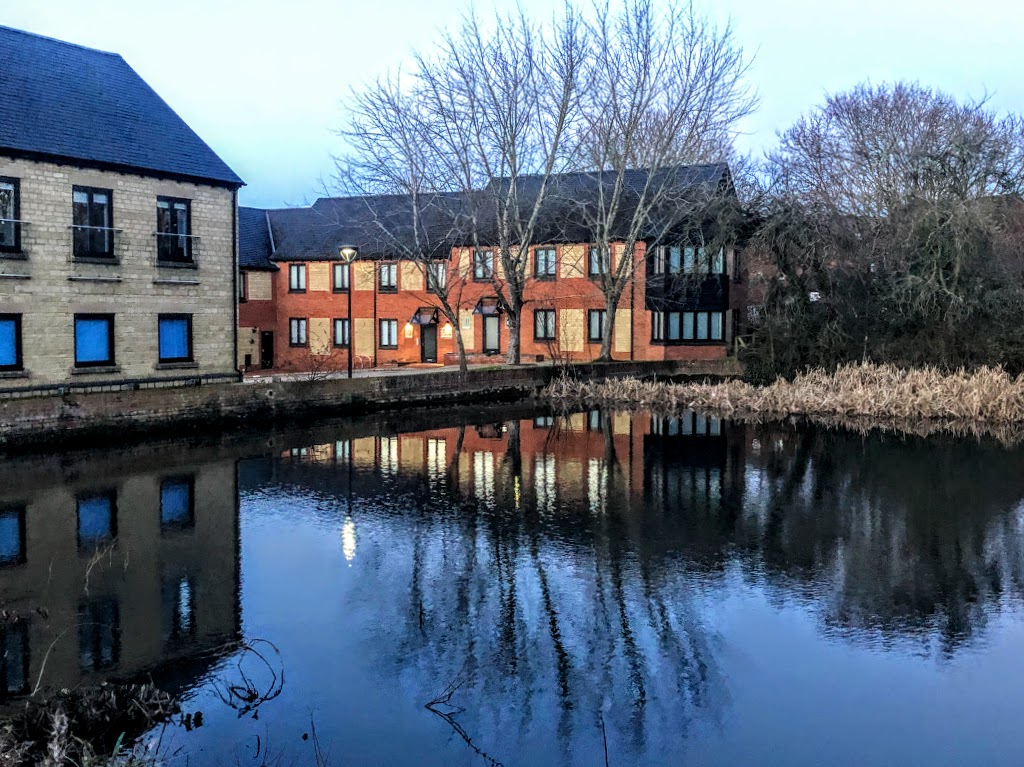
Showing posts with label Lake walks. Show all posts

15 April 2026

A return visit to Wolseley
after 55 years and lunch
in the Wolseley Arms

The Wolseley Arms, by the River Trent, near Rugeley in Staffordshire (Photograph: Patrick Comerford, 2026)

Patrick Comerford

I think it must be about 55 years since I previously Wolseley and interviewed Sir Charles Wolseley for the Lichfield Mercury and the Rugeley Mercury.

I was supposed to be training as a chartered surveyor through Jones Lang Wootton in Dublin and London and at the College of Estate Management, then part of Reading University, Charles Wolseley even offered to take me on as a trainee with him at Smiths Gore in Lichfield. Butat that age I had my heart set on becoming a journalist instead.

I was about 19 at that time, and that interview and feature secured my first freelance contract, writing a short series of features for the Lichfield Mercury and the Rugeley Mercury.

I have since passed Wolseley on the route between Stafford and Lichfield a number of times, but some inexplicable reason had never paid a return visit in all those years. I revisited it for the first time last week, when I decided to hop off the Stafford-Lichfield bus at Wolseley Bridge to have lunch at the Wolseley Arms, to walk by the River Trent and the lakes, and to visit the Wolseley Centre on the former Wolseley estate.

Woseley Bridge replaced a mediaeval bridge swept away in a flood in 1795 (Photograph: Patrick Comerford, 2026)

Family tradition says the Wolseley estate was given to the family in Anglo-Saxon times by King Edgar in 975 AD as a reward for ridding the area of wolves. As a reminder of that tradition, the Wolseley family adopted the motto Homo Homini Lupus (‘Man is a wolf towards his fellow man’), with a hunting dog in the shield of their coat of arms and a wolf’s head as the crest.

The Wolseley Arms sits on the banks of the River Trent, beside Wolseley Bridge, about 3 km (2 miles). A mediaeval wayfarers’ chapel was built on the bridge, supposedly on the central arch, but it was swept away with the rest of the bridge in 1795.

The pub is said to date back to the 15th century and originally was a hunting lodge on the Wolseley estate before being transformed into a coaching inn on the Liverpool-London route, and at one time, as a staging post for coaches, over 100 horses were kept at the Wolseley Arms.

The Wolseley Arms, said to date back to the 15th century, was known for some decades as the the Roebuck Inn (Photograph: Patrick Comerford, 2026)

The Wolseley Arms was the regular meeting place of the founder members of the Trent and Mersey Canal Co over 250 years ago. The first public meeting of the canal company, chaired by Granville Leveson-Gower (1721-1803), Earl Gower and later Marquess of Stafford, met there on 30 December 1765. When work on building the canal started, the inaugural spade-full of soil was dug out by Josiah Wedgewood at a point close by the inn. The stone section of the canal was completed in 1771.

Much to the chagrin of Sir Charles Wolseley (1769-1846), the seventh baronet, the coach traffic at the Wolseley Arms included the ‘Convict Van’ that stopped there in June 1834 to change horses and feed the convicts. The 18 prisoners were each offered a meal of white bread, cold beef and half a pint of ale.

Wolseley had a radical reputation and might have been expected to be more sympathetic to the plight of prisoners: as a young man in Paris, it is said, he took part in the storming of the Bastille in 1789; and in 1820, a year after his election as an MP, he was jailed for 18 months on charges of sedition and conspiracy.

A faded image of Wolseley Hall in the Wolseley Arms (Photograph: Patrick Comerford, 2026)

The Wolseley Arms changed its name to the Roebuck Inn after the original Roebuck on the other side of the road closed in the 1870s. Apparently, the pub had become known as a place of ill-repute and the Wolseley family did not want their name linked with a place like that.

The old name was partly restored and it became the Roebuck and Wolseley Arms around 1952, and it was still known as both the Wolseley Arms and the Roebuck Inn in 1963, when the Rugeley Times suggested it was one of the few pubs in England known by two names and with two signs to reflect this.

However, only the Wolseley Arms sign remained by 1973. The Wolseley Arms was enlarged that year and given a makeover with a mediaeval theme. It was renovated again in July 1982 when it was officially opened by the photographer Patrick Anson, 5th Earl of Lichfield.

Viscount Wolseley’s coat-of-arms from his ex libris bookplate

The interior decorations and fittings include many mementoes of the Wolseley family, including a faded and jaded image of Wolseley Hall, the seat of the Wolseley family, which was damaged by fire in the 1950s and finally demolished in 1966.

Interestingly, the only portraits on the walls of the Wolseley Arms of members of the Wolseley family are two of Field Marshal Garnet Joseph Wolseley (1833-1913), 1st Viscount Wolseley. But he was actually from the Irish branch of the family, seated at Mount Wolseley in Co Carlow, and was born in Golden Bridge House, Inchicore, Dublin. When his military career was recognised with a peerage in 1885, he paid tribute to his family’s roots in Staffordshire, taking the title of Viscount Wolseley, of Wolseley in the County of Stafford.

In a similar vein, the only heraldic emblem of the Wolseley family decorating the interior of the Wolseley Arms is Viscount Wolseley’s coat-of-arms from his ex libris bookplate.

A portrait of Dublin-born Field Marshal Garnet Joseph Wolseley (1833-1913), 1st Viscount Wolseley, in the Wolseley Arms (Photograph: Patrick Comerford, 2026)

Outside, the Wolseley Arms has managed to mistakenly present the Wolseley coat-of-arms that gives the pub its name. The original arms display a white shield with a red talbot or hunting dog (argent, a talbot passant gules), but on the pub sign the dog has turned in colour to black (argent, a talbot passant sable), the helmet is that of an untitled man rather than a baronet, black and white feathers – seen often in ‘bucket shop’ or AI generated cheap versions of heraldry – have replaced the wolf’s head that was a play on the family’s name and the legend of clearing wolves from this part of Staffordshire, and the displays are devoid of the motto echoing the family legend, Homo Homini Lupus.

I admit to being a heraldry nerd, but I also have a life-long familiarity with the Wolseley arms in heraldry: they are an inversion of the colours on the Comberford and Comerford coat-of-arms (gules, a talbot passant argent), and there were close links between the two families over many generations.

I remember an earlier sign with the correct colours, and hope that this mistake in presenting the Wolseley arms can be rectified by the Wolseley Arms, of all places.

The Wolseley arms at the Wolseley Arms … with the wrong colours and missing the wolf's head crest and the motto referring to the wolf legend (Photograph: Patrick Comerford, 2026)

The Wolseley Arms is a charming country pub and one of the 180 country pubs in Vintage Inn group that includes the Hedgehog in Lichfield and the Fish and Eel at Dobb’s Weir, near Hoddesdon.

After an enjoyable lunch there, I walked along the banks of the River Trent and under Wolseley Bridge, and then across to the Wolseley Centre in the former gardens of Wolseley Hall. Sir Charles Wolseley took a brave step in 1987 when he returned to Wolseley with plans to open the 45-acre landscaped gardens, attracting 250,000 visitors a year.

Wolseley Garden Park cost £1.73 million and was opened by Lord Rothschild in 1990. But the place only took in between £26,000 and £30,000 on gate receipts in its first year. The bank withdrew funding before the garden park was completed, and so had little chance of succeeding. Charles was made bankrupt in 1996 with mounting debts of £2.5 to £3 million, which he blamed on the recession and high interest rates.

The sad failure of that promising venture ended with the Wolseley family losing the 1,490 acre estate and a home that had passed down through successive generations for 1,000 years or more – the latest generation had failed to keep the wolf from the door.

The Wolseley Visitor Centre and Nature Reserve opened in the ground of the former Wolseley estate in 2019 (Photograph: Patrick Comerford, 2026)

The Wolseley Visitor Centre and Nature Reserve has been a nature reserve and the headquarters of the Staffordshire Wildlife Trust since 2003.

Sir Charles Wolseley died at the age of 73 on 5 March 2018, and his funeral took place in Saint Joseph and Saint Etheldreda Catholic Church, Rugeley. The site at the Wolseley Centre was redeveloped later that year, and opened as the Wolseley Visitor Centre and Nature Reserve in 2019. The grounds extend to 11 ha (26 acres), including woodlands, lakes, pools and marshland with wildlife habitats, a boardwalk around the pools and marshland, wildflower meadows and display gardens, a sensory garden a café with views across the lake.

In the afternoon April sunshine, I hopped back on the Stafford to Lichfield bus outside the Wolseley Centre, and on a whim decided to stop off in Rugeley before continuing on to Lichfield and Evening Prayer in Lichfield Cathedral. But more about Rugeley, its churches, and some more memories from 55 years ago in the days to come, hopefully.


A walk in April sunshine by the lakes at the Wolseley Centre and nature reserve (Patrick Comerford, 2026)

08 February 2026

Childhood memories of
waiting for Tomorrow
with Petticoat Loose by
the shores of Bay Lough

Bay Lough, the ‘bottomless’ lake near the Vee in the Knockmealdown Mountains … ‘Petticoat Loose’ and the monsters were condemned to its waters until ‘Tomorrow’ (Photograph: Patrick Comerford)

Patrick Comerford

I was musing a few evenings ago about the Greek word for tomorrow and how we can joke that the word avrio (αύριο) can never convey the same urgency that mañana has in Spanish.

Our anxieties about tomorrow are raised again in the Gospel reading tomorrow (Matthew 6: 25-34), when Jesus says: ‘But if God so clothes the grass of the field, which is alive today and tomorrow is thrown into the oven, will he not much more clothe you – you of little faith? … Therefore do not worry about tomorrow, for tomorrow will worry about itself. Each day has enough trouble of its own’ (Matthew 6: 30, 34).

Tomorrow seemed to be a far-away world to us as children on those Sunday afternoons when we were regularly brought on family outings to the ‘Vee’, a scenic, V-shaped hairpin bend in the Knockmealdown Mountains, with spectacular views across the Golden Vale and three counties, Waterford, Tipperary and Cork.

At the Vee we were halfway between Cappoquin and Clogheen, and only a few miles from my grandmother’s farm, we were entertained with stories and tales about Samuel Grubb and the grave where he was buried standing, and about ‘Petticoat Loose’ and the monsters in Bay Lough, the ‘bottomless’ lake, who came up and asked, day after day, ‘Is it tomorrow.’

The grave of Samuel Grubb overlooking the Vee and the Golden Vale (Photograph: Patrick Comerford)

Samuel Richard Grubb (1855-1921) was a wealthy landowner of Quaker descent and a former High Sheriff of Co Tipperary. His distinctive, beehive-shape grave stands on Sugarloaf Hill overlooking the Vee and the Golden Vale. He said he wanted to be buried on the mountainside, standing upright, so that he could keep watch over ‘his people’ and ‘his fields’ at Castle Grace, where he farmed over 1,600 acres.

Before he died, Grubb designed his grave of rubble stone, looking like one of the clochans on the Great Skellig. Some say he asked to be buried there because the Grubb family had been by the Society of Friends or Quakers before Samuel was born for attending ‘balls at which music and dancing form a chief part’.

Grubb died on 6 September 1921 and was buried four days later, with the Revd J Talbot of Clogheen conducting the burial service. Grubb was buried standing up, with his dog beside him, although some people in the area said the men who buried him put him in the grave upside down.

From his grave 2,000 ft up in the mountains, there are panoramic views across the Golden Vale, and of the Galtee Mountains, the Comeragh Mountains and Slievenamon. On clear summer days as we looked across the valley below, and the villages of Clogheen, Ardfinnan and Ballyporeen (later known as the ancestral home of Ronald Reagan) were pointed out to us, and the towns of Cahir and Clonmel. The Grubb family sold Castle Grace near Clogheen in 2019, although many of his descendants continue to live in the area, including Nicholas Grubb who lives in Dromana House at Villierstown, near Cappoquin.

The panoramic view from the Vee across south Tipperary (Photograph: Patrick Comerford)

Close to the Vee Gap, on the county boundaries of Waterford and Tipperary, Bay Lough is on the side of Knockaunabulloga in the Knockmealdown Mountains, close to Saint Declan’s Way, the path Saint Declan trod as he made his way from Ardmore to Cashel.

Bay Lough is easily accessed from a car park on the Co Waterford side of the lake. Many people believe it is a ‘bottomless’ lake and that it is not possible to swim across it, even though it is quite small. In late May and early June, the rhododendrons are in bloom at the lake, providing spectacular views from Bay Lough to Clogheen.

Folklore in South Tipperary and West Waterford says the lake is the place where Petticoat Loose was banished, condemned as penance to drain the ‘bottomless’ lake with a thimble until tomorrow came.

Local folklore portrays Petticoat Loose as a vengeful ghost, a banshee or a haunting witch and sometimes identify her as Mary Hannigan. She was said to be a 6-ft tall, strong woman who did a man’s work on the farm, drank like a man, fought like a man and wrestled and fought the local men when they mocked her. But she was known too for adulterating milk and for her wicked behaviour. They say she killed a bull with a single blow of her first, killed a farmhand with his own spade, and threatened to kill anyone who told on her.

Mary Hannigan was born in the early 19th century, the only child of a well-to-do farming family who lived in the townland of Colligan, near Clogheen, and she was known for her love of dancing and drinking. During one drunken dance, as she spun around, her skirt was caught on a nail and fell to the ground, causing mirth and leading to laughter and jeering. The incident raised her anger and left her with the name ‘Petticoat Lucy’ or ‘Petticoat Loose’.

She met her future husband on the dance floor, but the marriage lasted only a year, and he met an early death. Local people whispered that Mary’s lover, a local hedge-school teacher, had murdered him.

Then, one night during a drinking session in a pub in Dungarvan, Mary drank half a gallon of beer, suddenly slumped forward onto the table and died. There was a big wake but no priest was called, even for the burial.

Seven years after her death, there were several sightings of Petticoat Loose, seen as a ghost with red hair or as a monstrous horse-headed figure who had returned to haunt people on the Vee road. She was also seen in the pubs and dance halls and became the terror of the Vee road, although – for some inexplicable reason – she never harmed any man with the name John.

She continued to haunt the Vee road close to Bay Lough, and it became a common practice for people travelling at night to carry religious relics or hazel sticks as protection.

Finally, people who were living in fear of Petticoat Lucy called on a local priest to rid the area of Mary and her nightly visits. One night, the priest and two men spotted her coming across a field. When the priest asked her name, she replied ‘I’m Petticoat Loose’, telling him she would do evil wherever she was.

‘We will see’, the priest replied. ‘I will place you head downwards.’ He took out a bottle of holy water and sent her to the far banks of the deepest lake, telling her: ‘You shall be condemned until judgment day to empty it with a thimble!’

The priest is said to have died two weeks later – some say she had drained the life out of him.

Many people say Petticoat Loose still sits on the far bank of Bay Lough with her thimble, vainly trying to empty the lake, waiting for tomorrow. Some say she sometimes appears out of the water and asks the same questions over and over again: ‘When will judgment day come?’ ‘Is it tomorrow?’

She is often associated with other spirits and monsters trapped in the lake by Saint Patrick. He told them to stay there and wait, and that he would be back tomorrow. So, they are still there, deep in the dark waters, waiting for tomorrow. Petticoat Loose, or one of the monsters, is said to surface occasionally to ask ‘Is it tomorrow?’

It is only possible to walk about half way around Bay Lough and few ever swim in the lake (Photograph: Patrick Comerford)

Bay Lough is a favourite for walkers and family outings, although it is only possible to walk about half way around the lake, and few ever swim in it, frightened off by tales that Petticoat Loose waits below to grab your legs and pull you down.

Perhaps the idle tale that Samuel Grubb was buried upside down was conflated or confused with the story that Petticoat Loose had been sent head down into the lake. As children we revelled in those stories, pretending to be only slightly scared. But in the 1950s and the early 1960s, the men in the family had probably driven up to the Vee and Bay Lough to get better radio reception.

Back on my grandmother’s farm near Cappoquin, in a valley below the Knockmealdowns, the mountains often blocked reception of what was then Radio Éireann. Instead, I grew up listening to the BBC Light Programme, nourished by a daily diet of programmes that included the Archers, Mrs Dales Diary, Hancock’s Half Hour, Housewives’ Choice, Listen with Mother, Woman’s Hour, and, of course, the Goons. Petticoat Loose may have been as far from Petticoat Lane as I could imagine, yet I understand how I grew up in rural Ireland with Received Pronunciation or ‘BBC English’ as my first language.

In those years, the Waterford hurlers were at their peak, reaching the All-Ireland finals in 1957, 1959 and 1963, and the men in the family needed better reception to hear the match commentaries. The ‘wireless’ was taken from the house, brought with us up to Bay Lough or Grubb’s Grave and connected to the car battery so my uncles could listen to Mícheál Ó hEithir’s match commenaties while we children played and picknicked by the lake shore or on the mountainside.

As a treat later, we were brought back to the ‘Cats’ near Melleray for lemonade and crisps, while the men celebrated the match result – or drowned their sorrows. Later we might even be allowed to listen to the music or watch the dancing at the ‘Stage’ … if we behaved ourselves.

The working week resumed on Monday morning. Cows were to be milked, animals had to be fed, there was shopping to do in Cappoquin, and children had to go to school. Tomorrow always came.

Tomorrow brought work, school and shopping in Cappoquin (Photograph: Patrick Comerford)

Sexagesima Sunday and
the hope for that day when
‘heaven may be renewed’ and
‘Earth shall be very good’

‘Earth may not pass till heaven shall pass away’ (Christina Rossetti) … a February sunset at Minster Pool in Lichfield (Photograph: Patrick Comerford)

Patrick Comerford

Today [8 February 2026] is the Second Sunday before Lent, which is also known in some parts of the Anglican Communion as Creation Sunday. In the past, this Sunday was known as Sexagesima, one of those odd-sounding Latin names once used in the Book of Common Prayer for the Sundays in Ordinary Time between Candlemas and Lent: Septuagesima, Sexagesima and Quinquagesima.

These weeks, between the end of Epiphany and Ash Wednesday, are known as Ordinary Time. We are in a time of preparation for Lent, which in turn is a preparation for Holy Week and Easter.

The Sunday known as Sexagesima, although falling 57 days before Easter, was given this name representing 60 days before Lent. In the Western Church, these Sundays before Lent were a preparation for Lent: the refrain alleluia was forbidden in services, and the Alleluia acclamation at the Eucharist was replaced by the Tract, usually verses from the Psalms. The liturgical colour was also changed, so that purple or violet vestments were worn.

In very visible and audible ways, the three Sundays before Lent became an extension to Lent, and the longer period was often called ‘the Greater Lent.’ However, while their traditional names have a certain nostalgic beauty associated with them, they have no real logical, liturgical foundation and they make no sense numerically.

In recent years, the ‘-gesima’ Sundays before Lent have become part of Ordinary Time, and from the late 1960s on they were no longer regarded as a pre-penitential season, and this Sunday is now counted as the Second Sunday before Lent.

Christina Rossetti’s poem ‘Sexagesima’ takes its title from this Latin name once used for the Second Sunday before Lent. We are more likely to associate Christina Rossetti (1830-1894) with Christmas rather than Ordinary Time or Lent because two of her poems, ‘In the Bleak Midwinter’ and ‘Love came down at Christmas,’ are among the best-loved and most popular Christmas carols.

She was born in London, the daughter of Gabriele Rossetti, an exiled Italian poet, and she was a sister of Dante Gabriel Rossetti, the Pre-Raphaelite artist and poet. Their brother William Michael Rossetti and sister Maria Rossetti were writers too.

At the age of 14, Christina Rossetti suffered a nervous breakdown and left school. Bouts of depression and related illness followed. During this period she, her mother and her sister became absorbed in the Anglo-Catholic movement that developed in the Church of England, and religious devotion came to play a major role in Christian Rossetti’s life.

She spent much time spent alone, in prayer, in a single life, devoted to Christ and to working with the marginalised. Her writings have strongly influenced writers such as Ford Madox Ford, Virginia Woolf, Gerard Manley Hopkins, Elizabeth Jennings and Philip Larkin. She is honoured in the liturgical calendar of the Church of England and other Anglican churches on 27 April.

Christina Rossetti, by her brother Dante Gabriel Rossetti

Sexagesima, by Christina Georgina Rossetti:

Yet earth was very good in days of old,
And earth is lovely still:
Still for the sacred flock she spreads the fold,
For Sion rears the hill.

Mother she is, and cradle of our race,
A depth where treasures lie,
The broad foundation of a holy place,
Man’s step to scale the sky.

She spreads the harvest-field which Angels reap,
And lo! the crop is white;
She spreads God’s Acre where the happy sleep
All night that is not night.

Earth may not pass till heaven shall pass away,
Nor heaven may be renewed
Except with earth: and once more in that day
Earth shall be very good.

‘… and once more in that day / Earth shall be very good’ (Christina Rossetti) … a February walk along Cross in Hand Lane on the northern edges of Lichfield (Photograph: Patrick Comerford)

09 January 2025

Daily prayer in Christmas 2024-2025:
16, Thursday 9 January 2025

‘The boat was out on the lake, and he was alone on the land’ (Mark 6: 47) … on the water at Bako National Park, north of Kuching in Sarawak (Photograph: Patrick Comerford, 2024)

Patrick Comerford

The 40-day season of Christmas continues until Candlemas or the Feast of the Presentation (2 February).

Before today begins, I am taking some quiet time this morning to give thanks, to reflect, to pray and to read in these ways:

1, today’s Gospel reading;

2, a short reflection;

3, a prayer from the USPG prayer diary;

4, the Collects and Post-Communion prayer of the day.

‘Then he got into the boat with them and the wind ceased’ (Mark 6: 51) … gondolas near Saint Mark’s Square in Venice (Photograph: Patrick Comerford)

Mark 6: 45-52 (NRSVA):

45 Immediately he made his disciples get into the boat and go on ahead to the other side, to Bethsaida, while he dismissed the crowd. 46 After saying farewell to them, he went up on the mountain to pray.

47 When evening came, the boat was out on the lake, and he was alone on the land. 48 When he saw that they were straining at the oars against an adverse wind, he came towards them early in the morning, walking on the lake. He intended to pass them by. 49 But when they saw him walking on the lake, they thought it was a ghost and cried out; 50 for they all saw him and were terrified. But immediately he spoke to them and said, ‘Take heart, it is I; do not be afraid.’ 51 Then he got into the boat with them and the wind ceased. And they were utterly astounded, 52 for they did not understand about the loaves, but their hearts were hardened.

‘When evening came, the boat was out on the lake’ (Mark 6: 47) … a small lake at the Sarawak Cultural Village, near Kuching (Photograph: Patrick Comerford, 2024)

Today’s Reflection:

Saint Mark’s account of the feeding of the 5,000 (6: 34-44), which was the Gospel reading at the Eucharist yesterday, is followed today by his account of Jesus calming the storm on the lake (Mark 6: 45-52).

Each of Saint Mark’s feeding miracles is joined with a water miracle, evoking the Exodus stories, including God parting the waters (Exodus 14: 19-31) and God feeding the people in the wilderness (Exodus 16: 31-21), and the disciples’ misunderstanding is a serious condition, akin to Pharaoh’s misunderstanding that is linked to his oppression of the enslaved people (see Exodus 7 to 11).

In today’s Gospel reading, the disciples are on a boat on their way to Bethsaida when they are caught in a storm on the lake. Jesus walks on the water, calms their fears and shows his divine power – in this case over the stormy, choppy seas (verses 45-52).

In the Gospel reading, the disciples feel abandoned as they face their worst fears and face the abyss in the sea, the fear of drowning in the storms of life, of falling into the pit.

But Christ tells them, ‘Take heart, it is I; do not be afraid.’ And they respond with faith, bow down and worship him, and proclaim him the Son of God.

Christ tells the disciples to get into the boat and to go ahead of to the other side of the lake while he sends the crowd home.

Then, instead of using another boat to follow the disciples, or walking around the shoreline, he goes up a mountain by himself, and he spends the evening and much of the night in prayer.

The Sea of Galilee is shallow, but storms can rise suddenly. Early in the morning, before dawn, the boat is far from the shore when it is battered by waves and the wind. The disciples have lost control and are frightened. They see Jesus walking on the sea, and are terrified even more, thinking they are seeing a ghost. They cry out in their fears, but Jesus seeks to calm their fears: ‘Take heart, it is I; do not be afraid’ (verse 50).

During the past year, I have enjoyed a number of journeys on boats, and walked by countless rivers, harbours, lakes and canals, enjoying the sight of other people enjoying their time in boats and on the water – in Cambridge, Dublin, Great Linford, Iraklion, Kuching, London, Oxford, Paris, Rethymnon, Singapore, Stony Stratford …

It is almost 60 years since I first went rowing as a teenager on Lough Ramor in Virginia. But as an adult, I had long thought that I would be left regretting that I had arrived in Cambridge as a student in my 50s, too late in life to learn, or to re-learn how to row. I had come to enjoy rowing as a sport and an activity, but in a very passive way.

Then one evening, as I was standing casually at the slipway at Askeaton, Co Limerick, where I was living as the priest-in-charge, I was suddenly and unexpectedly invited to get into a boat and started to row.

I was fearless. It was a pleasure I had often hoped for and wished for. And for almost an hour, we rowed upstream, under the bridge at Askeaton, and as far as the castle, and then downstream past the factory, although not as far as the estuary.

When I suggested that I might be too old to learn, I was told brusquely and with humour, that once I stopped learning I had stopped living.

Since then, I have watched children and teenagers hop in and out of boats, freely and fearlessly, confident of their own ability and the ability of those who are training them.

Freely and fearlessly. But as I was messing about on boats in Crete during a holiday some years ago, hopping on and off boats in the sun as I visited smaller islands and lagoons off the coast, I thought of how this was a pleasure that I was paying for, while many refugees were full of fear as they boarded boats in the dark trying to arrive on Greek islands, or cross the Channel, having paid exorbitantly for the risk and the dangers.

Freely. Fearlessly. What are your worst fears?

Many of us have continuing fears about the economy, and some of us have fears that there may be yet another about the Covid-19 pandemic, or that the conflicts raging between Russia and Ukraine and throughout the Middle East may spill over into our own ‘safe areas’. Others of us also have well-founded fears about the ways a second Trump presidency threatens stability in the US and across the world.

As we grow up and mature, we tend to have fewer fears of the outside world, and as adults we begin to cope with the fears we once had as children, by turning threats into opportunities.

The fears I had as a child – of snakes, of the wind, of storms at sea, of lightning – are no longer the stuff of the recurring nightmares they were when I was a child. I have learned to be cautious, to be sensible and to keep my distance, and to be in awe of God’s creation.

Most of us have recurring dreams that are vivid and that have themes that keep repeating themselves. Yet in sleep the brain can act as a filter or filing cabinet, helping us to process, deal with and put aside what we have found difficult to understand in our waking hours, or to try to find ways of dealing with our lack of confidence, feelings of inadequacy, with the ways we confuse gaining attention with receiving love, or with our needs to be accepted, affirmed and loved.

The disciples’ plight in today’s Gospel reading seems to be the working out of a constant, recurring, vivid dream of the type many of us experience at some stage: the feelings of drowning, floating and falling suddenly, being in a crowd and yet alone, calling out and not being heard, or not being recognised for who we are.

As seasoned boat-handlers, the Disciples know not to try walking on water. They know the risk of sudden storms and swells, and they know the safety of a good boat, as long as it has a good crew.

But since the early history of the Church, the boat has symbolised the Church. The bark (barque or barchetta) symbolises the Church tossed on the sea of disbelief, worldliness, and persecution but finally reaching safe harbour. Part of the imagery comes from the ark saving Noah’s family during the Flood (I Peter 3: 20-21). Christ protects the Disciples and their boat on the stormy Sea of Galilee (see also Matthew 14: 22-33; John 6 16-21). The mast forms the shape of the Cross.

It is an image that appears in Apostolic Constitutions and the writings of Tertullian and Clement of Alexandria. We still use the word nave for the main part of the church, which, architecturally often looks like an up-turned boat.

None of us should risk walking on water, or risk play stupidly in boats on the river or in choppy waters or storms. But if we are to dream dreams for the Church and for the Kingdom of God, we need to be aware that it comes at the risk of feeling we are being sold out by those we see as brothers and sisters, and risk being seen as dreamers rather than people of action by others: for our dreams may be their nightmares.

If we are going to dream dreams for the Church, for the Kingdom of God, we may need to step out of our safety zones, our comfort zones, and know that this comes with a risk warning.

And if we are going to dream dreams for the Church, for the Kingdom of God, we need to keep our eyes focussed on Christ, and to know that the Church is there to bring us on that journey.

Let us dream dreams, take risks for the Kingdom of God, step outside the box, but let us keep our eyes on Christ and remember that the boat, the Church, is essential for our journey, and let us continue to worship the Lord in the beauty of holiness.

‘He came towards them early in the morning, walking on the lake’ (Mark 6: 48) … flood waters near the River Ouse at Stony Stratford (Photograph: Patrick Comerford, 2024)

Today’s Prayers (Thursday 9 January 2025):

The theme this week in ‘Pray With the World Church’, the Prayer Diary of the Anglican mission agency USPG (United Society Partners in the Gospel), is ‘The Melanesian Brotherhood Centenary’. This theme was introduced on Sunday with a Programme Update by Ella Sibley, Regional Manager for Europe and Oceania, USPG.

The USPG Prayer Diary today (Thursday 9 January 2025) invites us to pray:

God of peace, we pray for the Pacific Islands, asking you to bring unity, stability, and harmony to the region.

The Collect:

O God,
who by the leading of a star
manifested your only Son to the peoples of the earth:
mercifully grant that we,
who know you now by faith,
may at last behold your glory face to face;
through Jesus Christ your Son our Lord,
who is alive and reigns with you,
in the unity of the Holy Spirit,
one God, now and for ever.

The Post-Communion Prayer:

Lord God,
the bright splendour whom the nations seek:
may we who with the wise men have been drawn by your light
discern the glory of your presence in your Son,
the Word made flesh, Jesus Christ our Lord.

Additional Collect:

Creator of the heavens,
who led the Magi by a star
to worship the Christ-child:
guide and sustain us,
that we may find our journey’s end
in Jesus Christ our Lord.

Yesterday’s Reflection

Continued Tomorrow

‘Then he got into the boat with them and the wind ceased’ (Mark 6: 51) … the River Cam and the Backs below Magdalene Bridge in Cambridge (Photograph: Patrick Comerford, 2024)

Scripture quotations are from the New Revised Standard Version Bible: Anglicised Edition copyright © 1989, 1995 National Council of the Churches of Christ in the United States of America. Used by permission. All rights reserved worldwide. http://nrsvbibles.org


13 December 2023

Samuel Johnson
and his five willows
by Stowe Pool in his
‘City of Philosophers’

Samuel Johnson amid the Christmas lights … he described Lichfield as ‘a city of philosophers’ almost 250 years ago (Photograph: Patrick Comerford, 2023)

Patrick Comerford

The Calendar of the Church of England in Common Worship today (13 December) has been commemorating Samuel Johnson (1709-1784), a pious Anglican throughout his life, but is best remembered as a writer of dictionaries and a literary editor.

Johnson, who was known as ‘The Great Moralist’, was a High Church Anglican and deeply committed to the Church of England since his younger days when he read William Law’s A Serious Call to a Devout and Holy Life.

It is almost 250 years since Samuel Johnson took his friend James Boswell to Lichfield in 1776 to show him ‘genuine civilised life in an English provincial town’. Later Johnson would recall: ‘I lately took my friend Boswell and showed him genuine civilised life in an English provincial town. I turned him loose at Lichfield.’

They stayed at the Three Crowns in Breadmarket Street, beside the house on the corner of Market Square where Johnson was born and spent his childhood.

When Bosswell asked Johson why the people of Lichfield seemed to lack industry, Johnson famously replied that the people of Lichfield were philosophers: ‘Sir, (said Johnson,) we are a city of philosophers: we work with our heads, and make the boobies of Birmingham work for us with their hands.’

Lichfield has grown considerably in the two and a half centuries since that visit, from 4,000 people in Samuel Johnson’s days, to almost 35,000 people today. It is one of England’s smallest cities, but retains its civilised charm, and I returned to Johnson’s ‘city of philosophers’ – as I do so often – for a personal, three-day retreat last weekend.

Samuel Johnson was a key figure in shaping the English language as we use it today. Indeed, he has been described as ‘arguably the most distinguished man of letters in English history’ and his biography by Boswell has been described as ‘the most famous single work of biographical art in the whole of literature.’

Although Johnson began his literary career as a ‘Grub Street’ journalist, he made lasting contributions to English literature as a poet, essayist, moralist, novelist, literary critic, biographer, editor and lexicographer.

Samuel Johnson’s monument in a corner of the south transept in Lichfield Cathedral (Photograph: Patrick Comerford, 2023)

But why did Samuel Johnson describe Lichfield ‘a city of philosophers’?

In the decades before Johnson’s birth, Lichfield had been badly battered in the English Civil War. But the first sign of faith in its future was the decision by Bishop John Hacket to rebuild Lichfield Cathedral immediately after the Caroline Restoration.

Writers and cultural figures associated with Lichfield in the immediate aftermath of the Cromwellian era include: Elias Ashmole (1617-1692), whose legacy lives on in the Asmolean Museum in Oxford; Bishop John Fell (1625-1686), remembered in rhyme that opens ‘I do not like thee Doctor Fell’, and the son of a Dean of Lichfield; and Lancelot Addison (1632-1703), Dean of Lichfield and father of the essayist Joseph Addison (1672-1719).

It is easy to understand how, by the 18th century, Lichfield was a centre of genteel society, so that Daniel Defoe considered it the best town in the area for ‘good conversation and good company.’ There was little industry in Lichfield, but the place prospered thanks to both the wealth of the clergy in the Close, and to its place as coaching city on the main route to the north-west and Ireland.

The 18th century became a period of great intellectual activity, and Lichfield was home to many figures of intellect and culture, including Samuel Johnson, David Garrick, Erasmus Darwin and Anna Seward, prompting Johnson’s observation that Lichfield was ‘a city of philosophers’.

I spent some time on Sunday afternoon browsing the second-hand book stall in the Samuel Johnson Birthplace Museum, the five-storey house at the west end of the Market Square where Samuel Johnson was born on 18 September 1709.

Samuel Johnson married the widowed Elizabeth Porter in 1735, when he was 25 and she was 46 and the mother of three children. Two years later, Johnson and 20-year-old David Garrick set off for London in 1737 in search of fame and fortune. They survived many difficulties, and eventually Johnson became the leading literary figure of his generation and Garrick the leading actor.

Johnson’s fortunes took a dramatic turn in 1746 when a publisher commissioned him to compile a dictionary of the English language – a contract that was worth 1,500 guineas. Johnson claimed he could finish the project in three years. In comparison, the Académie Française had 40 scholars who would spend 40 years completing its French dictionary. Eventually, it took Johnson nine years to complete his Dictionary of the English Language.

Johnson’s Dictionary was not the first, nor was it unique. But it remained the standard, definitive and pre-eminent English dictionary for 150 years, until the Oxford English Dictionary was published in 1928. His Dictionary offers insights into the 18th century, providing ‘a faithful record of the language people used.’ It has been described as ‘one of the greatest single achievements of scholarship.’ As a work of literature, it has had a far-reaching impact on modern English.

The first edition of Johnson’s Dictionary is a huge book. The pages are almost 18 inches tall, and the book is 20 inches wide when opened. It contains 42,773 entries, and sold for £4 10s, the equivalent of about £350 today. An important innovation was his use of around 114,000 literary quotations to illustrate meanings. The authors most frequently cited include Shakespeare, Milton and Dryden.

Erasmus Darwin (1731-1802) was a generation younger than Johnson. He had a medical practice close to the cathedral, between the Close and Beacon Street, from 1757 until 1781, and was a member of the Lunar Society, which met sometimes in his house in Lichfield, from 1765 to 1813. The inner circle included Darwin, James Watt, Matthew Bolton, Joseph Priestley and Josiah Wedgwood, while others involved included the engineer James Brindley, the botanist Joseph Banks, American polymath Benjamin Franklin, astronomer William Herschel, printer and designer James Baskerville and artist Joseph Wright of Derby.

Johnson’s Willow (centre) with Lichfield Cathedral in the background … it is the fifth willow in this place on the north side of Stowe Pool (Photograph: Patrick Comerford, 2023)

During the weekend, I also took time to revisit some other Johnson legacies in Lichfield: the Johnson statue in Market Square; his monument in a corner of the south transept of Lichfield Cathedral; John Myatt’s fading mosaic mural on a wall on a corner of Bird Street, opposite New Minster House; and ‘Johnson’s Willow’ on the north shore of Stowe Pool.

I have been familiar with the willow trees at this location for over 50 years, and the present willow tree is the fifth there since Johnson’s days.

The first willow there was probably planted around 1700, and became famous for two reasons: its great size, and its connections with Samuel Johnson.

When Johnson was young, the willow was close to his father’s parchment factory. When he returned to Lichfield in later years, he never failed to visit the tree, passing it on his way to visit his friends the Aston sisters who lived at the two large houses on Stowe Hill. He is said to have described the willow as ‘the delight of his early and waning life’.

The willow also attracted the interest of the Lichfield poet Anna Seward (1742-1809) and the American poet Elizabeth Graeme Fergusson (1737-1801). Fergusson wrote two long ‘Odes on the Litchfield (sic Willow’, in which she celebrated Johnson and other cultural figures who might have walked beneath the willow’s boughs.

Fergusson also used this tree, along with its ancestors and descendants, to symbolise the spread of civilisation from the ancient world to modern Britain and America.

Because of the willow’s association with Johnson, many later visitors to Lichfield came to see it. The original tree eventually became decayed, and in 1829 it was blown down. But it has been replaced by many of its descendants ever since.

A second willow, grown from a cutting of the original, was planted on the same site in 1830. It too was blown down in a great storm in 1881.

The third willow – again a true descendant – was not planted beside Stowe Pool until 1898. In 1956 it was found to be unsafe, and was felled after cuttings had been taken to raise a new tree.

The fourth willow was planted in 1959 during the celebrations of the 250th anniversary of Johnson’s birth.

Because of decay, the fourth willow was pollarded in 2014, 2016 and 2018, and it was finally felled on 8 October 2021. However, cuttings had been taken, and one of these was planted on the same site by Stowe Pool on 2 November 2021 to become the fifth willow. The ceremony included a reading of a poem about Johnson’s Willow by Sarah Dale, the winning entry in the Johnson Society’s Willow poetry competition.

Johnson’s Willow remains a part of Lichfield’s heritage and a much-loved link with Johnson and his age.

John Myatt’s fading mosaic mural of Samuel Johnson on a wall on a corner of Bird Street (Photograph: Patrick Comerford, 2023)

On his last visit to church, the walk strained Samuel Johnson. However, while there he wrote a prayer for his friends, the Thrale family: ‘To thy fatherly protection, O Lord, I commend this family. Bless, guide, and defend them, that they may pass through this world, as finally to enjoy in thy presence everlasting happiness, for Jesus Christ’s sake. Amen.’

In his last prayer, on 5 December 1784, before receiving Holy Communion and eight days before he died, Samuel Johnson prayed:

Almighty and most merciful Father, I am now, as to human eyes it seems, about to commemorate, for the last time, the death of thy Son Jesus Christ our Saviour and Redeemer. Grant, O Lord, that my whole hope and confidence may be in his merits, and his mercy; enforce and accept my imperfect repentance; make this commemoration available to the confirmation of my faith, the establishment of my hope, and the enlargement of my charity; and make the death of thy Son Jesus Christ effectual to my redemption. Have mercy on me, and pardon the multitude of my offences. Bless my friends; have mercy upon all men. Support me, by the grace of thy Holy Spirit, in the days of weakness, and at the hour of death; and receive me, at my death, to everlasting happiness, for the sake of Jesus Christ. Amen.

As he lay dying, Samuel Johnson’s final words were: ‘Iam Moriturus’ (‘I who am about to die’). He fell into a coma and died at 7 p.m. on 13 December 1784 at the age of 75. He was buried at Westminster Abbey a week later.

Johnson’s life and work are celebrated in a stained glass window in Southwark Cathedral, he has monuments in Westminster Abbey, Saint Paul’s Cathedral, London, and Lichfield Cathedral, and he is named in the calendar of the Church of England on this day as a modern Anglican saint.

The Samuel Johnson Birthplace Museum in Lichfield where Samuel Johnson was born on 18 September 1709 (Photograph: Patrick Comerford, 2023)

01 January 2023

‘For last year’s words belong to
last year’s language and next
year’s words await another voice’

‘We shall not cease from exploration’ … winter sunset in the fields between Stony Stratford and Wolverton Mill (Photograph: Patrick Comerford, 2022)

Patrick Comerford

For last year’s words belong to last year’s language
And next year’s words await another voice.
…

We shall not cease from exploration
And the end of all our exploring
Will be to arrive where we started
And know the place for the first time.
Through the unknown, unremembered gate
When the last of earth left to discover
Is that which was the beginning;
At the source of the longest river
The voice of the hidden waterfall
And the children in the apple-tree

Not known, because not looked for
But heard, half-heard, in the stillness
Between two waves of the sea.


— TS Eliot, Little Gidding

‘And the end of all our exploring / Will be to arrive where we started’ (Photograph: Patrick Comerford, 2022)

‘Little Gidding’ is the last poem in TS Eliot’s Four Quartets.

Moving from last year’s words and language to the voice of this new year provides an opportunity to reflect on the meaning of time, the past, the present and the future.

A good place to do this last week was during the walks Charlotte and I took by the Balancing Lakes and the fields between Stony Stratford and Wolverton Mill.

It is a New Year, and I am now living on the outskirts of Milton Keynes, and living outside Ireland for the first time in many years. Fifty years ago I was living on High Street in Wexford; half a century later, I am living on High Street in Stony Stratford.

Time plays games with us all as we move between one place and the next, from one year to the next. Yet time does little to diminish the impact of a move like this, or to dampen the emotions – joys and losses – that are at the heart of making such a move.

During those late afternoon strolls at sunset by the water, between the enveloping dusk of the afternoon and the winter darkness of the evening, I was aware of how time moves on relentlessly even when we think we are moving at our own pace.

It has been a year in which I have been made aware of my own frailty and failings. Yet, in the midst of great losses, there have been immeasurable gains.

But ‘what might have been … is always present,’ as TS Eliot reminds us in ‘Burnt Norton,’ his first poem in the Four Quartets. And I have promised myself more time this year for walks by rivers and lakes, in gardens and in the countryside, more time for wonder at the world and creation, more time for prayer and reflection, and more time for friendship and for love.

‘Through the unknown, unremembered gate’ … in the mid-December snow in Saint Mary’s churchyard in Shenley Church End (Photograph: Patrick Comerford, 2022)

Time present and time past
Are both perhaps present in time future
And time future contained in time past
If all time is eternally present
All time is unredeemable.
What might have been is an abstraction
Remaining a perpetual possibility
Only in a world of speculation.
What might have been and what has been
Point to one end, which is always present.
Footfalls echo in the memory
Down the passage which we did not take
Towards the door we never opened
Into the rose-garden.


— TS Eliot, Burnt Norton

‘Footfalls echo in the memory / Down the passage which we did not take’ … night time in Stony Stratford (Photograph: Patrick Comerford, 2022)

29 December 2022

A walk through the fields
near Stony Stratford and
Wolverton to Warren Park

Walking in the fields and countryside around Stony Stratford and Wolverton at dusk (Photograph: Patrick Comerford, 2022)

Patrick Comerford

The people who walked in darkness
have seen a great light
(– Isaiah 9: 2)

These days after Christmas Day have been relaxing and the days have been dry at times and almost sunny, with weather that has encouraged the two of us to go for walks in the fields and countryside around Stony Stratford and Wolverton.

The Balancing Lake between Wolverton and Stony Stratford is one of a pair of small balancing lakes near Wolverton Mill that connect to the wider Ouse Valley Park. This area was once agricultural land and the balancing lakes were created to help prevent flooding in nearby areas.

The water levels in the balancing lakes can be raised to store water and to reduce the peaks of river flow, a process that reduces flood risk in downstream areas. The lakes are fed and controlled by a complex system of sluice gates and weirs.

The Balancing Lake between Wolverton and Stony Stratford is one of a pair of small balancing lakes near Wolverton Mill (Photograph: Patrick Comerford, 2022)

Many older trees still stand in the park, and at dusk their bare branches stood silhouetted against the dark blue skies. They serve as reminders that although we are close to the A5 this was once rich agricultural land before Milton Keynes was created half a century ago.

Walking through the fields and parkland earlier this week, Charlotte and I crossed a fence and found ourselves in Warren Park, on the outskirts of Stony Stratford and Wolverton and about three miles from the centre of Milton Keynes.

Warren Park is a purpose-built campus office development arranged in two courtyards, developed around Warren House and with extensive landscaped grounds incorporating Victorian fishponds.

Modern offices at Warren Park reflected in one of the Victorian fishponds (Photograph: Patrick Comerford, 2022)

There were six significant farms on the Wolverton Estate in the 19th century: Wolverton House, Wolverton Park, Manor Farm, Stonebridge House, Stacey Bushes and Brick Kiln. Other farms included Debbs Farm, then no more than 90 acres, and later absorbed by the new Warren farm.

The farms on the Wolverton Estate were inherited as family concerns, with sons succeeding fathers as tenants. Thomas Harrison at Wolverton House farmed about 400 acres. After he died in 1809, the house and farm passed to his son Richard Harrison. When Richard Harrison died in 1858, the farm was managed by his widow Grace until 1869, and then by their son Spencer Harrison until 1892.

When Spencer Harrison gave up the farm in 1892, the Radcliffe Trust separated Wolverton House from the farm and rented it as a large country house. Warren Farm was created that year and the trust rebuilt the farmhouse in the field once known as the Warren.

Henry Barrett was the first tenant and he remained at Warren Farm until he died in 1917. The Turney family then took over the tenancy of the farm. They stayed there until 1970 when the entire estate was sold to Milton Keynes Development Corporation.

Warren House or Warren Farm Cottage dates from the 18th century (Photograph: Patrick Comerford, 2022)

Warren House or Warren Farm Cottage dates from the 18th century. This is a stone-built house that has two storeys at the front or south-west side, and three storeys and an attic at the rear or north-east side.

The south-west front has two widely spaced windows on each floor, with three-light casements and glazing bars, and a closed, stone-built porch that is gabled, with a tile roof. There is a blind window recess above the porch.

The coursed dressed rubble north-east front has a lower floor half-basement. There are four windows with keys on each floor and they have glazing bar sashes. There is one hipped dormer and the house has a steep, old tile roof and two brick chimneys.

The north-east front of Warren House and the lower floor half-basement (Photograph: Patrick Comerford, 2022)

Today, Warren Park is a purpose-built campus office development, with a mixture of traditional properties and modern buildings. The courts and yards are atmospheric and intimate in their layout and design, with a mix of brick, stone and timber board elevations, all beneath pitched and tiled roofs.

Canon Harnett Close and Canon Harnett Drive leading into Warren Park are named after Canon WHL Harnett resigned as rector of Wolverton in the 1930s after 40 years.

Warren Park has a variety of businesses as tenants. The external landscaped areas include the Victorian fish ponds, and the onsite facilities include post boxes, electric vehicle charging points and a Greek café.

Warren Park is a purpose-built campus office development, with a mixture of traditional properties and modern buildings (Photograph: Patrick Comerford, 2022)

When we arrived at dusk, that part of me that is Greek was disappointed that the Greek Grill Café was closed. But it offers one of many excuses to return soon again and to explore Warren Park further.

We walked back to Galley Hill as dusk turned to evening darkness under a crescent moon and a sky decorated with bright stars.

The people who sat in darkness have seen a great light,
and for those who sat in the region and shadow of death
light has dawned
(– Matthew 4: 16)

Dusk turns to evening darkness in Warren Park (Photograph: Patrick Comerford, 2022)

26 May 2022

Saint Mary Magdalene, Willen,
the only surviving church
designed by Robert Hooke

The Church of Saint Mary Magdalene, Willen, is the only surviving church designed by Robert Hooke (Photograph: Patrick Comerford, 2022)

Patrick Comerford

I was writing on Tuesday about the recent visit two of us made to the Peace Pagoda at Willen Lake. But in Willen we also visited the Church of Saint Mary Magdalene, the only surviving church among the buildings designed by the scientist, inventor, and architect Robert Hooke.

This church is regarded as a classic of early English Baroque architecture. It is one of the finest churches in Milton Keynes and it is in a beautiful setting close to Willen Lake, beside the Hospice in Willen. It has been identified by the journalist, author and former chair of the National Trust, Sir Simon Jenkins, as one of the ‘1,000 Best Churches in England.’ It was designated a Grade I listed building in 1966.

The parish registers for Willen date back to the year 1065. The present church stands in the place of an older one that resembled the church in Great Woolston, but without a turret, the two bells belonging to it hanging in arches, as at Little Linford.

The present Church of Saint Mary Magdalene was built in 1680 by Robert Hooke (1635-1703), who was Secretary and Creator of Experiments at the Royal Society and City Surveyor for reconstruction after the Great Fire of London as well as co-designer of the Monument to The Great Fire of London.

The church was commissioned and paid for by the Revd Dr Richard Busby (1606-1695), the long-serving headmaster of Westminster School (1638-1695), who was also the local Lord of the Manor in the village of Willen.

Busby is said to have funded the cost of the church by asking for a silver spoon from each of his pupils. Among the more illustrious of his pupils were Christopher Wren, Robert South, John Dryden, John Locke, Matthew Prior, Henry Purcell, Thomas Millington, Francis Atterbury and Robert Hooke, who designed the church and supervised its construction.

As well as his work as an architect, Robert Hooke was the curator of experiments of the Royal Society, a member of its council, and the Gresham Professor of Geometry. He was Surveyor to the City of London and chief assistant to Christopher Wren. In that role, Hooke helped Wren rebuild London after the Great Fire in 1666, and his collaboration with Wren included Saint Paul’s Cathedral, where the dome uses a method of construction conceived by Hooke.

In the reconstruction of London after the Great Fire, Hooke proposed redesigning the streets on a grid pattern with wide boulevards and arteries, a pattern later used in the renovation of Paris, Liverpool, and many cities in the US. However, his proposal was thwarted by arguments over property.

Hooke also worked on the design of London’s Monument to the fire, the Royal Greenwich Observatory, Montagu House in Bloomsbury, and the Bethlem Royal Hospital (‘Bedlam’). Hooke was also involved in the design of the Pepys Library, where the diaries of Samuel Pepys offer the most frequently cited eyewitness account of the Great Fire of London.

Other buildings designed by Hooke include the Royal College of Physicians (1679), Ragley Hall, Warwickshire, and Ramsbury Manor, Wiltshire.
The church was modified In the 19th century by removing the cupola from the tower and adding an apse at the end of the nave (Photograph: Patrick Comerford, 2022)

Hooke’s church in Willen was built in 1678-1680. The project cost Busby almost £5,000, not including the materials taken from the former church on the site. George Lipscomb observes that ‘with good management the church might have been built for a third part of the money.’

The church is similar in style to several of the 52 churches rebuilt by Wren after the Great Fire of London.

The church was modified In the 19th century by removing the cupola from the tower and adding an apse at the end of the nave. This was a reversal of Hooke’s original architectural intention, which was to combine a simple nave with a decorative tower.

This is a plain structure in the Italian style, built of brick with stone dressings, and it consists of a nave with apse, a chancel, and a west tower.

The chancel floor is paved with black and white marble. The side walls of the nave are pierced by six plain windows; the pulpit and desk are of oak; the font, of marble, is ornamented with heads of cherubim, and has a carved oak cover. The oak pews are neat. The ceiling is coved, and enriched with angels’ heads and other ornaments.

The church is entered through the tower by some stone steps. The tower contains three bells, each inscribed: ‘Richard Chandler made me 1683’. On each angle of the tower is an ornament in the shape of a pineapple. There is a vestry on one side of the tower, and on the other side is a room erected for a library, chiefly for theology, founded by Busby for the use of the vicar.

The Church of Saint Mary Magdalene, Willen, is part of the Diocese of Oxford. Sunday services are held each Sunday in the church, led regularly by the Revd Dr Sam Muthuveloe. Stephen Fletcher and Margaret Moakes are the Licensed Lay Ministers. Saint Mary Magdalene Church is open for private prayer or quiet reflection on Mondays from 10am until evening.

Willen is part of the Stantonbury Ecumenical Partnership, involving six churches from four denominations in north-east Milton Keynes. The six churches in the partnership are Saint Lawrence, Bradwell; Saint James’s, New Bradwell; Saint Andrew’s, Great Linford; Saint Mary Magdalene, Willen; Cross and Stable, Downs Barn; and Christ Church, Stantonbury.

The Church of Saint Mary Magdalene was commissioned by Richard Busby, Headmaster of Westminster School and Lord of the Manor in Willen (Photograph: Patrick Comerford, 2022)