Showing posts with label Dracula. Show all posts

31 October 2025

Pumpkins are kosher, but
what about the antisemitic
images that are hidden
in the Hallowe’en traditions?

Pumpkins for Hallowe’en in a supermarket in Stony Stratford (Photograph: Patrick Comerford, 2025)

Patrick Comerford

Tonight is Hallowe’en, and you are probably going to have a number of visitors calling at your door during the evening, exclaiming: ‘Trick or Treat!’

Everyone knows pumpkins are kosher, as are most fruits and vegetables, with the caveat that they must be free of insects and other contaminants. Pumpkins are also considered kosher for Passover, and they have a long history of use in Jewish cuisine, particularly among Sephardic Jews, who have traditions of eating pumpkins at Rosh Hashanah and Sukkot.

Still, you might wonder what it is like for Jewish families, and Jewish children in particular, having Hallowe’en callers at the door, interrupting the sabbath meal this evening, perhaps even wondering – if they catch a glimpse inside – about the two lit shabbat candles.

Indeed, I am sometimes asked whether Jews have objections to celebrating Hallowe’en.

The plain simple answer is No, particularly among Orthodox Jews, although it is always difficult to generalise in cases such as this.

Tracy Morgan sang ‘Werewolf Bar Mitzvah’ on ‘30 Rock’, But Jewish werewolves are common and Jewish authors and commentators have sometimes used this term to describe other Jews. The novelty song was featured in just a few seconds of one episode of 30 Rock around 2010, but many it to become a Hallowe’en favourite.

Mara Kleinberg is a Jewish culture and entertainment writer based in Brooklyn, New York. Her work has appeared in many magazines, and she is also the founder and writer behind the Substack blog ‘Musings with Mara’, where she writes about everything from Judaism to grocery shops.

In a feature last year (21 October 2024), she looked at the Jewish lore behind many favourite Halloween creatures and themes, from goblins and werewolves to witches, from Jewish lore to antisemitic stereotypes and mythical creatures.

She says the most frightening element of this season is the rampant historical antisemitism that spawned many of these characters.

‘The Werewolf Hunter’ … recalling the graphic life of Viennese-born artist Lily Renée (Photograph: Patrick Comerford)

Some years ago, I visited an exhibition in the Jewish Museum in Judenplatz celebrating the work of Lily Renée, a Viennese-born artist who escaped the Holocaust and became a comic book pioneer in the US in the 1940s and 1950s.

She is best known as one of the earliest women in the comic-book industry, beginning in the period in the 1940s known as the ‘Golden Age of Comics.’ As a child she would sit under the dining table in her parents’ home, drawing mythical creatures or magnificent robes. She escaped from Nazi-occupied Vienna to England and later to New York, where she found work as a penciller and inker at the comics publisher Fiction House, working on such features as The Werewolf Hunter,’ ‘Jane Martin,’ ‘ ‘The Lost World’ and ‘Senorita Rio.’

She illustrated the feature ‘The Werewolf Hunter,’ with scripts credited to ‘Armand Weygand’ and ‘Armand Broussard,’ in Rangers Comics from December 1943 to April 1948. ‘The Werewolf Hunter’ was about a professor and monster hunter. A graphic biography, Lily Renée, Escape Artist: From Holocaust Survivor to Comic Book Pioneer (2011), chronicles her escape from the Nazis and her early years at Fiction House.

Mara Kleinberg recalled last year how werewolves initially appeared in ‘The Epic of Gilgamesh’ and in Greek mythology, and there were werewolf trials in Europe in the 1400s. The connection between Jews and werewolves may have been made because Jews were also outsiders, following a lunar calendar and disappearing at night for Jewish holidays that begin at sunset.

The mediaeval Rabbi Ephraim ben Shimshon described Jacob’s son Benjamin as a werewolf, writing, ‘There is a type of wolf that is calledloup-garou (werewolf), which is a person that changes into a wolf. When it changes into a wolf, his feet emerge from between his shoulders. So too with Benjamin – ‘he dwells between the shoulders’ (Deuteronomy 33:12).’

The rabbi wrote that the fear was not that Benjamin was not that killed ravenously, but that he would shift in front of others and be harmed as a result.

The Russian writer H Leyvick (Leyvik Halpern), is known for his 1921 dramatic Yiddish poem in eight scenes, The Golem. His 1920 Yiddish poem ‘The Wolf’ describes a rabbi who was the lone survivor in the aftermath of his destroyed town, and is transformed into a werewolf.

When other residents return to rebuild the town, the werewolf rabbi attacks the townspeople, eventually dying at their hands:

For on the floor, tortured, in a river of blood
Lay not a wolf but a Jew in a rabbinical fur hat.


The poem is a metaphor for the pogroms and the idea that Jews are no better than their oppressors, fighting each other to survive instead of turning their anger towards their attackers.

The film An American Werewolf in London (1981) follows Jewish werewolves like Leyvick’s werewolf. After being attacked by a werewolf in London, David Kessler wakes up in a hospital and learns he now suffers the same fate as his attacker. In the hospital, the nurses point out that he is Jewish. In his dreams, he and his family are attacked by Nazi zombie-werewolves.

Forty years earlier, the film The Wolf Man (1941) was written by Curt Siodmak, a Jewish screenwriter who fled Poland in the 1930s.

Is Bram Stoker’s Dracula the Eastern European outsider who represents the perceived threat of Jewish immigration? … street art in Dublin (Photograph: Patrick Comerford

Hobgoblins or goblins are seemingly friendly but evil at heart. In a scene in Harry Potter and the Sorcerer’s Stone, Harry Potter sees goblins in Gringotts Bank in Diagon Alley. They are clever but not friendly, and with their long noses, sharp teeth, short bodies, long fingers, and pointy ears, they have sometimes been criticised as antisemitic portrayals, with a resemblance to longstanding caricatures of Jewish people and antisemitic stereotypes about Jewish bankers.

The Campaign Against Antisemitism said JK Rowling’s goblins are a product of these depictions in the past, and some critics compare her portrayal of goblins with images in The Protocols of the Elders of Zion.

Some critics also see the portrayal of dwarves by JRR Tolkien in the The Lord of the Rings draws on another mythological creature that served as an allegory for Jewish people.

The myth of the vampire was widespread throughout mediaeval Europe, and for centuries, Jewish people have been depicted as scary vampires, drinking blood from unsuspecting Christians and corrupting them. The origin of this imagery comes from blood libel conspiracy theories that claim that Jews pray on gentile strangers, drinking their blood as a means for youth and freedom.

These myths date back to England in 1144, when a young boy named William went missing and a monk claimed Jews had taken him and crucified him for a ritual sacrifice. In France, a Jewish community of 40 was burned alive in 1171 following accusations they had killed a child in a ritual murder.

In Jewish folklore, there are Jewish-female vampires too. Known as estries, these creatures first appeared in the Sefer Hasidim, a mediaeval book by Italian Kabbalist Judah ben Samuel of Regensburg describing the life of pious Jews, including morals and tales. Estries are shape-shifters who only prey on Jewish people and are said to be the daughters of Lilith. There is also an alukah, the first Jewish vampire and demon, related to Lilith.

Many interpretations of Dracula can be viewed through a Jewish lens. Some scholars say that in Bram Stoker’s novel, Dracula is the Eastern European outsider who represents the perceived threat of Jewish immigration to the UK at the time.

Souvenir figures of the Golem in a shopfront in the Jewish Quarter in Prague (Photograph: Patrick Comerford)

In the decade before the rise of the Nazis, the silent film Nosferatu (1922), Count Orlock is seen as a threat to the values of Christians and a sexual predator, and he wears a six-pointed pendant around his neck. His role as the outsider reflects the increasing antisemitic views of Germans at the time. The film villain wears a six-pointed pendant that could represent the Star of David.

Witches to have a place an antisemitic history, and their depictions, with hooked noses and claws are associated with the blood libel. In stories like Grimm’s Hansel and Gretel or Roald Dahl’s The Witches, witches target children, and eat them, in a retelling of the blood libel stories.

If I want an appropriate image from central Europe to counter the barely-hidden antisemitism found in many Hallowe’en traditions, then perhaps I should return to reading stories of the Golem in Prague.

Shabbat Shalom, שבת שלום‎

Shabbat greetings for this weekend received today from an Irish-Jewish friend living in Israel

21 July 2025

The Fitzrovia Mural at
Whitefield Gardens shows
life in the 1970s and 1980s
on Tottenham Court Road

The Fitzrovia Mural fills a gable end facing onto the Whitefield Gardens and Tottenham Court Road (Photograph: Patrick Comerford, 2025)

Patrick Comerford

I was discussing yesterday a recent visit to the Whitefield Memorial Church and the American International Church on Tottenham Court Road, London, with the colourful food stalls lining the footpaths in front of the church.

On the south side of the church, the Fitzrovia Mural is a huge mural that fills the gable end of a building at the east end of Whitefield Road, off Tottenham Court Road and faces onto the Whitefield Gardens.

The former graveyard the Whitefield Memorial Church is now an open plaza, and has been left as an open space for the past 80 years, ever since the last V2 bomb in World War II destroyed many buildings in the area on Palm Sunday, 25 March 1945.

Today, Whitefield Gardens is a popular place to sit and relax on these sunny summer days for shoppers strolling between Euston Road and Oxford Street or between Bloomsbury and Fitzrovia and Soho and for people enjoying the fast food stalls that line the stretch of Tottenham Court Road in front of the church.

Simone the charismatic Italian waiter says the Fitzrovia Mural was painted in 1980 by Mick Jones and Simon Barber, working as the Art-Workers Co-Op (Photograph: Patrick Comerford, 2025)

The Fitzrovia Mural was commissioned by Camden Council for the Fitzrovia community and was painted in 1980 by Mick Jones and Simon Barber, working together as the Art-Workers Co-Op. It was financed by the Greater London Artists’ Association and Camden Town Council.

The two split the work between them, with Mick Jones working on the top half and Simon Barber creating the images lower down. Inspired by local life and people, as well as wider themes in the area, they took six months to plan out the mural, and another 10 weeks to execute.

They used highly-figurative, narrative, cartoon-style humour, and acknowledge the influence of the Mexican muralist Diego Rivera (1886-1957). Their work comes together as one whole cohesive work of art, with a montage of scenes frozen in time, all telling the story of this part of Central London half a century ago. All of Fitzrovia life is there, from bars and restaurants to local market workers.

There to be seen are building sites, the Post Office Tower, now the BT Tower, an angry cat, a television ad for cigarettes, footballers, and people around a table, others ironing, reading a newspaper named Tower, reading a book or writing. Here too is the Welsh poet Dylan Thomas, who lived in Fitzrovia and drank regularly in the pubs. He died in 1953, long before the mural was painted, and is seen with his wife Caitlin Macnamara (1913-1994), whose family were from Ennistymon, Co Clare.

Horace Cutler is dressed like Dracula, while Dylan Thomas sits to dinner, bills are churned out and an architect plans more buildings (Photograph: Patrick Comerford, 2025)

Horace Cutler was the leader of the Greater London Council (1977-1981) before it was abolished when Ken Livingstone was in office. The mural depicts Cutler dressed like Dracula, as though he was a vampire sucking the life out of London, dangling from a crane, pointing at Council Hall plans for skyscrapers and clutching blueprints for even more tower blocks.

There are many references to people with money riding roughshod over the common people: a greedy developer is worshipping his pile of money, which looks like a tower block; a clockwork architect on roller-skates at a drawing board churns out new plans; and a man in a fur coat reaches for a stack of bank notes with dice and cards nearby.

Office workers using early computer-like machines may be council workers or civil servants, churning out bills, rent demands and final notices.

Memories of the Middlesex Hospital, once part of life in Fitzrovia (Photograph: Patrick Comerford, 2025)

There are scenes that refer to the Middlesex Hospital, where Peter Sellers died in 1980, the same year the mural was painted, and there is a nurse holding an umbrella for a pregnant woman as she gets into an ambulance.

For 260 years, the Middlesex Hospital was part of life in central Fitzrovia, and in 1747 it was the first hospital in England to provide maternity beds. The hospital was closed in 2005, and the site has been redeveloped as office and hospitality complex, with the former hospital chapel, the Fitzrovia Chapel, at its heart.

There is an array of men and women in non-European clothes such as saris: Fitzrovia and neighbouring parts of Camden have long been home to a thriving South Asian community and some of the best Indian and Bangladeshi restaurants in London.

Fitzrovia is known for its restaurants, especially around Charlotte Street and Goodge Street. Food is well represented on the mural with diners and waiting staff. The bow-tied epicure to the right of the mural shows how the area was increasingly attracting a more affluent clientele.

There some drinkers in a pub, there is a man mixing cocktails, and there is a central section of rush-hour traffic in the rain with taxis, buses, motorbikes and a cyclist.

Rush-hour traffic in the rain on Tottenham Court Road, with taxis, buses, motorbikes and a cyclist (Photograph: Patrick Comerford, 2025)

If you click on my images, they come up in full-screen size. See if you can spot Simone the charismatic Italian waiter, an ace window-cleaner behaving like a Peeping Tom as he catches a glimpse of a woman in the shower, the disk jockey, the innocent-looking boy, or the tailor who is part of a trade that has long been part of life in the area.

Over time, the mural suffered damage and had problems with mould, bleaching from the sun, peeling paint peeling and graffiti on parts of the lower section. But the mural has been rescued and restored recently, with help from Global Street Art, and its vivid colours have been refreshed.

The Fitzrovia Mural at Whitefield Gardens on Tottenham Court Road is a short walk from Goodge Street station and it continues to offer a window onto life in the area in 1980s and earlier decades.

The Fitzrovia Mural has been refreshed and continues to offer a window onto life almost half a century ago (Photograph: Patrick Comerford, 2025)

20 May 2023

A walk on the beach at
Robin Hood’s Bay and
searching for smugglers

A walk in May along the beach at Robin Hood’s Bay in North Yorkshire (Photograph: Patrick Comerford, 2023)

Patrick Comerford

Living in Stony Stratford means I am perhaps as far from the coast as one can be in England. The nearest beach is at Southend-on-Sea in Essex, a two-hour drive away by car, and even longer by public transport.

Although I was back in Dublin a few weeks ago, the last time I had a walk on a beach until last week was in Courtown, Morriscastle and Kilmuckridge more than a year ago during a day in Co Wexford (6 March 2022), and before that in Skerries and Loughshinny in north Co Dublin the day before (5 March 2022).

Since my early childhood, I have always been invigorated by walks on the seashore and on the beach, and I miss the sound of the sea, the smell of the sea air, and the sea breeze blowing on my face.

I was missing all of these until last week. Charlotte and I were spending a few days in York, and one day we caught the bus to the North Yorkshire coast. We spent a few hours in Whitby, where we visited Whitby Abbey and Saint Mary’s Church on the East Cliff, walked around the town, paused for lunch, and caught a glimpse of the beach at the harbour.

Then, later in the afternoon, Charlotte brought me to Robin Hood’s Bay, a pretty village with a long beach, set in a sheltered bay beneath towering cliffs on the Yorkshire coast. Robin Hood’s Bay is a place where Charlotte spent many of her childhood holidays, and it is one of Yorkshire’s true jewels.

Robin Hood’s Bay is known to local people as Bay Town. It is a small fishing village and bay in the North York Moors National Park, 10 km (6 miles) south of Whitby and 24 km (15 miles) north of Scarborough.

Brooding cliffs tower above the beach at Robin Hood’s Bay (Photograph: Patrick Comerford, 2023)

Brooding cliffs tower above the beach this small fishing village with its quaint charming cottages that spill down to the edge of the sea. From the cliff top, we made our way down through the twisting village, with little cobbled alleyways and picturesque dwellings.

Smugglers would slip through the same narrow winding streets of this fishing village in the 18th century with their illicit trade, following the network of passageways with tea, silk and tobacco.

Over coffee in the café at the Old Coastguard Station and Visitor Centre, where Charlotte often stayed as a child, we learned how Robin Hood’s Bay is one of the best spots for fossil hunting in Britain, with some incredible discoveries across the years across the golden sands. We read too about the incredible fossil finds and a little about the geology of Robin Hood’s Bay.

There too we heard how smuggling was rife all along the Yorkshire coast in the late 18th century. Vessels from the continent brought contraband that was distributed by contacts on land and the operations were financed by syndicates who made profits without the risks taken by the seafarers and the villagers. The contraband smuggled into Yorkshire from the Netherlands and France to avoid the duty included tea, gin, rum, brandy and tobacco.

Two excise cutters, the Mermaid and the Eagle, were outgunned in 1773 and chased out of the bay by three smuggling vessels, a schooner and two shallops. A pitched battle between smugglers and excise officials took place in the dock over 200 casks of brandy and geneva (gin) and 15 bags of tea in 1779.

I suppose gives an extra resonance or new significance to Yorkshire tea.

Many houses in the village were built between 1650 and 1750 (Photograph: Patrick Comerford, 2023)

Many of the houses in the village were built between 1650 and 1750 and whole families were involved in the fishing industry. Fishing reached its peak in the mid-19th century, but started to decline in the late 19th century.

These days, instead of fishing and smuggling, the economy of Robin Hood’s Bay is vibrant thanks to the cafés, pubs, restaurants, galleries and craft shops and the income generated by tourism.

Essential repair work to the sea wall is being carried out, which means the sea wall path and the picnic area are closed until Autumn. But all the cottages remain accessible, all shops and businesses are open as usual, and we were able to spend some time at low tide in the late afternoon strolling along the sandy beach and in and out through the rocks and the rockpools.

Robin Hood’s Bay is built in a fissure between two steep cliffs. The headlands at each end of the beach are known as Ness Point or North Cheek (north) and Old Peak or South Cheek (south).

From the beach and the tiny harbour, we wandered back up through the maze of tiny, narrow and twisting cobbled streets and alleyways, imagining which houses had been the homes of sailors and fishermen, smugglers and press gangs, and wondering whether we might stumble across some of the tunnels or secret underground passages leading to hidden warehouses or linking the houses.

Wandering through the maze of tiny, narrow and twisting cobbled streets and alleyways in Robin Hood’s Bay (Photograph: Patrick Comerford, 2023)

Bram Stoker set some of his scenes in Dracula (1897) in Robin Hood’s Bay. The writer visited the area recreating the steep steps and the sightings of the red eyes, the ship that ran aground with the immense dog, the dog being none other than Dracula.

We all know, of course, that Dracula never visited either Robin Hood’s Bay or Whitby, and that he is not buried in the churchyard at Saint Mary’s beside Whitby Abbey. But did Robin Hood ever visit Robin Hood’s Bay?

‘Robin Hoode Baye’ is mentioned by John Leland in 1536, when he describes it as ‘a fischer tounlet of 20 bootes with Dok or Bosom of a mile yn length.’ There is a reference too to ‘Robyn Hoodis Baye’ in 1544. The place is also named in an old North Sea chart published by Waghenaer in 1586 and now in the Maritime Museum in Rotterdam.

The ballad ‘The Noble Fisherman’ tells of Robin Hood visiting Scarborough, taking a job as a fisherman, and using his skills in archery to defeat French pirates who were pillaging the fishermen’s boats along the coast. The pirates surrendered and Robin Hood used half the loot to build homes for poor people in the village now called Robin Hood’s Bay.

Or, so the story goes.

But this ballad is first referred to only in the 17th century at the earliest, three or four centuries after Robin Hood is said to have lived in Sherwood Forest.

Perhaps Robin Hood, Maid Marian, Friar Tuck, Little John, Will Scarlett and all the other merry band needed more than I can imagine to get away from the Sheriff of Nottingham and the Midlands for a day by the sea and a walk on the beach.

The economy of Robin Hood’s Bay is vibrant these days thanks to tourism (Photograph: Patrick Comerford, 2023)

18 May 2023

Saint Mary’s Church, Whitby,
is filled with box pews and
has never had electricity

Saint Mary’s Church in Whitby stands beside the ruins of Whitby Abbey, at the top of the 199 steps from the harbour (Photograph: Patrick Comerford, 2023)

Patrick Comerford

Saint Mary’s Church in Whitby stands beside the ruins of Whitby Abbey, sharing the East Cliff at the top of the 199 steps leading from the harbour and the town up to the top of the North Yorkshire headland.

The 199 steps were first referred to in 1340. However, it is said the steps were made long before this. One legend says Saint Hilda used the steps to test the faith of her followers The steps were originally made of wood and stood that way for hundreds of years until 1774, when the steps were replaced with Sneaton Stone.

Last week, two of us climbed the 199 steps, also known as the Church Stairs, from the Old Town up to Saint Mary’s and the ruins of Whitby Abbey.

The abbey’s minster church may have stood on the site of Saint Mary’s Church, but Danish raids in the ninth century destroyed the monastery and the minster. When Benedictine monks re-founded the abbey, they rebuilt the church for the parishioners of the town below. This means church is older than the surviving 13th century abbey ruins.

Saint Mary’s Church was founded around 1110, but the interior furnishings of the church are Georgian and date mainly from the late 18th century. The church is known for its links to seafarers, including Captain Cook who worshipped there, and the churchyard was a setting for Bram Stoker’s novel Dracula (1897).

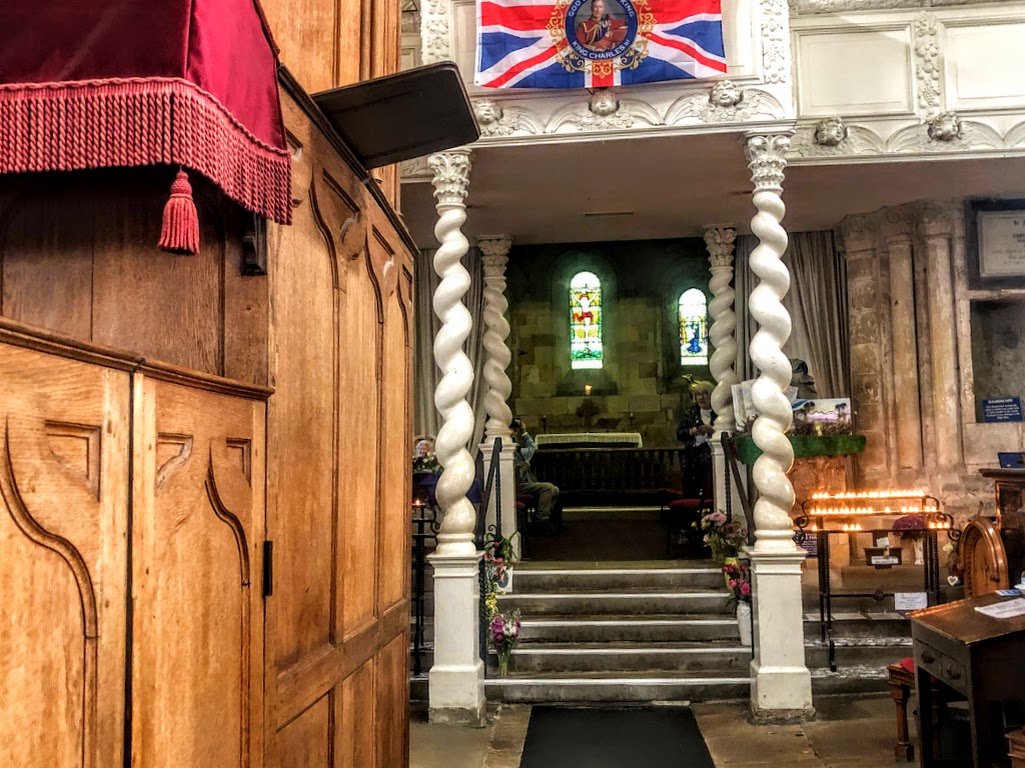
Inside Saint Mary’s Church, Whitby, facing east (Photograph: Patrick Comerford, 2023)

We entered the church through a small low ceiling area, and double doors opened into a building that took my breath away. The church never had electricity and is lit only by candles on sconces and a large brass chandelier. A Victorian cast-iron stove provides the only form of heating inside the church.

A Norman church was built on the site around 1110 and added to and altered over the centuries. The tower and transepts are from the 12th and 13th centuries. The nave, chancel and west tower date from the 12th century, the north and south transepts were added in the 13th and 14th centuries, while battlements were added around the roofline in the Tudor period.

The nave is largely Georgian, but the chancel has been relatively untouched, with three round-headed Norman windows and stonework, and three aumbries, including one with a small piscina. The side walls originally had three bays with similar windows, but they have been altered. The altar is Tudor, but the Victorian stained glass windows are by Charles Eamer Kempe.

The chancel has been relatively untouched, with three round-headed Norman windows and stonework (Photograph: Patrick Comerford, 2023)

The nave has five bays and is contemporary with the quire. Its south wall is much altered but three external buttresses remain.

The transept was built in the 13th century and has three altered lancet windows in its northern arm while its southern arm is considerably changed and its windows all replaced. A squint cuts through from the south transept to the quire.

The three-decker pulpit was installed in 1778 and altered in 1847. No matter where someone sits in the church, they can be seen by the preacher in the top level of the three-decker pulpit. A set of hearing trumpets at the back of the pulpit are said to have been used by the wife of a former rector because she was hard of hearing.

The poet Cædmon and Saint Coleman in window by Charles Eamer Kempe (Photograph: Patrick Comerford, 2023)

The interior of the church is dominated by the 18th-century box pews and seem to be crammed into every corner. As a result, Saint Mary’s can seat 3,000 people.

Larger, more luxurious pews near the pulpit once went for a higher price. A few plain, unadorned pews at the back of the church were reserved for poor parishioners. These are marked ‘Free’ on the pew doors. Others were for strangers to the church and are marked ‘For Strangers Only.’

The pews on the north side were for people from nearby villages who did not have their own parish church and had to travel to Whitby to worship. Each of these pews is marked with a village name.

There was also a special pew for the Cholmley family, who bought the site of Whitby Abbey in the mid-16th century and built a large elegant mansion by the ruins. The Cholmley pew had a prominent position between the chancel arch and the nave, and blocked direct views of the high altar. It was supported on barley sugar columns and was reached by an external stair.

The three-decker pulpit was installed in 1778 and altered in 1847 (Photograph: Patrick Comerford, 2023)

There was a special pew for the church maid, whose duties included keeping the privately-owned pews clean. Because of the church’s position on the cliff above the town, smoke from the chimneys of houses near the harbour would rise up and settle on the pews, so that anyone sitting there would soon be covered in soot and dust. The church maid kept the pews covered before and after services.

The galleries were installed in the 19th century, but to create extra space the staircases to some of the galleries are on the outside.

When the church was enlarged in 1818, most of the north wall was removed and replaced by columns to accommodate an aisle. Four large square-headed windows were inserted on the south side, the south porch was built in 1823 and a north porch was built in the new annexe. The ceilings over the nave have several skylights.

The interior of the church is dominated by the 18th-century box pews (Photograph: Patrick Comerford, 2023)

An 18th-century royal coat of arms sits above the chancel arch, and a second royal coat of arms is above the west door.

Painted boards against the north wall display the Lord’s Prayer and the Ten Commandments. Other 18th century boards on the walls bear Biblical texts.

A studded oak chest for parish valuables dates from the 15th century or earlier. The chest was stolen in 1743 and thrown over the cliff by thieves. It was recovered from the base of the cliff but the church plate and parish records were never found.

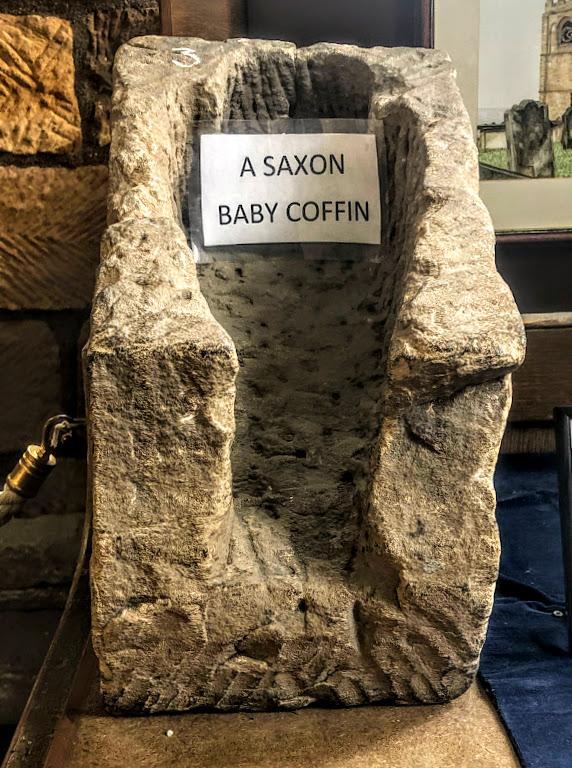
Several carved mediaeval stones are on display in the church, as well as a broken section of the stone coffin of a Saxon child. A small cupboard was once used for loaves of bread given to the poor.

The three-stage west tower was originally taller, but the top stage was taken down in the 17th century. As a result, the low, squat tower looks oddly out of proportion to the rest of the church, its corners supported by flat buttresses. The embattled parapet is a 16th-century addition. There is a ring of eight bells: six are inscribed, ‘Whitby 1762 Lester and Pack of London fecit’; two were added in 1897.

The galleries were installed in the 19th century (Photograph: Patrick Comerford, 2023)

Captain James Cook, the 18th-century seafaring explorer and cartographer was apprenticed to a shipowner in Whitby in 1746-1749. He lived in Whitby for another six years before joining the Royal Navy, and during those years went to church in Saint Mary’s.

Saint Mary’s churchyard provided Bram Stoker with a setting in his novel Dracula:

‘For a moment or two I could see nothing, as the shadow of a cloud obscured St. Mary's Church. Then as the cloud passed I could see the ruins of the Abbey coming into view; and as the edge of a narrow band of light as sharp as a sword-cut moved along, the church and churchyard became gradually visible ... It seemed to me as though something dark stood behind the seat where the white figure shone, and bent over it. What it was, whether man or beast, I could not tell.’

A broken section of the stone coffin of a Saxon child (Photograph: Patrick Comerford, 2023)

Many gravestones have the names of ships, trades or professions and name the place where people died or are buried. Several tombstones are engraved ‘in remembrance of’ rather than ‘here lies,’ for many sailors and fishermen were lost at sea and their bodies were never recovered.

Other graves include that of the Arctic explorer William Scoresby, who invented the crow’s nest for ships. But fact and fiction are mixed together in the churchyard: one stone is said to mark the grave of the original ‘Humpty Dumpty.’

Because of erosion and landslips, several graves have slipped off the cliffs, with bones later found below. Two significant recent landslips due to broken drainage and torrential rain have placed the churchyard and properties below the cliff in jeopardy, and pathways on the cliffside of the church have been closed.

The low, squat west tower was taller until the top stage was taken down in the 17th century (Photograph: Patrick Comerford, 2023)

17 May 2023

Whitby Abbey, the scene of
the Synod of Whitby, and its
many literary associations

Whitby Abbey played a crucial role as the venue for the Synod of Whitby in the year 664 (Photograph: Patrick Comerford, 2023; click on images for full-screen viewing)

Patrick Comerford

Whitby Abbey, overlooking the North Sea on the East Cliff above Whitby in North Yorkshire, is associated most popularly with Bram Stoker’s Dracula. But, for me, the most important reason for two of us climbing the 199 steps from Whitby to visit the abbey last week lies in its crucial role in church history as the venue for the Synod of Whitby in the year 664.

Whitby is also important in church history as the monastic centre of Saint Hilda and for the role of the Northumbrian kingdom in spreading Christianity to Mercia and other parts of England in the seventh century. In literary and church history, Whitby is also important as the home of the Northumbrian poet Cædmon (614-680).

For seafarers, Whitby Abbey has long been a distinctive landmark on the Yorkshire coast.

Saint Hilda (614-680), the founding Abbess of Whitby, depicted in a window in Saint Mary’s Church, Whitby (Photograph: Patrick Comerford, 2023)

The monastery at Whitby was first founded by Oswy (Oswiu), the Anglo-Saxon King of Northumbria, at a place named Streoneshalh in the year 657. The name Streoneshalh may signify Fort Bay or Tower Bay and refer to an earlier Roman settlement on the site.

Recent excavations have shown that the headland was settled during the late Bronze Age. A round house within a ditched enclosure was found near the cliff edge, and a number of Bronze Age objects have been recovered.

The headland may have been occupied by a Roman signal station in the 3rd century AD. After the collapse of Roman rule, Britain fragmented into a number of small kingdoms. By the seventh century Northumbria – corresponding to Northumberland and Yorkshire – was the most powerful Anglo-Saxon kingdom.

Edwin, the Anglian King of Northumbria, converted to Christianity in 627 and was baptised by the Roman missionary Saint Paulinus of York. King Oswy appointed Saint Hilda (614-680) of Hartlepool as the founding Abbess of Whitby in 657. She was a daughter of Hereric, a nephew of Edwin, the first Christian king of Northumbria.

The double monastery of monks and nuns was home to the Northumbrian poet Cædmon (ca 657-684).

Cædmon is commemorated with a cross in Saint Mary’s churchyard (Photograph: Patrick Comerford, 2023)

Cædmon was a monk who cared for the animals at the monastery when Saint Hilda was the abbot. He was originally ignorant of ‘the art of song’ but learned to compose one night in the course of a dream, according to the eighth century historian Bede.

His only known surviving work is Cædmon's Hymn a nine-line alliterative vernacular praise poem in honour of God. The poem is one of the earliest attested examples of Old English, making Cædmon the first English poet whose name is known.

And so, Whitby claims to be the birthplace of English literature. Cædmon is commemorated with a cross in Saint Mary’s churchyard.

The Synod of Whitby was called in 664 to resolve differences, including the calculation of the date of Easter (Photograph: Patrick Comerford, 2023)

Christianity had been brought to Northumbria by both missionaries from Rome and by Celtic missionaries from Iona in Scotland. The Synod of Whitby was called in 664 to resolve their differences on the calculation of the date of Easter, the style of monastic clothing, and the shape of monastic tonsures.

Some historians see the Synod of Whitby as early evidence of a clash between the centralising, authoritarian papacy in Rome and an independent native ‘Celtic’ or British Church. They see the debates in seventh century Northumbria foreshadowing the Reformation in the 16th century and rejection of papal authority.

However, Irish and Roman missionaries shared the same fundamental beliefs. By the time of the synod, the southern Irish had already adopted the Roman calculation of Easter, and this was being followed by the monks of Iona by the early eighth century.

Eventually, King Oswiu decided that the Roman side should prevail, and the Pope’s authority was gradually established over the Church in these islands.

The monastery was laid waste by Danes in successive raids from 867 to 870. The Anglian town and monastery were abandoned at some point in the ninth century, probably as a result of the Viking raids, and it remained desolate for more than 200 years.

By the time of the Norman Conquest, the headland seems to have been abandoned, although there was a substantial town down by the harbour called Whitby or Hwitebi, the ‘white settlement’ in Old Norse. An area named ‘Prestebi’ was recorded in the Domesday Survey, which may indicate religious life was revived in some form after the Danish raids.

A new monastery was founded at Whitby in 1078 and adopted the Benedictine rule (Photograph: Patrick Comerford, 2023)

Reinfrid, a former soldier, became a monk and travelled to Whitby, then known as Prestebi or Hwitebi. There, William de Percy granted him the ruined monastery of Saint Peter to found a new monastery in 1078.

The original grant included Saint Peter’s Monastery and the town and Port of Whitby, with its parish church of Saint Mary and six dependent chapels at Fyling, Hawsker, Sneaton, Ugglebarnby, Dunsley, and Aislaby; five mills including Ruswarp; the village of Hackness with two mills and Saint Mary’s Church; and Saint Peter’s Church in Hackness, ‘where our monks served God, died, and were buried.’

William de Percy’s brother, Serlo de Percy, joined the new monastery, which adopted the Benedictine rule. Reinfrid was the prior for many years until he died in an accident. He was buried at Saint Peter’s in Hackness, and was succeeded as prior by Serlo de Percy.

At an early stage, this community split and the two parts each developed into a fully-fledged Benedictine monastery: one on the headland at Whitby and the other at Saint Mary’s Abbey in York.

The Benedictine monastery at Whitby initially had timber buildings or reused the Anglian ruins on the headland. A stone church and conventual buildings were built ca 1100 in the Romanesque style, as well as a large parish church close by.

The monastery was rebuilt on a larger scale ca 1225-1250, when the monastery church was rebuilt in the Gothic style. The eastern arm, the crossing and the transepts, a central tower, and part of the nave were built before funds seem to have run out.

Work resumed on the nave in the 14th century, but it was not finished until the 15th century. Its architecture closely resembles other great churches in Yorkshire, including York Minister and Rievaulx Abbey. There were extensive monastic buildings south of the abbey church too.

Sir Walter Scott sets part of his epic poem ‘Marmion’ (1808) in Whitby Abbey (Photograph: Patrick Comerford, 2023)

Sir Walter Scott sets part of his epic poem ‘Marmion’ (1808) in Whitby Abbey during the early years of the reign of Henry VIII. The poem tells how Lord Marmion lusts for Clara de Clare, a rich woman. He and his mistress, Constance de Beverley, forge a letter implicating Clare’s fiancé, Sir Ralph de Wilton, in treason. Constance, a dishonest nun, hopes that her aid will restore her to favour with Marmion.

When de Wilton loses the duel he claims to defend his honour against Marmion, he goes into exile, and Clare enters a convent rather than risk Marmion’s attentions.

In Canto 2 (‘The Convent’), the Abbess of Whitby, with a party of nuns including a novice Sister Clare, journeys by sea to Lindisfarne, where she forms one of a tribunal in sentencing Constance de Beverly to be immured alive together with an accomplice in the planned murder of Clare.

In her final speech, Constance tells how she had escaped from a convent to join Marmion who had then abandoned her for the wealthy Clare, charging Clare’s fiancé with treason and defeating him in armed combat.

Whitby Abbey was suppressed in 1539 at the dissolution of the monastic houses (Photograph: Patrick Comerford, 2023)

Whitby Abbey was suppressed in 1539 at the dissolution of the monastic houses during the Tudor Reformation. Whitby Abbey was stripped of all the fixtures and fittings of value, including glass from the windows and lead from the roof, and it was left to decay. The roof of the great church and the central tower all eventually fell leaving behind the ruins.

After the suppression, Sir Richard Cholmley (died 1578) bought the abbey buildings and the core of its estates. These remained in the Cholmley family and their descendants in the Strickland family for generations.

The Cholmley family built an impressive private house beside the Abbey, and plundered the abbey ruins heavily in building their grand residence. Local people wreaked further damage, scavenging material for their own building projects and gardens.

The Cholmley family was originally from Cheshire, but already were major landowners in Yorkshire. Sir Hugh Cholmley I (1600-1657) played a notable part in the Civil War (1642-1651), defending Scarborough Castle for the king before surrendering it in 1645. Parliamentarian troops later captured and looted the Abbey House at Whitby.

After the Civil War, Sir Hugh Cholmley II (1632-1689) restored the family estates and he added a grand new wing, known locally as the Banqueting House, to the Abbey House around 1672. He laid out a new entrance courtyard to provide a formal approach and setting. The Cholmley family moved away in the 18th century, abandoning the Abbey House. The roof of the 1670s wing was removed after storm damage in the late 18th century.

The shell of the abbey church was substantially complete until the 18th century. It was weakened, however, by erosion from wind and rain. The south transept collapsed in 1736, much of the nave in 1763, the central tower in 1830 and the south side of the presbytery in 1839.

Whitby Abbey stands above the town and bay at Whitby (Photograph: Patrick Comerford, 2023)

Whitby became a popular seaside resort in the 19th century, with new terraces laid out on the West Cliff. The abbey ruins became a tourist destination, and a rising interest in the site is shown in numerous engravings and paintings.

In Bram Stoker’s Dracula (1897), Mina Harker describes the abbey in her diary: ‘Right over the town is the ruin of Whitby Abbey, which was sacked by the Danes, and which is the scene of part of Marmion, where the girl was built up in the wall. It is a most noble ruin, of immense size, and full of beautiful and romantic bits; there is a legend that a white lady is seen in one of the windows.’

During World War I, Whitby Abbey was shelled from the North Sea in December 1914, by the German battlecruisers Von der Tann and Derfflinger, whose crews ‘were aiming for the Coastguard Station on the end of the headland.’ Scarborough and Hartlepool were also attacked. The abbey buildings, including the west wall and nave, sustained considerable damage during the 10-minute attack.

The Strickland family handed over the abbey to the government by in 1920. The ruins have since been declared a Grade I listed building and are maintained by English Heritage. The site museum is housed in Cholmley House.

English Heritage carried out archaeological excavation and survey work in 1993 and 2008, in connection with the construction of the visitor centre and to rescue archaeological remains threatened by the steady erosion of the cliff. Whitby Abbey reopened in 2019 after a major project at the visitor centre, museum and interpretation across the site.

Cholmley House houses the site museum at Whitby Abbey (Photograph: Patrick Comerford, 2023)

16 May 2023

‘Sorry, it’s not here! … it’s
just a story’: searching
for Dracula in Whitby

Saint Mary’s Church, Whitby, and the surrounding churchyard inspired Bram Stoker when he was writing ‘Dracula’ (Photograph: Patrick Comerford, 2023)

Patrick Comerford

Our visit to Whitby last week was short and sweet. We took the bus from York, and over the course of a few hours in the seaside town in North Yorkshire we heard again how the ruins of Whitby Abbey and the graves in Saint Mary’s churchyard inspired Bram Stoker as he was writing his Gothic classic novel Dracula.

Abraham ‘Bram’ Stoker (1847-1912), who was born in Dublin, was the personal assistant of the leading actor of the day, Sir Henry Irving, and the business manager of the Lyceum Theatre in the West End when he came to Whitby on a holiday in August 1890 with his wife Florence and their son Noel.

In the late 19th century, Whitby was a fashionable seaside resort as well as a vibrant fishing port, and Irving this picturesque town as a holiday location to Stoker.

The Stoker family stayed at Mrs Veazey’s guesthouse at 6 Royal Crescent on Whitby’s West Cliff. Bram Stoker found a place to relax and to write, with walks along the windswept headland, climbing the 199 steps to Saint Mary’s Church, surrounded by swooping bats and a churchyard with empty graves, and strolling through the dramatic ruins of Whitby Abbey. He found time too to discover Whitby’s long links with jet, a semi-precious stone used in mourning jewellery.

At the end of the Victorian era, Gothic literature was set in foreign lands filled with eerie castles, convents and caves. But Whitby provided Stoker with a location nearer home for such horror stories.

Whitby’s rugged cliffs coastline, with its rich folklore and its fishing heritage, provided a dramatic setting for Stoker’s vampire to make his landing, and Whitby’s East and West Cliffs provided him with a natural theatrical backdrop.

Stoker heard about a Russian schooner, the Dmitry from Narva, that was shipwrecked in a storm in on Tate Hill Sands, below East Cliff, Saint Mary’s Churchyard and Whitby Abbey about five years earlier, in October 1885. The Dmitry ran aground carrying a cargo of silver sand. With a slightly rearranged name, this became the Demeter from Varna that carries Dracula to Whitby with a cargo of silver sand and boxes of earth that include Dracula and his coffins of Transylvanian soil.

The novel is written in the form of letters, diaries, newspaper cuttings and entries in the ship’s log of the Demeter. The log charts the gradual disappearance of the entire crew of the Demeter during the journey to Whitby, until only the captain is left, tied to the wheel.

As the ship sails close to the coast at Whitby, the vampire summons a storm. The ship runs aground below East Cliff and only one survivor lands safely – a large black dog, another manifestation of Dracula who has the power of transformation. The dog bounds from the wreck and runs up the 199 steps to the church, and from that moment things begin to go horribly wrong.

The name of the ship offers a link to the underworld: in Greek mythology, Demeter is the mother of Persephone who is forced to spend part of the year in the underworld after she is abducted by Hades, the god of the dead and king of the underworld.

Looking across Whitby Bay and towards the Crescent from Saint Mary’s churchyard (Photograph: Patrick Comerford, 2023; click on image for full-screen view)

The novel’s main female characters, Mina Murray and Lucy Westenra, are on holiday, like Stoker, at the Crescent in Whitby. They spend much of their time in Saint Mary’s churchyard, just as Stoker did. There, in conversation with an old local fisherman named Swales, they learn about the town’s fishing and folklore and Swales tells them how many of the graves are empty, with headstones as memorials to fishermen and sailors lost at sea. These empty graves become ideal resting places for a vampire who must sleep during the day.

Swales also tells Mina and Lucy about the ghost of Saint Hilda who reputedly can be seen in the window of Whitby Abbey as a white figure. Saint Hilda was said to have banished snakes into the sea and, as they fell over Whitby’s cliffs, they turned into ammonites.

Later, Mina wakes up in her room at the Crescent, and realises that Lucy, who is prone to sleepwalking, is missing. Mina grabs a cloak and rushes from the Crescent on the West Cliff and spots Lucy on their favourite seat in Saint Mary’s churchyard on the East Cliff.

Mina rushes through the town and climbs the 199 steps to the churchyard. Clouds passing over the moon obscure her view, only to part theatrically to reveal a white-robed Lucy. Looming above her is a figure Mina cannot quite identify. Is it a man, or is it a beast?

Lucy has two tiny marks or incisions on her neck where – unknown to either woman – the vampire has taken her blood. Dracula has acquired his first British victim in Whitby, with his bite initiates Lucy into vampirism and the underworld.

Mina and Lucy are told about the ghost of Saint Hilda who reputedly can be seen in a window in Whitby Abbey (Photograph: Patrick Comerford, 2023)

Whitby also provides the name of the vampire. During his holiday, Stoker spent time in the town library where read The Principalities of Wallachia and Moldavia, a book by a former British consul in Bucharest, William Wilkinson, recalling his experiences not in Transylvania but in the principalities of Wallachia and Moldavia, now in Romania.

There Stoker read about Dracula and his association with the Hungarian wars with Turkey in the 15th century. Wilkinson mentions Vlad Tepes, a 15th-century prince said to have impaled his enemies on wooden stakes. According to Wilkinson, Dracula means the ‘son of the dragon.’ Wilkinson adds in a footnote: ‘Dracula in the Wallachian language means Devil. The Wallachians at that time … used to give this as a surname to any person who rendered himself conspicuous either by courage, cruel actions, or cunning.’

Stoker spent six more years working on his novel before it was published in 1897, researching the landscapes and customs of Transylvania and the name of his villain. Dracula’s character may also have been modelled on Irving’s aristocratic bearing and histrionic acting style.

But some of the novel’s most dramatic scenes were inspired by Stoker’s holiday in Whitby. The innocent tourists, the picturesque harbour, the abbey ruins, the windswept churchyard and the salty tales he heard from Whitby seafarers – all became ingredients in the novel.

Today’s tourists find there are several Dracula-related activities in Whitby that are popular with the Goth community, including a Whitby Goth Weekend twice a year.

Dracula and Bram Stoker memorabilia on sale in Cholmley House (Photograph: Patrick Comerford, 2023)

At Saint Mary’s Church, it seems Dracula has attracted the wrong sort of questions from visitors. A sign inside the porch reads:

‘Sorry, it’s not here!

‘Where is Dracula’s grave? Do you know, we are asked this question more than any other by visitors to this church. We are sorry to disappoint you but it’s not here.

‘In fact, it’s not anywhere, because Dracula is fiction.

‘It’s just a story, and anyway, even in the story Dracula finally turned to dust, with a stake through his heart, not here but in Transylvania. So even if there are bats in our belfry, no vampire is going to come and suck your blood.

‘But, really and truly, you’re standing on hallowed ground. This is where Hilda walked and talked, taught and worshipped. The memory of her is still green today. This church, and the Abbey buildings next door, have been here for well over a thousand years because of Hilda. Today we try to worship God here, and express the love of Jesus Christ for all people.

‘Before you go, try spending a moment of quiet up by the altar of the church. Join with those who have prayed here throughout the many centuries.

‘We hope you enjoy Whitby.’

And, in case the message is not received, a second sign in plainer, larger letters is pinned to the door and is more direct:

‘Please do not ask staff where Dracula's grave is as there isn’t one.

‘Thank you.’

Count the cost … cost the count … Dracula miniatures on sale in Cholmley House, beside Whitby Abbey (Photograph: Patrick Comerford, 2023)

31 October 2009

Transylvanians sink their teeth into Dracula's lucrative legacy

Bran Castle towers above Bran village and is better known as Dracula’s Castle

Letter from
Transylvania

Patrick Comerford


Rosencrantz and Guildenstern are dead, according to Tom Stoppard. But so too are Rosenau, Kronstadt, Honigburg, Prejmer and Torzburg. The former Saxon names on the old maps of Transylvania have long since disappeared and these pretty town and villages on the southern slopes of the Carpatians have been known for a long time by their Romanian names – Rasnov, Brasov, Bran, Harman Tratlau and Bran.

If anyone in Brasov harbours any lingering regrets that the city is no longer known as Kronstadt, no-one wants to return to the brief interlude of post-war madness when the place was given the blood-chilling name of Stalingrad (Orasul Stalin).

Brasov is now the most-visited city of Romania, with its charm and popularity leading one guidebook to describe it as “the Prague of Romania, the Krakow of Transylvania.” With its cobbled streets, castellated towers and ornate churches and townhouses, it is no wonder that the legend grew up that when the Pied Piper charmed the children away from Hamelin, they emerged from the Carpathian Mountains in the town square of Brasov in 1284.

The legend may have been a way of explaining the migration of German-speaking Saxon settlers to this part of Transylvania. It was they who made Brasov the home of some of the best craftsmen, jewellers, and traders in Transylvania. After Ceausescu was toppled, an estimated 130,000 “Saxons” left Romania for Germany, leaving behind a small minority to look after a rich architectural legacy of fortified churches and mediaeval houses. In recent years, these “Saxons” have begun to trickle back to their ancestral homes in the region they once knew as Siebenburgen, and the centuries-old Lutheran churches have become popular venues for fashionable German weddings.

Meanwhile, the people of this region are happy to put the memories of Stalin and Ceausescu into the history books. Instead they are making a tidy tourist industry out of another ruler with a reputation for torture and mass murder – Vlad Tepes, better known to the rest of us, thanks to Dublin-born Bram Stoker, as Dracula.

But there is a remote and blood-curdling link between Stalin and Dracula in Brasov. Ceausescu had the word “Stalin” carved out in the trees of Mount Tampa, looking down on the city. It was close to this gory tribute that Brasov’s original defensive fortress was first built. When the Wallachian prince, Vlad Tepes, attacked Brasov in 1458-1460, he dismantled the citadel on Mount Tampa and 40 merchants were hauled up the slope and impaled on top of the mountain.

It was Vlad’s revenge for a city law that had prevented Romanians from entering the Saxon walled city of Kronstadt. Bram Stoker believed Vlad’s moniker was derived from the Romanian word “draco,” meaning “devil,” although it is more likely he was known as Dracula, or “Son of the Dragon,” because his father, Vlad III, was proud of being made a Knight of the Dragon by the Emperor Sigsimund in 1431.

Vlad Tepes was never a vampire, but he was certainly ruthless and cruel in his bloodletting as he pursued his campaign to rid the Romanian principalities of Saxons, Turks and Greeks. He decapitated his enemies or buried them alive if he had not subjected them to his favourite punishment of impalement, driving a stake carefully through the victim’s anus until it emerged just below the shoulder without piercing any vital organs. Victims were then left writhing in agony before their captor, who watched and ate as they took at least 48 hours to die.

Vlad Tepes or Vlad the Impaler is seen by many Romanians today as an early forerunner of Romanian nationalism. As the story is told and retold, it is often forgotten that he ruled Wallachia and not neighbouring Transylvania. Vlad was never the torturer of Torzburg, but Bram Stoker’s novel has allowed Transylvania to capitalise on popular Western images of Dracula, and the village of Bran 28 km south of Brasov, has prospered by convincing tourists that Bran Castle is Dracula’s Castle.

The castle, perched atop a 60 metre peak, towers above the village, and with its Gothic turrets, tiered towers, and labyrinthine secret passages, it sometimes looks the part. There is a remote possibility that Vlad might have attacked the castle in 1460; then he again, he might have spent a night or two here as fled a Turkish onslaught in 1462. But “might” never makes history, and in reality Bran Castle, is another part of Transylvania’s Saxon legacy, built in 1382 as Tortzburg and one of the defensive fortresses guarding Siebenburgen against the Turks.

Despite countless horror movies, Bran Castle had a more romantic association with Queen Marie, who lived here from 1920. She made a dramatic appearance at the Paris Peace Conference in 1919, declaring: “Romania needs a face, and I have come to show mine.” She rode unattended through the streets, showering her people with red roses at carnival time, and once declared: “My love for my country Romania is my religion.”

Bran Castle remained a royal residence until 1947. But royalty and romance are less attractive to tourists than any tentative link with Dracula. As we passed through King Ferdinand’s bedroom, a child looked on the four-poster bed in awe and asked: “Did Dracula sleep in that?” “No, silly,” her doting father replied. “He slept in a coffin in the crypt.”

Down in the village, the tourists generally ignore the beautiful, open-air Village Museum and head for the shops selling Hallowe’en-style trinkets and Dracula masks or to the bars that advertise themselves as “Haunted Castle” and “Skeleton’s Tavern.” We left before dark.

This Letter from Transylvania was first published in The Irish Times on 31 October 2005