‘Many will come in my name and say … “The time is near!” Do not go after them’ (Luke 21: 8) … the clock at Donegal House and the Guildhall in Lichfield (Photograph: Patrick Comerford)
Patrick Comerford
We are in the Kingdom Season, the time between All Saints’ Day and Advent, and this week began with the Sunday next before Advent and the Feast of Christ the King (23 November 2025). The calendar of the Church of England in Common Worship today remembers Saint Catherine of Alexandria, Martyr in the 4th century, and Isaac Watts (1674-1748), hymnwriter.
Saint Catherine of Alexandria is the Patron Saint of the Institute for Orthodox Christian Studies, where I have studied in Cambridge. IOCS is celebrating her Feast today at the Greek Orthodox Church of Saint Athanasios, Cambridge, today (25 November 2025), starting with Matins at 9 am, followed by the Divine Liturgy at 10 am, and with a Thanksgiving Service in the evening at 6 pm, followed by refreshments and fellowship in the parish hall.
Meanwhile, before the day begins, I am taking some quiet time early this morning, even before breakfast, to give thanks, to reflect, to pray and to read in these ways:
1, today’s Gospel reading;
2, a short reflection;
3, a prayer from the USPG prayer diary;
4, the Collects and Post-Communion prayer of the day.
‘When you hear of wars and insurrections, do not be terrified’ (Luke 21: 9) … the 1798 Rising recalled in street art in a laneway behind Anne Street and North Main Street in Wexford (Photograph: Patrick Comerford)
Luke 21: 5-11 (NRSVA):
5 When some were speaking about the temple, how it was adorned with beautiful stones and gifts dedicated to God, he said, 6 ‘As for these things that you see, the days will come when not one stone will be left upon another; all will be thrown down.’
7 They asked him, ‘Teacher, when will this be, and what will be the sign that this is about to take place?’ 8 And he said, ‘Beware that you are not led astray; for many will come in my name and say, “I am he!” and, “The time is near!” Do not go after them.
9 ‘When you hear of wars and insurrections, do not be terrified; for these things must take place first, but the end will not follow immediately.’ 10 Then he said to them, ‘Nation will rise against nation, and kingdom against kingdom; 11 there will be great earthquakes, and in various places famines and plagues; and there will be dreadful portents and great signs from heaven.’
‘Nation will rise against nation, and kingdom against kingdom’ (Luke 21: 10) … ‘Fuascailt’, Eamonn O’Doherty’s sculpture of the 1798 Wexford pikemen on the N25 near Barntown and Taghmon, Co Wexford (Photograph: Patrick Comerford)
Today’s reflection:
The Gospel reading at the Eucharist this morning (Luke 21: 5-11) is part of Saint Luke’s ‘Little Apocalypse’, to which we were introduced on the Sunday before last (see Luke 21: 5-19, Sunday 16 November 2025, the Second Sunday before Advent).
On his arrival in Jerusalem, Christ weeps, invokes sayings from the Prophet Jeremiah against a city that ‘did not recognise the time of your visitation from God’ (Luke 19: 41-44), and then faces up to three attempts by the authorities to entrap him, each concluding with Christ silencing his opponents (Luke 20: 1-19; 20: 20-26; and 20: 27-38).
The scene has been set in the verses in this chapter that immediately precede today’s reading. Christ is sitting by the Temple Treasury, where he watches the poor widow offer the smallest of coins (verses 1-4), as we read yesterday.
The scene does not change as he goes on to speak about the Temple, the Nation, and the looming future. But, instead of questioning him about what he has just said about this widow, which might have offered a focus for how the politics of God work, those around him, probably a wider group than just his own disciples, cannot get past the physical presence and appearance of Herod’s Temple in Jerusalem, then revered as a sign of God’s presence, even as the dwelling place of God’s sheltering protection for Israel (see Luke 13:34-35).
Christ is no longer facing attacks from others. Instead, he alerts his followers to the hardships they face ahead, beyond the time of his journey. But as he approached Jerusalem, Christ had declared that God’s ‘visitation’ had come with his reign, that the very stones of the Temple would testify against those who rejected him (19: 41-44).
Now he again predicts that all the stones will be thrown down (21: 6), as one scene in the divine drama.
A web of prophetic citations is woven through these verses. These include words and phrases from Jeremiah 4, 7, 14, and 21; Isaiah 19; and Ezekiel 14 and 38. Maybe we might say that Christ, like the prophets before him, was not very original in what he said. But there is still the question: how faithfully did these prophetic words and warnings of destruction speak to the people of the time, to the people who heard Christ speak?
But Christ also differentiates his teaching from the teaching of the false prophets, who also quoted the ancient words of God. While announcing the coming judgment, Christ cautions against following prophets who claim to know God’s timetable, even invoking Christ’s own name.
The account in this chapter of Christ’s words could be compared with Mark 13, and its intensity of the coming ‘tribulation.’ Or we might go back to Luke 17: 22-37, which also reminds us that Christ’s death is an integral part of God’s timetable: ‘But first he must endure much suffering and be rejected by this generation’ (17: 25). Saint Luke’s longer account of Christ’s discourse (21: 5-36) assures his readers they are experiencing not ‘the end’ … but the period of ‘tribulations’ or ‘persecutions’ through which believers will enter the kingdom (see Acts 14: 22).
And so, Saint Luke’s account of Christ’s speech does not provide yet another programme or timetable to predict the working out of God’s plan, down to the last second. The prophets and Christ teach us that the struggles in history and in disturbances in nature are more than accidental. They remind us that God triumphed over chaos in creating the natural world, and yet both human and supra-historical forces are still contending for the earth. Christ’s followers are aware, therefore, that his death and resurrection is God’s ultimate act in a struggle of cosmic proportions. Only the final outcome is sure.
As the Apostle Paul writes: ‘We know that the whole creation has been groaning in labour pains until now; and not only the creation, be we ourselves, who have the first fruits of the Spirit, groan inwardly while we wait for adoption, the redemption of our bodies’ (Romans 8: 22-23).
The hope to which Christ testifies in this passage, therefore, is no trivial denial of the struggles, the pain and agony of human life, or the catastrophic forces of nature. These are real, and the prophets of old have interpreted such devastations as the context of God’s saving work. Christ joins this chorus, bringing it close to the concrete realities of early Christians. But he says: ‘This will give you an opportunity to testify’ (verse 13) and ‘By your endurance you will gain your souls’ (verse 19).
The ‘opportunity to testify’ does not require Christ’s followers to know every answer to the question: ‘Why do bad things happen to good people.’
Christ is promising that he will give us ‘words and a wisdom that none of your opponents will be able to withstand or contradict.’ His earlier promise of the Holy Spirit’s wisdom in times of testimony (see Luke 12: 11-12) now becomes his own promise. When he commissions them as ‘my witnesses’ (Acts 1: 8), he assures them of the power and the presence of his Holy Spirit, and the stories in Acts will display the fulfilment of this promise of God’s ‘mouth and wisdom’ (see Acts 4: 13-14; 16: 6-7). And so, even these harsh prophecies in Luke 21 are filled with the confidence of Christ’s enduring presence.
And the ‘endurance’ that ‘will gain your soul’ (verse 19) is also not mere heroic persistence.
The early Christians knew all about endurance, and that endurance was often tested. Paul echoes that theme in Romans 5: 3-5, then transformed this endurance from reliance on human strength to trusting in God’s love: ‘… we also boast in our sufferings, knowing that suffering produces endurance, and endurance produces character, and character produces hope, and hope does not disappoint us, because God’s love has been poured into our hearts through the Holy Spirit that has been given to us.’
Saving endurance is a gift of the presence of the Holy Spirit.
A problem that continues to dominate parish priorities is the emphasis on buildings rather than people. Are there ‘building blocks’ we need to knock down so we can start again and care for little people like the poor widow who was at the centre of yesterday’s reading?
Is it time to rebuild, to become the kind of temples God really wants?
Should we change church politics and priorities for God’s politics and priorities?
In pursuing God’s vision for the future of the Church and the Kingdom, are we relying on our own knowledge and strengths?
What risks are we willing to take for our core values?
How would you be prophetic and offer hope in the face of the rise of the far-right across Europe or Trump’s behaviour in office in the US?
How do you read the signs of the times when it comes to global events, such as the conflicts in Ukraine, Russia, Gaza, Israel, Palestine and Lebanon?
Have we a vision for a new heaven and a new earth (see Isaiah 65: 17-25)?
How do we balance concerns for the wider world with those for the widow and her small coin in our parishes?
‘When you hear of wars and insurrections, do not be terrified’ (Luke 21: 9) … a plaque recalling the executions and deaths on Wexford Bridge in 1798 (Photograph: Patrick Comerford)
Today’s Prayers (Tuesday 25 November 2025):
The theme this week (23 to 29 November) in Pray with the World Church, the prayer diary of the Anglican mission agency USPG (United Society Partners in the Gospel), is ‘Gender Justice’ (pp 58-59). This theme was introduced on Sunday with Reflections by Rachael Anderson, former Senior Communications and Engagement Manager, USPG.
Today is International Day for the Elimination of Violence against Women and Girls, and the day is being marked in Milton Keynes with a vigil at the Rose in Campbell Park from 6 pm to 6:45 ‘to raise Awareness, Reflection and Action’. The USPG Prayer Diary today invites us to pray:
We pray that this year’s 16 Days campaign might make governments, churches and communities around the world take notice and support an end to gender-based violence.
The Collect:
Eternal Father,
whose Son Jesus Christ ascended to the throne of heaven
that he might rule over all things as Lord and King:
keep the Church in the unity of the Spirit
and in the bond of peace,
and bring the whole created order to worship at his feet;
who is alive and reigns with you,
in the unity of the Holy Spirit,
one God, now and for ever.
Post Communion Prayer:
Stir up, O Lord,
the wills of your faithful people;
that they, plenteously bringing forth the fruit of good works,
may by you be plenteously rewarded;
through Jesus Christ our Lord.
Additional Collect:
God the Father,
help us to hear the call of Christ the King
and to follow in his service,
whose kingdom has no end;
for he reigns with you and the Holy Spirit,
one God, one glory.
Yesterday’s Reflections
Continued Tomorrow
Saint Catherine of Alexandria (25 November) is patron of the IOCS in Cambridge … an icon in the Greek Orthodox Church in Stony Stratford (Photograph: Patrick Comerford, 2025)
Scripture quotations are from the New Revised Standard Version Bible: Anglicised Edition copyright © 1989, 1995 National Council of the Churches of Christ in the United States of America. Used by permission. All rights reserved worldwide. http://nrsvbibles.org
Showing posts with label Taghmon. Show all posts
25 November 2025
Daily prayer in the Kingdom Season:
25, Tuesday 25 November 2025
Labels:
Alexandria,
Barntown,
Cambridge,
Icons,
IOCS,
Justice,
Kingdom Season,
Lichfield,
Mission,
Orthodoxy,
Prayer,
Saint Luke's Gospel,
Sculpture,
Stony Stratford,
Taghmon,
Talking about 1798,
USPG,
violence,
War and peace,
Wexford
26 November 2024
Daily prayer in the Kingdom Season:
26, Tuesday 26 November 2024
‘When you hear of wars and insurrections, do not be terrified’ (Luke 21: 9) … ‘War’ by Richard Klingbeil (2009)
Patrick Comerford
We are in the Kingdom Season, the time between All Saints’ Day and Advent, and this week began with the Sunday next before Advent and the Feast of Christ the King (24 November 2024).
Before the day begins, I am taking some quiet time early this morning to give thanks, to reflect, to pray and to read in these ways:
1, today’s Gospel reading;
2, a short reflection;
3, a prayer from the USPG prayer diary;
4, the Collects and Post-Communion prayer of the day.
‘When you hear of wars and insurrections, do not be terrified’ (Luke 21: 9) … the 1798 Rising recalled in street art in a laneway behind Anne Street and North Main Street in Wexford (Photograph: Patrick Comerford)
Luke 21: 5-11 (NRSVA):
5 When some were speaking about the temple, how it was adorned with beautiful stones and gifts dedicated to God, he said, 6 ‘As for these things that you see, the days will come when not one stone will be left upon another; all will be thrown down.’
7 They asked him, ‘Teacher, when will this be, and what will be the sign that this is about to take place?’ 8 And he said, ‘Beware that you are not led astray; for many will come in my name and say, “I am he!” and, “The time is near!” Do not go after them.
9 ‘When you hear of wars and insurrections, do not be terrified; for these things must take place first, but the end will not follow immediately.’ 10 Then he said to them, ‘Nation will rise against nation, and kingdom against kingdom; 11 there will be great earthquakes, and in various places famines and plagues; and there will be dreadful portents and great signs from heaven.’
‘Nation will rise against nation, and kingdom against kingdom’ (Luke 21: 10) … ‘Fuascailt’, Eamonn O’Doherty’s sculpture of the 1798 Wexford pikemen on the N25 near Barntown and Taghmon (Photograph: Patrick Comerford)
Today’s reflection:
The Gospel reading at the Eucharist this morning (Luke 21: 5-11) is Saint Luke’s telling of the events recalled in the Gospel reading at the Eucharist on the Sunday before last (see Mark 13: 1-8, Sunday 17 November 2024, Second Sunday before Advent).
On his arrival in Jerusalem, Christ weeps, invokes sayings from the Prophet Jeremiah against a city that ‘did not recognise the time of your visitation from God’ (Luke 19: 41-44), and then faces up to three attempts by the authorities to entrap him, each concluding with Christ silencing his opponents (Luke 20: 1-19; 20: 20-26; and 20: 27-38).
The scene has been set in the verses in this chapter that immediately precede today’s reading. Christ is sitting by the Temple Treasury, where he watches the poor widow offer the smallest of coins (verses 1-4), as we read yesterday.
The scene does not change as he goes on to speak about the Temple, the Nation, and the looming future. But, instead of questioning him about what he has just said about this widow, which might have offered a focus for how the politics of God work, those around him, probably a wider group than just his own disciples, cannot get past the physical presence and appearance of Herod’s Temple in Jerusalem, then revered as a sign of God’s presence, even as the dwelling place of God’s sheltering protection for Israel (see Luke 13:34-35).
Christ is no longer facing attacks from others. Instead, he alerts his followers to the hardships they face ahead, beyond the time of his journey. But as he approached Jerusalem, Christ had declared that God’s ‘visitation’ had come with his reign, that the very stones of the Temple would testify against those who rejected him (19: 41-44).
Now he again predicts that all the stones will be thrown down (21: 6), as one scene in the divine drama.
A web of prophetic citations is woven through these verses. These include words and phrases from Jeremiah 4, 7, 14, and 21; Isaiah 19; and Ezekiel 14 and 38. Maybe we could say that Christ, like the prophets before him, was not very original in what he said. But there is still the question: how faithfully did these prophetic words and warnings of destruction speak to the people of the time, to the people who heard Christ speak?
But Christ also differentiates his teaching from the teaching of the false prophets, who also quoted the ancient words of God. While announcing the coming judgment, Christ cautions against following prophets who claim to know God’s timetable, even invoking Christ’s own name.
The account in this chapter of Christ’s words could be compared with Mark 13, and its intensity of the coming ‘tribulation.’ Or we might go back to Luke 17: 22-37, which also reminds us that Christ’s death is an integral part of God’s timetable: ‘But first he must endure much suffering and be rejected by this generation’ (17: 25). Saint Luke’s longer account of Christ’s discourse (21: 5-36) assures his readers they are experiencing not ‘the end’ … but the period of ‘tribulations’ or ‘persecutions’ through which believers will enter the kingdom (see Acts 14: 22).
And so, Saint Luke’s account of Christ’s speech does not provide yet another programme or timetable to predict the working out of God’s plan, down to the last second. The prophets and Christ teach us that the struggles in history and in disturbances in nature are more than accidental. They remind us that God triumphed over chaos in creating the natural world, and yet both human and supra-historical forces are still contending for the earth. Christ’s followers are aware, therefore, that his death and resurrection is God’s ultimate act in a struggle of cosmic proportions. Only the final outcome is sure.
As the Apostle Paul writes: ‘We know that the whole creation has been groaning in labour pains until now; and not only the creation, be we ourselves, who have the first fruits of the Spirit, groan inwardly while we wait for adoption, the redemption of our bodies’ (Romans 8: 22-23).
The hope to which Christ testifies in this passage, therefore, is no trivial denial of the struggles, the pain and agony of human life, or the catastrophic forces of nature. These are real, and the prophets of old have interpreted such devastations as the context of God’s saving work. Christ joins this chorus, bringing it close to the concrete realities of early Christians. But he says: ‘This will give you an opportunity to testify’ (verse 13) and ‘By your endurance you will gain your souls’ (verse 19).
The ‘opportunity to testify’ does not require Christ’s followers to know every answer to the question: ‘Why do bad things happen to good people.’
Christ is promising that he will give us ‘words and a wisdom that none of your opponents will be able to withstand or contradict.’ His earlier promise of the Holy Spirit’s wisdom in times of testimony (see Luke 12: 11-12) now becomes his own promise. When he commissions them as ‘my witnesses’ (Acts 1: 8), he assures them of the power and the presence of his Holy Spirit, and the stories in Acts will display the fulfilment of this promise of God’s ‘mouth and wisdom’ (see Acts 4: 13-14; 16: 6-7). And so, even these harsh prophecies in Luke 21 are filled with the confidence of Christ’s enduring presence.
And the ‘endurance’ that ‘will gain your soul’ (verse 19) is also not mere heroic persistence.
The early Christians knew all about endurance, and that endurance was often tested. Paul echoes that theme in Romans 5: 3-5, then transformed this endurance from reliance on human strength to trusting in God’s love: ‘… we also boast in our sufferings, knowing that suffering produces endurance, and endurance produces character, and character produces hope, and hope does not disappoint us, because God’s love has been poured into our hearts through the Holy Spirit that has been given to us.’
Saving endurance is a gift of the presence of the Holy Spirit.
A problem that continues to dominate parish priorities is the emphasis on buildings rather than people. Are there ‘building blocks’ we need to knock down so we can start again and care for little people like the poor widow who was at the centre of yesterday’s reading?
Is it time to rebuild, to become the kind of temples God really wants?
Should we change church politics and priorities for God’s politics and priorities?
In pursuing God’s vision for the future of the church and the Kingdom, are we relying on our own knowledge and strengths?
What risks are we willing to take for our core values?
How would you be prophetic and offer hope in the face of the rise of the far-right across Europe or Trump’s return to office in the US?
How do you read the signs of the times when it comes to global events, such as the conflicts in Ukraine, Russia, Gaza, Israel, Palestine and Lebanon?
Have we a vision for a new heaven and a new earth (see Isaiah 65: 17-25)?
How do we balance concerns for the wider world with those for the widow and her small coin in our parishes?
‘Many will come in my name and say … “The time is near!” Do not go after them’ (Luke 21: 8) … the clock at Donegal House and the Guildhall in Lichfield (Photograph: Patrick Comerford, 2024)
Today’s Prayers (Tuesday 26 November 2024):
The theme this week in ‘Pray With the World Church’, the Prayer Diary of the Anglican mission agency USPG (United Society Partners in the Gospel), is ‘16 Days of Activism Against Gender-Based Violence’. This theme was introduced on Sunday with a Programme Update.
The USPG Prayer Diary today invites us to pray:
God of justice and righteousness, use us to speak against gender-based violence with a clear and challenging voice in a world where the vulnerable strive to be heard. (Mothers’ Union).
The Collect:
Eternal Father,
whose Son Jesus Christ ascended to the throne of heaven
that he might rule over all things as Lord and King:
keep the Church in the unity of the Spirit
and in the bond of peace,
and bring the whole created order to worship at his feet;
who is alive and reigns with you,
in the unity of the Holy Spirit,
one God, now and for ever.
Post Communion Prayer:
Stir up, O Lord,
the wills of your faithful people;
that they, plenteously bringing forth the fruit of good works,
may by you be plenteously rewarded;
through Jesus Christ our Lord.
Additional Collect:
God the Father,
help us to hear the call of Christ the King
and to follow in his service,
whose kingdom has no end;
for he reigns with you and the Holy Spirit,
one God, one glory.
Yesterday’s Reflection
Continued Tomorrow
‘When you hear of wars and insurrections, do not be terrified’ (Luke 21: 9) … a plaque recalling the executions and deaths on Wexford Bridge (Photograph: Patrick Comerford)
Scripture quotations are from the New Revised Standard Version Bible: Anglicised Edition copyright © 1989, 1995 National Council of the Churches of Christ in the United States of America. Used by permission. All rights reserved worldwide. http://nrsvbibles.org
Patrick Comerford
We are in the Kingdom Season, the time between All Saints’ Day and Advent, and this week began with the Sunday next before Advent and the Feast of Christ the King (24 November 2024).
Before the day begins, I am taking some quiet time early this morning to give thanks, to reflect, to pray and to read in these ways:
1, today’s Gospel reading;
2, a short reflection;
3, a prayer from the USPG prayer diary;
4, the Collects and Post-Communion prayer of the day.
‘When you hear of wars and insurrections, do not be terrified’ (Luke 21: 9) … the 1798 Rising recalled in street art in a laneway behind Anne Street and North Main Street in Wexford (Photograph: Patrick Comerford)
Luke 21: 5-11 (NRSVA):
5 When some were speaking about the temple, how it was adorned with beautiful stones and gifts dedicated to God, he said, 6 ‘As for these things that you see, the days will come when not one stone will be left upon another; all will be thrown down.’
7 They asked him, ‘Teacher, when will this be, and what will be the sign that this is about to take place?’ 8 And he said, ‘Beware that you are not led astray; for many will come in my name and say, “I am he!” and, “The time is near!” Do not go after them.
9 ‘When you hear of wars and insurrections, do not be terrified; for these things must take place first, but the end will not follow immediately.’ 10 Then he said to them, ‘Nation will rise against nation, and kingdom against kingdom; 11 there will be great earthquakes, and in various places famines and plagues; and there will be dreadful portents and great signs from heaven.’
‘Nation will rise against nation, and kingdom against kingdom’ (Luke 21: 10) … ‘Fuascailt’, Eamonn O’Doherty’s sculpture of the 1798 Wexford pikemen on the N25 near Barntown and Taghmon (Photograph: Patrick Comerford)
Today’s reflection:
The Gospel reading at the Eucharist this morning (Luke 21: 5-11) is Saint Luke’s telling of the events recalled in the Gospel reading at the Eucharist on the Sunday before last (see Mark 13: 1-8, Sunday 17 November 2024, Second Sunday before Advent).
On his arrival in Jerusalem, Christ weeps, invokes sayings from the Prophet Jeremiah against a city that ‘did not recognise the time of your visitation from God’ (Luke 19: 41-44), and then faces up to three attempts by the authorities to entrap him, each concluding with Christ silencing his opponents (Luke 20: 1-19; 20: 20-26; and 20: 27-38).
The scene has been set in the verses in this chapter that immediately precede today’s reading. Christ is sitting by the Temple Treasury, where he watches the poor widow offer the smallest of coins (verses 1-4), as we read yesterday.
The scene does not change as he goes on to speak about the Temple, the Nation, and the looming future. But, instead of questioning him about what he has just said about this widow, which might have offered a focus for how the politics of God work, those around him, probably a wider group than just his own disciples, cannot get past the physical presence and appearance of Herod’s Temple in Jerusalem, then revered as a sign of God’s presence, even as the dwelling place of God’s sheltering protection for Israel (see Luke 13:34-35).
Christ is no longer facing attacks from others. Instead, he alerts his followers to the hardships they face ahead, beyond the time of his journey. But as he approached Jerusalem, Christ had declared that God’s ‘visitation’ had come with his reign, that the very stones of the Temple would testify against those who rejected him (19: 41-44).
Now he again predicts that all the stones will be thrown down (21: 6), as one scene in the divine drama.
A web of prophetic citations is woven through these verses. These include words and phrases from Jeremiah 4, 7, 14, and 21; Isaiah 19; and Ezekiel 14 and 38. Maybe we could say that Christ, like the prophets before him, was not very original in what he said. But there is still the question: how faithfully did these prophetic words and warnings of destruction speak to the people of the time, to the people who heard Christ speak?
But Christ also differentiates his teaching from the teaching of the false prophets, who also quoted the ancient words of God. While announcing the coming judgment, Christ cautions against following prophets who claim to know God’s timetable, even invoking Christ’s own name.
The account in this chapter of Christ’s words could be compared with Mark 13, and its intensity of the coming ‘tribulation.’ Or we might go back to Luke 17: 22-37, which also reminds us that Christ’s death is an integral part of God’s timetable: ‘But first he must endure much suffering and be rejected by this generation’ (17: 25). Saint Luke’s longer account of Christ’s discourse (21: 5-36) assures his readers they are experiencing not ‘the end’ … but the period of ‘tribulations’ or ‘persecutions’ through which believers will enter the kingdom (see Acts 14: 22).
And so, Saint Luke’s account of Christ’s speech does not provide yet another programme or timetable to predict the working out of God’s plan, down to the last second. The prophets and Christ teach us that the struggles in history and in disturbances in nature are more than accidental. They remind us that God triumphed over chaos in creating the natural world, and yet both human and supra-historical forces are still contending for the earth. Christ’s followers are aware, therefore, that his death and resurrection is God’s ultimate act in a struggle of cosmic proportions. Only the final outcome is sure.
As the Apostle Paul writes: ‘We know that the whole creation has been groaning in labour pains until now; and not only the creation, be we ourselves, who have the first fruits of the Spirit, groan inwardly while we wait for adoption, the redemption of our bodies’ (Romans 8: 22-23).
The hope to which Christ testifies in this passage, therefore, is no trivial denial of the struggles, the pain and agony of human life, or the catastrophic forces of nature. These are real, and the prophets of old have interpreted such devastations as the context of God’s saving work. Christ joins this chorus, bringing it close to the concrete realities of early Christians. But he says: ‘This will give you an opportunity to testify’ (verse 13) and ‘By your endurance you will gain your souls’ (verse 19).
The ‘opportunity to testify’ does not require Christ’s followers to know every answer to the question: ‘Why do bad things happen to good people.’
Christ is promising that he will give us ‘words and a wisdom that none of your opponents will be able to withstand or contradict.’ His earlier promise of the Holy Spirit’s wisdom in times of testimony (see Luke 12: 11-12) now becomes his own promise. When he commissions them as ‘my witnesses’ (Acts 1: 8), he assures them of the power and the presence of his Holy Spirit, and the stories in Acts will display the fulfilment of this promise of God’s ‘mouth and wisdom’ (see Acts 4: 13-14; 16: 6-7). And so, even these harsh prophecies in Luke 21 are filled with the confidence of Christ’s enduring presence.
And the ‘endurance’ that ‘will gain your soul’ (verse 19) is also not mere heroic persistence.
The early Christians knew all about endurance, and that endurance was often tested. Paul echoes that theme in Romans 5: 3-5, then transformed this endurance from reliance on human strength to trusting in God’s love: ‘… we also boast in our sufferings, knowing that suffering produces endurance, and endurance produces character, and character produces hope, and hope does not disappoint us, because God’s love has been poured into our hearts through the Holy Spirit that has been given to us.’
Saving endurance is a gift of the presence of the Holy Spirit.
A problem that continues to dominate parish priorities is the emphasis on buildings rather than people. Are there ‘building blocks’ we need to knock down so we can start again and care for little people like the poor widow who was at the centre of yesterday’s reading?
Is it time to rebuild, to become the kind of temples God really wants?
Should we change church politics and priorities for God’s politics and priorities?
In pursuing God’s vision for the future of the church and the Kingdom, are we relying on our own knowledge and strengths?
What risks are we willing to take for our core values?
How would you be prophetic and offer hope in the face of the rise of the far-right across Europe or Trump’s return to office in the US?
How do you read the signs of the times when it comes to global events, such as the conflicts in Ukraine, Russia, Gaza, Israel, Palestine and Lebanon?
Have we a vision for a new heaven and a new earth (see Isaiah 65: 17-25)?
How do we balance concerns for the wider world with those for the widow and her small coin in our parishes?
‘Many will come in my name and say … “The time is near!” Do not go after them’ (Luke 21: 8) … the clock at Donegal House and the Guildhall in Lichfield (Photograph: Patrick Comerford, 2024)
Today’s Prayers (Tuesday 26 November 2024):
The theme this week in ‘Pray With the World Church’, the Prayer Diary of the Anglican mission agency USPG (United Society Partners in the Gospel), is ‘16 Days of Activism Against Gender-Based Violence’. This theme was introduced on Sunday with a Programme Update.
The USPG Prayer Diary today invites us to pray:
God of justice and righteousness, use us to speak against gender-based violence with a clear and challenging voice in a world where the vulnerable strive to be heard. (Mothers’ Union).
The Collect:
Eternal Father,
whose Son Jesus Christ ascended to the throne of heaven
that he might rule over all things as Lord and King:
keep the Church in the unity of the Spirit
and in the bond of peace,
and bring the whole created order to worship at his feet;
who is alive and reigns with you,
in the unity of the Holy Spirit,
one God, now and for ever.
Post Communion Prayer:
Stir up, O Lord,
the wills of your faithful people;
that they, plenteously bringing forth the fruit of good works,
may by you be plenteously rewarded;
through Jesus Christ our Lord.
Additional Collect:
God the Father,
help us to hear the call of Christ the King
and to follow in his service,
whose kingdom has no end;
for he reigns with you and the Holy Spirit,
one God, one glory.
Yesterday’s Reflection
Continued Tomorrow
‘When you hear of wars and insurrections, do not be terrified’ (Luke 21: 9) … a plaque recalling the executions and deaths on Wexford Bridge (Photograph: Patrick Comerford)
Scripture quotations are from the New Revised Standard Version Bible: Anglicised Edition copyright © 1989, 1995 National Council of the Churches of Christ in the United States of America. Used by permission. All rights reserved worldwide. http://nrsvbibles.org
01 May 2022
Praying with the Psalms in Easter:
1 May 2022 (Psalm 67)
‘The earth has yielded its increase; God, our God, has blessed us’ (Psalm 67: 6) … the earth and the landscape at Old Wolverton near Milton Keynes (Photograph: Patrick Comerford, 2022)
Patrick Comerford
Today is the Third Sunday of Easter (1 May 2022). During this season of Easter, I am reflecting each morning on the Psalms.
Later this morning, I hope to attend the Parish Eucharist in the Church of Saint Mary and Saint Giles in Stony Stratford. But, before this day begins, I am taking some time this morning to reflect in this Prayer Diary on my blog in these ways:
1, Short reflections on a psalm or psalms;
2, reading the psalm or psalms;
3, a prayer from the USPG prayer diary.
Psalm 67:
Psalm 67 is often known by its opening words in Latin, Deus misereatur. In Jewish tradition, this is one of the psalms recited at the Service for the Conclusion of the Shabbat. In the variation in numbering in the Greek Septuagint and Latin Vulgate, this is known as Psalm 66.
Psalm 67 an be divided it into three sections:
1 and 2,, verses 1-3 and 4-5: two broadly parallel sections in that seek God’s favour and blessing;
3, verses 6-7: this third section express universal joy as ‘all the nations’ experience God’s blessing.
Verses 3 and 5 are a repeated refrain:
Let the peoples praise you, O God;
let all the peoples praise you.
Psalm 67 shows how embracing and inclusive is God’s vision, God’s mission, God’s love. It is a psalm of thanksgiving whose key phrase is ‘The earth has yielded its increase’ or ‘The earth has yielded its harvest’ (verse 6).
The word ‘earth’ appears four times throughout this psalm in a variety of senses, suggesting that when we do God’s will on earth, the earth yields its blessings with the result that God is recognised by all nations of the earth.
The opening verse is reminiscent of the priestly blessing of the Cohanim: ‘May God be gracious to us and bless us and make his face to shine upon us’ (verse 1):
May the Lord bless and protect you.
May the Lord make his face shine on you and be gracious to you
May the Lord turn his face toward you, and give you peace (Numbers 6: 24-26)
This psalm is a plea for the mercy of God, for his ‘saving health’ to be seen in all nations, for his righteous judgment, and for his governance of the world. When all of that is in place, ‘Then shall the earth bring forth her increase, and God, our own God, will bless us. God will bless us, and all the ends of the world shall fear him.’
God raises up his own, in the face of popular prejudice, and in spite of our prejudices, so that his saving health may be received and may be a blessing in all nations.
This psalm can be read as thanksgiving for an abundant harvest or a prayer for a good harvest. The blessing God gave to the people is extended to all nations, for he is the universal just ruler and guide and all people everywhere may hold God in awe.
When Adam was exiled from Eden, it was said, ‘Cursed be the ground because of you.’ This is reversed in this psalm, as we pray for the earth to be blessed.
In Jewish tradition, Psalm 67 is read during these evenings of ‘Counting of the Omer,’ the 49 evenings or seven complete weeks between the festivals of Pesach or Passover and Shavout or Pentecost. In the original Hebrew text, excluding the superscription, this psalm contains 49 words, corresponding to the days of Counting of the Omer.
Psalm 67 as Deus Misereatur was introduced into the Book of Common Prayer by Thomas Cranmer as a Canticle for Evening Prayer, as an alternative to the main canticles.
This one of only four canticles that are provided in the traditional language in the Book of Common Prayer (2004) of the Church of Ireland [see p 134] – the others are Urbs Fortitudinis, Cantate Domino, and A Song of the Light, although modern language versions may be found either in the Psalms in the Book of Common Prayer or in the Irish Church Hymnal.
Thomas Tallis, Samuel Adler and Charles Ives composed musical settings of Psalm 67. The Revd Henry Francis Lyte, the author of ‘Abdie with me’ and a former curate of Taghmon, Co Wexford, wrote an English hymn paraphrase of this psalm, ‘God of mercy, God of grace,’ generally sung to the tune ‘Heathlands’ by Henry Smart.
‘Let the nations be glad and sing for joy’ (Psalm 67: 4) … flags of the nations at a shop in Kalambaka near the monasteries of Meteora in central Greece (Photograph: Patrick Comerford)
Psalm 67 (NRSVA):
To the leader: with stringed instruments. A Psalm. A Song.
1 May God be gracious to us and bless us
and make his face to shine upon us,
Selah
2 that your way may be known upon earth,
your saving power among all nations.
3 Let the peoples praise you, O God;
let all the peoples praise you.
4 Let the nations be glad and sing for joy,
for you judge the peoples with equity
and guide the nations upon earth.
Selah
5 Let the peoples praise you, O God;
let all the peoples praise you.
6 The earth has yielded its increase;
God, our God, has blessed us.
7 May God continue to bless us;
let all the ends of the earth revere him.
Today’s Prayer:
The theme in this week’s prayer diary of the Anglican mission agency USPG (United Society Partners in the Gospel) is ‘Truth Telllers,’ and is introduced this morning by Steve Cox, Chair of Christians in the Media. He writes:
Edmund Burke, the 18th Century Anglo-Irish statesman, was reported to have said; ‘There are Three Estates in Parliament; but, in the Reporters’ Gallery yonder, there sits a Fourth Estate more important far than they all.’
This respect for the media has been severely shaken in recent years. Yet, at its very best, the media continues to hold those in power to account, to call out injustice where it is seen, and unseen, and to be a voice to the voiceless.
It is crucial we support a free and independent press, while maintaining strong regulatory oversight. In a world of powerful, and quickly emerging, media platforms, Christians in Media will always be objective, and question where necessary, but not be afraid to highlight a media that brings us facts, information and truth.
As Christians, we pray for those in the media to uncover the beauty of hope, love and renewal that blossom in the debris of conflict, greed and exploitation. We pray that everyone in the media turn their weapons of word and image into ploughshares of peace and reconciliation.
We pray World Press Freedom Day continues to support the ‘Truth Tellers’ and uphold freedom of expression and information as a public good.
The USPG Prayer Diary this morning (1 May 2022) invites us to pray:
Amazing God,
you reach the stubborn and the cynical.
Teach us to be empathetic and understanding
as we seek to spread the Word.
Yesterday’s reflection
Continued tomorrow
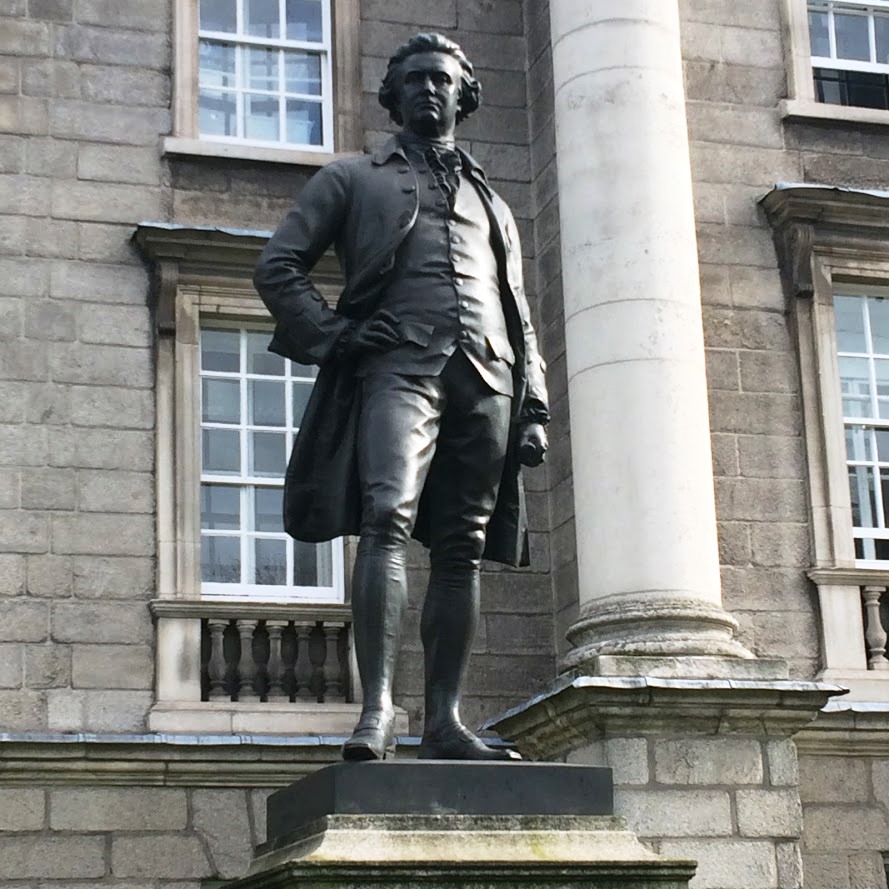
‘There are Three Estates in Parliament; but, in the Reporters’ Gallery yonder, there sits a Fourth Estate more important far than they all’ … Edmund Burke’s statue outside Trinity College Dublin (Photograph: Patrick Comerford)
Scripture quotations are from the New Revised Standard Version Bible: Anglicised Edition copyright © 1989, 1995, National Council of the Churches of Christ in the United States of America. Used by permission. All rights reserved worldwide. http://nrsvbibles.org
Patrick Comerford
Today is the Third Sunday of Easter (1 May 2022). During this season of Easter, I am reflecting each morning on the Psalms.
Later this morning, I hope to attend the Parish Eucharist in the Church of Saint Mary and Saint Giles in Stony Stratford. But, before this day begins, I am taking some time this morning to reflect in this Prayer Diary on my blog in these ways:
1, Short reflections on a psalm or psalms;
2, reading the psalm or psalms;
3, a prayer from the USPG prayer diary.
Psalm 67:
Psalm 67 is often known by its opening words in Latin, Deus misereatur. In Jewish tradition, this is one of the psalms recited at the Service for the Conclusion of the Shabbat. In the variation in numbering in the Greek Septuagint and Latin Vulgate, this is known as Psalm 66.
Psalm 67 an be divided it into three sections:
1 and 2,, verses 1-3 and 4-5: two broadly parallel sections in that seek God’s favour and blessing;
3, verses 6-7: this third section express universal joy as ‘all the nations’ experience God’s blessing.
Verses 3 and 5 are a repeated refrain:
Let the peoples praise you, O God;
let all the peoples praise you.
Psalm 67 shows how embracing and inclusive is God’s vision, God’s mission, God’s love. It is a psalm of thanksgiving whose key phrase is ‘The earth has yielded its increase’ or ‘The earth has yielded its harvest’ (verse 6).
The word ‘earth’ appears four times throughout this psalm in a variety of senses, suggesting that when we do God’s will on earth, the earth yields its blessings with the result that God is recognised by all nations of the earth.
The opening verse is reminiscent of the priestly blessing of the Cohanim: ‘May God be gracious to us and bless us and make his face to shine upon us’ (verse 1):
May the Lord bless and protect you.
May the Lord make his face shine on you and be gracious to you
May the Lord turn his face toward you, and give you peace (Numbers 6: 24-26)
This psalm is a plea for the mercy of God, for his ‘saving health’ to be seen in all nations, for his righteous judgment, and for his governance of the world. When all of that is in place, ‘Then shall the earth bring forth her increase, and God, our own God, will bless us. God will bless us, and all the ends of the world shall fear him.’
God raises up his own, in the face of popular prejudice, and in spite of our prejudices, so that his saving health may be received and may be a blessing in all nations.
This psalm can be read as thanksgiving for an abundant harvest or a prayer for a good harvest. The blessing God gave to the people is extended to all nations, for he is the universal just ruler and guide and all people everywhere may hold God in awe.
When Adam was exiled from Eden, it was said, ‘Cursed be the ground because of you.’ This is reversed in this psalm, as we pray for the earth to be blessed.
In Jewish tradition, Psalm 67 is read during these evenings of ‘Counting of the Omer,’ the 49 evenings or seven complete weeks between the festivals of Pesach or Passover and Shavout or Pentecost. In the original Hebrew text, excluding the superscription, this psalm contains 49 words, corresponding to the days of Counting of the Omer.
Psalm 67 as Deus Misereatur was introduced into the Book of Common Prayer by Thomas Cranmer as a Canticle for Evening Prayer, as an alternative to the main canticles.
This one of only four canticles that are provided in the traditional language in the Book of Common Prayer (2004) of the Church of Ireland [see p 134] – the others are Urbs Fortitudinis, Cantate Domino, and A Song of the Light, although modern language versions may be found either in the Psalms in the Book of Common Prayer or in the Irish Church Hymnal.
Thomas Tallis, Samuel Adler and Charles Ives composed musical settings of Psalm 67. The Revd Henry Francis Lyte, the author of ‘Abdie with me’ and a former curate of Taghmon, Co Wexford, wrote an English hymn paraphrase of this psalm, ‘God of mercy, God of grace,’ generally sung to the tune ‘Heathlands’ by Henry Smart.
‘Let the nations be glad and sing for joy’ (Psalm 67: 4) … flags of the nations at a shop in Kalambaka near the monasteries of Meteora in central Greece (Photograph: Patrick Comerford)
Psalm 67 (NRSVA):
To the leader: with stringed instruments. A Psalm. A Song.
1 May God be gracious to us and bless us
and make his face to shine upon us,
Selah
2 that your way may be known upon earth,
your saving power among all nations.
3 Let the peoples praise you, O God;
let all the peoples praise you.
4 Let the nations be glad and sing for joy,
for you judge the peoples with equity
and guide the nations upon earth.
Selah
5 Let the peoples praise you, O God;
let all the peoples praise you.
6 The earth has yielded its increase;
God, our God, has blessed us.
7 May God continue to bless us;
let all the ends of the earth revere him.
Today’s Prayer:
The theme in this week’s prayer diary of the Anglican mission agency USPG (United Society Partners in the Gospel) is ‘Truth Telllers,’ and is introduced this morning by Steve Cox, Chair of Christians in the Media. He writes:
Edmund Burke, the 18th Century Anglo-Irish statesman, was reported to have said; ‘There are Three Estates in Parliament; but, in the Reporters’ Gallery yonder, there sits a Fourth Estate more important far than they all.’
This respect for the media has been severely shaken in recent years. Yet, at its very best, the media continues to hold those in power to account, to call out injustice where it is seen, and unseen, and to be a voice to the voiceless.
It is crucial we support a free and independent press, while maintaining strong regulatory oversight. In a world of powerful, and quickly emerging, media platforms, Christians in Media will always be objective, and question where necessary, but not be afraid to highlight a media that brings us facts, information and truth.
As Christians, we pray for those in the media to uncover the beauty of hope, love and renewal that blossom in the debris of conflict, greed and exploitation. We pray that everyone in the media turn their weapons of word and image into ploughshares of peace and reconciliation.
We pray World Press Freedom Day continues to support the ‘Truth Tellers’ and uphold freedom of expression and information as a public good.
The USPG Prayer Diary this morning (1 May 2022) invites us to pray:
Amazing God,
you reach the stubborn and the cynical.
Teach us to be empathetic and understanding
as we seek to spread the Word.
Yesterday’s reflection
Continued tomorrow
‘There are Three Estates in Parliament; but, in the Reporters’ Gallery yonder, there sits a Fourth Estate more important far than they all’ … Edmund Burke’s statue outside Trinity College Dublin (Photograph: Patrick Comerford)
Scripture quotations are from the New Revised Standard Version Bible: Anglicised Edition copyright © 1989, 1995, National Council of the Churches of Christ in the United States of America. Used by permission. All rights reserved worldwide. http://nrsvbibles.org
Labels:
Canticles,
Easter 2022,
Flags,
Hymns,
Jewish Spirituality,
Journalism,
Justice,
media interviews,
Meteora,
Milton Keynes,
Mission,
Prayer,
Psalms,
Sabbath,
Taghmon,
TCD,
USPG,
Wolverton
03 January 2021
Joe Biden’s Irish ancestry is part of
a long tradition among US Presidents
A colourful street scene in Carlingford, Co Louth … Owen Finnegan and Jane Boyle were married in Carlingford in 1839 (Photograph Patrick Comerford)
Patrick Comerford
Joe Biden is due to be inaugurated as the 46th President of the United States later this month, in a public ceremony in front of the Capitol Building in Washington on Wednesday 20 January.
Already, links to the new president have been claimed by Co Louth, Co Mayo, and – more recently – Co Wexford. According to genealogist John Hamrock, all eight of Joe Biden’s great-great-grandparents on his mother’s side were born in Ireland in the first half of the 19th century and two great-grandparents on his father’s side were born in Ireland too.
Joseph Robinette Biden jr was born on 20 November 1942 in Scranton, Pennsylvania. His parents, Joseph Robinette Biden Sr and Catherine Eugenia (Jean) Finnegan, were married in 1941, and he grew up in a family steeped in Irish culture and values.
He once told RTÉ: ‘My grandfather and grandmother Finnegan, all my mother’s brothers, and my father told us about the courage and commitment it took for our relatives to emigrate from Ireland – in the midst of tragedy to distant shores, where they didn’t know what awaited them. It took great courage.’
His closest link to Ireland is his great-grandfather, James Finnegan, who emigrated from Carlingford, Co Louth, as a child in 1850, and his great-grandmother, Catherine Roche, who left Taghmon, Co Wexford, in the 1840s.
* * *
Saint Munn’s Church, Taghmon, Co Wexford … the hymnwriter Henry Francis Lyte was a curate while the Roche family was living in Taghmon (Photograph Patrick Comerford)
The family history research company Ancestor Network has carried out extensive research into the new President’s family tree. According to the genealogist John Hamrock, he has strong Irish roots. In the way Americans calculate or define Irish identity, President Biden is five-eighths Irish, with ten of his 16 great-great-grandparents born in Ireland.
John Hamrock’s research shows all eight of Joe Biden’s great-great-grandparents on his mother’s side were born in Ireland in the first half of the 19th century, and two great-grandparents on his father’s side were born in Ireland too.
Jean Finnegan was the daughter of Ambrose Joseph Finnegan and Geraldine Blewitt, who were married in 1909. Ambrose Finnegan was born in 1884, the son of Catherine (Roche) and James Finnegan, who lived in New York and moved to Scranton, Pennsylvania.
Ambrose Finnegan’s parents, Owen and Jane Finnegan, were from the Cooley Peninsula, near Carlingford, Co Louth. Owen Finnegan was born ca 1820, and while no record of his baptism survives, his parents may have been James Finnegan and Mary White. Owen Finnegan and Jane Boyle were married in 1839 in Carlingford. He emigrated to New York in 1849, and his wife Jane arrived a year later, with three children, James (7), Stephen (5) and Patrick (infant). Jane died in 1874 and Owen died in 1875.
Another son, Ambrose Joseph Finnegan, later married Catherine Roche, whose parents, Thomas and Roche and Bridget (née Fox), were from Taghmon, Co Wexford. Thomas Roche, who was born in 1813, was a stonemason. His daughter Catherine Roche emigrated from Taghmon in the 1840s; she later married Ambrose Joseph Finnegan, and they are great-grandparents of Joe Biden.
Paul Roche from Camolin, Co Wexford, uncovered Mr Biden’s connections with Taghmon and other parts of Co Wexford, going back seven generations to Maurice Roche, whose son Patrick married Mary Roche from Taghmon. Thomas and Bridget (Fox) Roche emigrated to America with their daughter Catherine, who married Ambrose Finnegan.
Sunset on the River Moy … Edward Blewitt was living in Ballina in the 1820s and 1830s (Photograph Patrick Comerford)
* * *
The Blewitt family also had strong Irish connections. Geraldine Blewitt’s four grandparents – Patrick Blewitt and Catherine (Kate) Scanlon, and James Stanton and Mary Arthurs – were all born in Ireland.
The Blewitt and Scanlon families were from Rappacastle, near Ballina, Co Mayo. Joe Biden’s great-great-great-grandfather, Edward Blewitt, emigrated to the US in 1851 on the SS Excelsior. He left Ireland with his wife Mary Mulderrig (sometimes given as Redington) and their seven children, including Patrick Blewitt, then 18, who is Joe Biden’s great-great-grandfather.
The Blewitt family from Rappacastle was living in Ballina by the 1820s. Edward Blewitt was a brickmaker, supplying bricks for the building of Ballina Cathedral in 1827, and his son Patrick Blewitt was baptised in Ballina in 1832.
Edward is thought to have worked with the Ordnance Survey in Mayo in the 1830s, and the family left Ballina for neighbouring Ardagh after an outbreak of cholera in Ballina, before moving to America.
Joe Biden also has Irish ancestors on his father’s side of the family. His great-great-grandparents, John Hanafy and Mary Ward, were born in Ireland. Mary Ward’s parents – Joe Biden’s great-great-great-grandparents – John and Mary Ward, were from Co Galway.
Today, Mr Biden’s Irish relations through the Finnegan family include the Ireland rugby internationals Rob and Dave Kearney. Their father, David Joseph Donald Kearney, is a fifth cousin of the president-elect, according to research out by Epic, the Irish Emigration Museum.
Kamala Harris and
an Irish slaveholder
The new Vice-President, Kamala Harris, has strong family roots in Jamaica through her father and in India through her mother. But Irish genealogists recently explored whether her great-grandmother from Jamaica, Iris Finegan, had another Irish link to match Joe Biden’s links with Louth, Wexford and Mayo.
However, if there is an Irish link in Kamala Brown’s ancestry, it is most likely through Hamilton Brown, who was from Co Antrim.
Her father, Professor Donald J Harris, is the son of Beryl and Oscar Harris, known to the family as ‘Miss Beryl’ and ‘Maas Oscar’. His paternal grandmother, Christiana Brown, was known as ‘Miss Chrishy’ and his maternal grandmother, Iris Allen or Finigan, was ‘Miss Iris.’
He has told how Miss Chrishy was a ‘descendant of Hamilton Brown, who is on record as a plantation and slave owner and founder of Brown’s Town.’ The Harris family was based in Orange Hill, Brown’s Town.
Kamala Harris’s great-grandmother Christiana Brown was born about 1881. According to Donald Harris, she was a descendant of Hamilton Brown, a slave owner and the founder of Brown’s Town.
* * *
The grave of Hamilton Brown in Jamaica … was the slaveowner from Co Antrim an ancestor Kamala Harris? (Photograph: Find a Grave)
Hamilton Brown was an Ulster Presbyterian and settled in Jamaica when he was about 20. He became a prominent plantation and slave owner, and was a lawyer and a member of the Jamaican Assembly. He was described as ‘an ignorant, brutish and fiend-like man, well calculated to be a member of the House of Assembly or any house disposed to uphold slavery.’
Hamilton Brown campaigned vigorously against the abolition of slavery and resented ‘the interference of the home government with their slaves.’ At the abolition of slavery in 1834, Brown was associated with compensation claims involving more than 1,000 slaves. He returned to Ireland to recruit new labourers in Ballymoney, Kildare and Limerick to replace the slaves on his plantations.
Brown died on 18 September 1848, and he is buried at Saint Mark’s Anglican Church in Brown’s Town.
Donald J Harris’s father, Kamala Harris’s grandfather, was born on 5 April 1914 and at birth was named Oscar Wilde Brown, perhaps as a tribute to the Irish writer. But his birth was re-registered as Oscar Joseph Harris in 1950. Meanwhile, the connection between Hamilton Brown and Kamala Harris remains unproven.
Biden’s links with
the Wexford Kennedys
The ‘Emigrant Flame’ on the Quays at New Ross, Co Wexford … the great-grandparents of John F Kennedy and Joe Biden may have left New Ross for America around the same time (Photograph Patrick Comerford)
Paul Roche was amazed when he came across Joe Biden’s links with Co Wexford. Already Co Wexford had one of the most significant connections with any American president in John Fitzgerald Kennedy, whose great-grandfather, Patrick Kennedy, was from Dunganstown, Co Wexford.
‘Where the Roches lived was only 18 miles from Dunganstown,’ he told the Wexford People. ‘Both great-grandparents possibly left New Ross around the same time for America.’
One genealogist said, ‘it’s fair to say’ that Joe Biden is ‘the most Irish of Irish presidents since John F Kennedy.’ The Kennedys were from Co Wexford and the Fitzgeralds from Bruff, Co Limerick.
Thomas Fitzgerald from Bruff emigrated to Boston and married Rosanna Cox from Co Cavan. Their son, John Francis (‘Honey’) Fitzgerald, was Mayor of Boston, and the father of Rose Kennedy, mother of the brothers John F, Bobbie and Ted Kennedy.
* * *
The John F Kennedy memorial and sculpture on the quayside in New Ross (Photograph Patrick Comerford)
In all, 22 US Presidents to date have Irish ancestry, from parents to seven times great grandparents and the children of immigrants. Although none was actually born in Ireland – if they were, they would not be eligible for the Presidency – many have come back to Ireland to visit their ancestral homes.
Andrew Jackson, the seventh President (1829-1837), was the first with Irish ancestry. He was born in 1767 to parents who emigrated from Carrickfergus just two years earlier with their two Irish-born sons. His father died at 29, just a few weeks before his birth.
James Buchanan also had Irish parents. His father, also James Buchanan, emigrated from Milford, Co Donegal, in 1783, and he raised James and his ten siblings in Pennsylvania.
Other presidents with immediate Irish ancestry include James Knox Polk, Ulysses S Grant, William McKinley, Theodore Roosevelt, Woodrow Wilson, Ronald Reagan, the Bush father and son, and – of course – Bill Clinton and Barack Obama.
As for Donald Trump, his only connection with Ireland seems to be his golf resort in Doonbeg, Co Clare. And that is probably more than enough.
The Trump golf resort in Doonbeg, Co Clare … Donald Trump’s only connection with Ireland (Photograph Patrick Comerford)
This feature was first published in January 2021 in the ‘Church Review’ (Dublin and Glendalough)
Patrick Comerford
Joe Biden is due to be inaugurated as the 46th President of the United States later this month, in a public ceremony in front of the Capitol Building in Washington on Wednesday 20 January.
Already, links to the new president have been claimed by Co Louth, Co Mayo, and – more recently – Co Wexford. According to genealogist John Hamrock, all eight of Joe Biden’s great-great-grandparents on his mother’s side were born in Ireland in the first half of the 19th century and two great-grandparents on his father’s side were born in Ireland too.
Joseph Robinette Biden jr was born on 20 November 1942 in Scranton, Pennsylvania. His parents, Joseph Robinette Biden Sr and Catherine Eugenia (Jean) Finnegan, were married in 1941, and he grew up in a family steeped in Irish culture and values.
He once told RTÉ: ‘My grandfather and grandmother Finnegan, all my mother’s brothers, and my father told us about the courage and commitment it took for our relatives to emigrate from Ireland – in the midst of tragedy to distant shores, where they didn’t know what awaited them. It took great courage.’
His closest link to Ireland is his great-grandfather, James Finnegan, who emigrated from Carlingford, Co Louth, as a child in 1850, and his great-grandmother, Catherine Roche, who left Taghmon, Co Wexford, in the 1840s.
* * *
Saint Munn’s Church, Taghmon, Co Wexford … the hymnwriter Henry Francis Lyte was a curate while the Roche family was living in Taghmon (Photograph Patrick Comerford)
The family history research company Ancestor Network has carried out extensive research into the new President’s family tree. According to the genealogist John Hamrock, he has strong Irish roots. In the way Americans calculate or define Irish identity, President Biden is five-eighths Irish, with ten of his 16 great-great-grandparents born in Ireland.
John Hamrock’s research shows all eight of Joe Biden’s great-great-grandparents on his mother’s side were born in Ireland in the first half of the 19th century, and two great-grandparents on his father’s side were born in Ireland too.
Jean Finnegan was the daughter of Ambrose Joseph Finnegan and Geraldine Blewitt, who were married in 1909. Ambrose Finnegan was born in 1884, the son of Catherine (Roche) and James Finnegan, who lived in New York and moved to Scranton, Pennsylvania.
Ambrose Finnegan’s parents, Owen and Jane Finnegan, were from the Cooley Peninsula, near Carlingford, Co Louth. Owen Finnegan was born ca 1820, and while no record of his baptism survives, his parents may have been James Finnegan and Mary White. Owen Finnegan and Jane Boyle were married in 1839 in Carlingford. He emigrated to New York in 1849, and his wife Jane arrived a year later, with three children, James (7), Stephen (5) and Patrick (infant). Jane died in 1874 and Owen died in 1875.
Another son, Ambrose Joseph Finnegan, later married Catherine Roche, whose parents, Thomas and Roche and Bridget (née Fox), were from Taghmon, Co Wexford. Thomas Roche, who was born in 1813, was a stonemason. His daughter Catherine Roche emigrated from Taghmon in the 1840s; she later married Ambrose Joseph Finnegan, and they are great-grandparents of Joe Biden.
Paul Roche from Camolin, Co Wexford, uncovered Mr Biden’s connections with Taghmon and other parts of Co Wexford, going back seven generations to Maurice Roche, whose son Patrick married Mary Roche from Taghmon. Thomas and Bridget (Fox) Roche emigrated to America with their daughter Catherine, who married Ambrose Finnegan.
Sunset on the River Moy … Edward Blewitt was living in Ballina in the 1820s and 1830s (Photograph Patrick Comerford)
* * *
The Blewitt family also had strong Irish connections. Geraldine Blewitt’s four grandparents – Patrick Blewitt and Catherine (Kate) Scanlon, and James Stanton and Mary Arthurs – were all born in Ireland.
The Blewitt and Scanlon families were from Rappacastle, near Ballina, Co Mayo. Joe Biden’s great-great-great-grandfather, Edward Blewitt, emigrated to the US in 1851 on the SS Excelsior. He left Ireland with his wife Mary Mulderrig (sometimes given as Redington) and their seven children, including Patrick Blewitt, then 18, who is Joe Biden’s great-great-grandfather.
The Blewitt family from Rappacastle was living in Ballina by the 1820s. Edward Blewitt was a brickmaker, supplying bricks for the building of Ballina Cathedral in 1827, and his son Patrick Blewitt was baptised in Ballina in 1832.
Edward is thought to have worked with the Ordnance Survey in Mayo in the 1830s, and the family left Ballina for neighbouring Ardagh after an outbreak of cholera in Ballina, before moving to America.
Joe Biden also has Irish ancestors on his father’s side of the family. His great-great-grandparents, John Hanafy and Mary Ward, were born in Ireland. Mary Ward’s parents – Joe Biden’s great-great-great-grandparents – John and Mary Ward, were from Co Galway.
Today, Mr Biden’s Irish relations through the Finnegan family include the Ireland rugby internationals Rob and Dave Kearney. Their father, David Joseph Donald Kearney, is a fifth cousin of the president-elect, according to research out by Epic, the Irish Emigration Museum.
Kamala Harris and
an Irish slaveholder
The new Vice-President, Kamala Harris, has strong family roots in Jamaica through her father and in India through her mother. But Irish genealogists recently explored whether her great-grandmother from Jamaica, Iris Finegan, had another Irish link to match Joe Biden’s links with Louth, Wexford and Mayo.
However, if there is an Irish link in Kamala Brown’s ancestry, it is most likely through Hamilton Brown, who was from Co Antrim.
Her father, Professor Donald J Harris, is the son of Beryl and Oscar Harris, known to the family as ‘Miss Beryl’ and ‘Maas Oscar’. His paternal grandmother, Christiana Brown, was known as ‘Miss Chrishy’ and his maternal grandmother, Iris Allen or Finigan, was ‘Miss Iris.’
He has told how Miss Chrishy was a ‘descendant of Hamilton Brown, who is on record as a plantation and slave owner and founder of Brown’s Town.’ The Harris family was based in Orange Hill, Brown’s Town.
Kamala Harris’s great-grandmother Christiana Brown was born about 1881. According to Donald Harris, she was a descendant of Hamilton Brown, a slave owner and the founder of Brown’s Town.
* * *
The grave of Hamilton Brown in Jamaica … was the slaveowner from Co Antrim an ancestor Kamala Harris? (Photograph: Find a Grave)
Hamilton Brown was an Ulster Presbyterian and settled in Jamaica when he was about 20. He became a prominent plantation and slave owner, and was a lawyer and a member of the Jamaican Assembly. He was described as ‘an ignorant, brutish and fiend-like man, well calculated to be a member of the House of Assembly or any house disposed to uphold slavery.’
Hamilton Brown campaigned vigorously against the abolition of slavery and resented ‘the interference of the home government with their slaves.’ At the abolition of slavery in 1834, Brown was associated with compensation claims involving more than 1,000 slaves. He returned to Ireland to recruit new labourers in Ballymoney, Kildare and Limerick to replace the slaves on his plantations.
Brown died on 18 September 1848, and he is buried at Saint Mark’s Anglican Church in Brown’s Town.
Donald J Harris’s father, Kamala Harris’s grandfather, was born on 5 April 1914 and at birth was named Oscar Wilde Brown, perhaps as a tribute to the Irish writer. But his birth was re-registered as Oscar Joseph Harris in 1950. Meanwhile, the connection between Hamilton Brown and Kamala Harris remains unproven.
Biden’s links with
the Wexford Kennedys
The ‘Emigrant Flame’ on the Quays at New Ross, Co Wexford … the great-grandparents of John F Kennedy and Joe Biden may have left New Ross for America around the same time (Photograph Patrick Comerford)
Paul Roche was amazed when he came across Joe Biden’s links with Co Wexford. Already Co Wexford had one of the most significant connections with any American president in John Fitzgerald Kennedy, whose great-grandfather, Patrick Kennedy, was from Dunganstown, Co Wexford.
‘Where the Roches lived was only 18 miles from Dunganstown,’ he told the Wexford People. ‘Both great-grandparents possibly left New Ross around the same time for America.’
One genealogist said, ‘it’s fair to say’ that Joe Biden is ‘the most Irish of Irish presidents since John F Kennedy.’ The Kennedys were from Co Wexford and the Fitzgeralds from Bruff, Co Limerick.
Thomas Fitzgerald from Bruff emigrated to Boston and married Rosanna Cox from Co Cavan. Their son, John Francis (‘Honey’) Fitzgerald, was Mayor of Boston, and the father of Rose Kennedy, mother of the brothers John F, Bobbie and Ted Kennedy.
* * *
The John F Kennedy memorial and sculpture on the quayside in New Ross (Photograph Patrick Comerford)
In all, 22 US Presidents to date have Irish ancestry, from parents to seven times great grandparents and the children of immigrants. Although none was actually born in Ireland – if they were, they would not be eligible for the Presidency – many have come back to Ireland to visit their ancestral homes.
Andrew Jackson, the seventh President (1829-1837), was the first with Irish ancestry. He was born in 1767 to parents who emigrated from Carrickfergus just two years earlier with their two Irish-born sons. His father died at 29, just a few weeks before his birth.
James Buchanan also had Irish parents. His father, also James Buchanan, emigrated from Milford, Co Donegal, in 1783, and he raised James and his ten siblings in Pennsylvania.
Other presidents with immediate Irish ancestry include James Knox Polk, Ulysses S Grant, William McKinley, Theodore Roosevelt, Woodrow Wilson, Ronald Reagan, the Bush father and son, and – of course – Bill Clinton and Barack Obama.
As for Donald Trump, his only connection with Ireland seems to be his golf resort in Doonbeg, Co Clare. And that is probably more than enough.
The Trump golf resort in Doonbeg, Co Clare … Donald Trump’s only connection with Ireland (Photograph Patrick Comerford)
This feature was first published in January 2021 in the ‘Church Review’ (Dublin and Glendalough)
09 September 2020
Who fears to speak of ’98?
Thoughts on Bagenal Harvey
on Wexford Bridge and quays
Wexford Bridge seen from Wexford’s quays (Photograph: Patrick Comerford, 2020)
Patrick Comerford
‘Who fears to speak of ’Ninety-Eight?’
The opening words of a poem by Professor John Kells Ingram were quoted regularly throughout the 1798 bicentenary commemorations throughout 1998. They came to mind last week during the second stage of my summer ‘Road Trip,’ as I strolled along Wexford Quay and onto Wexford Bridge.
Like many other aspects of the 1798 Rising, this poem has many connections with the Church of Ireland: the actual title of the poem, written in 1843, is ‘The Memory of the Dead,’ and its author, the economist and poet John Kells Ingram (1823-1907), was born in a Church of Ireland rectory in Co Donegal, the son of the Revd William Ingram.
In James Joyce’s Ulysses, Leopold Bloom alludes mentally to Ingram’s ‘Who Fears to Speak?’ in the ‘Wandering Rocks’ episode: ‘Fine poem that is: Ingram. They were gentlemen. Ben Dollard does sing that ballad touchingly. Masterly rendition.’
Throughout the bicentenary commemorations, which seemed to stretch across a two- or three-year period from 1996 to 1998 or 1999, I spoke throughout Co Wexford on the involvement of members of the Church of Ireland in the events in 1798.
Thanks to the efforts of Comoradh ’98 that year, there was a much more accurate, balanced and nuanced understanding than in previous commemorations of the events, the personalities, the lead-up to and the aftermath of the 1798 Rebellion.
Street art in a laneway behind Anne Street and North Main Street in Wexford (Photograph: Patrick Comerford, 2020)
I spoke in churches, schools and hotels, at seminars and meetings, workshops and summer schools, wrote features in The Irish Times, papers in history journals, and chapters for books, was interviewed for television and radio documentaries, unveiled plaques in churchyards and spoke one evening at a commemorative service on Wexford Bridge.
The participants in that service in memory of all who died on Wexford Bridge during the summer of 1798 included Bishop John Neill, then Bishop of Cashel and Ferns, the late Canon Norman Ruddock, then Rector of Wexford, and Father Walter Forde, then Parish Priest of Castlebridge.
In a kind letter later that week to The Irish Times, Walter Forde spoke of my ‘superb address at the Wexford Bridge service.’
On that evening, I drew attention to the fact that there were no memorials in Wexford to the key Church of Ireland personalities from the 1798 period. I suggested that the recently reconstructed Wexford Bridge should be renamed in honour of the commander of the Wexford army and president of the Wexford Town Committee, Beauchamp Bagenal Harvey, a member of the Church of Ireland.
In supporting that call, Father Forde suggested that Harvey should be linked with the name of the far-seeing and humane Roman Catholic from Castlebridge, General Edward Roche, and, he asked, ‘Why not the Harvey/Roche Bridge?’
Almost a quarter of a century after those bicentenary commemorations, it was interesting to take a fresh look last week at the plaques and memorials on Wexford Bridge.
One of these plaques recalls that the first bridge crossing the River Slaney on this site was a timber bridge constructed by Lemuel Cox of Boston in 1795, three years before the Rising. The bridge, which saw a frightful procession of executions in 1798, was repaired and strengthened in 1825 after storm damage.
That bridge was replaced in 1856 by a new bridge about 1 km upstream and built by Pierce Brothers of Wexford. But Wexford Bridge returned to the site associated with the1798 Rising in 1959, when a new pre-stressed concrete bridge was built by Ascon Ltd. That bridge was replaced in a 1997 with a steel structure that took just 10 weeks to complete. Ascon were the main contractors, and the consulting engineers were John B Barry and Partners. The bridge was opened on 22 November 1997.
One of the plaques recalling the executions and deaths on Wexford Bridge (Photograph: Patrick Comerford, 2020)
A plaque was erected on the bridge by the 1798 commemoration committee, naming Father Philip Roche, John Kelly, John Colclough, Edmond Kyan, Patrick Prendergast, Bagnal (sic) Harvey, Matthew Keough, John Hay, Cornelius Grogan, ‘and other patriots who were executed on the site of this bridge, June-July 1798 as a result of their struggle for Irish freedom.’
Beauchamp Bagenal Harvey was tried, convicted and hanged on Wexford Bridge on 28 June 1798. His body was afterwards beheaded, the trunk thrown into the River Slaney and the head displayed on a spike on the courthouse. His corpse was recovered by his friends and he was buried in Mayglass.
Another plaque on the bridge reflects the balance and nuance that marked the commemorations I was part of in 1998. It recalls:
‘During and after the insurrection of 1798, Wexford Bridge was the site of many executions. Some ninety loyalist prisoners were put to death, amongst whom were Edward Turner, Magistrate; David Dalton, Thomas Canford, Samuel Atkin, Francis Plumer, William Baubier, Benjamin Sunderland, George Sparrow, John Smyth and Kenneth Mathewson. Among the sixty-five United Irishmen executed were the leaders Beauchamp Bagnal (sic) Harvey, Dr John Colclough, John Kelly, Cornelius Crogan, Patrick Prendergast, Fr Philip Roche, John Herron, Edward Fryane, Esmond Kyan, and Matthew Keugh.’
I noticed, sadly, however, that Bagenal Harvey’s name is misspelled not just once but twice on the bridge that I still think should be named after him.
‘Fuascailt’ … a sculpture by Eamonn O’Doherty of Wexford pikemen on the N25 near Barntown and Taghmon (Photograph: Patrick Comerford, 2020)
Today, no matter what their political views are and despite the opening words of Ingram’s poem, no-one in Wexford is afraid ‘to speak of ’98.’ New monuments are still standing in every corner of the county from Bunclody and Gorey to Enniscorthy and Wexford, to Old Ross and New Ross.
As we continued our summer ‘Road Trip’ on the N25 from Ferrycarrig towards New Ross, near Barntown and Taghmon, ‘Fuascailt’ is a striking sculpture by Eamonn O’Doherty (1939-2011) by the roadside depicting a group of Wexford Pikemen from 1798. His other works include the Quincentennial Sculpture on Eyre Square in Galway; Anna Livia or the ‘Floozie in the Jacuzzi,’ moved from O’Connell Street to the Croppies’ Acre in Dublin in 2011; and the James Connolly Memorial near Liberty Hall, Dublin.
Even the description on the plinth below O’Doherty’s Pikemen recalls all who died there in battle on 30 May 1798.
On that day, the United Irishmen intercepted the reinforcements for the Wexford garrison near this place. The reinforcements were overwhelmed, and their defeat resulted in the evacuation of Wexford by government forces. The rebels were led by Thomas Cloney, colonel of Bantry battalion of United Irishmen.
But the plaque also remembers that nearby, in the Church Meadow, lie 80 men of the Royal Artillery and the Meath Militia who were killed in that battle.
No matter what one’s political views or sympathies are, there is no reason to fear to speak about 1798 in Co Wexford. And, for what it’s worth, I still think – fearlessly – that Wexford Bridge should be named after Bagenal Harvey.
The ten-week bridge … is it time Wexford Bridge was named after Beauchamp Bagenal Harvey? (Photograph: Patrick Comerford, 2020)
Patrick Comerford
‘Who fears to speak of ’Ninety-Eight?’
The opening words of a poem by Professor John Kells Ingram were quoted regularly throughout the 1798 bicentenary commemorations throughout 1998. They came to mind last week during the second stage of my summer ‘Road Trip,’ as I strolled along Wexford Quay and onto Wexford Bridge.
Like many other aspects of the 1798 Rising, this poem has many connections with the Church of Ireland: the actual title of the poem, written in 1843, is ‘The Memory of the Dead,’ and its author, the economist and poet John Kells Ingram (1823-1907), was born in a Church of Ireland rectory in Co Donegal, the son of the Revd William Ingram.
In James Joyce’s Ulysses, Leopold Bloom alludes mentally to Ingram’s ‘Who Fears to Speak?’ in the ‘Wandering Rocks’ episode: ‘Fine poem that is: Ingram. They were gentlemen. Ben Dollard does sing that ballad touchingly. Masterly rendition.’
Throughout the bicentenary commemorations, which seemed to stretch across a two- or three-year period from 1996 to 1998 or 1999, I spoke throughout Co Wexford on the involvement of members of the Church of Ireland in the events in 1798.
Thanks to the efforts of Comoradh ’98 that year, there was a much more accurate, balanced and nuanced understanding than in previous commemorations of the events, the personalities, the lead-up to and the aftermath of the 1798 Rebellion.
Street art in a laneway behind Anne Street and North Main Street in Wexford (Photograph: Patrick Comerford, 2020)
I spoke in churches, schools and hotels, at seminars and meetings, workshops and summer schools, wrote features in The Irish Times, papers in history journals, and chapters for books, was interviewed for television and radio documentaries, unveiled plaques in churchyards and spoke one evening at a commemorative service on Wexford Bridge.
The participants in that service in memory of all who died on Wexford Bridge during the summer of 1798 included Bishop John Neill, then Bishop of Cashel and Ferns, the late Canon Norman Ruddock, then Rector of Wexford, and Father Walter Forde, then Parish Priest of Castlebridge.
In a kind letter later that week to The Irish Times, Walter Forde spoke of my ‘superb address at the Wexford Bridge service.’
On that evening, I drew attention to the fact that there were no memorials in Wexford to the key Church of Ireland personalities from the 1798 period. I suggested that the recently reconstructed Wexford Bridge should be renamed in honour of the commander of the Wexford army and president of the Wexford Town Committee, Beauchamp Bagenal Harvey, a member of the Church of Ireland.
In supporting that call, Father Forde suggested that Harvey should be linked with the name of the far-seeing and humane Roman Catholic from Castlebridge, General Edward Roche, and, he asked, ‘Why not the Harvey/Roche Bridge?’
Almost a quarter of a century after those bicentenary commemorations, it was interesting to take a fresh look last week at the plaques and memorials on Wexford Bridge.
One of these plaques recalls that the first bridge crossing the River Slaney on this site was a timber bridge constructed by Lemuel Cox of Boston in 1795, three years before the Rising. The bridge, which saw a frightful procession of executions in 1798, was repaired and strengthened in 1825 after storm damage.
That bridge was replaced in 1856 by a new bridge about 1 km upstream and built by Pierce Brothers of Wexford. But Wexford Bridge returned to the site associated with the1798 Rising in 1959, when a new pre-stressed concrete bridge was built by Ascon Ltd. That bridge was replaced in a 1997 with a steel structure that took just 10 weeks to complete. Ascon were the main contractors, and the consulting engineers were John B Barry and Partners. The bridge was opened on 22 November 1997.
One of the plaques recalling the executions and deaths on Wexford Bridge (Photograph: Patrick Comerford, 2020)
A plaque was erected on the bridge by the 1798 commemoration committee, naming Father Philip Roche, John Kelly, John Colclough, Edmond Kyan, Patrick Prendergast, Bagnal (sic) Harvey, Matthew Keough, John Hay, Cornelius Grogan, ‘and other patriots who were executed on the site of this bridge, June-July 1798 as a result of their struggle for Irish freedom.’
Beauchamp Bagenal Harvey was tried, convicted and hanged on Wexford Bridge on 28 June 1798. His body was afterwards beheaded, the trunk thrown into the River Slaney and the head displayed on a spike on the courthouse. His corpse was recovered by his friends and he was buried in Mayglass.
Another plaque on the bridge reflects the balance and nuance that marked the commemorations I was part of in 1998. It recalls:
‘During and after the insurrection of 1798, Wexford Bridge was the site of many executions. Some ninety loyalist prisoners were put to death, amongst whom were Edward Turner, Magistrate; David Dalton, Thomas Canford, Samuel Atkin, Francis Plumer, William Baubier, Benjamin Sunderland, George Sparrow, John Smyth and Kenneth Mathewson. Among the sixty-five United Irishmen executed were the leaders Beauchamp Bagnal (sic) Harvey, Dr John Colclough, John Kelly, Cornelius Crogan, Patrick Prendergast, Fr Philip Roche, John Herron, Edward Fryane, Esmond Kyan, and Matthew Keugh.’
I noticed, sadly, however, that Bagenal Harvey’s name is misspelled not just once but twice on the bridge that I still think should be named after him.
‘Fuascailt’ … a sculpture by Eamonn O’Doherty of Wexford pikemen on the N25 near Barntown and Taghmon (Photograph: Patrick Comerford, 2020)
Today, no matter what their political views are and despite the opening words of Ingram’s poem, no-one in Wexford is afraid ‘to speak of ’98.’ New monuments are still standing in every corner of the county from Bunclody and Gorey to Enniscorthy and Wexford, to Old Ross and New Ross.
As we continued our summer ‘Road Trip’ on the N25 from Ferrycarrig towards New Ross, near Barntown and Taghmon, ‘Fuascailt’ is a striking sculpture by Eamonn O’Doherty (1939-2011) by the roadside depicting a group of Wexford Pikemen from 1798. His other works include the Quincentennial Sculpture on Eyre Square in Galway; Anna Livia or the ‘Floozie in the Jacuzzi,’ moved from O’Connell Street to the Croppies’ Acre in Dublin in 2011; and the James Connolly Memorial near Liberty Hall, Dublin.
Even the description on the plinth below O’Doherty’s Pikemen recalls all who died there in battle on 30 May 1798.
On that day, the United Irishmen intercepted the reinforcements for the Wexford garrison near this place. The reinforcements were overwhelmed, and their defeat resulted in the evacuation of Wexford by government forces. The rebels were led by Thomas Cloney, colonel of Bantry battalion of United Irishmen.
But the plaque also remembers that nearby, in the Church Meadow, lie 80 men of the Royal Artillery and the Meath Militia who were killed in that battle.
No matter what one’s political views or sympathies are, there is no reason to fear to speak about 1798 in Co Wexford. And, for what it’s worth, I still think – fearlessly – that Wexford Bridge should be named after Bagenal Harvey.
The ten-week bridge … is it time Wexford Bridge was named after Beauchamp Bagenal Harvey? (Photograph: Patrick Comerford, 2020)
22 August 2020
‘Dance me to the end of love
Dance me to your beauty
with a burning violin’
Leonard Cohen’s ‘Dance me to the end of love’ arose from a photograph of death camp musicians
Patrick Comerford
I have long decided the hymns I want to hear at my own funeral – later, rather than sooner, hopefully. I am not being morbid in any way, needless to say, but I think the hymns and readings at my funeral should reflect my own theological and spiritual journey through life.
1, Opening hymn: ‘Thine be the glory’ (Irish Church Hymnal, 288) is filled with hope of the Resurrection, and was first written in French and later translated into English. It became popular after it was sung at the Jerusalem Conference in 1928 and then at 1948 assembly of the World Conference of Churches in Amsterdam. The hymn was written to be sung to the tune in the chorus in Handel’s oratorio Judas Maccabeus.
2, Gradual: ‘Lead kindly light’ (ICH, 653) was written by John Henry Newman in 1832, during a time of spiritual turmoil in his own life. On the Sunday after writing this poem, he heard John Keble preach his influential ‘Assize Sermon’ in Oxford. Newman did not imagine at the time that his poem would become a hymn. The tune is by John Bacchus Dykes, Precentor of Durham Cathedral, and this later became Gandhi’s favourite hymn.
3, Offertory: ‘How shall I sing that majesty’ (ICH, 468), written by John Mason in the 17th century, is also a resurrection hymn. The tune ‘Coe Fen’ by Kenneth Naylor is outstanding, and also evokes memories long summer walks by the Backs in Cambridge. But I want all four verses of the hymn sung, and not just the three verses found in the Irish Church Hymnal.
4, Post-Communion hymn: ‘Abide with me’ (ICH, 62) by Henry Francis Lyte is known to every football fan, but also has strong Wexford connections. Lyte served his curacy in Taghmon, Co Wexford, and his experience there inspired many of the themes in this hymn, although he wrote it later in life, when he was acutely aware of his own impending death.
But I also want to hear two songs by Leonard Cohen at my funeral: ‘If it be your will’ when I am being brought into the church; and his ‘Dance me to the end of love’ as I am being brought out.
‘If it be your will’ seems so appropriate a hymn for any writer who has to accept that our time has come and that it is God’s will that we should become silent:
If it be your will
That I speak no more
And my voice be still
As it was before
I will speak no more
I shall abide until
I am spoken for
If it be your will
If it be your will
On the other hand, ‘Dance me to the end of love’ seemed, for so long, to be an appropriate way of saying that love continues after death, that death does not bring an end to love.
I also want this song because of its Greek inspiration: it follows a typical Greek Hasapiko dance path, inspired perhaps by Cohen’s long-lasting links with Greece and the island of Hydra.
So, I was taken aback earlier this week to learn from Allan Showalter’s blog that this song was inspired by a photograph Leonard Cohen had seen in his childhood of musicians in a death camp.
In a posting last year [29 March 2019], Allan Showalter quoted Leonard Cohen saying as he introduced the song at his concert in Koln on 10 April 1988, ‘This is a song that arose from a photograph that I saw when I was a child of some people in striped pyjamas prison uniforms with violins playing beside a smoke stack and the smoke was made out of gypsies and children, and this song arose out of that photograph: Dance Me To The End Of Love.’
The photograph Allan Showalter used to illustrate his posting shows prisoners in the death camp in Mauthausen, although it is only one of several such images, and he admits it ‘is unlikely to be the specific photo that inspired Leonard Cohen’s Dance me to the end of love.’
In an interview with CBC radio 25 years ago, on 26 August 1995, Cohen was asked about the origins of ‘Dance me to the end of love.’ Cohen said it ‘came from just hearing or reading or knowing that in the death camps, beside the crematoria, in certain of the death camps, a string quartet was pressed into performance while this horror was going on, those were the people whose fate was this horror also. And they would be playing classical music while their fellow prisoners were being killed and burnt. So, that music, ‘Dance me to your beauty with a burning violin,’ meaning the beauty there of being the consummation of life, the end of this existence and of the passionate element in that consummation.’
He continued, ‘But, it is the same language that we use for surrender to the beloved, so that the song – it’s not important that anybody knows the genesis of it, because if the language comes from that passionate resource, it will be able to embrace all passionate activity.’
Dance me to your beauty with a burning violin
Dance me through the panic till I’m gathered safely in
Lift me like an olive branch and be my homeward dove
Dance me to the end of love
Oh, let me see your beauty when the witnesses are gone
Let me feel you moving like they do in Babylon
Show me slowly what I only know the limits of
Dance me to the end of love
Dance me to the wedding now, dance me on and on
Dance me very tenderly and dance me very long
We're both of us beneath our love, we're both of us above
Dance me to the end of love
Dance me to the children who are asking to be born
Dance me through the curtains that our kisses have outworn
Raise a tent of shelter now, though every thread is torn
Dance me to the end of love
Dance me to your beauty with a burning violin
Dance me through the panic till I’m gathered safely in
Touch me with your naked hand or touch me with your glove
Dance me to the end of love
Further reading: ‘Play, Or Die. The Orchestras of Auschwitz,’ by Shannon Quinn
(Dance Me to the End of Love lyrics © Sony/ATV Music Publishing LLC)
Patrick Comerford
I have long decided the hymns I want to hear at my own funeral – later, rather than sooner, hopefully. I am not being morbid in any way, needless to say, but I think the hymns and readings at my funeral should reflect my own theological and spiritual journey through life.
1, Opening hymn: ‘Thine be the glory’ (Irish Church Hymnal, 288) is filled with hope of the Resurrection, and was first written in French and later translated into English. It became popular after it was sung at the Jerusalem Conference in 1928 and then at 1948 assembly of the World Conference of Churches in Amsterdam. The hymn was written to be sung to the tune in the chorus in Handel’s oratorio Judas Maccabeus.
2, Gradual: ‘Lead kindly light’ (ICH, 653) was written by John Henry Newman in 1832, during a time of spiritual turmoil in his own life. On the Sunday after writing this poem, he heard John Keble preach his influential ‘Assize Sermon’ in Oxford. Newman did not imagine at the time that his poem would become a hymn. The tune is by John Bacchus Dykes, Precentor of Durham Cathedral, and this later became Gandhi’s favourite hymn.
3, Offertory: ‘How shall I sing that majesty’ (ICH, 468), written by John Mason in the 17th century, is also a resurrection hymn. The tune ‘Coe Fen’ by Kenneth Naylor is outstanding, and also evokes memories long summer walks by the Backs in Cambridge. But I want all four verses of the hymn sung, and not just the three verses found in the Irish Church Hymnal.
4, Post-Communion hymn: ‘Abide with me’ (ICH, 62) by Henry Francis Lyte is known to every football fan, but also has strong Wexford connections. Lyte served his curacy in Taghmon, Co Wexford, and his experience there inspired many of the themes in this hymn, although he wrote it later in life, when he was acutely aware of his own impending death.
But I also want to hear two songs by Leonard Cohen at my funeral: ‘If it be your will’ when I am being brought into the church; and his ‘Dance me to the end of love’ as I am being brought out.
‘If it be your will’ seems so appropriate a hymn for any writer who has to accept that our time has come and that it is God’s will that we should become silent:
If it be your will
That I speak no more
And my voice be still
As it was before
I will speak no more
I shall abide until
I am spoken for
If it be your will
If it be your will
On the other hand, ‘Dance me to the end of love’ seemed, for so long, to be an appropriate way of saying that love continues after death, that death does not bring an end to love.
I also want this song because of its Greek inspiration: it follows a typical Greek Hasapiko dance path, inspired perhaps by Cohen’s long-lasting links with Greece and the island of Hydra.
So, I was taken aback earlier this week to learn from Allan Showalter’s blog that this song was inspired by a photograph Leonard Cohen had seen in his childhood of musicians in a death camp.
In a posting last year [29 March 2019], Allan Showalter quoted Leonard Cohen saying as he introduced the song at his concert in Koln on 10 April 1988, ‘This is a song that arose from a photograph that I saw when I was a child of some people in striped pyjamas prison uniforms with violins playing beside a smoke stack and the smoke was made out of gypsies and children, and this song arose out of that photograph: Dance Me To The End Of Love.’
The photograph Allan Showalter used to illustrate his posting shows prisoners in the death camp in Mauthausen, although it is only one of several such images, and he admits it ‘is unlikely to be the specific photo that inspired Leonard Cohen’s Dance me to the end of love.’
In an interview with CBC radio 25 years ago, on 26 August 1995, Cohen was asked about the origins of ‘Dance me to the end of love.’ Cohen said it ‘came from just hearing or reading or knowing that in the death camps, beside the crematoria, in certain of the death camps, a string quartet was pressed into performance while this horror was going on, those were the people whose fate was this horror also. And they would be playing classical music while their fellow prisoners were being killed and burnt. So, that music, ‘Dance me to your beauty with a burning violin,’ meaning the beauty there of being the consummation of life, the end of this existence and of the passionate element in that consummation.’
He continued, ‘But, it is the same language that we use for surrender to the beloved, so that the song – it’s not important that anybody knows the genesis of it, because if the language comes from that passionate resource, it will be able to embrace all passionate activity.’
Dance me to your beauty with a burning violin
Dance me through the panic till I’m gathered safely in
Lift me like an olive branch and be my homeward dove
Dance me to the end of love
Oh, let me see your beauty when the witnesses are gone
Let me feel you moving like they do in Babylon
Show me slowly what I only know the limits of
Dance me to the end of love
Dance me to the wedding now, dance me on and on
Dance me very tenderly and dance me very long
We're both of us beneath our love, we're both of us above
Dance me to the end of love
Dance me to the children who are asking to be born
Dance me through the curtains that our kisses have outworn
Raise a tent of shelter now, though every thread is torn
Dance me to the end of love
Dance me to your beauty with a burning violin
Dance me through the panic till I’m gathered safely in
Touch me with your naked hand or touch me with your glove
Dance me to the end of love
Further reading: ‘Play, Or Die. The Orchestras of Auschwitz,’ by Shannon Quinn
(Dance Me to the End of Love lyrics © Sony/ATV Music Publishing LLC)
28 March 2019
Loftus Hall is a fine house
without giving credibility
to any of the ghost stories
Loftus Hall … dates back to the first Anglo-Norman settlements in Co Wexford (Photograph: Patrick Comerford, 2019)
Patrick Comerford
Travelling around the Hook Peninsula recently, between Hook Head and New Ross, two of us stopped briefly to look at Loftus Hall, perhaps the largest country house in this part of south Co Wexford.
Loftus Hall is known for many myths and legends, including ghost stories and hauntings. But it is also an important part of the architectural heritage and historical legacy of Co Wexford.
The house stands on the original site of Redmond Hall, first built by the Redmond family ca 1350, at the time of Black Death, on the site of an earlier castle. The family traces its line back to Raymond le Gros, who landed at Baginbun, south of Fethard-on-Sea on the Hook Peninsula, on 1 May 1170. Alexander Redmond or FitzRedmond was granted the Hook area in the first wave of the Anglo-Norman settlements. His descendants, Robert and Walter Redmond, built the castellated mansion known as Redmond’s Hall in the early 14th century.
During the civil and confederate wars of the mid-17th century, Redmond Hall was attacked in 1642 by English soldiers loyal to Charles I.
Alexander Redmond, who was 68 at the time, barricaded the Hall and prepared to defend it. He was assisted by his sons, Robert and Michael, some of their tenants, two men at arms and an itinerant tailor who was working in the Hall at the time. The defenders were only 10 in number, armed simply with long-barrelled fowling pieces. In the lengthy battle that ensued, Captain Aston realised his cannon were too small to have any impact on the main door. To add to his woes, half his men abandoned him as they pillaged the countryside. As the battle dragged on, a heavy mist from the sea enveloped the Hook Peninsula.
When the Irish Confederates at Shielbaggan heard of the attack, they marched to the Hall and surprised the attackers under cover of the fog. About 30 English soldiers escaped to their boats and back to the fort. But Captain Aston was among those who were killed. Many others were taken prisoner, and several were hanged at Ballyhack and New Ross, including one of the Esmonde brothers.
The Redmond family pedigree, registered in 1763, claims Alexander Redmond also defended the Hall against one or even two attacks by Cromwellian forces in 1649. There is a tradition that the defenders used sacks of wool to block up breaches in the walls created by cannon fire. These woolsacks and a representation of the Hall are depicted on the coat of arms confirmed to the Redmond family in 1763.
It is said that Alexander Redmond negotiated favourable terms with Cromwell and died in the Hall in 1650 or 1651. But the surviving family members were evicted and held onto only one-third of their original estates in Co Wexford.
The pier gates at the entrance to Loftus Hall … the earlier house, Redmond Hall, was bought by the Loftus family in the 1660s (Photograph: Patrick Comerford, 2019)
The Hall and most of the Redmond estates on the Hook Peninsula were later bought by Nicholas Loftus from ‘several adventurers and soldiers.’ The Loftus family was descended from Adam Loftus (1533-1605) of Rathfarnham Castle, Archbishop of Armagh (1562-1567), Archbishop of Dublin (1567-1605), Lord Chancellor of Ireland (1573-1576, 1581-1605) and first Provost of Trinity College Dublin (1592-1594).
Adam Loftus had 20 children, and his eldest son, Sir Dudley Loftus, was granted lands around Kilcloggan in south Wexford in 1590. His son, Nicholas Loftus acquired the Manor of Fethard-on-Sea in 1634 and Fethard Castle became the family residence. His son, Henry Loftus, moved from Dungulph Castle to the Hall in 1666, when it became the principal residence of the Loftus family.
The Redmond family disputed the claims of the Loftus family in court but without success. They were compensated in 1684 with lands in Ballaghkeene in north Co Wexford. Some of their descendants joined the Wild Geese in France and other European armies, others were involved in banking and politics. One branch of the family became a prominent political dynasty in Co Wexford in the 19th and 20th centuries, including John Redmond, who led the Irish Party until he died in 1918.
To establish the new name of his house, Henry Loftus placed an inscription in stone on the entrance piers: ‘Henry Loftus of Loftus Hall Esq 1680.’ He carried out extensive repairs to the Hall in 1684.
The Loftus family rose in the peerage over the following centuries, receiving the titles of Baron Loftus of Loftus Hall (1751), Viscount Loftus of Ely (1756), Earl of Ely (1766, and again in 1771). But the male line of the family and titles died out in 1783. Loftus Hall was inherited by the last earl’s nephew, Sir Charles Tottenham (1738-1806), MP for Fethard-on-Sea (1776-1783) and then for Wexford Town (1783-1785).
His father, Sir John Tottenham, had married the Hon Elizabeth Loftus in 1736. She was the daughter of Nicolas Loftus (1687-1763), and her two brothers, Nicholas Hume-Loftus (1708-1766) and Henry Loftus (1709-1783) had no male heirs to inherit their titles of Earl of Ely and their vast estates, including Loftus Hall and Rathfarnham Castle.
On inheriting Loftus Hall, he changed his name to Charles Tottenham Loftus, and in time received the titles of Baron Loftus of Loftus Hall (1785), Viscount Loftus (1789), Earl of Ely (1794) and finally, with the passage of the Act of Union, Marquess of Ely (1800).
His descendant, John Henry Wellington Graham Loftus (1849-1889), inherited Loftus Hall and the family titles as 4th Marquess of Ely in 1857 when he was only an eight-year-old. He was still in his 20s when he rebuilt Loftus Hall in 1872-1879, under the direction of his mother, Jane (Hope-Vere) Loftus (1821-1890), Dowager Marchioness of Ely and a Lady of the Bedchamber to Queen Victoria.
Loftus Hall … rebuilt in the 1870s by John Loftus, 4th Marquess of Ely (Photograph: Patrick Comerford, 2019)
Lord Ely extensively rebuilt the entire house, adding many ornamental details such as the grand staircase, mosaic tiled floor, elaborate parquet flooring and technical elements not seen in Irish houses before, including flushing toilets and blown-air heating.
He was inspired by many of the details at Osborne House, Queen Victoria’s summer residence on the Isle of Wight. Its deliberate alignment maximises the panoramic vistas overlooking across Waterford Harbour and Saint George's Channel.
Loftus Hall stands on 70 acres of land and includes five reception rooms and 22 bedrooms. It is a three-storey house with a nine-bay front and without a basement. The symmetrical frontage is centred on the pillared porch, and the house has a balustraded parapet that hides the roof.
One of the most-admired features of the house is the magnificent hand-carved oak staircase. Other examples of fine Victorian craftsmanship include encaustic tiled floors, timber panelled doors, marble Classical-style chimneypieces, a ceiling with a stained-glass lantern and an Acanthus ceiling rose, decorative plasterwork, a bow-ended reception room and a chapel.
The diminishing scale of the windows on each floor produce a graduated visual impression. The decorative plasterwork is the work of James Hogan and Sons of Dublin. It has been said the stucco details might have been designed to resemble a grand hotel.
The adjacent coach house and stable outbuilding, the walled garden and a nearby gate lodge enhance the setting.
Loftus Hall was built in the expectation of a visit by Queen Victoria. But perhaps the proposed visit was all in imagination of the Dowager Marchioness: the Queen never visited Loftus Hall, and young Lord Ely was weighed down by unbearable debts.
He died at the age of 39 without children, having crippled the estate financially with his grand building scheme aimed at boosting his social standing in the aristocracy but probably hiding a sense of insecurity and a desire for acceptance.
The impoverished estate passed with the family titles to his distant cousin, John Henry Loftus (1851-1925), the son of a Church of Ireland priest. But the estate was in such a poor financial state that the new Lord Ely eventually decided to sell Loftus Hall.
Loftus Hall was bought in 1917 by a Benedictine order of nuns, who lived there for 18 years. It was then bought in 1935 by the Sisters of Providence, who ran a school for girls interested in joining the order until the early 1980s.
When the convent closed, Loftus Hall was bought in 1983 by Michael Devereux who reopened it as Loftus Hall Hotel. But it closed again in the late 1990s. It remained in the hands of the Devereux family until late 2008, when it was sold to an unnamed buyer. There were rumours it had been bought by Bono of U2, but it had been bought by the Quigley family from Bannow, Co Wexford.
In recent years, the hall has been turned into a tourist attraction with guided tours and seasonal events. The five acres of walled gardens at Loftus Hall have undergone a major restoration Spring 2016. From the overgrown tangle that had not been cared for in many years, a beautiful space has emerged to be explored and enjoyed.
It is difficult to determine where history ends and legends and fiction begin at Loftus Hall (Photograph: Patrick Comerford, 2019)
To this day, fact and fiction are so closely entwined in the history of Loftus Hall that it is difficult to determine where history ends and legends and fiction begin.
Loftus Hall is the subject of two apocryphal legends. The first is the famous ‘Legend of Loftus Hall’ and the second is the story that the house was built in the expectation of a royal visit by Queen Victoria that may have been planned only in the mind of the Dowager Marchioness.
It is said that Sir Charles Tottenham was at Loftus Hall in 1775 with his wife and daughter Anne. During a storm, a ship unexpectedly arrived at the Hook Peninsula, and a young man was welcomed at the doors of Loftus Hall.
One night, the family and the visitor were playing cards. In the game, each player received three cards, but Anne was only dealt two cards by the mystery man. A butler at the table was just about to question the man when Anne bent down to pick up the card she thought she may have dropped. As she bent beneath the table, she saw the mysterious man had a cloven foot.
As Anne stood up and challenged him, he went up through the roof, leaving behind a large hole in the ceiling. Soon Anne became ill, and the family was ashamed of her. She was locked away in the Tapestry Room, where she refused food and drink, and sat with her knees under her chin, looking out across the sea towards Dunmore East, waiting for the mysterious stranger to return. She died in the Tapestry Room in 1775. It is said that when she died, they could not straighten her body, and she was buried in the sitting position in which she had died.
It was said that the hole in the ceiling could never be repaired properly, and that to this day there is still a part of the ceiling that is slightly different from the rest.
The family eventually called on Canon Thomas Broaders, the local Roman Catholic parish priest who also a tenant on the Loftus Hall estate, to exorcise the house. Canon Broaders was parish priest of the Hook and Ramsgrange for almost 50 years, and the epitaph on his grave in Horetown Cemetery reads:
here lies the body of Thomas Broaders,
Who did good and prayed for all.
And banished the Devil from Loftus Hall.
But if this exorcism – if it ever took place – ever worked, it did not end the ghost stories. The ghost of a young woman, said to be Anne Tottenham, is said to return to Loftus Hall frequently.
However, there are main details in the story that are difficult to reconcile with historical details and facts.
Firstly, Canon Broaders died on 17 January 1773, two years before the supposed date of the story of Anne Tottenham and the card game.
Secondly, Charles Tottenham did not inherit Loftus Hall until 1785, ten years after these supposed events. He probably lived before that at either Tottenham Green, near Taghmon, or at Delare House, the Tottenham family townhouse in New Ross.
Thirdly, the first account of those events was published in The Whitehall Review on 28 September 1882 – over 100 years after they are said to have taken place.
Fourthly, the damaged ceiling could hardly have survived: the 17th century Loftus Hall was levelled in 1871 and the present house was built in its place in the 1870s.
Fifthly, there is a similar tradition in Taghmon that the whole affair took place at Tottenham Green, then the Tottenham family home, and not at Loftus Hall.
Indeed, some people believe these stories were told to keep local people away while Lord Ely was waiting for Queen Victoria to call – an anticipated visit that never materialised, if it was ever planned.
Today, the family titles are held by (Charles) John Tottenham, a former prep school teacher in Alberta Canada, who succeeded in 2006 as 9th Marquess of Ely, 9th Earl of Ely, 9th Viscount Loftus, and 9th Baron Loftus. His sister, Ann Elizabeth Tottenham, is a retired suffragan bishop in the Diocese of Toronto and the second woman to be elected a bishop in the Anglican Church of Canada. Their father, Charles John Tottenham (1913-2006), 8th Marquess of Ely, emigrated to Ontario.
Loftus Hall reopens to public next month, on 13 April 2019.
A Redmond Clan gathering is planned for Loftus Hall on 1-3 May, with a special reception at the Bishop’s Palace, Waterford, to honour the memory of John Redmond, leader of the Home Rule Party.
The Bishop’s Palace Waterford … a reception in May honours the memory of John Redmond (Photograph Patrick Comerford, 2019)
Patrick Comerford
Travelling around the Hook Peninsula recently, between Hook Head and New Ross, two of us stopped briefly to look at Loftus Hall, perhaps the largest country house in this part of south Co Wexford.
Loftus Hall is known for many myths and legends, including ghost stories and hauntings. But it is also an important part of the architectural heritage and historical legacy of Co Wexford.
The house stands on the original site of Redmond Hall, first built by the Redmond family ca 1350, at the time of Black Death, on the site of an earlier castle. The family traces its line back to Raymond le Gros, who landed at Baginbun, south of Fethard-on-Sea on the Hook Peninsula, on 1 May 1170. Alexander Redmond or FitzRedmond was granted the Hook area in the first wave of the Anglo-Norman settlements. His descendants, Robert and Walter Redmond, built the castellated mansion known as Redmond’s Hall in the early 14th century.
During the civil and confederate wars of the mid-17th century, Redmond Hall was attacked in 1642 by English soldiers loyal to Charles I.
Alexander Redmond, who was 68 at the time, barricaded the Hall and prepared to defend it. He was assisted by his sons, Robert and Michael, some of their tenants, two men at arms and an itinerant tailor who was working in the Hall at the time. The defenders were only 10 in number, armed simply with long-barrelled fowling pieces. In the lengthy battle that ensued, Captain Aston realised his cannon were too small to have any impact on the main door. To add to his woes, half his men abandoned him as they pillaged the countryside. As the battle dragged on, a heavy mist from the sea enveloped the Hook Peninsula.
When the Irish Confederates at Shielbaggan heard of the attack, they marched to the Hall and surprised the attackers under cover of the fog. About 30 English soldiers escaped to their boats and back to the fort. But Captain Aston was among those who were killed. Many others were taken prisoner, and several were hanged at Ballyhack and New Ross, including one of the Esmonde brothers.
The Redmond family pedigree, registered in 1763, claims Alexander Redmond also defended the Hall against one or even two attacks by Cromwellian forces in 1649. There is a tradition that the defenders used sacks of wool to block up breaches in the walls created by cannon fire. These woolsacks and a representation of the Hall are depicted on the coat of arms confirmed to the Redmond family in 1763.
It is said that Alexander Redmond negotiated favourable terms with Cromwell and died in the Hall in 1650 or 1651. But the surviving family members were evicted and held onto only one-third of their original estates in Co Wexford.
The pier gates at the entrance to Loftus Hall … the earlier house, Redmond Hall, was bought by the Loftus family in the 1660s (Photograph: Patrick Comerford, 2019)
The Hall and most of the Redmond estates on the Hook Peninsula were later bought by Nicholas Loftus from ‘several adventurers and soldiers.’ The Loftus family was descended from Adam Loftus (1533-1605) of Rathfarnham Castle, Archbishop of Armagh (1562-1567), Archbishop of Dublin (1567-1605), Lord Chancellor of Ireland (1573-1576, 1581-1605) and first Provost of Trinity College Dublin (1592-1594).
Adam Loftus had 20 children, and his eldest son, Sir Dudley Loftus, was granted lands around Kilcloggan in south Wexford in 1590. His son, Nicholas Loftus acquired the Manor of Fethard-on-Sea in 1634 and Fethard Castle became the family residence. His son, Henry Loftus, moved from Dungulph Castle to the Hall in 1666, when it became the principal residence of the Loftus family.
The Redmond family disputed the claims of the Loftus family in court but without success. They were compensated in 1684 with lands in Ballaghkeene in north Co Wexford. Some of their descendants joined the Wild Geese in France and other European armies, others were involved in banking and politics. One branch of the family became a prominent political dynasty in Co Wexford in the 19th and 20th centuries, including John Redmond, who led the Irish Party until he died in 1918.
To establish the new name of his house, Henry Loftus placed an inscription in stone on the entrance piers: ‘Henry Loftus of Loftus Hall Esq 1680.’ He carried out extensive repairs to the Hall in 1684.
The Loftus family rose in the peerage over the following centuries, receiving the titles of Baron Loftus of Loftus Hall (1751), Viscount Loftus of Ely (1756), Earl of Ely (1766, and again in 1771). But the male line of the family and titles died out in 1783. Loftus Hall was inherited by the last earl’s nephew, Sir Charles Tottenham (1738-1806), MP for Fethard-on-Sea (1776-1783) and then for Wexford Town (1783-1785).
His father, Sir John Tottenham, had married the Hon Elizabeth Loftus in 1736. She was the daughter of Nicolas Loftus (1687-1763), and her two brothers, Nicholas Hume-Loftus (1708-1766) and Henry Loftus (1709-1783) had no male heirs to inherit their titles of Earl of Ely and their vast estates, including Loftus Hall and Rathfarnham Castle.
On inheriting Loftus Hall, he changed his name to Charles Tottenham Loftus, and in time received the titles of Baron Loftus of Loftus Hall (1785), Viscount Loftus (1789), Earl of Ely (1794) and finally, with the passage of the Act of Union, Marquess of Ely (1800).
His descendant, John Henry Wellington Graham Loftus (1849-1889), inherited Loftus Hall and the family titles as 4th Marquess of Ely in 1857 when he was only an eight-year-old. He was still in his 20s when he rebuilt Loftus Hall in 1872-1879, under the direction of his mother, Jane (Hope-Vere) Loftus (1821-1890), Dowager Marchioness of Ely and a Lady of the Bedchamber to Queen Victoria.
Loftus Hall … rebuilt in the 1870s by John Loftus, 4th Marquess of Ely (Photograph: Patrick Comerford, 2019)
Lord Ely extensively rebuilt the entire house, adding many ornamental details such as the grand staircase, mosaic tiled floor, elaborate parquet flooring and technical elements not seen in Irish houses before, including flushing toilets and blown-air heating.
He was inspired by many of the details at Osborne House, Queen Victoria’s summer residence on the Isle of Wight. Its deliberate alignment maximises the panoramic vistas overlooking across Waterford Harbour and Saint George's Channel.
Loftus Hall stands on 70 acres of land and includes five reception rooms and 22 bedrooms. It is a three-storey house with a nine-bay front and without a basement. The symmetrical frontage is centred on the pillared porch, and the house has a balustraded parapet that hides the roof.
One of the most-admired features of the house is the magnificent hand-carved oak staircase. Other examples of fine Victorian craftsmanship include encaustic tiled floors, timber panelled doors, marble Classical-style chimneypieces, a ceiling with a stained-glass lantern and an Acanthus ceiling rose, decorative plasterwork, a bow-ended reception room and a chapel.
The diminishing scale of the windows on each floor produce a graduated visual impression. The decorative plasterwork is the work of James Hogan and Sons of Dublin. It has been said the stucco details might have been designed to resemble a grand hotel.
The adjacent coach house and stable outbuilding, the walled garden and a nearby gate lodge enhance the setting.
Loftus Hall was built in the expectation of a visit by Queen Victoria. But perhaps the proposed visit was all in imagination of the Dowager Marchioness: the Queen never visited Loftus Hall, and young Lord Ely was weighed down by unbearable debts.
He died at the age of 39 without children, having crippled the estate financially with his grand building scheme aimed at boosting his social standing in the aristocracy but probably hiding a sense of insecurity and a desire for acceptance.
The impoverished estate passed with the family titles to his distant cousin, John Henry Loftus (1851-1925), the son of a Church of Ireland priest. But the estate was in such a poor financial state that the new Lord Ely eventually decided to sell Loftus Hall.
Loftus Hall was bought in 1917 by a Benedictine order of nuns, who lived there for 18 years. It was then bought in 1935 by the Sisters of Providence, who ran a school for girls interested in joining the order until the early 1980s.
When the convent closed, Loftus Hall was bought in 1983 by Michael Devereux who reopened it as Loftus Hall Hotel. But it closed again in the late 1990s. It remained in the hands of the Devereux family until late 2008, when it was sold to an unnamed buyer. There were rumours it had been bought by Bono of U2, but it had been bought by the Quigley family from Bannow, Co Wexford.
In recent years, the hall has been turned into a tourist attraction with guided tours and seasonal events. The five acres of walled gardens at Loftus Hall have undergone a major restoration Spring 2016. From the overgrown tangle that had not been cared for in many years, a beautiful space has emerged to be explored and enjoyed.
It is difficult to determine where history ends and legends and fiction begin at Loftus Hall (Photograph: Patrick Comerford, 2019)
To this day, fact and fiction are so closely entwined in the history of Loftus Hall that it is difficult to determine where history ends and legends and fiction begin.
Loftus Hall is the subject of two apocryphal legends. The first is the famous ‘Legend of Loftus Hall’ and the second is the story that the house was built in the expectation of a royal visit by Queen Victoria that may have been planned only in the mind of the Dowager Marchioness.
It is said that Sir Charles Tottenham was at Loftus Hall in 1775 with his wife and daughter Anne. During a storm, a ship unexpectedly arrived at the Hook Peninsula, and a young man was welcomed at the doors of Loftus Hall.
One night, the family and the visitor were playing cards. In the game, each player received three cards, but Anne was only dealt two cards by the mystery man. A butler at the table was just about to question the man when Anne bent down to pick up the card she thought she may have dropped. As she bent beneath the table, she saw the mysterious man had a cloven foot.
As Anne stood up and challenged him, he went up through the roof, leaving behind a large hole in the ceiling. Soon Anne became ill, and the family was ashamed of her. She was locked away in the Tapestry Room, where she refused food and drink, and sat with her knees under her chin, looking out across the sea towards Dunmore East, waiting for the mysterious stranger to return. She died in the Tapestry Room in 1775. It is said that when she died, they could not straighten her body, and she was buried in the sitting position in which she had died.
It was said that the hole in the ceiling could never be repaired properly, and that to this day there is still a part of the ceiling that is slightly different from the rest.
The family eventually called on Canon Thomas Broaders, the local Roman Catholic parish priest who also a tenant on the Loftus Hall estate, to exorcise the house. Canon Broaders was parish priest of the Hook and Ramsgrange for almost 50 years, and the epitaph on his grave in Horetown Cemetery reads:
here lies the body of Thomas Broaders,
Who did good and prayed for all.
And banished the Devil from Loftus Hall.
But if this exorcism – if it ever took place – ever worked, it did not end the ghost stories. The ghost of a young woman, said to be Anne Tottenham, is said to return to Loftus Hall frequently.
However, there are main details in the story that are difficult to reconcile with historical details and facts.
Firstly, Canon Broaders died on 17 January 1773, two years before the supposed date of the story of Anne Tottenham and the card game.
Secondly, Charles Tottenham did not inherit Loftus Hall until 1785, ten years after these supposed events. He probably lived before that at either Tottenham Green, near Taghmon, or at Delare House, the Tottenham family townhouse in New Ross.
Thirdly, the first account of those events was published in The Whitehall Review on 28 September 1882 – over 100 years after they are said to have taken place.
Fourthly, the damaged ceiling could hardly have survived: the 17th century Loftus Hall was levelled in 1871 and the present house was built in its place in the 1870s.
Fifthly, there is a similar tradition in Taghmon that the whole affair took place at Tottenham Green, then the Tottenham family home, and not at Loftus Hall.
Indeed, some people believe these stories were told to keep local people away while Lord Ely was waiting for Queen Victoria to call – an anticipated visit that never materialised, if it was ever planned.
Today, the family titles are held by (Charles) John Tottenham, a former prep school teacher in Alberta Canada, who succeeded in 2006 as 9th Marquess of Ely, 9th Earl of Ely, 9th Viscount Loftus, and 9th Baron Loftus. His sister, Ann Elizabeth Tottenham, is a retired suffragan bishop in the Diocese of Toronto and the second woman to be elected a bishop in the Anglican Church of Canada. Their father, Charles John Tottenham (1913-2006), 8th Marquess of Ely, emigrated to Ontario.
Loftus Hall reopens to public next month, on 13 April 2019.
A Redmond Clan gathering is planned for Loftus Hall on 1-3 May, with a special reception at the Bishop’s Palace, Waterford, to honour the memory of John Redmond, leader of the Home Rule Party.
The Bishop’s Palace Waterford … a reception in May honours the memory of John Redmond (Photograph Patrick Comerford, 2019)
Subscribe to:
Posts (Atom)


