Varlaam is the second largest monastery in Meteora … the main church or katholikon is dedicated to All Saints, Άγιοι Πάντες (Photograph: Patrick Comerford)
Patrick Comerford
During the Covid-19 pandemic and lockdown, when I could not travel in ways I had become used too, I offered a number of ‘virtual tours’, many of them of churches I knew and was familiar with, not only in England, Ireland and Greece.
I continued these ‘virtual tour’ after the pandemic lockdown ended, and this afternoon, as All Saints’ Day continues, I am offering a ‘virtual tour’ of a dozen churches dedicated to All Saints, including a monastery church in Greece, and churches in Bedfordshire, Buckinghamshire, Hertfordshire, London, Norfolk, Northamptonshire and Oxford.
Two of these churches – one on Stepney, the other in Walsingham – have double dedications, but their original dedication in each case was to All Saints, while the
katholikon in the monastery in the monastery is Meteora is dedicated to All Saints although the monastery bears the name of Saint Varlaam.
The majority of the churches I am looking at today are or were parish churches in the Church of England, but the two Greek Orthodox examples are a monastery church in Greece and a cathedral in London that was originally a Church of England parish church.
1, All Saints’ Church, Varlaam Monastery, Meteora:
A modern icon of Christ in a ceiling in Varlaam Monastery (Photograph: Patrick Comerford)
The Monastery of Saint Varlaam (Μονή Βαρλαάμ) in Meteora is a Greek Orthodox monastery at the top of a rocky precipice 373 metres above the valley below. Founded in 1517, it is one of 24 monasteries that were originally built at Meteora, and one of the six living monasteries there today are UNESCO World Heritage site.
The main church or
katholikon in Varlaam is dedicated to All Saints (Άγιοι Πάντες, Agioi Pantes). It is built in the Athonite style, in the shape of a cross-in-square with a dome and choirs, and spacious exonarthex is surrounded by a dome.
The monastery of Varlaam, built by Theophanes in 1517, is reputed to house the finger of Saint John and the shoulder blade of Saint Andrew. The church dedicated to All Saints was built in 1541-1542 and decorated in 1548, while the exonarthex was decorated in 1566.
The early ropes and pulleys used by the monks still survive in the monastery of Varlaam (Photograph: Patrick Comerford)
The old refectory is used as a museum while north of the church is the
parekklesion of the Three Hierarchs, built in 1627 and decorated in 1637.
The monastery became more accessible in 1923 when 195 steps were cut into rockface, allowing monks and visitors to walk to the top.
Unlike Mount Athos, visitors to Meteora need no permits issued in advance, women as well as men are welcome as visitors, and all the monasteries display notices outside advising when they are open and when the Divine Liturgy is served.
2, All Saints Greek Orthodox Cathedral, Camden Street, London:
All Saints’ Greek Orthodox Cathedral, on the corner of Camden Street and Pratt Street, London (Photograph: Patrick Comerford)
The Greek Orthodox Cathedral in Camden Town, London, is a ten-minute walk from Euston Road. All Saints is both a cathedral and a parish church in the Archdiocese of Thyateira and Great Britain under the Ecumenical Patriarchate. Although the cathedral was first designed as an Anglican church, its architectural design displays interesting Greek inspiration.
The church was built as a Church of England church, All Saints’ Church, Camden Town, within Saint Pancras Parish. The church was designed by the father and son team, William and Henry Inwood, who also designed Saint Pancras New Church. In both cases, they were inspired by Classical Greek architecture. At All Saints, their inspiration for the tower was the Monument of Lysicrates in the Plaka in Athens.
The Choragic Monument of Lysicrates near the Acropolis was built by the choregos Lysicrates, a wealthy patron of musical performances in the Theatre of Dionysus. Lysicrates was the liturgist of the performance in 335/334 BCE. The monument, also known as Diogenes’ Lantern, is the first known use of the Corinthian order on the exterior of a building. It became part of a French Capuchin monastery in the 1650s and 1660s, and Lord Byron stayed at the monastery during his second visit to Greece.
A large Greek-speaking community, mostly from Cyprus, moved into the Camden area in the decades after World War II. All Saints’ Church became a Greek Orthodox church in 1948. The Greek Orthodox Church of All Saints was formed after a request to Metropolitan Germanos (Strenopoulos) by a group of Greek-Cypriots for the creation of a second Greek Orthodox church in London. The existing dedication of All Saints’ was retained, and the patronal feast is celebrated on the first Sunday after Pentecost.
The Monument of Lysicrates in Athens inspired the Inwoods’ design of the tower at All Saints (Photograph: Patrick Comerford)
The first Orthodox liturgy was served at All Saints’ Church on Palm Sunday 25 April 1948, with Archbishop Germanos of Thyateira and Great Britain and Archimandrite Parthenios officiating.
The church was later bought by the community and was raised to cathedral status. It was consecrated as a cathedral by Archbishop Gregorios of Thyateira, a former parish priest, in 1991. The church has been renovated a number of times, and it is a Grade I listed building.
The galleried interior is dominated by the icon screen that separates the apse and east end portion from the main body of the church. It was carved in 1974 by Chrysanthos K Taliadorou of Nicosia, who was also responsible for the Holy Table and the ciborium. The main icons on the screen are attributed to a Russian artist living in France, while the icons of the upper range reflect the style of painting in Cyprus.
3, All Saints’ Church, Berkhamsted, Hertfordshire:
All Saints’ Church in Kitsbury, Berkhamsted … built in 1905 and designed by Charles Henry Rew and his son Noel Ackroyd Rew (Photograph: Patrick Comerford)
All Saints’ Church is an early 20th-century red brick church and Grade II listed building on the corner of Cross Oak Road and Shrublands Road, in the Kitsbury area of Berkhamsted. It is a Local Ecumenical Partnership (LEP) between the Church of England and the Methodist Church and in the Diocese of St Albans.
The Revd Arthur Johnson, the Rector of Saint Peter’s (1883-1902), and Adelbert Wellington Brownlow-Cust (1844-1921), 3rd Earl Brownlow, then the patron of the parish, obtained permission to build a ‘chapel-of-ease’ to meet the needs of local churchgoers in Saint Peter’s Parish Church.
The foundation stone of All Saints’ Church was laid in 1905 by the Suffragan Bishop of Colchester, Bishop Henry Frank Johnson (1834-1908). The new church was designed by the architect Charles Henry Rew (1842-1912), who also designed Berkhamsted School Chapel, and his son Noel Ackroyd Rew (1881-1971).
The Rews designed All Saints’ Church in the Early English style. It is built in red brick, with a large tall nave, aisles and an apsidal chancel. However, the church was never completed as planned: the original plans included twin towers at an extended west end that might have rivalled even those of Westminster Abbey.
Christ the King and the saints on the panels of the altar in All Saints’ Church, Berkhamsted (Photograph: Patrick Comerford)
All Saints’ Church closed in 1923 due to a lack of funds, but re-opened in 1938. By the 1970s, All Saints’ church hall, then a separate building, needed repairs, and the Methodists were outgrowing their church on the High Street. It was agreed that All Saints should be a shared building, modernised and enlarged.
All Saints’ Church was reordered in 1974, the main altar was moved and the direction of worship was reversed, giving the church a west-east liturgical orientation rather than the traditional and original east-west alignment. The original chancel area at the east end of the church is now at the back of the church, while a small worship area at the back of the church has replaced the former Lady Chapel.
4, All Saints’ Church, Lamport, Northamptonshire:
All Saints’ Church, Lamport, dates from the 12th century (Photograph: Patrick Comerford)
Lamport is nestled in the Northamptonshire countryside midway between Northampton and Market Harborough. Lamport Hall faces out onto the Church of All Saints, a Grade I listed building on the north side of the High Street in the village.
All Saints’ Church was first built in the 12th and 13th centuries. It has a mediaeval tower but the remainder was rebuilt and added to in the 17th, 18th and 19th centuries. The church has many monuments to members of the Isham family who lived at Lamport Hall from 1560 to 1976.
The earliest part of All Saints’ Church is the stocky mediaeval tower, but the remainder of the church was built in the 17th, 18th and 19th centuries. There is no reference to a church or priest in the entry for the parish in the
Domesday Book (1086). All Saints’ Church dates from the 12th century, with additions in the 13th century and major alterations from the 17th to the 19th century.
Much of the church interior was commissioned by Sir Justinian Isham (1610-1675) of Lamport Hall, who added the chancel in 1652 and 20 years later added the north chapel in 1672 as a place of burial for members of the Isham family. It was built by a local mason, Henry Jones, probably using plans first drafted by John Webb, Inigo Jones’s principal assistant.
Another Sir Justinian Isham (1687-1737), the fifth baronet, travelled extensively in Italy and was heavily influenced by the classical architecture he saw there. When he died in 1737, he left bequests to remodel the 17th century interiors in the Italianate style. The result is elegant without being overpowering, although it overshadows the mediaeval elements of All Saints’ Church.
The Lamport Crucifix … once on display in All Saints’ Church, Lamport (Photograph: Patrick Comerford)
The church also has a delicate Georgian plastered ceiling in the nave, created by John Woolston. It has three large roundels, the centre one depicting an ‘eye of God’ with doves. The pulpit dates from the 18th century.
The 19th century south vestry, dating from 1879, was designed by the Gothic Revival architect George Frederick Bodley (1827-1907), who was also closely associated with William Morris and the Pre-Raphaelites and a lifelong friend of Charles Eamer Kempe. Bodley also designed the font and its Victorian wooden cover, and the small organ chamber.
All Saints’ Church has a series of memorials to members of the Isham family, who lived at Lamport Hall from 1560 to 1976.
The Lamport Crucifix dates from
ca 1475 and was found when alterations were made to the dairy at Lamport Hall in 1674. It was preserved by the Isham family until 1905, when Sir Vere Isham presented it to the parish of Lamport in thanksgiving for his recovery from illness earlier that year. At some point, the cross was moved to Peterborough Cathedral for safekeeping, and it has been on display there for several decades.
5, All Saints’ Church, Leighton Buzzard, Bedfordshire:
The spire of All Saints’ Church, Leighton Buzzard, at 190 ft can be seen for miles around (Photograph: Patrick Comerford)
All Saints’ Church at the end of Church Square in Leighton Buzzard, Bedfordshire, stands on a site where there has been a church for about 1,000 years. The present church was built in the early 13th century and its 190 ft spire is a dominant feature in the town that can be seen for miles around.
Leighton became a prebendal ‘peculiar’ in 1189. The Prebendary of Leighton Buzzard was a canon of Lincoln Cathedral and received his income from a prebendal manor in Leighton. One explanation for the name of Leighton Buzzard suggests an early prebendary, Theobald de Busar, gave his name to Leighton, which became Leighton de Busar, and later Leighton Buzzard.
Former prebendaries included William de Packington (1389), who was also Archdeacon of Canterbury and Dean of Lichfield (1380-1390). Former vicars included Christopher Sclater, who was Vicar from 1624 until he died in 1642. A petition from local people shows that he was not popular. He was described as ‘a promoter of superstitious innovations and of a scandalous life’.
The parish was transferred to the Diocese of Ely in 1837, and then to St Albans in 1914. There is still a prebendal stall for Leighton Buzzard in Lincoln Cathedral.
The Simon and Nellie graffiti in Leighton Buzzard, linked locally with the origin of the Simnel Cake or ‘Sim and Nell’ cake (Photograph: Patrick Comerford)
The church is large, and of cruciform shape, with a central tower and spire, and with a long chancel that is only slightly shorter than the nave. Most of the walls, tower, spire and nave arcading date from the 13th century, and the ground plan remains basically the same with some later additions, such as porches and the coffee shop.
There are 25 15th century gargoyles around the outside of the church, dating from the 15th century. Five sundials are fixed to the outside of the church, including one on the north transept wall that only catches the sun soon after sunrise or just before sunset. The great West Door has hinges made by Thomas of Leighton, a 13th century ironsmith who made the iron grill on the tomb of Queen Eleanor of Castile in Westminster Abbey.
All Saints’ Church has many windows by Charles Eamer Kempe (1837-1907), including 12 at lower levels and 16 in the clerestory. The windows depict various saints, and the great west window depicts Saint George, Saint Etheldreda, Saint Michael, Saint Hugh and Saint Alban.
Mediaeval graffiti or scratchings can be seen throughout the church, on the pillars and walls. They include crosses, birds, a king’s head, strange beasts, coats of arms, names and initials and geometric designs. The best-known is the Simon and Nellie graffiti, on the south-west pier of the tower. It is linked locally with the origin of the Simnel Cake or ‘Sim and Nell’ cake. It dates from
ca 1400.
6, All Saints’ Church, Margaret Street, London:
All Saints’ Church, Margaret Street, London, is known for its architecture, liturgy, interior, rich decoration and music (Photograph: Patrick Comerford)
All Saints’ Church, Margaret Street, off Oxford Street, is an Anglo-Catholic church in the heart of London’s West End. It is known for its architecture, its style of liturgy, its interior, rich decoration and beautiful fittings, for its musical tradition. Many regard it as one of the foremost examples of High Victorian Gothic architecture, and it is a Grade I listed building.
All Saints’ Church was designed in 1850 by William Butterfield (1814-1900), an architect strongly associated with the Gothic revival in church architecture and the Oxford Movement. The church owes it building to the Cambridge Camden Society, which in 1841 proposed building a ‘model church on a large and splendid scale’ that would embody the society’s values.
It was to be in late 13th and early 14th century Gothic style and built of solid materials. Its ornament should decorate its construction, and its artist should be ‘a single, pious and laborious artist alone, pondering deeply over his duty to do his best for the service of God’s Holy Religion.’ Above all, the church was to be built so that the ‘Rubricks and Canons of the Church of England may be consistently observed, and the Sacraments rubrically and decently administered.’
The foundation stone was laid on All Saints’ Day 1850 by Edward Bouverie Pusey, a key figure in the Oxford Movement, and the church was consecrated on 28 May 1859.
All Saints’ Church is particularly celebrated for its interior decoration. Every surface is richly patterned or decorated: the floor in diaper patterned tiles, wall surfaces in geometrical patterned brick, tile, and marble, as well as tiles with painted decoration, large friezes executed in painted tiles, a painted ceiling, and painted and gilded timberwork behind the altar.
John Betjeman declared, ‘It was here, in the 1850s, that the revolution in architecture began … It led the way, All Saints Margaret Street, in church building’ (Photograph: Patrick Comerford)
After seeing All Saints, John Ruskin wrote: ‘Having done this, we may do anything … and I believe it to be possible for us, not only to equal, but far to surpass, in some respects, any Gothic yet seen in Northern countries.’ However, Ruskin did not ‘altogether like the arrangements of colour in the brickwork.’
The author and columnist Simon Jenkins says All Saints is ‘architecturally England’s most celebrated Victorian church.’ The architectural historian Simon Thurley lists All Saints among the 10 most important buildings in Britain.
In the 1970 BBC Television programme,
Four With Betjeman – Victorian Architects and Architecture, the poet Sir John Betjeman visited All Saints. In his view, ‘It was here, in the 1850s, that the revolution in architecture began … It led the way, All Saints Margaret Street, in church building.’
The architectural historian Sir Nikolaus Pevsner described the interior as ‘dazzling, though in an eminently High Victorian ostentatiousness or obtrusiveness … No part of the walls is left undecorated. From everywhere the praise of the Lord is drummed into you.’
7, All Saints’ Church, Milton Keynes, Buckinghamshire:
All Saints’ Church, Milton Keynes Village … one of the largest and most attractive mediaeval churches in Buckinghamshire (Photograph: Patrick Comerford)
All Saints’ Church in Milton Keynes Village – or Middleton, as it is sometimes called – is one of the largest and most attractive mediaeval churches Buckinghamshire, in a forgotten corner hidden in the midst of modern Milton Keynes.
In John Betjeman’s
Guide to English Parish Churches (1958), long before Milton Keynes was developed, Clive Rouse describes All Saints’ Church as ‘text-book 14th century.’ This attractive church, with its roofs and north tower, is said to be one of the best examples in the area of the Decorated period of architecture.
The first church in the village may have stood at the Saxon burial ground discovered in 1992 close to the Old Rectory. On All Saints’ Day 1995, 100 Saxon bodies were reburied in the churchyard at All Saint Saints’ Church.
All Saints’ Church was mainly built
ca 1330, although the chancel arch remains from an earlier building on the site and dates from
ca 1200. All Saints’ Church consists of a chancel, north chapel, north tower and south porch. The layout is unusual, with a chancel offset from the centre-line of the nave so that a chapel could be accommodated on the north side of the church. The tower is also in an unusual position on the north side of the nave.
The earliest-known church on the present site dates from
ca1200. The church was first mentioned in 1221, when Luke de Kaynes presented Ralph de Kaynes to the rectory. The only remains of the original structure are the east wall of the nave, the fine chancel arch, and a lancet reset in the south wall of the nave.
The present church dates from an extensive rebuilding
ca 1330 by Philip de Aylesbury, then lord of the manor. The nave was widened towards the north and probably lengthened, the chancel enlarged, and the chapel, tower, and porch added.
On All Saints’ Day 1995, 100 Saxon bodies were reburied at All Saints’ Churchyard (Photograph: Patrick Comerford)
Extensive restorations were carried out in 1864 by George Edmund Street, the Oxford diocesan architect, who also restored Christ Church Cathedral, Dublin, at this time. He was sensitive to the decorated period features of the church, and eliminated some of the later alterations to bring it more into line with his ideas of how it would have been
ca 1330.
The Revd Francis Babington, who was the Rector of Milton Keynes in 1559-1565, appears to have been a son of Humphrey Babington (1489-1544) and his wife Eleanor Beaumont; she was a co-heir with her sisters Dorothy who married Humphrey Comberford of Comberford Hall and Jane who married William Babington of Teremore.
Francis Babington was also Lady Margaret Professor of Divinity at Oxford University and Master of Balliol College, Oxford (1559-1560), but he was forced to flee overseas because of his Catholic sympathies and died in exile
ca 1569.
8, All Saints’ Church, Northampton:
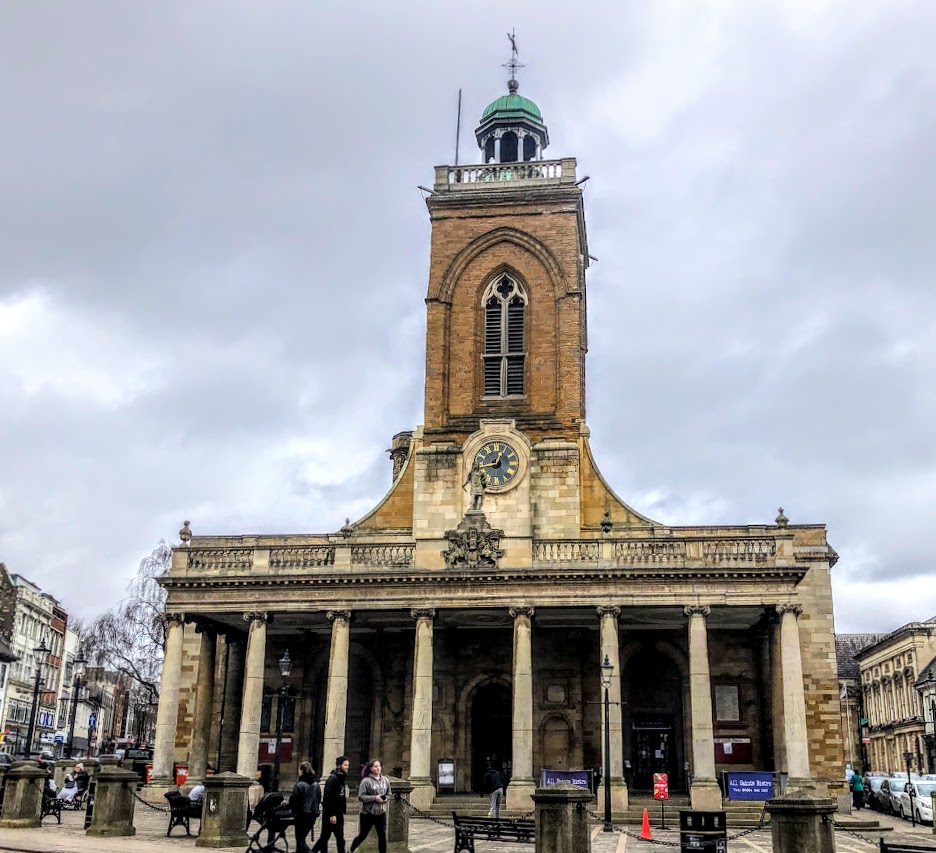
All Saints’ Church is the parish church in the centre of Northampton (Photograph: Patrick Comerford)
All Saints’ Church is the parish church in the centre of Northampton. The church was largely built after a fire and was consecrated in 1680 and is a Grade I listed building. Outside London, it is one of the foremost examples of 17th century church architecture in England.
From the earliest times, the church on this site has been associated with the life of the borough and the county. There has been a church on the site since the Church of All Hallows was built by Simon de Senlis or Simon de St Liz, the first Norman Earl of Northampton, who had built Northampton Castle and the town walls in the 1080s and 1090s.
Simon de Senlis took part in the First Crusade in 1094, and it is likely that after his return he built the Church of the Holy Sepulchre in Northampton ca 1100, and the Church of All Hallows.
Inside All Saints’ Church, Northampton, facing the east end (Photograph: Patrick Comerford)
All Hallows’ Church with its mediaeval alterations continued until 20 September 1675, when the collegiate church and much of the old town were destroyed by the Great Fire of Northampton.
The Parliamentarian leanings of Northampton had resulted in the razing of the castle by King Charles II after his invitation to reclaim the throne in 1660. Despite this, the Earl of Northampton, a friend and confidant of the King, persuaded Charles II to contribute 1,000 tons of timber from the royal forests of Salcey and Rockingham. This gesture, along with the repeal of the ‘chimney tax’ endeared the king to the people of Northamptonshire.
One tenth of the money collected for rebuilding the town was allocated to rebuilding All Hallows’ Church under the architect Henry Bell from King’s Lynn and Edward Edwards. Bell, who was living in Northampton at the time, rebuilt the church in a manner similar to Sir Christopher Wren’s designs.
The rebuilt All Saints’ Church was consecrated and opened in 1680. A large portico was added to the west end in 1701, in front of the narthex, in the style of the Inigo Jones portico added to Old Saint Paul’s Cathedral in the 1630s. The portico was added as a memorial to Charles II’s contribution after the fire, and a statue of him above the portico shows him dressed in a Roman tunic.
All Saints’ is one of the few parish churches in England to have a Consistory Court. The principal role of Consistory Courts is dispensing faculties dealing with churchyards and church property, and hearing the trials of clergy accused of immoral acts or misconduct.
The Patrons of All Saints are the Bishop of Peterborough and the Royal Foundation of Saint Katharine in Radcliffe. All Saints’ Church is in the Catholic tradition of the Church of England. The parochial church council passed Resolutions A, B and C in 1993. The parish rejects the ordination of women and receives alternative episcopal oversight from Bishop Luke Irvine-Capel of Richborough.
9, (former) All Saints’ Church, High Street, Oxford:
The former All Saints’ Church on the the High Street, Oxford … now the library of Lincoln College (Photograph: Patrick Comerford)
All Saints’ Church is a former parish church on the north side of the High Street in central Oxford, on the corner of the High Street and Turl Street, with the Mitre on the facing side of the corner. The former church is now the library of Lincoln College and is a Grade I listed building.
The original All Saints’ Church was founded on the site in 1122. However, the spire of the church collapsed on 8 March 1700, destroying most of the building. After an appeal for funds, the present building, with a seating capacity of 350, was completed in 1720.
The church was designed by Henry Aldrich (1648-1710), the Dean of Christ Church, Oxford, who was also a theologian, philosopher, architect and composer. Evidence of his skill as an architect is seen in the church and campanile of All Saints’ Church and in three sides of the Peckwater Quadrangle of Christ Church, which were built to his designs. Nicholas Hawksmoor is thought to be responsible for the tower and spire of All Saints’ Church.
Nicholas Hawksmoor is said to have designed the tower and spire of the former All Saints’ Church, Oxford (Photograph: Patrick Comerford)
The altar piece, which was of stone, coloured in imitation of marble, was donated by Nathaniel Crew (1633-1721), 3rd Lord Crew, who was the Rector of Lincoln College from 1668, Bishop of Oxford (1671-1674) and Bishop of Durham (1674-1721). Bishop Crew’s arms as Bishop of Durham are still visible on the south wall of the church, close to the south porch.
Bishop Samuel Wilberforce in 1857 and 1860 described the Vicar of All Saints’ Church, the Revd WW West, as ‘a clever man. Strong head & not apparently religious or a pleasant man.’
When Saint Martin’s Church at Carfax was demolished, except for its tower, in 1896, All Saints’ Church became the official City Church in Oxford, where the Mayor and Corporation were expected to attend church services.
When All Saints’ Church was declared redundant in 1971, the City Church moved to Saint Michael at the North Gate. All Saints was then deconsecrated and offered to Lincoln College, immediately to the north of the church. The church was converted by Robert Potter, the architect also responsible for refurbishing the Radcliffe Camera in 1969. Since 1975, the building has been Lincoln College’s library.
The dedication to All Saints can still be found in Oxford at All Saints’ Mission Chapel (1870), Piper Street, Headington, now used as a scout hall; All Saints’ Church, Lime Walk, Headington (1909-1910); and at Upton Chapel (2017), Magdalen Road, Cowley, which is the chapel of the All Saints Sisters of the Poor, one of the oldest Anglican sisterhoods.
10, All Saints’ Church, Yelvertoft, Northamptonshire:
All Saints’ Church in Yelvertoft, Northamptonshire, was connected with the Comberford family for about a century and Henry Comberford was the rector in 1546-1560 (Photograph: Patrick Comerford)
All Saints’ Church in the village of Yelvertoft, Northamptonshire was connected with the Comberford family for about a century, and Henry Comberford was the rector from 1546 to 1560. The advosom, or the right to nominate the rector, was held by the Combeford family from some time after the 1460s, when John Comberford married Joan Parles, the heiress of Watford Manor and Shutlanger.
All Saints’ Church, Yelvertoft, is an attractive country church, with an interesting mediaeval tomb niche, a series of carved heraldic shields on the outside north wall of the chancel, a surviving mediaeval sedilia and piscina, a double south aisle and mediaeval carvings on the south porch.
There has probably been a church on this site in Yelvertoft since Saxon times, and a church is mentioned in the
Domesday Book (1086).
The lofty chancel and a slightly taller nave were built of local cobblestones in the early 12th century in Norman style. The east chancel wall was rebuilt towards the end of the 13th century, when the west tower was added. The north and south aisles were added
ca 1330 and an unusual second south aisle was added in the 15th century, making the interior of the church almost as broad as it is long. When the second south aisle was built, the south door and porch were moved and reinserted in south side of the new, second aisle.
The most intriguing feature of the church is in the chancel, where half the north wall is taken up by an elaborate tomb in Perpendicular style, probably dating from the 15th century. Within the tomb niche is the alabaster effigy of a priest, thought to be the Revd John Dycson or Dixon, who was the Rector in 1439-1445.
On the opposite wall in the sanctuary is a three-seat sedilia, where clergy – priest, deacon and sub-deacon – were seated during the liturgy. The columns separating the seats are worn or eroded, as if they had been badly damaged by weathering. A local story says the incisions were caused by Cromwell’s soldiers who used the sedilia to sharpen their swords before the Battle of Naseby, about 5 miles from Yelvertoft.
Inside All Saints’ Church, Yelvertoft, facing east (Photograph: Patrick Comerford)
When John Comberford died in 1508, Cumberford Manor in Watford and his estates near Tamworth and Lichfield were inherited by his son Thomas Comberford (1472-1532), along with the advowsom of Yelvertoft. Many of the Rectors of Yelvertoft appointed by the Comberford family were either drawn from church life in the Diocese of Lichfield or were part of a nexus of families that included the Comberford, Fitzherbert, Babington and Beaumont families.
The priests nominated to Yelvertoft by the Comberford family included William Smith, Rector of Yelvertoft in 1507-1510, a nephew of Bishop William Smith (1460-1514), Bishop of Lichfield and later Bishop of Lincoln, who re-founded Saint John’s Hospital, Lichfield, in 1495.
Smith was succeeded in Yelvertoft in 1510 by Thomas Babington, who was presented to the parish by his wife’s uncle, Thomas Comberford (1472-1532) of Comberford. He was the Rector of Yelvertoft for only a short time, and died in Cambridge in 1511.
Yelvertoft was transferred to the Diocese of Peterborough when it was formed in 1541. Henry Comberford (1499-1586) was appointed Rector of Yelvertoft by his brother Humphrey Comberford in 1546. With his brothers, Humphrey and Richard, Henry Comberford was educated at Cambridge. He went on to become a Fellow of Saint John’s College and a Proctor of Cambridge University. His brother Richard Comberford was also a Fellow and Senior Bursar of Saint John’s College, Cambridge, and is sometimes said, confusingly, to be the ancestor of the Comerford family of Co Kilkenny and Co Wexford.
Like many of his clerical contemporaries, Henry Comberford was a careerist and a pluralist. After ordination, he was the Rector of Saint Mary’s, Polstead, near Colchester, Suffolk, a Proctor of Cambridge University, Rector of All Saints’, Earsham, near Bunbay, Norfolk, All Saints’, Hethel, near Norwich, Norbury in Derbyshire, and Yelvertoft, and also the Precentor of Lichfield, Prebendary of Bishop’s Itchington, and perhaps also the Archdeacon of Coventry, although this is disputed.
Henry was soon deprived of all his church appointments because of his Catholic sympathies. Thomas Comberford sold his manor in Watford to Sir John Spencer in 1563, and the Comberford family interest in Yelvertoft came to an end after a century of patronage and appointing the rectors of the parish.
11, Saint Dunstan and All Saints’, Stepney:
Saint Dunstan and All Saints’ Church, Stepney … dates back to long before 952 (Photograph: Patrick Comerford)
Saint Dunstan and All Saints’ Church on Stepney High Street dates back to long before 952, when Saint Dunstan, Bishop of London, replaced the then wooden structure with a stone church dedicated to All Saints. When Saint Dunstan was canonised in 1029, the church was rededicated to Saint Dunstan and All Saints.
The church served the whole of Middlesex east of the City of London until the early 14th century, when new churches were built at Whitechapel and Bow. The existing church is the third on the site and was built of Kentish ragstone in the 15th century.
The Church of Saint Dunstan and All Saints is regarded as ‘the mother church of the East End.’ The church has a long traditional link with the sea and many sailors were buried here. It was once known as the ‘Church of the High Seas,’ and until recently births, marriages and deaths at sea were registered there. The red ensign, the flag flown by British passenger and merchant ships, is still flown from the tower. The church also has long connections with three City livery companies: the Mercers, the Vintners and the Coopers.
The High Altar and East Window in Saint Dunstan and All Saints’ Church, Stepney (Photograph: Patrick Comerford)
The present building is essentially a mediaeval Gothic church, with a 13th century chancel and a 15th century nave, aisles and tower. The existing building is the third on the site and was built of Kentish ragstone mainly in the 15th century, although the chancel dates from 200 years earlier. The chancel has a triple sedilia.
The church has an Anglo-Saxon stone relief panel of the Crucifixion dating from the early 11th century and a relief of the Annunciation
ca 1400 over north chancel door. There are two carvings above the main entrance door: the carving on the left of a ship refers to the long association of the church with the sea and sailors; the carving on the right of the devil and tongs refers to a story about Saint Dunstan pulling the nose of the devil with red hot tongs.
Nicholas Comberford the 17th century map maker and Mary Kithen were married in the church on 10 June 1624, and many members of the Comberford or Comerford family were baptised there from the 16th to the 18th century.
12, Saint Mary and All Saints’ Church, Little Walsingham, Norfolk:
Inside Saint Mary and All Saints’ Church, the Church of England parish church in Walsingham, rebuilt after a fire in 1964 (Photograph: Patrick Comerford, 2026)
Saint Mary and All Saints’ Church, the parish church of Little Walsingham in Norfolk, is dedicated to the Virgin Mary and All Saints. The Anglican shrine was revived by Father Alfred Hope Patten (1885-1958), the Vicar of Little Walsingham, in 1922, and an image of Our Lady of Walsingham was in the church until its translation to the new priory in 1931.
The original dedication was to All Saints; when Father Hope Patten became the vicar in 1921 he changed the dedication to the present double dedication of Saint Mary and All Saints.
The church dates from the 14th and 15th century, built from flint with stone dressings. In addition to the nave and chancel, there are north and south aisles and north and south transepts. The tower is at the west, with a lead needle spire. The church was gutted by fire in 1961; only the tower and north porch remain from the original, and the rest of the church has been rebuilt. The church is Grade I listed, while the churchyard walls and gates are separately listed Grade II.
Saint Mary and All Saints’ Church dates from the 14th and 15th centuries and is built from flint with stone dressings (Photograph: Patrick Comerford, 2026)
The church has a 15th-century font that illustrate the Seven Sacraments and the Crucifixion. The font survived the fire in 1961, but the 17th-century font cover did not, and the 1964 font cover is a replica of the original.
The church was destroyed in a fire on 14 July 1961, probably arson. The porch, tower and spire survived, as well as the church plate and Father Edgar Reeves’s statue of Our Lady, but everything else was lost. The then vicar, Father Alan Arthur Roe (1958-1977), appealed in the
Church Times for ‘unwanted vestments of all kinds, cassocks, cottas, hassocks, and copies of the
English Hymnal’.
The church was rebuilt by the church architect Laurence King (1907-1981), whose work is characterised by his engagement with 1960s liturgical reforms, which often emphasised a central altar and light, open spaces. His work is considered a significant part of post-war English church architecture, and he worked closely with artists such as John Hayward for glass and sculpture.
Commemorating All Saints and All Souls in All Saints’ Church, Margaret Street, London, today and tomorrow
I last offered a ‘virtual tour’ of
a dozen churches dedicated to All Saints and All Hallows four years ago on All Saints’ Eve, 31 October 2022. But I was snared by own numeracy problems, I listed two churches with number 11, so that there were 13 churches in all in that list, with churches in Calverton, Cambridge, London and York in England, Dublin, Co Westmeath, Co Limerick, and Co Wexford in Ireland, and in Rome and Bucharest:
1, All Saints’ Church, Calverton, Buckinghamshire; 2, All Saints’ Church, Jesus Lane, Cambridge; 3, All Saints’ Church, North Street, York; 4, All Saints’ Church, Pavement, York; 5, All Saints’ Church, Blackrock, Co Dublin; 6, All Saints’ Church, Grangegorman, Dublin; 7, All Saints’ Church, Mullingar, Co Westmeath; 8, All Saints’ Church, Stradbally, Co Limerick; 9, All Saints’ Church, Templetown, Co Wexford; 10, All Saints’ Church, Rome; 11, All Saints’ Church, Bucharest; 11, All Hallows by the Tower, London; and 12, All Hallows’ Church, Bread Street, London.
All Saints Day, celebrated on 1 November by Enid Chadwick in ‘My Book of the Church’s Year’


 The British Museum … still waiting for the Muses to inspire the return of the Parthenon Marbles (Photograph: Patrick Comerford)