Showing posts with label Saint Thomas. Show all posts

13 September 2026

A series of 11 heraldic paintings in
Saint Thomas’s Cathedral, Kuching,
tells the stories of four dioceses

Saint Thomas’s Cathedral, Kuching ... painted heraldic decorations represent the Diocese of Kuching, the dioceses in the Church of the Province of South East Asia and dioceses that are part of the story of Anglican missions in the region (Photograph: Patrick Comerford, 2026)

Patrick Comerford

Above the choir and chapter stalls in Saint Thomas’s Cathedral, Kuching, a series of nine painted heraldic decorations represent the Diocese of Kuching, its partner dioceses in the Church of the Province of South East Asia, and four other dioceses that are part of the story of Anglican missions in the region.

In addition, the cathedral also displays the coats of arms of both the State of Sarawak and the Federation of Malaysia.

It is difficult to find technically correct heraldic descriptions for some of these coats-of-arms, and in some cases they have been adopted without any heraldic authority. But I am grateful to Mark Scott, Somerset Herald at the College of Arms in London, who has kindly helped me to identify and describe many of these heraldic displays.

The coats of arms of Church of the Province of South East Asia and its four provinces, in a poster the Kuching diocesan offices beside Saint Thomas’s Cathedral (Photograph: Patrick Comerford, 2026)

These coats of arms are of interest to specialists in ecclesiastical heraldry and church history. But they also tell part of the story of the relationship of the Anglican Church in Sarawak with the Brooke Rajahs of Sarawak and the short-live British Crown Colony and of the subsequent incorporation of Sarawak into the modern state of Malaysia.

They also tell the story of the relationship between Diocese of Kuching with the neighbouring Anglican dioceses in Malaysia, Singapore and throughout South-East Asia.

The coat of arms of Church of the Province of South East Asia above the chapter and choir stalls in Saint Thomas’s Cathedral, Kuching (Photograph: Patrick Comerford, 2026)

The Church of the Province of South East Asia, made up of four dioceses – Sabah, Sarawak, Singapore and West Malaysia – was formed 30 years ago in 1996 as the 37th Province in the Anglican Communion. It is self-governing, self-supporting, self-propagating and truly indigenous.

At first, the See of Calcutta provided episcopal supervision for Anglican work throughout much of south and east Asia, and beyond, as far as Australia and New Zealand. The first Anglican church in what is now Malaysia was on Penang island, where the Church of Saint George the Martyr, was built in 1819 and consecrated by Thomas Fanshaw Middleton, first Bishop of Calcutta.

In time, because it was so widespread, the Diocese of Calcutta became impractical, and new dioceses were formed. As a result, for example, the Diocese of Australia was formed in 1836 and the Diocese of Singapore, Labuan and Sarawak was formed in 1855 as a missionary diocese under the oversight of the Archbishop of Canterbury.

Today the Church of the Province of South East Asia covers a geographical area of 329,800 sq km with a population: 23.8 million. The coat of arms of the province, which appears to be without a full, technical heraldic description, has a white cross on a blue background, that echoes both the Saint Andrew’s cross used by the Diocese of Singapore, which its four quarters or segments may acknowledge the four dioceses that form the province.

The coat of arms of the Diocese of Kuching in the chancel in Saint Thomas’s Cathedral, Kuching (Photograph: Patrick Comerford, 2026)

The Diocese of Kuching:

Francis Thomas McDougall (1817-1886) was the first Bishop of Labuan and Sarawak (1855-1868). He was consecrated bishop in Calcutta on Saint Luke’s Day, 18 October 1855, by Bishop Daniel Wilson of Calcutta, under a commission from Archbishop John Bird Sumner of Canterbury.

His consecration was the first of an English bishop to take place outside Britain and Ireland. He was styled Bishop of Labuan and Sarawak because Labuan was a British territory and Sarawak was not. The Church in the Straits Settlements, including Singapore, Penang and Malacca, was separated from the Diocese of Calcutta in 1869, and placed under the episcopal care of the Bishop of Labuan. This arrangement lasted until 1909, when the Diocese of Singapore was founded.

After the Japanese occupation and World War II, the Diocese of Labuan and the Bishopric of Sarawak were joined into the Diocese of Borneo. The Diocese of Borneo was divided in 1962, forming a new Diocese of Jesselton (Sabah), including Labua, while the rest of the diocese, including Brunei, was reconstituted as the Diocese of Kuching.

The arms of the Diocese of Kuching have inherited elements from the arms granted to the Bishopric of Borneo in 1949 and that were transferred to Kuching in 1964.

They are described in heraldic language or blazoned as: Per pale gules and sable, a cross crosslet fitchy or. This describes a shield that is divided vertically down the middle, red and black, with a gold cross that has three smaller crosses at the top and to the side, and a pointed tip at the end.

At the time of the grant, Sir George Bellew (1899-1993), the Dublin-born Somerset Herald (1926-1950) and later Garter Principal King of Arms (1950-1961), pointed to these arms as an example of how with grants of arms ‘it is still possible to design simple arms without infringing those already in use.’

The coat of arms of the Diocese of Kuching echoes the colours and imagery of the coat of arms of the Brooke family, Rajahs of Sarawak (Photograph: Patrick Comerford, 2024)

The shield incorporates the red and black split design associated with the Brooke family, Rajahs of Sarawak, combined with a gold cross. The dominant colours mirror the historic colours of the Sarawak state flag and the heraldic arms of the Brooke dynasty, founded by James Brooke, the first Rajah of Sarawak.

The coat of arms used by the Brooke dynasty for over a century, from 1841 to 1946, were: Or (gold or yellow), a cross engrailed parted per pale gules (red) and sable (black), charged in fess point with an eastern crown or (gold or yellow); crest: a brock or badger proper (natural colours); motto: Dum Spiro Spero (‘While I Breathe, I hope’).

This blazon describes a gold or yellow shield, with a red and black cross that has wavy edges, surmounted by a crown that was added in 1848. The badger or brock in the crest is a pun alluding to the dynastic surname, and its symbolism is remembered, for example, in the name of the Badger Bar in the Sarawak Club.

The coat of arms of Sir James Brooke, first Rajah of Sarawak, granted by the College of Arms, London, in 1848 (Image: PMostEpic/Wikipedia/CC BY-SA 4.0)

The arms of Sir James Brooke were: or (gold), a cross engrailed per cross indented azure (blue) and sable (black), in the first quarter an estoile of the second (blue); crest: on an eastern crown a brock proper ducally gorged or. Motto: Dum Spiro Spero.

The azure and sable or blue and black colours were abandoned for red and black two years after the succession of his son Sir Charles Johnson Brooke (1868-1917). His achievement was: arms: or (yellow or gold), a cross engrailed parted per pale sable (black) and gules (red); crest: on a wreath of the colours a brock proper; motto: Dum Spiro Spero.

His son, Sir Charles Vyner Brooke (1917-1946), altered the arms by introducing a five-pointed crown, symbolising the five divisions of the kingdom, centred around Kuching, Sri Aman and Simanggang, Sibu, Miri, and Limbang. Shortly before World War II, the engrailed edging of the cross was abandoned and replaced by a simple cross parted per pale.

The simplified coat of arms of the Brooke family as Rajahs of Sarawak (Photograph: Patrick Comerford, 2026)

Sir Charles Brooke abdicated in 1946 after the Japanese occupation (1941-1945), and Sarawak became a British Crown Colony. A new coat of arms was adopted on 10 March 1947: or, on a cross parted per pale sable and gules, charged with a five-pointed eastern crown or.

The arms of the British Crown Colony of Sarawak continued to be used as the state coat of arms when Sarawak formed Malaysia with Malaya, Sabah and Singapore in 1963, and were used until 1973.

The design of the shield also provided the basis for the Sarawak flag used until 1973, and the state flag reverted to these original colours in 1988. At the same time a new state coat of arms was adopted, in which the state flag became the shield, displayed on a hornbill.

The arms of the Diocese of Sabah, first granted to the Diocese of Jesselton, seen in Kuching Cathedral (Photograph: Patrick Comerford, 2026)

The Diocese of Sabah:

The British Colony of North Borneo changed its name to Sabah on 31 August 1963, and joined the Federation of Malaysia as an independent state. The Diocese of Sabah, covering Sabah and Labuan, was formed in 1962 as the Diocese of Jesselton. Originally, it was part of the much larger Diocese of Labuan and its Dependencies, established in 1855. When the Diocese of Singapore was formed out of that earlier diocese in 1909, the area of the present-day Diocese of Sabah fell under the jurisdiction of the Diocese of Labuan and Sarawak, which was reorganised as the Diocese of Borneo in 1949.

The Diocese of Borneo was divided in two in 1962, forming the Diocese of Kuching and the Diocese of Jesselton, which was renamed the Diocese of Sabah when Jesselton, the capital city, was renamed Kota Kinabalu in 1967.

The coat of arms of the Diocese of Sabah are the arms of the former Diocese of Jesselton: argent (silver or white), issuant from a base vert (green) thereon three barrulets wavy argent (silver or white) a mountain sable (black), in chief five crosses three and two couped gules (red).

A variation in the colours in the official grant of arms of the Diocese of Sabah, seen in a poster marking the 20th anniversary of the Church of the Province of South-East Asia (Photograph: Patrick Comerford, 2026)

These arms have some echoes of the arms adopted in 1948 by the former Crown Colony of British North Borneo. The diocesan arms incorporate representations of the South China Sea, with historical connotations of the early Christian missionaries travelling by sea, or of the fields of Sabah, beneath Mount Kinabalu.

However, there are variations in the colours in the official grant of arms, as seen in the chancel in Saint Thomas’s Cathedral, Kuching, and those used by Diocese of Sabah today.

The coat of arms of the Diocese of Singapore seen in Saint Thomas’s Cathedral, Kuching (Photograph: Patrick Comerford, 2026)

The Diocese of Singapore:

The Diocese of Singapore dates back to 1826, shortly after Singapore was founded by Stanford Raffles and at first the Anglican presence there was under the jurisdiction of the Diocese of Calcutta.

Saint Andrew’s Cathedral, Simgapre, was named after the patron saint of Scotland in honour of the Scottish community who first donated to the building fund. Singapore was transferred from the Diocese of Calcutta to the jurisdiction of the Bishop of Labuan and Sarawak in 1869, and Saint Andrew’s Cathedral became the cathedral church of the diocese in 1870. It officially became the Diocese of Singapore, Labuan and Sarawak in 1881, and in 1909 Singapore was made a separate diocese covering the Straits Settlements, Peninsular Malaya, Siam (Thailand), Java, Sumatra and the adjacent islands.

It was renamed the Diocese of Singapore and Malaya on 6 February 1960. The diocese was dissolved on 8 April 1970 when it was divided into two new dioceses, the Diocese of Singapore and the Diocese of West Malaysia.

The official grant of arms to the Bishopric of Singapore are blazoned or described in heraldic language as: azure (blue) a saltire argent (white or silver) between four garbs or (gold or yellow), on a chief of the last (gold or yellow) a pastoral staff and a key in saltire purpure (purple).

The principal element in the arms of the Diocese of Singapore is the shield of Saint Andrew, similar to the symbol seen on the flag of Scotland. The four bunches of wheat symbolise the harvest of the mission fields, the crozier is a symbol of episcopal office, the key represents episcopal authority, and the crozier and key are crossed in the shape of Saint Andrew’s saltire.

The emblem the Diocese of West Malaysia displayed in Kuching Cathedral in the style of a diocesan coat of arms (Photograph: Patrick Comerford, 2026)

The Diocese of West Malaysia:

A new and independent diocese, the Diocese of West Malaysia, was formed from the Diocese of Singapore and Malaya in 1970, and it was incorporated by an Act of the Malaysian Parliament in 1971. Saint Mary’s Cathedral is beside Independence Square or Dataran Merdeka in Kuala Lumpur.

An official formal heraldic blazon for the arms used by the Anglican Diocese of West Malaysia is not found in standard armorial databases, it does not follow traditional heraldic designs and heraldry remains largely unregulated in Malaysia.

However, the arms used by the diocese draws heavily on local symbols and Malaysian cultural motifs seen in the shape and design of the cross and the depiction of a hornbill.

The coat of arms of the Archbishops of Canterbury above the bishop’s throne in Kuching Cathedral (Photograph: Patrick Comerford, 2026)

The Diocese of Canterbury:

The blazon for the coat of arms of the Diocese of Canterbury is: Azure (blue), an archiepiscopal staff or (gold) ensigned with a cross formy or (gold), surmounted of a pallium argent (silver or white) edged and fringed gold, charged with four crosses formy fitchy sable (black).

These are similar to the arms used by the Archbishops of York, Armagh and Dublin. The pallium on all these is a white lamb’s wool band shaped like a ‘Y’ and is an ancient symbol of metropolitan authority.

The coat of arms of the Diocese of London seen in the chancel in Kuching Cathedral (Photograph: Patrick Comerford, 2026)

The Diocese of London:

The Bishop of London historically had responsibility for the administration, oversight, and provision of the Church of England in all British overseas colonies. From the 17th century on, Anglican congregations and chaplaincies in British territories outside England – including North America and the West Indies – were within the remit of the Diocese of London.

After the American Revolution in 1776, the North American mainland colonies left this oversight, leaving only the British West Indies under the London bishop's direct care. To manage expanding global territories, the Church of England began forming separate colonial dioceses starting in 1787 with Nova Scotia, eventually forming 41 distinct overseas dioceses before they gained autonomy by 1863.

The technical heraldic description (blazon) for the coat of arms of the Diocese of London is: gules (red), two swords in saltire proper hilts and pommels or (gold).

This is a red shield, with two swords crossed in an ‘X’ shape or saltire. They represent Saint Paul, who is often depicted in iconography with an up-turned sword. He is the patron saint of Saint Paul’s Cathedral, the seat of the Diocese of London.

The coat of arms of the Diocese of Calcutta seen in Kuching Cathedral (Photograph: Patrick Comerford, 2026)

The Diocese of Calcutta:

The Diocese of Calcutta was formed as an Anglican diocese in 1814. The Bishop of Calcutta was the Metropolitan of India, with a vast geographical province that initially included the entire British empire in India, Ceylon (Sri Lanka), British territories across south and south-east Asia and Australia.


From 1863 on, former colonial dioceses were separate from and independent of the Church of England, although, exceptionally, the Archbishop of Canterbury has retained some metropolitan jurisdictions outside England.

The coat of arms of the Diocese of Calcutta is recorded as: Gules (red), a pastoral staff or crozier in bend or (gold), headed argent (silver), surmounted by an open book argent bound or; on a chief indented ermine, two palm fronds in saltire vert (green), debruised with a mitre with infulae or (gold.

This is a red shield, representing holy zeal and martyrdom, with a bishop’s gold crosier placed diagonally across the shield, surmounted by an open Bible.

The coat of arms of the Diocese of Sydney displayed in Kuching Cathedral (Photograph: Patrick Comerford, 2026)

The Diocese of Sydney:

The Diocese of Australia was formed in 1836 and William Grace Broughton became the first Bishop of Australia. The Diocese of New Zealand became a separate diocese in 1841 and the Diocese of Tasmania in 1842. When the Diocese of Australia was divided in 1847 into four separate dioceses – Sydney, Adelaide, Newcastle and Melbourne – Broughton remained as Bishop of Sydney.

The coat of arms of the Diocese of Sydney granted to William Broughton, first Bishop of Sydney, is: azure (blue), four mullets of eight points in cross argent (silver or white). This is a blue shield with four eight-pointed silver stars arranged in the shape of a cross, representing the Southern Cross constellation, with four of its primary stars.

The present coat of arms of Sarawak seen in Kuching Cathedral (Photograph: Patrick Comerford, 2026)

The arms of Sarawak and Malaysia:

The traditional arms of Sarawak are: Or (gold or yellow), a cross engrailed parted per pale gules (red) and sable (black), charged with an eastern crown or (gold or yellow). Motto: Dum Spiro Spero (‘While I breathe, I hope’).

The arms of the British Crown Colony of Sarawak were based on the arms of the Rajah and were the state coat of arms when Sarawak formed Malaysia with Malaya, Sabah and Singapore in 1963. These arms were used from 1947 to 1973: or (gold or yellow), on a cross parted per pale sable (black) and gules (red), an Eastern crown of the field.

The current coat of arms of Sarawak dates from 31 August 1988. The shield features a symbolic wing-spread kenyalang or rhinoceros hornbill with a shield bearing the state flag. The hornbill’s wings have 13 feathers, which represent the states in Malaysia. The hibiscus represent the Malaysia’s national flower which appears on the right and left sides of the bird’s legs and the hornbill perches on a banner with the words Bersatu, Berusaha, Berbakti (‘Unity, Effort, Service’).

The coat of arms of Malaysia displayed in Kuching Cathedral (Photograph: Patrick Comerford, 2026)

The coat of arms of Malaysia (Jata Negara Malaysia) retains many of the design elements used in the arms of the Federated Malay States during British colonial rule, and it resembles European heraldic designs. The shield is supported by two tigers for supporters, and the crest is a yellow crescent and a yellow 14-point star representing Islam and the states of Malaysia.

The shield consists of a chief or upper portion and a lower section that is divided in three per pale (longitudinally). The chief is gules (red) charged with five krises (Malay daggers), representing the five former Unfederated Malay States: Johor, Kedah, Kelantan, Terengganu and Perlis.

The dexter section (the viewer’s left) shows the former coat of arms of Penang; the upper middle section below the chief shows the colours of the Federated Malay States (red, black, white and yellow); while in the lower middle section are three sections representing the new states of Sabah, Singapore and Sarawak which joined the Federation of Malaysia in 1963. In the sinister section (the right side from the viewer’s point of view) is a Malacca tree (Phyllanthus emblica), after which the state was named.

The two tigers supporting the shield are traditional Malay symbols, and were inherited from the earlier armorial ensigns of the Federated Malay States and Federation of Malaya.

The motto, Bersekutu Bertambah Mutu (‘Unity is Strength’), is in both Latin and Jawi script.

The arms of the Diocese of Lichfield, seen on the railway bridge at Upper John Street, Lichfield (Photograph: Patrick Comerford)

A missing coat of arms:

The inclusion of the arms of Canterbury, London, Calcutta and Sydney affirms the historic links between the Diocese of Kuching and those four other dioceses. But if a fifth diocese was to be represented, I would suggest the Diocese of Lichfield.

The Diocese of Lichfield and the Diocese of Kuching have been linked together since the Lambeth Conference in 1988. But the two were linked before that when the second bishop, Walter Chambers (1870-1881), who was ordained a priest in Lichfield Cathedral by Bishop John Lonsdale of Lichfield in 1849, moved to Borneo to assist Bishop Thomas McDougal, the first Bishop of Borneo. Chambers became Archdeacon of Sarawak in 1868 and became Bishop of Sarawak and the Straits Settlements when McDougal resigned in 1870.

The coat of arms of the iocese of Lichfield are described in heraldic terms in this way: Per pale gules (red) and argent (white) , a cross potent and quadrate (Cross of Saint Chad) between four crosses patée all counterchanged. I like to imagine the per pale or vertical division of the field and the shape of the central cross may have had some incluence on the design of the arms of the Diocese of Kuching.

The coat of arms of the Diocese of Kuching on the lectern in the chapel in the Bishop’s House in Kuching (Photograph: Patrick Comerford, 2026)

03 July 2026

Daily prayer in Ordinary Time 2026:
57, Friday 3 July 2026,
Saint Thomas the Apostle

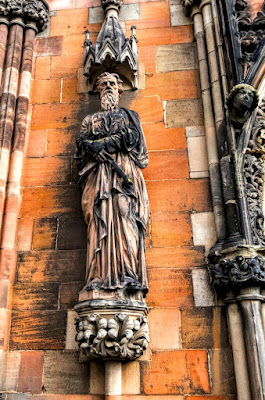
Saint Thomas the Apostle … a sculpture on the west façade of Lichfield Cathedral (Photograph: Patrick Comerford)

Patrick Comerford

We are in Ordinary Time in the Church Calendar and the week began with the Fourth Sunday after Trinity (Trinity IV, 28 June 2025) and the Feast of Saint Peter and Saint Paul (29 June 2026). Today (3 July), the Calendar of the Church of England celebrates Saint Thomas the Apostle.

Before today begins, though, I am taking some quiet time this morning to give thanks, to reflect, to pray and to read in these ways:

1, reading today’s Gospel reading;

2, a short reflection;

3, a prayer from the USPG prayer diary;

4, the Collects and Post-Communion prayer of the day.

An icon of the Incredulity of Saint Thomas in the iconostasis in the Greek Orthodox Church in Stony Stratford (Photograph: Patrick Comerford, 2024)

John 20: 24-29 (NRSVA):

24 But Thomas (who was called the Twin), one of the twelve, was not with them when Jesus came. 25 So the other disciples told him, ‘We have seen the Lord.’ But he said to them, ‘Unless I see the mark of the nails in his hands, and put my finger in the mark of the nails and my hand in his side, I will not believe.’

26 A week later his disciples were again in the house, and Thomas was with them. Although the doors were shut, Jesus came and stood among them and said, ‘Peace be with you.’ 27 Then he said to Thomas, ‘Put your finger here and see my hands. Reach out your hand and put it in my side. Do not doubt but believe.’ 28 Thomas answered him, ‘My Lord and my God!’ 29 Jesus said to him, ‘Have you believed because you have seen me? Blessed are those who have not seen and yet have come to believe.’

Saint Thomas and the Risen Christ depicted in a fresco in a church in Athens (Photograph: Patrick Comerford)

Today’s Reflection:

The Calendar of the Church of England commemorates Saint Thomas today (3 July), while the Orthodox Church remembers the doubting of the Apostle Thomas on the first Sunday after Easter; this year Thomas Sunday was on Sunday 19 April 2026.

In the Gospels, Saint Thomas is named ‘Thomas, also called the Twin (Didymus).’ But the name ‘Thomas’ comes from the Aramaic word for twin, T'oma (תאומא), so there is a tautological wordplay going on here.

Syrian tradition says the apostle’s full name was Judas Thomas, or Jude Thomas. But, who was his twin brother – or sister?

I have often visited Didyma on the south coast of Anatolia. There, the Didymaion was one of the most important shrines and temples in the classical world to Apollo and his twin sister Artemis. Apollo was the sun-god, the son of Zeus; he was the patron of shepherds and the guardian of truth, and in Greek and Roman mythology he died and rose again.

Is the story of Saint Thomas’s doubts an invitation to the followers of the cult of Apollo to turn to Christ, the true Son of God the Father, who is the Good Shepherd, who is the way, the truth and the light, who has died and who is truly risen?

We can never be quite sure about Saint Thomas in Saint John’s Gospel. After the death of Lazarus, the disciples resist Christ’s decision to return to Judea, where there had been an attempt to stone Jesus. But Thomas shows he has no idea of the real meaning of death and resurrection when he suggests that the disciples should go to Bethany with Jesus: ‘Let us also go, that we may die with him’ (John 11: 16).

And, while Thomas saw the raising of Lazarus, what did he believe in?

Could seeing ever be enough for a doubting Thomas to believe?

The Apostle Thomas also speaks at the Last Supper (John 14: 5). When Christ assures the disciples that they know where he is going, Thomas protests that they do not know at all. He has been with Christ for three years, and still he does not believe or understand. Seeing and explanations are not enough for him. Christ replies to his remarks and to Philip’s requests with a detailed exposition of his relationship to God the Father.

In the Resurrection story in Saint John’s Gospel, Saint Mary Magdalene – who is commemorated later this month on 22 July – does not recognise the Risen Christ at first. For her, appearances could be deceptive, and she thinks he is the gardener. But when he speaks to her, she recognises his voice, and then wants to hold on to him. From that moment of seeing and believing, she rushes off to tell the Disciples: ‘I have seen the Lord.’

Two of the disciples, John the Beloved and Simon Peter, have already seen the empty tomb, but they fail to make the vital connection between seeing and believing. When they hear Mary’s testimony, they still fail to believe fully. They only believe when they see the Risen Lord standing among them, when he greets them, ‘Peace be with you,’ and when he shows them his pierced hands and side.

They had to see and to hear, they had to have the Master stand over them in their presence, before they could believe.

On the first Easter Day, the Disciples locked themselves away out of fear. But where is Thomas? Is he fearless? Or is he foolish?

For a full week, Thomas is absent and does not join in the Easter experience of the remaining disciples. He has not seen and so he refuses to believe. When they tell him what has happened, Thomas refuses to accept their stories of the Resurrection. For him hearing, even seeing, are not enough.

Thomas wants to see, hear and touch. He wants to use all his learning faculties before he can believe this story. He has heard, but he wants to see. When he sees, he wants to touch … he demands not only to touch the Risen Christ, but to touch his wounds too before being convinced.

And so, for a second time within eight days, Christ comes and stands among his disciples, and says: ‘Peace be with you.’

The traditional icon depicting the event recalled in John 20: 19-31 emphasises the closed door, a significant part of the narrative: ‘the doors were locked’ (verse 19). After Christ’s arrest, the disciples tried to hide from the authorities out of fear. They returned to the last place where they had seen him alive, the upper room, around the same table where they had shared that last meal.

The young Thomas was not present the first time round and had said to the others: ‘Unless I see the mark of the nails in his hands and put my finger in the mark of the nails and my hand in his side, I will not believe’ (John 20: 25).

Christ appears within the disciples’ hiding place, where the door is firmly shut. His presence is real, and he invites Thomas: ‘Put your finger here and see my hands. Reach out your hand and put it in my side. Do not doubt but believe’ (John 20: 27).

In this icon, Christ’s right arm is raised not so much in blessing but revealing his right side with its open wound. Saint Thomas is raising his right hand, about to touch the wounded side, but not actually placing his finger in the open wound.

The wounds from the nails on the Cross can also be seen in Christ’s hand and feet. The traditional icons following Byzantine iconography and style show Christ standing in front of the closed door of a large domed building, with his right arm raised; we can see the signs of the nails on his hands. In many icons, Christ holds a scroll in his left hand.

The Apostles, divided in two groups, watch Thomas touch Christ’s side.

The familiar term ‘doubting Thomas’, referring to the Apostle, is used to describe someone who unreasonably doubts someone’s word. Where Orthodox icons depicting this scene have inscriptions, they do not refer to the doubts of Saint Thomas. Instead, the usual Greek inscription reads Η ψηλάφηση του Θωμά (I Psilafisi tou Thoma), ‘the Assurance of Thomas.’ Often English icons are inscribed ‘The Belief of Thomas.’ The icons show not a ‘Doubting Thomas,’ but a reassured Thomas. This is the Thomas who bends before the Risen Christ to touch his wounds and exclaims: ‘My Lord and my God!’ (John 20: 28).

The Church Fathers recognised that although Saint Thomas doubted, his doubt was not unreasonable. Christ responded, spurring Saint Thomas to a confession of Christ’s Divinity that is more explicit than anywhere else in the Gospels.

Looking out from the scene, Christ’s response to Thomas is also for us: ‘Have you believed because you have seen me? Blessed are those who have not seen and yet have come to believe’ (John 20: 29).

Mary was asked in the garden on Easter morning not to cling on to Christ. But Thomas is invited to touch him in the most intimate way. He is told to place his finger in Christ’s wounded hands and his hand in Christ’s pierced side.

Yet we are never told whether Thomas actually touches those wounds with his fingers. All we are told is that once he has seen the Risen Christ, Thomas simply professes his faith in Christ: ‘My Lord and my God!’

In that moment, we hear the first expression of faith in the two natures of Christ, that he is both divine and human. For all his doubts, Saint Thomas provides us with an exquisite summary of the apostolic faith, contained within the Nicene Creed, whose 1,700th anniversary we are commemorating this year.

Too often, perhaps, we talk about ‘Doubting Thomas,’ when we might better call him ‘Believing Thomas.’ His doubting leads him to questions. But his questioning leads to listening. And when he hears, he sees, perhaps he even touches. Whatever he does, he learns in his own way, and he comes not only to faith but to faith that for this first time is expressed in that eloquent yet succinct acknowledgment of Christ as both ‘My Lord and My God.’

In our society today, are we easily deceived by appearances?

Do we confuse what pleases me with beauty and with truth?

Do we allow those who have power to define the boundaries of trust and integrity merely to serve their own interests?

Too often, in this world, we are deceived easily by the words of others and deceived by what they want us to see. Seeing is not always believing today. Hearing does not always mean we have heard the truth, as we know in politics today. It is easy to deceive and to be deceived by a good presentation and by clever words.

Too often, we accept or judge people by their appearances, and we are easily deceived by the words of others because of their office or their privilege. But there are times when our faith, however simple or sophisticated, must lead us to ask appropriate questions, not to take everything for granted, and not to confuse what looks like being in our own interests with real beauty and truth.

Although the doors were shut, Jesus came and stood among them and said, ‘Peace be with you’ (John 20: 26) … an icon in Saint Mary and All Saints Church, Walsingham (Photograph: Patrick Comerford, 2026)

Today’s Prayers (Friday 3 July 2026, Saint Thomas the Apostle):

In Pray with the World Church, the prayer diary of the Anglican mission agency USPG (United Society Partners in the Gospel), the theme this week, from 28 June to 4 July 2026 (pp 14-15), is ‘Living Stones’. This theme was introduced on Sunday with a reflection by the Very Revd Lydia Kelsey Bucklin, President and Dean of Episcopal Divinity School.

The USPG prayer diary today (Friday 3 July 2026, Saint Thomas the Apostle) invites us to pray:

Faithful God, as we remember Saint Thomas, we pray for those who doubt the myths of Christian nationalism. Give us courage to question and resist the use of faith to harm, and to see Christ more clearly.

The Collect:

Almighty and eternal God,
who, for the firmer foundation of our faith,
allowed your holy apostle Thomas
to doubt the resurrection of your Son
till word and sight convinced him:
grant to us, who have not seen, that we also may believe
and so confess Christ as our Lord and our God;
who is alive and reigns with you,
in the unity of the Holy Spirit,
one God, now and for ever.

The Post-Communion Prayer:

Almighty God,
who on the day of Pentecost
sent your Holy Spirit to the apostles
with the wind from heaven and in tongues of flame,
filling them with joy and boldness to preach the gospel:
by the power of the same Spirit
strengthen us to witness to your truth
and to draw everyone to the fire of your love;
through Jesus Christ our Lord.

Yesterday’s reflections

Continued tomorrow

The Temple of Apollo in Didyma … one of the most important shrines and temples in the classical world to Apollo and his twin sister Artemis (Photograph: Patrick Comerford)

Scripture quotations are from the New Revised Standard Version, Anglicised Edition copyright © 2021, National Council of the Churches of Christ in the United States of America. Used by permission. All rights reserved worldwide.

12 April 2026

Daily prayer in Easter 2026:
8, Sunday 12 April 2026,
the Second Sunday of Easter

The doors of the house … were locked … Jesus came and stood among them and said, ‘Peace be with you’ (John 20: 19) … an icon in Saint Mary and All Saints Church, Walsingham (Photograph: Patrick Comerford, 2026)

Patrick Comerford

Our Easter celebrations continue in the Church Calendar, and today is the Second Sunday of Easter (Easter II). In the calendar of the Greek Orthodox Church, however, today is Easter Day.

I was at the celebrations of Easter Eve in the Greek Orthodox Church in Stony Stratford late last night, and they continued until after 3 am this morning. Later this morning, I hope to be at the Parish Eucharist in Saint Mary and Saint Giles Church, Stony Stratford, and to read one of the lessons. Then, at lunchtime today, there is a Greek community barbeque in the grounds of the Greek Orthodox Church in Stony Stratford.

But, before today begins, I am taking some quiet time this morning to give thanks, to reflect, to pray and to read in these ways:

1, reading today’s Gospel reading;

2, a short reflection;

3, a prayer from the USPG prayer diary;

4, the Collects and Post-Communion prayer of the day.

An icon of the Incredulity of Saint Thomas in the Greek Orthodox Church in Stony Stratford (Photograph: Patrick Comerford)

John 20: 19-31 (NRSVA):

19 When it was evening on that day, the first day of the week, and the doors of the house where the disciples had met were locked for fear of the Jews, Jesus came and stood among them and said, ‘Peace be with you.’ 20 After he said this, he showed them his hands and his side. Then the disciples rejoiced when they saw the Lord. 21 Jesus said to them again, ‘Peace be with you. As the Father has sent me, so I send you.’ 22 When he had said this, he breathed on them and said to them, ‘Receive the Holy Spirit. 23 If you forgive the sins of any, they are forgiven them; if you retain the sins of any, they are retained.’

24 But Thomas (who was called the Twin), one of the twelve, was not with them when Jesus came. 25 So the other disciples told him, ‘We have seen the Lord.’ But he said to them, ‘Unless I see the mark of the nails in his hands, and put my finger in the mark of the nails and my hand in his side, I will not believe.’

26 A week later his disciples were again in the house, and Thomas was with them. Although the doors were shut, Jesus came and stood among them and said, ‘Peace be with you.’ 27 Then he said to Thomas, ‘Put your finger here and see my hands. Reach out your hand and put it in my side. Do not doubt but believe.’ 28 Thomas answered him, ‘My Lord and my God!’ 29 Jesus said to him, ‘Have you believed because you have seen me? Blessed are those who have not seen and yet have come to believe.’

30 Now Jesus did many other signs in the presence of his disciples, which are not written in this book. 31 But these are written so that you may come to believe that Jesus is the Messiah, the Son of God, and that through believing you may have life in his name.

Saint Thomas and the Risen Christ depicted in a fresco in a church in Athens (Photograph: Patrick Comerford)

Today’s Reflections:

This Second Sunday of Easter (Easter II) is traditionally known as Low Sunday. In the past this has also been known as Saint Thomas Sunday, because of the Gospel reading (John 20: 19-31) recalling the story of ‘Doubting Thomas.’

Some people say this Sunday was called ‘Low Sunday’ because today’s liturgy is something of an anti-climax after the solemn Easter liturgy and celebrations a week ago. Some even joke that today is known as Low Sunday because this is the Sunday choirs take off after their hard work during Holy Week and Easter.

In these difficult times, with a continuing conflict in the Middle East and an unsteady ceasefire in the Gul, with between Russia and Ukraine, and global tensions exacerbated by the actions of the Trump regime, many people are feeling low, feeling isolated and looking for hope. Like the disciples in the Gospel reading, they may feel they are living locked away in fear. But the Gospel reading is not just a reminder, but a triple reminder, that the primary message of the Risen Christ is ‘Peace be with you.’ In Saint John’s Gospel, this phrase has the same impact as the message of the Risen Christ in Saint Matthew’s Gospel, ‘Be not afraid.’

In the Gospels, Saint Thomas is named ‘Thomas, also called the Twin (Didymus)’. But the name ‘Thomas’ comes from the Aramaic word for twin, T'oma (תאומא), so there is a tautological wordplay going on here.

Syrian tradition says the apostle’s full name was Judas Thomas, or Jude Thomas, but who was his twin brother (or sister)?

I have often visited Didyma on the southern Anatolian coast. There the Didymaion was one of the most important shrines and temples in the classical world to Apollo and his twin sister Artemis. Apollo was the sun-god, the sun of Zeus; he was the patron of shepherds and the guardian of truth, and in Greek and Roman mythology he died and rose again.

Is the story of Saint Thomas’s doubts an invitation to the followers of the cult of Apollo to turn to Christ, the true Son of God the Father, who is the Good Shepherd, who is the way, the truth and the light, who has died and who is truly risen?

We can never be quite sure about Saint Thomas in Saint John’s Gospel. After the death of Lazarus, the disciples resist Christ’s decision to return to Judea, where there had been an attempt to stone Jesus. But Thomas shows he has no idea of the real meaning of death and resurrection when he suggests that the disciples should go to Bethany with Jesus: ‘Let us also go, that we may die with him’ (John 11: 16).

And while Thomas saw the raising of Lazarus, what did he believe in?

Could seeing ever be enough for a doubting Thomas to believe?

The Apostle Thomas also speaks at the Last Supper (John 14: 5). When Christ assures his disciples that they know where he is going, Thomas protests that they do not know at all. He has been with Christ now for three years, and still he does not believe or understand. Seeing and explanations are not enough for him. Christ replies to this and to Philip’s requests with a detailed exposition of his relationship to God the Father.

In the Resurrection story in Saint John’s Gospel, Mary does not recognise the Risen Christ at first. For her, appearances could be deceiving, and she thinks he is the gardener. But when he speaks to her, she recognises his voice, and then wants to hold on to him. From that moment of seeing and believing, she rushes off to tell the Disciples: ‘I have seen the Lord.’

Two of the disciples, John the Beloved and Simon Peter, have already seen the empty tomb, but they fail to make the vital connection between seeing and believing. When they hear Mary’s testimony, they still fail to believe fully. They only believe when they see the Risen Lord standing among them, when he greets them, ‘Peace be with you,’ and when he shows them his pierced hands and side.

They had to see and to hear, they had to have the Master stand over them in their presence, before they could believe.

On the first Easter Day, the Disciples locked themselves away out of fear. But where is Thomas? Is he fearless? Or is he foolish?

For a full week, Thomas is absent and does not join in the Easter experience of the remaining disciples. He has not seen and so he refuses to believe. When they tell him what has happened, Thomas refuses to accept their stories of the Resurrection. For him hearing, even seeing, are not enough.

Thomas wants to see, hear and touch. He wants to use all his learning faculties before he can believe this story. He has heard, but he wants to see. When he sees, he wants to touch … he demands not only to touch the Risen Christ, but to touch his wounds too before being convinced.

And so for a second time within eight days, Christ comes and stands among his disciples, and says: ‘Peace be with you.’

Mary was asked in the garden on Easter morning not to cling on to Christ. But Thomas is invited to touch him in the most intimate way. He is told to place his finger in Christ’s wounded hands and his hand in Christ’s pierced side.

Caravaggio has depicted this scene in his painting, The Incredulity of Saint Thomas. Yet we are never told whether Thomas actually touched those wounds with his fingers. All we are told is that once he has seen the Risen Christ, Thomas simply professes his faith in Jesus: ‘My Lord and my God!’

In that moment, we hear the first expression of faith in the two natures of Christ, that he is both divine and human. For all his doubts, Saint Thomas provides us with an exquisite summary of the apostolic faith.

Too often, perhaps, we talk about ‘Doubting Thomas.’ Instead, we might better call him ‘Believing Thomas.’ His doubting leads him to question. But his questioning leads to listening. And when he hears, he sees, perhaps he even touches. Whatever he does, he learns in his own way, and he comes not only to faith but to faith that for this first time is expressed in that eloquent yet succinct acknowledgment of Christ as both ‘My Lord and My God.’

In our society today, are we easily deceived by appearances?

Do we confuse what pleases me with beauty and with truth?

Do we allow those who have power to define the boundaries of trust and integrity merely to serve their own interests?

Too often, in this world, we are deceived easily by the words of others and deceived by what they want us to see. Seeing is not always believing today. Hearing does not always mean we have heard the truth, as we know with the decline in honesty and integrity in political life in the US in the past three months. It is easy to deceive and to be deceived by a good presentation and by clever words.

Too often, we accept or judge people by their appearances, and we are easily deceived by the words of others because of their office or their privilege. But there are times when our faith, however simple or sophisticated, must lead us to ask appropriate questions, not to take everything for granted, and not to confuse what looks like being in our own interests with real beauty and truth.

The Second Sunday of Easter is traditionally called ‘Low Sunday.’ But we need not be low in spirit; instead, we can be in high spirits because of the Risen Christ. ‘Peace be with you!’

Χριστὸς ἀνέστη!
Christ is Risen!


The Temple of Apollo in Didyma … one of the most important shrines and temples in the classical world to Apollo and his twin sister Artemis (Photograph: Patrick Comerford)

Today’s Prayers (Sunday 12 April 2026, Easter II):

‘Stocked with Hope’ provides the theme this week in ‘Pray With the World Church’, the Prayer Diary of the Anglican mission agency USPG (United Society Partners in the Gospel), pp 46-47. This theme is introduced today with a Programme Update by Mayank Thomas, Programme Manager, the Synodical Board of Social Services, Church of North India:

Many women in North India face economic and social barriers due to long-standing inequalities. The Church of North India believes in the dignity of all and is therefore responding by supporting skills development, income opportunities, and community advocacy, helping women gain economic independence and a stronger voice in decision-making.

Shaila*, a resident of a remote village, lives with her husband and their eight-year-old daughter. With her husband’s income coming from irregular daily wage labour and her own small grocery shop bringing in only limited earnings, the family often struggles to make ends meet. Shaila’s greatest worry is her daughter’s education, which she fears could be interrupted by financial constraints. In December, a ray of hope arrived when the Church of North India extended financial support through its social services programme. Shaila used this support to expand her grocery shop, increasing both the variety and quantity of goods on offer, which in turn began attracting more customers.

As her income grew, Shaila gained more than financial relief – it brought dignity, confidence, and purpose. She can now send her daughter to school and manage her shop with pride, knowing she is securing her family’s future. Shaila expresses her heartfelt appreciation to the Church of North India, saying, “Thanks to their support, women like me are slowly becoming economically stronger. I’m truly thankful.” Her story is one of quiet strength and transformation, shaped by a Church that notices, cares, and acts.

*name changed.

The USPG Prayer Diary today (Sunday 12 April 2026, Easter II) invites us to pray as we read and meditate on John 20: 19-31.

The Collect:

Almighty Father,
you have given your only Son to die for our sins
and to rise again for our justification:
grant us so to put away the leaven of malice and wickedness
that we may always serve you
in pureness of living and truth;
through the merits of your Son Jesus Christ our Lord,
who is alive and reigns with you,
in the unity of the Holy Spirit,
one God, now and for ever.

The Post-Communion Prayer:

Lord God our Father,
through our Saviour Jesus Christ
you have assured your children of eternal life
and in baptism have made us one with him:
deliver us from the death of sin
and raise us to new life in your love, in the fellowship of the Holy Spirit,
by the grace of our Lord Jesus Christ.

Additional Collect:

Risen Christ,
for whom no door is locked, no entrance barred:
open the doors of our hearts,
that we may seek the good of others
and walk the joyful road of sacrifice and peace,
to the praise of God the Father.

Yesterday’s Reflections

Continued Tomorrow

Saint Thomas the Apostle … a sculpture on the west façade of Lichfield Cathedral (Photograph: Patrick Comerford)

Scripture quotations are from the New Revised Standard Version Bible: Anglicised Edition copyright © 1989, 1995 National Council of the Churches of Christ in the United States of America. Used by permission. All rights reserved worldwide. http://nrsvbibles.org


The Easter celebrations come to a conclusion in the Greek Orthodox Church in Stony Stratford early this morning … today is Easter Day in the Orthodox calendar (Patrick Comerford, 2026)

04 March 2026

26.5 million people in Australia,
26.5 million tourists in Miami and
26.5 million visitors to this blog

On the shores of Lake Eola in Orlando … 26.5 million tourists visit Miami each year (Photograph: Patrick Comerford)

Patrick Comerford

This blog continues to surpass all previous records, with yet another record landmark today with 26.5 million views or hits by late evening Kuching yesterday (3 March) or around noon in Irish or UK time. It has been like this for days, reaching 26 million on Sunday (1 March 2026) when the hits that day were also the highest daily figure I have ever recorded (318,307).

Last month (February), indeed this year so far, has seen a phenomenal amount of traffic on this blog, reaching a volume of readers that I never have expected when I first started blogging 16 years ago. Half the total hits (over 13 million) have been within the past nine months, and the February total of hits was the highest monthly total ever (3,386,504).

The new figure of 26.5 million hits for this blog followed the mileposts of 26 million three days ago (1 March), and 25.5 million the day before (28 February). Indeed, it passed the half-million mark seven times in all last month: 25 million four days ago (26 February), 24.5 million hits earlier last week (22/23 February Sarawak or Irish time), 24 million the previous week (20 February 2026), 23.5 million (17 February 2026), 23 million (12 February 2026), and 22.5 million (4 February).

At the end of 2025, this blog had 21 million hits by New Year’s Eve (31 December 2025). So far this year, there have been more than 5,5 million hits or visitors for 2026, and February 2026 has been the busiest month ever, with over 3.3 million hits.

I first began blogging in 2010, and it took almost two years until July 2012 to reach half a million readers – a number reached seven times last month alone. Half of the 26 million hits – 13 million – have been within less than nine months, since 17 June 2025.

Throughout last year and this year, the daily figures have been overwhelming on many occasions. Eight of the 12 days of busiest traffic on this blog have been in February alone, two were this month (March) and two were in January last year:

• 318,307 (1 March 2026)
• 314,018 (28 February 2026)
• 301,449 (2 March 2026)
• 289,076 (11 January 2025)
• 285,366 (12 January 2025)
• 280,802 (26 February 2026)

• 273,022 (27 February 2026)
• 261,422 (13 January 2026)
• 195,391 (20 February 2026)
• 190,630 (23 February 2026)
• 190,467 (21 February 2026)
• 188,376 (19 February 2026)

The rise in the number of readers is overwhelming – indeed, overpowering – this year and last, with the daily averages currently running at over 200,000 hits a day over the past week. Ten years ago, the daily average was around 1,000.

It is not paranoid to imagine how the bots at work in some ugly, dim basement in Washington, trawling far and wide for anyone critical of the Trump regime (Cartoon: Gavin McNeil)

Joseph Heller wrote in Catch-22, ‘Just because you’re paranoid doesn’t mean they aren’t after you.’ It may only be a hunch, but I have not failed to notice that some of the record traffic on this blog has been around the days Trump declared war on Iran, his state of the union address, his attack on Venezuela, and in the week before and after his inauguration and his damp-squib military parade in Washington DC. Indeed, the overwhelming number of hits are not from Ireland, the UK and Greece, as I might expect, but from the US.

It is not paranoid to imagine how the bots at work in some ugly, dim basement in Washington, trawling far and wide for anyone critical of the Trump regime. The costs may be minimal, but it’s still money that could be better spent on healthcare, education, rehiring air traffic controllers or reinstating DEI programmes. But I doubt my criticisms of Trump, Rubio, Vance, Hegseth and Musk are going to make it easy to get a visa to visit the US over the coming years, should I ever want to visit the place under the present dystopian regime.

I’d prefer to boost my ego and convince myself that my popularity is growing and that I have become a ‘must-read’ writer for so many people every day. But, sadly, I don’t think that is so. And if a minor critic of the Trump regime outside the US such as me is being intimidated at this level, try to imagine how many critics inside the US feel they really are being monitored, intimidated and bullied into silence.

To put this figure of 26.5 million in context:

The populations of Syria and North Korea are about 26 million each. Despite its population of about 26.5 million, Australia’s size means it is one of the most sparsely populated nations.

Toronto, Hanoi and Miami attract over 26.5 million visitors annually.

26.5 million metres is 26,500 km and 26.5 million sq metres is 26,500 sq km: Saudi Arabia is developing a 26,500 sq km, futuristic mega-city named Neom, spread along 468 km of coast.

£26.5 million was stolen in the Northern Bank robbery in Belfast on 20 December 2004.

And 26.5 million minutes is 50 years, 4 months, and 18 days, or more than 18,402 days, or almost 441,667 hours. In other words, if this blog was getting only one hit a minute, it would take over 50 years to reach today’s 26.5 million mark.

It is almost four years since I retired from active parish ministry. These days, though, about 100 people on average are reading my daily prayer blog posted on this blog each morning. I imagine many of my priest-colleagues would be prayerfully thankful if the congregations in their churches totalled 700 or more people each week.

Today, I am very grateful to the real readers among those 26.5 million hits on this blog to date, and in particular I remain grateful to the faithful core group of about 100 people who join me in prayer, reading and reflections each day.

The High Altar in Saint Thomas’s Cathedral, Kuching … I am grateful to the readers who join me on this blog each day for prayer and reflection (Photograph: Patrick Comerford, 2026)

01 March 2026

Saint Thomas’s Cathedral,
Kuching, celebrates its
70th anniversary in 2026,
but dates back to 1851

Saint Thomas’s Cathedral, Kuching, is the cathedral of the Anglican Diocese of Kuching, which includes Sarawak and Brunei (Photograph: Patrick Comerford, 2026)

Patrick Comerford

During this visit to Kuching, I am attending the Cathedral Eucharist each Sunday in Saint Thomas’s Cathedral, Kuching, the cathedral of the Anglican Diocese of Kuching, which includes Sarawak and Brunei. We are staying beside the cathedral, which is a three-minute walk from where we stay, and I hear the cathedral bell ringing thtroughout the day, including ringing for the angelus at 6 am, 12 noon and 6 pm.

The present cathedral is celebrating its 70th anniversary. The cathedral grounds include the cathedral, the bishop’s house on the top of a hill, the diocesan offices, the cathedral hall, the parish centre, and the House of the Epiphany, the theological college for the Diocese of Kuching. Nearby are Saint Thomas’s, the diocesan boys’ school, Saint Mary’s, the diocesan girls’ school, and the Marian Hotel, once the Ong family home, then the boarding house of Saint Mary’s School, later became the diocesan guesthouse, and now a charming boutique hotel where we stayed for a week at the beginning of our visit in 2024.

Saint Thomas’s Cathedral was built in 1954-1956. It is a plain but modern structure that in many ways is typical of many large churches of this size and importance built in the English-speaking world in the mid-20th-century.

Inside Saint Thomas’s Cathedral, Kuching, facing the east end from the west doors (Photograph: Patrick Comerford, 2026)

The cathedral faces Padang Merdeka (Independence Square) with its monumental kapok or Java cotton tree. But the cathedral compound is also accessed from Jalan McDougall, a street named after the first Anglican bishop in Kuching, Francis Thomas McDougall (1817-1886), who arrived in Sarawak on Saint Peter’s Day, 25 August 1848.

The Borneo Church Mission and McDougall and his party were invited to Sarawak by James Brooke, the Rajah of Sarawak. McDougall who led the group was both a doctor and a priest. The Rajah gave the missionaries a considerable area of jungle-covered hill. on which they built Saint Thomas’s Church, a wooden church that could seat up to 250 people.

Saint Thomas’s served as a pro-cathedral for many years and stood on a hill where the parish hall now stands, about 50 metres north of the present cathedral. These first missionaries also built a school that later became Saint Thomas’s and Saint Mary’s, and a dispensary.

Inside Saint Thomas’s Cathedral, Kuching, facing the west end from the chancel and choir at the east end (Photograph: Patrick Comerford, 2026)

Kuching was then within the Diocese of Calcutta, and Bishop Daniel Wilson of Calcutta, consecrated Saint Thomas’s Church on 22 January 1851. The church became the home church and base of the Borneo Church Mission in Sarawak.

McDougall returned to England in 1853 to manage the transfer of the mission from the Borneo Mission Society, whose funds came to an end, to the Anglican mission agency SPG (the Society for the Propagation of the Gospel), now USPG.

The initiative to create a separate diocese based in Kuching came from SPG and SPG contributed £5,000 (about £875,00 today) towards the endowment of the new diocese. McDougall returned to Sarawak in 1854 and the work of the mission grew.

McDougall was appointed the first Bishop of Labuan and Sarawak in 1855. His title was chosen carefully because Labuan was a British territory and Sarawak was not, and was ruled as an autonomous state by the Brooke family with the title of rajah. McDougall was consecrated a bishop in Calcutta on Saint Luke’s Day, 18 October 1855, by Daniel Wilson, Bishop of Calcutta, under a commission from John Bird Sumner, Archbishop of Canterbury. His consecration was said to be ‘the first consecration of an English bishop performed outside the British Isles.’

The cathedral chancel was built with funds from SPG (USPG) to mark more than 100 years of links between SPG and the Diocese of Kuching (Photograph: Patrick Comerford, 2026)

Saint Thomas’s Church was wrecked in the Chinese insurrection in 1857, but was restored soon after, and continued to serve as the Pro-Cathedral after McDougall returned to England in 1868.

Walter Chambers (1824-1893) was the second Bishop of Labuan, Sarawak and Singapore from 1868 to 1881. Chambers had arrived in Sarawak in 1851, and he brought his first four converts to Kuching to be baptised on Christmas Eve 1854. He married Lizzie Wooley, another missionary and a cousin of McDougall’s wife, Harriette McDougall, in 1857.

George Frederick Hose (1838-1922), a former Archdeacon of Singapore, was the third Bishop of Labuan, Sarawak and Singapore from 1881 to 1909. He organised the first Iban conference in 1893, and expanded mission work in Sabah. Hose is also credited with having planted the first rubber seeds in Borneo.

The Lady Chapel in Saint Thomas’s Cathedral was the gift of Yap Ghee Heng (Photograph: Patrick Comerford)

When Hose retired, a separate Diocese of Singapore was formed, and the diocese reverted to the name of Labuan and Sarawak with William Robert Mounsey (1867-1952) as the fourth bishop (1909-1916). He founded the Borneo Mission Association in 1909, and after he retired, he joined the Community of the Resurrection in Mirfield, where he was known as Father Rupert.

Ernest Denny Logie Danson (1880-1946) was the fifth Bishop of Labuan and Sarawak (1917-1931). During his time, the old Saint Thomas’s continued to serve as the Pro-Cathedral. While Danson was bishop, the building was enlarged and it was given the status of a cathedral in 1920.

Danson saw these enlargements as temporary measures, and by 1920 he was proposing a permanent cathedral building of brick. However, those dreams were not realised for another 35 years.

Danson was succeeded as bishop by Noel Hudson in 1932-1937 and Francis Hollis in 1938-1948. After Hudson resigned from Sarawak, he became Secretary of SPG, then Bishop of St Albans, of Newcastle and later of Ely.

The figure of the Crucified Christ on the Rood Beam appears to be modelled on a man from one of the indigenous people of Sarawak (Photograph: Patrick Comerford, 2026)

Francis Hollis (1884-1955) first came to Sarawak in 1916, and was the assistant priest at Saint Thomas’s Cathedral, Kuching (1916-1923), priest-in-charge of the Land Dayak mission of Saint James, Quop and Tai (1923-1928), principal of Saint Thomas’s School (1928-1938), and Archdeacon of Sarawak (1934-1938).

He became Bishop of Labuan and Sarawak in 1938. During World War II, Hollis was interned at Batu Lintang camp near Kuching for 3½ years (1942-1945), and his time in internment seriously undermined his health and his eyesight. He resigned in 1948 after 32 years in Sarawak.

During World War II, the wooden cathedral suffered from four years of neglect and abuse, and the occupying Japanese forces used the old cathedral as a store. After the devastation of World War II, the Diocese of Labuan and the bishopric of Sarawak were joined into the Diocese of Borneo.

The Calvary in the cathedral grounds, close to the west doors of Saint Thomas’s Cathedral (Photograph: Patrick Comerford, 2024)

Nigel Edmund Cornwall (1903-1948) became the first Bishop of Borneo in 1949. His immediate task was to restore the churches, schools and other church property destroyed during the Japanese occupation. The high points of his time as bishop were the construction of the new Saint Thomas’s Cathedral in Kuching, and the centenary of the founding of the Anglican Church in Borneo.

Soon after he arrived in Kuching, Cornwall commissioned an architect in England to design a new cathedral and an appeal was launched.

The foundation stone of a new cathedral was laid by Princess Marina, Duchess of Kent, on 15 October 1952. The old cathedral building was dismantled carefully, and the parts that could be reused were taken by boat to the Iban village of Sungai Tanju, located in the Samarahan division.

The architect’s plans sought to incorporate a western plan and layout with the outward appearance of the Far East. However, it was soon realised the plans would have placed a heavy financial burden on the diocese. Alfred George Church of the Singapore architects Swan and McLaren drew up new plans that were unanimously approved in October 1954.

The coat of arms of the Diocese of Kuching beside the choir stalls and chapter stalls in Saint Thomas’s Cathedral (Photographs: Patrick Comerford, 2026)

The Swan and Maclaren group is one of the oldest architectural practices in Singapore and was formerly known as Swan & Maclaren and Swan & Lermit, and was one of the most prominent architectural firms in Singapore when it was a crown colony during the early 20th century.

The firm has designed numerous heritage buildings in Singapore and Malaysia, including Raffles Hotel (1899), the Teutonia Club (1900, now the Goodwood Park Hotel) and Victoria Memorial Hall (1905, now the Victoria Theatre and Concert Hall), the Chesed-El Synagogue (1905), and the Sultan Mosque (1924-1928) in Singapore.

The architect of the new cathedral in Kuching, Alfred Church, had been a prisoner of war during World War II at Kanu Camp, a Japanese POW camp in Siam (Thailand).

Bishop Cornwall cut the first sod on 27 January 1955, the building was completed by May 1956, and Cornwall consecrated the cathedral on 9 June 1956.

An image of the original Saint Thomas’s Pro-Cathedral in the cathedral office (Photographs: Patrick Comerford, 2026)

Saint Thomas’s Cathedral is built in the style of a basilica, with a bright red barrel-vaulted ceiling. As light pours in the upper windows, the of yellow and golden light and the red ceiling create a combination of colours that many Chinese people associate with prayers, worship and the spiritual life.

The 12 pillars are each marked with consecration crosses. The white pillars are thin at the bottom and thick at the top, and the arches reach a height of about 48 ft. The Rood Beam has a figure of the Crucified Christ, with the Virgin Mary and Saint John on either side. The figure of Christ on the Crucifix appears to be modelled on a man from one of the indigenous people of Sarawak.

The greater part of the cost of building the cathedral came from within the Diocese of Kuching, but there were generous outside contributions, while each parish in the diocese provided a part of the building.

The chancel was built with funds from SPG (USPG) to mark more than 100 years of links between the diocese and SPG. The six stained glass windows high above the chapter and choir stalls depict six of the seven sacraments and commemorate Geraldine Ng Siew Lan, who died in 2014.

Inside the original Saint Thomas’s Pro-Cathedral, an image in the cathedral office (Photographs: Patrick Comerford, 2026)

A plaque above the lectern reads: ‘Borneo Mission Association, 1909-2015, For its memorial look around you.’

The coats-of-arms of the Diocese of Kuching, Singapore, Calcutta, London, Canterbury and other linked dioceses decorate the walls above the chapter and choir stalls.

A plaque at the west end records that Saint Andrew’s in Brunei paid for the roofing, Saint Philip and Saint James in Kuala Belait provided the cost of the terrazzo paving of the floor, and the new parish of Saint Margaret and All Saints, Seria in Brunei bore the cost of the electric lighting.

The Lady Chapel is the gift of Yap Ghee Heng (1880-1967).

The chime of bells in the tower were presented jointly in 1956 by Sarawak Oilfields Ltd, British Malayan Petroleum and the Shell Company of North Borneo. The eight bells in the tower were dedicated to eight priests who were ordained on the centenary of the diocese in 1955.

A plaque above the lectern reads: ‘Borneo Mission Association, 1909-2015, For its memorial look around you.’ (Photograph: Patrick Comerford, 2026)

Sarawak and Sabah became parts of the new Federation of Malaysia in 1963. Bishop Cornwall was succeeded by Bishop David Nicholas Allenby (1909-1995), and the Diocese of Borneo was the divided into the Diocese of Kuching and the Diocese of Jesselton, later renamed the Diocese of Sabah.

Allenby appointed the Very Revd Michael Lim as the first Sarawakian Dean of Saint Thomas’s Cathedral, and Ven (later Bishop) Basil Temenggong, the first Sarawakian and Iban, as Archdeacon.

Bishop Allenby retired in 1968 and spent the last years of his life at Willen Hospice, near Milton Keynes. When he died in 1995, he was is buried in the churchyard of Saint Mary Magdalene, Willen.

The Diocese of Sabah, which covers Sabah and Labuan, was formed in 1962. The Diocese of West Malaysia was formed to separate that region from Singapore in 1970.

The Bishop’s House in the grounds of Saint Thomas’s Cathedral (Photograph: Patrick Comerford)

Bishop Basil Temenggong, who became bishop in 1968, was the first Sarawakian and the first Iban to be made bishop. He died suddenly in Simunjan while administering Confirmation in 1984. Bishop John Leong was consecrated in 1985 and enthroned in Saint Thomas’s Cathedral, Kuching.

The Diocese of Kuching became a part of the Province of South East Asia when it was formed in 1996, with the neighbouring Dioceses of Sabah, West Malaysia, and Singapore. The Church of the Province of South East Asia is celebrating the 30th anniversary of its formation this year (2026).

Today, the Diocese of Kuching includes Sarawak in Malaysia and Brunei, as well as part of Indonesian Borneo lying north of the equator and west of longitude 115 42. The Right Revd Danald Jute has been the 14th Bishop of Kuching and Brunei since 2017; the Right Revd Andrew Shie is the assistant bishop.

The House of the Epiphany beside the cathedral has provided ordination training for the Diocese of Kuching (Photograph: Patrick Comerford, 2026)

The House of the Epiphany beside the cathedral was established in 1952 and has provided ordination training for the diocese. The House of the Epiphany has been closely identified with the work of Peter Howes (1911-2003), later an assistant bishop in Kuching. He was arrested by the Japanese at Kuap in 1942. While he was interned in the Batu Lintang Prison Camp, he celebrated the Eucharist for the prisoners, together with Biship Hollis and other missionaries.

After World War II, Howes returned to Sarawak to begin rebuilding the Church. He became the first Warden of the House of Epiphany when it opened in 1953. Later, he became Archdeacon of Sarawak and Brunei, Archdeacon of Brunei and North Sarawak, and then Principal of the re-founded House of the Epiphany (1971-1976). He was an assistant bishop in the Diocese of Kuching from 1976 to 1981.

There has been a warm welcome in Saint Thomas’s Cathedral from the Dean of Kuching, the Very Revd Kho Thong Meng, the Revd Dato Bong Ah Loi who preached last Sunday and who presided this morning, from my friend the Revd Dr Jeffry Renos Nawie, who preached this morning, and from the priests of the cathedral each time I visit. Saint Thomas’s has become my home church and cathedral each time I visit Kuching.

• Saint Thomas’s Cathedral has six regular Sunday services: Holy Communion in English, 6:30 am; Sung Eucharistic in English, 8:30 am; Bahasa Malaysia Service with Holy Communion (McDougall Hall, Level 3, Parish Centre), 10:30 am; Mandarin Service with Holy Communion, 10:30 am; Iban Service with Holy Communion, 2 pm; Evensong with Holy Communion in English, 5:30 pm.

The eight bells in the cathedral tower were dedicated to eight priests who were ordained on the centenary of the diocese in 1955 (Photograph: Patrick Comerford, 2026)