Showing posts with label Tanzania. Show all posts

03 January 2026

Daily prayer in Christmas 2025-2026:
10, Saturday 3 January 2026

‘On the Tenth Day of Christmas … Ten Lords a-Leaping’… Bishop David Walker of Manchester, who is the chair of USPG, is the Convenor of the Lords Spiritual in the House of Lords

Patrick Comerford

On the tenth day of Christmas my true love sent to me … ‘ten lords a-leaping, nine ladies dancing, eight maids a-milking, seven swans a-swimming, six geese a-laying, five golden rings, four colly birds, three French hens, two turtle doves, and a partridge in a pear tree’.

Although New Year’s Day has passed, and many of our New Year resolutions may even be forgotten, we are still in the season of Christmas, a 40-day season that lasts not until Epiphany (6 January), but until Candlemas or the Feast of the Presentation (2 February).

Before today begins, I am taking some quiet time this morning to give thanks, to reflect, to pray and to read in these ways:

1, today’s Gospel reading;

2, a short reflection;

3, a prayer from the USPG prayer diary;

4, the Collects and Post-Communion prayer of the day.

‘This is the Lamb of God’ … Saint John the Baptist (left) with Christ in the centre depicted as the Good Shepherd and the Virgin Mary (right) … a stained-glass window in Saint Mary’s Church, Lichfield (Photograph: Patrick Comerford)

John 1: 29-34 (NRSVA):

29 The next day he saw Jesus coming towards him and declared, ‘Here is the Lamb of God who takes away the sin of the world! 30 This is he of whom I said, “After me comes a man who ranks ahead of me because he was before me.” 31 I myself did not know him; but I came baptizing with water for this reason, that he might be revealed to Israel.’ 32 And John testified, ‘I saw the Spirit descending from heaven like a dove, and it remained on him. 33 I myself did not know him, but the one who sent me to baptize with water said to me, “He on whom you see the Spirit descend and remain is the one who baptizes with the Holy Spirit.” 34 And I myself have seen and have testified that this is the Son of God.’

The Lamb of God depicted in a stained glass window in Saint Mary’s Cathedral, Limerick (Photograph: Patrick Comerford)

Today’s Reflection:

The Christian interpretation of the song ‘The 12 Days of Christmas’ often sees the ten Lords a-Leaping as figurative representations of the Ten Commandments (see Exodus 20: 1-17).

In modern Roman Catholic usage, today celebrates the Holy Name of Jesus, which is marked in most other traditions, including the Anglican and Lutheran traditions, on 1 January.

When I read this morning’s Gospel reading at the Eucharist (John 1: 29-34), I am surprised when John the Baptist says of Jesus: ‘I myself did not know him’. For this is the same John who leapt for joy in the womb of his mother Elizabeth as soon as she heard the sound of the greeting of her pregnant cousin, the Virgin Mary.

How did John not know his cousin Jesus?

Yet, John also points to Jesus as ‘the Lamb of God who takes away the sin of the world’.

The Advent and Christmas repertoire of the choir of Saint Mary and Saint Giles, Stony Stratford includes ‘The Lamb’, a choral work written in 1982 by John Tavener (1944-2013) and one of his best-known works. It is a setting for unaccompanied SATB choirs of William Blake’s poem ‘The Lamb’ (1789).

‘The Lamb’ had its premiere in Winchester Cathedral on 22 December 1982, and was performed again two days later at the Festival of Nine Lessons and Carols in King’s College Chapel, Cambridge, on Christmas Eve. Since then, it has remained popular with many churches and choirs, especially around Christmas.

Tavener often composed pieces for family and friends. He wrote ‘The Lamb’ as a birthday present for his three-year-old nephew, Simon, without any intention of commercial success. He wrote ‘The Lamb’ on a car journey from South Devon to London, and completed it within 15 minutes. He said the work came to him ‘fully grown so to speak, all I had to do was to write it down.’

The chordal verses of ‘The Lamb’ feature a musical device that Tavener called the ‘joy-sorrow chord’, sung on the word ‘Lamb’. He used the chord in other pieces too, including ‘Funeral Ikos’ and ‘Ikon of Light’.

‘The Lamb’ is part of William Blake’s collection Songs of Innocence and Experience (1789). Blake’s poem draws primarily on the Agnus Dei and the concept of Jesus as the Lamb of God. His text highlights various binaries, including the contrast between youthful innocence and older age, and the pairing of lamb the animal with the Lamb of God.

Inspired by ‘The Lamb’ while reading Blake’s poetry, Tavener said ‘I read the words, and immediately I heard the notes.’

After finishing the composition, Tavener sent it to his publisher Chester Music, asking if they could share it with King’s College, Cambridge, for the service of Nine Lessons and Carols in 1982. When he saw the piece, Stephen Cleobury, Director of Music at King’s College, decided to include it, and ‘The Lamb’ has been popular with churches and choirs ever since.

The Lamb (William Blake and John Tavener:

Little Lamb who made thee?
Dost thou know who made thee
Gave thee life and bid thee feed
By the stream and o’er the mead;
Gave thee clothing of delight
Softest clothing woolly bright;
Gave thee such a tender voice
Making all the vales rejoice!
Little Lamb who made thee
Dost thou know who made thee?

Little Lamb I’ll tell thee,
Little Lamb I'll tell thee!
He is called by thy name
For he calls himself a Lamb:
He is meek and he is mild
He became a little child:
I a child and thou a lamb
We are called by his name.
Little Lamb God bless thee.

‘There is the Lamb of God’ … a detail in a window in Mount Melleray Abbey, Cappoquin, Co Waterford (Photograph: Patrick Comerford)

Today’s Prayers (Saturday 3 January 2026):

The theme this week (28 December 2025 to 3 January 2026) in Pray with the World Church, the prayer diary of the Anglican mission agency USPG (United Society Partners in the Gospel), has been ‘Mother and Child’ (pp 14-15). This theme was introduced last Sunday with a Programme Update by Imran Englefield, Individual Giving Manager, USPG.

The USPG Prayer Diary today (Saturday 3 January 2026) invites us to pray:

Loving God, we give thanks for the partnerships that make care possible at Mvumi Hospital. Bless the staff and the wider ministry of the Anglican Church of Tanzania.

The Collect:

Almighty God,
who wonderfully created us in your own image
and yet more wonderfully restored us
through your Son Jesus Christ:
grant that, as he came to share in our humanity,
so we may share the life of his divinity;
who is alive and reigns with you,
in the unity of the Holy Spirit,
one God, now and for ever.

The Post-Communion Prayer:

Heavenly Father,
whose blessed Son shared at Nazareth the life of an earthly home:
help your Church to live as one family,
united in love and obedience,
and bring us all at last to our home in heaven;
through Jesus Christ our Lord.

Additional Collect:

God in Trinity,
eternal unity of perfect love:
gather the nations to be one family,
and draw us into your holy life
through the birth of Emmanuel,
our Lord Jesus Christ.

Collect on the Eve of Christmas II:

Almighty God,
in the birth of your Son
you have poured on us the new light of your incarnate Word,
and shown us the fullness of your love:
help us to walk in his light and dwell in his love
that we may know the fullness of his joy;
who is alive and reigns with you,
in the unity of the Holy Spirit,
one God, now and for ever.

Yesterday’s Reflections

Continued Tomorrow


Scripture quotations are from the New Revised Standard Version Bible: Anglicised Edition copyright © 1989, 1995 National Council of the Churches of Christ in the United States of America. Used by permission. All rights reserved worldwide. http://nrsvbibles.org

28 December 2025

Daily prayer in Christmas 2025-2026:
4, Sunday 28 December 2025,
First Sunday of Christmas (Christmas I)

The Presentation in the Temple and the Flight into Egypt … scenes from Christ’s childhood years in windows designed by Father Vincent Chin in Saint Peter’s Church, Kuching (Photograph: Patrick Comerford)

Patrick Comerford

On the fourth day of Christmas my true love sent to me … ‘Four Calling Birds, three French hens, two turtle doves, and a partridge in a pear tree’.

This is the fourth day of Christmas and today in the church calendar is the First Sunday of Christmas (Christmas I, (28 December 2025), and later this morning I hope to take part in the Parish Eucharist in Saint Mary and Saint Giles Church, Stony Stratford.

Before today begins, I am taking some quiet time this morning to give thanks, to reflect, to pray and to read in these ways:

1, today’s Gospel reading;

2, a short reflection;

3, a prayer from the USPG prayer diary;

4, the Collects and Post-Communion prayer of the day.

The Flight into Egypt … a stained glass window by the Harry Clarke Studios in Saint Peter and Saint Paul Church, Athlone (Photograph: Patrick Comerford)

Matthew 2: 13–23 (NRSVA):

13 Now after they had left, an angel of the Lord appeared to Joseph in a dream and said, ‘Get up, take the child and his mother, and flee to Egypt, and remain there until I tell you; for Herod is about to search for the child, to destroy him.’ 14 Then Joseph got up, took the child and his mother by night, and went to Egypt, 15 and remained there until the death of Herod. This was to fulfil what had been spoken by the Lord through the prophet, ‘Out of Egypt I have called my son.’

16 When Herod saw that he had been tricked by the wise men, he was infuriated, and he sent and killed all the children in and around Bethlehem who were two years old or under, according to the time that he had learned from the wise men. 17 Then was fulfilled what had been spoken through the prophet Jeremiah:

18 ‘A voice was heard in Ramah,
wailing and loud lamentation,
Rachel weeping for her children;
she refused to be consoled, because they are no more.’

19 When Herod died, an angel of the Lord suddenly appeared in a dream to Joseph in Egypt and said, 20 ‘Get up, take the child and his mother, and go to the land of Israel, for those who were seeking the child’s life are dead.’ 21 Then Joseph got up, took the child and his mother, and went to the land of Israel. 22 But when he heard that Archelaus was ruling over Judea in place of his father Herod, he was afraid to go there. And after being warned in a dream, he went away to the district of Galilee. 23 There he made his home in a town called Nazareth, so that what had been spoken through the prophets might be fulfilled, ‘He will be called a Nazorean.’

‘Rest on the Flight into Egypt’ (1879), by Luc-Olivier Merson

This Sunday can be something of an anti-climax for many people, after all that has happened on Christmas Day and the day after, Saint Stephen’s Day.

The ‘four calling birds’ on the fourth day of Christmas are said to represent the four Gospel writers. But Saint Matthew is alone among the Gospel writers in recounting the flight into Egypt (Matthew 2: 13-23). We hear this morning how Saint Joseph learns after the visit of the Magi that King Herod the Great is plotting to murder the infants in his kingdom.

Herod the Great fears the new-born ‘King of the Jews’ that the Magi speak about is going to be a threat to his throne, and so he sets out to kill all innocent children under the age of two.

The wise men from the East (verse 1) came to Herod the Great asking ‘Where is the child who has been born king of the Jews?’ (verse 2). Now They have visited the child with Mary (verse 11), paid him homage, and offered him gifts. They have now returned to their own country (verse 12).

In yet another dream, an angel warns Saint Joseph of the plot, and so he takes the Virgin Mary and the Christ Child with him, and the family flee to Egypt (verse 13).

Egypt was to the west or south-west of Bethlehem a logical place to seek refuge: it was outside Herod’s kingdom, but both Egypt and Palestine were part of the Roman Empire, linked by a coastal road known as ‘the way of the sea.’ After a time, the Holy Family returns from exile in Egypt and settles in Galilee.

In this account, Matthew 2: 15 cites Hosea (11: 1) as prophetically fulfilled in their return from Egypt: ‘… and out of Egypt I called my son.’

We have yet to read about the Circumcision and Naming of Christ (1 January) and the Epiphany (6 January), so this Gospel reading, with its story of Saint Joseph’s dream and the Flight into Egypt, may seem out of sequence.

This story can be read as a comparison with either Moses leading the people out of exile in Egypt or with the forced exile for many generations in Babylon. In either case, Christ is seen, from the beginning of his life, as leading people out of exile and slavery.

The story is often read as the final episode in the Nativity narrative, and is associated with this season of Epiphany. Perhaps this reading, with its events and its geographical setting, may present many parishes with an interesting opportunity to consider the plight of refugees, particularly in North Africa, the Middle East and the Mediterranean.

Or, perhaps, given the present political climate in the US, Russia and many other countries, the story could provide an interesting opening to discuss the policies and whims of capricious, demanding and despotic rulers.

Herod has all the infants in the area around Bethlehem area killed because he fears that Jesus may succeed to his throne, rather than one of his own sons (verse 16). The Gospel then recalls the Prophet Jeremiah (verse 18) and how Rachel weeps over the exile of her sons, and then (verse 20).

In Joseph’s next dream, the angel’s message recalls God’s words to Moses as he sends him to lead Israel out of bondage. In this way, Christ is presented as the new leader of God’s people.

Herod the Great’s son, Herod Antipas, ruled Galilee benignly, compared to how his brother Herod Archelaus ruled in Judea. Some commentators suggest Joseph may also have chosen to make his home in Nazareth (verse 23) because he could find work at Sepphoris, the city being rebuilt 6 km nearby.

The closing quotation is not found in the Hebrew Scriptures. Perhaps Saint Matthew is misquoting Isaiah, who says ‘a branch [nezer] shall grow’ out of Jesse’s ‘roots’ (see Isaiah 11: 1) – David was Jesse’s son.

The painting ‘Rest on the Flight into Egypt’ (1879) by Luc-Olivier Merson (1846–1920) is in the Museum of Fine Arts in Boston. It is in Oil on Canvas and measures 71.8 cm x 128.3 cm. It was bought in Paris by George Golding Kennedy (1841-1918) of Boston, who bequeathed it to museum in 1918.

The scene Merson depicts is haunting and full of fatigue. An exhausted Saint Joseph is asleep, perhaps suffering from mental and physical exhaustion in his flight from danger with his wife and her baby, stretched out on the desert sands as he tries to doze off.

The Virgin Mary is resting in the arms of the Sphinx, cradling the Christ Child, both unable to sleep because of their plight, because of what they have witnessed.

The Christ Child seems to light up the whole scene but is beginning his life in exile, in homelessness, a refugee, an immigrant, a stranger in a strange land.

The donkey – that little donkey who becomes a domestic pet in children’s carols – is worn out from the journey from Bethlehem, and scavenges in the dark in the desert soil, seeking what few blades of grass he can find to eat.

By the time the 12 days of Christmas have passed, most of us will be tired of the seven swans a-swimming, the six geese a-laying … and only too happy to get back to work, and to begin looking at summer holiday brochures.

However, this is not what it is like for the Holy Family in the days after their first Christmas. That first Christmas was not one filled with tedium and boredom. Their first Christmas was the very opposite to our comfortable holiday season in Northern Europe.

This painting by Merson reminds us of the stark reality of the hardship and deprivation suffered by a family on the run. Who among us would swap the tedium and boredom of the coming week for that time Mary and Joseph had with the Christ Child?

Harried by Herod’s hunters, they barely escaped a maniacal plot for mass murder, and ended up in exile where their ancestors had once been slaves, seeking succour and refuge with the Jewish diaspora by the Nile and the Pyramids.

The Flight into Egypt was no bargain package holiday. Rather, it was an ordeal that inspired artists throughout the centuries. It has been painted by Fra Angelico, Giotto, Carpaccio, Durer, Claude Lorrain, Tintoretto, Barbieri, Tiepolo … the great Dutch and Italian masters, indeed most of the great Western artists.

Saint Matthew’s unique account of this event in this reading had many resonances for his first readers: it is a powerful restructuring of the story of Joseph forced into exile in Egypt because of the evil plots hatched against him. And the exodus from Egypt in later, safer, days, would point anew towards redemption from slavery and sin and offer the hope of imminent salvation.

Later legends surrounding the Flight into Egypt include the family hiding in a cave and being protected by a spider’s web, the beasts of the desert bowing in homage to the Christ Child, an encounter with two thieves who would be crucified beside Christ on the Cross on Calvary, and palm trees bending in reverence as Mary and Joseph passed by with the Child Jesus.

Legend says that when they found shelter on the banks of Nile, the Holy Family lived in an area known as Babylon in Egypt, where there was a long, continuous Jewish presence. Although those stories of flight and exile are unique to Saint Matthew’s Gospel, they also appear in the Quran, and are part of the way Muslims come to own the story of Jesus within their own religious traditions.

On various visits to Egypt, I was aware that the stories of the flight into Egypt, the refuge, the welcome and the asylum offered to the Holy Family there, are stories shared and definitive for all Egyptians, including Muslims, the large Christian community, and the dwindling but ancient Jewish community.

Many shrines and churches are claimed as places where the family rested or dwelt, none more so than Abu Sergha or the Church of Saint Sergius and Saint Bacchus, one of the oldest Coptic Churches in Egypt, and the place where many Patriarchs of Alexandria or Coptic Popes were elected.

Every Egyptian today – Jew, Christian and Muslim – identifies with both the Holy Family and those who offered them asylum. But who would we here identify with if you and I were hearing this story of mass murder and enforced exile for the first time?

Would I have been among the innkeepers who first refused them a welcome at my inn or hostel in Bethlehem?

Would I have been willing to work with the political apparatus around the Herod of my day, holding onto power and privilege, inspiring fear rather than respect and loyalty, no matter who had to be trampled on, no matter who suffered, no matter how the innocent would be counted among the victims?

Would I have had the courage of the wandering Magi, not only to seek truth, even if it is outside my own area of learning and knowledge, but also willing to take the risks involved in refusing to respect the immoral demands of those holding the reins of power when they are lawful but patently immoral?

When was I last like Joseph, realising that God’s promptings are not idle dreams but that they demand discipleship and action, even if this puts my personal security at risk?

When did I listen to the voice of today’s Rachels, the weeping mothers and widows, whether at a local level it was listening to the grief of someone who has lost a dear family member at Christmas time, or at a global level it was listening to those who are weeping in grief in Ukraine and Russia, in Gaza, Israel and Palestine, in Afghanistan or Sudan, or facing hostility from local communities asked to host asylum seekers and refugees in hotels and shelters?

The story of Herod’s jealous plot and of a family fleeing in search of refuge continues to have radical relevance today.

We cannot be open to the plight of the fleeing Holy Family unless we are open to the plight and needs of the families who have come to live among us today – whatever their political, social or ethnic backgrounds may be.

We cannot understand the plight of families who saw the hope of future generations sacrificed in the interest of political greed unless we too are willing to stand against political and personal greed today.

We cannot praise the disobedience of the Magi unless we are willing to say regularly that morality in politics must overrule the personal interests, gain and profit of those who hold office.

We cannot rejoice in the welcome the Egyptians gave to Mary, Joseph and the Baby Jesus unless we too are willing to rejoice in every initiative, every stage in the process of dialogue that brings Jews, Christians and Muslims together in our own country.

We cannot pity the plight of that family in exile unless we can acknowledge the needs of the new families living among us today.

Christmas is the story of the true insider who becomes a real outsider in order that we who in our reality are outsiders may truly become insiders.

Today’s Gospel story is an unsettling story. Perhaps it’s a story that reminds us how we can make Christmas too easy, too comfortable.

This is not a ‘family-friendly’ story, if you think of what happens to the Holy Family, to Joseph, Mary and Jesus. The Christmas story is not complete without tyrannical rulers, mass murder, refugees and families fleeing injustice.

Perhaps the Christmas story is a reminder to us that everywhere today we find oppressive rulers, the denial of human rights, child abuse, and the creation of mass numbers of refugees there is something very wrong, there is a denial of the Kingdom of God that Christ has come into the world to announce, that the state of our world today is a clear denial of the message of Christmas, of what Christmas is all about.

That’s the dark and bitter side of Christmas.

The Flight into Egypt … a stained glass window in Saint Ailbe’s Church, Emly, Co Tipperary (Photograph: Patrick Comerford)

Today’s Prayers (Sunday 28 December 2025, Christmas I):

The theme this week (28 December 2025 to 3 January 2026) in Pray with the World Church, the prayer diary of the Anglican mission agency USPG (United Society Partners in the Gospel), is ‘Mother and Child’ (pp 14-15). This theme is introduced today with a Programme Update by Imran Englefield, Individual Giving Manager, USPG, who writes:

‘As we celebrate the coming of Christ, I think of the mothers I met in Tanzania and the hope I saw in their eyes. None more so than Alice, a young mother I met at Mvumi Hospital.

‘Alice and her husband both live with HIV. After losing a child and suffering several miscarriages, she feared she would never hold a healthy baby again. Through the Prevention of Mother-to-Child Transmission programme, she received treatment, counselling, and care throughout her pregnancy.

‘When I met her, she was sitting quietly on her hospital bed, holding her one-year-old son. They had come in for a regular check-up. With deep emotion, she said, “I never thought I would see my child so healthy and strong. This hospital has given us hope and a reason to keep going.”

‘In the waiting rooms, other mothers, including many who were expecting, waited for check-ups, chatting softly and comforting one another. It was lovely to witness. I remember thinking that this is what partnership truly looks like; a church and hospital working hand in hand, creating a community and space for mothers to bring healthy children into the world.

‘It is a powerful reminder that the story of new life we celebrate at Christmas is still unfolding every day at Mvumi Hospital.’

The USPG Prayer Diary today (Sunday 28 December 2025, Christmas I) invites us to pray as we read and meditate on Matthew 2: 13-23.

The Collect:

Almighty God,
who wonderfully created us in your own image
and yet more wonderfully restored us
through your Son Jesus Christ:
grant that, as he came to share in our humanity,
so we may share the life of his divinity;
who is alive and reigns with you,
in the unity of the Holy Spirit,
one God, now and for ever.

The Post-Communion Prayer:

Heavenly Father,
whose blessed Son shared at Nazareth the life of an earthly home:
help your Church to live as one family,
united in love and obedience,
and bring us all at last to our home in heaven;
through Jesus Christ our Lord.

Additional Collect:

God in Trinity,
eternal unity of perfect love:
gather the nations to be one family,
and draw us into your holy life
through the birth of Emmanuel,
our Lord Jesus Christ.

Yesterday’s Reflections

Continued Tomorrow

The Flight into Egypt in Harry Clarke’s ‘Presentation Window’ in Saint Flannan’s Church, Killaloe, Co Clare (Photograph: Patrick Comerford)

Scripture quotations are from the New Revised Standard Version Bible: Anglicised Edition copyright © 1989, 1995 National Council of the Churches of Christ in the United States of America. Used by permission. All rights reserved worldwide. http://nrsvbibles.org

27 December 2025

Daily prayer in Christmas 2025-2026:
3, Saturday 27 December 2025,
Saint John the Apostle and Evangelist

Saint John depicted in a statue on the Great Gate of Saint John’s College, Cambridge (Photograph: Patrick Comerford)

Patrick Comerford

On the third day of Christmas my true love sent to me … ‘three French hens, two turtle doves, and a partridge in a pear tree’.

This is the third day of Christmas and today the church calendar celebrates Saint John the Apostle and Evangelist. Before today begins, I am taking some quiet time this morning to give thanks, to reflect, to pray and to read in these ways:

1, today’s Gospel reading;

2, a short reflection;

3, a prayer from the USPG prayer diary;

4, the Collects and Post-Communion prayer of the day.

Saint John (right) and the Virgin Mary (left) at the Crucifixion … the rood beam in Holy Rood Church, Watford (Photograph: Patrick Comerford, 2025)

John 21: 19b-25 (NRSVA):

19 After this he said to him, ‘Follow me.’

20 Peter turned and saw the disciple whom Jesus loved following them; he was the one who had reclined next to Jesus at the supper and had said, ‘Lord, who is it that is going to betray you?’ 21 When Peter saw him, he said to Jesus, ‘Lord, what about him?’ 22 Jesus said to him, ‘If it is my will that he remain until I come, what is that to you? Follow me!’ 23 So the rumour spread in the community that this disciple would not die. Yet Jesus did not say to him that he would not die, but, ‘If it is my will that he remain until I come, what is that to you?’

24 This is the disciple who is testifying to these things and has written them, and we know that his testimony is true. 25 But there are also many other things that Jesus did; if every one of them were written down, I suppose that the world itself could not contain the books that would be written.

The symbol of the serpent and the chalice, a carving by Eric Gill in the capstone at Saint John’s College, Cambridge (Photograph: Patrick Comerford)

Today’s Reflections:

The Christian interpretation of the song ‘The 12 Days of Christmas’ often sees the three French hens as figurative representations of the three theological virtues – faith, hope and love: ‘And now faith, hope, and love remain, these three, and the greatest of these is love.’ (I Corinthians 13: 13).

Other interpretations say the three French hens represent the three persons of the Holy Trinity, Father, Son and Holy Spirit, or the three gifts of the Wise Men, gold, frankincense and myrrh.

There is a custom in some places of blessing wine on this day and drinking a toast to the love of God and to Saint John. The theological virtue of love is intimately associated with the story of Saint John, the disciple Jesus loved.

It seems appropriate in the days immediately after Christmas that we should be jolted out of our comforts, in case we begin to atrophy, and to be reminded of what the great German martyr Dietrich Bonhoeffer called the ‘Cost of Discipleship.’

Following Christ is not all about Christmas shopping, feasts, decorations and falling asleep in front of the television – comforting, enjoyable and pleasant as they are, particularly in family settings.

Yesterday was the feast of Saint Stephen [26 December], often referred to as the first Christian martyr; and 28 December usually recalls the Holy Innocents, the first – albeit unwitting – martyrs according to Saint Matthew’s Gospel.

In The Ariel Poems TS Eliot puts wise words into the mouth of the Wise Man who recalls the cold coming of it experienced in the ‘Journey of the Magi’. There he makes the connection between birth and death:

All this was a long time ago, I remember,
And I would do it again, but set down
This set down
This: were we led all that way for
Birth or Death? There was a Birth, certainly,
We had evidence and no doubt. I had seen birth and death,
But had thought they were different; this Birth was
Hard and bitter agony for us, like Death, our death.
We returned to our places, these Kingdoms,
But no longer at ease here, in the old dispensation,
With an alien people clutching their gods.
I should be glad of another death.

Between those two commemorations of martyrdom, we find ourselves today [27 December] marking the Feast of Saint John the Evangelist.

At first, this too may not seem an appropriate feast day to celebrate in the days immediately after Christmas Day. Even chronologically it creates difficulties, for tradition says Saint John was the last of the disciples to die, making his death the one that is separated most in terms of length of time from the birth of Christ.

In art, Saint John the Evangelist is frequently represented as an Eagle, symbolising the heights to which he rises in the first chapter of his Gospel.

For Saint John, there is no annunciation, no nativity, no crib in Bethlehem, no shepherds or wise men, no little stories to allow us to be sentimental and to be amused. He is sharp, direct and gets to the point: ‘In the beginning …’

But the Prologue to Saint John’s Gospel is one of the traditional readings on Christmas Day, so many of us immediately associate his writings with this time of the year.

Saint John the Evangelist is unnamed in the Fourth Gospel. Yet tradition identifies him with the John who is:

• one of the three at the Transfiguration,
• one of the disciples sent to prepare a place for the Last Supper,
• one of the three present in the Garden of Gethsemane,
• the only disciple present at the Crucifixion,
• the disciple to whom Christ entrusts his mother from the Cross,
• the first disciple to arrive at Christ’s tomb after the Resurrection,
• the disciple who first recognises Christ standing on the lake shore following the Resurrection.

The Beloved Disciple, alone among the Twelve, remains with Christ at the foot of the Cross with the Mother of Christ and the women and he is asked by the dying Christ to take Mary into his care (John 19: 25-27). After Mary Magdalene’s report of the Resurrection, Peter and the ‘other disciple’ are the first to go to the grave, and the ‘other disciple’ is the first to believe that Christ is truly risen (John 20: 2-10).

When the Risen Christ appears at the Lake of Genesareth, ‘that disciple whom Jesus loved’ is the first of the seven disciples present who recognises Christ standing on the shore (John 21: 7).

Saint Paul names John as one of the pillars of the Church in Jerusalem (see Galatians 2: 9). Later, tradition says, he takes over the position of leadership Paul once had in the Church in Ephesus and is said to have lived there and to have been buried there.

According to a tradition mentioned by Saint Jerome, in the second general persecution, in the year 95, Saint John was arrested and sent to Rome, where he was thrown into a vat or cauldron of boiling oil but miraculously was preserved from death.

According to ancient tradition, during the reign of the Emperor Domitian, Saint John was once given a cup of poisoned wine, but he blessed the cup and the poison rose out of the cup in the form of a serpent. Saint John then drank the wine with no ill effect. A chalice with a serpent signifying the powerless poison has become one of his symbols.

Domitian then banished Saint John to the island of Patmos. It was there in the year 96 he had those heavenly visions recorded in the Book of Revelation. After the death of Domitian, it is said, he returned to Ephesus in the year 97, and there tradition says he wrote his gospel about the year 98. He is also identified with the author of the three Johannine letters.

The tradition of the Church says Saint John lived to old age in Ephesus. Jerome, in his commentary on Chapter 6 of the Epistle to the Galatians (Jerome, Comm. in ep. ad. Gal., 6, 10), tells the well-loved story that Saint John continued preaching in Ephesus even when he was in his 90s.

He was so enfeebled with old age that the people carried him into the Church in Ephesus on a stretcher. When he was no longer able to preach or deliver a long discourse, his custom was to lean up on one elbow on each occasion and to say simply: ‘Little children, love one another.’ This continued on, even when the ageing John was on his deathbed.

Then he would lie back down and his friends would carry him back out. Every week in Ephesus, the same thing happened, again and again. And every week it was the same short sermon, exactly the same message: ‘Little children, love one another.’

One day, the story goes, someone asked him about it: ‘John, why is it that every week you say exactly the same thing, ‘little children, love one another’?’ And John replied: ‘Because it is enough.’ If you want to know the basics of living as a Christian, there it is in a nutshell. All you need to know is. ‘Little children, love one another.’

According to Eusebius, Saint John died in peace at Ephesus, in the third year of Trajan, that is, the year 100, when he was about 94 years old. According to Saint Epiphanius, he was buried on a mountain outside the town. The Basilica of Saint John the Theologian gave the later name of Aysoluk to the hill above the town of Selçuk, beside Ephesus.

I am constantly overwhelmed and in awe of the emphasis on love and light throughout the Johannine letters. That emphasis on love, which informs the story of Saint John’s last days, is brought through in the first of the Johannine letters (I John 1: 1-9) which we read this morning.

This emphasis constantly informs all aspects of my ministry.

I was once doing Sunday duty during a vacancy in a parish that has three churches. A student asked me at the time how many sermons I preached. I replied: ‘Three.’

‘You preach three sermons every Sunday?’ she asked with an air of incredulity.

I explained: ‘I preach three sermons all the time. The first is ‘Love God,’ the second is ‘Love one another,’ and the third, in case someone missed the first and second sermons, is ‘Love God and love one another’.’

That is the heart of the Christmas story, that is the heart of the Gospel, that is the heart of the Johannine writings, and that, to put it simply, is why we celebrate Saint John in the days immediately after Christmas. ‘Little children, love one another.’

The site of Saint John’s tomb in Ephesus is marked by a marble plaque and four Byzantine pillars (Photograph: Patrick Comerford)

Today’s Prayers (Saturday 27 December 2025, Saint John the Apostle and Evangelist):

The theme this week (21 to 27 December 2025) in Pray with the World Church, the prayer diary of the Anglican mission agency USPG (United Society Partners in the Gospel), has been ‘Love Brings Life in Tanzania’ (pp 12-13). This theme was introduced last Sunday with a Programme Update by Imran Englefield, Individual Giving Manager, USPG.

The USPG Prayer Diary today (Saturday 27 December 2025, Saint John the Apostle and Evangelist) invites us to pray:

Lord, bless the health projects of the Anglican Church of Tanzania. Grant wisdom, strengthen partnerships, and help the work bring healing and hope to many.

The Collect:

Merciful Lord,
cast your bright beams of light upon the Church:
that, being enlightened by the teaching
of your blessed apostle and evangelist Saint John,
we may so walk in the light of your truth
that we may at last attain to the light of everlasting life;
through Jesus Christ your incarnate Son our Lord,
who is alive and reigns with you,
in the unity of the Holy Spirit,
one God, now and for ever.

The Post-Communion Prayer:

Grant, O Lord, we pray,
that the Word made flesh
proclaimed by your apostle John
may, by the celebration of these holy mysteries,
ever abide and live within us;
through Jesus Christ our Lord.

Collect on the Eve of Christmas I:

Almighty God,
who wonderfully created us in your own image
and yet more wonderfully restored us
through your Son Jesus Christ:
grant that, as he came to share in our humanity,
so we may share the life of his divinity;
who is alive and reigns with you,
in the unity of the Holy Spirit,
one God, now and for ever.

Yesterday’s Reflections

Continued Tomorrow

A relief sculpture of Saint John … one of a series in Pugin’s font in Saint Chad’s Roman Catholic Cathedral in Birmingham with the symbols of the four evangelists (Photograph: Patrick Comerford)

Scripture quotations are from the New Revised Standard Version Bible: Anglicised Edition copyright © 1989, 1995 National Council of the Churches of Christ in the United States of America. Used by permission. All rights reserved worldwide. http://nrsvbibles.org

26 December 2025

Daily prayer in Christmas 2025-2026:
2, Friday 26 December 2025,
Saint Stephen’s Day

Saint Stephen before the Council … a window by CE Kempe (1837-1907) in the south aisle in Lichfield Cathedral in memory of John Toke Godfrey-Faussett (Photograph: Patrick Comerford)

Patrick Comerford

On the second day of Christmas my true love sent to me … ‘two turtle doves, and a partridge in a pear tree’.

Christmas is not over; this is the second day of Christmas and today is Saint Stephen’s Day, the feast of Saint Stephen the deacon and first martyr. Before today begins, I am taking some quiet time this morning to give thanks, to reflect, to pray and to read in these ways:

1, today’s Gospel reading;

2, a short reflection;

3, a prayer from the USPG prayer diary;

4, the Collects and Post-Communion prayer of the day.

An image of Saint Stephen in Saint Stephen Walbrook, London … on the site of a seventh century Saxon church (Photograph: Patrick Comerford)

Matthew 10: 17-22 (NRSVA):

[Jesus said:] 17 ‘Beware of them, for they will hand you over to councils and flog you in their synagogues; 18 and you will be dragged before governors and kings because of me, as a testimony to them and the Gentiles. 19 When they hand you over, do not worry about how you are to speak or what you are to say; for what you are to say will be given to you at that time; 20 for it is not you who speak, but the Spirit of your Father speaking through you. 21 Brother will betray brother to death, and a father his child, and children will rise against parents and have them put to death; 22 and you will be hated by all because of my name. But the one who endures to the end will be saved.’

On the second day of Christmas my true love sent to me … ‘two turtle doves, and a partridge in a pear tree’ … Christmas decorations at a house in Padbury, Buckinghamshire (Photograph: Patrick Comerford, 2025)

Today’s Reflections:

The Gospel reading in the lectionary for the Eucharist today tells us nothing about the martyrdom of Saint Stephen. Instead, the story of his martyrdom is found in one of today’s other readings (Acts 7: 51-60).

About 55 years ago, when I was training to be a chartered surveyor with Jones Lang Wootton and the College of Estate Management then part of Reading University, a file for an investment or development property in Dublin went missing one day. It was an important portfolio, and ought to have been filed under ‘S’ for ‘Saint Stephen’s Green.’

Eventually, the file was found under the letter ‘G’.

‘I filed it under G for Green,’ the person who did the filing explained.

But for many Dubliners, it is probably not Saint Stephen’s Green, but ‘Stevenses Green,’ as in ‘Dr Steevenses Hospital’ and ‘Stevenses Day.’

I find it hard to call today ‘Boxing Day.’ For me, 26 December is always going to be Saint Stephen’s Day.

Stephen is a family name: my grandfather, father, eldest brother and a nephew were all baptised Stephen – four successive generations with the name Stephen Comerford. But my reasons for insisting on retaining the name of Saint Stephen’s Day is not some quirky genealogical sentimentality or some misplaced filial loyalty.

It is theologically important to remind ourselves on the day after Christmas Day of the important link between the Incarnation and bearing witness to our Resurrection faith.

Saint Stephen’s Day today (26 December), Holy Innocents’ Day two days later (28 December), and the commemoration of Thomas à Beckett on 29 December are reminders that Christmas, far from being surrounded by sanitised images of the crib, angels and wise men, is followed by martyrdom and violence. Close on the joy of Christmas comes the cost of following Christ. A popular expression, derived from the leading 17th century Quaker William Penn, says: ‘No Cross, No Crown.’

Saint Stephen the Deacon is the Protomartyr of Christianity. The Greek word or name Στέφανος (Stephanos) means ‘crown’ or ‘wreath’ and the Acts of the Apostles tell us that Saint Stephen earned his crown at his martyrdom when he was stoned to death around the year 34 or 35 CE by an angry mob encouraged by Saul of Tarsus, the future Apostle Paul.

Stephen was the first of the seven deacons chosen in the Apostolic Church in Jerusalem. While he was on trial, Saint Stephen experienced a theophany: But filled with the Holy Spirit, he gazed into heaven and saw the glory of God and Jesus standing at the right hand of God. ‘Look,’ he said, ‘I see the heavens opened and the Son of Man standing at the right hand of God!’ (Acts 7: 55-56).

The Lion’s Gate in the Old City of Jerusalem is also known as Saint Stephen’s Gate because of the tradition that Saint Stephen was stoned there. In 415 CE, a church was built in Saint Stephen’s honour in Jerusalem to hold his relics. The relics were later moved to Constantinople. Today, those relics are said to be buried under the altar of the Church of San Lorenzo fuori le Mura in Rome.

The ‘Feast of Stephen’ is inextricably linked with Christmas through the English carol Good King Wenceslas, although during my visits to Prague, I have been aware that the Czechs have a far better claim than the English to Good King Wenceslas.

Today is a public holiday in the United Kingdom as Boxing Day. But as Saint Stephen’s Day, today is still a public holiday in Ireland and many other countries, including Australia, Austria, Canada, Croatia, the Czech Republic, Finland, Germany, Italy, New Zealand, Poland, Serbia, Slovakia, and parts of France, the Philippines and Spain. In the Orthodox Church, Saint Stephen’s Day is celebrated on 27 December, and is known as the ‘Third Day of the Nativity.’

Saint Stephen Walbrook, a Wren church in the heart of the City of London, has been listed by Sir Nikolaus Pevsner as one of the 10 most important buildings in England.

Saint Stephen’s Church in Mount Street Crescent, Dublin – popularly known as the ‘Pepper Canister Church’ – is one of the last churches built in the classical style in Dublin. Saint Stephen’s, which opened in 1824, was designed by John Bowden and Joseph Welland. The tower and portico were modelled on three elegant monuments in Athens: the Erechtheum on the Acropolis (the portico), the Tower of the Winds (the campanile), and the Monument of Lysicrates (the cupola). But the Victorian apse, which was added in 1852, owes its inspiration to the Oxford Movement.

However, the most impressive church I have visited that is named after the first martyr is the Stephansdom, the Cathedral of Saint Stephen, in Vienna, which dates back to 1147.

I first visited the Stephansdom many years ago, while I was a panellist at a seminar organised by the Diplomatic Academy of Vienna in 2002, and I have returned to visit the cathedral a number of times since then.

A memorial tablet there recalls Mozart’s relationship with the cathedral. This was his parish church when he lived at the ‘Figaro House’, he was married there and two of his children were baptised there. He was named an adjunct music director in the Stephansdom shortly before his death, and his funeral was held in the Chapel of the Cross in the cathedral in 1791.

The Stephansdom has 23 bells, and it is said Beethoven realised the full extent of his deafness when he saw birds flying from the bell tower and realised he could not hear the bells toll.

I have also visited Saint Stephen’s House, the theological college in Oxford popularly known as ‘Staggers,’ which is firmly rooted in the Anglo-Catholic tradition, maintaining high standards of liturgy and intellectual rigour.

Saint Stephen’s House was founded in 1876 by leading Anglo-Catholics members of the Anglo-Catholic Movement, including Edward King, then Regius professor of Pastoral Theology at Oxford and later Bishop of Lincoln.

King was one of the outstandingly holy men of his time. Other founding figures included Henry Scott Holland, one of the leading figures in the development of the Christian social teaching of the time. It was he who suggested the name of the house.

Saint Stephen’s has moved since its foundation, and since 1980 it has been located at Iffley Road in East Oxford in the former monastery of the Cowley Fathers, where it is said Dietrich Bonhoeffer decided to return to Germany where he met with martyrdom.

Bonhoeffer’s martyrdom illustrates how none of this architecture or grandeur, nor the extension to the Christmas holiday provided by this saint’s day, would have any meaning today without the faithful witness of Saint Stephen, the first deacon and first martyr, who links our faith in the Incarnation with our faith in the Resurrection.

A tranquil morning in Saint Stepehen’s Green, Dublin (Photograph: Patrick Comerford)

Today’s Prayers (Friday 26 December 2025, Saint Stephen’s Day):

The theme this week (21 to 27 December 2025) in Pray with the World Church, the prayer diary of the Anglican mission agency USPG (United Society Partners in the Gospel), is ‘Love Brings Life in Tanzania’ (pp 12-13). This theme was introduced on Sunday with a Programme Update by Imran Englefield, Individual Giving Manager, USPG.

The USPG Prayer Diary today (Friday 26 December 2025, Saint Stephen’s Day) invites us to pray:

Gracious God, we give thanks for the mothers and babies at Mvumi Hospital who are HIV-free. We celebrate this gift of life and health, and pray that you will continue to be present by your Spirit.

The Collect:

Gracious Father,
who gave the first martyr Stephen
grace to pray for those who took up stones against him:
grant that in all our sufferings for the truth
we may learn to love even our enemies
and to seek forgiveness for those who desire our hurt,
looking up to heaven to him who was crucified for us,
Jesus Christ, our mediator and advocate,
who is alive and reigns with you,
in the unity of the Holy Spirit,
one God, now and for ever.

The Post-Communion Prayer:

Merciful Lord,
we thank you for the signs of your mercy
revealed in birth and death:
save us by the coming of your Son,
and give us joy in honouring Stephen,
first martyr of the new Israel;
through Jesus Christ our Lord.

Yesterday’s Reflections

Continued Tomorrow

The interior of the Stephansdom or Saint Stephen’s Cathedral, Vienna (Photograph: Patrick Comerford)

Scripture quotations are from the New Revised Standard Version Bible: Anglicised Edition copyright © 1989, 1995 National Council of the Churches of Christ in the United States of America. Used by permission. All rights reserved worldwide. http://nrsvbibles.org

24 December 2025

Daily prayer in Advent 2025:
25, Wednesday 24 December 2025,
Christmas Eve

‘By the tender mercy of our God, the dawn from on high will break upon us’ (Luke 1: 78) … a December sunrise on Stony Stratford High Street (Photograph: Patrick Comerford, 2025)

Patrick Comerford

We come to the end of Advent today, and this evening is Christmas Eve. Later this evening, I hope to join the choir of Saint Mary and Saint Giles Church, Stony Stratford, singing at the ‘Midnight Mass’ at 9 pm in All Saints’ Church, Calverton, .

Before today begins, I am taking some quiet time this morning to give thanks, to reflect, to pray and to read in these ways:

1, today’s Gospel reading;

2, a short reflection;

3, a prayer from the USPG prayer diary;

4, the Collects and Post-Communion prayer of the day.

‘By the tender mercy of our God, the dawn from on high will break upon us’ (Luke 1: 78) … a December sunrise in Gally Hill in Stony Stratford (Photograph: Patrick Comerford, 2025)

Luke 1: 67-79 (NRSVA):

67 Then his father Zechariah was filled with the Holy Spirit and spoke this prophecy:

68 ‘Blessed be the Lord God of Israel,
for he has looked favourably on his people and redeemed them.
69 He has raised up a mighty saviour for us
in the house of his servant David,
70 as he spoke through the mouth of his holy prophets from of old,
71 that we would be saved from our enemies and from the hand of all who hate us.
72 Thus he has shown the mercy promised to our ancestors,
and has remembered his holy covenant,
73 the oath that he swore to our ancestor Abraham,
to grant us 74 that we, being rescued from the hands of our enemies,
might serve him without fear, 75 in holiness and righteousness
before him all our days.
76 And you, child, will be called the prophet of the Most High;
for you will go before the Lord to prepare his ways,
77 to give knowledge of salvation to his people
by the forgiveness of their sins.
78 By the tender mercy of our God,
the dawn from on high will break upon us,
79 to give light to those who sit in darkness and in the shadow of death,
to guide our feet into the way of peace.’

‘To give light to those who sit in darkness’ (Luke 1: 79) … Christmas lights in winter darkness on the High Street in Stony Stratford (Photograph: Patrick Comerford, 2025)

Today’s Reflections:

In the Gospel reading at the Eucharist this morning (Luke 1: 67-79), we conclude a series of readings before Christmas that draw on the two nativity narratives found in Matthew 1: 1-24 and Luke 1: 5-79.

This reading continues on from the stories of the Visitation of the Virgin Mary to her cousin Saint Elizabeth and the account of the birth of Saint John the Baptist.

After the birth and naming of his son, Zechariah finds his speech is restored, and prophesies in a poetic speech that we have come to know as the canticle Benedictus.

The canticle naturally falls into two parts. Part 1 (verses 68-75) is a song of thanksgiving for the realisation of the Messianic hopes. In Part 2 (verses 76-79), Zechariah addresses his own son, who is to be a prophet, who will go before the Lord to prepare his ways, who will tell people of the good news of their salvation and forgiveness:

‘By the tender mercy of our God,
the dawn from on high will break upon us,
to give light to those who sit in darkness and in the shadow of death,
to guide our feet into the way of peace.’

How many parents could say this with confidence, joy and love about their own children on this Christmas Eve?

As I was meeting and talking to children during Santa’s visit to the Christmas Market in Stony Stratford yesterday, I was reminded how the English Catholic theologian and writer Tina Beattie last year made a plea to parents, priests, teachers and anyone who has dealings with children in the build-up to Christmas. In a posting on Facebook, she asked them: ‘please never tell children that Santa only comes to good children, or that Santa won’t come if they’re naughty.’

‘There are thousands of good children to whom Santa won’t come because they live in poverty, dereliction or neglect,’ she pointed out. ‘But also, children so easily internalise a sense of blame and shame – for parental squabbles and separations, for bad things that happen to their families and friends. They don’t need to be threatened into good behaviour or made fearful that Santa won’t come because they misbehaved.’

And she concluded: ‘If you want them to have a sense of why gifts are given at Christmas, tell them that this is a time of gifts not because we’re good, but because God is good and loves them, whatever they do and whoever they are.’

The theologian Tina Beattie says children ‘don’t need to be threatened into good behaviour or made fearful that Santa won’t come’ … Santa in Christmas decorations at a house in Stony Stratford (Photograph: Patrick Comerford, 2025)

Today’s Prayers (Wednesday 24 December 2025, Christmas Eve):

The theme this week (21 to 27 December 2025) in Pray with the World Church, the prayer diary of the Anglican mission agency USPG (United Society Partners in the Gospel), is ‘Love Brings Life in Tanzania’ (pp 12-13). This theme was introduced on Sunday with a Programme Update by Imran Englefield, Individual Giving Manager, USPG.

The USPG Prayer Diary today (Wednesday 24 December 2025, Christmas Eve) invites us to pray:

As we await the birth of Christ, we remember the expectant mothers at Mvumi Hospital. Protect them, we pray, grant them strength and care, and surround them with hope and love as they await the gift of new life.

The Collect:

Almighty God,
you make us glad with the yearly remembrance
of the birth of your Son Jesus Christ:
grant that, as we joyfully receive him as our redeemer,
so we may with sure confidence behold him
when he shall come to be our judge;
who is alive and reigns with you,
in the unity of the Holy Spirit,
one God, now and for ever.

The Post-Communion Prayer:

Eternal God, for whom we wait,
you have fed us with the bread of eternal life:
keep us ever watchful,
that we may be ready to stand before the Son of man,
Jesus Christ our Lord.

Additional Collect:

Almighty God,
as we prepare with joy
to celebrate the gift of the Christ-child,
embrace the earth with your glory
and be for us a living hope
in Jesus Christ our Lord.

Yesterday’s Reflections

Continued Tomorrow

‘To give light to those who sit in darkness’ (Luke 1: 79) … early morning light on Stowe Pool in Lichfield (Photograph: Patrick Comerford)

Scripture quotations are from the New Revised Standard Version Bible: Anglicised Edition copyright © 1989, 1995 National Council of the Churches of Christ in the United States of America. Used by permission. All rights reserved worldwide. http://nrsvbibles.org

23 December 2025

Daily prayer in Advent 2025:
24, Tuesday 23 December 2025

Saint John the Baptist with his parents, Saint Zechariah and Saint Elizabeth, in a mosaic at the Monastery of Saint John the Baptist in Tolleshunt Knights, Essex (Photograph: Patrick Comerford)

Patrick Comerford

We are drawing near to the end of Advent and tomorrow is Christmas Eve. Later this morning I am involved in Santa’s visit to the Christmas Fayre and Farmers’ Market in Stoy Stratford. But, before today begins, I am taking some quiet time this morning to give thanks, to reflect, to pray and to read in these ways:

1, today’s Gospel reading;

2, a short reflection;

3, a prayer from the USPG prayer diary;

4, the Collects and Post-Communion prayer of the day.

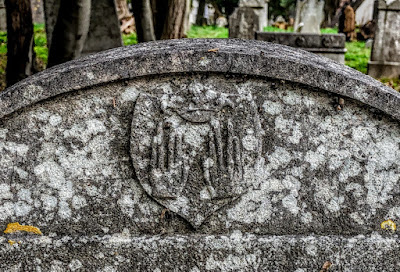
A priest’s hands raised for the blessing of the cohanim … a gravestone in the new Jewish cemetery on the Lido in Venice (Photograph: Patrick Comerford)

Luke 1: 57-66 (NRSVA):

57 Now the time came for Elizabeth to give birth, and she bore a son. 58 Her neighbours and relatives heard that the Lord had shown his great mercy to her, and they rejoiced with her.

59 On the eighth day they came to circumcise the child, and they were going to name him Zechariah after his father. 60 But his mother said, ‘No; he is to be called John.’ 61 They said to her, ‘None of your relatives has this name.’ 62 Then they began motioning to his father to find out what name he wanted to give him. 63 He asked for a writing-tablet and wrote, ‘His name is John.’ And all of them were amazed. 64 Immediately his mouth was opened and his tongue freed, and he began to speak, praising God. 65 Fear came over all their neighbours, and all these things were talked about throughout the entire hill country of Judea. 66 All who heard them pondered them and said, ‘What then will this child become?’ For, indeed, the hand of the Lord was with him.

Dreidels in a synagogue in Prague, part of children’s games at Hanukkah … did John the Baptist and Jesus spin dredels together at Hanukkah? (Photograph: Patrick Comerford)

Today’s Reflections:

In the Gospel reading at the Eucharist today (Luke 1: 57-66), we continue a series of readings before Christmas that draw on the two nativity narratives found in Matthew 1: 1-24 and Luke 1: 5-79.

During the week before Christmas, the great canticle Magnificat at Evensong traditionally has a refrain or antiphon attached to it proclaiming the ascriptions or ‘names’ given to God through the Old Testament. Each name develops into a prophecy of the coming of the Messiah.

O Sapientia, or O Wisdom, is the first of these days, and was marked on Wednesday (17 December). It was followed on Thursday (18 December) by O Adonai, by O Root of Jesse on Friday (19 December), O Key of David on Saturday (20 December), O Dayspring on Sunday (21 December), O King of the Nations yesterday (22 December), and, finally O Emmanuel today (23 December).

The seven majestic Messianic titles for Christ are based on Biblical prophecies, and they help the Church to recall the variety of the ills of humanity before the coming of the Redeemer as each antiphon in turn pleads with mounting impatience for Christ to save his people.

The Gospel reading at the Eucharist today (Luke 1: 57-66) continues on from the story of the Visitation of the Virgin Mary to her cousin Saint Elizabeth, with the only Gospel account of the birth, circumcision and naming of Saint John the Baptist.

Zechariah (זְכַרְיָה‎ or Ζαχαρίας), also named in translations as Zacharias, Zachariah and Zachary, the husband of Elizabeth and the father of John the Baptist, is a priest, one of the cohanim descended from the sons of Aaron. Origen suggests that the Zechariah mentioned in Matthew 23: 35 as being killed between the temple and the altar may be the father of John the Baptist.

His name means ‘remember Yah’ or ‘remember God’ or ‘God remembers’. There are several Biblical figures with the name, including the Prophet Zachariah in Judah, a martyred son of a high priest, a king who reigned in Judah for six months, and several minor characters.

On the other hand, the Greek name Ἰωάννης (Ioannes) is a rendering of the Hebrew name Yohanan (יוֹחָנָן‎), a shorter form of the name Yəhôḥānān (יְהוֹחָנָן‎), which means ‘God is gracious’.

In the Hebrew Bible, Yohanan was the son of King Josiah of Judah (7th century BCE); Yohanan, son of Kareah, was a leader of the army who led the remnant of the population of Judah to Egypt for safety after the Babylonian dismantling of the kingdom in 586 BCE; Yohanan ben Yehoyada is a high priest named in the Book of Nehemiah and was the fourth in the line of high priests after Joshua the High Priest, who returned from the Babylonian captivity with Zerubbabel.

During the Hasmonean or Maccabean period, Yohanan was the father of Matityahu; John Gaddi, the eldest of the sons of Mattathias and brother of Judas Maccabeus, was one of the leaders of the revolt of the Maccabees in the 2nd century BCE; John Hyrcanus was a Maccabean leader and Jewish high priest from 134 BCE until his death in 104 BCE; and John Hyrcanus II (1st century BCE) was a member of the Hasmonean dynasty, High Priest, King, and ethnarch of Judea.

So, the name John, in its variant forms, was both a priestly and a royal name, and was associated with the leaders of resistance to occupation and resistance.

In idle moments, I sometimes wonder whether Jesus and John grew up knowing each other.

Did Mary and Joseph regularly visit Zechariah and Elizabeth?

Was Zechariah present as a priest in the Temple at the Presentation, or when the teenage Jesus was lost in the Temple?

Did Jesus and John send birthday greetings to one another?

Did they go to each other’s bar mitzvah?

Did they celebrate and major holidays of Holy Days together … Purim, Passover, Shavuot, Sukkot, Rosh Hashanah, Yom Kippur, Simchat Torah, Hanukkah … ?

Did they dress up together at Purim?

Did they spin dreidels with each other and play games together at Hanukkah? – Incidentally, yesterday (Monday) was the last day of Hanukkah this year, but Christmas Day and the first day of Hanukkah fell on the same day last year, for the first time in 19 years.

Did John the Baptist ever take up his duties and responsibilities as a priest in the Temple before going out into the Wilderness?

Was he in the Temple when Jesus visited, healed, taught, debated Caesar’s coins, or overturned the tables of the moneychangers?

Did John offer Jesus the priestly blessing that the cohanim alone impart?

The priestly blessing (Numbers 6: 24-26) that Zechariah and John would have pronounced, with their hands outstretched in the traditional way, is:

May the Lord bless and protect you.
May the Lord make his face shine on you and be gracious to you
May the Lord turn his face toward you, and give you peace.


The Priestly Blessing (ברכת כהנים‎, birkat cohanim) is known in rabbinic literature as raising the hands or rising to the platform because the blessing is given from a raised rostrum.

The Jewish Sages stressed that although the priests are the ones carrying out the blessing, it is not them or the ceremonial practice of raising their hands that results in the blessing, but rather it is God’s desire that his blessing should be symbolised by the hands of the cohanim.

The former Chief Rabbi, the late Lord (Jonathan) Sacks, says the Torah explicitly says that while the cohanim say the words, it is God who sends the blessing: ‘When the cohanim bless the people, they are not doing anything in and of themselves. Instead they are acting as channels through which God’s blessing flows into the world and into our lives.’

He adds, ‘Only love does this. Love means that we are focused not on ourselves but on another. Love is selflessness. And only selflessness allows us to be a channel through which flows a force greater than ourselves, the love that as Dante said, “moves the sun and the other stars”, the love that brings new life into the world.’

Hands raised in the priestly blessing on a gravestone in the Jewish cemetery in Kraków (Photograph: Patrick Comerford)

Today’s Prayers (Tuesday 23 December 2025):

The theme this week (21 to 27 December 2025) in Pray with the World Church, the prayer diary of the Anglican mission agency USPG (United Society Partners in the Gospel), is ‘Love Brings Life in Tanzania’ (pp 12-13). This theme was introduced on Sunday with a Programme Update by Imran Englefield, Individual Giving Manager, USPG.

The USPG Prayer Diary today (Tuesday 23 December 2025) invites us to pray:

Gracious Lord, we give thanks for the success of the Prevention of Mother-to-Child Transmission programme. Strengthen those who care, comfort those who suffer, and let hope, healing, and life flourish in this place.

The Collect:

God our redeemer,
who prepared the Blessed Virgin Mary
to be the mother of your Son:
grant that, as she looked for his coming as our saviour,
so we may be ready to greet him
when he comes again as our judge;
who is alive and reigns with you,
in the unity of the Holy Spirit,
one God, now and for ever.

The Post-Communion Prayer:

Heavenly Father,
who chose the Blessed Virgin Mary
to be the mother of the promised saviour
: fill us your servants with your grace,
that in all things we may embrace your holy will
and with her rejoice in your salvation;
through Jesus Christ our Lord.

Additional Collect:

Eternal God,
as Mary waited for the birth of your Son,
so we wait for his coming in glory;
bring us through the birth pangs of this present age
to see, with her, our great salvation
in Jesus Christ our Lord.

Yesterday’s Reflections

Continued Tomorrow

Hands raised in the priestly blessing on a Holocaust memorial in Berlin (Photograph: Patrick Comerford)

Scripture quotations are from the New Revised Standard Version Bible: Anglicised Edition copyright © 1989, 1995 National Council of the Churches of Christ in the United States of America. Used by permission. All rights reserved worldwide. http://nrsvbibles.org

22 December 2025

Daily prayer in Advent 2025:
23, Monday 22 December 2025

An image of the Virgin Mary in a quiet corner at the High Leigh Conference Centre in Hoddesdon, Hertfordshire (Photograph: Patrick Comerford)

Patrick Comerford

We are in the final days of the Season of Advent, yesterday was the Fourth Sunday of Advent (Advent IV, 21 December 2025), today is the last of the eight days of Hanukkah this year, and Christmas Day is just a few days away.

Before today begins, I am taking some quiet time this morning to give thanks, to reflect, to pray and to read in these ways:

1, today’s Gospel reading;

2, a short reflection;

3, a prayer from the USPG prayer diary;

4, the Collects and Post-Communion prayer of the day.

The words of the canticle Magnificat carved on a wooden screen in Mount Melleray Abbey, Cappoquin, Co Waterford (Photograph: Patrick Comerford)

Luke 1: 46-56 (NRSVA):

46 And Mary said,

‘My soul magnifies the Lord,
47 and my spirit rejoices in God my Saviour,
48 for he has looked with favour on the lowliness of his servant.
Surely, from now on all generations will call me blessed;
49 for the Mighty One has done great things for me,
and holy is his name.
50 His mercy is for those who fear him
from generation to generation.
51 He has shown strength with his arm;
he has scattered the proud in the thoughts of their hearts.
52 He has brought down the powerful from their thrones,
and lifted up the lowly;
53 he has filled the hungry with good things,
and sent the rich away empty.
54 He has helped his servant Israel,
in remembrance of his mercy,
55 according to the promise he made to our ancestors,
to Abraham and to his descendants for ever.’

56 And Mary remained with her for about three months and then returned to her home.

The Virgin Mary with the Crown of Thorns depicted in a church window in Bansha, Co Tipperary (Photograph: Patrick Comerford)

Today’s Reflections:

In the Gospel reading at the Eucharist today (Luke 1: 46-56), we continue a series of readings before Christmas that draw on the two nativity narratives found in Matthew 1: 1-24 and Luke 1: 5-79.

During the days before Christmas, the great canticle Magnificat at Evensong traditionally has a refrain or antiphon attached to it proclaiming the ascriptions or ‘names’ given to God through the Old Testament. Each name develops into a prophecy of the coming of the Messiah.

O Sapientia, or O Wisdom, is the first of these days, and was marked on Wednesday (17 December). It was followed on Thursday (18 December) by O Adonai, by O Root of Jesse on Friday (19 December), O Key of David on Saturday (20 December), O Dayspring yesterday (21 December), and by O King of the Nations today (22 December), and, finally O Emmanuel tomorrow (23 December).

The seven majestic Messianic titles for Christ are based on Biblical prophecies, and they help the Church to recall the variety of the ills of humanity before the coming of the Redeemer as each antiphon in turn pleads with mounting impatience for Christ to save his people.

The Gospel reading at the Eucharist today is set withing the story of the Visitation of the Virgin Mary to her cousin Saint Elizabeth.

This Advent has been a time of waiting, a time of preparation, a time of anticipation. Since 30 November, in our time of waiting, preparation and anticipation, we have been preparing ourselves in the liturgy and the music, with carol services and quiet days, with Christmas Markets and Santa’s grotto, with the Advent Wreath and the Crib.

The four candles on the Advent wreath have reminded us, week-after-week, of those who prepared us in the past for the Coming of the Christ Child: first the Patriarchs and Matriarchs, our ancestors in faith, including Abraham and Sarah, Isaac and Jacob; then the prophets, including Isaiah, Jeremiah, and Micah; then Saint John the Baptist; and yesterday, the fourth and final candle reminded us of the Virgin Mary. This fourth candle connects with the Gospel reading yesterday, telling the story of Joseph’s response to Mary’s pregnancy, and today’s reading from the Canticle Magnificat (Luke 1: 46-55), so often heard at Evening Prayer.

The great German theologian and martyr, Dietrich Bonhoeffer (1906-1945), in an Advent sermon in London 92 years ago (17 December 1933), said Magnificat ‘is the oldest Advent hymn,’ and he spoke of how Mary knows better than anyone else what it means to wait for Christ’s coming:

‘In her own body she is experiencing the wonderful ways of God with humankind: that God does not arrange matters to suit our opinions and views, does not follow the path that humans would like to prescribe. God’s path is free and original beyond all our ability to understand or to prove.’

The Virgin Mary of the Visitation and of the canticle Magnificat is a strong and revolutionary woman, unlike the Virgin Mary of the plaster-cast statues and the Rosary.

The Mary I see as a role model for belief and discipleship is the Mary who sets off in a hurry and a flurry to visit her cousin Elizabeth, the Mary with a gob on her who speaks out of turn when she comes out with those wonderful words we hear in this Gospel reading, the Mary who sings the Canticle Magnificat.

This Mary is a wonderful, feisty person. She is what the red-top tabloid newspapers today might describe ‘a gymslip Mum.’ But, instead of hiding herself away from her family, from her cousins, from the woman in her family who is married to a priest, she rushes off to her immediately, to share her good news with her.

And she challenges so many of our prejudices and our values and our presumptions today. Not just about gymslip mums and unexpected or unplanned pregnancies, but about what the silent and the marginalised have to say about our values in society today.

And Mary declares:

He has shown strength with his arm;
he has scattered the proud in the thoughts of their hearts.
He has brought down the powerful from their thrones,
and lifted up the lowly;
he has filled the hungry with good things,
and sent the rich away empty.
He has helped his servant Israel,
in remembrance of his mercy,
according to the promise he made to our ancestors,
to Abraham and to his descendants for ever.’

It is almost like this is the programme or the agenda we can expect when the Christ Child is born, a programme and agenda that the world so desparately needs to hear the promise of today.

An icon of the Virgin Mary in an antique shop in Rethymnon (Photograph: Patrick Comerford)

Today’s Prayers (Monday 22 December 2024):

The theme this week (21 to 27 December 2025) in Pray with the World Church, the prayer diary of the Anglican mission agency USPG (United Society Partners in the Gospel), is ‘Love Brings Life in Tanzania’ (pp 12-13). This theme was introduced yesterday with a Programme Update by Imran Englefield, Individual Giving Manager, USPG.

The USPG Prayer Diary today (Monday 22 December 2025) invites us to pray:

Loving God, we give thanks for Dr Chalinzee and his devoted service at Mvumi Hospital. Strengthen him with wisdom, patience, and compassion as he cares for mothers and children.

The Collect:

God our redeemer,
who prepared the Blessed Virgin Mary
to be the mother of your Son:
grant that, as she looked for his coming as our saviour,
so we may be ready to greet him
when he comes again as our judge;
who is alive and reigns with you,
in the unity of the Holy Spirit,
one God, now and for ever.

The Post-Communion Prayer:

Heavenly Father,
who chose the Blessed Virgin Mary
to be the mother of the promised saviour:
fill us your servants with your grace,
that in all things we may embrace your holy will
and with her rejoice in your salvation;
through Jesus Christ our Lord.

Additional Collect:

Eternal God,
as Mary waited for the birth of your Son,
so we wait for his coming in glory;
bring us through the birth pangs of this present age
to see, with her, our great salvation
in Jesus Christ our Lord.

Yesterday’s Reflections

Continued Tomorrow


Scripture quotations are from the New Revised Standard Version Bible: Anglicised Edition copyright © 1989, 1995 National Council of the Churches of Christ in the United States of America. Used by permission. All rights reserved worldwide. http://nrsvbibles.org