Liverpool Cathedral, where Justin Welby introduced a Hallowe’en service as ‘Night of the Living Dead’ (Photograph: Patrick Comerford)
Patrick Comerford
We are continuing in Ordinary Time in the Church Calendar, which changes to Kingdom-time or the Kingdom Season tomorrow with All Saints’ Day. In the Calendar of the Church of England in Common Worship and Exciting Holiness, today is not marked as Hallowe’en but, instead, remembers Martin Luther.
Before the day begins, before having breakfast, I am taking some quiet time early this morning to give thanks, and for reflection, prayer and reading in these ways:
1, today’s Gospel reading;
2, a short reflection;
3, a prayer from the USPG prayer diary;
4, the Collects and Post-Communion prayer of the day.
Stony Stratford prepares for Hallowe’en … but does Christ make a Hallowe’en choice between trick or treat? (Photographs: Patrick Comerford, 2025)
Luke 14:1-6 (NRSVA)
1 On one occasion when Jesus was going to the house of a leader of the Pharisees to eat a meal on the sabbath, they were watching him closely. 2 Just then, in front of him, there was a man who had dropsy. 3 And Jesus asked the lawyers and Pharisees, ‘Is it lawful to cure people on the sabbath, or not?’ 4 But they were silent. So Jesus took him and healed him, and sent him away. 5 Then he said to them, ‘If one of you has a child or an ox that has fallen into a well, will you not immediately pull it out on a sabbath day?’ 6 And they could not reply to this.
‘Ars Longa, Vita Brevis’ … words from Hippocrates at the Medical School in the Royal Hallamshire Hospital, Sheffield (Photograph: Patrick Comerford)
Today’s Reflections:
Tomorrow is All Saints’ Day, although this may be celebrated in many parishes and churches on Sunday (2 November 2025) as All Saints’ Sunday.
But if All Saints’ Day is not celebrated properly and appropriately in our churches, with a celebration of the Eucharist, whether that is tomorrow or on Sunday, how do we explain to a younger generation what Hallowe’en is truly about?
Hallowe’en is the ‘Night of the Living Dead’ ... for the saints are alive, and we are part of the Communion of Saints, the Church Triumphant (Ecclesia Triumphans) and the Church Militant (Ecclesia Militans), which are part of the one Church, and we are together.
Hallowe’en, or the Eve of All Hallows, is the evening before celebrating All the Saints, All the Holy Ones in Glory, the Saints of every time and place. This is the Eve of a Great Feast of Light – the Solemnity of All Saints, the saints in glory who have ‘inherited the light’ (Colossians 1: 12-13), whether we are alive or dead, whether we have been canonised or faded into obscurity, whether they have given heroic examples in their lives or are unsung and unknown. We are all with God in endless joy.
When he became Dean of Liverpool in 2007, the former Archbishop of Canterbury, Justin Welby, found himself in one of England’s largest and most deprived cathedrals. He doubled attendances, abseiled from the roof, and allowed John Lennon’s Imagine to be played on the cathedral bells – despite the line ‘imagine there is no heaven.’
He also encouraged a ‘Night of the Living Dead’ service on Hallowe’en, when a coffin was carried into the cathedral and a man rose from a coffin to represent the Resurrection.
If we cannot explain Hallowe’en and All Saints’ Day, how can we hope to explain the greater truths of Christmas and Easter?
In today’s Gospel reading (Luke 14:1-6), we are faced with a ‘trick or treat’ conundrum. It is the sabbath and Jesus is going to eat dinner at the home of a local religious leader: if he ignores the sick man’s plight, does he ignore that love and compassion are the core of true religion? Or, if heals this man, is he going to be accused of breaching religious rules, regulations traditions.
The discussion this prompts is not about whether Christ has the duty or responsibility, he legal right or power, the appropriate qualifications or the authority, to heal the man with dropsy, but whether doing this on the Sabbath shows disdain for the law of God.
This is the sole, lone and only Gospel incident in n which the Greek word ὑδρωπικός (hydropikos) is used to describe a person suffering from dropsy. It is a pathological retention of fluid that causes abnormal swelling. Although it is a medical term, its single New Testament appearance here becomes theologically rich when placed within the Gospel narrative.
In the world of the Biblical Mediterranean, dropsy was seen as incurable and associated with other systemic illnesses. Swelling of the limbs and abdomen visibly marked the sufferer, making him ritually unclean by religious understanding of the ay and socially marginalised.
Physicians such as Hippocrates discussed the malady, yet effective treatment was scarce. A hydropic person embodied chronic suffering and exclusion, providing a stark contrast to the wholeness of life envisioned in God’s covenant promises.
Should this man be left, as it were, among the living dead?
By asking whether it is it lawful to heal on the Sabbath or not (verse 3), Jesus exposes the discrepancy between the Law’s intent and the tradition-bound application of it. When he heals the man and sends him away whole, he affirms the Sabbath as a day ‘for doing good’.
Of course, the man is not dying. Although he has dropsy, his healing could take place on any other day, indeed at any other venue. But, even before they speak, Christ’s response to his potential protagonists is to ask a question: ‘Is it lawful to cure people on the sabbath, or not?’ (verse 4).
If they say no, they show their ignorance of the law and the rabbinical tradition; if they say yes, how could they possibly disagree with what they know he is about to do?
After this healing miracle, Christ goes on to share two parables about humility and the heavenly banquet (Luke 14: 7-24). The hydropic man’s restoration anticipates the inclusive feast of the Kingdom, where the physically and spiritually bloated pride of the self-righteous is contrasted with the humble who accept the invitation.
If mercy towards animals or family members is permitted, how much more should mercy for a suffering image-bearer of God be celebrated?
What better day is there than the Sabbath, a day meant to promote God’s commitment to humanity’s well-being, for the restoration of a man with a debilitating illness?
Trick or Treat?
In his response, Christ allows this man to return to work with dignity, and restores him to his full and rightful place in the community of faith that may have been denied to him by the very people who are present that Sabbath.
The man who must once have thought he might as well have been dead is given new life, and is assured he is a Child of God.
Later this evening, as children go knocking on doors in this town, under the watchful and loving eyes of parents or older siblins, I shall remind myself that in Christ there is no trick, there is only treat. And it would be reflective and approopriate to return to a prayer attributed to Saint Ambrose of Milana has become part of Anglican tradition as part of the office of Compline in the Book of Common Prayer:
Before the ending of the day,
Creator of the world, we pray
That thou with wonted love wouldst keep
Thy watch around us while we sleep.
O let no evil dreams be near,
Or phantoms of the night appear;
Our ghostly enemy restrain,
Lest aught of sin our bodies stain.
Almighty Father, hear our cry
Through Jesus Christ our Lord most high,
Who with the Holy Ghost and thee
Doth live and reign eternally. Amen.
A sign in Lichfield Cathedral this week about the true meaning of Hallowe’en (Photograph: Hugh Ashton, 2025)
Today’s Prayers (Friday 31 October 2025):
The theme this week (26 October to 1 November) in Pray with the World Church, the prayer diary of the Anglican mission agency USPG (United Society Partners in the Gospel), is ‘Bonds of Affection’ (pp 50-51). This theme was introduced on Sunday with reflections from Rachel Weller, Communications Officer, USPG.
The USPG Prayer Diary today (Friday 31 October 2025) invites us to pray:
Father, we pray that one day the group may get to meet in person in order that the bonds of affection might be strengthened.
The Collect:
Blessed Lord,
who caused all holy Scriptures to be written for our learning:
help us so to hear them,
to read, mark, learn and inwardly digest them
that, through patience, and the comfort of your holy word,
we may embrace and for ever hold fast
the hope of everlasting life,
which you have given us in our Saviour Jesus Christ,
who is alive and reigns with you,
in the unity of the Holy Spirit,
one God, now and for ever.
The Post Communion Prayer:
God of all grace,
your Son Jesus Christ fed the hungry
with the bread of his life
and the word of his kingdom:
renew your people with your heavenly grace,
and in all our weakness
sustain us by your true and living bread;
who is alive and reigns, now and for ever.
Additional Collect:
Merciful God,
teach us to be faithful in change and uncertainty,
that trusting in your word
and obeying your will
we may enter the unfailing joy of Jesus Christ our Lord.
Collect on the Eve of All Saints’ Day:
Almighty God,
you have knit together your elect
in one communion and fellowship
in the mystical body of your Son Christ our Lord:
grant us grace so to follow your blessed saints
in all virtuous and godly living
that we may come to those inexpressible joys
that you have prepared for those who truly love you;
through Jesus Christ your Son our Lord,
who is alive and reigns with you,
in the unity of the Holy Spirit,
one God, now and for ever.
Yesterday’s Reflections
Continued Tomorrow
A carvwd Hallowe’en pumpkin in Stony Stratford (Photograph: Patrick Comerford)
Scripture quotations are from the New Revised Standard Version Bible: Anglicised Edition copyright © 1989, 1995 National Council of the Churches of Christ in the United States of America. Used by permission. All rights reserved worldwide. http://nrsvbibles.org
Showing posts with label Luther. Show all posts
31 October 2025
30 October 2024
Daily prayer in Ordinary Time 2024:
173, Thursday 31 October 2024
‘How often have I desired to gather your children together as a hen gathers her brood under her wings’ (Luke 13: 34) … a painting of Grey’s Guest House on Achill Island, Co Mayo (Photograph: Patrick Comerford)
Patrick Comerford
We come to the end of Ordinary Time in the Church Calendar today. The week began with the Last Sunday after Trinity (27 October 2024). The Church Calendar in many parts of the Church today remembers Martin Luther (1483-1546), Reformer. This is also Hallowe’en or the Eve of All Saints’ Day. The Kingdom Season begins tomorrow with All Saints’ Day (1 November 2024) and continues until Advent Sunday (1 December 2024).
Before the day begins, before having breakfast, I am taking some quiet time early this morning to give thanks, and for reflection, prayer and reading in these ways:
1, today’s Gospel reading;
2, a short reflection;
3, a prayer from the USPG prayer diary;
4, the Collects and Post-Communion prayer of the day.
‘How often have I desired to gather your children together as a hen gathers her brood under her wings’ (Luke 13: 34) … farmyard hens in Co Wicklow (Photograph: Patrick Comerford)
Luke 13: 31-35 (NRSVA):
31 At that very hour some Pharisees came and said to him, ‘Get away from here, for Herod wants to kill you.’ 32 He said to them, ‘Go and tell that fox for me, “Listen, I am casting out demons and performing cures today and tomorrow, and on the third day I finish my work. 33 Yet today, tomorrow, and the next day I must be on my way, because it is impossible for a prophet to be killed away from Jerusalem.” 34 Jerusalem, Jerusalem, the city that kills the prophets and stones those who are sent to it! How often have I desired to gather your children together as a hen gathers her brood under her wings, and you were not willing! 35 See, your house is left to you. And I tell you, you will not see me until the time comes when you say, “Blessed is the one who comes in the name of the Lord”.’
‘Jerusalem, Jerusalem … How often have I desired to gather your children together’ (Luke 13: 34) … the city of Jerusalem depicted on a tile in a restaurant in Dublin (Photograph: Patrick Comerford)
Today’s Reflection:
In my private meditations and prayers, I often reflect on words from Samuel Johnson from Lichfield, who compiled the first English-language dictionary but who is also often regarded as one of the great Anglican saints of the 18th century. Thinking about the stars at night, the great tragedies in the world and the unbounded love of God, Dr Johnson once wrote:
‘The pensive man at one time walks ‘unseen’ to muse at midnight, and at another hears the sullen curfew. If the weather drives him home he sits in a room lighted only by ‘glowing embers’; or by a lonely lamp outwatches the North Star to discover the habitation of separate souls, and varies the shades of meditation by contemplating the magnificent or pathetick scenes of tragick and epick poetry.’
Sometimes, I have found as I stood presiding at or celebrating the Holy Communion or the Eucharist that I am taken aback by intense feelings of the love of God.
On one memorable occasion, this happened to me as I was using the ‘Prayer of Humble Access’ at the fraction, when we were breaking the Bread of Communion at the invitation.
It is a prayer that has gone out of fashion in many parishes, but it is a reminder that we come to the Table or the Altar not because of our own goodness, not in spite of our own sinfulness, but because of the overflowing mercy and grace that God gives us freely and with unlimited bounty:
We do not presume to come to this your table,
merciful Lord,
trusting in our own righteousness
but in your manifold and great mercies.
We are not worthy so much as to gather up the crumbs under your table.
But you art the same Lord,
whose nature is always to have mercy.
Grant us, therefore, gracious Lord,
so to eat the flesh of your dear Son Jesus Christ,
and to drink his blood,
that our sinful bodies may be made clean by his body,
and our souls washed through his most precious blood,
and that we may evermore dwell in him, and he in us. Amen.
I was taken aback and was conscious of the love of God unexpectedly as I came to those words: ‘We are not worthy so much as to gather up the crumbs under your table.’
What flashed across my mind was a video clip that had gone viral at that time on YouTube and social media, of two small, frail abandoned children caught up in Syria’s bloody civil war, fending for themselves by picking up crumbs of bread from the street to eat.
These two homeless mites, who are braver than any groups fighting or waging war in Syria, told the camera crew: ‘We go to sleep hungry, we wake up hungry.’
They have been separated from their parents. At the time, the Anglican mission agency, USPG, was working with the plight of Syrian refugees in Lesvos and Athens and other parts of Greece.
In that video clip, the 10-year-old girl said she had been collecting bread crumbs off the street with her brother because their area of Damascus, al-Hajar, has been under siege for more than 15 months.
‘If we had food, you wouldn’t have seen us here,’ she said.
But their final message to the world that had abandoned them was: ‘May you be happy and blessed with what God has given you!’
Europe takes pity on children like this when we see them on YouTube or on the 9 o’clock news. But when they land on our shores in the Aegean Islands in Greece, or make their way up through central Europe and cross the Channel into England, we deem them not worthy to gather up the crumbs under our table.
I have looked at this video clip again and again since then. And I think of the image of Christ in our Gospel reading this morning:
‘How often have I desired to gather your children together as a hen gathers her brood under her wings, and you were not willing!’ (Luke 13: 34)
The children of the world are the future of the world. It does not matter whose children they are. It does not matter how many of them there are: whether they are two children searching for crumbs that I am not worthy to gather up, or small enough to be gathered in by a loving parent, or are countless in numbers like the stars, they are all embraced in the love of the loving and living God. They are all heirs to God’s promises.
And how we respond to them, how I respond to them, shows them what I think, what we think, of God and how much we believe in his promises.
Today’s Prayers (Thursday 31 October 2024):
The theme this week in ‘Pray With the World Church’, the Prayer Diary of the Anglican mission agency USPG (United Society Partners in the Gospel), is ‘All Saints’ Day’. This theme was introduced on Sunday with a programme update by the Revd Dr Duncan Dormor, General Secretary, USPG.
The USPG Prayer Diary today (Thursday 31 October 2024) invites us to pray:
We give thanks for the rich diversity of the Church across the world – for all we can learn from one another and our different cultures.
The Collect:
Blessed Lord,
who caused all holy Scriptures to be written for our learning:
help us so to hear them,
to read, mark, learn and inwardly digest them
that, through patience, and the comfort of your holy word,
we may embrace and for ever hold fast
the hope of everlasting life,
which you have given us in our Saviour Jesus Christ,
who is alive and reigns with you,
in the unity of the Holy Spirit,
one God, now and for ever.
The Post Communion Prayer:
God of all grace,
your Son Jesus Christ fed the hungry
with the bread of his life
and the word of his kingdom:
renew your people with your heavenly grace,
and in all our weakness
sustain us by your true and living bread;
who is alive and reigns, now and for ever.
Additional Collect:
Merciful God,
teach us to be faithful in change and uncertainty,
that trusting in your word
and obeying your will
we may enter the unfailing joy of Jesus Christ our Lord.
Collect on the Eve of All Saints’ Day:
Almighty God,
you have knit together your elect
in one communion and fellowship
in the mystical body of your Son Christ our Lord:
grant us grace so to follow your blessed saints
in all virtuous and godly living
that we may come to those inexpressible joys
that you have prepared for those who truly love you;
through Jesus Christ your Son our Lord,
who is alive and reigns with you,
in the unity of the Holy Spirit,
one God, now and for ever.
Yesterday’s Reflection
Continued Tomorrow
‘We are not worthy so much as to gather up the crumbs under your table’ (the Prayer of Humble Access) … preparing bread for the Eucharist early on a Sunday morning (Photograph: Patrick Comerford)
Scripture quotations are from the New Revised Standard Version Bible: Anglicised Edition copyright © 1989, 1995 National Council of the Churches of Christ in the United States of America. Used by permission. All rights reserved worldwide. http://nrsvbibles.org
Patrick Comerford
We come to the end of Ordinary Time in the Church Calendar today. The week began with the Last Sunday after Trinity (27 October 2024). The Church Calendar in many parts of the Church today remembers Martin Luther (1483-1546), Reformer. This is also Hallowe’en or the Eve of All Saints’ Day. The Kingdom Season begins tomorrow with All Saints’ Day (1 November 2024) and continues until Advent Sunday (1 December 2024).
Before the day begins, before having breakfast, I am taking some quiet time early this morning to give thanks, and for reflection, prayer and reading in these ways:
1, today’s Gospel reading;
2, a short reflection;
3, a prayer from the USPG prayer diary;
4, the Collects and Post-Communion prayer of the day.
‘How often have I desired to gather your children together as a hen gathers her brood under her wings’ (Luke 13: 34) … farmyard hens in Co Wicklow (Photograph: Patrick Comerford)
Luke 13: 31-35 (NRSVA):
31 At that very hour some Pharisees came and said to him, ‘Get away from here, for Herod wants to kill you.’ 32 He said to them, ‘Go and tell that fox for me, “Listen, I am casting out demons and performing cures today and tomorrow, and on the third day I finish my work. 33 Yet today, tomorrow, and the next day I must be on my way, because it is impossible for a prophet to be killed away from Jerusalem.” 34 Jerusalem, Jerusalem, the city that kills the prophets and stones those who are sent to it! How often have I desired to gather your children together as a hen gathers her brood under her wings, and you were not willing! 35 See, your house is left to you. And I tell you, you will not see me until the time comes when you say, “Blessed is the one who comes in the name of the Lord”.’
‘Jerusalem, Jerusalem … How often have I desired to gather your children together’ (Luke 13: 34) … the city of Jerusalem depicted on a tile in a restaurant in Dublin (Photograph: Patrick Comerford)
Today’s Reflection:
In my private meditations and prayers, I often reflect on words from Samuel Johnson from Lichfield, who compiled the first English-language dictionary but who is also often regarded as one of the great Anglican saints of the 18th century. Thinking about the stars at night, the great tragedies in the world and the unbounded love of God, Dr Johnson once wrote:
‘The pensive man at one time walks ‘unseen’ to muse at midnight, and at another hears the sullen curfew. If the weather drives him home he sits in a room lighted only by ‘glowing embers’; or by a lonely lamp outwatches the North Star to discover the habitation of separate souls, and varies the shades of meditation by contemplating the magnificent or pathetick scenes of tragick and epick poetry.’
Sometimes, I have found as I stood presiding at or celebrating the Holy Communion or the Eucharist that I am taken aback by intense feelings of the love of God.
On one memorable occasion, this happened to me as I was using the ‘Prayer of Humble Access’ at the fraction, when we were breaking the Bread of Communion at the invitation.
It is a prayer that has gone out of fashion in many parishes, but it is a reminder that we come to the Table or the Altar not because of our own goodness, not in spite of our own sinfulness, but because of the overflowing mercy and grace that God gives us freely and with unlimited bounty:
We do not presume to come to this your table,
merciful Lord,
trusting in our own righteousness
but in your manifold and great mercies.
We are not worthy so much as to gather up the crumbs under your table.
But you art the same Lord,
whose nature is always to have mercy.
Grant us, therefore, gracious Lord,
so to eat the flesh of your dear Son Jesus Christ,
and to drink his blood,
that our sinful bodies may be made clean by his body,
and our souls washed through his most precious blood,
and that we may evermore dwell in him, and he in us. Amen.
I was taken aback and was conscious of the love of God unexpectedly as I came to those words: ‘We are not worthy so much as to gather up the crumbs under your table.’
What flashed across my mind was a video clip that had gone viral at that time on YouTube and social media, of two small, frail abandoned children caught up in Syria’s bloody civil war, fending for themselves by picking up crumbs of bread from the street to eat.
These two homeless mites, who are braver than any groups fighting or waging war in Syria, told the camera crew: ‘We go to sleep hungry, we wake up hungry.’
They have been separated from their parents. At the time, the Anglican mission agency, USPG, was working with the plight of Syrian refugees in Lesvos and Athens and other parts of Greece.
In that video clip, the 10-year-old girl said she had been collecting bread crumbs off the street with her brother because their area of Damascus, al-Hajar, has been under siege for more than 15 months.
‘If we had food, you wouldn’t have seen us here,’ she said.
But their final message to the world that had abandoned them was: ‘May you be happy and blessed with what God has given you!’
Europe takes pity on children like this when we see them on YouTube or on the 9 o’clock news. But when they land on our shores in the Aegean Islands in Greece, or make their way up through central Europe and cross the Channel into England, we deem them not worthy to gather up the crumbs under our table.
I have looked at this video clip again and again since then. And I think of the image of Christ in our Gospel reading this morning:
‘How often have I desired to gather your children together as a hen gathers her brood under her wings, and you were not willing!’ (Luke 13: 34)
The children of the world are the future of the world. It does not matter whose children they are. It does not matter how many of them there are: whether they are two children searching for crumbs that I am not worthy to gather up, or small enough to be gathered in by a loving parent, or are countless in numbers like the stars, they are all embraced in the love of the loving and living God. They are all heirs to God’s promises.
And how we respond to them, how I respond to them, shows them what I think, what we think, of God and how much we believe in his promises.
Today’s Prayers (Thursday 31 October 2024):
The theme this week in ‘Pray With the World Church’, the Prayer Diary of the Anglican mission agency USPG (United Society Partners in the Gospel), is ‘All Saints’ Day’. This theme was introduced on Sunday with a programme update by the Revd Dr Duncan Dormor, General Secretary, USPG.
The USPG Prayer Diary today (Thursday 31 October 2024) invites us to pray:
We give thanks for the rich diversity of the Church across the world – for all we can learn from one another and our different cultures.
The Collect:
Blessed Lord,
who caused all holy Scriptures to be written for our learning:
help us so to hear them,
to read, mark, learn and inwardly digest them
that, through patience, and the comfort of your holy word,
we may embrace and for ever hold fast
the hope of everlasting life,
which you have given us in our Saviour Jesus Christ,
who is alive and reigns with you,
in the unity of the Holy Spirit,
one God, now and for ever.
The Post Communion Prayer:
God of all grace,
your Son Jesus Christ fed the hungry
with the bread of his life
and the word of his kingdom:
renew your people with your heavenly grace,
and in all our weakness
sustain us by your true and living bread;
who is alive and reigns, now and for ever.
Additional Collect:
Merciful God,
teach us to be faithful in change and uncertainty,
that trusting in your word
and obeying your will
we may enter the unfailing joy of Jesus Christ our Lord.
Collect on the Eve of All Saints’ Day:
Almighty God,
you have knit together your elect
in one communion and fellowship
in the mystical body of your Son Christ our Lord:
grant us grace so to follow your blessed saints
in all virtuous and godly living
that we may come to those inexpressible joys
that you have prepared for those who truly love you;
through Jesus Christ your Son our Lord,
who is alive and reigns with you,
in the unity of the Holy Spirit,
one God, now and for ever.
Yesterday’s Reflection
Continued Tomorrow
‘We are not worthy so much as to gather up the crumbs under your table’ (the Prayer of Humble Access) … preparing bread for the Eucharist early on a Sunday morning (Photograph: Patrick Comerford)
Scripture quotations are from the New Revised Standard Version Bible: Anglicised Edition copyright © 1989, 1995 National Council of the Churches of Christ in the United States of America. Used by permission. All rights reserved worldwide. http://nrsvbibles.org
17 January 2024
Daily prayers during
Christmas and Epiphany:
24, 17 January 2024
Saint James the Less is usually identified with the author of the Letter of James … a statue on the west front of Lichfield Cathedral (Photograph: Patrick Comerford)
Patrick Comerford
The celebrations of Epiphany-tide continue today (17 January 2023), and this week began with the Second Sunday of Epiphany (14 January 2024). Christmas is a season that lasts for 40 days that continues from Christmas Day (25 December) to Candlemas or the Feast of the Presentation (2 February).
The Calendar of the Church of England in Common Worship today recalls the lives of Antony of Egypt (356), Hermit, Abbot, and Charles Gore (1932), Bishop, Founder of the Community of the Resurrection.
Before today begins, I am taking some time for reflection, reading and prayer. My reflections each morning during the seven days of this week include:
1, A reflection on one of the seven people who give their names to epistles in the New Testament;
2, the Gospel reading of the day;
3, a prayer from the USPG prayer diary.
Saint James the Brother of the Lord … an icon written by Tobias Stanislas Haller, BSG, for Saint James Episcopal Church, Parkton, Maryland
4, James:
Saint Paul does not give his own name to any of his letters, but seven people give their names to a total of seven of the letters or epistles in the New Testament: Timothy (I and II Timohty), Titus, Philemon, James, Peter (I and II Peter), John (I, II and III John), and Jude.
The author of the Epistle of James identifies himself as ‘James, a servant (or slave) of God and of the Lord Jesus Christ’ who is writing to ‘the twelve tribes in the Dispersion’ or ‘scattered abroad’ (James 1: 1). The letter is traditionally attributed to James the Brother of Jesus, or James the Just, and his audience is generally considered to be Jewish Christians living among the Jewish diaspora.
Framing his letter within an overall theme of patient perseverance during trials and temptations, James writes to encourage his readers to live consistently with what they have learned in Christ. He condemns various sins, including pride, hypocrisy, favouritism and slander. He encourages and implores believers to humbly live by godly, rather than worldly, wisdom and to pray in all situations.
In recent decades, the epistle has attracted increasing scholarly interest with a surge in the quest for the historical James, and with an increasing awareness of the Jewish grounding of both the epistle and the early Christian movement.
The name James or Jacob (יַעֲקֹב, Ιάκωβος) was a common name in antiquity, and a number of early Christian figures are named James, including: James the son of Zebedee or James the Great, James the son of Alphaeus or James the Less, and James the brother of Jesus. Of these, James the brother of Jesus has the most prominent role in the early Church, and is often understood as either the author of the letter or the implied author.
The Eastern Orthodox Church teaches that the epistle was ‘written not by either of the apostles, but by the ‘brother of the Lord’ who was the first bishop of the Church in Jerusalem.
The Acts of the Apostles says that when Peter escapes from prison and flees Jerusalem, he asks that James be informed (Acts 12: 17). Later, the Christians of Antioch ask whether Gentile Christians should be circumcised and send Paul and Barnabas to confer with the Church in Jerusalem (Acts 15: 12-22). James charts a middle course, supporting those who oppose demanding circumcision for Gentile converts but suggesting prohibitions against eating blood and against eating meat sacrificed to idols.
When Saint Paul arrives in Jerusalem with the money he has raised for the Church there, he speaks to James, and James insists Paul should ritually cleanse himself at the Temple to prove his faith and to counter rumours of teaching rebellion against the Torah (Acts 21: 18ff).
The Acts of the Apostles is silent about James after the year 60 CE. However, according to Josephus in his Jewish Antiquities (20: 197-203), ‘the brother of Jesus, who was called Christ, whose name was James’ met his death in the year 62 CE, when he was condemned ‘on the charge of breaking the law.’ He was thrown from the wall of the Temple on the day of the Passover and was stoned. As he prayed for his slayers, his head was crushed by a wooden club wielded by a scribe.
James, Joses, Simon, and Judas are mentioned as the brothers or siblings of Jesus as well as two unnamed sisters (see Matthew 13: 55; Mark 6: 3). Roman Catholics and the Eastern Orthodox teach that James, along with others named brothers of Jesus, were not the biological children of Mary, but were possibly cousins of Jesus, or step-brothers from a previous marriage of Joseph. He is sometimes referred to in Eastern Christianity as James Adelphotheos (Ἰάκωβος ὁ Ἀδελφόθεος), James the Brother of God. The oldest surviving Christian liturgy, the Liturgy of Saint James, uses this epithet.
Origen may be the first person to link the epistle to ‘James the brother of Lord’ (Comm. on Romans 4.8.2), though this is only preserved in Rufinus’s Latin translation of Origen. Eusebius writes that ‘James, who is said to be the author of the first of the so-called catholic epistles. But it is to be observed that it is disputed’ (Historia ecclesiae 2.23.25).
Jerome reported that the Epistle of James ‘is claimed by some to have been published by someone else under his name, and gradually, as time went on, to have gained authority’ (De viris illustribus 2).
The Letter of James is missing from the Muratorian fragment (2nd to 4th century), the Cheltenham list (ca 360 CE), but was listed with the 27 New Testament books by Athanasius of Alexandria in 367 CE, and subsequently it was affirmed by the Councils of Laodicea (363 CE), Rome (382 CE) and Carthage (397 and 419).
The link between James the brother of Jesus and the epistle continued to strengthen, and is now considered the traditional view on the authorship of the work. Many scholars, however, consider the Epistle pseudonymous, written by a writer who chose to write under the name James.
Some commentators say James wrote the letter prior to the Galatians controversy (see Galatian 2: 11-14), and before to the Jerusalem council (Acts 15). Others say James wrote the letter in response to Paul’s teachings. Still others suggest James wrote this letter after the events recorded in Galatians and Acts, but not in response to Paul or his teachings.
Some say James had a sufficient proficiency in Greek education to write the letter. Some argue that the letter was written by someone else on behalf of James and that this explains the quality of Greek in the letter. Galilee was sufficiently Hellenised by the first century CE to produce figures such the rhetorician Theodorus or the poet Meleager, but there is no evidence outside the epistle to suggest that had a Greek education.
The epistle resembles the form of a Diaspora letter, written to encourage Jewish-Christian communities living amid the hardships of diaspora life. James stands in the tradition of the Jewish genre of ‘Letters to the Diaspora,’ including the letters of the members of the family of Gamaliel, the letter preserved in II Maccabees 1: 1-9, or some copied by Josephus, all of which are characterised by a double opening and an abrupt ending.
Poverty and wealth are key concerns throughout the letter, and these issues are likely to reflect the epistle’s historical context. The author shows concern for vulnerable and marginalised groups, such as ‘orphans and widows’ (James 1:27), believers who are poorly clothed and lacking in daily food (James 2: 15), and the poorly-paid labourers (James 5: 4). He writes strongly against the rich (James 1: 10; 5: 1-6) and those who show favouritism towards the rich (James 2: 1-7).
Chapter 2 includes an oft-quoted passage about faith and works:
14 What good is it, my brothers and sisters, if you say you have faith but do not have works? Can faith save you? 15 If a brother or sister is naked and lacks daily food, 16 and one of you says to them, ‘Go in peace; keep warm and eat your fill’, and yet you do not supply their bodily needs, what is the good of that? 17 So faith by itself, if it has no works, is dead.
For James, claims about belief are empty, unless they are alive in action, works and deeds: ‘22 You see that faith was active along with his works, and faith was brought to completion by the works. 23 Thus the scripture was fulfilled that says, ‘Abraham believed God, and it was reckoned to him as righteousness’, and he was called the friend of God. 24 You see that a person is justified by works and not by faith alone. 25 Likewise, was not Rahab the prostitute also justified by works when she welcomed the messengers and sent them out by another road?’ (James 1: 22-25)
Martin Luther dismissed the letter as an ‘epistle of straw.’ He rejected the letter because the passage in James 2: 14-17 contradicts his ideas of justification by faith alone (sola fide). Luther was tempted to remove the letter from the Bible, and when he included James from his German Bible, he moved it, along with Hebrews, Jude and Revelation, to the end of the Bible.
A traditional icon of James the Brother of the Lord
Mark 3: 1-6 (NRSVA):
1 Again he entered the synagogue, and a man was there who had a withered hand. 2 They watched him to see whether he would cure him on the sabbath, so that they might accuse him. 3 And he said to the man who had the withered hand, ‘Come forward.’ 4 Then he said to them, ‘Is it lawful to do good or to do harm on the sabbath, to save life or to kill?’ But they were silent. 5 He looked around at them with anger; he was grieved at their hardness of heart and said to the man, ‘Stretch out your hand.’ He stretched it out, and his hand was restored. 6 The Pharisees went out and immediately conspired with the Herodians against him, how to destroy him.
An image of Saint Anthony above the entrance to Saint Anthony’s Church in Rethymnon … Saint Anthony is commemorated in the Church Calendar today (Photograph: Patrick Comerford)
Today’s Prayers (Wednesday 17 January 2024):
The theme this week in ‘Pray With the World Church,’ the Prayer Diary of the Anglican mission agency USPG (United Society Partners in the Gospel), is: ‘Climate Justice from Bangladesh perspective.’ This theme was introduced on Sunday by the Right Revd Shourabh Pholia, Bishop of Barishal Diocese, Church of Bangladesh.
The USPG Prayer Diary today (17 January 2024) invites us to pray in these words:
Lord God, we pray for those in positions of power and decision-making to address the issue of climate change and stand together to save the earth.
The Collect:
Most gracious God,
who called your servant Antony to sell all that he had
and to serve you in the solitude of the desert:
by his example may we learn to deny ourselves
and to love you before all things;
through Jesus Christ your Son our Lord,
who is alive and reigns with you,
in the unity of the Holy Spirit,
one God, now and for ever.
The Post-Communion Prayer:
Merciful God, who gave such grace to your servant Antony
that he served you with singleness of heart
and loved you above all things:
help us, whose communion with you
has been renewed in this sacrament,
to forsake all that holds us back from following Christ
and to grow into his likeness from glory to glory;
through Jesus Christ our Lord.
Yesterday’s reflection (Philemon)
Continued tomorrow (Peter)
A statue of Bishop Charles Gore at Birmingham Cathedral … he is commemorated in ‘Common Worship’ on 17 January (Photograph: Patrick Comerford)
Scripture quotations are from the New Revised Standard Version Bible: Anglicised Edition copyright © 1989, 1995, National Council of the Churches of Christ in the United States of America. Used by permission. All rights reserved worldwide. http://nrsvbibles.org
Patrick Comerford
The celebrations of Epiphany-tide continue today (17 January 2023), and this week began with the Second Sunday of Epiphany (14 January 2024). Christmas is a season that lasts for 40 days that continues from Christmas Day (25 December) to Candlemas or the Feast of the Presentation (2 February).
The Calendar of the Church of England in Common Worship today recalls the lives of Antony of Egypt (356), Hermit, Abbot, and Charles Gore (1932), Bishop, Founder of the Community of the Resurrection.
Before today begins, I am taking some time for reflection, reading and prayer. My reflections each morning during the seven days of this week include:
1, A reflection on one of the seven people who give their names to epistles in the New Testament;
2, the Gospel reading of the day;
3, a prayer from the USPG prayer diary.
Saint James the Brother of the Lord … an icon written by Tobias Stanislas Haller, BSG, for Saint James Episcopal Church, Parkton, Maryland4, James:
Saint Paul does not give his own name to any of his letters, but seven people give their names to a total of seven of the letters or epistles in the New Testament: Timothy (I and II Timohty), Titus, Philemon, James, Peter (I and II Peter), John (I, II and III John), and Jude.
The author of the Epistle of James identifies himself as ‘James, a servant (or slave) of God and of the Lord Jesus Christ’ who is writing to ‘the twelve tribes in the Dispersion’ or ‘scattered abroad’ (James 1: 1). The letter is traditionally attributed to James the Brother of Jesus, or James the Just, and his audience is generally considered to be Jewish Christians living among the Jewish diaspora.
Framing his letter within an overall theme of patient perseverance during trials and temptations, James writes to encourage his readers to live consistently with what they have learned in Christ. He condemns various sins, including pride, hypocrisy, favouritism and slander. He encourages and implores believers to humbly live by godly, rather than worldly, wisdom and to pray in all situations.
In recent decades, the epistle has attracted increasing scholarly interest with a surge in the quest for the historical James, and with an increasing awareness of the Jewish grounding of both the epistle and the early Christian movement.
The name James or Jacob (יַעֲקֹב, Ιάκωβος) was a common name in antiquity, and a number of early Christian figures are named James, including: James the son of Zebedee or James the Great, James the son of Alphaeus or James the Less, and James the brother of Jesus. Of these, James the brother of Jesus has the most prominent role in the early Church, and is often understood as either the author of the letter or the implied author.
The Eastern Orthodox Church teaches that the epistle was ‘written not by either of the apostles, but by the ‘brother of the Lord’ who was the first bishop of the Church in Jerusalem.
The Acts of the Apostles says that when Peter escapes from prison and flees Jerusalem, he asks that James be informed (Acts 12: 17). Later, the Christians of Antioch ask whether Gentile Christians should be circumcised and send Paul and Barnabas to confer with the Church in Jerusalem (Acts 15: 12-22). James charts a middle course, supporting those who oppose demanding circumcision for Gentile converts but suggesting prohibitions against eating blood and against eating meat sacrificed to idols.
When Saint Paul arrives in Jerusalem with the money he has raised for the Church there, he speaks to James, and James insists Paul should ritually cleanse himself at the Temple to prove his faith and to counter rumours of teaching rebellion against the Torah (Acts 21: 18ff).
The Acts of the Apostles is silent about James after the year 60 CE. However, according to Josephus in his Jewish Antiquities (20: 197-203), ‘the brother of Jesus, who was called Christ, whose name was James’ met his death in the year 62 CE, when he was condemned ‘on the charge of breaking the law.’ He was thrown from the wall of the Temple on the day of the Passover and was stoned. As he prayed for his slayers, his head was crushed by a wooden club wielded by a scribe.
James, Joses, Simon, and Judas are mentioned as the brothers or siblings of Jesus as well as two unnamed sisters (see Matthew 13: 55; Mark 6: 3). Roman Catholics and the Eastern Orthodox teach that James, along with others named brothers of Jesus, were not the biological children of Mary, but were possibly cousins of Jesus, or step-brothers from a previous marriage of Joseph. He is sometimes referred to in Eastern Christianity as James Adelphotheos (Ἰάκωβος ὁ Ἀδελφόθεος), James the Brother of God. The oldest surviving Christian liturgy, the Liturgy of Saint James, uses this epithet.
Origen may be the first person to link the epistle to ‘James the brother of Lord’ (Comm. on Romans 4.8.2), though this is only preserved in Rufinus’s Latin translation of Origen. Eusebius writes that ‘James, who is said to be the author of the first of the so-called catholic epistles. But it is to be observed that it is disputed’ (Historia ecclesiae 2.23.25).
Jerome reported that the Epistle of James ‘is claimed by some to have been published by someone else under his name, and gradually, as time went on, to have gained authority’ (De viris illustribus 2).
The Letter of James is missing from the Muratorian fragment (2nd to 4th century), the Cheltenham list (ca 360 CE), but was listed with the 27 New Testament books by Athanasius of Alexandria in 367 CE, and subsequently it was affirmed by the Councils of Laodicea (363 CE), Rome (382 CE) and Carthage (397 and 419).
The link between James the brother of Jesus and the epistle continued to strengthen, and is now considered the traditional view on the authorship of the work. Many scholars, however, consider the Epistle pseudonymous, written by a writer who chose to write under the name James.
Some commentators say James wrote the letter prior to the Galatians controversy (see Galatian 2: 11-14), and before to the Jerusalem council (Acts 15). Others say James wrote the letter in response to Paul’s teachings. Still others suggest James wrote this letter after the events recorded in Galatians and Acts, but not in response to Paul or his teachings.
Some say James had a sufficient proficiency in Greek education to write the letter. Some argue that the letter was written by someone else on behalf of James and that this explains the quality of Greek in the letter. Galilee was sufficiently Hellenised by the first century CE to produce figures such the rhetorician Theodorus or the poet Meleager, but there is no evidence outside the epistle to suggest that had a Greek education.
The epistle resembles the form of a Diaspora letter, written to encourage Jewish-Christian communities living amid the hardships of diaspora life. James stands in the tradition of the Jewish genre of ‘Letters to the Diaspora,’ including the letters of the members of the family of Gamaliel, the letter preserved in II Maccabees 1: 1-9, or some copied by Josephus, all of which are characterised by a double opening and an abrupt ending.
Poverty and wealth are key concerns throughout the letter, and these issues are likely to reflect the epistle’s historical context. The author shows concern for vulnerable and marginalised groups, such as ‘orphans and widows’ (James 1:27), believers who are poorly clothed and lacking in daily food (James 2: 15), and the poorly-paid labourers (James 5: 4). He writes strongly against the rich (James 1: 10; 5: 1-6) and those who show favouritism towards the rich (James 2: 1-7).
Chapter 2 includes an oft-quoted passage about faith and works:
14 What good is it, my brothers and sisters, if you say you have faith but do not have works? Can faith save you? 15 If a brother or sister is naked and lacks daily food, 16 and one of you says to them, ‘Go in peace; keep warm and eat your fill’, and yet you do not supply their bodily needs, what is the good of that? 17 So faith by itself, if it has no works, is dead.
For James, claims about belief are empty, unless they are alive in action, works and deeds: ‘22 You see that faith was active along with his works, and faith was brought to completion by the works. 23 Thus the scripture was fulfilled that says, ‘Abraham believed God, and it was reckoned to him as righteousness’, and he was called the friend of God. 24 You see that a person is justified by works and not by faith alone. 25 Likewise, was not Rahab the prostitute also justified by works when she welcomed the messengers and sent them out by another road?’ (James 1: 22-25)
Martin Luther dismissed the letter as an ‘epistle of straw.’ He rejected the letter because the passage in James 2: 14-17 contradicts his ideas of justification by faith alone (sola fide). Luther was tempted to remove the letter from the Bible, and when he included James from his German Bible, he moved it, along with Hebrews, Jude and Revelation, to the end of the Bible.
A traditional icon of James the Brother of the LordMark 3: 1-6 (NRSVA):
1 Again he entered the synagogue, and a man was there who had a withered hand. 2 They watched him to see whether he would cure him on the sabbath, so that they might accuse him. 3 And he said to the man who had the withered hand, ‘Come forward.’ 4 Then he said to them, ‘Is it lawful to do good or to do harm on the sabbath, to save life or to kill?’ But they were silent. 5 He looked around at them with anger; he was grieved at their hardness of heart and said to the man, ‘Stretch out your hand.’ He stretched it out, and his hand was restored. 6 The Pharisees went out and immediately conspired with the Herodians against him, how to destroy him.
An image of Saint Anthony above the entrance to Saint Anthony’s Church in Rethymnon … Saint Anthony is commemorated in the Church Calendar today (Photograph: Patrick Comerford)
Today’s Prayers (Wednesday 17 January 2024):
The theme this week in ‘Pray With the World Church,’ the Prayer Diary of the Anglican mission agency USPG (United Society Partners in the Gospel), is: ‘Climate Justice from Bangladesh perspective.’ This theme was introduced on Sunday by the Right Revd Shourabh Pholia, Bishop of Barishal Diocese, Church of Bangladesh.
The USPG Prayer Diary today (17 January 2024) invites us to pray in these words:
Lord God, we pray for those in positions of power and decision-making to address the issue of climate change and stand together to save the earth.
The Collect:
Most gracious God,
who called your servant Antony to sell all that he had
and to serve you in the solitude of the desert:
by his example may we learn to deny ourselves
and to love you before all things;
through Jesus Christ your Son our Lord,
who is alive and reigns with you,
in the unity of the Holy Spirit,
one God, now and for ever.
The Post-Communion Prayer:
Merciful God, who gave such grace to your servant Antony
that he served you with singleness of heart
and loved you above all things:
help us, whose communion with you
has been renewed in this sacrament,
to forsake all that holds us back from following Christ
and to grow into his likeness from glory to glory;
through Jesus Christ our Lord.
Yesterday’s reflection (Philemon)
Continued tomorrow (Peter)
A statue of Bishop Charles Gore at Birmingham Cathedral … he is commemorated in ‘Common Worship’ on 17 January (Photograph: Patrick Comerford)
Scripture quotations are from the New Revised Standard Version Bible: Anglicised Edition copyright © 1989, 1995, National Council of the Churches of Christ in the United States of America. Used by permission. All rights reserved worldwide. http://nrsvbibles.org
Labels:
Acts of the Apostles,
Bangladesh,
Bible Studies,
Birmingham,
Church History,
Egypt,
Environment,
Epiphany,
Icons,
Lichfield Cathedral,
Luther,
Mission,
Prayer,
Rethymnon,
Saint James,
Saint Mark's Gospel,
USPG
31 October 2023
Daily prayers in Ordinary Time
with USPG: (156) 31 October 2023
Saint Thomas’ Church, once part of Saint Thomas’ Hospital … its history is intimately linked with Southwark Cathedral (Photograph: Patrick Comerford)
Patrick Comerford
We are in Ordinary Time in the Church Calendar, and this week began with the Last Sunday after Trinity (Trinity XXI, 29 October 2023). The calendar of the Church of England in Common Worship today (31 October 2023) remembers Martin Luther, Reformer, 1546.
Before today begins, I am taking some time for prayer and reflection early this morning.
Throughout this week, with the exceptions of All Saints’ Day (Wednesday 1 November) and All Souls’ Day (Thursday 2 November), my reflections each morning this week follow this pattern:
1, A reflection on a church or cathedral in Southwark;
2, the Gospel reading of the day in the Church of England lectionary;
3, a prayer from the USPG prayer diary.
A 19th century drawing of Saint Thomas Church, Southwark
Saint Thomas’ Church, Southwark:
Saint Thomas Church, Southwark, which now houses the Amazing Grace bar and restaurant is a stone’s throw away from London Bridge station, nestled right in between the Shard and Borough Market in Southwark. The former church dates back to a church that was part of the original Saint Thomas’ Hospital.
An early hospital for the sick and the poor was founded within the precincts of the Priory of Saint Mary Overy, now Southwark Cathedral, around the time the priory was founded in 1106. It was maintained by a small community of brothers and sisters following a monastic rule. Later, it was said the hospital was founded as an adjunct of the priory by Saint Thomas Becket, Archbishop of Canterbury in 1162-1170. It was named in his honour after he was canonised in 1173.
The hospital building was severely damaged during a disastrous fire in the Priory in 1213. Amicius, who was Archdeacon of Surrey in 1189-1215, was the warden of the hospital at the time. The canons immediately erected a temporary building for the poor at a little distance from the priory, and while the priory was being rebuilt they held their own services in the chapel of the new hospital.
Peter des Roches, Bishop of Winchester, added to the endowment of the hospital, and built a new house, moving the hospital from ‘Trenet Lane’ in 1215 to Saint Thomas Street in Southwark, where it was said the water was purer and the air more healthy. The new hospital, also dedicated to Saint Thomas the Martyr, was built by 1215.
The mediaeval pilgrimage to Canterbury honouring Saint Thomas Becket began in Southwark at London Bridge and coaching inns such as the George. It is celebrated in Chaucer’s Canterbury Tales.
The hospital provided shelter and treatment for the poor, sick, and homeless. When Bishop Asserio visited the hospital in 1323, he admonished the master of the hospital for the irregular lives led by the brethren and sisters. They were ordered to follow the rule of Saint Augustine, and the master was to eat with the brethren.
Like many English religious houses, the hospital, suffered at the time of the Black Death. Walter de Marlowe, brother of the hospital, obtained a dispensation from illegitimacy from Pope Clement VI in 1349 so he could be appointed the prior or master. The petition said mortality among the brethren had left no one so fit to rule as Walter.
Richard Whittington, four-times Lord Mayor of London and known in folklore for the tales of Dick Whittington and his cat, endowed a lying-in ward for unmarried mothers in the 15th century.
The hospital or conventual precinct had become a parish by 1496.
A letter from Sir Thomas More dated 16 March 1528 to Cardinal Thomas Wolsey (1473-1530), Bishop of Winchester and Archbishop of York, mentions the hospital of Southwark, then in the Diocese of Winchester, anddescribes the master, Richard Richardson, as old, blind and feeble.
Matters did not improve with a new Master. Richard Layton, the Dean of York and monastic visitor, wrote to Thomas Cromwell on 26 September 1535, saying he was going to visit ‘the bawdy hospital of St Thomas.’ Although Layton’s choice of language was usually coarse and untrustworthy, his reference to the hospital seems justified, and the master Richard Mabbot was both lax in discipline and bad in personal character.
In a complaint to Sir Richard Longe and Robert Acton in July 1536, nine parishioners of Saint Thomas’ accused the master and brethren of the hospital of maintaining improper characters within the precincts, refusing charitable relief to the sick and even to those willing to pay. As examples, they said a poor pregnant woman was denied a place and died at the church door, while rich men’s servants were readily taken in. They children were refused baptism until the master was paid 3s 4d.
The master was accused of quarrelling with the brethren and sisters, even in the quire of the church. Referring to the services in the church, they complained that the usual three or four sermons in Lent had not been preached, there were seldom two masses a day, and at times they had been forced to seek a priest in the Borough to sing High Mass.
They said the master had closed the free school that was part of the hospital, although was £4 a year was provided for its maintenance. They accused him of ‘filthy and indecent’ conduct, said he openly kept a concubine, that he behaved as ‘lord, king and bishop’ within his precincts, and that he sold the church plate, pretending it was stolen.
Despite this, the hospital was the place where one of the first printed English Bibles was printed in 1537. This is commemorated by a plaque on the surviving wing in Borough High Street.
In all, 24 priors, masters, wardens or rectors served from the time of Archdeacon Amicius in 1213-1215 to Thomas Thurleby, who was appointed in 1539 and surrendered in 1540. The monastery was dissolved in 1539 during the Tudor Reformation, the hospital was surrendered by the Master in 1540, and it was closed.
However, the City of London was granted the site with a charter from Edward VI, and the hospital reopened in 1551. The cult of Saint Thomas Becket had been abolished in 1538 during the Reformation, and the hospital was rededicated to Saint Thomas the Apostle. It has remained open ever since.
The present church was built by the Hospital Governors and desiged by Thomas Cartwright in 1703. It had a garret that was called the Herb Garret in 1821. In the same year, the Old Operating Theatre was built in the Herb Garret.
Saint Thomas’ was declared redundant as a church in 1899 and the parish merged with Saint Saviour’s, which became Southwark Cathedral in 1905.
For a time, Saint Thomas’ was used as the Chapter House for Southwark Cathedral. In the late 20th century it was used as an office by the Chapter Group, an insurance company.
When the Jubilee Line extension was built in the mid-1990s, the church was damaged and was declared ‘at risk’ on the English Heritage register. It was renovated in 2008-2009 and it became the headquarters of the Cathedral Group, a property development company, in 2010. It opened in October 2021 as Amazing Grace, a bar, restaurant and music venue.
The renovation of the old church includes the addition of striking lightning, a green tiled bar and 3D visuals. The work included inserting a higher level mezzanine over the galleries, a partially raised floor in the church and subdividing the basement for restrooms and the restaurant kitchen.
Many of the original features in the building have been restored, including four tall, stained glass windows with glazing bars and red rubbed brick dressings; the exterior brown-red brick with stone dressings; the interior panelled galleries with oak mouldings; and the wooden reredos or altarpiece which features fluted columns with Corinthian capitals and a pediment topped with a crown motif flanked by a unicorn and lion.
As for Saint Thomas’ Hospital, it moved from Southwark in 1862, when the site was compulsorily purchased to make way for building Charing Cross railway viaduct from London Bridge Station. The hospital was temporarily housed at Royal Surrey Gardens in Newington (Walworth) until new buildings were completed near Lambeth Palace in 1871.
Today, Saint Thomas’ Hospital is a large NHS teaching hospital in Central London, and administratively it is part of the Guy's and St Thomas' NHS Foundation Trust, together with Guy’s Hospital, King’s College Hospital, University Hospital Lewisham and Queen Elizabeth Hospital.
The Operating Theatre of Saint Thomas’s Hospital was operational from 1822 to 1862. It was uncovered in the church attic by Raymond Russell in 1957. It is said to be the oldest surviving operating theatre in England, and it is now a museum that is accessed by a narrow tower staircase.
The plaque in Southwark commemorating Saint Thomas Church and an early English Bible (Photograph: Simon Harriyott, CC by 2.0/Wikipedia)
Luke 13: 18-21 (NRSVA):
18 He said therefore, ‘What is the kingdom of God like? And to what should I compare it? 19 It is like a mustard seed that someone took and sowed in the garden; it grew and became a tree, and the birds of the air made nests in its branches.’
20 And again he said, ‘To what should I compare the kingdom of God? 21 It is like yeast that a woman took and mixed in with three measures of flour until all of it was leavened.’
Saint Thomas’ Church stands between the Shard and Southwark Cathedral (Photograph: Patrick Comerford)
Today’s Prayers: USPG Prayer Diary:
The theme this week in ‘Pray With the World Church,’ the Prayer Diary of the Anglican mission agency USPG (United Society Partners in the Gospel), is inspired by a Reflection – ‘He restores my soul’ – by Revd Dale R Hanson, introduced on Sunday.
The USPG Prayer Diary today (31 October 2023) invites us to pray in these words:
We pray Lord for any tough decisions we are currently facing. We offer these up to you Oh Lord, grant us your wisdom.
The Collect:
Blessed Lord,
who caused all holy Scriptures to be written for our learning:
help us so to hear them,
to read, mark, learn and inwardly digest them
that, through patience, and the comfort of your holy word,
we may embrace and for ever hold fast
the hope of everlasting life,
which you have given us in our Saviour Jesus Christ,
who is alive and reigns with you,
in the unity of the Holy Spirit,
one God, now and for ever.
The Post-Communion Prayer:
God of all grace,
your Son Jesus Christ fed the hungry
with the bread of his life
and the word of his kingdom:
renew your people with your heavenly grace,
and in all our weakness
sustain us by your true and living bread;
who is alive and reigns, now and for ever.
Yesterday’s Reflection
Continued tomorrow
The pilgrimage to Canterbury honouring Saint Thomas began in Southwark inns such as the George (Photograph: Patrick Comerford)
Scripture quotations are from the New Revised Standard Version Bible: Anglicised Edition copyright © 1989, 1995, National Council of the Churches of Christ in the United States of America. Used by permission. All rights reserved worldwide. http://nrsvbibles.org
The tower of Saint Thomas is dwarfed by the height of the Shard (Photograph: Patrick Comerford)
Patrick Comerford
We are in Ordinary Time in the Church Calendar, and this week began with the Last Sunday after Trinity (Trinity XXI, 29 October 2023). The calendar of the Church of England in Common Worship today (31 October 2023) remembers Martin Luther, Reformer, 1546.
Before today begins, I am taking some time for prayer and reflection early this morning.
Throughout this week, with the exceptions of All Saints’ Day (Wednesday 1 November) and All Souls’ Day (Thursday 2 November), my reflections each morning this week follow this pattern:
1, A reflection on a church or cathedral in Southwark;
2, the Gospel reading of the day in the Church of England lectionary;
3, a prayer from the USPG prayer diary.
A 19th century drawing of Saint Thomas Church, Southwark
Saint Thomas’ Church, Southwark:
Saint Thomas Church, Southwark, which now houses the Amazing Grace bar and restaurant is a stone’s throw away from London Bridge station, nestled right in between the Shard and Borough Market in Southwark. The former church dates back to a church that was part of the original Saint Thomas’ Hospital.
An early hospital for the sick and the poor was founded within the precincts of the Priory of Saint Mary Overy, now Southwark Cathedral, around the time the priory was founded in 1106. It was maintained by a small community of brothers and sisters following a monastic rule. Later, it was said the hospital was founded as an adjunct of the priory by Saint Thomas Becket, Archbishop of Canterbury in 1162-1170. It was named in his honour after he was canonised in 1173.
The hospital building was severely damaged during a disastrous fire in the Priory in 1213. Amicius, who was Archdeacon of Surrey in 1189-1215, was the warden of the hospital at the time. The canons immediately erected a temporary building for the poor at a little distance from the priory, and while the priory was being rebuilt they held their own services in the chapel of the new hospital.
Peter des Roches, Bishop of Winchester, added to the endowment of the hospital, and built a new house, moving the hospital from ‘Trenet Lane’ in 1215 to Saint Thomas Street in Southwark, where it was said the water was purer and the air more healthy. The new hospital, also dedicated to Saint Thomas the Martyr, was built by 1215.
The mediaeval pilgrimage to Canterbury honouring Saint Thomas Becket began in Southwark at London Bridge and coaching inns such as the George. It is celebrated in Chaucer’s Canterbury Tales.
The hospital provided shelter and treatment for the poor, sick, and homeless. When Bishop Asserio visited the hospital in 1323, he admonished the master of the hospital for the irregular lives led by the brethren and sisters. They were ordered to follow the rule of Saint Augustine, and the master was to eat with the brethren.
Like many English religious houses, the hospital, suffered at the time of the Black Death. Walter de Marlowe, brother of the hospital, obtained a dispensation from illegitimacy from Pope Clement VI in 1349 so he could be appointed the prior or master. The petition said mortality among the brethren had left no one so fit to rule as Walter.
Richard Whittington, four-times Lord Mayor of London and known in folklore for the tales of Dick Whittington and his cat, endowed a lying-in ward for unmarried mothers in the 15th century.
The hospital or conventual precinct had become a parish by 1496.
A letter from Sir Thomas More dated 16 March 1528 to Cardinal Thomas Wolsey (1473-1530), Bishop of Winchester and Archbishop of York, mentions the hospital of Southwark, then in the Diocese of Winchester, anddescribes the master, Richard Richardson, as old, blind and feeble.
Matters did not improve with a new Master. Richard Layton, the Dean of York and monastic visitor, wrote to Thomas Cromwell on 26 September 1535, saying he was going to visit ‘the bawdy hospital of St Thomas.’ Although Layton’s choice of language was usually coarse and untrustworthy, his reference to the hospital seems justified, and the master Richard Mabbot was both lax in discipline and bad in personal character.
In a complaint to Sir Richard Longe and Robert Acton in July 1536, nine parishioners of Saint Thomas’ accused the master and brethren of the hospital of maintaining improper characters within the precincts, refusing charitable relief to the sick and even to those willing to pay. As examples, they said a poor pregnant woman was denied a place and died at the church door, while rich men’s servants were readily taken in. They children were refused baptism until the master was paid 3s 4d.
The master was accused of quarrelling with the brethren and sisters, even in the quire of the church. Referring to the services in the church, they complained that the usual three or four sermons in Lent had not been preached, there were seldom two masses a day, and at times they had been forced to seek a priest in the Borough to sing High Mass.
They said the master had closed the free school that was part of the hospital, although was £4 a year was provided for its maintenance. They accused him of ‘filthy and indecent’ conduct, said he openly kept a concubine, that he behaved as ‘lord, king and bishop’ within his precincts, and that he sold the church plate, pretending it was stolen.
Despite this, the hospital was the place where one of the first printed English Bibles was printed in 1537. This is commemorated by a plaque on the surviving wing in Borough High Street.
In all, 24 priors, masters, wardens or rectors served from the time of Archdeacon Amicius in 1213-1215 to Thomas Thurleby, who was appointed in 1539 and surrendered in 1540. The monastery was dissolved in 1539 during the Tudor Reformation, the hospital was surrendered by the Master in 1540, and it was closed.
However, the City of London was granted the site with a charter from Edward VI, and the hospital reopened in 1551. The cult of Saint Thomas Becket had been abolished in 1538 during the Reformation, and the hospital was rededicated to Saint Thomas the Apostle. It has remained open ever since.
The present church was built by the Hospital Governors and desiged by Thomas Cartwright in 1703. It had a garret that was called the Herb Garret in 1821. In the same year, the Old Operating Theatre was built in the Herb Garret.
Saint Thomas’ was declared redundant as a church in 1899 and the parish merged with Saint Saviour’s, which became Southwark Cathedral in 1905.
For a time, Saint Thomas’ was used as the Chapter House for Southwark Cathedral. In the late 20th century it was used as an office by the Chapter Group, an insurance company.
When the Jubilee Line extension was built in the mid-1990s, the church was damaged and was declared ‘at risk’ on the English Heritage register. It was renovated in 2008-2009 and it became the headquarters of the Cathedral Group, a property development company, in 2010. It opened in October 2021 as Amazing Grace, a bar, restaurant and music venue.
The renovation of the old church includes the addition of striking lightning, a green tiled bar and 3D visuals. The work included inserting a higher level mezzanine over the galleries, a partially raised floor in the church and subdividing the basement for restrooms and the restaurant kitchen.
Many of the original features in the building have been restored, including four tall, stained glass windows with glazing bars and red rubbed brick dressings; the exterior brown-red brick with stone dressings; the interior panelled galleries with oak mouldings; and the wooden reredos or altarpiece which features fluted columns with Corinthian capitals and a pediment topped with a crown motif flanked by a unicorn and lion.
As for Saint Thomas’ Hospital, it moved from Southwark in 1862, when the site was compulsorily purchased to make way for building Charing Cross railway viaduct from London Bridge Station. The hospital was temporarily housed at Royal Surrey Gardens in Newington (Walworth) until new buildings were completed near Lambeth Palace in 1871.
Today, Saint Thomas’ Hospital is a large NHS teaching hospital in Central London, and administratively it is part of the Guy's and St Thomas' NHS Foundation Trust, together with Guy’s Hospital, King’s College Hospital, University Hospital Lewisham and Queen Elizabeth Hospital.
The Operating Theatre of Saint Thomas’s Hospital was operational from 1822 to 1862. It was uncovered in the church attic by Raymond Russell in 1957. It is said to be the oldest surviving operating theatre in England, and it is now a museum that is accessed by a narrow tower staircase.
The plaque in Southwark commemorating Saint Thomas Church and an early English Bible (Photograph: Simon Harriyott, CC by 2.0/Wikipedia)
Luke 13: 18-21 (NRSVA):
18 He said therefore, ‘What is the kingdom of God like? And to what should I compare it? 19 It is like a mustard seed that someone took and sowed in the garden; it grew and became a tree, and the birds of the air made nests in its branches.’
20 And again he said, ‘To what should I compare the kingdom of God? 21 It is like yeast that a woman took and mixed in with three measures of flour until all of it was leavened.’
Saint Thomas’ Church stands between the Shard and Southwark Cathedral (Photograph: Patrick Comerford)
Today’s Prayers: USPG Prayer Diary:
The theme this week in ‘Pray With the World Church,’ the Prayer Diary of the Anglican mission agency USPG (United Society Partners in the Gospel), is inspired by a Reflection – ‘He restores my soul’ – by Revd Dale R Hanson, introduced on Sunday.
The USPG Prayer Diary today (31 October 2023) invites us to pray in these words:
We pray Lord for any tough decisions we are currently facing. We offer these up to you Oh Lord, grant us your wisdom.
The Collect:
Blessed Lord,
who caused all holy Scriptures to be written for our learning:
help us so to hear them,
to read, mark, learn and inwardly digest them
that, through patience, and the comfort of your holy word,
we may embrace and for ever hold fast
the hope of everlasting life,
which you have given us in our Saviour Jesus Christ,
who is alive and reigns with you,
in the unity of the Holy Spirit,
one God, now and for ever.
The Post-Communion Prayer:
God of all grace,
your Son Jesus Christ fed the hungry
with the bread of his life
and the word of his kingdom:
renew your people with your heavenly grace,
and in all our weakness
sustain us by your true and living bread;
who is alive and reigns, now and for ever.
Yesterday’s Reflection
Continued tomorrow
The pilgrimage to Canterbury honouring Saint Thomas began in Southwark inns such as the George (Photograph: Patrick Comerford)
Scripture quotations are from the New Revised Standard Version Bible: Anglicised Edition copyright © 1989, 1995, National Council of the Churches of Christ in the United States of America. Used by permission. All rights reserved worldwide. http://nrsvbibles.org
The tower of Saint Thomas is dwarfed by the height of the Shard (Photograph: Patrick Comerford)
Labels:
Chaucer,
Church History,
Hospitals,
Local History,
London churches,
Luther,
Mission,
Museums,
Pilgrimage,
Prayer,
Saint Luke's Gospel,
Saint Thomas,
Southwark,
Southwark Cathedral,
USPG
17 January 2023
A virtual tour of ten
churches in Budapest
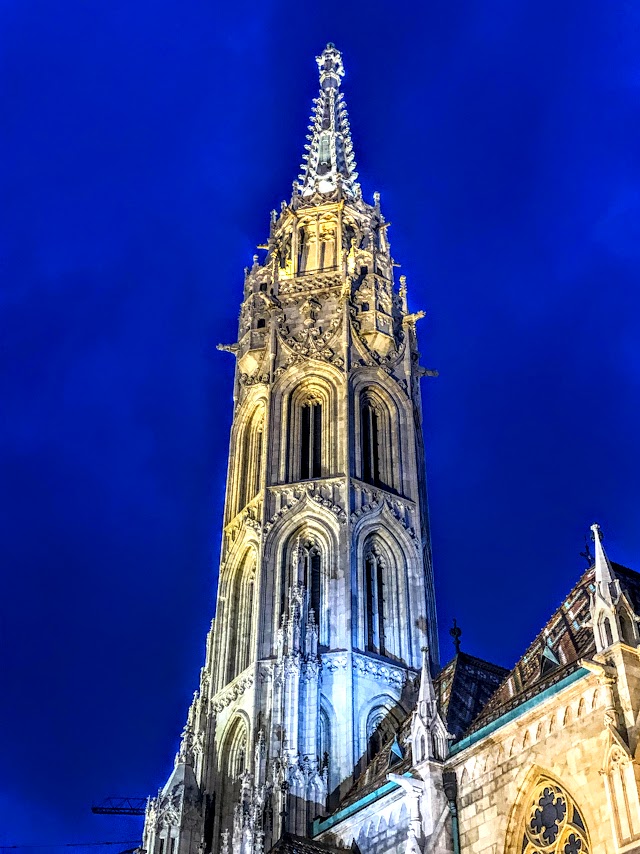
The south-west bell tower of the Matthias Church beside the Fisherman’s Bastion at Buda Castle is one of the finest pieces of Gothic architecture in Hungary (Photograph: Patrick Comerford, 2023)
Patrick Comerford
During our recent visit to Budapest with the Anglican mission agency USPG (United Society Partners in the Gospel) and the Anglican Diocese in Europe, Charlotte and I were introduced to a number of projects working with Ukrainian refugees by the Revd Dr Frank Hegedűs, the Anglican chaplain in the Hungarian capital, and attended the Sunday Eucharist in Saint Margaret’s Church, Budapest.
We never got to visit Saint Stephen’s Basilica which is named in honour of Saint Stephen, the first King of Hungary. It is been the co-cathedral of the Roman Catholic Archdiocese of Esztergom-Budapest and the third largest church building in Hungary.
However, during our visits to projects throughout the Hungarian capital, we visited a number of churches in various traditions, including Roman Catholic, Anglican, Lutheran, Reformed, Church of Scotland and Greek Catholic churches and a shared ecumenical chapel.
The Matthias Church stands in Holy Trinity Square, in front of the Fisherman’s Bastion at the heart of Buda’s Castle District (Photograph: Patrick Comerford, 2023)
1, Matthias Church, Fisherman’s Bastion:
The Church of the Assumption of the Buda Castle is more commonly known as the Matthias Church and is sometimes referred to as the Coronation Church of Buda. The church stands in Holy Trinity Square, in front of the Fisherman’s Bastion at the heart of Buda’s Castle District.
According to tradition, the first church on the site was founded by Saint Stephen, King of Hungary, in Romanesque style in 1015. The present church was built in the florid late Gothic style in the second half of the 14th century and was extensively restored in the late 19th century.
The Matthias Church is said to have been founded in 1015 by Saint Stephen, King of Hungary (Photograph: Patrick Comerford, 2023)
This was the second largest church in mediaeval Buda and the seventh largest church in mediaeval Hungary. Two Austrian emperors were crowned as Kings of Hungary in the church: Franz Joseph I and Charles IV.
During the siege of Buda in 1686, a wall of the church – used as a mosque by the Ottoman occupiers of the city – collapsed under to cannon fire. An old, hidden statue of the Virgin Mary was revealed behind the wall. As the statue appeared before the praying Muslims, the morale of the Muslim garrison collapsed and the city fell on the same day.
Since the 19th century, the church has been known as the Matthias Church, after King Matthias Corvinus (1458-1490), who built the south-west bell tower, one of the finest pieces of Gothic architecture in Hungary.
The Reformed Church on Kálvin tér or Calvin Square was built in 1816-1830 (Photograph: Patrick Comerford, 2023)
2, Calvin Church, Calvin Square:
The Reformed Church on Kálvin tér or Calvin Square is a neoclassical church near the Hungarian National Museum and has been the centre of Budapest’s Reformed community for almost two centuries.
The church was designed by Vince Hild and built in 1816-1830. The four-columned foyer at the main entrance and the two-storey side galleries were designed by József Hild. The originally plan was for two belfries, but only one belfry was built.
The Puritan interior is painted white, giving an impressive effect. The memorials inside include one to an English-born countess, Charlotte Strachan (1815-1851), wife of Count Emanuel Zichy-Ferraris (1808-1877). She was an Anglican, but because she made a significant contribution towards the cost of building the church, she was given special permission to be buried there.
The statue of John Calvin faces the church with his back to the square (Photograph: Patrick Comerford, 2023)
The tower is topped with a star, referring to the Star of Bethlehem, and the tower is especially striking when lit up from behind at night. A statue of the reformer John Calvin (János Kálvin in Hungarian) stands facing the church, with his back to the square.
This part of the city is a centre of the Reformed Church, with a Reformed theology faculty, a Protestant university, secondary school, Bible museum and book shop.
The University Church was built on the site of a former mosque (Photograph: Patrick Comerford, 2023)
3, The University Church:
The Church of Saint Mary the Virgin, commonly known as the University Church, is on Papnövelde Street in inner city Budapest.
Since 1786, the church has belonged to the former Theology Faculty of the Eötvös Loránd University, and to the Pázmány Péter Catholic University. Prior to that, it was the main church of the Pauline Order, the only Hungarian-founded monastic order and dating from the 13th century.
The Central Priestly Educational Institute is beside to the church, and the liturgical services in the church are provided by the student priests and the academic staff of the institute.
The church stands on the site of a former mosque in Pest. When Buda was liberated from the Ottoman Empire in 1686, the Paulines moved to Pest and bought the former mosque and some neighbouring houses.
The foundation stone of the church was laid in 1725. The church was completed in 1771 and has two towers, each 56 metres high.
Fasor Lutheran Church is part of a Lutheran campus created in the late 19th century (Photograph: Patrick Comerford, 2023)
4, Fasor Lutheran Church:
The Evangelical-Lutheran Church of Budapest-Fasor is on a prominent street corner close to Reformáció Park and the Fasori Gimnázium school. The church was designed by Samu Petz and built in 1905. The features include the mosaic from Miksa Róth’s workshop above the main entrance, the central rose window and the organ.
The first school on the site was built in 1795, the first church there was built in 1799-1808, and the high school in 1862-1865, creating a Lutheran centre. A new church was designed in the early 20th century by the architect Samu Pecz, who submitted up to seven proposed plans. The church two years to build, and opened on 8 October 1905. The altar was painted in 1911-1913 by Gyula Benczúr, one of Hungary's foremost painters.
Fasor Lutheran Church was designed by Samu Pecz (Photograph: Patrick Comerford, 2023)
The church in Fasor was the first in Budapest where services were held exclusively in Hungarian. Until then, Lutheran services in Budapest had been held in Hungarian and German and in Slovak.
The windows were blown out during World War II. The interior of the church was restored in 1973-1974, with new decorative painting by Géza Kovács, the two manual organs were rebuilt in 1989, and new windows and new bells were installed in the years that followed.
The Sacred Heart Church is the main Jesuit church in Hungary (Photograph: Patrick Comerford, 2023)
5, The Sacred Heart Church:
The Sacred Heart Church on Horánszky Street in the Józsefváros district is the main Jesuit church in Hungary. It stands in a small square next to it the Jesuit community house and other Jesuit houses, and a statue of Count Nándor Zichy, the main patron of the church, stands in the square.
The Jesuits came to Budapest again in the early 1880s and acquired a plot for building a church and a community house. The community house was built in 1890, but financial problems delayed the construction of the church and it was not completed until 1909.
The Sacred Heart Church was designed by József Kauser in a neo-Romanesque style with Gothic elements (Photograph: Patrick Comerford, 2023)
The church was designed by József Kauser is built in red brick in a neo-Romanesque style with Gothic elements. The façade is symmetrical with an impressive rose window and two towers on each side of the entrance, flying buttresses and gargoyles. The nave is high, but there are two low aisles, so the church follows the classical basilica floor plan, with a half-octagonal sanctuary.
The church and the community buildings were returned to the Jesuits after the Communist system fell in 1989.
Saint Michael’s Church in inner city Budapest was built for the Dominicans in the 18th century (Photograph: Patrick Comerford, 2023)
6, Saint Michael’s Church:
Saint Michael’s Church in inner city Budapest is a remarkable baroque church in the middle of the busy bustle of Váci Street. The church dates back to the 1700s, and was built between 1700 and 1765 for the Dominicans. The beautiful main altar and the furniture of the sacristy were made by the Dominican friars in the 1760s.
After the Dominicans in Hungary was dissolved by Joseph II in 1784, the church was given to the Order of Saint Paul for a short period (1785-1786), and then to the Congregatio Jesu or Mary Ward sisters in 1787. During the Great Flood of Budapest in 1838, the water stood two metres high in the church, yet the wood furnishings of the church were saved.
The nuns ran a girls’ school in the building next door until 1950, when the school was nationalised by the Communist regime.
Saint Michael’s Church also serves the Greek Catholic Church (Photograph: Patrick Comerford, 2023)
The frescoes were whitewashed during renovation in 1964-1968. Since 1997, the church has been under continuous restoration both inside and outside.
Today, the excellent acoustics and beautiful setting make Saint Michael’s Church a popular venue for classical music concerts.
The church is also used by the Greek Catholic Church, a church with Orthodox-style liturgy and in communion with the Roman Catholic Church and with a predominantly Ukrainian congregation, and Charlotte and I were invited to join them for their Christmas celebrations on 7 January.
Saint Columba’s Church dates back to the work of Scottish missionaries in the 1840s (Photograph: Patrick Comerford, 2023)
7, Saint Columba’s (Church of Scotland):
Saint Columba’s Scottish Church is an English-speaking international church in Budapest. It belongs to both the Church of Scotland and the Reformed Church in Hungary, and is Presbyterian in its style of church government and theology. It dates back to 1841, and in the past was known as ‘the Scottish Mission.’ Its roots are in evangelical publishing and mission to the Jewish community in Budapest, with a girls’ school for Jewish and Christian girls. Later, the school served as a shelter for refugee Polish Jews.
The place was known for its religious tolerance and high standards, and because of her work there Jane Haining, Matron of the Jewish-Hungarian School for Girls, was arrested in 1944 and was later killed in Auschwitz.
During the Communist era, the work of the mission was continued by Hungarian Reformed ministers who occasionally held services for the international community. The Revd Aaron C Stevens, has been the minister of Saint Columba’s since 2006.
Members of Saint Columba’s were involved in launching the Refugee Mission of the Reformed Church in Hungary in 2005. In recent decades, the church has reached out to refugees from Romania, Iran, Syria, and, more recently, Ukraine.
In recent years, the church has engaged with the Kalunba Charity Group, which set up the Salaam Overnight Shelter in the church in 2015 to welcome families who would have otherwise slept at railway stations. Today, Saint Columba’s is hosting refugees from Ukraine. Many of them are Africans who were students in Ukraine when the war started last year. The church is open four nights a week for up to 20 overnight guests.
The chapel at the centre run by the Ecumenical Council of Churches in Hungary (MEÖT) in Budapest (Photograph: Patrick Comerford, 2023)
8, Evangelical University Church:
Charlotte and I were staying in Budapest in the centre run by the Ecumenical Council of Churches in Hungary (MEÖT) on Magyar Tudósok körútja (Hungarian Scientists Boulevard). MEÖT groups 10 Protestant, Orthodox and Anglican churches in Hungary, and co-operates with 18 other churches and church-related organisations, including the Roman Catholic Church.
The MEÖT centre is close to the Petőfi bridge across the Danube, linking Buda and Pest, and next to the Magyar Szentek church.
The chapel and the centre were designed by the award-wining architects Lászlo Benczúr and Pál Csonka (Photograph: Patrick Comerford, 2023)
The chapel and the centre were designed by the award-wining architects Lászlo Benczúr and Pál Csonka.
The chapel is used for ecumenical and church conferences, as well as occasional weddings. The chapel is used by the Evangelical University Church, which welcomes university students, college students, college students and young adults, regardless of religious affiliation. It is also used on Sundays by a Korean-speaking congregation.
The Church of the Hungarian Saints in Budapest (Photograph: Patrick Comerford, 2023)
9, The Church of the Hungarian Saints:
From our rooms in the MEÖT centre, we could see the Church of the Hungarian Saints on Magyar Tudosok körútja is one of the newest churches in Budapest, and we were woken by its bells each morning. This part of Budapest was designated as the site of the World Exhibition (Expo) in Budapest in 1996, and the church site was originally planned as part of the Vatican Pavilion. When Expo was cancelled, the Archdiocese of Budapest decided to go ahead with building the church.
Pope John Paul II was invited to consecrate the church, but this never materialised and instead he blessed a marble slab that was placed in the new church.
The church was built in the form of a fifth century Rotunda. In his design, the architect was inspired by Santo Stefano Rotondo or the Basilica of Saint Stephen in the Round, an early Rotunda in Rome dating from the 5th century AD and now Hungary’s ‘national church’ in Rome.
The Church of the Hungarian Saints is inspired by Santo Stefano Rotondo in Rome (Photograph: Patrick Comerford, 2023)
The church is a centrally planned church, with an inner circular shape surrounded by an external ring. The church can be accessed through a two-storey gate, leading into a courtyard complex and the church entrances. These ‘adherent’ structures, like a ‘city wall,’ hide the slowly unfolding beauty of the central space. The complex interior-exterior space structure gives a character of ever varied beauties that are slowly showing themselves over the time. The sanctuary is embellished by a unique crucifix in gold, wood and stone by the sculptor László Somogyi-Soma, the painter Mihály Balázs and the architect Katalin Somogyi-Soma.
The cornerstone was laid in May 1995, and the church was dedicated to the Hungarian Saints. The church was consecrated on 17 August 1996 by Cardinal László Paskai and received parish church status on 1 January 2001.
The church is beside the campus of the Eötvös Loránd Public University and is also home to the University Chaplaincy in Budapest. The chaplaincy community has nurtured co-operation between the historical Christian Churches and played a role in forming the Christian Ecumenical Student Movement.
The church crypt or undercroft served Saint Margaret’s Anglican Church in Budapest for some years.
Inside Saint Margaret’s Church, the Anglican church in Budapest (Photograph: Patrick Comerford, 2023)
10, Saint Margaret’s Anglican Church:
The Revd Dr Frank Hegedűs, the chaplain of Saint Margaret’s Anglican Church in Budapest, has been the catalyst in securing funding from USPG (United Society Partners in the Gospel) and the Anglican Diocese in Europe for the projects working with Ukrainian refugees we have been visiting in recent weeks.
The congregation in Budapest comes from many nations and continents: from Hungary to the United Kingdom, from Africa to North America, of ‘all vintages and sizes,’ as Father Frank says.
Anglicans have been present in Hungary for generations, with an Anglican presence in Hungary that dates back to the 1890s. Many of those early Anglicans were business-people and, interestingly, English horse trainers and riders employed by Hungarian aristocrats In the Tata Castle in Komárom-Esztergom county.
Anglican worship in Hungary remained sporadic during the Communist era, with an Anglican priest coming to Budapest periodically from Vienna. Current records also show there was an Anglican service on the first Sunday after the revolution in 1956.
Saint Margaret’s was officially founded after the fall of Communism in 1992 by Canon Denis Moss. The church first met in the crypt in the Church of the Hungarian Saints. Canon Moss now lives in retirement near Lake Balaton in Hungary.
Father Frank Hegedűs presides at the Sunday Eucharist in Saint Margaret’s Church, Budapest (Photograph: Charlotte Hunter, 2023)
Saint Margaret’s uses a chapel in the Lutheran building on Szentkirály utca, with the Sunday Eucharist celebrate at 10:30 according to Rite II in Common Worship of the Church of England.
According to Father Frank, the Anglican presence in Budapest is ‘miniscule’ but this small congregation provides a presence in Hungary for one of the largest Churches or Communions in the world.
About one-third of the current community is British, and another third, Hungarian. There are members too from Africa and from North America.
Father Frank says the Ukrainian crisis and the arrival of Ukrainian refugees in Budapest has given Saint Margaret’s and its people ‘a new sense of purpose and mission’, with the people actively responding to the needs of refugees and engaging with the projects we have been visiting.
He recalls how Saint Margaret’s opened its doors to about 20 Nigerian medical students who had been studying in Ukraine. ‘Along with the students came a medical professor and her husband, Father Solomon Ekiyor, who had been an Archdeacon in Nigeria. Receiving Father Solomon and his family was a bittersweet experience – it was wonderful to have them with us but the circumstances that brought them here were most unfortunate.’
The crisis has also given a new ecumenical dimension to the presence of Saint Margaret’s in the Hungarian capital. Through Father Frank’s passion, grants from the Diocese in Europe and USPG have also helped the work of other churches in Hungary, including the Jesuit Refugee Service and Saint Columba’s Church, the Church of Scotland church in Budapest.
The monument commemorating Martin Luther and the Reformation at Fasor Lutheran Church (Photograph: Patrick Comerford, 2023)
Patrick Comerford
During our recent visit to Budapest with the Anglican mission agency USPG (United Society Partners in the Gospel) and the Anglican Diocese in Europe, Charlotte and I were introduced to a number of projects working with Ukrainian refugees by the Revd Dr Frank Hegedűs, the Anglican chaplain in the Hungarian capital, and attended the Sunday Eucharist in Saint Margaret’s Church, Budapest.
We never got to visit Saint Stephen’s Basilica which is named in honour of Saint Stephen, the first King of Hungary. It is been the co-cathedral of the Roman Catholic Archdiocese of Esztergom-Budapest and the third largest church building in Hungary.
However, during our visits to projects throughout the Hungarian capital, we visited a number of churches in various traditions, including Roman Catholic, Anglican, Lutheran, Reformed, Church of Scotland and Greek Catholic churches and a shared ecumenical chapel.
The Matthias Church stands in Holy Trinity Square, in front of the Fisherman’s Bastion at the heart of Buda’s Castle District (Photograph: Patrick Comerford, 2023)
1, Matthias Church, Fisherman’s Bastion:
The Church of the Assumption of the Buda Castle is more commonly known as the Matthias Church and is sometimes referred to as the Coronation Church of Buda. The church stands in Holy Trinity Square, in front of the Fisherman’s Bastion at the heart of Buda’s Castle District.
According to tradition, the first church on the site was founded by Saint Stephen, King of Hungary, in Romanesque style in 1015. The present church was built in the florid late Gothic style in the second half of the 14th century and was extensively restored in the late 19th century.
The Matthias Church is said to have been founded in 1015 by Saint Stephen, King of Hungary (Photograph: Patrick Comerford, 2023)
This was the second largest church in mediaeval Buda and the seventh largest church in mediaeval Hungary. Two Austrian emperors were crowned as Kings of Hungary in the church: Franz Joseph I and Charles IV.
During the siege of Buda in 1686, a wall of the church – used as a mosque by the Ottoman occupiers of the city – collapsed under to cannon fire. An old, hidden statue of the Virgin Mary was revealed behind the wall. As the statue appeared before the praying Muslims, the morale of the Muslim garrison collapsed and the city fell on the same day.
Since the 19th century, the church has been known as the Matthias Church, after King Matthias Corvinus (1458-1490), who built the south-west bell tower, one of the finest pieces of Gothic architecture in Hungary.
The Reformed Church on Kálvin tér or Calvin Square was built in 1816-1830 (Photograph: Patrick Comerford, 2023)
2, Calvin Church, Calvin Square:
The Reformed Church on Kálvin tér or Calvin Square is a neoclassical church near the Hungarian National Museum and has been the centre of Budapest’s Reformed community for almost two centuries.
The church was designed by Vince Hild and built in 1816-1830. The four-columned foyer at the main entrance and the two-storey side galleries were designed by József Hild. The originally plan was for two belfries, but only one belfry was built.
The Puritan interior is painted white, giving an impressive effect. The memorials inside include one to an English-born countess, Charlotte Strachan (1815-1851), wife of Count Emanuel Zichy-Ferraris (1808-1877). She was an Anglican, but because she made a significant contribution towards the cost of building the church, she was given special permission to be buried there.
The statue of John Calvin faces the church with his back to the square (Photograph: Patrick Comerford, 2023)
The tower is topped with a star, referring to the Star of Bethlehem, and the tower is especially striking when lit up from behind at night. A statue of the reformer John Calvin (János Kálvin in Hungarian) stands facing the church, with his back to the square.
This part of the city is a centre of the Reformed Church, with a Reformed theology faculty, a Protestant university, secondary school, Bible museum and book shop.
The University Church was built on the site of a former mosque (Photograph: Patrick Comerford, 2023)
3, The University Church:
The Church of Saint Mary the Virgin, commonly known as the University Church, is on Papnövelde Street in inner city Budapest.
Since 1786, the church has belonged to the former Theology Faculty of the Eötvös Loránd University, and to the Pázmány Péter Catholic University. Prior to that, it was the main church of the Pauline Order, the only Hungarian-founded monastic order and dating from the 13th century.
The Central Priestly Educational Institute is beside to the church, and the liturgical services in the church are provided by the student priests and the academic staff of the institute.
The church stands on the site of a former mosque in Pest. When Buda was liberated from the Ottoman Empire in 1686, the Paulines moved to Pest and bought the former mosque and some neighbouring houses.
The foundation stone of the church was laid in 1725. The church was completed in 1771 and has two towers, each 56 metres high.
Fasor Lutheran Church is part of a Lutheran campus created in the late 19th century (Photograph: Patrick Comerford, 2023)
4, Fasor Lutheran Church:
The Evangelical-Lutheran Church of Budapest-Fasor is on a prominent street corner close to Reformáció Park and the Fasori Gimnázium school. The church was designed by Samu Petz and built in 1905. The features include the mosaic from Miksa Róth’s workshop above the main entrance, the central rose window and the organ.
The first school on the site was built in 1795, the first church there was built in 1799-1808, and the high school in 1862-1865, creating a Lutheran centre. A new church was designed in the early 20th century by the architect Samu Pecz, who submitted up to seven proposed plans. The church two years to build, and opened on 8 October 1905. The altar was painted in 1911-1913 by Gyula Benczúr, one of Hungary's foremost painters.
Fasor Lutheran Church was designed by Samu Pecz (Photograph: Patrick Comerford, 2023)
The church in Fasor was the first in Budapest where services were held exclusively in Hungarian. Until then, Lutheran services in Budapest had been held in Hungarian and German and in Slovak.
The windows were blown out during World War II. The interior of the church was restored in 1973-1974, with new decorative painting by Géza Kovács, the two manual organs were rebuilt in 1989, and new windows and new bells were installed in the years that followed.
The Sacred Heart Church is the main Jesuit church in Hungary (Photograph: Patrick Comerford, 2023)
5, The Sacred Heart Church:
The Sacred Heart Church on Horánszky Street in the Józsefváros district is the main Jesuit church in Hungary. It stands in a small square next to it the Jesuit community house and other Jesuit houses, and a statue of Count Nándor Zichy, the main patron of the church, stands in the square.
The Jesuits came to Budapest again in the early 1880s and acquired a plot for building a church and a community house. The community house was built in 1890, but financial problems delayed the construction of the church and it was not completed until 1909.
The Sacred Heart Church was designed by József Kauser in a neo-Romanesque style with Gothic elements (Photograph: Patrick Comerford, 2023)
The church was designed by József Kauser is built in red brick in a neo-Romanesque style with Gothic elements. The façade is symmetrical with an impressive rose window and two towers on each side of the entrance, flying buttresses and gargoyles. The nave is high, but there are two low aisles, so the church follows the classical basilica floor plan, with a half-octagonal sanctuary.
The church and the community buildings were returned to the Jesuits after the Communist system fell in 1989.
Saint Michael’s Church in inner city Budapest was built for the Dominicans in the 18th century (Photograph: Patrick Comerford, 2023)
6, Saint Michael’s Church:
Saint Michael’s Church in inner city Budapest is a remarkable baroque church in the middle of the busy bustle of Váci Street. The church dates back to the 1700s, and was built between 1700 and 1765 for the Dominicans. The beautiful main altar and the furniture of the sacristy were made by the Dominican friars in the 1760s.
After the Dominicans in Hungary was dissolved by Joseph II in 1784, the church was given to the Order of Saint Paul for a short period (1785-1786), and then to the Congregatio Jesu or Mary Ward sisters in 1787. During the Great Flood of Budapest in 1838, the water stood two metres high in the church, yet the wood furnishings of the church were saved.
The nuns ran a girls’ school in the building next door until 1950, when the school was nationalised by the Communist regime.
Saint Michael’s Church also serves the Greek Catholic Church (Photograph: Patrick Comerford, 2023)
The frescoes were whitewashed during renovation in 1964-1968. Since 1997, the church has been under continuous restoration both inside and outside.
Today, the excellent acoustics and beautiful setting make Saint Michael’s Church a popular venue for classical music concerts.
The church is also used by the Greek Catholic Church, a church with Orthodox-style liturgy and in communion with the Roman Catholic Church and with a predominantly Ukrainian congregation, and Charlotte and I were invited to join them for their Christmas celebrations on 7 January.
Saint Columba’s Church dates back to the work of Scottish missionaries in the 1840s (Photograph: Patrick Comerford, 2023)
7, Saint Columba’s (Church of Scotland):
Saint Columba’s Scottish Church is an English-speaking international church in Budapest. It belongs to both the Church of Scotland and the Reformed Church in Hungary, and is Presbyterian in its style of church government and theology. It dates back to 1841, and in the past was known as ‘the Scottish Mission.’ Its roots are in evangelical publishing and mission to the Jewish community in Budapest, with a girls’ school for Jewish and Christian girls. Later, the school served as a shelter for refugee Polish Jews.
The place was known for its religious tolerance and high standards, and because of her work there Jane Haining, Matron of the Jewish-Hungarian School for Girls, was arrested in 1944 and was later killed in Auschwitz.
During the Communist era, the work of the mission was continued by Hungarian Reformed ministers who occasionally held services for the international community. The Revd Aaron C Stevens, has been the minister of Saint Columba’s since 2006.
Members of Saint Columba’s were involved in launching the Refugee Mission of the Reformed Church in Hungary in 2005. In recent decades, the church has reached out to refugees from Romania, Iran, Syria, and, more recently, Ukraine.
In recent years, the church has engaged with the Kalunba Charity Group, which set up the Salaam Overnight Shelter in the church in 2015 to welcome families who would have otherwise slept at railway stations. Today, Saint Columba’s is hosting refugees from Ukraine. Many of them are Africans who were students in Ukraine when the war started last year. The church is open four nights a week for up to 20 overnight guests.
The chapel at the centre run by the Ecumenical Council of Churches in Hungary (MEÖT) in Budapest (Photograph: Patrick Comerford, 2023)
8, Evangelical University Church:
Charlotte and I were staying in Budapest in the centre run by the Ecumenical Council of Churches in Hungary (MEÖT) on Magyar Tudósok körútja (Hungarian Scientists Boulevard). MEÖT groups 10 Protestant, Orthodox and Anglican churches in Hungary, and co-operates with 18 other churches and church-related organisations, including the Roman Catholic Church.
The MEÖT centre is close to the Petőfi bridge across the Danube, linking Buda and Pest, and next to the Magyar Szentek church.
The chapel and the centre were designed by the award-wining architects Lászlo Benczúr and Pál Csonka (Photograph: Patrick Comerford, 2023)
The chapel and the centre were designed by the award-wining architects Lászlo Benczúr and Pál Csonka.
The chapel is used for ecumenical and church conferences, as well as occasional weddings. The chapel is used by the Evangelical University Church, which welcomes university students, college students, college students and young adults, regardless of religious affiliation. It is also used on Sundays by a Korean-speaking congregation.
The Church of the Hungarian Saints in Budapest (Photograph: Patrick Comerford, 2023)
9, The Church of the Hungarian Saints:
From our rooms in the MEÖT centre, we could see the Church of the Hungarian Saints on Magyar Tudosok körútja is one of the newest churches in Budapest, and we were woken by its bells each morning. This part of Budapest was designated as the site of the World Exhibition (Expo) in Budapest in 1996, and the church site was originally planned as part of the Vatican Pavilion. When Expo was cancelled, the Archdiocese of Budapest decided to go ahead with building the church.
Pope John Paul II was invited to consecrate the church, but this never materialised and instead he blessed a marble slab that was placed in the new church.
The church was built in the form of a fifth century Rotunda. In his design, the architect was inspired by Santo Stefano Rotondo or the Basilica of Saint Stephen in the Round, an early Rotunda in Rome dating from the 5th century AD and now Hungary’s ‘national church’ in Rome.
The Church of the Hungarian Saints is inspired by Santo Stefano Rotondo in Rome (Photograph: Patrick Comerford, 2023)
The church is a centrally planned church, with an inner circular shape surrounded by an external ring. The church can be accessed through a two-storey gate, leading into a courtyard complex and the church entrances. These ‘adherent’ structures, like a ‘city wall,’ hide the slowly unfolding beauty of the central space. The complex interior-exterior space structure gives a character of ever varied beauties that are slowly showing themselves over the time. The sanctuary is embellished by a unique crucifix in gold, wood and stone by the sculptor László Somogyi-Soma, the painter Mihály Balázs and the architect Katalin Somogyi-Soma.
The cornerstone was laid in May 1995, and the church was dedicated to the Hungarian Saints. The church was consecrated on 17 August 1996 by Cardinal László Paskai and received parish church status on 1 January 2001.
The church is beside the campus of the Eötvös Loránd Public University and is also home to the University Chaplaincy in Budapest. The chaplaincy community has nurtured co-operation between the historical Christian Churches and played a role in forming the Christian Ecumenical Student Movement.
The church crypt or undercroft served Saint Margaret’s Anglican Church in Budapest for some years.
Inside Saint Margaret’s Church, the Anglican church in Budapest (Photograph: Patrick Comerford, 2023)
10, Saint Margaret’s Anglican Church:
The Revd Dr Frank Hegedűs, the chaplain of Saint Margaret’s Anglican Church in Budapest, has been the catalyst in securing funding from USPG (United Society Partners in the Gospel) and the Anglican Diocese in Europe for the projects working with Ukrainian refugees we have been visiting in recent weeks.
The congregation in Budapest comes from many nations and continents: from Hungary to the United Kingdom, from Africa to North America, of ‘all vintages and sizes,’ as Father Frank says.
Anglicans have been present in Hungary for generations, with an Anglican presence in Hungary that dates back to the 1890s. Many of those early Anglicans were business-people and, interestingly, English horse trainers and riders employed by Hungarian aristocrats In the Tata Castle in Komárom-Esztergom county.
Anglican worship in Hungary remained sporadic during the Communist era, with an Anglican priest coming to Budapest periodically from Vienna. Current records also show there was an Anglican service on the first Sunday after the revolution in 1956.
Saint Margaret’s was officially founded after the fall of Communism in 1992 by Canon Denis Moss. The church first met in the crypt in the Church of the Hungarian Saints. Canon Moss now lives in retirement near Lake Balaton in Hungary.
Father Frank Hegedűs presides at the Sunday Eucharist in Saint Margaret’s Church, Budapest (Photograph: Charlotte Hunter, 2023)
Saint Margaret’s uses a chapel in the Lutheran building on Szentkirály utca, with the Sunday Eucharist celebrate at 10:30 according to Rite II in Common Worship of the Church of England.
According to Father Frank, the Anglican presence in Budapest is ‘miniscule’ but this small congregation provides a presence in Hungary for one of the largest Churches or Communions in the world.
About one-third of the current community is British, and another third, Hungarian. There are members too from Africa and from North America.
Father Frank says the Ukrainian crisis and the arrival of Ukrainian refugees in Budapest has given Saint Margaret’s and its people ‘a new sense of purpose and mission’, with the people actively responding to the needs of refugees and engaging with the projects we have been visiting.
He recalls how Saint Margaret’s opened its doors to about 20 Nigerian medical students who had been studying in Ukraine. ‘Along with the students came a medical professor and her husband, Father Solomon Ekiyor, who had been an Archdeacon in Nigeria. Receiving Father Solomon and his family was a bittersweet experience – it was wonderful to have them with us but the circumstances that brought them here were most unfortunate.’
The crisis has also given a new ecumenical dimension to the presence of Saint Margaret’s in the Hungarian capital. Through Father Frank’s passion, grants from the Diocese in Europe and USPG have also helped the work of other churches in Hungary, including the Jesuit Refugee Service and Saint Columba’s Church, the Church of Scotland church in Budapest.
The monument commemorating Martin Luther and the Reformation at Fasor Lutheran Church (Photograph: Patrick Comerford, 2023)
Labels:
Architecture,
Budapest,
Church History,
Dominicans,
Ecumenism,
Hungary,
Hungary 2023,
Jesuits,
Luther,
Lutheranism,
Mission,
Presbyterianism,
Rome,
Sculpture,
USPG,
Virtual Tours
Subscribe to:
Posts (Atom)