Saint John the Baptist in a fresco by the Cretan iconographer, Alexandra Kaouki, in Rethymnon
Patrick Comerford
We are half-way through Advent, and today is the Third Sunday of Advent (11 December 2022), or Gaudete Sunday.
The day takes its common name from the Latin word Gaudete (‘Rejoice’), the first word of the introit of this day’s Liturgy:
Gaudete in Domino semper: iterum dico, gaudete. Modestia vestra nota sit omnibus hominibus: Dominus enim prope est. Nihil solliciti sitis: sed in omni oratione petitiones vestræ innotescant apud Deum. Benedixisti Domine terram tuam: avertisti captivitatem Jacob.
Rejoice in the Lord always; again I say, rejoice. Let your forbearance be known to all, for the Lord is near at hand; have no anxiety about anything, but in all things, by prayer and supplication, with thanksgiving, let your requests be known to God. Lord, you have blessed your land; you have turned away the captivity of Jacob (see Philippians 4: 4–6; Psalm 85: 1).
Throughout Advent, the spirit of the Liturgy is one of expectation and preparation for Christmas and for the coming of Christ. Gaudete Sunday in Advent is a counterpart to Laetare Sunday in Lent, and provides a similar break about mid-way through the season of preparation, and signifies the joy and gladness as the Lord’s coming comes nearer and nearer. On Gaudete Sunday, rose-coloured vestments may be worn instead of violet or Sarum blue, and this is noted as an option in the Church of England in Common Worship. On the Advent wreath, the rose-coloured or pink candle is lit in addition to the two violet or blue candles, which represent the first two Sundays of Advent. The readings emphasise the joyous anticipation of the Lord’s coming.
Later this morning, I plan to attend the Parish Eucharist in Saint Mary and Saint Giles Church, Stony Stratford. But, before today gets busy, I am taking some time this morning for reading, prayer and reflection.
During Advent, I am reflecting in these ways:
1, The reading suggested in the Advent and Christmas Devotional Calendar produced by Lichfield Cathedral this year;
2, praying with the Lichfield Cathedral Devotional Calendar;
3, a prayer from the USPG prayer diary, ‘Pray with the World Church.’
Saint John the Baptist with his mother, Saint Elizabeth, in a stained glass window in Dingle, Co Kerry (Photograph: Patrick Comerford, 2021)
Matthew 11: 2-11 (NRSVA):
2 When John heard in prison what the Messiah was doing, he sent word by his disciples 3 and said to him, ‘Are you the one who is to come, or are we to wait for another?’ 4 Jesus answered them, ‘Go and tell John what you hear and see: 5 the blind receive their sight, the lame walk, the lepers are cleansed, the deaf hear, the dead are raised, and the poor have good news brought to them. 6 And blessed is anyone who takes no offence at me.’
7 As they went away, Jesus began to speak to the crowds about John: ‘What did you go out into the wilderness to look at? A reed shaken by the wind? 8 What then did you go out to see? Someone dressed in soft robes? Look, those who wear soft robes are in royal palaces. 9 What then did you go out to see? A prophet? Yes, I tell you, and more than a prophet. 10 This is the one about whom it is written,
“See, I am sending my messenger ahead of you,
who will prepare your way before you.”
11 ‘Truly I tell you, among those born of women no one has arisen greater than John the Baptist; yet the least in the kingdom of heaven is greater than he.’
‘The Beheading of Saint John the Baptist’ (1608) by Caravaggio in Saint John’s Co-cathedral in Valletta (Photograph: Patrick Comerford, 2022)
The Lichfield Cathedral Devotional Calendar:
Reflect on the relationship between Jesus and John the Baptist. Think about how the Church is the herald of Jesus’s message, how it points to him, helps to bring the world to him. Ask for the grace and blessing to help people find Jesus Christ, the true light, and that all the Cathedral community may play a part in mission.
Collect:
O Lord Jesus Christ,
who at your first coming sent your messenger
to prepare your way before you:
grant that the ministers and stewards of your mysteries
may likewise so prepare and make ready your way
by turning the hearts of the disobedient to the wisdom of the just,
that at your second coming to judge the world
we may be found an acceptable people in your sight;
for you are alive and reign with the Father
in the unity of the Holy Spirit,
one God, now and for ever.
Post Communion:
We give you thanks, O Lord, for these heavenly gifts;
kindle in us the fire of your Spirit
that when your Christ comes again
we may shine as lights before his face;
who is alive and reigns now and for ever.
Additional Collect:
God for whom we watch and wait,
you sent John the Baptist to prepare the way of your Son:
give us courage to speak the truth,
to hunger for justice,
and to suffer for the cause of right,
with Jesus Christ our Lord.
USPG Prayer Diary:
The theme in the USPG Prayer Diary this week is ‘Walking Together.’ This theme is introduced today by the Right Revd Maria Grace Tazu Sasamori, who became Bishop of Hokkaido in Japan in April 2022. She shares her reflections on this year’s Lambeth Conference with Archbishop Justin Welby:
‘I was very nervous about coming to the Lambeth Conference; as the conference is conducted in English, I was very nervous about keeping up with the conversations that were happening all of the time.
‘Through the time I spent at the Lambeth Conference, I have really understood the diversity and breadth of the Anglican Communion. This diversity is one that at times involves pain and suffering. I have come to appreciate the value of this diversity and the way that bishops bring strength from their positions in their own dioceses and provinces to share the message of Christ. I hope that I can do this going forward.
‘All of the stories that I have heard and that we have shared over the course of the Lambeth Conference have had a great impact on me. When I return to Japan, I hope that I can take the following message: that even though we may have different stories and are part of different cultures, we can continue to work and walk together.’
The USPG Prayer Diary invites us to pray today (the Third Sunday of Advent, International Migrants Day) in these words:
Prepare our hearts to receive you, O Lord,
and open our hearts to receive one another.
Yesterday’s reflection
Continued tomorrow</b>
‘The Baptism of Christ’ by Paolo Veronese in the Church of Il Redentore in Venice (Photograph: Patrick Comerford, 2021)
Scripture quotations are from the New Revised Standard Version Bible: Anglicised Edition copyright © 1989, 1995, National Council of the Churches of Christ in the United States of America. Used by permission. All rights reserved worldwide. http://nrsvbibles.org
Showing posts with label Malta 2022. Show all posts
05 December 2022
A ‘virtual tour’ of a dozen
churches and cathedrals
named after Saint Nicholas
An icon of Saint Nicholas in a church in Crete … in time, he became Santa Claus (Photograph: Patrick Comerford)
Patrick Comerford
One of my favourite restaurants in Milton Keynes must be the Olive Tree, a Turkish Mediterranean Restaurant and Bar on Midsummer Boulevard.
As our Christmas shopping began, Charlotte and I had a late lunch there last week, and were amused to see the Olive Tree is offering a special Christmas menu. At top of the menu, it asks: ‘Did you know that Santa Clause (sic) also known as Saint Nicholas was born in Turkey, who was much admired for his kindness and generosity. So here is our freshly prepared dishes in honour of Santa Clause.’
Tomorrow is the Feast of Saint Nicholas of Myra, the ‘real Santa Claus’ (6 December 2022). But, instead of retelling the story of the bishop who risked his life when he defended Orthodox doctrine against the Arains at the Council of Nicaea in the year 325, I thought it would be interesting to follow in his footsteps, visiting or revisiting a number of cathedrals, churches or former church sites to which he has given his name.
During the Covid-19 pandemic lockdown, I offered a number of ‘virtual tours’ of churches and other sites. My offering this evening, on the eve of the Feast of Saint Nicholas, is a ‘virtual tour’ with Saint Nicholas of a half-dozen churches in Greece, and a half-dozen more spread across the Czech Republic, Malta, Italy, Spain, Slovakia and Turkey.
1, Saint Nicholas, Rethymnon Harbour:
The Church of Saint Nicholas, near the bus station in Rethymnon (Photograph: Patrick Comerford)
The Church of Saint Nicholas is in a small square formed at the corner of Priskosoridi street and Emmanouil Kefalogianni avenue, the street that runs around the shore of the rocky bay beneath the western slopes of the Venetian Fortezza.
This small chapel or church, close to the bus station, is surrounded by good fish restaurants and tavernas. This is now a suburban part of western Rethymnon, and is slowly becoming a part of the tourist area. But, only a few decades ago and within living memory, this was an area closely associated with fishers and their fishing boats.
Saint Nicholas, as well as being the patron saint of children and the inspiration for Santa Claus, is also the patron saint of sailors, fishermen, ships and sailing, which explains the presence of this modern church dedicated to his name in this part of Rethymnon.
2, Saint Nicholas, Fortezza, Rethymnon:
The former Venetian Cathedral of Saint Nicholas on the Fortezza in Rethymnon … the stump of the former minaret is to the right (Photograph: Patrick Comerford)
The Fortezza towers above the city of Rethymnon. It was built by the Venetians during their rule in Crete (1204-1669) to protect the city and people from Ottoman invasions, on the hill of Paleokastro and the site the acropolis of ancient Rithymna.
The cathedral of Rethymnon was destroyed during a Turkish attack on the city by the Pasha of Algeria, Ulu Ali Reis, in 1571. A new Episcopal Palace was also built on the Fortezza in 1575, and the foundation stone for a new cathedral was laid in 1583 by the Latin Bishop of Rethymnon, Bartolomeo Chiapponi.
The new Venetian cathedral on the Fortezza was dedicated to Saint Nicholas and stands next to the former Episcopal Palace. When the cathedral was completed in 1585, Bishop Chiapponi’s successor, Bishop Giulio Carrara, refused to celebrated the Mass there, claiming conditions in the cathedral were too cramped and there were no sacred vessels there.
During the Ottoman period, Saint Nicholas Cathedral was converted into the Sultan Ibrahim Khan, named in honour of the reigning sultan, adding an over-sized dome, with a base diameter of 11 metres, was added. The former mosque is now used for exhibitions and as a venue for music events and recordings.
3, Saint Nicholas Church (Nerantze Mosque), Rethymnon:
The former Santa Maria Church and Nerantze Mosque glimpsed through the streets of the old town of Rethymnon … it became Saint Nicholas Church in 1925 (Photograph: Patrick Comerford, 2021)
The Nerantze Mosque or Gazi Hussein Mosque is on the corner of Ethnikis Antistaseos and Vernardou streets, and faces onto what was once the grand Venetian piazza of the old city of Rethymnon.
In Venetian times, this was the Church of Santa Maria. It was built in the style of Saint Mark’s in Venice and faced a large open piazza that included a clock tower, fountains and public buildings. It was originally the church of an Augustinian Priory, but only the east and north side of the original building survive.
After the Turks left Crete, the mosque was reconsecrated as a church in 1925 with a dedication to Saint Nicholas. However, it was seldom if ever used as a church, and for many years housed a Music School. Now known as the Municipal Odeon, it is a venue for lectures, concerts and theatre performances, and is sometimes open to the public. The minaret has been restored in recent years.
4, Saint Nicholas, Aghios Nikolaos:
The mediaeval church of Saint Nicholas in Aghios Nikolaos (Photograph: Patrick Comerford)
Aghios Nikoloas in Crete takes its name from Saint Nicholas. The town is built around an inner lagoon, Voulismeni, and local people try to convince visiting tourists that the lake is fathomless.
The town takes its name from the tiny 11th century church of Aghios Nikólaos (Saint Nicholas). Many years ago, a visit to this Church of Aghios Nikólaos, with its icons of the saint, was enough to end the doubts about Santa Claus that were beginning to emerge in hearts of two small children.
5, Aghios Nikolaos, Georgioupoli, Crete:
The picturesque modern Church of Saint Nicholas on a tiny islet off Georgioupoli in Crete (Photograph: Patrick Comerford)
The tiny white-washed chapel of Aghios Nikolaos (Άγιος Νικόλαος, Saint Nicholas) is on a small rocky islet off Georgioupoli in Crete. Rather than reaching the chapel by boat many tourists take the challenge each day of walking out to the chapel along a narrow rocky causeway.
It is said the chapel was built about 100 years ago by an anonymous sailor to give thanks for his rescue. Today, it is a much-photographed landmark that has become a symbol of Crete in the way that the Vlacherna Monastery close to the southern tip of the Kanoni peninsula has become an image of Corfu.
The rocky outcrop of Aghios Nikolaos is officially listed as a Greek island, and the chapel is a popular choice for weddings.
6, Aghios Nikolas, Élos, Crete :
The modern parish church of Aghios Nikolas in Élos (Photograph: Patrick Comerford)
The small village of Élos is 60 km south-west of Chania in west Crete, on the road to the Monastery of Chrissoskalitissa and the sandy beach of Elafonissi. Élos is one of the nine villages that are known collectively as the Enneachora, and is known for its chestnut forests.
Behind a taverna in the village, an old arch is said to have been part of an ancient Roman aqueduct. But the real hidden treasure in Elos is the Byzantine Church of Saint John the Theologian. This is a single-room, vaulted church, measuring 11.20 x 4.46 meters, and probably dates from the first half of the 14th century. he frescoes of Christ and the saints are attributed to Ioannis Pagomenos, a well-known icon writer and painter from Kissamos.
This tiny church, hidden in a shaded corner among trees behind a taverna, is almost dwarfed by the neighbouring modern parish church of Aghios Nikolas of Élos.
7, Saint Nicholas, Prague:
The Church of Saint Nicholas at night in the Old Town Square in Prague, with the statue of John Hus in the centre of the square (Photograph: Patrick Comerford)
The Church of Saint Nicholas stands on the corner of the Old Town Square, Pařížská Street and Franz Kafka Square in Prague. Its beautiful green baroque towers and dome can be seen throughout the old town centre.
This monumental church was built in 1732-1735 to designs by Kilián Ignaz Dientzenhofer, on the site of an earlier 13th century Gothic church, also dedicated to Saint Nicholas.
The church was the parish church of the Old Town and the meeting place until the Church of Our Lady Before Tyn the opposite side of the square was completed in the 14th century.
The church became part of a Benedictine monastery in 1620. The early mediaeval church was destroyed by fire, and the present church was completed in 1735, and its white façade decorated with statues by Antonin Braun. When the Emperor Joseph II closed all monasteries not engaged in socially useful activities in 1781, the church was stripped bare and the interior decorations were sold off.
The empty building was used as a granary and then as a registry archive. The church returned to its original purpose in 1871 when it was used by the Russian Orthodox Church. The Czechoslovak Hussite Church was founded here in 1920, reviving the legacy of the reformer Jan Hus. Since then, this has been the main church of the Czechoslovak Hussite Church and its Prague Diocese, and so it is often known as Saint Nicholas Cathedral.
During World War II, the church was used by Czech partisans as a hidden site for Radio Prague.
8, Saint Nicholas, Valletta, Malta:
The Church of Saint Nicholas in Valletta (Photograph: Patrick Comerford, 2022)
The Church of Saint Nicholas also known as the Church of All Souls, in Valletta, the capital of Malta, is used by both the Greek Orthodox Church and the Greek Catholic Church.
The church was originally built as a Greek Orthodox church in 1569. It was handed over to the Confraternity of the Souls in Purgatory in 1639, which rebuilt the church in the Baroque style in 1652. Since 2014, the church has been used by both a parish of the Ecumenical Patriarchate of Constantinople and a Greek Catholic parish.
9, Cattedrale di San Nicolò di Mira, Noto, Sicily
The Duomo or Cattedrale di San Nicolò di Mira in Noto, Sicily (Photograph: Patrick Comerford)
The old city of Noto was destroyed by the 1693 earthquake, and a new city was then built on the bank of River Asinaro, nearer the Ionian Sea. The new city was the vision of Giuseppe Lanza, Duke of Camastra, and was laid out on a grid system by Giovanni Battista Landolina. The architects Rosario Gagliardi, Vincenzo Sinatra, Paolo Labisi, Francesco Sortino and others, made the new Noto a masterpiece of Sicilian Baroque.
Most of the buildings are built with a soft tufa stone, and in the summer sunlight they reflect a warm, bright honey tone. They include cathedrals, churches, convents, bell towers, religious buildings, and several palaces. Halfway along the Corso Vittorio Emanuele, in the Piazza del Municipio, Noto’s imposing cathedral or Duomo, the Cattedrale di San Nicolò di Mira, in the Piazza, was finished in 1776. Dozens of steps climb up to the towering cathedral its twin towers and an imposing dome that was restored after it collapsed dramatically in 1996.
Noto and its churches were declared a World Heritage Site by Unesco in 2002.
10, The Church of San Nicolás de Bari and San Pedro Mártir, Valencia
The Church of San Nicolás de Bari and San Pedro Mártir has been called the ‘Sistine Chapel’ of Valencia (Photograph: Patrick Comerford)
The Church of San Nicolás de Bari and San Pedro Mártir has been called the ‘Sistine Chapel’ of Valencia and a ‘Baroque jewel’. It is one of the finest examples of a Gothic church with baroque decorations. Frescoes and plasterwork cover the entire interior, from small pilasters in chapels, to the walls, apse and vaulted ceiling, creating a visual and colour spectacle.
The Church of Saint Nicholas was built ca 1242, and is tucked in the streets of the old town in Valencia. It almost hidden from view in a laneway off Calle Caballeros, adding to the surprise awaiting visitors. The church stands on the site of a Roman-Hispanic temple that later became a mosque with the Muslim conquest of the area. It was founded in the 13th century as one of the first 12 parish churches in the city following the reconquest of Valencia by King James I in 1238, and from an early stage was associated with the Dominicans.
The church was remodelled on the initiative of the Borja family in the Gothic style between 1419 and 1455, with the Gothic rib vault contracting in the central nave. The refurbishments include a rose window alluding to a miracle of Saint Nicholas. The interior was completed between 1690 and 1693, and was decorated in the baroque style by Juan Pérez Castiel, who filled it with frescoes depicting the lives and miracles of the two patrons, Saint Nicholas of Bari and Saint Peter of Verona or San Pedro Mártir (Saint Peter Martyr).
11, Saint Nicholas, Bratislava, Slovakia:
Saint Nicholas Church (left) seen from the ramparts of Bratislava Castle (Photograph: Patrick Comerford)
On my way down the hill from Bratislava Castle during a visit three years ago, I stopped to look at the locked Saint Nicholas Church, an Orthodox church built in 1661 by Countess Frances Khuen, the widow of Paul Pálffy (1589-1655), before she died 1672.
This early baroque church is simple, single nave church with a small wooden bell tower. It was built on the site of an earlier Gothic church dating back to the 11th century. After the castle area was incorporated into Bratislava, the church was administrated by a Catholic funeral society in Saint Martin's parish.
The church was no longer in use by 1936 when it was given to the Greek Catholic Church of Bratislava, an Orthodox-style church in communion with Rome. At the end of World War II in 1945, the church roof caught fire and the church was rebuilt by the Greek Catholic Church in 1945-1950. A violent persecution of the Greek Catholic Church in Slovakia began in 1950 and the church was given to the Orthodox Church.
12, Saint Nicholas Church, Gemiler Island, Turkey:
Saint Nicholas Church on Gemiler Island … was this is true burial place of Saint Nicholas? (Photograph: Patrick Comerford)
Gemiler Island is off the coast of Turkey, between near the city of Fethiye and the Greek island of Rhodes. The Turkish name Gemile from the Greek καμήλα (kamila, ‘camel’). The island has several church ruins on Gemiler, dating from the fourth and sixth centuries.
Archaeologists believe Saint Nicholas was buried there after his death in 326. His relics remained there until the 650s, when the island was abandoned as it was threatened by an Arab fleet. They were then moved to Myra, 40 km to the east.
Lighting candles at the chapel of Aghios Nikolaos on an islet off Georgioupoli in Crete (Photograph: Patrick Comerford)
Patrick Comerford
One of my favourite restaurants in Milton Keynes must be the Olive Tree, a Turkish Mediterranean Restaurant and Bar on Midsummer Boulevard.
As our Christmas shopping began, Charlotte and I had a late lunch there last week, and were amused to see the Olive Tree is offering a special Christmas menu. At top of the menu, it asks: ‘Did you know that Santa Clause (sic) also known as Saint Nicholas was born in Turkey, who was much admired for his kindness and generosity. So here is our freshly prepared dishes in honour of Santa Clause.’
Tomorrow is the Feast of Saint Nicholas of Myra, the ‘real Santa Claus’ (6 December 2022). But, instead of retelling the story of the bishop who risked his life when he defended Orthodox doctrine against the Arains at the Council of Nicaea in the year 325, I thought it would be interesting to follow in his footsteps, visiting or revisiting a number of cathedrals, churches or former church sites to which he has given his name.
During the Covid-19 pandemic lockdown, I offered a number of ‘virtual tours’ of churches and other sites. My offering this evening, on the eve of the Feast of Saint Nicholas, is a ‘virtual tour’ with Saint Nicholas of a half-dozen churches in Greece, and a half-dozen more spread across the Czech Republic, Malta, Italy, Spain, Slovakia and Turkey.
1, Saint Nicholas, Rethymnon Harbour:
The Church of Saint Nicholas, near the bus station in Rethymnon (Photograph: Patrick Comerford)
The Church of Saint Nicholas is in a small square formed at the corner of Priskosoridi street and Emmanouil Kefalogianni avenue, the street that runs around the shore of the rocky bay beneath the western slopes of the Venetian Fortezza.
This small chapel or church, close to the bus station, is surrounded by good fish restaurants and tavernas. This is now a suburban part of western Rethymnon, and is slowly becoming a part of the tourist area. But, only a few decades ago and within living memory, this was an area closely associated with fishers and their fishing boats.
Saint Nicholas, as well as being the patron saint of children and the inspiration for Santa Claus, is also the patron saint of sailors, fishermen, ships and sailing, which explains the presence of this modern church dedicated to his name in this part of Rethymnon.
2, Saint Nicholas, Fortezza, Rethymnon:
The former Venetian Cathedral of Saint Nicholas on the Fortezza in Rethymnon … the stump of the former minaret is to the right (Photograph: Patrick Comerford)
The Fortezza towers above the city of Rethymnon. It was built by the Venetians during their rule in Crete (1204-1669) to protect the city and people from Ottoman invasions, on the hill of Paleokastro and the site the acropolis of ancient Rithymna.
The cathedral of Rethymnon was destroyed during a Turkish attack on the city by the Pasha of Algeria, Ulu Ali Reis, in 1571. A new Episcopal Palace was also built on the Fortezza in 1575, and the foundation stone for a new cathedral was laid in 1583 by the Latin Bishop of Rethymnon, Bartolomeo Chiapponi.
The new Venetian cathedral on the Fortezza was dedicated to Saint Nicholas and stands next to the former Episcopal Palace. When the cathedral was completed in 1585, Bishop Chiapponi’s successor, Bishop Giulio Carrara, refused to celebrated the Mass there, claiming conditions in the cathedral were too cramped and there were no sacred vessels there.
During the Ottoman period, Saint Nicholas Cathedral was converted into the Sultan Ibrahim Khan, named in honour of the reigning sultan, adding an over-sized dome, with a base diameter of 11 metres, was added. The former mosque is now used for exhibitions and as a venue for music events and recordings.
3, Saint Nicholas Church (Nerantze Mosque), Rethymnon:
The former Santa Maria Church and Nerantze Mosque glimpsed through the streets of the old town of Rethymnon … it became Saint Nicholas Church in 1925 (Photograph: Patrick Comerford, 2021)
The Nerantze Mosque or Gazi Hussein Mosque is on the corner of Ethnikis Antistaseos and Vernardou streets, and faces onto what was once the grand Venetian piazza of the old city of Rethymnon.
In Venetian times, this was the Church of Santa Maria. It was built in the style of Saint Mark’s in Venice and faced a large open piazza that included a clock tower, fountains and public buildings. It was originally the church of an Augustinian Priory, but only the east and north side of the original building survive.
After the Turks left Crete, the mosque was reconsecrated as a church in 1925 with a dedication to Saint Nicholas. However, it was seldom if ever used as a church, and for many years housed a Music School. Now known as the Municipal Odeon, it is a venue for lectures, concerts and theatre performances, and is sometimes open to the public. The minaret has been restored in recent years.
4, Saint Nicholas, Aghios Nikolaos:
The mediaeval church of Saint Nicholas in Aghios Nikolaos (Photograph: Patrick Comerford)
Aghios Nikoloas in Crete takes its name from Saint Nicholas. The town is built around an inner lagoon, Voulismeni, and local people try to convince visiting tourists that the lake is fathomless.
The town takes its name from the tiny 11th century church of Aghios Nikólaos (Saint Nicholas). Many years ago, a visit to this Church of Aghios Nikólaos, with its icons of the saint, was enough to end the doubts about Santa Claus that were beginning to emerge in hearts of two small children.
5, Aghios Nikolaos, Georgioupoli, Crete:
The picturesque modern Church of Saint Nicholas on a tiny islet off Georgioupoli in Crete (Photograph: Patrick Comerford)
The tiny white-washed chapel of Aghios Nikolaos (Άγιος Νικόλαος, Saint Nicholas) is on a small rocky islet off Georgioupoli in Crete. Rather than reaching the chapel by boat many tourists take the challenge each day of walking out to the chapel along a narrow rocky causeway.
It is said the chapel was built about 100 years ago by an anonymous sailor to give thanks for his rescue. Today, it is a much-photographed landmark that has become a symbol of Crete in the way that the Vlacherna Monastery close to the southern tip of the Kanoni peninsula has become an image of Corfu.
The rocky outcrop of Aghios Nikolaos is officially listed as a Greek island, and the chapel is a popular choice for weddings.
6, Aghios Nikolas, Élos, Crete :
The modern parish church of Aghios Nikolas in Élos (Photograph: Patrick Comerford)
The small village of Élos is 60 km south-west of Chania in west Crete, on the road to the Monastery of Chrissoskalitissa and the sandy beach of Elafonissi. Élos is one of the nine villages that are known collectively as the Enneachora, and is known for its chestnut forests.
Behind a taverna in the village, an old arch is said to have been part of an ancient Roman aqueduct. But the real hidden treasure in Elos is the Byzantine Church of Saint John the Theologian. This is a single-room, vaulted church, measuring 11.20 x 4.46 meters, and probably dates from the first half of the 14th century. he frescoes of Christ and the saints are attributed to Ioannis Pagomenos, a well-known icon writer and painter from Kissamos.
This tiny church, hidden in a shaded corner among trees behind a taverna, is almost dwarfed by the neighbouring modern parish church of Aghios Nikolas of Élos.
7, Saint Nicholas, Prague:
The Church of Saint Nicholas at night in the Old Town Square in Prague, with the statue of John Hus in the centre of the square (Photograph: Patrick Comerford)
The Church of Saint Nicholas stands on the corner of the Old Town Square, Pařížská Street and Franz Kafka Square in Prague. Its beautiful green baroque towers and dome can be seen throughout the old town centre.
This monumental church was built in 1732-1735 to designs by Kilián Ignaz Dientzenhofer, on the site of an earlier 13th century Gothic church, also dedicated to Saint Nicholas.
The church was the parish church of the Old Town and the meeting place until the Church of Our Lady Before Tyn the opposite side of the square was completed in the 14th century.
The church became part of a Benedictine monastery in 1620. The early mediaeval church was destroyed by fire, and the present church was completed in 1735, and its white façade decorated with statues by Antonin Braun. When the Emperor Joseph II closed all monasteries not engaged in socially useful activities in 1781, the church was stripped bare and the interior decorations were sold off.
The empty building was used as a granary and then as a registry archive. The church returned to its original purpose in 1871 when it was used by the Russian Orthodox Church. The Czechoslovak Hussite Church was founded here in 1920, reviving the legacy of the reformer Jan Hus. Since then, this has been the main church of the Czechoslovak Hussite Church and its Prague Diocese, and so it is often known as Saint Nicholas Cathedral.
During World War II, the church was used by Czech partisans as a hidden site for Radio Prague.
8, Saint Nicholas, Valletta, Malta:
The Church of Saint Nicholas in Valletta (Photograph: Patrick Comerford, 2022)
The Church of Saint Nicholas also known as the Church of All Souls, in Valletta, the capital of Malta, is used by both the Greek Orthodox Church and the Greek Catholic Church.
The church was originally built as a Greek Orthodox church in 1569. It was handed over to the Confraternity of the Souls in Purgatory in 1639, which rebuilt the church in the Baroque style in 1652. Since 2014, the church has been used by both a parish of the Ecumenical Patriarchate of Constantinople and a Greek Catholic parish.
9, Cattedrale di San Nicolò di Mira, Noto, Sicily
The Duomo or Cattedrale di San Nicolò di Mira in Noto, Sicily (Photograph: Patrick Comerford)
The old city of Noto was destroyed by the 1693 earthquake, and a new city was then built on the bank of River Asinaro, nearer the Ionian Sea. The new city was the vision of Giuseppe Lanza, Duke of Camastra, and was laid out on a grid system by Giovanni Battista Landolina. The architects Rosario Gagliardi, Vincenzo Sinatra, Paolo Labisi, Francesco Sortino and others, made the new Noto a masterpiece of Sicilian Baroque.
Most of the buildings are built with a soft tufa stone, and in the summer sunlight they reflect a warm, bright honey tone. They include cathedrals, churches, convents, bell towers, religious buildings, and several palaces. Halfway along the Corso Vittorio Emanuele, in the Piazza del Municipio, Noto’s imposing cathedral or Duomo, the Cattedrale di San Nicolò di Mira, in the Piazza, was finished in 1776. Dozens of steps climb up to the towering cathedral its twin towers and an imposing dome that was restored after it collapsed dramatically in 1996.
Noto and its churches were declared a World Heritage Site by Unesco in 2002.
10, The Church of San Nicolás de Bari and San Pedro Mártir, Valencia
The Church of San Nicolás de Bari and San Pedro Mártir has been called the ‘Sistine Chapel’ of Valencia (Photograph: Patrick Comerford)
The Church of San Nicolás de Bari and San Pedro Mártir has been called the ‘Sistine Chapel’ of Valencia and a ‘Baroque jewel’. It is one of the finest examples of a Gothic church with baroque decorations. Frescoes and plasterwork cover the entire interior, from small pilasters in chapels, to the walls, apse and vaulted ceiling, creating a visual and colour spectacle.
The Church of Saint Nicholas was built ca 1242, and is tucked in the streets of the old town in Valencia. It almost hidden from view in a laneway off Calle Caballeros, adding to the surprise awaiting visitors. The church stands on the site of a Roman-Hispanic temple that later became a mosque with the Muslim conquest of the area. It was founded in the 13th century as one of the first 12 parish churches in the city following the reconquest of Valencia by King James I in 1238, and from an early stage was associated with the Dominicans.
The church was remodelled on the initiative of the Borja family in the Gothic style between 1419 and 1455, with the Gothic rib vault contracting in the central nave. The refurbishments include a rose window alluding to a miracle of Saint Nicholas. The interior was completed between 1690 and 1693, and was decorated in the baroque style by Juan Pérez Castiel, who filled it with frescoes depicting the lives and miracles of the two patrons, Saint Nicholas of Bari and Saint Peter of Verona or San Pedro Mártir (Saint Peter Martyr).
11, Saint Nicholas, Bratislava, Slovakia:
Saint Nicholas Church (left) seen from the ramparts of Bratislava Castle (Photograph: Patrick Comerford)
On my way down the hill from Bratislava Castle during a visit three years ago, I stopped to look at the locked Saint Nicholas Church, an Orthodox church built in 1661 by Countess Frances Khuen, the widow of Paul Pálffy (1589-1655), before she died 1672.
This early baroque church is simple, single nave church with a small wooden bell tower. It was built on the site of an earlier Gothic church dating back to the 11th century. After the castle area was incorporated into Bratislava, the church was administrated by a Catholic funeral society in Saint Martin's parish.
The church was no longer in use by 1936 when it was given to the Greek Catholic Church of Bratislava, an Orthodox-style church in communion with Rome. At the end of World War II in 1945, the church roof caught fire and the church was rebuilt by the Greek Catholic Church in 1945-1950. A violent persecution of the Greek Catholic Church in Slovakia began in 1950 and the church was given to the Orthodox Church.
12, Saint Nicholas Church, Gemiler Island, Turkey:
Saint Nicholas Church on Gemiler Island … was this is true burial place of Saint Nicholas? (Photograph: Patrick Comerford)
Gemiler Island is off the coast of Turkey, between near the city of Fethiye and the Greek island of Rhodes. The Turkish name Gemile from the Greek καμήλα (kamila, ‘camel’). The island has several church ruins on Gemiler, dating from the fourth and sixth centuries.
Archaeologists believe Saint Nicholas was buried there after his death in 326. His relics remained there until the 650s, when the island was abandoned as it was threatened by an Arab fleet. They were then moved to Myra, 40 km to the east.
Lighting candles at the chapel of Aghios Nikolaos on an islet off Georgioupoli in Crete (Photograph: Patrick Comerford)
Labels:
Aghios Nikólaos,
Bratislava,
Chania,
Christmas 2022,
Crete,
Czech Republic,
Fethiye,
Georgioupoli,
Greece,
Greece 2022,
Malta 2022,
Noto,
Prague,
Rethymnon,
Saint Nicholas,
Sicily,
Turkey,
Valencia,
Valletta
08 August 2022
Praying with USPG and the hymns of
Vaughan Williams: Monday 8 August 2022
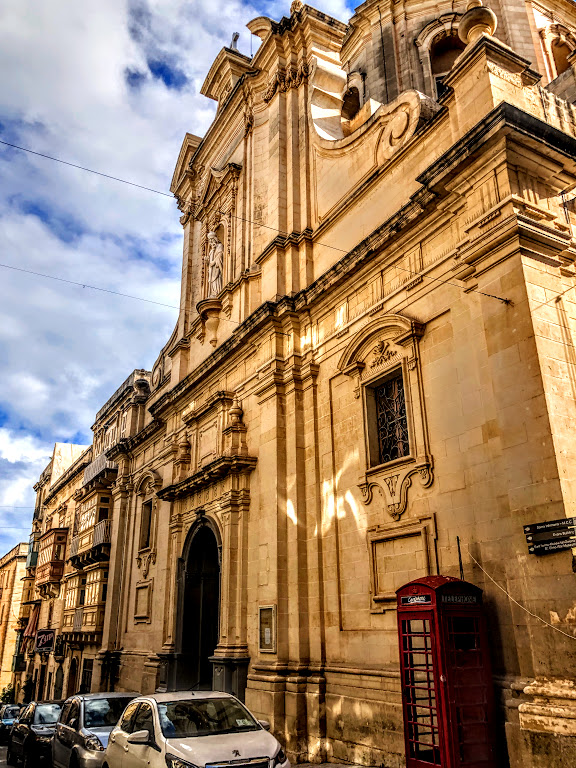
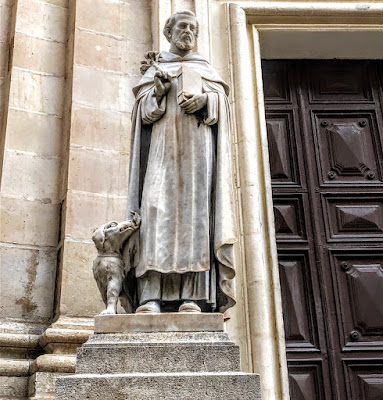
Saint Dominic (1170-1221) is commemorated in the Church Calendar on 8 August … a statue outside the Basilica of Our Lady of Fair Havens and Saint Dominic in Valletta (Photograph: Patrick Comerford, 2022)
Patrick Comerford
Today the Calendar of the Church of England in Common Worship remembers Saint Dominic, Priest, Founder of the Order of Preachers (1221), with a Lesser Festival (8 August). Before this becomes a busy day, I am taking some time this morning for prayer and reflection.
This year marks the 150th anniversary of the composer Ralph Vaughan Williams, whose music is celebrated throughout this year’s Proms season.
In my prayer diary for these weeks I am reflecting in these ways:
1, One of the readings for the morning;
2, Reflecting on a hymn or another piece of music by Vaughan Williams, often drawing, admittedly, on previous postings on the composer;
3, a prayer from the USPG prayer diary, ‘Pray with the World Church.’
The shrine of Saint Dominic in Saint Dominic’s chapel in the Basilica of San Domenico in Bologna (Photograph: Patrick Comerford)
Matthew 10: 5-13 (NRSVA):
5 These twelve Jesus sent out with the following instructions: ‘Go nowhere among the Gentiles, and enter no town of the Samaritans, 6 but go rather to the lost sheep of the house of Israel. 7 As you go, proclaim the good news, “The kingdom of heaven has come near.” 8 Cure the sick, raise the dead, cleanse the lepers, cast out demons. You received without payment; give without payment. 9 Take no gold, or silver, or copper in your belts, 10 no bag for your journey, or two tunics, or sandals, or a staff; for labourers deserve their food. 11 Whatever town or village you enter, find out who in it is worthy, and stay there until you leave. 12 As you enter the house, greet it. 13If the house is worthy, let your peace come upon it; but if it is not worthy, let your peace return to you.’
Today’s reflection: ‘The Five Mystical Songs,’ 1, ‘Easter
Ralph Vaughan Williams was the composer of symphonies, chamber music, opera, choral music, and film scores, a collector of English folk music and song. With Percy Dearmer, he co-edited the English Hymnal, in which he included many folk song arrangements as hymn tunes, and several of his own original compositions.
This morning [8 August 2022], I have chosen the hymn ‘Easter’ by the 17th century Welsh-born English priest-poet George Herbert (1593-1633).
For the weekdays this week, I am reflecting on ‘The Five Mystical Songs,’ composed by Vaughan Williams between 1906 and 1911. He conducted the first performance of the completed work at the Three Choirs Festival in Worcester on 14 September 1911.
The work, taken as one, sets four poems by George Herbert from his collection The Temple: Sacred Poems (1633).
Many of George Herbert’s poems have become hymns that are well-known and well-loved by generations of Anglicans. They include ‘Let all the world in every corner sing,’ ‘Teach me, my God and King’ and ‘King of Glory, King of Peace.’
He was the Public Orator at Cambridge for eight years, and spent only three years as a priest before he died.
Herbert was a younger contemporary of Shakespeare, and lived at a time when the English language was expanding and developing its literary capacities, aided by the publication of the King James Version of the Bible and the Book of Common Prayer.
Like most Anglicans of his day, Herbert sought to steer a middle course between the Roman Catholics and the Puritans. Perhaps he appealed to Vaughan Williams because were both men were creatively preoccupied with that age-old conflict between God and World, Flesh and Spirit, Soul and Senses.
Vaughan Williams wrote his ‘Five Mystical Songs’ for a baritone soloist, with several choices for accompaniment: piano only; piano and string quintet; TTBB chorus, a cappella; and orchestra with optional SATB chorus, the choice Vaughan Williams used at the premiere.
Like George Herbert’s simple verse, the songs are fairly direct, but have the same intrinsic spirituality as the original text. The first four songs are personal meditations in which the soloist takes a key role. They were supposed to be performed together, as a single work, but the styles of each vary quite significantly.
Vaughan Williams has divided George Herbert’s poem ‘Easter ’into two parts to provide the first two songs, ‘Easter’ and ‘I Got Me Flowers.’
The setting for ‘Easter’ by Vaughan Williams is elaborate in design and Michael Kennedy ascribes its richness of orchestral detail to ‘Elgarian prototypes.’
1, Easter
Rise heart; thy Lord is risen.
Sing his praise without delayes,
Who takes thee by the hand,
that thou likewise with him may’st rise;
That, as his death calcined thee to dust,
His life may make thee gold, and much more, just.
Awake, my lute, and struggle for thy part with all thy art.
The crosse taught all wood to resound his name, who bore the same.
His stretched sinews taught all strings, what key
Is the best to celebrate this most high day.
Consort both heart and lute, and twist a song pleasant and long;
Or since all musick is but three parts vied and multiplied.
O let thy blessed Spirit bear a part,
And make up our defects with his sweet art.
The Basilica of San Domenico seen from the cloisters … one of the major churches in Bologna (Photograph: Patrick Comerford)
Today’s Prayer:
The Collect:
Almighty God,
whose servant Dominic grew in the knowledge of your truth
and formed an order of preachers to proclaim the faith of Christ:
by your grace give to all your people a love for your word
and a longing to share the gospel,
so that the whole world may come to know you
and your Son Jesus Christ our Lord,
who is alive and reigns with you,
in the unity of the Holy Spirit,
one God, now and for ever.
Monday 8 August 2022:
The theme in the USPG prayer diary this week is ‘International Youth Day.’ It was introduced yesterday by Dorothy deGraft Johnson, a Law student from Ghana.
The USPG Prayer Diary invites us to pray today in these words:
Let us pray for young people across the Anglican Communion. May we encourage them to fully engage in the life of the Church and treat them with dignity and respect.
Yesterday’s reflection
Continued tomorrow
Scripture quotations are from the New Revised Standard Version Bible: Anglicised Edition copyright © 1989, 1995, National Council of the Churches of Christ in the United States of America. Used by permission. All rights reserved worldwide. http://nrsvbibles.org
Patrick Comerford
Today the Calendar of the Church of England in Common Worship remembers Saint Dominic, Priest, Founder of the Order of Preachers (1221), with a Lesser Festival (8 August). Before this becomes a busy day, I am taking some time this morning for prayer and reflection.
This year marks the 150th anniversary of the composer Ralph Vaughan Williams, whose music is celebrated throughout this year’s Proms season.
In my prayer diary for these weeks I am reflecting in these ways:
1, One of the readings for the morning;
2, Reflecting on a hymn or another piece of music by Vaughan Williams, often drawing, admittedly, on previous postings on the composer;
3, a prayer from the USPG prayer diary, ‘Pray with the World Church.’
The shrine of Saint Dominic in Saint Dominic’s chapel in the Basilica of San Domenico in Bologna (Photograph: Patrick Comerford)
Matthew 10: 5-13 (NRSVA):
5 These twelve Jesus sent out with the following instructions: ‘Go nowhere among the Gentiles, and enter no town of the Samaritans, 6 but go rather to the lost sheep of the house of Israel. 7 As you go, proclaim the good news, “The kingdom of heaven has come near.” 8 Cure the sick, raise the dead, cleanse the lepers, cast out demons. You received without payment; give without payment. 9 Take no gold, or silver, or copper in your belts, 10 no bag for your journey, or two tunics, or sandals, or a staff; for labourers deserve their food. 11 Whatever town or village you enter, find out who in it is worthy, and stay there until you leave. 12 As you enter the house, greet it. 13If the house is worthy, let your peace come upon it; but if it is not worthy, let your peace return to you.’
Today’s reflection: ‘The Five Mystical Songs,’ 1, ‘Easter
Ralph Vaughan Williams was the composer of symphonies, chamber music, opera, choral music, and film scores, a collector of English folk music and song. With Percy Dearmer, he co-edited the English Hymnal, in which he included many folk song arrangements as hymn tunes, and several of his own original compositions.
This morning [8 August 2022], I have chosen the hymn ‘Easter’ by the 17th century Welsh-born English priest-poet George Herbert (1593-1633).
For the weekdays this week, I am reflecting on ‘The Five Mystical Songs,’ composed by Vaughan Williams between 1906 and 1911. He conducted the first performance of the completed work at the Three Choirs Festival in Worcester on 14 September 1911.
The work, taken as one, sets four poems by George Herbert from his collection The Temple: Sacred Poems (1633).
Many of George Herbert’s poems have become hymns that are well-known and well-loved by generations of Anglicans. They include ‘Let all the world in every corner sing,’ ‘Teach me, my God and King’ and ‘King of Glory, King of Peace.’
He was the Public Orator at Cambridge for eight years, and spent only three years as a priest before he died.
Herbert was a younger contemporary of Shakespeare, and lived at a time when the English language was expanding and developing its literary capacities, aided by the publication of the King James Version of the Bible and the Book of Common Prayer.
Like most Anglicans of his day, Herbert sought to steer a middle course between the Roman Catholics and the Puritans. Perhaps he appealed to Vaughan Williams because were both men were creatively preoccupied with that age-old conflict between God and World, Flesh and Spirit, Soul and Senses.
Vaughan Williams wrote his ‘Five Mystical Songs’ for a baritone soloist, with several choices for accompaniment: piano only; piano and string quintet; TTBB chorus, a cappella; and orchestra with optional SATB chorus, the choice Vaughan Williams used at the premiere.
Like George Herbert’s simple verse, the songs are fairly direct, but have the same intrinsic spirituality as the original text. The first four songs are personal meditations in which the soloist takes a key role. They were supposed to be performed together, as a single work, but the styles of each vary quite significantly.
Vaughan Williams has divided George Herbert’s poem ‘Easter ’into two parts to provide the first two songs, ‘Easter’ and ‘I Got Me Flowers.’
The setting for ‘Easter’ by Vaughan Williams is elaborate in design and Michael Kennedy ascribes its richness of orchestral detail to ‘Elgarian prototypes.’
1, Easter
Rise heart; thy Lord is risen.
Sing his praise without delayes,
Who takes thee by the hand,
that thou likewise with him may’st rise;
That, as his death calcined thee to dust,
His life may make thee gold, and much more, just.
Awake, my lute, and struggle for thy part with all thy art.
The crosse taught all wood to resound his name, who bore the same.
His stretched sinews taught all strings, what key
Is the best to celebrate this most high day.
Consort both heart and lute, and twist a song pleasant and long;
Or since all musick is but three parts vied and multiplied.
O let thy blessed Spirit bear a part,
And make up our defects with his sweet art.
The Basilica of San Domenico seen from the cloisters … one of the major churches in Bologna (Photograph: Patrick Comerford)
Today’s Prayer:
The Collect:
Almighty God,
whose servant Dominic grew in the knowledge of your truth
and formed an order of preachers to proclaim the faith of Christ:
by your grace give to all your people a love for your word
and a longing to share the gospel,
so that the whole world may come to know you
and your Son Jesus Christ our Lord,
who is alive and reigns with you,
in the unity of the Holy Spirit,
one God, now and for ever.
Monday 8 August 2022:
The theme in the USPG prayer diary this week is ‘International Youth Day.’ It was introduced yesterday by Dorothy deGraft Johnson, a Law student from Ghana.
The USPG Prayer Diary invites us to pray today in these words:
Let us pray for young people across the Anglican Communion. May we encourage them to fully engage in the life of the Church and treat them with dignity and respect.
Yesterday’s reflection
Continued tomorrow
Scripture quotations are from the New Revised Standard Version Bible: Anglicised Edition copyright © 1989, 1995, National Council of the Churches of Christ in the United States of America. Used by permission. All rights reserved worldwide. http://nrsvbibles.org
02 August 2022
Praying with USPG and the hymns of
Vaughan Williams: Tuesday 2 August 2022
‘I sometimes think about the cross,/ and shut my eyes, and try to see’ … the Stony Stratford Cross in Saint Mary and Saint Giles Church, sculpted by Antony Weller (Photograph: Patrick Comerford, 2022)
Patrick Comerford
This year marks the 150th anniversary of the composer Ralph Vaughan Williams, whose music is celebrated throughout this year’s Proms season.
In my prayer diary for these weeks I am reflecting in these ways:
1, One of the readings for the morning;
2, Reflecting on a hymn or another piece of music by Vaughan Williams, often drawing, admittedly, on previous postings on the composer;
3, a prayer from the USPG prayer diary, ‘Pray with the World Church.’
The readings for Morning Prayer in Common Worship this morning include:
II Corinthians 11: 16-33 (NRSVA):
16 I repeat, let no one think that I am a fool; but if you do, then accept me as a fool, so that I too may boast a little. 17 What I am saying in regard to this boastful confidence, I am saying not with the Lord’s authority, but as a fool; 18 since many boast according to human standards, I will also boast. 19 For you gladly put up with fools, being wise yourselves! 20 For you put up with it when someone makes slaves of you, or preys upon you, or takes advantage of you, or puts on airs, or gives you a slap in the face. 21 To my shame, I must say, we were too weak for that!
But whatever anyone dares to boast of—I am speaking as a fool—I also dare to boast of that. 22 Are they Hebrews? So am I. Are they Israelites? So am I. Are they descendants of Abraham? So am I. 23 Are they ministers of Christ? I am talking like a madman—I am a better one: with far greater labours, far more imprisonments, with countless floggings, and often near death. 24 Five times I have received from the Jews the forty lashes minus one. 25 Three times I was beaten with rods. Once I received a stoning. Three times I was shipwrecked; for a night and a day I was adrift at sea; 26 on frequent journeys, in danger from rivers, danger from bandits, danger from my own people, danger from Gentiles, danger in the city, danger in the wilderness, danger at sea, danger from false brothers and sisters; 27 in toil and hardship, through many a sleepless night, hungry and thirsty, often without food, cold and naked. 28 And, besides other things, I am under daily pressure because of my anxiety for all the churches. 29 Who is weak, and I am not weak? Who is made to stumble, and I am not indignant?
30 If I must boast, I will boast of the things that show my weakness. 31 The God and Father of the Lord Jesus (blessed be he for ever!) knows that I do not lie. 32 In Damascus, the governor under King Aretas set a guard on the city of Damascus in order to seize me, 33 but I was let down in a basket through a window in the wall, and escaped from his hands.
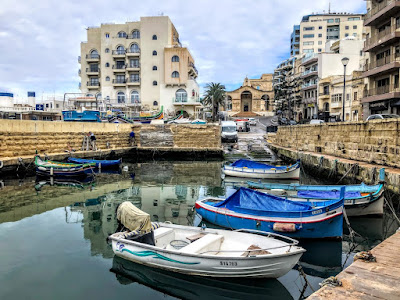
‘Three times I was shipwrecked’ (II Corinthians 11: 25) … Saint Paul’s Church above the Menqa or boat shelter at the harbour in Saint Paul’s Bay, the site of Saint Paul’s shipwreck (Photograph: Patrick Comerford, 2022)
Today’s reflection: ‘It is a thing most wonderful’
Ralph Vaughan Williams was the composer of symphonies, chamber music, opera, choral music, and film scores, a collector of English folk music and song. With Percy Dearmer, he co-edited the English Hymnal, in which he included many folk song arrangements as hymn tunes, and several of his own original compositions.
This morning I have chosen the hymn, ‘It is a thing most wonderful’ (Irish Church Hymnal, 226; New English Hymnal, 84), written as a poem in 1872 by Bishop William Walsham How (1823-1897).
The tune normally used for this hymn is Herongate, an Essex folk song arranged by Ralph Vaughan Williams.
William Walsham How, a solicitor’s son, was born in Shrewsbury in 1823 and educated at Shrewsbury School and Wadham College, Oxford (BA 1845). He was ordained in 1846, and was curate of Saint George’s, Kidderminster (1846), Holy Cross, Shrewsbury (1848), before becoming the Rector of Whittington in the Diocese of St Asaph in 1851. He was later a Rural Dean (1853), a canon of Saint Asaph Cathedral (1860), chaplain of the English church in Rome (1865) and Rector of Saint Andrew’s Undershaft, London, (1879).
He became a Suffragan Bishop for East London as Bishop of Bedford, and in 1888 he became the first Bishop of Wakefield, a new diocese in the industrial heartlands. His untiring work among the people of the docks and the slums earned him the title of ‘the poor man’s bishop,’ and because he insisted on using public transport he was also known as the ‘omnibus bishop.’ But he liked best his description as ‘the children’s bishop.’ He died in Leenane, Co Mayo, in 1897, while on a fishing holiday in Dulough.
Bishop How, who was strongly influenced by the Tractarian Movement, was the author and editor of several collections of hymns, sermons and children’s stories, many of them published by the Society for Promoting Christian Knowledge (SPCK), and he wrote at least sixty hymns.
His hymns are marked by pure rhythm as well as directness and simplicity, showing a comprehensive grasp of the subject and throwing unexpected light on their themes, with images interwoven with tender thoughts. Although he is seldom thought of as a poet, his hymns have outlived his other literary works and he is one of the most effective Victorian hymn writers.
Seven of his hymns are included in the Irish Church Hymnal. His most popular hymns include ‘For all the Saints who from their labours rest,’ (Irish Church Hymnal, 459; New English Hymnal, 197), ‘It is a thing most wonderful’ (Irish Church Hymnal, 226, New English Hymnal, 84), ‘To thee our God we fly’ (Irish Church Hymnal, 540, New English Hymnal, 127), and ‘Who is this so weak and helpless’ (New English Hymnal, 474).
‘It is a thing most wonderful’ was written by How, while he was Rector of Whittington in Shropshire – then in the Diocese of St Asaph but now in the Diocese of Lichfield – but it was not published until 1872.
The first version was five verses in length, but within 15 years he had added two more verses to the original. Through this hymn, How is trying to reveal the love of God by looking at the Cross through the eyes of a child. In the 1872 draft, he placed the text I John 4: 10 above the hymn: ‘Herein is love, not that we loved God, but that he loved us, and sent his son to be the propitiation for our sins.’
The tune ‘Herongate’ is one of several folksong melodies collected by Vaughan Williams. He transcribed the tune of ‘In Jesse’s City’ in 1903 when he heard a maid singing that song in Ingrave Rectory near Brentwood, about three miles from Herongate in Essex. It was first used with this hymn in 1906 in the first edition of the English Hymnal, which Vaughan Wlliams edited with Percy Dearmer.
It is a thing most wonderful
almost too wonderful to be
that God’s own Son should come from heaven
and die to save a child like me.
And yet I know that it is true:
he came to this poor world below,
and wept and toiled, and mourned and died,
only because he loved us so.
I cannot tell how he could love
a child so weak and full of sin;
his love must be most wonderful
if he could die my love to win.
I sometimes think about the cross,
and shut my eyes, and try to see
the cruel nails, and crown of thorns,
and Jesus crucified for me.
But, even could I see him die,
I could but see a little part
of that great love which, like a fire,
is always burning in his heart.
How wonderful it is to see
my love for him so faint and poor,
but yet more wonderful to know
his love for me so free and sure.
And yet I want to love you, Lord:
O teach me how to grow in grace,
that I may love you more and more
until I see you face to face.
‘We pray for the Anglican Church in Poland which serves communities in Warsaw, Krakow and Gdansk’ … the Mały Rynek or Small Square in Kraków (Photograph: Patrick Comerford)
Today’s Prayer:
At the annual conference of the USPG (United Society Partners in the Gospel) in High Leigh last week, we were updated on the work of USPG’s partners in Ukraine, Russia and with USPG’s partners with Ukrainian refugees. The theme in the USPG prayer diary this week is ‘Refugee Support in Poland,’ and was introduced by the Revd David Brown, Chaplain of the Anglican Church in Poland.
Tuesday 2 August 2022:
The USPG Prayer Diary invites us to pray today in these words:
We pray for the Anglican Church in Poland which serves communities in Warsaw, Krakow and Gdansk.
Yesterday’s reflection
Continued tomorrow
Scripture quotations are from the New Revised Standard Version Bible: Anglicised Edition copyright © 1989, 1995, National Council of the Churches of Christ in the United States of America. Used by permission. All rights reserved worldwide. http://nrsvbibles.org
Patrick Comerford
This year marks the 150th anniversary of the composer Ralph Vaughan Williams, whose music is celebrated throughout this year’s Proms season.
In my prayer diary for these weeks I am reflecting in these ways:
1, One of the readings for the morning;
2, Reflecting on a hymn or another piece of music by Vaughan Williams, often drawing, admittedly, on previous postings on the composer;
3, a prayer from the USPG prayer diary, ‘Pray with the World Church.’
The readings for Morning Prayer in Common Worship this morning include:
II Corinthians 11: 16-33 (NRSVA):
16 I repeat, let no one think that I am a fool; but if you do, then accept me as a fool, so that I too may boast a little. 17 What I am saying in regard to this boastful confidence, I am saying not with the Lord’s authority, but as a fool; 18 since many boast according to human standards, I will also boast. 19 For you gladly put up with fools, being wise yourselves! 20 For you put up with it when someone makes slaves of you, or preys upon you, or takes advantage of you, or puts on airs, or gives you a slap in the face. 21 To my shame, I must say, we were too weak for that!
But whatever anyone dares to boast of—I am speaking as a fool—I also dare to boast of that. 22 Are they Hebrews? So am I. Are they Israelites? So am I. Are they descendants of Abraham? So am I. 23 Are they ministers of Christ? I am talking like a madman—I am a better one: with far greater labours, far more imprisonments, with countless floggings, and often near death. 24 Five times I have received from the Jews the forty lashes minus one. 25 Three times I was beaten with rods. Once I received a stoning. Three times I was shipwrecked; for a night and a day I was adrift at sea; 26 on frequent journeys, in danger from rivers, danger from bandits, danger from my own people, danger from Gentiles, danger in the city, danger in the wilderness, danger at sea, danger from false brothers and sisters; 27 in toil and hardship, through many a sleepless night, hungry and thirsty, often without food, cold and naked. 28 And, besides other things, I am under daily pressure because of my anxiety for all the churches. 29 Who is weak, and I am not weak? Who is made to stumble, and I am not indignant?
30 If I must boast, I will boast of the things that show my weakness. 31 The God and Father of the Lord Jesus (blessed be he for ever!) knows that I do not lie. 32 In Damascus, the governor under King Aretas set a guard on the city of Damascus in order to seize me, 33 but I was let down in a basket through a window in the wall, and escaped from his hands.
‘Three times I was shipwrecked’ (II Corinthians 11: 25) … Saint Paul’s Church above the Menqa or boat shelter at the harbour in Saint Paul’s Bay, the site of Saint Paul’s shipwreck (Photograph: Patrick Comerford, 2022)
Today’s reflection: ‘It is a thing most wonderful’
Ralph Vaughan Williams was the composer of symphonies, chamber music, opera, choral music, and film scores, a collector of English folk music and song. With Percy Dearmer, he co-edited the English Hymnal, in which he included many folk song arrangements as hymn tunes, and several of his own original compositions.
This morning I have chosen the hymn, ‘It is a thing most wonderful’ (Irish Church Hymnal, 226; New English Hymnal, 84), written as a poem in 1872 by Bishop William Walsham How (1823-1897).
The tune normally used for this hymn is Herongate, an Essex folk song arranged by Ralph Vaughan Williams.
William Walsham How, a solicitor’s son, was born in Shrewsbury in 1823 and educated at Shrewsbury School and Wadham College, Oxford (BA 1845). He was ordained in 1846, and was curate of Saint George’s, Kidderminster (1846), Holy Cross, Shrewsbury (1848), before becoming the Rector of Whittington in the Diocese of St Asaph in 1851. He was later a Rural Dean (1853), a canon of Saint Asaph Cathedral (1860), chaplain of the English church in Rome (1865) and Rector of Saint Andrew’s Undershaft, London, (1879).
He became a Suffragan Bishop for East London as Bishop of Bedford, and in 1888 he became the first Bishop of Wakefield, a new diocese in the industrial heartlands. His untiring work among the people of the docks and the slums earned him the title of ‘the poor man’s bishop,’ and because he insisted on using public transport he was also known as the ‘omnibus bishop.’ But he liked best his description as ‘the children’s bishop.’ He died in Leenane, Co Mayo, in 1897, while on a fishing holiday in Dulough.
Bishop How, who was strongly influenced by the Tractarian Movement, was the author and editor of several collections of hymns, sermons and children’s stories, many of them published by the Society for Promoting Christian Knowledge (SPCK), and he wrote at least sixty hymns.
His hymns are marked by pure rhythm as well as directness and simplicity, showing a comprehensive grasp of the subject and throwing unexpected light on their themes, with images interwoven with tender thoughts. Although he is seldom thought of as a poet, his hymns have outlived his other literary works and he is one of the most effective Victorian hymn writers.
Seven of his hymns are included in the Irish Church Hymnal. His most popular hymns include ‘For all the Saints who from their labours rest,’ (Irish Church Hymnal, 459; New English Hymnal, 197), ‘It is a thing most wonderful’ (Irish Church Hymnal, 226, New English Hymnal, 84), ‘To thee our God we fly’ (Irish Church Hymnal, 540, New English Hymnal, 127), and ‘Who is this so weak and helpless’ (New English Hymnal, 474).
‘It is a thing most wonderful’ was written by How, while he was Rector of Whittington in Shropshire – then in the Diocese of St Asaph but now in the Diocese of Lichfield – but it was not published until 1872.
The first version was five verses in length, but within 15 years he had added two more verses to the original. Through this hymn, How is trying to reveal the love of God by looking at the Cross through the eyes of a child. In the 1872 draft, he placed the text I John 4: 10 above the hymn: ‘Herein is love, not that we loved God, but that he loved us, and sent his son to be the propitiation for our sins.’
The tune ‘Herongate’ is one of several folksong melodies collected by Vaughan Williams. He transcribed the tune of ‘In Jesse’s City’ in 1903 when he heard a maid singing that song in Ingrave Rectory near Brentwood, about three miles from Herongate in Essex. It was first used with this hymn in 1906 in the first edition of the English Hymnal, which Vaughan Wlliams edited with Percy Dearmer.
It is a thing most wonderful
almost too wonderful to be
that God’s own Son should come from heaven
and die to save a child like me.
And yet I know that it is true:
he came to this poor world below,
and wept and toiled, and mourned and died,
only because he loved us so.
I cannot tell how he could love
a child so weak and full of sin;
his love must be most wonderful
if he could die my love to win.
I sometimes think about the cross,
and shut my eyes, and try to see
the cruel nails, and crown of thorns,
and Jesus crucified for me.
But, even could I see him die,
I could but see a little part
of that great love which, like a fire,
is always burning in his heart.
How wonderful it is to see
my love for him so faint and poor,
but yet more wonderful to know
his love for me so free and sure.
And yet I want to love you, Lord:
O teach me how to grow in grace,
that I may love you more and more
until I see you face to face.
‘We pray for the Anglican Church in Poland which serves communities in Warsaw, Krakow and Gdansk’ … the Mały Rynek or Small Square in Kraków (Photograph: Patrick Comerford)
Today’s Prayer:
At the annual conference of the USPG (United Society Partners in the Gospel) in High Leigh last week, we were updated on the work of USPG’s partners in Ukraine, Russia and with USPG’s partners with Ukrainian refugees. The theme in the USPG prayer diary this week is ‘Refugee Support in Poland,’ and was introduced by the Revd David Brown, Chaplain of the Anglican Church in Poland.
Tuesday 2 August 2022:
The USPG Prayer Diary invites us to pray today in these words:
We pray for the Anglican Church in Poland which serves communities in Warsaw, Krakow and Gdansk.
Yesterday’s reflection
Continued tomorrow
Scripture quotations are from the New Revised Standard Version Bible: Anglicised Edition copyright © 1989, 1995, National Council of the Churches of Christ in the United States of America. Used by permission. All rights reserved worldwide. http://nrsvbibles.org
Labels:
Hymns,
Kraków,
Malta,
Malta 2022,
Mission,
Poland,
Prayer,
refugees,
Saint Paul,
Sculpture,
Stony Stratford,
Ukraine,
USPG
16 June 2022
Bloomsday and recalling
James Joyce’s forgotten
months in a flat in London
Ulysses, a wine label in Malta seen in a restaurant in Valletta … today is Bloomsday and this year marks the centenary of ‘Ulysses’ (Photograph: Patrick Comerford, 2022)
Patrick Comerford
‘Stately, plump Buck Mulligan came from the stairhead, bearing a bowl of lather on which a mirror and a razor lay crossed.’
The opening line of Ulysses is known to many people, even if they have never read Ulysses. But of course, Buck Mulligan has no link at all with the Bucks of Buckinghamshire; nor could James Joyce have ever known about the plans for Milton Keynes.
Nor, for that matter, did Buck Mulligan, Leopold Bloom or James Joyce have any associations with Ulysses, a wine label I came across in Malta earlier this year.
Today is Bloomsday, and this year marks the centenary of the publication of Ulysses. I normally associate James Joyce with Dublin, whose streets he celebrates in Ulysses, Trieste and Zurich, where he lived in exile, and Paris, where Ulysses was first published 100 years ago in 1922.
But until two of us visited London last week, I had forgotten that Joyce also lived in London in 1931. Ulysses celebrated the day James Joyce and Nora Barnacle first met in 1904, but the couple did not marry until they were living in London almost three decades later.
No 28B Campden Grove, near Holland Park, was the home of James Joyce in 1931, and while living in this Kensington flat he married Nora Barnacle, and worked on his manuscript for Finnegans Wake.
Joyce was working on his first draft of A Portrait of the Artist as a Young Man in 1904 when he met Nora Barnacle (1884-1951) from Galway. They eloped and spent much of their lives in Trieste, Zurich and Paris.
Many writers, including WB Yeats, Ezra Pound and TS Eliot, moved to London to pursue their literary careers. Joyce first visited London in 1900, where he met TP O’Connor (1848-1929), a journalist, Irish Parliamentary Party MP, and later Father of the House in the House of Commons. Joyce hoped O’Connor could help him find employment on Fleet Street.
During later visits to London in 1902 and 1903, WB Yeats introduced Joyce to a number of literary editors and writers.
Although Joyce eloped with Nora Barnacle to Europe in 1904, London was still vital in his career plans. While he was in Trieste, he was constantly approaching London publishers and writers in order to have his work published in London.
Most of Joyce’s work was published in London, including first collection of poetry, Chamber Music (1907), Dubliners (1914), A Portrait of the Artist as a Young Man (1914), and his play Exiles (1918).
Most orders for A Portrait during the period 1918-1920 came from London, with Hatchards of Piccadilly, London’s oldest bookshop, placing most of those orders, including an order for A Portrait for HMS Monarch. Copies of A Portrait were also ordered by highly successful commercial ventures: the book club run by The Times and Mudie’s circulating library, a private book lending scheme.
However, English printers and publishers were afraid of prosecution for typesetting a book considered by some to be obscene, and Ulysses was first published in Paris in 1922. Yet Ulysses (1922) became one of the greatest literary masterpieces of the 20th century, bringing Joyce both acclaim and infamy: it was banned in the US until 1934 and in Britain until 1936.
His work continued to feature in many edited collections, anthologies, and magazines published in London. Joyce was constantly moving between hotels and flats across Europe throughout his life. His decision to buy a flat in London with a long-term lease in May 1931 shows a shift in his life: he wanted to abandon Paris, where he was living, to pursue publishing success in London.
Joyce lived at the flat at 28B Campden Grove, Kensington from early May until early September 1931. Those five months in London were remarkably settled by Joyce’s own standards, and he intended to make London his permanent home.
He relaunched his career in London, thanks to the support of TS Eliot, who was a director at Faber and Faber. During that time he was occupied with Finnegans Wake (1939), and Nora Barnacle and James Joyce were married at a Kensington registry office on 4 July 1931.
When Joyce was in London, he often enjoyed evenings with Irish people there, including the musician Herbert Hughes, the writers Robert and Sylvia Lynd, and the Irish Free State High Commissioner or ambassador John Dulanty. The restaurants they dined at included the Monico by Piccadilly Circus, a favourite haunt of London’s Fin de siècle writers and Kettner’s in Soho, frequented by Oscar Wilde.
When Joyce was not in the city, he would write to friends about aspects of the city that he missed, from the pantomime theatre at Drury Lane to luxury menswear shops. Bond Street and Savile Row, famous for their men’s tailoring shops, are mentioned in Finnegans Wake, which also includes extensive references to London’s restaurants, shops, streets, squares, parks, the tube, and major tourist attractions, including the British Museum, which Joyce visited in 1927.
Joyce’s experience of London is imaginatively recorded in Finnegans Wake in distinctive wordplay and sentence structures. Barker’s department store, down the road from Joyce’s flat, is also referred to in Finnegans Wake, along with Harrod’s, Schoolbred’s and Whiteley’s: ‘if he outharrods against barkers, to the schoolbred he acts whitely.’
The phrase ‘his sole admirers … with Annie Oakley deadliness’ (p 52 line 01) alludes not only to the location of the editorial offices of the Egoist at Oakley House, but also to the editors’ admiration for Joyce’s work and the deadlines they used to set him.
TS Eliot also worked at the Egoist magazine, which serialised Joyce’s A Portrait and Ulysses, while the Egoist Press published and promoted Eliot’s Prufrock and Other Observations and Joyce’s A Portrait.
However, Joyce was constantly hounded by the press, and his view of London soured. He started to refer to Campden Grove as ‘Campden Grave’, to be inhabited by mummies. The flat was let, and Joyce never again set foot in England.
Yet, in Finnegans Wake Joyce pays tribute to the city that helped him launch his career and which he so often returned to, both physically and imaginatively. TS Eliot oversaw the arrangements for the contract for Finnegans Wake (1939), and the publication and dissemination of pamphlets and books, as well as a gramophone disc with Joyce reading of the final pages of Anna Livia Plurabelle.
Faber also used a crossword puzzle in The Times to promote Joyce’s work. This attention helped end the ban on Ulysses and its legal publication by John Lane in London in 1936.
Contrary to popular belief, James Joyce's Ulysses was technically never banned in Ireland, but this was because for many years it was never imported and offered for sale, for fear of such a ban and the costs that would ensue.
An English Heritage blue plaque was placed on the wall of 28B Campden Grove in 1994 to commemorate Joyce’s short time there in 1931. It reads: ‘James Joyce 1882-1941 Author lived here in 1931.’
A plaque at the Bailey remembers the first Bloomsday celebrations in Dublin (Photograph: Patrick Comerford, 2022)
Patrick Comerford
‘Stately, plump Buck Mulligan came from the stairhead, bearing a bowl of lather on which a mirror and a razor lay crossed.’
The opening line of Ulysses is known to many people, even if they have never read Ulysses. But of course, Buck Mulligan has no link at all with the Bucks of Buckinghamshire; nor could James Joyce have ever known about the plans for Milton Keynes.
Nor, for that matter, did Buck Mulligan, Leopold Bloom or James Joyce have any associations with Ulysses, a wine label I came across in Malta earlier this year.
Today is Bloomsday, and this year marks the centenary of the publication of Ulysses. I normally associate James Joyce with Dublin, whose streets he celebrates in Ulysses, Trieste and Zurich, where he lived in exile, and Paris, where Ulysses was first published 100 years ago in 1922.
But until two of us visited London last week, I had forgotten that Joyce also lived in London in 1931. Ulysses celebrated the day James Joyce and Nora Barnacle first met in 1904, but the couple did not marry until they were living in London almost three decades later.
No 28B Campden Grove, near Holland Park, was the home of James Joyce in 1931, and while living in this Kensington flat he married Nora Barnacle, and worked on his manuscript for Finnegans Wake.
Joyce was working on his first draft of A Portrait of the Artist as a Young Man in 1904 when he met Nora Barnacle (1884-1951) from Galway. They eloped and spent much of their lives in Trieste, Zurich and Paris.
Many writers, including WB Yeats, Ezra Pound and TS Eliot, moved to London to pursue their literary careers. Joyce first visited London in 1900, where he met TP O’Connor (1848-1929), a journalist, Irish Parliamentary Party MP, and later Father of the House in the House of Commons. Joyce hoped O’Connor could help him find employment on Fleet Street.
During later visits to London in 1902 and 1903, WB Yeats introduced Joyce to a number of literary editors and writers.
Although Joyce eloped with Nora Barnacle to Europe in 1904, London was still vital in his career plans. While he was in Trieste, he was constantly approaching London publishers and writers in order to have his work published in London.
Most of Joyce’s work was published in London, including first collection of poetry, Chamber Music (1907), Dubliners (1914), A Portrait of the Artist as a Young Man (1914), and his play Exiles (1918).
Most orders for A Portrait during the period 1918-1920 came from London, with Hatchards of Piccadilly, London’s oldest bookshop, placing most of those orders, including an order for A Portrait for HMS Monarch. Copies of A Portrait were also ordered by highly successful commercial ventures: the book club run by The Times and Mudie’s circulating library, a private book lending scheme.
However, English printers and publishers were afraid of prosecution for typesetting a book considered by some to be obscene, and Ulysses was first published in Paris in 1922. Yet Ulysses (1922) became one of the greatest literary masterpieces of the 20th century, bringing Joyce both acclaim and infamy: it was banned in the US until 1934 and in Britain until 1936.
His work continued to feature in many edited collections, anthologies, and magazines published in London. Joyce was constantly moving between hotels and flats across Europe throughout his life. His decision to buy a flat in London with a long-term lease in May 1931 shows a shift in his life: he wanted to abandon Paris, where he was living, to pursue publishing success in London.
Joyce lived at the flat at 28B Campden Grove, Kensington from early May until early September 1931. Those five months in London were remarkably settled by Joyce’s own standards, and he intended to make London his permanent home.
He relaunched his career in London, thanks to the support of TS Eliot, who was a director at Faber and Faber. During that time he was occupied with Finnegans Wake (1939), and Nora Barnacle and James Joyce were married at a Kensington registry office on 4 July 1931.
When Joyce was in London, he often enjoyed evenings with Irish people there, including the musician Herbert Hughes, the writers Robert and Sylvia Lynd, and the Irish Free State High Commissioner or ambassador John Dulanty. The restaurants they dined at included the Monico by Piccadilly Circus, a favourite haunt of London’s Fin de siècle writers and Kettner’s in Soho, frequented by Oscar Wilde.
When Joyce was not in the city, he would write to friends about aspects of the city that he missed, from the pantomime theatre at Drury Lane to luxury menswear shops. Bond Street and Savile Row, famous for their men’s tailoring shops, are mentioned in Finnegans Wake, which also includes extensive references to London’s restaurants, shops, streets, squares, parks, the tube, and major tourist attractions, including the British Museum, which Joyce visited in 1927.
Joyce’s experience of London is imaginatively recorded in Finnegans Wake in distinctive wordplay and sentence structures. Barker’s department store, down the road from Joyce’s flat, is also referred to in Finnegans Wake, along with Harrod’s, Schoolbred’s and Whiteley’s: ‘if he outharrods against barkers, to the schoolbred he acts whitely.’
The phrase ‘his sole admirers … with Annie Oakley deadliness’ (p 52 line 01) alludes not only to the location of the editorial offices of the Egoist at Oakley House, but also to the editors’ admiration for Joyce’s work and the deadlines they used to set him.
TS Eliot also worked at the Egoist magazine, which serialised Joyce’s A Portrait and Ulysses, while the Egoist Press published and promoted Eliot’s Prufrock and Other Observations and Joyce’s A Portrait.
However, Joyce was constantly hounded by the press, and his view of London soured. He started to refer to Campden Grove as ‘Campden Grave’, to be inhabited by mummies. The flat was let, and Joyce never again set foot in England.
Yet, in Finnegans Wake Joyce pays tribute to the city that helped him launch his career and which he so often returned to, both physically and imaginatively. TS Eliot oversaw the arrangements for the contract for Finnegans Wake (1939), and the publication and dissemination of pamphlets and books, as well as a gramophone disc with Joyce reading of the final pages of Anna Livia Plurabelle.
Faber also used a crossword puzzle in The Times to promote Joyce’s work. This attention helped end the ban on Ulysses and its legal publication by John Lane in London in 1936.
Contrary to popular belief, James Joyce's Ulysses was technically never banned in Ireland, but this was because for many years it was never imported and offered for sale, for fear of such a ban and the costs that would ensue.
An English Heritage blue plaque was placed on the wall of 28B Campden Grove in 1994 to commemorate Joyce’s short time there in 1931. It reads: ‘James Joyce 1882-1941 Author lived here in 1931.’
A plaque at the Bailey remembers the first Bloomsday celebrations in Dublin (Photograph: Patrick Comerford, 2022)
25 April 2022
Praying with the Psalms in Easter:
25 April 2022 (Psalm 61)
‘Lead me to the rock that is higher than I; for you are my refuge’ (Psalm 61: 2-3) … the rocks above the beach at Foinikas on the south coast of Crete (Photograph: Patrick Comerford)
Patrick Comerford
During this season of Easter, I have returned to my morning reflections on the Psalms, and in this Prayer Diary on my blog each morning I am reflecting in these ways:
1, Short reflections on a psalm or psalms;
2, reading the psalm or psalms;
3, a prayer from the USPG prayer diary.
Psalm 61:
Psalm 61 is to be played on a neginah or stringed instrument. In the slightly different numbering system in the Greek Septuagint and Latin Vulgate this is Psalm 60.
This Psalm is attributed to King David and is called in Latin Exaudi Deus (‘Hear my cry, O God’).
The Jerusalem Bible calls it a ‘prayer of an exile.’ It describes verses 1-5 as the lament of an exiled Levite, and verses 6-7 as a prayer for the king.
The Czech composer Antonín Dvořák set verses 1, 3 and 4 to music, together with part of Psalm 63, in No. 6 of his Biblical Songs (1894).
‘You are my refuge, a strong tower against the enemy’ (Psalm 61: 3) … the Wignacourt Tower in Saint Paul’s Bay, Malta (Photograph: Patrick Comerford, 2022)
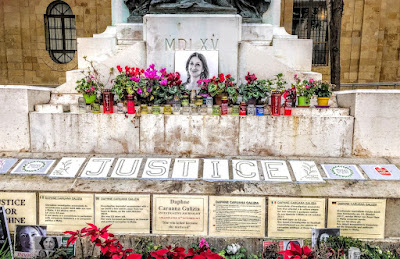
Psalm 61 (NRSVA):
To the leader: with stringed instruments. Of David.
1 Hear my cry, O God;
listen to my prayer.
2 From the end of the earth I call to you,
when my heart is faint.
Lead me to the rock
that is higher than I;
3 for you are my refuge,
a strong tower against the enemy.
4 Let me abide in your tent for ever,
find refuge under the shelter of your wings.
Selah
5 For you, O God, have heard my vows;
you have given me the heritage of those who fear your name.
6 Prolong the life of the king;
may his years endure to all generations!
7 May he be enthroned for ever before God;
appoint steadfast love and faithfulness to watch over him!
8 So I will always sing praises to your name,
as I pay my vows day after day.
Today’s Prayer:
The theme in this week’s prayer diary of the Anglican mission agency USPG (United Society Partners in the Gospel) is ‘Logging in the Solomon Islands,’ and was introduced yesterday morning by Brother Christopher John SSF, Minister General of the Society of Saint Francis.
The USPG Prayer Diary this morning (25 April 2022, Saint Mark the Evangelist) invites us to pray:
We give thanks for the life of Saint Mark the Evangelist. May we devote our lives to evangelism and witness..
Yesterday’s reflection
Continued tomorrow
A figure representing Saint Mark at the base of the memorial cross in the churchyard at All Saints’ Church, Calverton … the Church Calendar today commemorates Saint Mark the Evangelist (Photograph: Patrick Comerford, 2022)
Scripture quotations are from the New Revised Standard Version Bible: Anglicised Edition copyright © 1989, 1995, National Council of the Churches of Christ in the United States of America. Used by permission. All rights reserved worldwide. http://nrsvbibles.org
Patrick Comerford
During this season of Easter, I have returned to my morning reflections on the Psalms, and in this Prayer Diary on my blog each morning I am reflecting in these ways:
1, Short reflections on a psalm or psalms;
2, reading the psalm or psalms;
3, a prayer from the USPG prayer diary.
Psalm 61:
Psalm 61 is to be played on a neginah or stringed instrument. In the slightly different numbering system in the Greek Septuagint and Latin Vulgate this is Psalm 60.
This Psalm is attributed to King David and is called in Latin Exaudi Deus (‘Hear my cry, O God’).
The Jerusalem Bible calls it a ‘prayer of an exile.’ It describes verses 1-5 as the lament of an exiled Levite, and verses 6-7 as a prayer for the king.
The Czech composer Antonín Dvořák set verses 1, 3 and 4 to music, together with part of Psalm 63, in No. 6 of his Biblical Songs (1894).
‘You are my refuge, a strong tower against the enemy’ (Psalm 61: 3) … the Wignacourt Tower in Saint Paul’s Bay, Malta (Photograph: Patrick Comerford, 2022)
Psalm 61 (NRSVA):
To the leader: with stringed instruments. Of David.
1 Hear my cry, O God;
listen to my prayer.
2 From the end of the earth I call to you,
when my heart is faint.
Lead me to the rock
that is higher than I;
3 for you are my refuge,
a strong tower against the enemy.
4 Let me abide in your tent for ever,
find refuge under the shelter of your wings.
Selah
5 For you, O God, have heard my vows;
you have given me the heritage of those who fear your name.
6 Prolong the life of the king;
may his years endure to all generations!
7 May he be enthroned for ever before God;
appoint steadfast love and faithfulness to watch over him!
8 So I will always sing praises to your name,
as I pay my vows day after day.
Today’s Prayer:
The theme in this week’s prayer diary of the Anglican mission agency USPG (United Society Partners in the Gospel) is ‘Logging in the Solomon Islands,’ and was introduced yesterday morning by Brother Christopher John SSF, Minister General of the Society of Saint Francis.
The USPG Prayer Diary this morning (25 April 2022, Saint Mark the Evangelist) invites us to pray:
We give thanks for the life of Saint Mark the Evangelist. May we devote our lives to evangelism and witness..
Yesterday’s reflection
Continued tomorrow
A figure representing Saint Mark at the base of the memorial cross in the churchyard at All Saints’ Church, Calverton … the Church Calendar today commemorates Saint Mark the Evangelist (Photograph: Patrick Comerford, 2022)
Scripture quotations are from the New Revised Standard Version Bible: Anglicised Edition copyright © 1989, 1995, National Council of the Churches of Christ in the United States of America. Used by permission. All rights reserved worldwide. http://nrsvbibles.org
Labels:
Calverton,
Crete,
Easter 2022,
Malta,
Malta 2022,
Mission,
Prayer,
Psalms,
Saint Mark,
USPG
06 March 2022
Malta: a modern
European state
with a legacy
of 8,000 years
Red pillar boxes on the streets of Valletta … Malta is comfortable with its British legacy (Photograph: Patrick Comerford, 2022)
Patrick Comerford
Malta is an island republic in the Mediterranean, between Italy, Tunisia and Libya, and the tenth smallest and fourth most densely populated country in the world. Its capital Valletta, is the smallest capital city in the European Union, and Maltese and English are the official languages, although many people are also fluent in Italian.
Malta has been inhabited for about 8,000 years, and its location in the centre of the Mediterranean has given Malta strategic importance as a naval base. The Maltese islands have been ruled by Phoenicians, Carthaginians, Romans, Greeks, Arabs, Normans, Aragon, the Knights of Saint John or Knights of Malta, Napoleonic France, and Britain.
Malta became a British colony in 1813, becoming an important base for British naval vessels and the headquarters of the British Mediterranean Fleet.
During World War II, Malta was an important Allied base for operations in North Africa and the Mediterranean and besieged by the Axis powers, Nazi Germany and Fascist Italy.
The bravery of the Maltese people moved King George VI to award the George Cross on a collective basis on 15 April 1942.
Malta became an independent state in 1964, and became a republic in 1974. It remains a member of the Commonwealth and joined the European Union in 2004. But the red pillar boxes and telephone boxes everywhere show that Malta has no cultural problems about the British legacy and a depiction of the George Cross remains on the flag and the coat of arms of Malta.
The Grand Master’s Palace of Knights of Saint John … still used for Maltese state receptions (Photograph: Patrick Comerford, 2022)
***
The most enduring presence on Malta has been the Knights Hospitaller or the Knights of Saint John, also known as the Knights of Malta. They ruled Malta from 1530, after they were forced by the advancing Ottoman Turks to abandon Rhodes and other islands in the east Mediterranean, until 1798, when they were expelled from Malta and Gozo by Napoleon.
The knights, led by their French-born Grand Master, Jean Parisot de Vallette, withstood the Great Siege of Malta in 1565. With the help of Spanish and Maltese forces, they repelled the Ottoman Turks.
After the siege, the knights stepped up the fortification of Malta, particularly in the inner-harbour area, built the new city of Valletta, named in honour of Valette and replacing the old capital of Mdina.
The bastions and watchtowers of Valletta retain the names of saints and the Grand Masters of the order, and many of the minor palaces of the knights, named after their different nationalities and languages, including Castille, Leon and Portugal, have survived for almost five centuries.
The Grand Master’s Palace is still used for state receptions. But, as a modern democracy, Malta also boasts interesting modern architecture, including the new Parliament on Freedom Square, designed by Rezo Piano, the Italian architect who also designed Europe’s tallest skyscraper, the Shard in London.
Saint John’s Co-Cathedral in Valletta, built by the Knights of Saint John (Photograph: Patrick Comerford, 2022)
Saint Paul’s shipwreck
and an Anglican cathedral
Perhaps the most visited church in Valletta is the Co-Cathedral of Saint John, with its masterpiece by Caravaggio depicting the beheading of Saint John the Baptist, the patron of the Knights of Saint John.
Throughout Malta, many churches are dedicated to Saint Paul, who was shipwrecked in Malta on his way from Caesarea to Rome as a prisoner. The town of Saint Paul’s Bay, about 16 km north-west of Valletta, recalls his shipwreck, recounted in the Acts of the Apostles (Acts 27-28). on Saint Paul’s Islands near St Paul's Bay, on his voyage to Rome. Saint Paul’s stay is said to have laid the foundations of Christianity on the island.
Saint Luke recounts that Saint Paul’s ship was lost at sea for two weeks during winter storms. Eventually, the ship ran aground on the island of Malta and was dashed to pieces by the surf, but all of the occupants survived and made it to shore.
Saint Paul’s Island, an uninhabited, rocky islet at the entrance to Saint Paul’s Bay, is thought to be the site where of the shipwreck (Acts 27: 41). Saint Paul’s Shipwreck Church stands on the water’s edge in the town of Saint Paul’s Bay. The church is also known as Saint Paul’s Bonfire Church and commemorates the traditional site where the shipwreck survivors, including Saint Paul, swam ashore and a bonfire was built for them.
The Maltese Parliament on Freedom Square in Valletta, designed by the Italian architect Rezo Piano (Photograph: Patrick Comerford, 2022)
***
The Metropolitan Cathedral of Saint Paul, commonly known as Saint Paul’s Cathedral or the Mdina Cathedral, is the Roman Catholic cathedral in Mdina, the ancient capital of Malta. It was founded in the 12th century and remains the seat of the Roman Catholic Archdiocese of Malta, although since the 19th century it has shared this function with Saint John’s Co-Cathedral in Valletta.
Saint Paul’s Pro-Cathedral in Independence Square, Valletta, officially the Pro-Cathedral and Collegiate Church of Saint Paul, is an Anglican pro-cathedral of the Diocese in Europe, alongside the cathedrals in Gibraltar and Brussels.
The cathedral was commissioned by the Dowager Queen Adelaide during a visit to Malta in the 19th century, when she learned there was no place of Anglican worship on the island. Before her visit, Anglican services were held in a room in the Grand Master’s Palace.
Saint Paul’s was built on the site of the Auberge d’Allemagne, or the conventual home of the German Knights Hospitaller. The cathedral was designed by William Scamp and was built in 1839-1844.
The cathedral is a landmark in Valletta, thanks to its spire rising to a over 60 metres, and is clearly visible in the Marsamxett Harbour. The undercroft was used as an air raid shelter during World War II.
The cathedral suffered minor damage during World War II and the roof collapsed, but most of the structure remained intact. A project to restore Saint Paul’s Cathedral and the steeple was launched five years ago, with the aim of raising €3 million. When I visited the cathedral last week, much of the building was still covered in cladding and scaffolding.
Saint Paul’s Church above the Menqa or boat shelter at the harbour in Saint Paul’s Bay … the site of Saint Paul’s shipwreck (Photograph: Patrick Comerford, 2022)
Irish saints, governors
and burials in Valletta
It seems almost every second street in Valletta is named after a saint, including steep San Patriziziju or Saint Patrick Street. Most of those streets also have a church named after the saint. I could find no Saint Patrick’s Church, but I found two monuments on the bastions with interesting Irish connections.
The Hastings Gardens, on top of Saint Michael’s Bastion, are named after Francis Edward Rawdon-Hasting (1754-1826), 1st Marquis of Hastings and an Irish-born Governor of Malta.
Lord Hastings, who is buried in the gardens, was Governor-General of India in 1813-1823 and Governor of Malta in 1824-1826. Hastings was born at Moira, Co Down, the son of John Rawdon, 1st Earl of Moira and Lady Elizabeth Hastings, 13th Baroness Hastings. He was baptised in Saint Audoen’s Church, Dublin, on 2 January 1755, and grew up in Moira and in Dublin.
As an officer, he fought in the British army during the American War of Independence and raised a regiment, called the Volunteers of Ireland. He was MP for Randalstown, Co Antrim, in the Irish Parliament in 1781-1783. He was given the title of Baron Rawdon in 1783, succeeded his father as 2nd Earl of Moira in 1793, and sat in the Irish House of Lords until the Act of Union.
It was rumoured briefly in 1797 that he would replace William Pitt as Prime Minister. In the Irish Parliament, he was identified with the Patriot party of Henry Grattan and Lord Charlemont, he appealed for parliamentary reform and Catholic Emancipation, and denounced government coercion before the 1798 Rising began. Wolfe Tone described him as ‘The Irish Lafayette,’ and he was a patron of the poet Thomas Moore.
Saint Paul’s Anglican Cathedral, Valletta … Queen Adelaide laid the foundation stone in 1839 (Photograph: Patrick Comerford, 2022)<
***
While Lord Moira was the Governor-General of India (1812-1821), he became the Marquess of Hastings in 1816. He was appointed Governor of Malta in 1824 but he died at sea off Naples in 1826 on his way home.
Lady Hastings returned his body to Malta, but had his right hand cut off and preserved. His body was then buried in a large marble sarcophagus in Hastings Gardens in Valletta. His right hand was eventually buried, clasped with hers, when she died.
Close to the Hastings Gardens is the unusual grave of Sir Robert Cavendish Spencer (1791-1830), a naval officer with Irish family links. He was a nephew of Lady Georgiana Spencer, and her husband William Cavendish, 5th Duke of Devonshire, of Lismore Castle, Co Waterford. His brother-in-law, Lord George Quin, was MP for Kells (1776-1790) Longford (1794-1795) and Meath (1794-1795). Spencer’s brothers included George Spencer (1799-1864), known as Father Ignatius, a Passionist preacher throughout Ireland and Britain.
Spencer died on board HMS Madagascar off Alexandria on 4 November 1830, on his way back to London. His body was kept in quarantine at the Lazaretto on Manoel Island near Valletta for 40 days, and was then taken to Valletta, where he was buried on Saint Michael’s Bastion.
At the time, Spencer’s cousin, Sir Frederick Cavendish Ponsonby (1783-1837) from Co Kilkenny, was Governor of Malta (1826-1836). Ponsonby’s Column was erected in his honour in Valletta in 1838, but was destroyed by lightning in 1864.
The grave and monument to Lord Hastings on the walls on Valletta … he was born in Moira, Co Down, and raised in Dublin (Photograph: Patrick Comerford, 2022)
This feature was first published in March 2022 in the Church Review, the diocesan magazine of Dublin and Glendalough, pp 6-7
Patrick Comerford
Malta is an island republic in the Mediterranean, between Italy, Tunisia and Libya, and the tenth smallest and fourth most densely populated country in the world. Its capital Valletta, is the smallest capital city in the European Union, and Maltese and English are the official languages, although many people are also fluent in Italian.
Malta has been inhabited for about 8,000 years, and its location in the centre of the Mediterranean has given Malta strategic importance as a naval base. The Maltese islands have been ruled by Phoenicians, Carthaginians, Romans, Greeks, Arabs, Normans, Aragon, the Knights of Saint John or Knights of Malta, Napoleonic France, and Britain.
Malta became a British colony in 1813, becoming an important base for British naval vessels and the headquarters of the British Mediterranean Fleet.
During World War II, Malta was an important Allied base for operations in North Africa and the Mediterranean and besieged by the Axis powers, Nazi Germany and Fascist Italy.
The bravery of the Maltese people moved King George VI to award the George Cross on a collective basis on 15 April 1942.
Malta became an independent state in 1964, and became a republic in 1974. It remains a member of the Commonwealth and joined the European Union in 2004. But the red pillar boxes and telephone boxes everywhere show that Malta has no cultural problems about the British legacy and a depiction of the George Cross remains on the flag and the coat of arms of Malta.
The Grand Master’s Palace of Knights of Saint John … still used for Maltese state receptions (Photograph: Patrick Comerford, 2022)
***
The most enduring presence on Malta has been the Knights Hospitaller or the Knights of Saint John, also known as the Knights of Malta. They ruled Malta from 1530, after they were forced by the advancing Ottoman Turks to abandon Rhodes and other islands in the east Mediterranean, until 1798, when they were expelled from Malta and Gozo by Napoleon.
The knights, led by their French-born Grand Master, Jean Parisot de Vallette, withstood the Great Siege of Malta in 1565. With the help of Spanish and Maltese forces, they repelled the Ottoman Turks.
After the siege, the knights stepped up the fortification of Malta, particularly in the inner-harbour area, built the new city of Valletta, named in honour of Valette and replacing the old capital of Mdina.
The bastions and watchtowers of Valletta retain the names of saints and the Grand Masters of the order, and many of the minor palaces of the knights, named after their different nationalities and languages, including Castille, Leon and Portugal, have survived for almost five centuries.
The Grand Master’s Palace is still used for state receptions. But, as a modern democracy, Malta also boasts interesting modern architecture, including the new Parliament on Freedom Square, designed by Rezo Piano, the Italian architect who also designed Europe’s tallest skyscraper, the Shard in London.
Saint John’s Co-Cathedral in Valletta, built by the Knights of Saint John (Photograph: Patrick Comerford, 2022)
Saint Paul’s shipwreck
and an Anglican cathedral
Perhaps the most visited church in Valletta is the Co-Cathedral of Saint John, with its masterpiece by Caravaggio depicting the beheading of Saint John the Baptist, the patron of the Knights of Saint John.
Throughout Malta, many churches are dedicated to Saint Paul, who was shipwrecked in Malta on his way from Caesarea to Rome as a prisoner. The town of Saint Paul’s Bay, about 16 km north-west of Valletta, recalls his shipwreck, recounted in the Acts of the Apostles (Acts 27-28). on Saint Paul’s Islands near St Paul's Bay, on his voyage to Rome. Saint Paul’s stay is said to have laid the foundations of Christianity on the island.
Saint Luke recounts that Saint Paul’s ship was lost at sea for two weeks during winter storms. Eventually, the ship ran aground on the island of Malta and was dashed to pieces by the surf, but all of the occupants survived and made it to shore.
Saint Paul’s Island, an uninhabited, rocky islet at the entrance to Saint Paul’s Bay, is thought to be the site where of the shipwreck (Acts 27: 41). Saint Paul’s Shipwreck Church stands on the water’s edge in the town of Saint Paul’s Bay. The church is also known as Saint Paul’s Bonfire Church and commemorates the traditional site where the shipwreck survivors, including Saint Paul, swam ashore and a bonfire was built for them.
The Maltese Parliament on Freedom Square in Valletta, designed by the Italian architect Rezo Piano (Photograph: Patrick Comerford, 2022)
***
The Metropolitan Cathedral of Saint Paul, commonly known as Saint Paul’s Cathedral or the Mdina Cathedral, is the Roman Catholic cathedral in Mdina, the ancient capital of Malta. It was founded in the 12th century and remains the seat of the Roman Catholic Archdiocese of Malta, although since the 19th century it has shared this function with Saint John’s Co-Cathedral in Valletta.
Saint Paul’s Pro-Cathedral in Independence Square, Valletta, officially the Pro-Cathedral and Collegiate Church of Saint Paul, is an Anglican pro-cathedral of the Diocese in Europe, alongside the cathedrals in Gibraltar and Brussels.
The cathedral was commissioned by the Dowager Queen Adelaide during a visit to Malta in the 19th century, when she learned there was no place of Anglican worship on the island. Before her visit, Anglican services were held in a room in the Grand Master’s Palace.
Saint Paul’s was built on the site of the Auberge d’Allemagne, or the conventual home of the German Knights Hospitaller. The cathedral was designed by William Scamp and was built in 1839-1844.
The cathedral is a landmark in Valletta, thanks to its spire rising to a over 60 metres, and is clearly visible in the Marsamxett Harbour. The undercroft was used as an air raid shelter during World War II.
The cathedral suffered minor damage during World War II and the roof collapsed, but most of the structure remained intact. A project to restore Saint Paul’s Cathedral and the steeple was launched five years ago, with the aim of raising €3 million. When I visited the cathedral last week, much of the building was still covered in cladding and scaffolding.
Saint Paul’s Church above the Menqa or boat shelter at the harbour in Saint Paul’s Bay … the site of Saint Paul’s shipwreck (Photograph: Patrick Comerford, 2022)
Irish saints, governors
and burials in Valletta
It seems almost every second street in Valletta is named after a saint, including steep San Patriziziju or Saint Patrick Street. Most of those streets also have a church named after the saint. I could find no Saint Patrick’s Church, but I found two monuments on the bastions with interesting Irish connections.
The Hastings Gardens, on top of Saint Michael’s Bastion, are named after Francis Edward Rawdon-Hasting (1754-1826), 1st Marquis of Hastings and an Irish-born Governor of Malta.
Lord Hastings, who is buried in the gardens, was Governor-General of India in 1813-1823 and Governor of Malta in 1824-1826. Hastings was born at Moira, Co Down, the son of John Rawdon, 1st Earl of Moira and Lady Elizabeth Hastings, 13th Baroness Hastings. He was baptised in Saint Audoen’s Church, Dublin, on 2 January 1755, and grew up in Moira and in Dublin.
As an officer, he fought in the British army during the American War of Independence and raised a regiment, called the Volunteers of Ireland. He was MP for Randalstown, Co Antrim, in the Irish Parliament in 1781-1783. He was given the title of Baron Rawdon in 1783, succeeded his father as 2nd Earl of Moira in 1793, and sat in the Irish House of Lords until the Act of Union.
It was rumoured briefly in 1797 that he would replace William Pitt as Prime Minister. In the Irish Parliament, he was identified with the Patriot party of Henry Grattan and Lord Charlemont, he appealed for parliamentary reform and Catholic Emancipation, and denounced government coercion before the 1798 Rising began. Wolfe Tone described him as ‘The Irish Lafayette,’ and he was a patron of the poet Thomas Moore.
Saint Paul’s Anglican Cathedral, Valletta … Queen Adelaide laid the foundation stone in 1839 (Photograph: Patrick Comerford, 2022)<
***
While Lord Moira was the Governor-General of India (1812-1821), he became the Marquess of Hastings in 1816. He was appointed Governor of Malta in 1824 but he died at sea off Naples in 1826 on his way home.
Lady Hastings returned his body to Malta, but had his right hand cut off and preserved. His body was then buried in a large marble sarcophagus in Hastings Gardens in Valletta. His right hand was eventually buried, clasped with hers, when she died.
Close to the Hastings Gardens is the unusual grave of Sir Robert Cavendish Spencer (1791-1830), a naval officer with Irish family links. He was a nephew of Lady Georgiana Spencer, and her husband William Cavendish, 5th Duke of Devonshire, of Lismore Castle, Co Waterford. His brother-in-law, Lord George Quin, was MP for Kells (1776-1790) Longford (1794-1795) and Meath (1794-1795). Spencer’s brothers included George Spencer (1799-1864), known as Father Ignatius, a Passionist preacher throughout Ireland and Britain.
Spencer died on board HMS Madagascar off Alexandria on 4 November 1830, on his way back to London. His body was kept in quarantine at the Lazaretto on Manoel Island near Valletta for 40 days, and was then taken to Valletta, where he was buried on Saint Michael’s Bastion.
At the time, Spencer’s cousin, Sir Frederick Cavendish Ponsonby (1783-1837) from Co Kilkenny, was Governor of Malta (1826-1836). Ponsonby’s Column was erected in his honour in Valletta in 1838, but was destroyed by lightning in 1864.
The grave and monument to Lord Hastings on the walls on Valletta … he was born in Moira, Co Down, and raised in Dublin (Photograph: Patrick Comerford, 2022)
This feature was first published in March 2022 in the Church Review, the diocesan magazine of Dublin and Glendalough, pp 6-7
31 January 2022
A reminder that freedom
of expression comes with
a price and at a cost in Malta
The Great Siege Monument in Valletta is the work of the sculptor Antonio Sciortino and faces the Courts of Justice on Republic Street (Photograph: Patrick Comerford, 2022)
Patrick Comerford
The Great Siege Monument in Valletta is in Great Siege Square at the side of Saint John’s Co-Cathedral and facing the Courts of Justice on Republic Street, the fashionable street running through the heart of the Maltese capital.
This monument, also known as the Monument to the Fallen of the Great Siege, is the work of the celebrated Maltese sculptor, Antonio Sciortino (1879-1945), and was inaugurated in 1927 to commemorate the victims of the Great Siege in 1565, when Malta was besieged by the Ottoman Turks.
The three bronze figures on a granite plinth in Sciortino’s sculpture represent Faith, Civilisation and Fortitude or Valour.
The male figure in the centre is described as Fortitude or Valour, and he is portrayed bare-chested and wearing a three-pointed crown and some armour, while holding a sword and a shield. There is a female figure on either side, with Faith on the left and Civilisation on the right. Faith holds a papal tiara, while Civilisation holds a mask of Minerva, the Roman goddess of Wisdom.
The monument originally faced the Auberge d’Auvergne, one of the hostels of the Order of Saint John or Knights of Malta. That building was replaced by the in the 1960s after the original building had been severely damaged in World War II.
Since October 2017, this monument has also become a monument to the murdered Maltese journalist, Daphne Caruana Galizia, who in her own way has come to symbolise Faith, Civilisation and Valour in Malta.
Daphne Anne Caruana Galizia (1964-2017) was a Maltese writer, journalist, blogger and anti-corruption activist, who reported on political events in Malta. In particular, she focused on investigative journalism, reporting on government corruption, nepotism, patronage, allegations of money laundering, links between Malta’ online gambling industry and organised crime, Malta’s citizenship-by-investment scheme, and payments from the government of Azerbaijan.
Caruana Galizia’s national and international reputation was built on her regular reporting of misconduct by Maltese politicians and politically exposed persons.
She continued to publish articles for decades, despite intimidation and threats, libel suits and other lawsuits. She was arrested by the Malta Police Force on two occasions. Her investigations were published on her personal blog, Running Commentary, which she set up in 2008.
She was a regular columnist with The Sunday Times of Malta and later The Malta Independent. Her blog consisted of investigative reporting and commentary, some of which was regarded as personal attacks on individuals, leading to a series of legal battles. In 2016 and 2017, she revealed controversially sensitive information and allegations relating to a number of Maltese politicians and the Panama Papers scandal.
She was murdered close to her home on 16 October 2017, when a car bomb was detonated inside her car. Her murder attracted widespread local and international condemnation. Three men were arrested in connection with the attack in December 2017. Yorgen Fenech, the owner of the Dubai-based company 17 Black, was arrested by police on his yacht on 20 November 2019 in connection with her murder.
The base of the monument has become a tribute to the murdered journalist Daphne Caruana Galizia (Photograph: Patrick Comerford, 2022)
An international consortium of 45 journalists in April 2018 published The Daphne Project, a collaboration to complete her investigative work. The GUE/NGL Award for Journalists, Whistleblowers and Defenders of the Right to Information was established in 2018 in her honour.
The base of the Great Siege Monument in the heart of Valletta has countless photographs of this brave and slain investigative journalist, with quotations from her work, floral tributes and a number of small lights and candles that are kept lighting throughout the day and night.
For a while, the tributes were removed on a daily basis by government employees. However, a court decision in 2020 found that the orders by the then Minister for Justice, Owen Bonnici, to repeatedly clear the memorial were a violation of protesters’ human rights of freedom of expression.
The Great Siege Monument opposite the Courts of Justice in Valletta is a reminder that justice is not always available in the courts in Malta and that freedom of expression is not always free in Malta and comes at a price.
The tributes to Daphne Caruana Galizia are now protected by a court order (Photograph: Patrick Comerford, 2022)
Patrick Comerford
The Great Siege Monument in Valletta is in Great Siege Square at the side of Saint John’s Co-Cathedral and facing the Courts of Justice on Republic Street, the fashionable street running through the heart of the Maltese capital.
This monument, also known as the Monument to the Fallen of the Great Siege, is the work of the celebrated Maltese sculptor, Antonio Sciortino (1879-1945), and was inaugurated in 1927 to commemorate the victims of the Great Siege in 1565, when Malta was besieged by the Ottoman Turks.
The three bronze figures on a granite plinth in Sciortino’s sculpture represent Faith, Civilisation and Fortitude or Valour.
The male figure in the centre is described as Fortitude or Valour, and he is portrayed bare-chested and wearing a three-pointed crown and some armour, while holding a sword and a shield. There is a female figure on either side, with Faith on the left and Civilisation on the right. Faith holds a papal tiara, while Civilisation holds a mask of Minerva, the Roman goddess of Wisdom.
The monument originally faced the Auberge d’Auvergne, one of the hostels of the Order of Saint John or Knights of Malta. That building was replaced by the in the 1960s after the original building had been severely damaged in World War II.
Since October 2017, this monument has also become a monument to the murdered Maltese journalist, Daphne Caruana Galizia, who in her own way has come to symbolise Faith, Civilisation and Valour in Malta.
Daphne Anne Caruana Galizia (1964-2017) was a Maltese writer, journalist, blogger and anti-corruption activist, who reported on political events in Malta. In particular, she focused on investigative journalism, reporting on government corruption, nepotism, patronage, allegations of money laundering, links between Malta’ online gambling industry and organised crime, Malta’s citizenship-by-investment scheme, and payments from the government of Azerbaijan.
Caruana Galizia’s national and international reputation was built on her regular reporting of misconduct by Maltese politicians and politically exposed persons.
She continued to publish articles for decades, despite intimidation and threats, libel suits and other lawsuits. She was arrested by the Malta Police Force on two occasions. Her investigations were published on her personal blog, Running Commentary, which she set up in 2008.
She was a regular columnist with The Sunday Times of Malta and later The Malta Independent. Her blog consisted of investigative reporting and commentary, some of which was regarded as personal attacks on individuals, leading to a series of legal battles. In 2016 and 2017, she revealed controversially sensitive information and allegations relating to a number of Maltese politicians and the Panama Papers scandal.
She was murdered close to her home on 16 October 2017, when a car bomb was detonated inside her car. Her murder attracted widespread local and international condemnation. Three men were arrested in connection with the attack in December 2017. Yorgen Fenech, the owner of the Dubai-based company 17 Black, was arrested by police on his yacht on 20 November 2019 in connection with her murder.
The base of the monument has become a tribute to the murdered journalist Daphne Caruana Galizia (Photograph: Patrick Comerford, 2022)
An international consortium of 45 journalists in April 2018 published The Daphne Project, a collaboration to complete her investigative work. The GUE/NGL Award for Journalists, Whistleblowers and Defenders of the Right to Information was established in 2018 in her honour.
The base of the Great Siege Monument in the heart of Valletta has countless photographs of this brave and slain investigative journalist, with quotations from her work, floral tributes and a number of small lights and candles that are kept lighting throughout the day and night.
For a while, the tributes were removed on a daily basis by government employees. However, a court decision in 2020 found that the orders by the then Minister for Justice, Owen Bonnici, to repeatedly clear the memorial were a violation of protesters’ human rights of freedom of expression.
The Great Siege Monument opposite the Courts of Justice in Valletta is a reminder that justice is not always available in the courts in Malta and that freedom of expression is not always free in Malta and comes at a price.
The tributes to Daphne Caruana Galizia are now protected by a court order (Photograph: Patrick Comerford, 2022)
29 January 2022
It looks like a Roman Theatre,
but the Royal Opera House
in Valletta has a curious story
The ruins of the Royal Opera House look like the ruins of a classical theatre or temple (Photograph: Patrick Comerford, 2022)
Patrick Comerford
At first, I thought had come face-to-face with ancient Roman ruins in Valletta, the capital of Malta. The pillars and columns, and the classical looking structure, had me asking whether this was the site of a Roman theatre or temple.
It turns out that site on Valletta’s man street, close to the Maltese Parliament and close to the Osborne Hotel on South Street, where I was staying last week, is the ruins of the Royal Opera House, or the Royal Theatre, a relatively modern, English-style concert hall.
It looks like something from the classical world and seems older than it is. But it serves Valletta as an open-air theatre.
The Royal Opera House, also known as the Royal Theatre (It-Teatru Rjal), was designed by the English architect Edward Middleton Barry (1830-1880), son of Sir Charles Barry, the architect of the Houses of Parliament in Westminster.
Edward Middleton Barry was the architect of Covent Garden Theatre. His classic design plan for the theatre in Valletta was completed by 1861. His original plans had to be altered because he had not taken account of the sloping streets on the sides of the theatre. This resulted in a terrace being added on the side of Strada Reale, now Republic Street, designed by Maltese architects.
Building started in 1862, after the Casa della Giornata was demolished. After four years, the Opera House, with a seating capacity of 1,095 and 200 standing, was ready for the official opening on 9 October 1866.
The theatre was not to last long. On 25 May 1873, a mere six years after its opening, it was struck by fire, and the interior was extensively damaged. The exterior of the theatre was undamaged but the interior stonework was calcified by the intense heat.
The theatre was eventually restored by 1877 and after nearly 4½ years, the theatre reopened on 11 October 1877, with a performance of Verdi’s Aida. In time, it became one of the most beautiful and iconic buildings in Valletta.
During World War II, the theatre received a direct hit from Luftwaffe bombers on the night of Tuesday 7 April 1942. The portico and the auditorium were a heap of stones, the roof a gaping hole of twisted girders. However, the rear end starting half way from the colonnade was left intact.
The remaining structures were levelled down in the late 1950s as a safety precaution. It is German prisoners-of-war in Malta offered to rebuild the theatre in 1946, but the government declined their offer due to trade union pressure. All that remained of the Opera House were the terrace and parts of the columns.
The Royal Opera House was destroyed by German bomns in 1942 (Photograph: Patrick Comerford, 2022)
Although the bombed site was cleared of much of the rubble and all of the remaining decorative sculpture, rebuilding was repeatedly postponed by successive post-war governments in favour of reconstruction projects that were deemed to be more pressing.
Six renowned architects submitted designs for the new theatre in 1953. The plans of Zavellani-Rossi were recommended to the Government, but the project ground to a halt on Labour’s re-election. Although a provision of £280,000 for rebuilding the theatre was made in the 1955-1956 budget, this never happened. By 1957, the project had been shelved and after 1961 all references to the theatre were omitted from development plans.
In the 1980s contact was made with the architect Renzo Piano to design a building on the site and to rehabilitate the entrance to the city. Piano’s plans received government approval in 1990, but work never started.
Then, in 1996, a new Labour Government announced the site would be developed as a commercial and cultural complex, including an underground car park, as Malta's millennium project. In the late 1990s, the Maltese architect Richard England was also commissioned to design a cultural centre. Each time, however, controversies killed off all initiatives.
In 2006, the government announced a proposal to redevelop the site for a dedicated House of Parliament, which by then was located in the former Armoury of the Grandmaster's Palace in Valletta.
Renzo Piano was then approached and started to work on new designs. His proposal was shelved until after the general elections of 2008. The Prime Minister Lawrence Gonzi revived the proposal on 1 December 2008 with a budget of €80 million. Piano dissuaded the Government from building a Parliament on site of the Opera House, instead planning a House of Parliament on present-day Freedom Square and re-modelling the city gate. At the same time, Piano proposed an open-air theatre for the site.
Piano’s development of the theatre was controversial at the time. But the government went ahead with the plans and the open-air theatre was officially opened on 8 August 2013. The theatre was named Pjazza Teatru Rjal after the original structure, meaning Royal Theatre Square.
Remains of the original theatre have been conserved in the 2013 development (Photograph: Patrick Comerford, 2022)
Patrick Comerford
At first, I thought had come face-to-face with ancient Roman ruins in Valletta, the capital of Malta. The pillars and columns, and the classical looking structure, had me asking whether this was the site of a Roman theatre or temple.
It turns out that site on Valletta’s man street, close to the Maltese Parliament and close to the Osborne Hotel on South Street, where I was staying last week, is the ruins of the Royal Opera House, or the Royal Theatre, a relatively modern, English-style concert hall.
It looks like something from the classical world and seems older than it is. But it serves Valletta as an open-air theatre.
The Royal Opera House, also known as the Royal Theatre (It-Teatru Rjal), was designed by the English architect Edward Middleton Barry (1830-1880), son of Sir Charles Barry, the architect of the Houses of Parliament in Westminster.
Edward Middleton Barry was the architect of Covent Garden Theatre. His classic design plan for the theatre in Valletta was completed by 1861. His original plans had to be altered because he had not taken account of the sloping streets on the sides of the theatre. This resulted in a terrace being added on the side of Strada Reale, now Republic Street, designed by Maltese architects.
Building started in 1862, after the Casa della Giornata was demolished. After four years, the Opera House, with a seating capacity of 1,095 and 200 standing, was ready for the official opening on 9 October 1866.
The theatre was not to last long. On 25 May 1873, a mere six years after its opening, it was struck by fire, and the interior was extensively damaged. The exterior of the theatre was undamaged but the interior stonework was calcified by the intense heat.
The theatre was eventually restored by 1877 and after nearly 4½ years, the theatre reopened on 11 October 1877, with a performance of Verdi’s Aida. In time, it became one of the most beautiful and iconic buildings in Valletta.
During World War II, the theatre received a direct hit from Luftwaffe bombers on the night of Tuesday 7 April 1942. The portico and the auditorium were a heap of stones, the roof a gaping hole of twisted girders. However, the rear end starting half way from the colonnade was left intact.
The remaining structures were levelled down in the late 1950s as a safety precaution. It is German prisoners-of-war in Malta offered to rebuild the theatre in 1946, but the government declined their offer due to trade union pressure. All that remained of the Opera House were the terrace and parts of the columns.
The Royal Opera House was destroyed by German bomns in 1942 (Photograph: Patrick Comerford, 2022)
Although the bombed site was cleared of much of the rubble and all of the remaining decorative sculpture, rebuilding was repeatedly postponed by successive post-war governments in favour of reconstruction projects that were deemed to be more pressing.
Six renowned architects submitted designs for the new theatre in 1953. The plans of Zavellani-Rossi were recommended to the Government, but the project ground to a halt on Labour’s re-election. Although a provision of £280,000 for rebuilding the theatre was made in the 1955-1956 budget, this never happened. By 1957, the project had been shelved and after 1961 all references to the theatre were omitted from development plans.
In the 1980s contact was made with the architect Renzo Piano to design a building on the site and to rehabilitate the entrance to the city. Piano’s plans received government approval in 1990, but work never started.
Then, in 1996, a new Labour Government announced the site would be developed as a commercial and cultural complex, including an underground car park, as Malta's millennium project. In the late 1990s, the Maltese architect Richard England was also commissioned to design a cultural centre. Each time, however, controversies killed off all initiatives.
In 2006, the government announced a proposal to redevelop the site for a dedicated House of Parliament, which by then was located in the former Armoury of the Grandmaster's Palace in Valletta.
Renzo Piano was then approached and started to work on new designs. His proposal was shelved until after the general elections of 2008. The Prime Minister Lawrence Gonzi revived the proposal on 1 December 2008 with a budget of €80 million. Piano dissuaded the Government from building a Parliament on site of the Opera House, instead planning a House of Parliament on present-day Freedom Square and re-modelling the city gate. At the same time, Piano proposed an open-air theatre for the site.
Piano’s development of the theatre was controversial at the time. But the government went ahead with the plans and the open-air theatre was officially opened on 8 August 2013. The theatre was named Pjazza Teatru Rjal after the original structure, meaning Royal Theatre Square.
Remains of the original theatre have been conserved in the 2013 development (Photograph: Patrick Comerford, 2022)
Subscribe to:
Posts (Atom)