Showing posts with label Greece 2021. Show all posts

23 December 2021

Praying in Advent 2021:
26, Archbishop William Temple

Frederick Temple (1821-1902), Archbishop of Canterbury (1896-1902) … died on this day in 1902 (Portrait in Exeter Palace)

Patrick Comerford

We are in the last few days of Advent, and there are Christmas sermons and the details of Christmas services to finalise. Today (23 December 2021) is going to be yet another busy day, but before the day begins, I am taking some time early this morning for prayer, reflection and reading.

Each morning in my Advent calendar this year, I have been reflecting in these ways:

1, Reflections on a saint remembered in the calendars of the Church during Advent;

2, the day’s Gospel reading;

3, a prayer from the USPG prayer diary.

As we come to the end of Advent today [23 December], there are no major saints in the principal calendars of the Church, and Frederick Temple (1821-1902), with his liberal views on theology and Biblical criticism, would hardly have been regarded as a saint by many of his Victorian contemporaries in the Victorian Church of England.

Yet, Archbishop Temple’s own life span in some way symbolises our journey through Advent: he was born 200 years ago on Saint Andrew’s Day (30 November 1821), and he died on this day, the day before Christmas Eve, 23 December 1902.

He took costly and risky efforts to reconcile science and religion in his day, faced down harsh criticism from his fellow bishops and clergy, was outspoken in his efforts to promote women’s education, and sided with the working class in their demands for industrial justice.

Although he was initially attracted to Tractarianism as an undergraduate at Oxford, he was unloved by High Church Anglicans for many of his decisions as a bishop and archbishop, yet he continuously sought to maintain Anglican unity and diversity.

During his long and active ecclesiastical career, Frederick Temple held some of the most important posts in the Church of England during critical periods for the Victorian Church. Temple was an undergraduate and fellow of Balliol College during the Oxford Movement, a close friend of Matthew Arnold, Benjamin Jowett, and Archbishop Archibald Tait, a noted educational reformer and headmaster of Rugby, the contributor of the lead article to the controversial Essays and Reviews, Bishop of Exeter, Bishop of London and finally Archbishop of Canterbury from 1897 to 1902.

He was involved in many crucial events in education, theology, and Church politics in the second half of the 19th century. One of his last acts as Archbishop of Canterbury was to crown Edward VII.

William Temple was born on 30 November 1821 in Lefkada in the Greek Ionian Islands, where his father, Major Octavius Temple (1784-1834), was a colonial administrator. Major Temple was transferred to Corfu in 1828 as Administrator of the ecclesiastical and municipal revenues, and in 1833 he became lieutenant-governor of Sierra Leone. When he retired, he moved to Devon. The archbishop’s grandfather, the Revd William Johnson Temple (1739-1796), was known for his radical views and was a friend of both Samuel Johnson (see 13 December) and James Boswell.

He was baptised in Lefkada by the Revd George Winort, a British military chaplain, on 8 December 1822. As a child in Lefkada, the young Frederick Temple became fluent in modern Greek and Italian. When the family returned to England, he was sent to Blundell’s School, Tiverton, where he earned a Blundell scholarship to Balliol College. Oxford. When he arrived at Oxford, the Oxford Movement was already under way, although Tract XC had yet to be written.

When he graduated in 1842, he was elected a fellow of Balliol, and was appointed lecturer in mathematics and logic. He was ordained priest in 1847 four years later, and was appointed head of Kneller Hall, a college for training masters of workhouses and penal schools.

The college was not a success, and in 1855 he became a school inspector. He could be considered the real designer of the Oxford and Cambridge Examination Board in the 1850s. In 1856 he was appointed a chaplain to Queen Victoria, in 1857 he was the select preacher at Oxford University, and in 1858 he took the degrees BD and DD at Oxford.

From 1857 to 1869, Temple was the Dean of the Chapel Royal and Headmaster of Rugby. At Rugby, he strengthened the school’s reputation in classics, set up scholarships in natural science, built a laboratory and reformed the sporting activities. His school sermons emphasised loyalty, faith and duty.

Temple had a lifelong interest in science and religion. In 1860, at the famous meeting of the British Association when Thomas Huxley and Bishop Samuel Wilberforce engaged in a famous debate, Temple preached a sermon welcoming the insights of evolution.

The publication of the volume Essays and Reviews in 1860, a year after the publication of Charles Darwin’s Origin of the Species, stirred controversy. In the book’s opening essay, ‘The Education of the World,’ Temple discussed the intellectual and spiritual growth of humanity, and pointed out the contributions made by the Hebrews, Egyptians, Greeks, Romans and others.

Many people called for the collection of liberal essays to be banned, and Bishop Samuel Wilberforce of Oxford led demands that the headmaster of Rugby should also dissociate himself from his colleagues. However, Temple refused to repudiate his associates, and it was ten years before he decided to withdraw his essay. In the meantime, he published a volume of his Rugby sermons to put forward his own religious views.

Politically, Temple was associated with Gladstone, and supported educational reforms and the disestablishment of the Church of Ireland. In 1869, Gladstone offered him an appointment as Dean of Durham Cathedral, but Temple wanted to stay at Rugby and declined. Later that year, however, the Bishop of Exeter, Henry Phillpotts, died, and once again Gladstone turned again to Temple, who accepted the nomination.

Temple’s appointment to Exeter caused a fresh controversy. Archdeacon George Denison of Taunton, Lord Shaftesbury, and others led the protests. Edward Pusey said ‘the choice was the most frightful enormity ever perpetrated by a Prime Minister.’

When it came to the confirmation of Temple’s election, the chapter of Exeter Cathedral was divided in its vote. But Gladstone stood firm, and Temple was consecrated on 21 December 1869. In his 16 years as Bishop of Exeter, Temple overcame the prejudices of his opponents.

He was Bampton Lecturer at Oxford University in 1884, taking for his subject ‘The Relations between Religion and Science.’ In his eight Brampton Lectures, he states clearly that the ‘doctrine of Evolution is in no sense whatever antagonistic to the teachings of religion.’ His Bampton lectures made the theory of evolution respectable and also addressed the origin and nature of scientific, and of religious belief and the apparent conflicts between science and religion on free will and supernatural power.

He was elected an honorary fellow of Exeter College, Oxford, in 1885, and he was appointed Bishop of London that year.

As Bishop of London, Temple often worked 14 or 15 hours a day, even in the face of the rapid onset of blindness. He was demanding when it came to standards of diligence and preaching among his clergy, and he was a tireless temperance worker. He became known as a friend of the working class, and he attempted to mediate in the London dock strike in 1889.

As his sight continued to deteriorate, he offered to resign as Bishop of London, but when Archbishop Edward Benson died suddenly in 1896, Temple was appointed Archbishop of Canterbury at the age of 76.

Temple presided at the 1897 Lambeth Conference. In the same year, Temple and Archbishop William Maclagan issued a joint response to the papal encyclical Apostolicae Curae, in which the Pope denied the validity of Anglican orders.

In 1899, Temple and Maclagan acted together again, when they responded to an appeal from the bishops of the Church of England and ruled against the use of incense in the liturgy and against carrying candles in liturgical processions. After hearing the arguments the two archbishops decided against both practices.

As Archbishop of Canterbury, Temple was deeply distressed by the divisions within Anglicanism, and in his sermons he called repeatedly for unity.

He was a keen supporter of missionary causes, and in a sermon to mark the opening of the 20th century he said Britain had a supreme obligation to seek to evangelise all nations. He presided over the World Temperance Congress in London in 1900, and also preached on the need for women’s education.

He crowned Edward VII as king in 1902, but by then the strain of advanced age was telling on his health. While he was speaking in the House of Lords on 2 December 1902 on education, he was taken ill. He was revived sufficiently to finish his speech, but he never fully recovered. He died on this day, 23 December 1902, and was buried in Canterbury Cathedral.

He was succeeded as Archbishop of Canterbury by Randall Davidson. Over 100 volumes of Temple’s official papers are kept at Lambeth Palace.

Frederick Temple married Beatrice Blanche Lascelles, daughter of William Sebright Lascelles MP, on 24 August 1876 and they had two sons. His second son, William Temple, was later Archbishop of Canterbury from 1942 to 1944.

Archbishop Frederick Temple’s monument in Canterbury Cathedral

Prayers of Frederick Temple:

O Lord Jesus Christ,
take us to thyself,
draw us with cords to the foot of thy cross;
for we have no strength to come,
and we know not the way.
Thou art mighty to save, and none can separate us from thy love.
Bring us home to thyself, for we are gone astray.
We have wandered: do thou seek us.
Under the shadow of thy cross let us live all the rest of our lives,
and there we shall be safe. Amen.


Let us take all our wishes, all our longings….to the feet of our Father.

God does not require you to be sinless when you come before him, but he does require you to be unceasing in your perseverance. He does not require that you shall never have fallen; but he does require unwearied efforts. He does not require you to win, but he does require you to fight.

Frederick Temple in his own words:

Am I really what I ought to be? Am I what, in the bottom of my heart, I honestly wish to be? Am I living a life at all like what I myself approve? My secret nature, the true complexion of my character, is hidden from all men, and only I know it. Is it such as I should be willing to show? Is my soul at all like what my kindest and most intimate friends believe? Is my heart at all such as I should wish the Searcher of Hearts to judge me by? Is every year adding to my devotion, to my unselfishness, to my conscientiousness, to my freedom from the hypocrisy of seeming so much better than I am? When I compare myself with last year, am I more ready to surrender myself at the call of duty? Am I more alive to the commands of conscience? Have I shaken off my besetting sins?” These are the questions which this season of Lent ought to find us putting fairly and honestly to our hearts. – Frederick Temple, Biography

We often make our duties harder by thinking them hard. We dwell on the things we do not like till they grow before our eyes, and, at last, perhaps shut out heaven itself. But this is not following our Master, and he, we may be sure, will value little the obedience of a discontented heart. The moment we see that anything to be done is a plain duty, we must resolutely trample out every rising impulse of discontent. We must not merely prevent our discontent from interfering with the duty itself; we must not merely prevent it from breaking out into murmuring; we must get rid of the discontent itself. Cheerfulness in the service of Christ is one of the first requisites to make that service Christian. – Frederick Temple, Biography

In return for the love which brought the Son of Man down from heaven, in return for the love which led him to die for us on the cross, we cannot give him holy lives, for we are not holy; we cannot give him pure souls, for our souls are not pure; but this one thing we can give, and this is what he asks, hearts that shall never cease from this day forward, till we reach the grave, to strive to be more like him; to come nearer to him; to root out from within us the sin that keeps us from him. To such a battle I call you in his name. And even if at the last day you shall not be able to show any other service, yet be sure that when thousands of his saints go forth to meet him, and to show his triumph, he will turn to embrace with arms of tenderness the poor penitent who has nothing to offer but a life spent in one never-ceasing struggle with oneself, an unwearied battle with the faults that had taken possession of his soul. – Frederick Temple, Biography
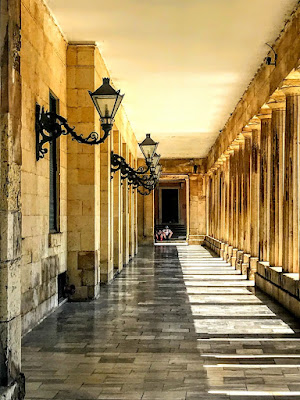
The Palace of Saint Michael and Saint George in Corfu was once home to British administration in the Ionian Islands … the Temple family lived in Corfu in 1828-1833 (Photograph: Patrick Comerford)

Luke 1: 57-66 (NRSVA):

57 Now the time came for Elizabeth to give birth, and she bore a son. 58 Her neighbours and relatives heard that the Lord had shown his great mercy to her, and they rejoiced with her. 59 On the eighth day they came to circumcise the child, and they were going to name him Zechariah after his father. 60 But his mother said, ‘No; he is to be called John.’ 61 They said to her, ‘None of your relatives has this name.’ 62 Then they began motioning to his father to find out what name he wanted to give him. 63 He asked for a writing-tablet and wrote, ‘His name is John.’ And all of them were amazed. 64 Immediately his mouth was opened and his tongue freed, and he began to speak, praising God. 65 Fear came over all their neighbours, and all these things were talked about throughout the entire hill country of Judea. 66 All who heard them pondered them and said, ‘What then will this child become?’ For, indeed, the hand of the Lord was with him.

The Prayer in the USPG Prayer Diary today (23 December 2021) invites us to pray:

We give thanks for the power of creativity to raise awareness of complex issues and break taboos.

Yesterday: Fyodor Dostoevsky

Tomorrow:The Little Drummer Boy

Scripture quotations are from the New Revised Standard Version Bible: Anglicised Edition copyright © 1989, 1995, National Council of the Churches of Christ in the United States of America. Used by permission. All rights reserved worldwide. http://nrsvbibles.org

Further reading:

Peter Hinchliff, Frederick Temple, Archbishop of Canterbury: A Life (Oxford: Clarendon Press, 1998).

07 November 2021

Dancing with Zorba
and Electra on a
return visit to Crete

An improvised interpretation of syrtaki in an olive grove in Crete days after the death of Mikis Theodorakis (Photograph: Patrick Comerford, 2021)

Patrick Comerford

After a two-year absence, I returned to Crete at the end of summer, glad that the lifting of pandemic restrictions allowed me to return to the Greek island I have visited almost every year since the mid-1980s.

Young men from Ireland and England first became acquainted with parts of present-day Italy and Greece in the 18th century, when the ‘Grand Tour’ became an essential part of the education of aristocrats and gentlemen.

Their letters home were the equivalent of later postcards, texts and Facebook postings, their journals the equivalent of blog postings, and the plundered antiquities they brought back have given way to today’s souvenirs and tourist trinkets.

They probably behaved no better than Leaving Cert students now behave in Malia and Hersonissos, but they also reached other parts of Crete. Perhaps the first modern tourist to visit Rethymnon was Richard Pococke (1704-1765). He was an 18th century Church of Ireland Bishop of Ossory (1756-1765) and briefly, before his death, he was Bishop of Meath (1765).

Pococke was ahead of his time: he was in Rethymnon almost a century before Robert Pashley visited Crete in 1834. A century after Pococke’s death, the English writer and artist Edward Lear visited Crete in 1864 and painted five watercolours of Rethymnon.

* * *

During my first week back in Crete, the island was immersed in three days of official mourning for the composer Mikis Theodorakis, who died in Athens but was buried in Chania.

Theodorakis is best-known outside Greece for his film scores, particularly for Zorba the Greek (1964) and the political masterpiece Z (1969). Zorba is based on a novel by the great Cretan author Nikos Kazantzakis, and is remembered for the syrtaki or ‘Zorba’s Dance’ performed by Anthony Quinn.

Anthony Quinn later claimed he had improvised or even invented syrtaki. But it was choreographed for the film by Girogos Provias. It is the staple Greek folkdance, and is a mixture of the slow and fast rhythms in Greek folkdance. On our way back to Rethymnon from the monastery and beaches at Preveli, we were treated to an improvised interpretation of syrtaki in an olive grove in the Kourtaliotiko Gorge.

The Monastery of Arkadi is a national symbol of Greece (Photograph: Patrick Comerford, 2021)

Three monasteries
in the mountains


I have been visiting the Monastery of Arkadi, in the mountains above Rethymnon, since I first arrived in Crete in the mid-1980s. Arkadi is a national symbol, and before Greece joined the Eurozone the monastery featured on the 100 Drachma banknote.

The monastery dates back to the 16th century, if not earlier, and is associated with important cultural figures in the history of Crete, including Georgios Chortatzis, author of the great Cretan epic poem Erofili, written in Rethymnon in 1600.

Bishop Pococke, whose travels have been published in three volumes by Dr Rachel Finnegan, visited Arkadi Monastery in 1739, and wrote: ‘It is a charming structure built around an extensive courtyard. They have a very fine refectory and in the centre of the courtyard a very pretty church with a wonderful facade in the Venetian architectural style.’

But the place of pride held by Arkadi in Greece comes from the massacre of 943 people, mostly women and children, during the Cretan resistance to Ottoman rule. The Greek War of Independence began 200 years ago in 1821, but Crete was still part of the Ottoman Empire when the massacre took place 45 years later, on 8 November 1866.

The Monastery of Preveli looks out onto the island of Gavdos, the southern-most point of Europe, and across the Libyan Sea (Photograph: Patrick Comerford, 2021)

* * *

The Monastery of Preveli, 37 km south of Rethymnon and on the south coast of Crete, stands above the famous ‘Palm Beach’ of Preveli and looks out onto the small island of Gavdos, the southern-most point of Europe, and across the Libyan Sea.

The earliest records for the monastery date back to 1594. In 1821, the Abbot of Preveli, Melchisedek Tsouderos, was a leading figure in the revolutionary events in Crete. Following the catastrophe at Arkadi, Turkish soldiers set fire to the monastery in 1867.

During the German occupation of Crete in World War II, 5,000 stranded Greek, Australian, New Zealand and British troops who fought in the Battle of Crete in 1941, found shelter in Preveli until the Abbot, Agathangelos Lagouvardos, organised their escape to Egypt on two submarines on the nights of 31 May and 1 June 1941 and 20 and 21 August 1941.

The best-known relic in Preveli is the large, richly decorated silver cross brought back from Constantinople by Abbot Ephrem. It is said to contain a relic of the true cross and is kept in a special shrine in the main church. I visited Preveli on the day after the Feast of the Holy Cross. One of the three monks in the monastery put on his stole, took the cross out of its shrine, and blessed me before I went on my way.

West of Preveli, the tiny monastic church dedicated to Saint Paisos of Mount Athos stands on a tall craggy rock above the beaches of Damnoni of Amoudaki. It looks out of place and might be more appropriate among the monasteries of Meteora, perched perilously on high, precipitous rocky peaks in northern Greece.

Saint Paisios (1924-1994), whose feast day is 12 July, is still known for his spiritual guidance and ascetic life and has been described as ‘the saint of the dispirited and of sinners.’ This tiny, almost inaccessible church probably goes unnoticed by tourists, but it was filled with tourists on his feast day this year after popular reports that miraculous myrrh was seen streaming from his icon.

The Church of Saint Paisos might easily sit among the monasteries of Meteora (Photograph: Patrick Comerford, 2021)

Watching the sunset
on the seashore


On the day I visited Preveli Monastery and the Palm Beach below, I also visited the beaches at Plakias, Damnoni and Amoudaki for the first time.

But since 2015, I have been staying in Platanias, a working suburban village on the eastern fringes of Rethymnon that has also grown into a resort in the last decade or so. And one of the joys of staying in Platanias is being a mere a two or three-minute walk from Pavlos Beach.

Pavlos Beach is part of the long, sandy stretch of white beach that stretches for miles and miles east of Rethymnon, as far as the eye can see. When the summer season is at its highest, the beach can be filled with tourists on sunbeds. But, on days when you least expect it, the seas can be turbulent, the sunbeds are abandoned, and it becomes a new pleasure to watch the high waves crashing against the shoreline.

When the tourists leave to get ready for dinner or an evening out, Pavlos Beach comes into its own. It is transformed into a quiet place to watch the sun setting majestically in the east behind Rethymnon and the Venetian Fortezza that dominates the town.

The Venetian harbour and the Ottoman lighthouse of Rethymnon (Photograph: Patrick Comerford, 2021)

* * *

Two friends from Leixlip arrived unexpectedly while we were staying in Rethymnon, and I brought them on a walking tour of the town through the narrow streets, the Venetian churches and palazzi, around the harbour and the lighthouse, into the cafés and tavernas, and up into the Fortezza.

I realised then how I have come to feel at home in the town. But, as they asked questions and expressed their awe and surprise, seeing places with new insights, I wondered whether I had come to take the town for granted over these past three or four decades.

As tour groups elbowed their way past us, I also caught a glimpse of how the residents of Rethymnon must feel about the tourists who crowd out their town for six months of the year.

The real impact of the pandemic lockdown on tourism and its impact on local businesses came a few days later when I brought these friends to Maroulas, an old Venetian village in the hills above Platanias. Only one taverna and one shop were open, the main church and the main Venetian tower were locked, and it was only with great difficulty that we found someone to call a taxi back down to Platanias.

I realised how the economy of Crete, and of Greece in general, depends on the earnings of the tourism sector.

Elektra in Rethymnon … bringing together, Zorba, Euripides and Theodorakis (Photograph: Patrick Comerford, 2021)

When Zorba dances
with Electra


As we walked around the harbour of Rethymnon in early afternoon sunshine, I noticed a boat named Elektra out of the water and near the old lighthouse.

It brought to mind the score Mikis Theodorakis wrote for the film Electra (1962), two years before Zorba the Greek. The film, starring Irene Papas, is based on the play Electra by Euripides. It was the first in a Greek tragedy trilogy by Michael Cacoyannis, followed by The Trojan Women (1971) and Iphigenia (1977).

His music expressed his political values and fused his idealism and his commitment to freedom. His scores for Zorba and Electra show how Theodorakis caught Greek cultural imaginations, combining Greek traditional music and classical composition, high art and popular culture.

In the week after his death, Theodorakis was described by a leading Greek newspaper, Kathimerini, as ‘Greece’s last enduring myth.’

Pavlos Beach, east of the Rethymnon … the sun sets on another holiday (Photograph: Patrick Comerford, 2021)

This feature was first published in the November 2021 edition of the ‘Church Review’ (Dublin and Glendalough)

06 November 2021

Dancing with Zorba in Crete

A two-page feature in the Church Review looking back on a visit to Rethymnon in Crete in September

Patrick Comerford

My monthly column in the Church Review, the Dublin and Glendalough diocesan magaine, is a two-page feature this month (November 2021) that looks back on my visit to Rethymnon in Crete in September, my visits to monasteries and beaches, and at the music and fineral of the composer Mikis Theodorakis.

But more about all that tomorrow HERE.

10 October 2021

Praying in Ordinary Time 2021:
134, Saint Anthony’s Church, Rethymnon

The Church of Saint Anthony of Padua the only Roman Catholic church in Rethymnon (Photograph: Patrick Comerford, 2021)

Patrick Comerford

This is the Nineteenth Sunday after Trinity (Trinity XIX). Later this morning (10 October 2021), I am preaching at the Harvest Thanksgiving in Saint Michael’s Church, Limerick, and, as Canon Precentor, at Choral Mattins in Saint Mary’s Cathedral, Limerick.

But, before the day gets busy, I am taking a little time this morning for prayer, reflection and reading. Each morning in the time in the Church Calendar known as Ordinary Time, I am reflecting in these ways:

1, photographs of a church or place of worship;

2, the day’s Gospel reading;

3, a prayer from the USPG prayer diary.

My theme for these few weeks is churches in the Franciscan (and Capuchin) tradition. In the past, in this series, I have also visited the chapel at Gormanston College, Co Meath (8 March), the Franciscan friary in Askeaton (25 April), the Capuchin Friary in Chania (2 July), and Saint Francis Church in Rethymnon (4 October).

For the past two weeks, my photographs were from churches in Rethymnon, where I spent two weeks last month. So, those two themes are linked in my photographs this morning (10 October 2021), from the Church of Saint Anthony of Padua, the only Roman Catholic church in the old town of Rethymnon.

Inside the Church of Saint Anthony of Padua in Rethymnon (Photograph: Patrick Comerford, 2021)

Saint Francis of Assisi is one of the few Western saints from the period after the great schism who is also revered in the Eastern Church. Many Franciscan churches were built in Crete during the Venetian period, including churches in Iraklion, Rethymnon, Chania and Neapolis, and Petros Philargos, a friar of the Franciscan community in Iraklion who was born in Neapolis in eastern Crete, later became Pope Alexander V.

Saint Francis was popular in the Orthodox community of Crete and by the end of the 14th century was represented in Orthodox Churches throughout the Island. It is mainly due to the fictionalised biography by the Cretan writer Nikos Kazantzakis, The Poor Man of God, that Saint Francis is known throughout the world as ‘God’s Pauper.’

The Church of Saint Anthony of Padua, on the corner of Mesolongíou Street and Salamínas Street, is run by the Franciscan Capuchins and is the only Roman Catholic Church in Rethymnon.

After an absence of over two centuries, ‘God’s paupers’ returned to Rethymnon in 1855 when the Franciscan Capuchins built a small monastery on a corner of Mesolongíou Street.

There had been a continuous, albeit small, Catholic presence in the town since the arrival of the Venetians in the early 13th century, and by the mid-19th century the local Catholic population in Rethymnon was eager to build a new church.

The Roman Catholic Diocese of Crete was established in 1874, and the first bishop was an Italian-born Franciscan Capuchin, Luigi Canavo (1827-1907), who was Bishop of Crete from 1874 to 1889.

Catholic numbers in Rethymnon increased with the arrival of Polish soldiers among the allied forces sent to Crete in the 1890s to hold the peace between the Ottoman Turks and Greek islanders demanding union with the modern Greek state.

A small neoclassical church was built on the corner of Mesolongíou Street and Salamínas Street, behind the old port and close to the entrance to Fortezza.

The new tall, slender, Church of Saint Anthony of Padua was completed on 30 March 1897. The doorway is crowned by a pediment with a semi-circular Venetian window. Above this, there is a circular window in an opening in the centre of the tympanum.

After World War II, Saint Anthony’s Church was sealed for many years, and was in a hazardous state of repair. It was renovated in 1982-1988 and restored to its former glory over 30 years ago with the help of local people and foreign residents, mainly from Switzerland.

There is an older church in the basement beside the present neoclassical church. This was used by the Capuchin Friars from about 1855 and is still in good condition. It is now used as a garage, but it served as a church once again briefly in the 1980s while the main church was being refurbished.

The determination and passion behind the renovation and restoration of Saint Anthony’s Church was the work of a priest of the Catholic Diocese of Crete, Father Andreas Marzohl from Lucern in Switzerland.

Today, the majority of visitors to the church are the thousands of tourists who visit Rethymnon between March and November. The church is open all day, every day, to visitors.

Saint Anthony’s Church is the town’s only Roman Catholic Church but it continues the traditional Franciscan link with Rethymnon, dating back to the Venetian era, when the most important church in the town was Saint Francis (Aghios Frangiskos), the church of the Franciscan Friary in the town.

Services are held in Saint Anthony’s Church from April to October on Saturday (7 p.m.) and Sunday (10 a.m.) and from November to March on Saturday (6 p.m.).

The high altar in the Church of Saint Anthony of Padua in Rethymnon (Photograph: Patrick Comerford, 2021)

Mark 10: 17-31 (NRSVA):

17 As [Jesus] was setting out on a journey, a man ran up and knelt before him, and asked him, ‘Good Teacher, what must I do to inherit eternal life?’ 18 Jesus said to him, ‘Why do you call me good? No one is good but God alone. 19 You know the commandments: “You shall not murder; You shall not commit adultery; You shall not steal; You shall not bear false witness; You shall not defraud; Honour your father and mother”.’ 20 He said to him, ‘Teacher, I have kept all these since my youth.’ 21 Jesus, looking at him, loved him and said, ‘You lack one thing; go, sell what you own, and give the money to the poor, and you will have treasure in heaven; then come, follow me.’ 22 When he heard this, he was shocked and went away grieving, for he had many possessions.

23 Then Jesus looked around and said to his disciples, ‘How hard it will be for those who have wealth to enter the kingdom of God!’ 24 And the disciples were perplexed at these words. But Jesus said to them again, ‘Children, how hard it is to enter the kingdom of God! 25 It is easier for a camel to go through the eye of a needle than for someone who is rich to enter the kingdom of God.’ 26 They were greatly astounded and said to one another, ‘Then who can be saved?’ 27 Jesus looked at them and said, ‘For mortals it is impossible, but not for God; for God all things are possible.’

28 Peter began to say to him, ‘Look, we have left everything and followed you.’ 29 Jesus said, ‘Truly I tell you, there is no one who has left house or brothers or sisters or mother or father or children or fields, for my sake and for the sake of the good news, 30 who will not receive a hundredfold now in this age – houses, brothers and sisters, mothers and children, and fields, with persecutions – and in the age to come eternal life. 31 But many who are first will be last, and the last will be first.’

The church is open all day, every day, to visitors (Photograph: Patrick Comerford, 2021)

The Prayer in the USPG Prayer Diary today (10 October 2021) invites us to pray:

Loving Father,
Teach us to have the right priorities.
Let us focus on fellowship and love,
Rather than material wealth.
May we live in a world in which
People matter more than profit.

Yesterday’s reflection

Continued tomorrow

Saint Anthony’s Church was renovated in 1982-1988 (Photograph: Patrick Comerford, 2021)

Scripture quotations are from the New Revised Standard Version Bible: Anglicised Edition copyright © 1989, 1995, National Council of the Churches of Christ in the United States of America. Used by permission. All rights reserved worldwide. http://nrsvbibles.org

Colourful steps in the side streets between Saint Anthony’s Church and the Fortezza (Photograph: Patrick Comerford)

09 October 2021

Praying in Ordinary Time 2021:
133, Santa Maria (Nerantze Mosque), Rethymnon

When the former Santa Maria Church became the Nerantze Mosque or Gazi Hussein Mosque, the domes and minaret were added (Photograph: Patrick Comerford)

Patrick Comerford

Before the day gets busy, I am taking a little time this morning for prayer, reflection and reading. Each morning in the time in the Church Calendar known as Ordinary Time, I am reflecting in these ways:

1, photographs of a church or place of worship;

2, the day’s Gospel reading;

3, a prayer from the USPG prayer diary.

My theme for these few weeks is churches in Rethymnon on the island of Crete, where I spent two weeks last month.

My photographs this morning (9 October 2021) are from the Church of Santa Maria in the old town of Rethymnon, which became the Nerantze Mosque during the years of Ottoman rule.

The former Santa Maria Church and Nerantze Mosque glimpsed through the streets of the old town of Rethymnon (Photograph: Patrick Comerford, 2021)

The Nerantze Mosque or Gazi Hussein Mosque is on the corner of Ethnikis Antistaseos and Vernardou streets, and faces onto what was once the grand Venetian piazza of the old city.

In Venetian times, this was the Church of Santa Maria. It was built in the style of Saint Mark’s in Venice and faced a large open piazza that included a clock tower, fountains and public buildings.

Santa Maria was originally built in the Venetian period as the church of an Augustinian Priory. But only the east and north side of the original building survive.

The east side has round windows, while the elaborate entrance on the north side, which provides a glimpse of the original splendour of the church, has two tall narrow windows, similar to those in the nearby Saint Francis Church, and a monumental doorway whose design may have been inspired by Roman triumphal arches. The wide entrance is flanked by a pair of columns with Corinthian capitals.

Inside the church, the floor plan is square. During the Turkish era, the original peaked and tiled Venetian roof was replaced by three small domes.

When the town fell to the Turks in 1657, the church was converted into a mosque by Gazi Huseyin Pasha, and three domes were added to the building although it retained its original elaborate entrance. This became the largest mosque in Rethymnon, and in 1890, shortly before Crete became an autonomous state, work began on building the tallest minaret in the town.

After the Turks left Crete, the mosque was reconsecrated as a church in 1925 with a dedication to Saint Nicholas. However, it was seldom if ever used as a church, and for many years housed a Music School.

Now known as the Municipal Odeon, it is a venue for lectures, concerts and theatre performances, and is sometimes open to the public. The minaret has been restored in recent years.

To the west of the church is the shell of the Corpus Christi Chapel, with a Renaissance doorway. This small church, was built at the expense of the sisters Anna and Maria Muazzo, from a well-known Venetian family in Rethymnon whose name survives in the name of a boutique hotel nearby.

When the town fell to the Turks in 1657, the Chapel of Corpus Christi was turned into a library and was also used as a madrassa or Islamic religious school.

Behind the former church, the Nerantze mosque faces onto Mikrasiaton Square (Πλατεία Μικρασιατών), which has been transformed into the biggest square in the heart of the Old Town. Its name recalls the refugees from Asia Minor, who were known as Μικρασιάτες or Mikrasiates, people from Minor Asia. The former Turkish primary school on the square was founded in 1796 and still operates as a primary school today.

Inside the former church or mosque (Photograph: Patrick Comerford)

Luke 11: 27-28 (NRSVA):

27 While he was saying this, a woman in the crowd raised her voice and said to him, ‘Blessed is the womb that bore you and the breasts that nursed you!’ 28 But he said, ‘Blessed rather are those who hear the word of God and obey it!’

The former church doorway of the Santa Maria Church (Photograph: Patrick Comerford)

The Prayer in the USPG Prayer Diary today (9 October 2021) invites us to pray:

Let us pray for peace in the Philippines. May communities across the country live alongside each other harmoniously and combat all forms of persecution.

Yesterday’s reflection

Continued tomorrow

The Corpus Christi Chapel, beside the Nerantze Mosque (Photograph: Patrick Comerford)

Scripture quotations are from the New Revised Standard Version Bible: Anglicised Edition copyright © 1989, 1995, National Council of the Churches of Christ in the United States of America. Used by permission. All rights reserved worldwide. http://nrsvbibles.org

The former Turkish primary school on Mikrasiaton Square still operates as a primary school today (Photograph: Patrick Comerford)

08 October 2021

Praying in Ordinary Time 2021:
132, Saint Nicholas Cathedral, the Fortezza, Rethymnon

The former Venetian Cathedral of Saint Nicholas on the Fortezza in Rethymnon … the stump of the former minaret is to the right (Photograph: Patrick Comerford, 2021)

Patrick Comerford

Before the day gets busy, I am taking a little time this morning for prayer, reflection and reading. Each morning in the time in the Church Calendar known as Ordinary Time, I am reflecting in these ways:

1, photographs of a church or place of worship;

2, the day’s Gospel reading;

3, a prayer from the USPG prayer diary.

My theme for these few weeks is churches in Rethymnon on the island of Crete, where I spent two weeks last month.

My photographs this morning (8 October 2021) are from the former Venetian Cathedral of Saint Nicholas on the Fortezza in Rethymnon.

The over-sized dome has a base diameter of 11 metres and rests on eight arches (Photograph: Patrick Comerford, 2021)

The Fortezza towers above the city of Rethymnon. It was built by the Venetians during their rule in Crete (1204-1669) to protect the city and people from Ottoman invasions. It is built on the hill of Paleokastro and the site the acropolis of ancient Rithymna.

The cathedral of Rethymnon was destroyed during a Turkish attack on the city by the Pasha of Algeria, Ulu Ali Reis, in 1571. A new Episcopal Palace was also built on the Fortezza in 1575, and the foundation stone for a new cathedral was laid in 1583 by the Latin Bishop of Rethymnon, Bartolomeo Chiapponi.

The new Venetian cathedral on the Fortezza was dedicated to Saint Nicholas and stands next to the former Episcopal Palace. When the cathedral was completed in 1585, Bishop Chiapponi’s successor, Bishop Giulio Carrara, refused to celebrated the Mass there, claiming conditions in the cathedral were too cramped and there were no sacred vessels there.

Perhaps these were only excuses, for Bishop Carrara did not want to move up to the Fortezza, and hoped to stay living in the Bishop’s Palace in Arampatzoglou Street (Thessaloníkis Street) in the old town.

The Venetian rettore or governor of Rethymnon, Benetto Bembo, whose official residence was opposite the new cathedral, was insistent on its use, and had alterations made to the cathedral in 1586 so that it could accommodate soldiers and residents at the Sunday Mass and so that the bishop could have no further excuses.

During the Ottoman period, from 1646, the form of the Fortezza did not change significantly, apart from minor extensions and additions. The one significant change they made was to convert Saint Nicholas Cathedral into the Sultan Ibrahim Khan, named in honour of the reigning sultan.

When the cathedral was converted into a mosque, an over-sized dome, with a base diameter of 11 metres, was added. The dome rests on eight arches, four of which are in the middle of the sides, while the other four are in the corners. The side and corner arches meet at a height of about 3 metres above the floor.

This was the first mosque in Rethymnon, and with the large dome and minaret it towered above the city.

The mosque is a square structure with spherical triangles that are formed in the corners by the arcs of the four walls. The unique architectural element that indicates the former existence of the Venetian cathedral is the angular extensions in the north and the west corners of the building.

The heptagonal mihrab or prayer niche pointing towards Mecca is on the south-east side of the mosque. It is decorated elaborately, with the semi-conical coverage decorated with relief stalactites, and with engraved circular rosettes on five of the sides.

Above is a small recessed inscription in Arabic lettering. This is an inscription from the Quran: ‘When Zachariah came to see Maryam (Mary) in the sanctuary’ (3: 37), a reference to a passage about the Virgin Mary’s conception of Christ, designed, perhaps, to appease Christians and encourage their acceptance of the Muslim presence in Rethymnon.

The many openings in the walls ensure good lighting. A heavy chain hanging from the centre of the dome held a large chandelier. The water for the fountain under the dome was stored in a tank.

The interior of the former mosque has been maintained and restored. Only the stump of the minaret survives today. The former mosque is now used for exhibitions and as a venue for music events and recordings.

Inside the former cathedral and former mosque on the Fortezza (Photograph: Patrick Comerford, 2021)

Luke 11: 15-26 (NRSVA):

15 But some of them said, ‘He casts out demons by Beelzebul, the ruler of the demons.’ 16 Others, to test him, kept demanding from him a sign from heaven. 17 But he knew what they were thinking and said to them, ‘Every kingdom divided against itself becomes a desert, and house falls on house. 18 If Satan also is divided against himself, how will his kingdom stand? —for you say that I cast out the demons by Beelzebul. 19 Now if I cast out the demons by Beelzebul, by whom do your exorcists cast them out? Therefore they will be your judges. 20 But if it is by the finger of God that I cast out the demons, then the kingdom of God has come to you. 21 When a strong man, fully armed, guards his castle, his property is safe. 22 But when one stronger than he attacks him and overpowers him, he takes away his armour in which he trusted and divides his plunder. 23 Whoever is not with me is against me, and whoever does not gather with me scatters.

24 ‘When the unclean spirit has gone out of a person, it wanders through waterless regions looking for a resting-place, but not finding any, it says, “I will return to my house from which I came.” 25 When it comes, it finds it swept and put in order. 26 Then it goes and brings seven other spirits more evil than itself, and they enter and live there; and the last state of that person is worse than the first.’

The mihrab or prayer niche pointing towards Mecca is decorated elaborately (Photograph: Patrick Comerford, 2021)

The Prayer in the USPG Prayer Diary today (8 October 2021) invites us to pray:

We pray for the work of the United Nations Permanent Forum on Indigenous Issues. May this arena facilitate the inclusion and amplification of the rights and needs of indigenous communities worldwide.

Yesterday’s reflection

Continued tomorrow

Looking out to the Fortezza from the main door of the former cathedral and mosque (Photograph: Patrick Comerford, 2021)

Scripture quotations are from the New Revised Standard Version Bible: Anglicised Edition copyright © 1989, 1995, National Council of the Churches of Christ in the United States of America. Used by permission. All rights reserved worldwide. http://nrsvbibles.org

The modern Erofili Theatre on the Fortezza modern Erofili Theatre, was built in the Saint Elias Bastion in the 20th century and is named after the play by Georgios Hortatzis, the Rethymnon-born poet of the Cretan Renaissance (Photograph: Patrick Comerford, 2021)

07 October 2021

Praying in Ordinary Time 2021:
131, Saint Theodore Trichinás, the Fortezza, Rethymnon

The Church of Saint Theodore Trichinás is one of two surviving small churches in the Fortezza in Rethymnon (Photograph: Patrick Comerford, 2021)

Patrick Comerford

Before the day gets busy, I am taking a little time this morning for prayer, reflection and reading. Each morning in the time in the Church Calendar known as Ordinary Time, I am reflecting in these ways:

1, photographs of a church or place of worship;

2, the day’s Gospel reading;

3, a prayer from the USPG prayer diary.

My theme for these few weeks is churches in Rethymnon on the island of Crete, where I spent two weeks last month.

My photographs this morning (7 October 2021) are from the Church of Saint Theodore Trichinás, one of two surviving small churches in the Fortezza in Rethymnon.

Inside the Church of Saint Theodore Trichinás on the Fortezza (Photograph: Patrick Comerford, 2021)

The Fortezza towers above the city of Rethymnon. It was built by the Venetians during their rule in Crete (1204-1669) to protect the city and people from Ottoman invasions. It is built on the hill of Paleokastro and the site the acropolis of ancient Rithymna.

During the Ottoman period, from 1646, the form of the Fortezza did not change significantly, apart from minor extensions and additions, and the number of residents increased. During the German occupation of Crete in World War II, the German garrison settled in the Fortezza and turned some of the buildings into prisons and dormitories.

After World War II, the residents gradually started moving from the Fortezza and down into the town below. Today, the Fortezza is managed by the Municipality of Rethymnon. Many of the buildings have been restored, and the Fortezza remains the landmark of Rethymnon.

The Church of Saint Theodore Trichinás is a single-aisle, barrel-vaulted chapel situated between the bastions of Saint Nicholas and Saint Paul.

Saint Theodore Trichinás, a fourth/fifth century monk from Constantinople, is so-called because of his practice of wearing a hairshirt throughout his life. His feast day is on 20 April.

The church was dedicated on 21 March 1899 in the presence of the Russian commander of the allied forces in Rethymnon, General Theodor de Chiostak, during the period of the Cretan State (1898-1913). The general also renovated the bishop’s palace on Mousoúrou Street, near the cathedral, at his own expense.

The biggest bell in Saint Barbara’s Church in the old town also has the name of Theodor de Chiostak, and the other six bells have the names of six Russian regiments.

However, Saint Theodore’s Church was probably not a new church, and the building project may have involved repairing an older, original Venetian church.

Today, many couples in Rethymnon choose a simple, plain wedding in this little church in the setting of a pretty pine copse.

Votive candles burning in the Church of Saint Theodore Trichinás (Photograph: Patrick Comerford, 2021)

Luke 11: 5-13 (NRSVA):

5 [And Jesus] said to them, ‘Suppose one of you has a friend, and you go to him at midnight and say to him, “Friend, lend me three loaves of bread; 6 for a friend of mine has arrived, and I have nothing to set before him.” 7 And he answers from within, “Do not bother me; the door has already been locked, and my children are with me in bed; I cannot get up and give you anything.” 8 I tell you, even though he will not get up and give him anything because he is his friend, at least because of his persistence he will get up and give him whatever he needs.

9 ‘So I say to you, Ask, and it will be given to you; search, and you will find; knock, and the door will be opened for you. 10 For everyone who asks receives, and everyone who searches finds, and for everyone who knocks, the door will be opened. 11 Is there anyone among you who, if your child asks for a fish, will give a snake instead of a fish? 12 Or if the child asks for an egg, will give a scorpion? 13 If you then, who are evil, know how to give good gifts to your children, how much more will the heavenly Father give the Holy Spirit to those who ask him!’

The church was dedicated in 1899 in the presence of the Russian commander in Rethymnon, General Theodor de Chiostak (Photograph: Patrick Comerford, 2021)

The Prayer in the USPG Prayer Diary today (7 October 2021) invites us to pray:

Let us pray for Lumad communities across the Philippines. May they be free from persecution and enabled to live as they wish.

Yesterday’s reflection

Continued tomorrow

The church is a venue of choice for couples in Rethymnon seeking a simple, plain wedding (Photograph: Patrick Comerford, 2021)

Scripture quotations are from the New Revised Standard Version Bible: Anglicised Edition copyright © 1989, 1995, National Council of the Churches of Christ in the United States of America. Used by permission. All rights reserved worldwide. http://nrsvbibles.org

Rethymnon, with its churches and former mosques, spreads below the fortifications of the Fortezza (Photograph: Patrick Comerford, 2021)

06 October 2021

Praying in Ordinary Time 2021:
130, Saint Catherine, the Fortezza, Rethymnon

Saint Catherine’s is a small church in the Fortezza in Rethymnon (Photograph: Patrick Comerford, 2021)

Patrick Comerford

Before the day gets busy, I am taking a little time this morning for prayer, reflection and reading. Each morning in the time in the Church Calendar known as Ordinary Time, I am reflecting in these ways:

1, photographs of a church or place of worship;

2, the day’s Gospel reading;

3, a prayer from the USPG prayer diary.

My theme for these few weeks is churches in Rethymnon on the island of Crete, where I spent two weeks last month.

My photographs this morning (6 October 2021) are from Saint Catherine’s Church, one of two surviving small churches in the Fortezza in Rethymnon.

Inside Saint Catherine’s Church in the Fortezza in Rethymnon (Photograph: Patrick Comerford, 2021)

The Fortezza towers above the city of Rethymnon. It was built by the Venetians during their rule in Crete (1204-1669) to protect the city and people from Ottoman invasions. It is built on the hill of Paleokastro and the site the acropolis of ancient Rithymna.

The Fortezza was founded on 13 September 1573, based on designs by the Italian engineer Sforza Pallavicini, and it was completed in the 1580. The original Venetian plan envisaged moving the entire city permanently into the new fortress. However, the city’s residents were unwilling to move, and the space was inadequate. Finally, only the Venetian administration and guard settled there.

The Fortezza was surrendered to the Ottomans in 1646, and in the decades that followed the form of the Fortezza did not change significantly, apart from minor extensions and additions, and the number of residents increased.

During the German occupation of Crete in World War II, the German garrison settled in the Fortezza and turned some of the buildings into prisons and dormitories. After the Germans left, the residents gradually started moving from the Fortezza and down into the town below.

Many ruined buildings were demolished and the Fortezza became the responsibility of the Municipality of Rethymnon. Since then, great efforts have been invested in restoration work, and the Fortezza remains the landmark of Rethymnon.

Saint Catherine’s Church lies immediately south of the former Episcopal Residence, which is beside the Sultan Ibrahim Khan Mosque, first built as Saint Nicholas Cathedral. The church is a small, single-aisle, barrel-vaulted church, with a simple, wooden iconostasis or icon scree. It was built in the 19th century over a cistern, and was refurbished in 1985.

The simple wooden iconostasis or icon screen in Saint Catherine’s Church (Photograph: Patrick Comerford, 2021)

Luke 11: 1-4 (NRSVA):

1 [Jesus] was praying in a certain place, and after he had finished, one of his disciples said to him, ‘Lord, teach us to pray, as John taught his disciples.’ 2 He said to them, ‘When you pray, say:

Father, hallowed be your name.
Your kingdom come.
3 Give us each day our daily bread.
4 And forgive us our sins,
for we ourselves forgive everyone indebted to us.
And do not bring us to the time of trial.’

An icon of Saint Catherine in Saint Catherine’s Church (Photograph: Patrick Comerford, 2021)

The Prayer in the USPG Prayer Diary today (6 October 2021) invites us to pray:

We pray for the Save Our Schools network and the work they do to bring human rights issues in the Philippines to light.

Yesterday’s reflection

Continued tomorrow

An icon of the Presentation of the Theotokos or the Virgin Mary in Saint Catherine’s Church (Photograph: Patrick Comerford, 2021)

Scripture quotations are from the New Revised Standard Version Bible: Anglicised Edition copyright © 1989, 1995, National Council of the Churches of Christ in the United States of America. Used by permission. All rights reserved worldwide. http://nrsvbibles.org

The Fortezza towers above the city and harbour of Rethymnon (Photograph: Patrick Comerford, 2021)

05 October 2021

Praying in Ordinary Time 2021:
129, Aghia Triada, Platanias

Aghia Triada in the suburban village of Platanias, on the eastern fringes of Rethymnon (Photograph: Patrick Comerford)

Patrick Comerford

Before the day gets busy, I am taking a little time this morning for prayer, reflection and reading. Each morning in the time in the Church Calendar known as Ordinary Time, I am reflecting in these ways:

1, photographs of a church or place of worship;

2, the day’s Gospel reading;

3, a prayer from the USPG prayer diary.

My theme for these few weeks is churches in Rethymnon on the island of Crete, where I spent two weeks last month.

My photographs this morning (5 October 2021) are from the Church of the Holy Trinity or Aghia Triada in the suburban village of Platanias, on the eastern fringes of Rethymnon.

The iconostasis or icon screen in Aghia Triada Church in Platanias (Photograph: Patrick Comerford)

I have been visiting Rethymnon almost annually since the mid-1980s, and I have stayed in the suburban areas of Platanias and Tsesmes, east of Rethymnon, since 2015. This area is a mix of suburban, commercial, and slowly developing tourism.

The shops and supermarkets cater primarily for the local residents, but there is a number of small hotels and apartment blocks where I have stayed, including La Stella, Varvara’s Diamond, and Julia Apartments, and restaurants that I have become comfortable with and where I receive a warm welcome each time I return.

These two villages have merged almost seamlessly, and although they have two churches, they form one parish, served by one priest, Father Dimitrios Tsakpinis.

These churches are recently-built parish churches: the church in Platanias dates from 1959 and the church in Tsesmes from 1979. They are small, and in many ways, unremarkable churches, compared to the older, more historic churches in the old town of Rethymnon.

But when I am staying in Platanias and Tsesmes, I have seen them as my parish churches, and I have always been welcomed warmly.

The church in Platantias, just 100 metres south of long sandy beach that stretches for kilometres east of Rethymnon, is dedicated to the Holy Trinity (Αγία Τριάδα).

The Divine Liturgy in Aghia Triada Church in Platanias (Photograph: Patrick Comerford)

Luke 10: 38-42 (NRSVA):

38 Now as they went on their way, he entered a certain village, where a woman named Martha welcomed him into her home. 39 She had a sister named Mary, who sat at the Lord’s feet and listened to what he was saying. 40 But Martha was distracted by her many tasks; so she came to him and asked, ‘Lord, do you not care that my sister has left me to do all the work by myself? Tell her then to help me.’ 41 But the Lord answered her, ‘Martha, Martha, you are worried and distracted by many things; 42 there is need of only one thing. Mary has chosen the better part, which will not be taken away from her.’

A Sunday morning in Aghia Triada Church in Platanias (Photograph: Patrick Comerford)

The Prayer in the USPG Prayer Diary today (5 October 2021, World Teachers’ Day) invites us to pray:

Let us pray for those who teach in schools, universities and other educational institutions. May we continue to learn from those around us.

Yesterday’s reflection

Continued tomorrow

The bells of Aghia Triada Church in Platanias, which dates from 1959 (Photograph: Patrick Comerford)

Scripture quotations are from the New Revised Standard Version Bible: Anglicised Edition copyright © 1989, 1995, National Council of the Churches of Christ in the United States of America. Used by permission. All rights reserved worldwide. http://nrsvbibles.org

Sunset at Pavlos Beach behind Aghia Triada Church, with the Fortezza and Rethymnon to the west (Photograph: Patrick Comerford, 2021)

04 October 2021

Praying in Ordinary Time 2021:
128, Saint Francis Church, Rethymnon

The former Church of Saint Francis on Saint Francis street now hosts the Archaeological Museum of Rethymnon (Photograph: Patrick Comerford, 2021)

Patrick Comerford

Today is the Feast of Saint Francis (4 October 2021), one of the few post-schism Western saints who remains popular in the Orthodox Church. Saint Francis is recalled on this day in the calendars of many Anglican churches, although not in the calendar of the Church of Ireland.

Before the day gets busy, I am taking a little time this morning for prayer, reflection and reading. Each morning in the time in the Church Calendar known as Ordinary Time, I am reflecting in these ways:

1, photographs of a church or place of worship;

2, the day’s Gospel reading;

3, a prayer from the USPG prayer diary.

My theme for these few weeks is churches in Rethymnon on the island of Crete, where I spent two weeks in mid-September.

My photographs this morning (4 October 2021) are from the Church of Saint Francis on Saint Francis street (Αγίου Φραγκίσκου, Agiou Frankiskou), between Ethnikís Antistaseos street (Εθνικής Αντιστάσεως) and Mikrasiaton square (Μικρασιατών) in the heart of the old city.

Gazi Huseyin Pasha incorporated the church into in a larger complex and the former church was used as a poorhouse during the Turkish occupation (Photograph: Patrick Comerford, 2021)

During the Venetian period in Crete, many Franciscan churches were built in Crete, including Iraklion, Rethymnon, Chania and Neapolis. Petros Philargos, a friar of the Franciscan community in Iraklion who was born in Neapolis in eastern Crete, later became Pope Alexander V.

The Church of Saint Francis was the main church of the Franciscan monastery in Venetian Rethymnon. It was founded at the turn of the 16th and 17th centuries, and despite the small number of friars, the monastery enjoyed considerable prestige and became the burial place for members of the nobility, officials, and wealthy families.

The churches and some annexes on the south side are the only surviving buildings of the former monastery.

The church was a timber-roofed basilica with transepts, having a square sanctuary and two side chapels. The central nave was separated from the rest of the church by a wall built in the Ottoman period.

The transept has no roof, and the sanctuary and part of the south chapel are now in private ownership.

The magnificent doorway and its composite columns are unique in Rethymnon and are part of the building programme in the late 16th and early 17th century that gave the monastery its Renaissance character.

This elaborately – almost excessively – decorated ornate doorway is mainly Corinthian in style, but it includes the only example in Rethymnon of compound capitals, which are one of the five Renaissance styles. The overlapping levels of the architrave help to date the doorway from the same time as both the doorway of Santa Maria Church and the Rimondi fountain, both only a few paces away. The keystone is notable for its large acanthus flower.

The south chapel is noted for its dome, which rests on four pairs of arches supported by pillars and columns, all made of grey marble from Istria, a rare material in Venetian Crete.

Excavation in the west nave uncovered several makeshift shaft graves that have been linked with the Ottoman siege of the city in 1646. The transept and north chapel contained well-made cist graves. The single tomb in the centre of the south chapel probably belonged to a prominent member of the local community.

After the Ottoman capture of Rethymnon, Gazi Huseyin Pasha incorporated the church into in a complex that included the neighbouring Nerantze Mosque in 1654, and the former church was used as an imaret or poorhouse during the Turkish occupation.

In the 1920s, the church was used to provide shelter for Greek refugees from Anatolia. In more recent years it contained a number of shops, and then until 1996 it was used as an exhibition centre for the local city council.

Careless and fruitless attempts at restoration work in the 1970s led to part of the building being demolished. However, recent excavations around the church unearthed some important archaeological discoveries, including the tombs of two Venetian nobles.

For a time, the building belonged to the University of Crete, and the later plans are to use the former church to house the Byzantine Museum of Rethymnon and the Byzantine and Post-Byzantine Collection of the Prefecture of Rethymnon. For many years, it remains closed to the public, but it now hosts the Archaeological Museum of Rethymnon.

Inside the former Church of Saint Francis (Photograph: Patrick Comerford, 2021)

Luke 10: 25-37 (NRSVA):

25 Just then a lawyer stood up to test Jesus. ‘Teacher,’ he said, ‘what must I do to inherit eternal life?’ 26 He said to him, ‘What is written in the law? What do you read there?’ 27 He answered, ‘You shall love the Lord your God with all your heart, and with all your soul, and with all your strength, and with all your mind; and your neighbour as yourself.’ 28 And he said to him, ‘You have given the right answer; do this, and you will live.’

29 But wanting to justify himself, he asked Jesus, ‘And who is my neighbour?’ 30 Jesus replied, ‘A man was going down from Jerusalem to Jericho, and fell into the hands of robbers, who stripped him, beat him, and went away, leaving him half dead. 31 Now by chance a priest was going down that road; and when he saw him, he passed by on the other side. 32 So likewise a Levite, when he came to the place and saw him, passed by on the other side. 33 But a Samaritan while travelling came near him; and when he saw him, he was moved with pity. 34 He went to him and bandaged his wounds, having poured oil and wine on them. Then he put him on his own animal, brought him to an inn, and took care of him. 35 The next day he took out two denarii, gave them to the innkeeper, and said, “Take care of him; and when I come back, I will repay you whatever more you spend.” 36 Which of these three, do you think, was a neighbour to the man who fell into the hands of the robbers?’ 37 He said, ‘The one who showed him mercy.’ Jesus said to him, ‘Go and do likewise.’

The magnificent doorway and its composite columns are unique in Rethymnon (Photograph: Patrick Comerford, 2021)

The Prayer in the USPG Prayer Diary today (4 October 2021, Saint Francis, World Habitat Day) invites us to pray:

Lord, we give thanks for your bountiful creation. May we endeavour to take better care of the environment by living sustainably.

Yesterday’s reflection

Continued tomorrow

A relief from the funerary monument of a priest’s wife, Maria Kouratoupolou (1531), from Saint John’s Church, Skouloufia (Photograph: Patrick Comerford, 2021)

Scripture quotations are from the New Revised Standard Version Bible: Anglicised Edition copyright © 1989, 1995, National Council of the Churches of Christ in the United States of America. Used by permission. All rights reserved worldwide. http://nrsvbibles.org

A 15th century Byzantine-style fresco from the Church of the Panaghia (Virgin Mary) at Patsos in Amari (Photograph: Patrick Comerford, 2021)