The Cadogan Hall in Chelsea is a former Christian Science Church designed by Robert Fellowes Chisholm in the Byzantine Revival style with some eastern elements (Photograph: Patrick Comerford, 2022)
Patrick Comerford
The Cadogan Hall is a 950-seat concert hall in the heart of Chelsea, off Sloane Square and Sloane Street, between Sloane Terrace and Wilbraham Place. This impressive building is the home of the Royal Philharmonic Orchestra. It is only steps away from Holy Trinity Church, Sloane Square, and with its domed campanile it too looks a church or, perhaps even, a mosque – because the building was designed as a Christian Science Church over a century ago.
The church was designed by Robert Fellowes Chisholm (1840-1915), and when it opened in 1907 it could hold a congregation of up to 1,400 people.
The Christian Science movement was founded by Mary Baker Eddy in Boston in 1879. The first Christian Scientists on these islands were Graves Colles and Marjorie Colles of Killiney, Co Dublin, some time around 1888-1893, and Christian Science came to Britain in 1890.
Mary Baker Eddy sent students to London, where fashionable West End women began to be attracted to it. The first Christian Science services in London were in one of the Portman Rooms, Baker Street and Dorset Street, in February 1896.
Three years after the original ‘Mother Church’ was completed in Boston, the London congregation moved into the old Spanish and Portuguese Synagogue in Bryanston Street, near Marble Arch, in 1897.
The former Sephardic synagogue in Marylebone was built in 1861, but closed in 1896 when the congregation moved to Lauderdale Road. The building was remodelled and when it opened in late 1897 it was the first Christian Science church in Europe.
The former Christian Science church was built on the site of a disused Wesleyan chapel in Chelsea in 1904-1909 (Photograph: Patrick Comerford, 2022)
Less than two decades later, the members bought a disused Wesleyan chapel on a freehold site in Chelsea for almost £40,000 in April 1903 and hired Chisholm as the architect for a new church. When building their own churches, Christian Scientists looked to their churches in Boston as examples. But Chisholm had worked in eastern architectural idioms in India, and provided a completely original design for the new Christian Science church in London.
However, a more traditional plan was asked for, and Chisholm provided a more traditional design in the Byzantine Revival style, with some eastern elements and seven coupled windows across the façade.
Chisholm was a pioneer the Indo-Saracenic style of architecture in Madras. The Indo-Saracenic style was also known as Indo-Gothic, Mughal-Gothic, Neo-Mughal, or Hindoo style. This revivalist architectural style was used by many British architects in India in the late 19th century, especially in public and government buildings for the British Raj and palaces for princely rulers. It drew stylistic and decorative elements from native Indo-Islamic architecture, especially Mughal architecture, and, less often, from Hindu temple architecture.
Chisholm was born in London and even in his youth he was recognised as a talented landscape painter. He moved to Madras in 1865, where he became head of the school of industrial art.
Chisholm began to design the older building of Presidency College, Madras (1865-1870). His first buildings were in the Renaissance and Gothic styles, and he designed or rebuilt the Presidency College, Madras (1865-1870), the Nilgiri Library (1869) and the Lawrence Memorial School in in Ootacamund (1865-1869). The revenue board building in the Chepauk Palace complex (1871) was his first building in the ‘Indo-Saracenic’ style.
Chisholm became Consulting Architect to the Government of Madras in 1872, and designed the Napier Museum, Trivandrum, the Senate buildings of the University of Madras (1874-1879), the offices of P Orr & Sons and the Post and Telegraph Office in Ootacamund (1875-1883), and he enlarged and built a pavilion at the MA Chidambaram Stadium. He also designed the Bombay Municipal Offices and the immense Laxmi Vilas Palace in Baroda (Vadodara) in 1880-1890.
Robert Fellowes Chisolm incorporated both classical and Byzantine elements in his design of the church (Photograph: Patrick Comerford, 2022)
Chisholm returned to London in 1902, and his best-known building there was the First Church of Christ Scientist or Cadogan Hall near Sloane Square. He died on 28 May 1915 at Southsea at the age of 75.
The cornerstone of the Christian Science church was made of granite from Concord, New Hampshire, and was laid on 19 November 1904. As the church was being built, Christian Scientists in London had so grown in influence that over 9,000 people were invited to a Christian Science lecture by an American Bicknell Young in the Albert Hall in 1907.
The new church was built at a cost of £40,000 and was dedicated on 13 June 1909.
The church was built in the Byzantine style in Portland stone ashlar. It has a five-bay granite arcade on the ground storey, seven round-headed two-light windows above with carved capitals, a central entrance, and a dome-capped campanile at the south-east corner.
An architectural critic called the church an ‘Indian Reminiscence in Chelsea’ and suggested that ‘one would not be surprised to see a muezzin call the faithful to prayer’ from the tower’s ‘lofty outlook.’
He told the readers of the Evening Standard that the ‘decorative details … are of an Anglo-Norman type well suited to the monumental character of the design.’ But, because it Christian Science was a religion from America, ‘its projectors were under the influence of [Henry Hobson] Richardson, that architect who has invested American architecture with proportions almost Cyclopean.’
The Architect and Contract Reporter thought differently: ‘The particular style of architecture for a Christian Science church should present no difficulties. The very early churches were mostly pagan temples converted into churches; when constructed as churches they exhibited many Eastern features.’ The writer was implying that Christian Science was returning to the time of primitive Christianity, where both classical and Byzantine designs were historically located.
The church had a three-manual pipe organ built by JW Walker & Sons in 1907 and installed in 1911. It was on a raised position on the platform.
The stained-glass windows were designed by the Danish artist and aristocrat Baron Arild Rosenkrantz (Photograph: Patrick Comerford, 2022)
The stained-glass windows were designed by the Danish painter, sculptor and artist, Baron Arild Rosenkrantz (1870-1964). He studied art in Rome under Modesto Faustini, who instilled an appreciation of the Italian masters. Rosenkrantz later studied under Jean-Paul Laurens and Benjamin Constant in Paris and was also influenced by the Pre-Raphaelites, JMW Turner, William Blake and Claude Monet.
When he was studying in the US in 1894-1895, Rosenkrantz made glasswork for Tiffany. While he lived in London in 1898-1914, he developed his reputation as an artist and made stained-glass windows for a wide range of English churches and mansions, including the Christian Science church in Chelsea.
Under the influence of Rudolf Steiner, Rosenkranktz and his wife moved to Dornach in Switzerland, but they returned to London after Steiner died in 1925. Back in London, he designed costumes, created stage decorations and decorated the interior of two theatres.
Rosenkrantz returned to Denmark in 1939 to organise an exhibition in Copenhagen for his 70th birthday in 1940. However, Nazi Germany invaded Denmark and he found it impossible to return to London was impossible. His moved to Rosenholm Castle in Jutland and died in 1964.
The Christian Science church in Chelsea was listed a Grade II building in 1969.
The congregation had fallen dramatically by 1996 and the building fell into disuse as a smaller congregation moved to Kensington (Photograph: Patrick Comerford, 2022)
The congregation had fakken dramatically by 1996. When a smaller congregation moved to an updated church building in Wright’s Lane in Kensington, the hall was sold and fell into disuse for several years.
Mohamed Fayed, then owner of Harrods, had bought the property, but because of its listed status he was unable to secure permission to convert it into a palatial luxury house.
Cadogan Estates bought the building in 2000 to safeguard its future. The property company is owned by Lord Cadogan, whose ancestors have been the main landowners in Chelsea since the 18th century, and the family gives its names to many nearby addresses, including Cadogan Square, Cadogan Place, Sloane Square, Sloane Street and Sloane Terrace.
Through its connections with Opera Holland Park, the Cadogan Estate found that the Royal Philharmonic Orchestra was looking for a permanent base in London. Cadogan Hall was an excellent opportunity for the orchestra to benefit from the Cadogan Estate’s aim to bring the former church back to life in a way that befitted its character and civic presence.
The building was refurbished by Paul Davis and Partners Architects at a cost of £7.5 million. The changes included new lighting and sound systems and bespoke acoustic ceiling modules in the performance space. The hall reopened as a concert hall in 2004.
The 1911 Walker organ was carefully dismantled and put into store. The original intention was to install the organ in a church in the Midlands. Instead, however, it was installed in Christ the King Catholic Church in Gothenburg, Sweden, in 2009-2010. Walker’s organ case, an integral part of the character of the auditorium, remains in place in the concert hall.
The Royal Philharmonic Orchestra (RPO), now the resident music ensemble at Cadogan Hall, is the first London orchestra to have a permanent home. It gave its first concert as the resident ensemble of Cadogan Hall in November 2004.
Cadogan Hall has become one of London’s leading venues. Its surroundings makes it a choice for some leading orchestras and the chosen venue for the BBC Proms Chamber Music Series. It also offers a vibrant selection of contemporary, jazz, folk and world music events as well as talks, debates and conferences.
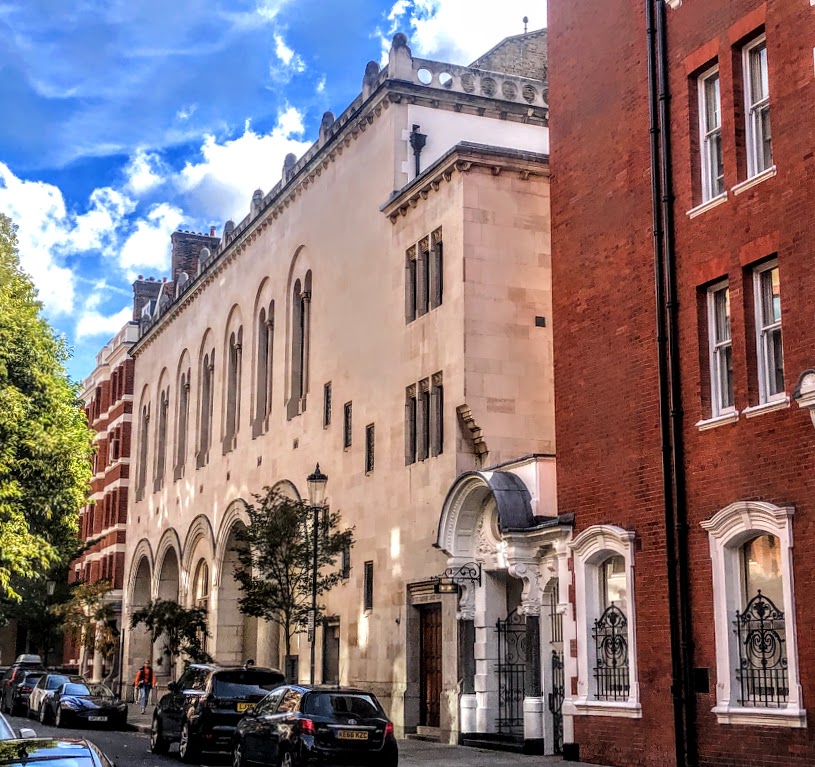
Cadogan Hall is the home of the Royal Philharmonic Orchestra and one of London’s leading venues (Photograph: Patrick Comerford, 2022)
Showing posts with label Chelsea. Show all posts
03 October 2022
Keeping up appearances
on Sloane Square after
the arrest of Oscar Wilde
The Cadogan Hotel, where Oscar Wilde was arrested in 1895 (Photograph: Patrick Comerford, 2022)
Patrick Comerford
Sloane Street and Sloane Square are part of the Cadogan Estate, one of London’s most expensive retailing districts with some of the most expensive residential property in Chelsea and Knightsbridge.
The estate’s streets and buildings were first commissioned by Charles Cadogan, 1st Earl Cadogan, in the 18th century, and Sloane Street evolved into one of the world’s most exclusive retail areas. The shops include Chloe, Salvatore Ferragamo, Giorgio Armani, Tom Ford and Valentino.
I was not in Sloane Square and Sloane Street to go shopping, but to take part in a day’s events organised by the Anglican mission agency USPG (United Society Partners in the Gospel) in Holy Trinity Church, also built by the Cadogan Estate.
Before the day’s programme began, I walked the length of Sloane Street to see the Cadogan Hotel, where Oscar Wilde (1854-1900) was arrested in 1895 and which is the venue at the centre of a celebrated poem by the Poet Laureate Sir John Betjeman (1906-1984).
Betjeman’s poem ‘The Arrest of Oscar Wilde at the Cadogan Hotel’ tells of the arrest of the Irish-born poet, playwright and wit in the hotel on Sloane Street on 6 April 1895.
The Cadogan Hotel on Sloane Street, was built in 1887 and is one of London’s most prestigious luxury hotels.
Lillie Langtry, famous actress and close friend of Edward VII and of Oscar Wilde, lived at 21 Pont Street from 1892 to 1897. A blue plaque recalls that long after she had sold the house, Lillie Langtry continued to stay in her old bedroom, by then a part of the hotel.
Shortly after it opened, the Cadogan Hotel became infamous for the arrest of Oscar Wilde in Room 118, charged with ‘committing acts of gross indecency with other male persons.’ The events in the room are recalled by Betjeman in his tragic poem.
The Marquess of Queensbury, father of his Wilde’s long-time lover, Sir Alfred Douglas, was at the centre of Wilde’s arrest, trial, and imprisonment. Wilde sued Queensbury for defamation, but this lead to the case in which Wilde’s homosexuality was all but proven for the court. The lawsuit was eventually withdrawn. This was seen as an admission of guilt on Wilde’s part and he was soon arrested.
In this poem, the John Betjeman imagines the moment when Oscar Wilde was arrested on 6 April 1895. Wilde was charged with gross indecency and, at a time when homosexuality was illegal, he was sentenced to two years’ hard labour. The prison regime was brutal and, although he was released in 1897, a toxic mix of illnesses contracted in prison and a increasing alcoholism lead to his death in Paris in 1900.
The poem has significant rhythm and rhyme and deploys three voices. Its rhyming scheme and use of quatrains make ‘The Arrest of Oscar Wilde at the Cadogan Hotel’ a ballad.
The voice of narrator is almost without emotion, describing the scene inside the Cadogan Hotel where Oscar Wilde and his friend Robbie Ross are waiting for the inevitable arrival of the police.
Oscar Wilde presents the second voice at the moment of crisis.
The third voices are those of the policemen, who speak with an almost pantomime quality. Their language, dialect and accents emphasise the gap between the sophisticated and cultured poet and the working class background of the ‘two plain clothes policemen.’
The poem begins with the speaker describing how the Wilde spent his last moments with his close friend the journalist Robbie Ross before his arrest in the Cadogan Hotel. Wilde and Ross were once been in a relationship, and Ross worked as Wilde’s literary executor after his death. Ross was with Wilde at his deathbed in Paris, and his ashes are within the headstone on Wilde’s grave.
Wilde was continuously drinking and knew everything was about to change. The unmade bed may be a symbol of Wilde’s mental state at this point in his life. He knew that things were starting to cascade against him.
He grows more irritated that the hotel and Robbie are not acting fast enough. Eventually, he starts wondering about the location of his expensive coats and his leather suitcase or ‘portmanteau’.
The fourth stanza refers to The Yellow Book, a literary periodical in London in the 1890s. It features in Wilde’s novel, The Picture of Dorian Gray, and the art director, Audrey Beardsley, who produced illustrations for Wilde’s play Salome in 1893. It is thought Wilde had this publication with him when he was arrested at the Cadogan Hotel.
John Buchan’s works were also published in The Yellow Book, but Wilde looked down on Buchan’s writing, dismissing it is a backward step for literature and society.
The arrival of the two plain clothes policemen is the turning point in the poem, when the climactic moment of Wilde’s arrest arrives. There is thumping and murmuring outside the door and as they come in Wilde light-heartedly complains about the noise they are making.
There are some noises outside the door as the two policemen enter. They ask Wilde to come ‘quoietly’ and to leave the hotel with them. They see the Cadogan Hotel as a reputable respectable establishment, and do not want to disturb the guests or the staff, dismissed by Wilde as ‘little better than cretins’.
Wilde is taken away without much fuss. On the way to the waiting hansom cab or two-wheeled coach outside, he touches the plants on the staircase, and the poem ends abruptly with him being helped into the carriage. The poem ends abruptly, leaving the reader to mourn over Wilde’s fate.
The Arrest of Oscar Wilde at the Cadogan Hotel (1937), by John Betjeman
He sipped at a weak hock and seltzer
As he gazed at the London skies
Through the Nottingham lace of the curtains
Or was it his bees-winged eyes?
To the right and before him Pont Street
Did tower in her new built red,
As hard as the morning gaslight
That shone on his unmade bed,
“I want some more hock in my seltzer,
And Robbie, please give me your hand —
Is this the end or beginning?
How can I understand?
“So you’ve brought me the latest Yellow Book:
And Buchan has got in it now:
Approval of what is approved of
Is as false as a well-kept vow.
“More hock, Robbie — where is the seltzer?
Dear boy, pull again at the bell!
They are all little better than cretins,
Though this is the Cadogan Hotel.
“One astrakhan coat is at Willis’s —
Another one’s at the Savoy:
Do fetch my morocco portmanteau,
And bring them on later, dear boy.”
A thump, and a murmur of voices —
(”Oh why must they make such a din?”)
As the door of the bedroom swung open
And TWO PLAIN CLOTHES POLICEMEN came in:
“Mr. Woilde, we ’ave come for tew take yew
Where felons and criminals dwell:
We must ask yew tew leave with us quoietly
For this is the Cadogan Hotel.”
He rose, and he put down The Yellow Book.
He staggered — and, terrible-eyed,
He brushed past the plants on the staircase
And was helped to a hansom outside.
Danny Osborne’s sculpture of Oscar Wilde in Merrion Square, Dublin … unveiled in 1997, 100 years after Wilde was arrested in the Cadogan Hotel (Photograph: Patrick Comerford, 2022)
Poem © John Betjeman and The Estate of John Betjeman
Patrick Comerford
Sloane Street and Sloane Square are part of the Cadogan Estate, one of London’s most expensive retailing districts with some of the most expensive residential property in Chelsea and Knightsbridge.
The estate’s streets and buildings were first commissioned by Charles Cadogan, 1st Earl Cadogan, in the 18th century, and Sloane Street evolved into one of the world’s most exclusive retail areas. The shops include Chloe, Salvatore Ferragamo, Giorgio Armani, Tom Ford and Valentino.
I was not in Sloane Square and Sloane Street to go shopping, but to take part in a day’s events organised by the Anglican mission agency USPG (United Society Partners in the Gospel) in Holy Trinity Church, also built by the Cadogan Estate.
Before the day’s programme began, I walked the length of Sloane Street to see the Cadogan Hotel, where Oscar Wilde (1854-1900) was arrested in 1895 and which is the venue at the centre of a celebrated poem by the Poet Laureate Sir John Betjeman (1906-1984).
Betjeman’s poem ‘The Arrest of Oscar Wilde at the Cadogan Hotel’ tells of the arrest of the Irish-born poet, playwright and wit in the hotel on Sloane Street on 6 April 1895.
The Cadogan Hotel on Sloane Street, was built in 1887 and is one of London’s most prestigious luxury hotels.
Lillie Langtry, famous actress and close friend of Edward VII and of Oscar Wilde, lived at 21 Pont Street from 1892 to 1897. A blue plaque recalls that long after she had sold the house, Lillie Langtry continued to stay in her old bedroom, by then a part of the hotel.
Shortly after it opened, the Cadogan Hotel became infamous for the arrest of Oscar Wilde in Room 118, charged with ‘committing acts of gross indecency with other male persons.’ The events in the room are recalled by Betjeman in his tragic poem.
The Marquess of Queensbury, father of his Wilde’s long-time lover, Sir Alfred Douglas, was at the centre of Wilde’s arrest, trial, and imprisonment. Wilde sued Queensbury for defamation, but this lead to the case in which Wilde’s homosexuality was all but proven for the court. The lawsuit was eventually withdrawn. This was seen as an admission of guilt on Wilde’s part and he was soon arrested.
In this poem, the John Betjeman imagines the moment when Oscar Wilde was arrested on 6 April 1895. Wilde was charged with gross indecency and, at a time when homosexuality was illegal, he was sentenced to two years’ hard labour. The prison regime was brutal and, although he was released in 1897, a toxic mix of illnesses contracted in prison and a increasing alcoholism lead to his death in Paris in 1900.
The poem has significant rhythm and rhyme and deploys three voices. Its rhyming scheme and use of quatrains make ‘The Arrest of Oscar Wilde at the Cadogan Hotel’ a ballad.
The voice of narrator is almost without emotion, describing the scene inside the Cadogan Hotel where Oscar Wilde and his friend Robbie Ross are waiting for the inevitable arrival of the police.
Oscar Wilde presents the second voice at the moment of crisis.
The third voices are those of the policemen, who speak with an almost pantomime quality. Their language, dialect and accents emphasise the gap between the sophisticated and cultured poet and the working class background of the ‘two plain clothes policemen.’
The poem begins with the speaker describing how the Wilde spent his last moments with his close friend the journalist Robbie Ross before his arrest in the Cadogan Hotel. Wilde and Ross were once been in a relationship, and Ross worked as Wilde’s literary executor after his death. Ross was with Wilde at his deathbed in Paris, and his ashes are within the headstone on Wilde’s grave.
Wilde was continuously drinking and knew everything was about to change. The unmade bed may be a symbol of Wilde’s mental state at this point in his life. He knew that things were starting to cascade against him.
He grows more irritated that the hotel and Robbie are not acting fast enough. Eventually, he starts wondering about the location of his expensive coats and his leather suitcase or ‘portmanteau’.
The fourth stanza refers to The Yellow Book, a literary periodical in London in the 1890s. It features in Wilde’s novel, The Picture of Dorian Gray, and the art director, Audrey Beardsley, who produced illustrations for Wilde’s play Salome in 1893. It is thought Wilde had this publication with him when he was arrested at the Cadogan Hotel.
John Buchan’s works were also published in The Yellow Book, but Wilde looked down on Buchan’s writing, dismissing it is a backward step for literature and society.
The arrival of the two plain clothes policemen is the turning point in the poem, when the climactic moment of Wilde’s arrest arrives. There is thumping and murmuring outside the door and as they come in Wilde light-heartedly complains about the noise they are making.
There are some noises outside the door as the two policemen enter. They ask Wilde to come ‘quoietly’ and to leave the hotel with them. They see the Cadogan Hotel as a reputable respectable establishment, and do not want to disturb the guests or the staff, dismissed by Wilde as ‘little better than cretins’.
Wilde is taken away without much fuss. On the way to the waiting hansom cab or two-wheeled coach outside, he touches the plants on the staircase, and the poem ends abruptly with him being helped into the carriage. The poem ends abruptly, leaving the reader to mourn over Wilde’s fate.
The Arrest of Oscar Wilde at the Cadogan Hotel (1937), by John Betjeman
He sipped at a weak hock and seltzer
As he gazed at the London skies
Through the Nottingham lace of the curtains
Or was it his bees-winged eyes?
To the right and before him Pont Street
Did tower in her new built red,
As hard as the morning gaslight
That shone on his unmade bed,
“I want some more hock in my seltzer,
And Robbie, please give me your hand —
Is this the end or beginning?
How can I understand?
“So you’ve brought me the latest Yellow Book:
And Buchan has got in it now:
Approval of what is approved of
Is as false as a well-kept vow.
“More hock, Robbie — where is the seltzer?
Dear boy, pull again at the bell!
They are all little better than cretins,
Though this is the Cadogan Hotel.
“One astrakhan coat is at Willis’s —
Another one’s at the Savoy:
Do fetch my morocco portmanteau,
And bring them on later, dear boy.”
A thump, and a murmur of voices —
(”Oh why must they make such a din?”)
As the door of the bedroom swung open
And TWO PLAIN CLOTHES POLICEMEN came in:
“Mr. Woilde, we ’ave come for tew take yew
Where felons and criminals dwell:
We must ask yew tew leave with us quoietly
For this is the Cadogan Hotel.”
He rose, and he put down The Yellow Book.
He staggered — and, terrible-eyed,
He brushed past the plants on the staircase
And was helped to a hansom outside.
Danny Osborne’s sculpture of Oscar Wilde in Merrion Square, Dublin … unveiled in 1997, 100 years after Wilde was arrested in the Cadogan Hotel (Photograph: Patrick Comerford, 2022)
Poem © John Betjeman and The Estate of John Betjeman
28 September 2022
Holy Trinity Sloane Square is
John Betjeman’s ‘Cathedral of
the Arts and Crafts Movement’
Part of the Edward Burne-Jones East Window in Holy Trinity Church, Sloane Square, London (Photograph: Patrick Comerford, 2022)
Patrick Comerford
I was in London last weekend for the annual reunion of the Anglican mission agency USPG (United Society Partners in the Gospel). We were invited to a celebration of the Eucharist in Holy Trinity Church, Sloane Square, followed by lunch and short presentations by USPG staff.
Holy Trinity Church, Sloane Square, is right at the heart of London. The former Poet Laureate, Sir John Betjeman, described Holy Trinity Church in Chelsea as the ‘Cathedral of the Arts and Crafts Movement’, referring to treasures and glass by William Morris, Edward Burne-Jones and many others.
Holy Trinity Sloane Square is in the Catholic tradition in the Church of England, and says on its website and materials ‘The world will be saved by beauty’, a quotation from The Fool by Fyodor Dostoevsky.
Holy Trinity Church, Sloane Square, was described by John Betjeman as the ‘Cathedral of the Arts and Crafts Movement’ (Photograph: Patrick Comerford, 2022)
Holy Trinity is one of the few churches in these islands that can be regarded as what the Germans describe as a gesamtkunstwerk – a total work of art. Behind the magnificent red brick and stone façade, reminiscent of collegiate architecture of the late 16th and early 17th century, is truly a jewel-box of the best stained glass, sculpture and highly wrought metalwork created by many of the finest artists and craftsmen of the late 19th century.
The first church on the site was a Gothic building from 1828-1830, designed by James Savage and built in brick with stone dressings. The west front, towards the street, had an entrance flanked by octagonal turrets topped with spires.
It was originally intended as chapel of ease to the new parish church of Saint Luke, but was given its own parish, sometimes known as Upper Chelsea, in 1831. It could seat 1,450 in 1838 and 1,600 in 1881.
Inside Holy Trinity Church, Sloane Square, facing east (Photograph: Patrick Comerford, 2022)
George Henry Cadogan (1840-1915), 5th Earl Cadogan, and his wife, the former Lady Beatrix Craven, decided to replace the earlier church building which was part of their London estate. The old church was closed and demolished in 1888, and a temporary iron church with seating for 800 was provided in Symons Street while the new church was built.
The Cadogans chose John Dando Sedding (1838-1891) as the architect. He was one of the prime movers in the Arts and Crafts Movement, which was inspired at an early stage by AWN Pugin and John Ruskin.
At the Liverpool Art Congress in 1888, in a roll-call of the great architects and designers of his day, Sedding declared, ‘We should have had no Morris, no Burges, no Shaw, no Webb, no Bodley, no Rossetti, no Crane, but for Pugin.’
While he was still in his teens, Sedding was influenced by Ruskin and his Stones of Venice (1853). He trained as an architect in the offices of GE Street (1824-1881), the prolific and influential church architect. Other key figures in the Arts and Crafts Movement, including William Morris, Philip Webb and Norman Shaw, had also trained in Street’s offices.
Inside Holy Trinity Church, Sloane Square, facing west (Photograph: Patrick Comerford, 2022)
Holy Trinity Church was built in 1888-1890 on the south-east side of Sloane Street and was paid for by Lord Cadogan.
Sedding’s church was not the longest church in London, but it was the widest, exceeding Saint Paul’s Cathedral by 23 cm (9 inches). The internal fittings were the work of leading sculptors and designers of the day, including FW Pomeroy, HH Armstead, Onslow Ford and Hamo Thornycroft. Sedding died in 1891, and his memorial is on the north wall in the Lady Chapel.
Sedding died two years after Lady Cadogan laid the foundation stone of the church. His chief assistant, Henry Wilson (1864-1934), took charge of the project to complete the interior decoration of the church to Sedding’s original design.
The great East Window by Edward Burne-Jones and William Morris is the largest window ever made by William Morris & Company (Photograph: Patrick Comerford, 2022)
The main structure is as Sedding designed it, but the street railings and much of the interior fittings and decoration were inspired or designed by Wilson, including the font, the Lady Chapel, the Byzantine-inspired metal screen and the bronze angels that flank the entrance to the Memorial Chapel. However, Sedding’s original conception was never fully completed.
The first thing that impresses visitors is the wealth of stained glass, particularly the great east window by Edward Burne-Jones (1833-1898) and William Morris (1834-1896), the largest window ever made by William Morris & Company.
Burne-Jones first contemplated a window with ‘thousands of bright little figures.’ This idea became 48 Prophets, Apostles and Saints in three columns of four rows that make up the bottom half of the window.
There are impressive windows in the north and south aisles, three by Sir William Blake Richmond (1842-1921) and two by Christopher Whall (1849-1924), and by James Powell and Sons in the Memorial Chapel.
The large west window, which Morris and Burne-Jones planned to complete before moving onto the east window, but this never happened. Its plain glass was destroyed during World War II, although all the other windows survived or were repaired.
The pulpit was designed by Seddling in the Sienna Renaissance style and is made of marble of different colours (Photograph: Patrick Comerford, 2022)
The range of sculptures includes FW Pomeroy’s bronze angels and sculptured reliefs. There are works of other major sculptors too, including Onslow Ford, Frank Boucher, HH Armstead, Harry Bates and John Tweed, who carved the marble reredos in 1901.
A wealth of different marbles is employed, especially on the pulpit and in the Lady Chapel, while the bowl of the Font is made of one piece of Mexican Onyx.
The processional cross is a reproduction of the 12th century Celtic Cross of Cong.
The Sedding Altar Frontal and busts of William Morris and John Ruskin (Photograph: Patrick Comerford, 2022)
The Sedding Altar Frontal, originally intended for use in Advent and Lent, was designed by Sedding and embroidered by his wife Rose.
Sedding believed that nature was the source of all true art. He always sought to find his inspiration in hedgerows and cottage gardens, especially those in Somerset, Devon and Cornwall. He also had a deep love of mediaeval embroidery, a passion he shared with his wife.
The emblems in the panel of the frontal alternate between symbols of Christ’s passion, and human images of holy devotion: Prophets and Saints.
Above the display case with the frontal are busts of William Morris and John Ruskin.
The Altar frontal of the entombment was carved by Harry Bates; the reredos was carved by John Tweed; the altar candlesticks are copies of Michelangelo’s originals in San Lorenzo Church, Florence (Photograph: Patrick Comerford, 2022)
The churchmanship when the new church opened might be described as eclectically high, as the liturgy seems to have been drawn from a number of sources and traditions.
The church soon attracted the attention of Bohemian artists and poets some of whom clustered loosely round Oscar Wilde, who was arrested nearby in the Cadogan Hotel on Sloane Street. Many notable figures have been parishioners, including the Liberal politicians WE Gladstone and Sir Charles Dilke. Dilke lived on Sloane Street; his promising political career was destroyed by a well-publicised divorce case in the 1880s.
The interior was whitened by the third architect of Holy Trinity FC Eden in the 1920s, lightening the character and feel of the building considerably. The south chapel was remodelled to become the Memorial Chapel with Eden’s crucifix painted by Egerton Cooper, and the panelling inscribed with the names of parishioners who died in World War I. The War Memorial is in Sloane Square and on Remembrance Sunday clergy, choir and congregation process from the church to Sloane Square.
The central North Wall window by Sir William Blake-Richmond with the theme of Youth and its sacrifice and joys (Photograph: Patrick Comerford, 2022)
The church was very popular in the 1920s with a very extensive clergy team under the rector, the Revd Christopher Cheshire (1924-1945). For a time, the liturgist and hymn writer Percy Dearmer, who collaborated closely with Ralph Vaughan Williams, was associated the church.
During World War II, the church was hit by several incendiary bombs, one at least bursting in the nave, causing considerable damage.
It took several decades of work to carry out post-war repairs and the church was closed except for Sunday matins. There was pressure to demolish rather than restore the building, and it was saved only by a vigorous campaign mounted by the Victorian Society and Sir John Betjeman who wrote in verse:
Bishop, archdeacon, rector, wardens, mayor
Guardians of Chelsea’s noblest house of prayer.
You your church’s vastness deplore
‘Should we not sell and give it to the poor?’
Recall, despite your practical suggestion
Which the disciple was who asked that question.
Betjeman said the central North Wall window by Sir William Blake-Richmond, with the theme of Youth and its sacrifice and joys, was ‘symbolising the hope that this great city may rise to the value of beauty, setting aside money and society as chief aims of life.’ Needless to say, Betjeman’s ‘noblest house of prayer’ was saved.
Holy Trinity Church, Sloane Square, was described by Sir John Betjeman as ‘Chelsea’s noblest house of prayer’ (Photograph: Patrick Comerford, 2022)
After a long period of less symbolic worship, notably when the Revd Alfred Basil Carver was Rector (1945-1980) and the shorter incumbencies of the Revd Phillip Roberts (1980-1987) and the Revd Keith Yates (1987–1997), the church has returned to a liberal Catholic style of worship and liturgy.
The church now has a thriving congregation built when Bishop Michael Eric Marshall, former Bishop of Woolwich, was Rector (1997-2007). The connection with the world of the fine arts continued under the Revd Rob Gillion was Rector (2008-2014). He later became Bishop of Riverina in western New South Wales.
Holy Trinity has enjoyed a reputation for church music since its early days. John Sedding, also an organist, provided an unusually large chamber for the noted four-manual Walker organ. Notable organists have included Edwin Lemare (1892-1895), Sir Walter Alcock (1895-1902), John Ireland (sub organist, 1896-1904), and HL Balfour (1902-1942).
The organ was badly damaged in World War II, but was repaired in 1947 and partially rebuilt in 1967. Harrison & Harrison completed a rebuild in 2012, using the surviving Walker pipework and matching new material. The organ has 71 speaking stops and about 4,200 pipes, and remains one of the principal organs in London.
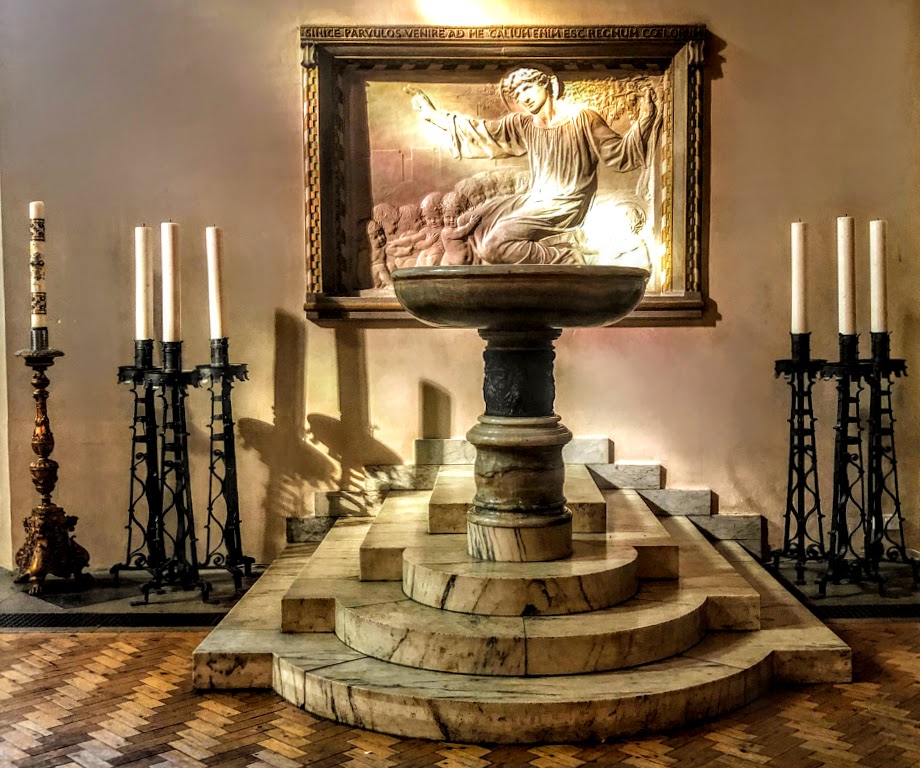
The relief panel on the west wall behind the font is to the design of Henry Wilson (Photograph: Patrick Comerford, 2022)
Today, the church sees itself as a ‘Shrine and Sanctuary’ for Sloane Square, and, for example, also provides chaplaincies to neighbouring places such as Harrods and the Royal Court Theatre. The parish of Saint Saviour, Upper Chelsea, was added to Holy Trinity in 2011.
Canon Nicholas Wheeler is the Rector of Holy Trinity and Saint Saviour. He returned to London from Brazil where he worked with USPG in the Parish of Christ the King in Rio de Janeiro and as a canon of the Cathedral of the Redeemer. His work in Cidade de Deus, one of the most disadvantaged communities in Rio, inspired the 2002 film, City of God.
Before going to Brazil with USPG, he spent 21 years in the Diocese of London, where his posts included Team Rector at Old Saint Pancras.
The Sung Eucharist is celebrated in Holy Trinity Church every Sunday at 11 a.m.
Holy Trinity sees itself as a ‘Shrine and Sanctuary’ for Sloane Square (Photograph: Patrick Comerford, 2022)
Patrick Comerford
I was in London last weekend for the annual reunion of the Anglican mission agency USPG (United Society Partners in the Gospel). We were invited to a celebration of the Eucharist in Holy Trinity Church, Sloane Square, followed by lunch and short presentations by USPG staff.
Holy Trinity Church, Sloane Square, is right at the heart of London. The former Poet Laureate, Sir John Betjeman, described Holy Trinity Church in Chelsea as the ‘Cathedral of the Arts and Crafts Movement’, referring to treasures and glass by William Morris, Edward Burne-Jones and many others.
Holy Trinity Sloane Square is in the Catholic tradition in the Church of England, and says on its website and materials ‘The world will be saved by beauty’, a quotation from The Fool by Fyodor Dostoevsky.
Holy Trinity Church, Sloane Square, was described by John Betjeman as the ‘Cathedral of the Arts and Crafts Movement’ (Photograph: Patrick Comerford, 2022)
Holy Trinity is one of the few churches in these islands that can be regarded as what the Germans describe as a gesamtkunstwerk – a total work of art. Behind the magnificent red brick and stone façade, reminiscent of collegiate architecture of the late 16th and early 17th century, is truly a jewel-box of the best stained glass, sculpture and highly wrought metalwork created by many of the finest artists and craftsmen of the late 19th century.
The first church on the site was a Gothic building from 1828-1830, designed by James Savage and built in brick with stone dressings. The west front, towards the street, had an entrance flanked by octagonal turrets topped with spires.
It was originally intended as chapel of ease to the new parish church of Saint Luke, but was given its own parish, sometimes known as Upper Chelsea, in 1831. It could seat 1,450 in 1838 and 1,600 in 1881.
Inside Holy Trinity Church, Sloane Square, facing east (Photograph: Patrick Comerford, 2022)
George Henry Cadogan (1840-1915), 5th Earl Cadogan, and his wife, the former Lady Beatrix Craven, decided to replace the earlier church building which was part of their London estate. The old church was closed and demolished in 1888, and a temporary iron church with seating for 800 was provided in Symons Street while the new church was built.
The Cadogans chose John Dando Sedding (1838-1891) as the architect. He was one of the prime movers in the Arts and Crafts Movement, which was inspired at an early stage by AWN Pugin and John Ruskin.
At the Liverpool Art Congress in 1888, in a roll-call of the great architects and designers of his day, Sedding declared, ‘We should have had no Morris, no Burges, no Shaw, no Webb, no Bodley, no Rossetti, no Crane, but for Pugin.’
While he was still in his teens, Sedding was influenced by Ruskin and his Stones of Venice (1853). He trained as an architect in the offices of GE Street (1824-1881), the prolific and influential church architect. Other key figures in the Arts and Crafts Movement, including William Morris, Philip Webb and Norman Shaw, had also trained in Street’s offices.
Inside Holy Trinity Church, Sloane Square, facing west (Photograph: Patrick Comerford, 2022)
Holy Trinity Church was built in 1888-1890 on the south-east side of Sloane Street and was paid for by Lord Cadogan.
Sedding’s church was not the longest church in London, but it was the widest, exceeding Saint Paul’s Cathedral by 23 cm (9 inches). The internal fittings were the work of leading sculptors and designers of the day, including FW Pomeroy, HH Armstead, Onslow Ford and Hamo Thornycroft. Sedding died in 1891, and his memorial is on the north wall in the Lady Chapel.
Sedding died two years after Lady Cadogan laid the foundation stone of the church. His chief assistant, Henry Wilson (1864-1934), took charge of the project to complete the interior decoration of the church to Sedding’s original design.
The great East Window by Edward Burne-Jones and William Morris is the largest window ever made by William Morris & Company (Photograph: Patrick Comerford, 2022)
The main structure is as Sedding designed it, but the street railings and much of the interior fittings and decoration were inspired or designed by Wilson, including the font, the Lady Chapel, the Byzantine-inspired metal screen and the bronze angels that flank the entrance to the Memorial Chapel. However, Sedding’s original conception was never fully completed.
The first thing that impresses visitors is the wealth of stained glass, particularly the great east window by Edward Burne-Jones (1833-1898) and William Morris (1834-1896), the largest window ever made by William Morris & Company.
Burne-Jones first contemplated a window with ‘thousands of bright little figures.’ This idea became 48 Prophets, Apostles and Saints in three columns of four rows that make up the bottom half of the window.
There are impressive windows in the north and south aisles, three by Sir William Blake Richmond (1842-1921) and two by Christopher Whall (1849-1924), and by James Powell and Sons in the Memorial Chapel.
The large west window, which Morris and Burne-Jones planned to complete before moving onto the east window, but this never happened. Its plain glass was destroyed during World War II, although all the other windows survived or were repaired.
The pulpit was designed by Seddling in the Sienna Renaissance style and is made of marble of different colours (Photograph: Patrick Comerford, 2022)
The range of sculptures includes FW Pomeroy’s bronze angels and sculptured reliefs. There are works of other major sculptors too, including Onslow Ford, Frank Boucher, HH Armstead, Harry Bates and John Tweed, who carved the marble reredos in 1901.
A wealth of different marbles is employed, especially on the pulpit and in the Lady Chapel, while the bowl of the Font is made of one piece of Mexican Onyx.
The processional cross is a reproduction of the 12th century Celtic Cross of Cong.
The Sedding Altar Frontal and busts of William Morris and John Ruskin (Photograph: Patrick Comerford, 2022)
The Sedding Altar Frontal, originally intended for use in Advent and Lent, was designed by Sedding and embroidered by his wife Rose.
Sedding believed that nature was the source of all true art. He always sought to find his inspiration in hedgerows and cottage gardens, especially those in Somerset, Devon and Cornwall. He also had a deep love of mediaeval embroidery, a passion he shared with his wife.
The emblems in the panel of the frontal alternate between symbols of Christ’s passion, and human images of holy devotion: Prophets and Saints.
Above the display case with the frontal are busts of William Morris and John Ruskin.
The Altar frontal of the entombment was carved by Harry Bates; the reredos was carved by John Tweed; the altar candlesticks are copies of Michelangelo’s originals in San Lorenzo Church, Florence (Photograph: Patrick Comerford, 2022)
The churchmanship when the new church opened might be described as eclectically high, as the liturgy seems to have been drawn from a number of sources and traditions.
The church soon attracted the attention of Bohemian artists and poets some of whom clustered loosely round Oscar Wilde, who was arrested nearby in the Cadogan Hotel on Sloane Street. Many notable figures have been parishioners, including the Liberal politicians WE Gladstone and Sir Charles Dilke. Dilke lived on Sloane Street; his promising political career was destroyed by a well-publicised divorce case in the 1880s.
The interior was whitened by the third architect of Holy Trinity FC Eden in the 1920s, lightening the character and feel of the building considerably. The south chapel was remodelled to become the Memorial Chapel with Eden’s crucifix painted by Egerton Cooper, and the panelling inscribed with the names of parishioners who died in World War I. The War Memorial is in Sloane Square and on Remembrance Sunday clergy, choir and congregation process from the church to Sloane Square.
The central North Wall window by Sir William Blake-Richmond with the theme of Youth and its sacrifice and joys (Photograph: Patrick Comerford, 2022)
The church was very popular in the 1920s with a very extensive clergy team under the rector, the Revd Christopher Cheshire (1924-1945). For a time, the liturgist and hymn writer Percy Dearmer, who collaborated closely with Ralph Vaughan Williams, was associated the church.
During World War II, the church was hit by several incendiary bombs, one at least bursting in the nave, causing considerable damage.
It took several decades of work to carry out post-war repairs and the church was closed except for Sunday matins. There was pressure to demolish rather than restore the building, and it was saved only by a vigorous campaign mounted by the Victorian Society and Sir John Betjeman who wrote in verse:
Bishop, archdeacon, rector, wardens, mayor
Guardians of Chelsea’s noblest house of prayer.
You your church’s vastness deplore
‘Should we not sell and give it to the poor?’
Recall, despite your practical suggestion
Which the disciple was who asked that question.
Betjeman said the central North Wall window by Sir William Blake-Richmond, with the theme of Youth and its sacrifice and joys, was ‘symbolising the hope that this great city may rise to the value of beauty, setting aside money and society as chief aims of life.’ Needless to say, Betjeman’s ‘noblest house of prayer’ was saved.
Holy Trinity Church, Sloane Square, was described by Sir John Betjeman as ‘Chelsea’s noblest house of prayer’ (Photograph: Patrick Comerford, 2022)
After a long period of less symbolic worship, notably when the Revd Alfred Basil Carver was Rector (1945-1980) and the shorter incumbencies of the Revd Phillip Roberts (1980-1987) and the Revd Keith Yates (1987–1997), the church has returned to a liberal Catholic style of worship and liturgy.
The church now has a thriving congregation built when Bishop Michael Eric Marshall, former Bishop of Woolwich, was Rector (1997-2007). The connection with the world of the fine arts continued under the Revd Rob Gillion was Rector (2008-2014). He later became Bishop of Riverina in western New South Wales.
Holy Trinity has enjoyed a reputation for church music since its early days. John Sedding, also an organist, provided an unusually large chamber for the noted four-manual Walker organ. Notable organists have included Edwin Lemare (1892-1895), Sir Walter Alcock (1895-1902), John Ireland (sub organist, 1896-1904), and HL Balfour (1902-1942).
The organ was badly damaged in World War II, but was repaired in 1947 and partially rebuilt in 1967. Harrison & Harrison completed a rebuild in 2012, using the surviving Walker pipework and matching new material. The organ has 71 speaking stops and about 4,200 pipes, and remains one of the principal organs in London.
The relief panel on the west wall behind the font is to the design of Henry Wilson (Photograph: Patrick Comerford, 2022)
Today, the church sees itself as a ‘Shrine and Sanctuary’ for Sloane Square, and, for example, also provides chaplaincies to neighbouring places such as Harrods and the Royal Court Theatre. The parish of Saint Saviour, Upper Chelsea, was added to Holy Trinity in 2011.
Canon Nicholas Wheeler is the Rector of Holy Trinity and Saint Saviour. He returned to London from Brazil where he worked with USPG in the Parish of Christ the King in Rio de Janeiro and as a canon of the Cathedral of the Redeemer. His work in Cidade de Deus, one of the most disadvantaged communities in Rio, inspired the 2002 film, City of God.
Before going to Brazil with USPG, he spent 21 years in the Diocese of London, where his posts included Team Rector at Old Saint Pancras.
The Sung Eucharist is celebrated in Holy Trinity Church every Sunday at 11 a.m.
Holy Trinity sees itself as a ‘Shrine and Sanctuary’ for Sloane Square (Photograph: Patrick Comerford, 2022)
Labels:
Architecture,
Brazil,
Chelsea,
Church History,
John Betjeman,
Liturgy,
London,
London churches,
Poetry,
Pre-Raphaelites,
Pugin,
Ruskin,
Sculpture,
Stained Glass,
Theology and Culture,
USPG
Subscribe to:
Posts (Atom)