Showing posts with label Poland. Show all posts

30 January 2026

Empty Chairs in a square in
Kraków recall the Jewish ghetto
and are a poignant tribute to
victims of the Holocaust

The Empty Chairs Memorial in Kraków, a powerful yet poignant tribute to the Jewish victims of the Holocaust (Photograph: Patrick Comerford)

Patrick Comerford

International Holocaust Memorial day this week (27 January 2026) marked the 81st anniversary of the end of the Holocaust, which began with the liberation of the concentration camps at Auschwitz Birkenau on 27 January 1945.

In a blog posting to mark the day, I posted a ‘virtual tour’ of Holocaust memorials I have visited in a dozen countries, but I also came across photographs I had taken of an unusual memorial in a square in Kraków that remembers the victims of the Holocaust who had first been forcibly squeezed into the ghetto and then murdered either in the ghetto or in the camps such as Auschwitz.

I visited Kraków and Auschwitz ten years ago, I wrote about the death camps at Auschwitz-Birkenau, and about the seven surviving synagogues in Kraków, the history and life of the old Jewish Quarter in Kazimierz, the Jewish cemeteries, the Salt Mines at Wieliczka, the churches in Kraków, and the castle and cathedralon on Wawel Hill. But I had only made a passing reference in a magazine feature to some of the monuments and memorials I had seen in the ghetto the Nazis had created in Podgórze, to Schindler’s's factory, or to an unusual sculpture in the Ghetto Heroes Square in the former ghetto. Yet, when I came across my photographs from Kraków and Auschwitz-Birkenau this week, my memories of that visit ten years ago were as traumatic and as sharp as yesterday, filled with heartache and tenderness at one and the same time.

The Empty Chairs Memorial, a powerful yet poignant tribute to the Jewish victims of the Holocaust, is in the Ghetto Heroes Square (Bohaterów Getta Square) in the Kazimierz Jewish Quarter in Kraków. This series of empty chairs symbolised the lives abandoned and the homes left empty during the mass deportation of Jews from the Kraków Ghetto in March 1943.

Bohaterów Getta Square began as a quiet, small market place, first known as Zgody Square or Plac Zgody. In the 1930s, the square also became a local bus station.

All changed in 1939 when Nazi Germany invaded Poland. Zgody Square was closed off by a large gate marked with a Star of David, confining the Jewish populations to a ghetto, segregated the rest of the people of Kraków.

The Nazis issued an edict on 3 March 1941, forcing the Jews into the ‘Jewish residential quarter’ in Podgórze, ordering them to move there by 20 March. Non-Jewish residents were force to leave the Podgórze district, and Jewish families from across Kraków were forced to move into the area.

The ghetto, which functioned in Podgórze from 1941 to 1943, became the place for the brutal and savage extermination of the Jews of Kraków. The ghetto covered am area of just 20 ha and had 320 tenement houses, previously inhabited by the 3,500 people who had been forced to leave. About 17,000 Jews were crammed into 320 buildings in the ghetto, often with four or five families in one flat. Many slept on the floor; all, including children, the elderly and the sick, were forced to work; hunger and disease prevailed; and brutal treatment was a daily experience.

The only non-Jewish business not included in the order was the sole remaining pharmacy in the ghetto, run by Tadeusz Pankiewicz, a Pole who became the only non-Jew living in the area.

An arcaded portion of the ghetto wall mockingly resembled matzevot or traditional Jewish tombstones (Photograph: Patrick Comerford)

The ‘Jewish residential quarter’ was surrounded by a three-metre wall with an arcaded portion mockingly styled to resemble matzevot or traditional Jewish tombstones. Four gates led into the ghetto: the main gate had an inscription that read Jüdischer Wohnbezirk (Jewish Quarter) and stood where Limanowskiego Street enters the Main Market of Podgórze.

A tram ran along Lwowska and Limanowskiego streets, but there were no stops inside the walls, and passengers were forbidden even to look at the ghetto through the windows. Of course, that prohibition was broken, and sometimes parcels of food were dropped from a tram.

In October 1941, any departure from the ghetto without leave became punishable by death. The same penalty faced people helping fugitives. Postal services were forbidden, and all ground-floor windows on the non-Jewish side were bricked up, cutting the ghetto off from possible channels of food delivery.

Soon deportations to death camps and forced labour camps began in the ghetto. Płaszów concentration camp was originally intended as a forced labour camp, and was constructed on the grounds of the old and new Jewish cemeteries in Podgórze.

Exceedingly brutal resettlements were carried out in June and October 1942, and many people died in the streets during the roundups and transports. The painter Abraham Neuman and the folk singer and poet Mordecai Gebirtig were executed on so-called ‘Bloody Thursday’, 4 June 1942. Hospital patients and children from the orphanage were murdered on the spot or deported. Some of the deported people were executed over the mass graves already dug by the inmates in Płaszów.

The area of the ghetto was repeatedly reduced throughout 1942. Before the end of the year, it was bisected by barbed wire: precinct A was for able-bodied people capable of labour, while B was for children, the elderly, and the ailing.

Zgody Square became the site for roll-calls and selections. The police station was at the former bus terminal, the ghetto wall was nearby, and square became the place where people were selected to send from the ghetto to trains, waiting for hours for their final journey. The elderly, the sick and the young were often executed in the streets, in their homes, or even in the square.

The victims were clustered together at the west end of the square, while looted property was stacked in the centre. Tadeusz Pankiewicz, who ran the Under the Eagle Pharmacy, was an eyewitness to the horrors of daily life in the ghetto. He helped to smuggle in food and medicines, and provided fake documents to Jews living in hiding. In his memoir, The Kraków Ghetto Pharmacy, recalled ‘In Plac Zgody, an incalculable number of wardrobes, tables, sideboards and other furniture was rotting.’

Finally, on 13 and 14 March 1943, the Nazis carried out the final ‘liquidation’ of the Kraków ghetto. Around 6,000 residents of ghetto A, capable of heavy labour, were moved to the camp in Płaszów. Their children under 14 had to stay in the orphanage. On the following day, the residents of ghetto B were driven to Zgody Square. Many elderly, sick, and unemployed residents – along with children – were shot on-site, in the square or in nearby courtyards.

Around 1,000 people were shot dead on the spot, including the elderly, patients and physicians from the hospital, children and mothers who would not let them go. Many were worked to death in the camps in Płaszów and Belzec. Those who remained were taken to Auschwitz Birkenau, where they were murdered in the gas chambers. The action ended with SS officers searching the now abandoned buildings, murdering anyone who tried to hide.

Oskar Schindler’s factory, featured in ‘Schindler’s List’, is close to Ghetto Heroes Square (Photograph: Patrick Comerford)

The city renamed Plac Zgody as Ghetto Heroes Square in 1948 to honour the victims. For a time, it became a hub for public transport once again, but the memory of the wartime atrocities never faded. This chapter in the square’s history is retold in Stephen Spielberg’s film Schindler’s List (1993).

Inspired by Tadeusz Pankiewicz’s memoirs, the city commissioned an installation of oversized metal chairs, symbolising what was left behind – and the absence of those who once sat there. The architects Piotr Lewicki and Kazimierz Łatak created the monument, and it was completed in 2005.

The memorial features 33 large chairs arranged in rows, reminiscent of the roll-calls, facing the former pharmacy. Three face Lwowska Street, where a fragment of the original ghetto wall survives. An additional 37 smaller chairs for sitting encircle the larger ones. Each chair represents 1,000 lives.

Many people walk past the installation or weave their way their way through and around it, while children play and sit on the chairs, and only an odd walking tour seems to pause briefly to acknowledge it. But the empty chairs are stark and bold, sparse and empty, and they carry a powerful message with their feeling of absence. They capture a moment when human life was discarded just like the furniture piled up in the square.

A paved line through the square marks the symbolic border of the ghetto. Two dates are displayed on the old bus station building: 1941 (ghetto establishment) and 1943 (ghetto liquidation).

The memorial won the European Prize for Urban Public Space in 2006 and the Gold Award for Urban Quality in 2011.

The memorial is near other sites, including Oskar Schindler’s factory, and is a focal point for Holocaust remembrance in Kraków. In the March of Memory on 13 and 14 March each year, people march from Bohaterów Getta Square to the former Płaszów camp, following the route that led the Jews of Kraków to their death.

Shabbat Shalom, שבת שלום‎

The Empty Chairs, installed in 2005, were inspired by Tadeusz Pankiewicz’s memoirs (Photograph: Patrick Comerford)

27 January 2026

A ‘virtual tour’ of Holocaust
memorials on Holocaust
Memorial Day, a reminder
that we must never forget

‘Arbeit macht frei’ … the gate at Auschwitz … today is Holocaust Memorial Day (Photograph: Patrick Comerford)

Patrick Comerford

Today is Holocaust Memorial Day, marking the anniversary of the liberation of Auschwitz in 1945 and the beginning of the liberation of the concentration camps in Europe.

In a ‘virtual tour’ today, I visit Holocaust memorials in a dozen European countries: Austria, Czech Republic, England, France, Germany, Greece, Hungary, Ireland, Italy, Poland, Slovakia and Slovenia.

Looking back on many visits over the years, my images today include monuments, memorials, plaques, sculptures, shattered grave stones and Stolpersteine or ‘stumbling stones’, in cemeteries, libraries, museums, parks, schools, squares, streets, synagogues, railway stations, and bridges.

There are photographs from the concentration camps in Auschwitz, Birkenau and Sachsenhausen. There are Jewish families and individuals, mothers and children, the murdered and the survivors, resistance fighters and the ‘Righteous Among the Nations’.

Austria:

Rachel Whiteread’s Holocaust Memorial in Judenplatz in Vienna (Photograph: Patrick Comerford)

Czech Republic:

The walls of the Pinkas Synagogue in Prague are covered with the names of 78,000 victims of the Holocaust (Photograph: Patrick Comerford)

The names of the concentration camps surround the Aron haKodesh or Holy Ark in the Pinkas Synagogue, Prague (Photograph: Patrick Comerford)

England:

The Holocaust Memorial Stone at the east end of Bourton Park, Buckingham, was installed in 2021 (Photograph: Patrick Comerford)

France:

The Mur des Names or Wall of Names in the Mémorial de la Shoah lists 76,000 French Jews deported and murdered by the Nazis (Photograph: Patrick Comerford)

A plaque on a school in the Marais in Paris recalling the children of the Shoah (Photograph: Patrick Comerford)

Germany:

The Memorial to the Murdered Jews of Europe in Berlin (Photograph: Patrick Comerford)

A memorial to Jewish children at the Jewish Cemetery in Berlin (Photograph: Patrick Comerford)

The memorial to the victims of the Sachsenhausen Concentration Camp 1936-1945 … the victims included gays, Gypsies, political prisoners and disabled people (Photograph: Patrick Comerford)

Greece:

The Jewish Holocaust Memorial at Plateia Eleftherias (Liberty Square) in Thessaloniki (Photograph: Patrick Comerford)

Chief Rabbi Gabriel Negrin places candles in the Holocaust memorial in Etz Hayyim Synagogue in Chania (Photograph: Patrick Comerford)

The Holocaust Memorial by Georgios Karahalios (2001) in Corfu remembers the 2,000 Jews of Corfu who were murdered in Auschwitz in 1944 (Photograph: Patrick Comerford)

The monument in the Nuova or New Synagogue in Corfu to families who died in the Holocaust (Photograph: Patrick Comerford)

Hungary:

The Memorial of the Hungarian Jewish Martyrs by Imre Varga at the Dohány Street Synagogue in Budapest (Photograph: Patrick Comerford)

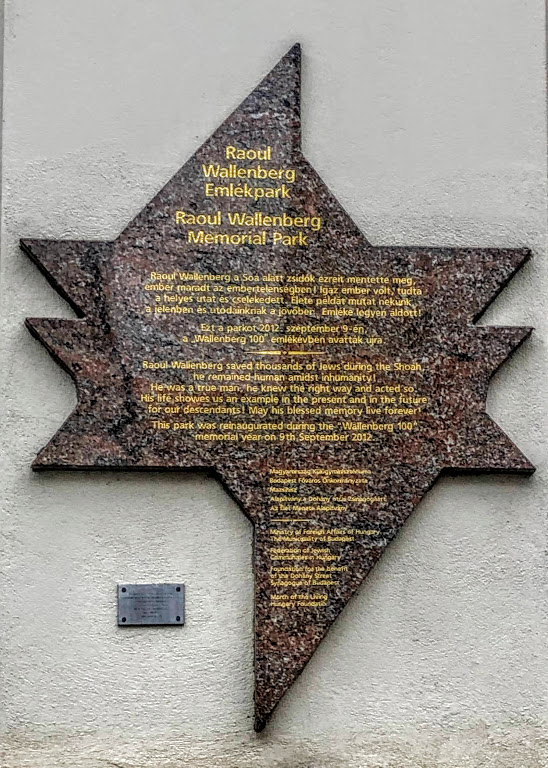
The Holocaust Memorial Park at the Dohány Street Synagogue in Budapest (Photograph: Patrick Comerford)

Italy:

A monument in Bologna commemorating victims of the Holocaust (Photograph: Patrick Comerford)

The Holocaust Memorial outside the railway station in Gorizia, a town that straddles the border of Italy and Slovenia (Photograph: Patrick Comerford)

The Holocaust Memorial at the Synagogue in Padua (Photograph: Patrick Comerford)

A monument to Jewish partisans and resistance to the Nazis and Fascists in Rome (Photograph: Patrick Comerford)

The memorial wall to victims of the Holocaust in the Ghetto in Venice (Photograph: Patrick Comerford)

The Holocaust memorial in the Ghetto in Venice (Photograph: Patrick Comerford)

Poland:

Multilingual memorials in Birkenau … a reminder of the many nationalities of the victims of the Holocaust (Photographs: Patrick Comerford)

Shattered gravestones make a Holocaust memorial in a Jewish cemetery in Kraków (Photograph: Patrick Comerford)

The Empty Chairs Memorial in Ghetto Heroes Square in Kazimierz , symbolising abandoned homes and mass deportations from the Kraków Ghetto in 1943 (Photograph: Patrick Comerford)

Slovakia:

The Holocaust Memorial in the centre of Bratislava on the site of the former Neolog Synagogue (Photograph: Patrick Comerford)

Stolpersteine or ‘stumbling stones’

Berlin:

Stolpersteine or Stumbling stones on Rosenthaler Straße 39, Berlin-Mitte, remembering members of the Salinger family murdered by the Nazis in Auschwtiz and Riga (Photograph: Patrick Comerford)

Dublin:

Dublin’s first Stolpersteine or ‘stumbling stones’, recalling six Irish Holocaust victims, at Saint Catherine’s National School on Donore Avenue (photograph: Patrick Comerford)

Prague:

‘Stolpersteine’ or ‘Stumbling Stones’ on the streets of Prague remember members of the Bergmann family deported to Terezín during the Holocaust (Photograph: Patrick Comerford)

Thessaloniki:

‘Stolpersteine’ or ‘Stumbling Stones’ on the pavement on Vassilisis Olgas Avenue in Thessaloniki commemorate Greek Jews deported to Auschwitz (Photograph: Patrick Comerford)

Venice:

Stolpersteine or stumbling stones (Pietre d’inciampo) in Venice recall victims of the Holocaust (Photograph: Patrick Comerford)

Remembering individuals:

Remembering Anne Frank in street art in Berlin (Photograph: Patrick Comerford)

The sculpture of Anne Frank by Doreen Kern in the British Library, London (Photograph: Patrick Comerford)

The Kindertransport monument at Liverpool Street Station … a reminder in the heart of London of the Holocaust (Photograph: Patrick Comerford)

A plaque on Heydukova Street in Bratislava marks the former home of Aron Grünhut (1895-1974), involved in heroic rescues during the Holocaust (Photograph: Patrick Comerford)

Monuments to ‘Righteous Among the Nations’:

Philip Jackson’s monument of the Swedish diplomat Raoul Wallenberg at Wallenberg Place, near Hyde Park, London (Photograph: Patrick Comerford)

A memorial to Raoul Wallenberg in the Raoul Wallenberg Holocaust Memorial Park at the Dohány Street Synagogue, Budapest (Photograph: Patrick Comerford)

The Mary Elmes Bridge in Cork … the centrepiece of the bridge is designed to look like a menorah (Photograph: Patrick Comerford)

The Wall of the Righteous in Paris lists 3,300 French people who have been recognised as ‘Righteous Among the Nations’ (Photograph: Patrick Comerford)

These images are reminders not only of the Holocaust and its victims, but of real individuals who suffered and were humiliated, whose lives were shattered and who were murdered.

They are reminders of why we must never forget. The Holocaust happened not just because of one evil man but because many good people stood by and remained silent.

Over 80 years after the end of the Holocaust, antisemitism is on the rise once again. We are seeing the rise of the far-right in Britain across Europe and a resurgence of the far-right in Latin America, far-right ideology and vocabulary has become part and parcel of the language of the Trump regime, its spokespersons and those who support street murders by ICE in Minneapolis.

We must never forget.

The Eternal Flame in the Mémorial de la Shoah, Paris (Patrick Comerford)

09 January 2026

Nicolás Maduro and the claims
of the kidnapped president of
Venezuela to Sephardic ancestry

Nicolás Maduro Moro claimed Sephardic Jewish ancestry in an interview 13 years ago

Patrick Comerford

The kidnapped Venezuelan President Nicolás Maduro Moro claimed Sephardic Jewish ancestry 13 years ago, although he has never identified himself as Jewish in terms of religion, nor has he ever practised Judaism. In an interview in 2013, Maduro spoke of how his grandparents were descended from Sephardic families but had converted from Judaism to Catholicism in Venezuela.

The Antilles and the Caribbean have long had an important Jewish presence, and a large proportion of the Jewish families in the region are Sephardic in origin, as I learned during a course in Sephardic genealogy and history that I took during the Covid-19 lockdown. The series of weekly Zoom seminars or webinars on Sephardic history was organised by the Bevis Marks Synagogue and the Spanish and Portuguese Jewish Community in London in May and June 2020.

Researchers recently claimed Christopher Columbus may have been a Sephardic Jew from Spain rather than being from Genoa. They announced their conclusions in October 2024 after 20 years of DNA and genetic tests on part of his remains that are said to be held in a tomb in the Cathedral in Seville.

Maduro’s claims to Jewish ancestry are not unique for a Latin American president: President Claudia Sheinbaum Pardo of Mexico, whose 83% approval ratings make her one of the most popular leaders in the world today, is the first Jewish president in a country with one of the largest Catholic populations. Although she is not a religiously observant Jew, Dr Sheinbaum identifies as culturally Jewish and has spoken proudly about her heritage. Her father Carlos Sheinbaum was of Ashkenazi Jewish descent, from a family who emigrated from Lithuania in 1928; her mother Annie Pardo is from a Sephardi Jewish family who fled to Mexico from the persecution of Jews in Bulgaria during World War II.

The first Jewish immigrants to Venezuela were found in the Dutch colonies in South America in the 17th century. Jews escaping the Spanish and Portuguese inquisitions found refuge and freedom of worship in places such as Recife in Dutch Brazil, although, even after Simon Bolivar’s wars of liberation, Jews faced anti-Jewish discrimination.

Maduro is a classic Sephardic name and is a common name on the island of Curaçao in the Dutch Antilles, which has an extensive Jewish heritage. Both of Nicolás Maduro’s parents – Nicolás Maduro García (d. 1989), and Teresa de Jesús Moros (d. 1994) – were descended from Sephardic families whose ancestors were among Iberian Jews expelled from Spain and Portugal in the late 15th century and who moved to the Netherlands.

The Maduro family moved from Amsterdam to the Caribbean in the 18th century, first to Curaçao and then to Aruba in the Dutch Antilles, where they were among the islands’ earliest settlers. Over generations, members of the family migrated from Aruba to Colombia and later to Venezuela, through the coasts of Falcón state and then on to Lara and Zulia states, where some family members converted to Catholicism.

Salomon Elias Levy Maduro (Papa Monchi) bought the Maduro plantation in Curaçao in 1853

The first family member to move to Aruba, Moses Solomon Levy Maduro, arrived in 1754 while working for the Dutch West India Company. Salomón de Moisés Levy Maduro and his wife Sara, daughter of Jacob de Samuel Levy Maduro, were living in Aruba in 1764.

The Mongui Maduro Museum is housed in the former Rooi Catootje plantation house in the Dutch Antilles island of Curaçao. The house dates from 1735, and the museum tells the story of four generations of the Levy Maduro family and its Sephardic Jewish ancestry, with displays that include the family tree of Salomon Abraham (Mongui) Levy Maduro.

Their stories and influence on the social and economic history of Curaçao are told in the museum, and the displays include antiques and heirlooms. Mongui Maduro’s grandfather Salomon Elias Levy Maduro (Papa Monchi) was a businessman who bought Rooi Catootje in 1853 and built a legacy that continues today. Mongui Maduro was raised by his uncle Manchi and spent a lifetime collecting Judaica and Antillana books and newspaper clippings. His collection evolved into a fully functioning reference library through the efforts of his daughter Ena in 2010.

The history of the Jews in Venezuela dates from the mid-17th century, when groups of marranos or Spanish and Portuguese descendants of baptised Jews who may have secretly continued to adhere to Judaism, lived in Tucacas, Caracas and Maracaibo. The Jewish Cemetery in Santa Ana de Coro is the oldest Jewish cemetery in continuous use in the Americas.

The vast majority of Venezuela’s Jews left during the past two decades, under Maduro and his predecessor Hugo Chávez. They left for Israel and the US, as well as Panama, Colombia, Costa Rica and Guatemala. Maduro may have been anxious to assert his claims to Sephardic ancestry in an interview in 2013 as a response to accusations that his regime tolerated or even encouraged antisemitism in Venezuela.

After Chávez was elected in 1998, he began to engineer a campaign against Venezuela’s Jews, and his anti-Zionism often descended into antisemitism. During a demonstration outside the main Sephardi synagogue in Caracas, the wall was scrawled with the words ‘Jews, killers – leave’. Police raided the Club Hebraica in Los Chorros, an upmarket neighbourhood in East Caracas, in November 2004, after the murder of a public prosecutor, Danilo Anderson, and accused the club of storing Mossad weapons alleged to have been used in the killing. Chávez later said ‘the descendants of those who killed Christ had taken possession of all the wealth in the world.’

Maduro was Foreign Minister and then Vice-President under Chávez. At times, Maduro publicised his contacts with Jewish figures in Venezuela. When he announced in 2013 that his grandparents were Sephardim and had converted to Catholicism, he may have been anxious to counter accusations of antisemitism made against his regime. He met Jewish leaders in Caracas, including Rabbi Isaac Cohen of the Asociación Israelita de Venezuela, in 2017 framing the meeting as a dialogue on coexistence. In Maduro met Rabbi Shlomo Moshe Amar, the Sephardic chief rabbi, who was visiting Venezuela in 2018, and during that visit awarded a medal to Rabbi Isaac Cohen.

On the other hand, Maduro’s recent election rival, Henrique Capriles Radonski, who was raised a Catholic, also has Sephardi Jewish and Ashkenazi Jewish ancestry: his maternal grandparents, Andrés Radonski and Lili Bochenek, survived the Holocaust and emigrated from Poland with his mother to Venezuela in 1947. His great-grandparents were murdered in Treblinka during the Holocaust; his maternal grandmother, Lili Bochenek, lived for 20 months in the Warsaw Ghetto; and his paternal grandfather, Armando Capriles-Myerston, was a Sephardi Jew.

The attacks on Jews lessened during Maduro’s presidency, but by then many Jews had left Venezuela. After his kidnapping, the now acting President, Delcy Rodríguez, alleged his capture of Maduro and the US attack were a ‘Zionist’ attack. Her claims were seen as a thinly-veiled attempt to scapegoat to the ever-shrinking Jewish community in Venezuela. Venezuela had a Jewish community of about 22,000 people when Chávez took office in 1999. Today there are fewer than 6,000 Jews in the country.

• These links offer closer looks at the family tree of the Maduro family in Curaçao: a genealogical profile of Susana Maduro, grandmother of Nicolás Maduro on Geneanet and her ancestral connections HERE; and the story of Sephardic Jews in Aruba, with details of the arrival of the Maduro family in Aruba HERE.

Four generations of the Levy Maduro family were owners of Landhuis Rooi Catootje from 1853 to 1974

Shabbat Shalom, שבת שלום‎

09 May 2024

Planet Walk sculptures in
Tamworth Castle Grounds:
a walk around the galaxy

Walenty Pytel’s Planet Walk in Tamworth Castle Grounds marked the millennium in 2000 (Photograph: Patrick Comerford, 2024)

Patrick Comerford

I was writing yesterday about Fritz Steller’s paired mural ‘Communication and Documentation’ at the entrance to Tamworth Library. But Tamworth has impressive outdoors works of sculpture too, including Luke Perry’s sculpture of Æthelflæd, near the train station (26 July 2023), and Walenty Pytel’s ‘Anchor’ sculpture in Saint Editha’s Square, commemorating Colin Grazier (23 February 2023).

The Polish-born sculptor Walenty Pytel also created the Planet Walk in the castle grounds, which was commissioned in 2000 to mark the millennium. The Planet Walk was the brainchild of Tamworth’s Town Twinning Association, and it is based on a similar trail created in Bad Laasphe, Tamworth’s twin town in North Rhine-Westphalia in Germany.

Walenty Pytel designed the trail with the sun and nine planets in his studio in Ross-on-Wye. The distances between each of the planets was designed to relatively represent the distance between the planets in the solar system, to give some concept of the distance between us and our neighbouring – or not so neighbouring – planets.

Some of the original planets now seem to be missing. The trail takes 15-25 minutes to walk, and is easily followed by young and old alike, by with red rockets laid into the ground leading a trail around the galaxy.

Walenty Pytel is an internationally renowned artist and is recognised as a leading metal sculptor of birds and beasts. He created the Colin Grazier statue in Saint Editha’s Square, Tamworth, in 2002. His work also appears at the entrance to Birmingham International Airport and outside the House of Commons.

Earth is one of the planets in Walenty Pytel’s Planet Walk in the Tamworth Castle Grounds (Photograph: Patrick Comerford, 2024)

Pytel was born in 1941 in German-occupied Poland during World War II. Because of his blond features, the Nazis kidnapped him from his mother Jadwiga Pytel and had him adopted by a Gestapo officer and his childless wife. However, his mother escaped from a prison camp, snatched him from outside the couple’s home and fled Poland with him across the Alps to Italy.

He came to England at the age of five and later studied graphic design at Hereford College of Arts. After working in a publishing studio in London, he opened two studios in Hereford in 1963, initially focusing on paper sculptures for window displays but turned to metal two years later.

His first public commission came in 1965, when Hereford City Council paid £100 for Christmas decorations. Three stainless-steel angels arranged in a triangle for the centre of High Town and 400 thin metal stars were erected in the city. The works have been lost since then.

His creations are often inspired by nature and his work includes the Jubilee Fountain in New Palace Yard, Westminster, ‘Take Off’ at Birmingham Airport, and one of Europe’s largest metalwork sculptures, ‘The Fossor’ (1979), at the headquarters of JCB in Rocester, Staffordshire.

Pytel was commissioned to create four huge steel eagles for the Portuguese football club Benfica in 2005. A year later, his career was disrupted after a fall in 2006 resulted in a loss of memory. However, at 83, he has continued to receive commissions for public sculptures and he continues to live near Ross-on-Wye.

The trail around Walenty Pytel’s Planet Walk in Tamworth takes 15-25 minutes to walk (Photograph: Patrick Comerford, 2024)

22 February 2024

Daily prayer in Lent with
early English saints:
9, 22 February 2024,
Saint Aidan of Lindisfarne

Saint Aidan depicted in a panel on the altar in Saint Chad’s Church, Lichfield (Photograph: Patrick Comerford)

Patrick Comerford

The Season of Lent began last week with Ash Wednesday (14 February 2024), and we began this week with the First Sunday in Lent (Lent I, 18 February 2024).

This year, I am taking time each morning in Lent to reflect on the lives of early, pre-Reformation English saints commemorated by the Church of England in the Calendar of Common Worship.

Before today begins, I am taking some quiet time this morning for reflection, prayer and reading in these ways:

1, A reflection on an early, pre-Reformation English saint;

2, today’s Gospel reading;

3, a prayer from the USPG prayer diary.

The lower panels in a window in Lichfield Cathedral depict Saint Aidan preaching, with King Oswald interpreting, and Saint Aidan at his school in Lindisfarne, where Saint Chad was one of the students (Photograph: Patrick Comerford, 2023)

Early English pre-Reformation saints: 9, Saint Aidan (651), Bishop of Lindisfarne, Missionary

Saint Aidan (651), Bishop of Lindisfarne, is commemorated in Common Worship on 31 August. He was one of Saint Columba’s monks from the monastery of Iona. He was sent as a missionary to Northumbria at the request of King Oswald, who was later to become his friend and interpreter. Aidan was consecrated Bishop of Lindisfarne in 635, worked closely with Oswald and became involved with the training of priests.

Saint Chad of Lichfield was one of four brothers who were of Northumbrian nobility and who were educated by Saint Aidan at the monastery in Lindisfarne. At that time Lindisfarne, also known as Holy Island, was one of the most important religious and centres in these islands.

From Lindisfarne, Saint Aidan was able to combine a monastic lifestyle with his missionary journeys. With his concern for the poor and enthusiasm for preaching, he won popular support that enabled him to strengthen the Church beyond the boundaries of Northumbria. He died on 31 August 651.

Saint Aidan (right) and Saint Oswald (left) in a stained-glass window in the Chapter House in Lichfield Cathedral (Photograph: Patrick Comerford, 2023)

Matthew 7: 7-12 (NRSVA):

[Jesus said,] 7 ‘Ask, and it will be given to you; search, and you will find; knock, and the door will be opened for you. 8 For everyone who asks receives, and everyone who searches finds, and for everyone who knocks, the door will be opened. 9 Is there anyone among you who, if your child asks for bread, will give a stone? 10 Or if the child asks for a fish, will give a snake? 11 If you then, who are evil, know how to give good gifts to your children, how much more will your Father in heaven give good things to those who ask him!

12 ‘In everything do to others as you would have them do to you; for this is the law and the prophets.’

The Saint Oswald and Saint Aidan window in Lichfield Cathedral … in memory of Archdeacon John Allen and Canon Henry George de Bunsen (Photograph: Patrick Comerford, 2023)

Today’s Prayers (Thursday 22 February 2024):

The theme this week in ‘Pray With the World Church,’ the Prayer Diary of the Anglican mission agency USPG (United Society Partners in the Gospel), is ‘Stories of Hope, Ukraine – Two years on …’ This theme was introduced on Sunday by Rachel Weller, Digital Communications Officer, USPG.

The USPG Prayer Diary today (22 February 2024) invites us to pray in these words:

We pray for the counsellors who help heal the unseen wounds of war. May those who receive therapy know peace and protection.

The Collect:

Almighty God,
whose Son Jesus Christ fasted forty days in the wilderness,
and was tempted as we are, yet without sin:
give us grace to discipline ourselves in obedience to your Spirit;
and, as you know our weakness,
so may we know your power to save;
through Jesus Christ your Son our Lord,
who is alive and reigns with you,
in the unity of the Holy Spirit,
one God, now and for ever.

The Post-Communion Prayer:

Lord God,
you have renewed us with the living bread from heaven;
by it you nourish our faith,
increase our hope,
and strengthen our love:
teach us always to hunger for him who is the true and living bread,
and enable us to live by every word
that proceeds from out of your mouth;
through Jesus Christ our Lord.

Additional Collect:

Heavenly Father,
your Son battled with the powers of darkness,
and grew closer to you in the desert:
help us to use these days to grow in wisdom and prayer
that we may witness to your saving love
in Jesus Christ our Lord.

Yesterday’s Reflection: Saint Birinus of Dorchester

Tomorrow: Saint Cedd of Lastingham

Saint Aidan (left) with Saint Oswald (centre) and Saint Chad (right) on the altar in Saint Chad’s Church, Lichfield (Photograph: Patrick Comerford)

Scripture quotations are from the New Revised Standard Version Bible: Anglicised Edition copyright © 1989, 1995, National Council of the Churches of Christ in the United States of America. Used by permission. All rights reserved worldwide. http://nrsvbibles.org