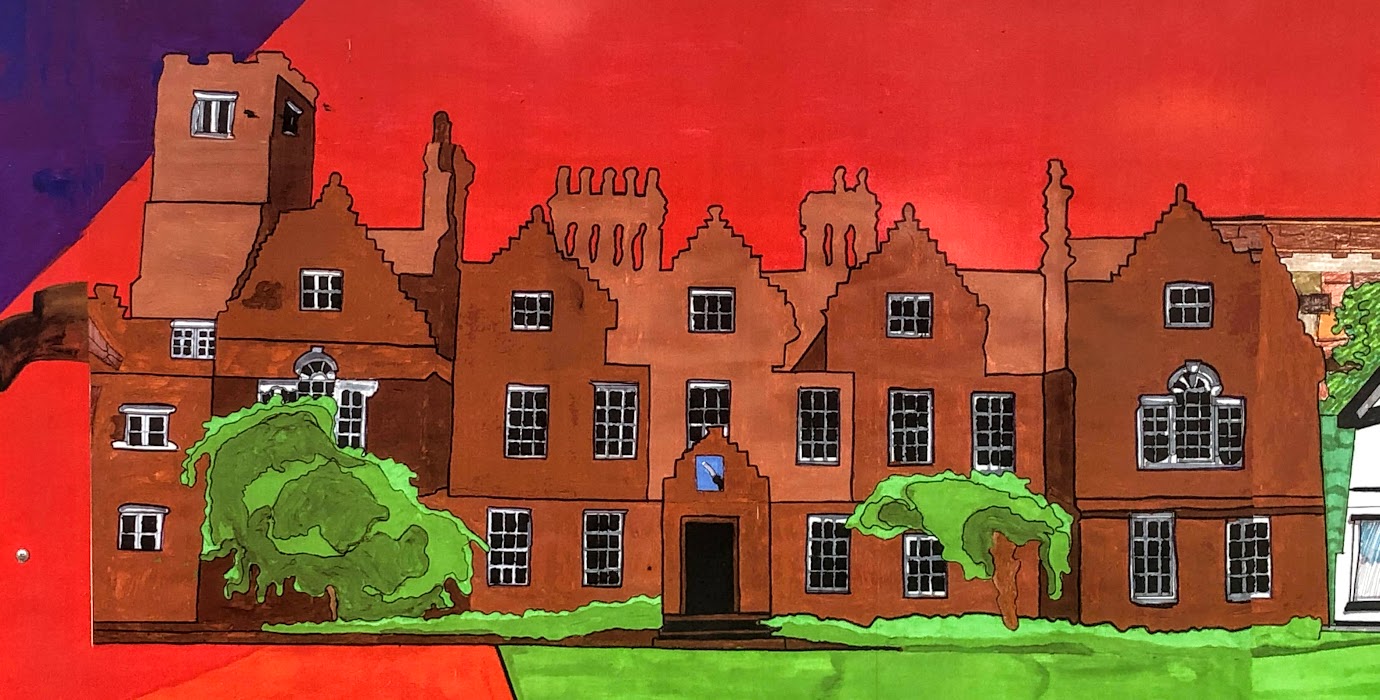
A glass of wine with an old friend … the Lichfield Mercury published my first commissioned feature 55 years ago on 15 October 1971 (Photograph: Patrick Comerford)
Patrick Comerford
Today, I suppose, marks the 55th anniversary of the start of a long and fulfilling career in journalism. I was supposed to be training as a chartered surveyor with the College of Estate Management, then at Reading University, and with Jones Lang Woottom from soon after leaving school. But by late 1970, I was pitching occasional pieces at local newspapers in England and Ireland, including the Lichfield Mercury, the Tamworth Herald, the Atherstone Herald, the Coleshill Chronicle and the Kilkenny People, and magazines like Horse and Hound.
The Tamworth Herald published a substantial feature by me on the Comberford family and the Moat House 56 years ago, on 30 October 1970 (p 11). But my first real break came when the editor of the Lichfield Mercury, Neil Beddows, commissioned me to write a series of regular features on local history and local families. The first of these features was published on this day 55 years ago – a full page feature on p 13 of the Lichfield Mercury and the Rugeley Mercury on 15 October 1971.
I was still in my teens and I thought I had made it. My first feature was on Sir Charles Wolseley and the Wolseley family. That first commissioned feature, published on 15 October 1971), was well-edited, with a fine photograph of Charles and Anita and their young family, who welcomed me to Wolseley Park House. There were more features to follow in the ‘Famous Families’ series, one a month, including one on the Dyott family of Freeford in November and another on the Ansons and the Earls of Lichfield. I soon began to build up a portfolio that helped to set me up for a lengthy career as a journalist.
At the time, I was still training as a chartered surveyor, and Charles Wolseley was then a chartered surveyor with Smith Gore in Lichfield, driving a trademark red sports car around town, commuting daily between Lichfield and Wolseley. When we met, he was already a chartered surveyor with the Lichfield branch of Smiths Gore, known for its rural property consultancy services.
He could not understand why I wanted to move from surveying to journalism. I had already inquired about finishing my training with Wintertons in Lichfield, and he wondered why I would not join him at Smiths Gore instead. He was still in his 20s, and he had a lifestyle that I probably thought at the time was enviable.
I never joined the staff of the Lichfield Mercury, nor did I pursue the prospect of joining either Smiths Gore or Wintertons in Lichfield to finish my training as a chartered surveyor. Instead, mainly on the strength of that portfolio that included those first commissioned features and reports in the Lichfield Mercury, as well as the Tamworth Herald and Horse and Hound, the late Gerry Breen and Major Austin Channing offered me my first full-time job with a newspaper 54 years ago, and I joined the staff of the Wexford People in July 1972 as a sub-editor.
For a time, I continued to contribute occasionally to the Lichfield Mercury and to visit its new premises in Bird Street – and the King’s Head, just two or three doors away. The Lichfield Mercury had moved to 17 Bird Street, now the Ma Ma Thai restaurant, and was using what then we called ‘photo-typesetting’ – an early form of computerised production of newspapers. I was welcomed back in 1974 to see this process, and to learn about how the pages of the newspaper were designed and made up.
I probably thought then that I was going to find a full-time position with the Lichfield Mercury and return to live there. I never did, but I was always grateful for those early opportunities and that generous sharing of skills and insights – they later proved useful when I was with The Irish Times.
The Lichfield Mercury was first published on 7 July 1815 (Photograph: Patrick Comerford, 2015)
For all its modernity, the Lichfield Mercury was an old newspaper with a long history, dating back to 1815. A new version of a revived Lichfield Mercury was first published in September 1877 from premises at 36-38 Bird Street. It was later bought by WH Smith & Son in 1905, and had different owners and publishers down through the decades. Printing was transferred to Tamworth the mid-1960s, the old Bird Street premises were demolished in 1972, and the new editorial and advertising offices were opened at 17 Bird Street.
The Lichfield Mercury became part of Central Independent Newspapers and Northcliffe Media, a division of the Daily Mail. The Rugeley Mercury ceased publication in late 2010, but other titles in the group continued, including the Tamworth Herald.
An exhibition marking 200 years of the Lichfield Mercury was held in the Dyott Chapel in Saint Mary’s Church in the Market Square, Lichfield, in 2015. But the physical print edition was suspended in April 2020 due to falling advertising revenues during the coronavirus pandemic, and it has never returned although there is still an online presence, usually involving reports of Lichfield news from the Birmingham Mail.
I was on the staff of The Irish Times for almost 30 years, from December 1974 until September 2002, with the last eight of those as Foreign Desk Editor. I had uncles, cousins, members of my extended family and old schoolfriends who were journalists too, and I have remained a journalist at heart.
Journalists never stop being journalists. I was ordained a priest, had a second and very satisfying academic career in theology, and spent five years in parish ministry before retiring. But alongside writing books, chapters and papers for academic journals, I continued to contribute to magazines and newspapers – including the occasional feature in The Irish Times, the Wexford People and magazines in Lichfield and Tamworth.
The Ma Ma Thai restaurant at No 17 Bird Street … once the home of the Lichfield Mercury (Photograph: Patrick Comerford)
Wexford and Lichfield have remained home in many special ways and for many reasons, and in my heart I have never ceased being a journalist. So it is in grief that I watch the daily assaults on journalists, journalism and the freedom of the press that is a directed and intense policy of the Trump regime in America.
Trump frequently attacks the US media as having a left-wing bias and being corrupt, and he uses a variety of insults when speaking about outlets that he sees as giving him unfavourable coverage. He has sued many media outlets, and has used his position as president to pressure outlets he dislikes by interfering in their business operations, launching investigations, threatening to revoke broadcast licenses, and cutting funding for public broadcasting.
In a talk at the Deadline Club of New York in 2018, Lesley Stahl recalled Trump explaining in 2016 why he discredits and demeans the press: ‘You know why I do it? I do it to discredit you all and demean you all so that when you write negative stories about me no one will believe you.’
In a special report in 2020 for the Committee to Protect Journalists, Leonard Downie Jr. said: ‘Trump has habitually attacked the news media in rallies, responses to reporters’ questions, and many hundreds of tweets. He has repeatedly called the press fake news, the enemy of the people, dishonest, corrupt, low life reporters, bad people, human scum and ‘some of the worst human beings you’ll ever meet’.
His tweets constantly target specific news organisations, including the New York Times, the Washington Post, CNN, NBC and MSNBC, and Fox News. He says the New York Times is fake, phony, nasty, disgraced, dumb, clueless, stupid, sad, failing and dying, and that the Washington Post is fake, crazy, dishonest, phony and disgraced.
Last year (14 November 2025), when Catherine Lucey of Bloomberg News asked him a question, his response was: ‘Quiet, piggy’. Four days later (18 November, 2025), he told Mary Bruce of ABC News ‘You’re a terrible person and a terrible reporter.’
He has threatened to charge media outlets with treason, called them the enemies of the people, and often threatens to silence journalists and to send them to jail. He abruptly banned reporter Jim Acosta of CNN from the White House after he asked a difficult question, he has cancelled the credentials of most of the White House press corps, and he has banned Associated Press from pooled press events in the Oval Office and aboard Air Force One because it continued to use the term Gulf of Mexico.
Last month (18 September 2026), Trump banned CNN, MS NOW, and Politico reporters from the White and warned that other outlets that they too would also be targeted. The White House television pool responded by suspending its television coverage of pool events. Still later in September, Trump told a female reporter from MS NOW that she was ‘fake news’ and then told her to ‘be quiet’.
Judge Timothy J Kelly granted a 14-day temporary restraining order requiring the White House to restore the journalists’ press credentials, the order has been extended and a final ruling is awaited. Meanwhile, the White House continues to ban reporters from CNN and MS Now from events and from Air Force One.
Trump has sued ABC News, CBS News, the BBC, CNN, the Washington Post, The New York Times, The Wall Street Journal, the journalist Bob Woodward, the publishers Simon & Schuster and Penguin Random House, Meta after it suspended his accounts following the 6 January Capitol attack by a mob of Trump supporters, Twitter and YouTube.
He has blocked federal funding for NPR, PBS and the CPB, he habitually complains about shows that criticise him, such as Jimmy Kimmel and Stephen Colbert, and following reports on his Qatari jet, he has tried to demand the phone and text messaging records of many New York Times journalists and their family members.
When he was speaking in Arizona yesterday about the US military operation against Iran, Trump referred to the leak to the press about the B-2 bombers were sent and how someone had leaked to press their departure time to the press. Trum declared, ‘Leakers should be shot … In the old days, we used to shoot leakers.’ He called them ‘the scum of the earth.’
He then turned his attention to the reporters at the event, pointed at them and said they are ‘almost as bad as a leaker because they leak false information. That makes them a leaker, right?’ The crowd heard the President of the US say that leakers should be shot and that the press were leakers.
In her analysis, the writer and commentator said: ‘Not too long ago, if a President of the United States even suggested that journalists should be harmed, they would have faced immediate consequences because freedom of the press is protected by the First Amendment of the Constitution … Congress would be demanding answers and the country would be outraged if the President of the United States started suggesting that reporters deserve to be shot simply for doing their jobs. But because this has become a near-daily occurrence, it will likely be forgotten or pushed aside by something just as sinister that he will say tomorrow.’
The world seemed a freer and more open society when I began working as a journalist 55 years ago, despite the Vietnam War and even though the Iron Curtain still stood, apartheid was still in place; Europe was still not the democratic society we presume on today: Franco was still in power in Spain, Salazar had died but his regime was still clinging on in Portugal, and the colonels still ruled in Greece. But there was hope, the colonels would fall, the Watergate Papers would soon be published, Nixon would be brought down, the Vietnam War would end, Franco would die.
Given the standards of journalism and theexpectations of freedom of the press in the those heady days in the early 1970s, I wonder how long this assulat on freedom and liberty is to continue to US, and I fell compelled to speak out, for all journalists remain my colleagues.
Morning coffee with an old, old friend in Nero in Bore Street, Lichfield, before the Lichfield Mercury ceased publishing the paper version (Photograph: Patrick Comerford)
Showing posts with label Tamworth Herald. Show all posts
15 October 2026
10 May 2026
Saint Chad’s Church, Hopwas:
‘an ingenious and entertaining’
church built by a Vicar of Tamworth
Saint Chad’s Church in Hopwas, Staffordshire, was designed by John Douglas (1830-1911) and built in 1879-1881 (Photograph: Patrick Comerford, 2026)
Patrick Comerford
My 10-mile walk through the countryside in south Staffordshire last week, starting at the Moat House in Tamworth, brought me to Wigginton and Saint Leonard’s Church, along Comberford Lane and Wigginton Lane to Comberford and the banks of the River Tame, and then along Coton Lane to Hopwas.
Before returning to Tamworth, I stopped to see Hopwas and Hopwas Hayes Wood, climbed up the hill to Saint Chad’s Church, walked along the canal towpaths beside the Tame Otter and the Red Lion, and had a late lunch in the Tame Otter.
Saint Chad’s Church, tucked under the woods, was built in 1879-1881 to replace the earlier Saint John’s Chapel, built as a chapel-of-ease for Tamworth parish in 1836. Saint John’s churchyard can still be seen on the right-hand or west side of Hints Lane, walking up from the Tame Otter, just beyond Hopwas Methodist Church.
Saint Chad’s Church, Hopwas, was built on the initiative of the Revd William MacGregor (1848-1937), Vicar of Tamworth (Photograph: Patrick Comerford, 2026)
The Revd William MacGregor (1848-1937) who was, without doubt, Tamworth’s ultimate ‘champion of the poor’ and the very embodiment of the Victorian ‘slum priest’. He was a curate in Hopwas, outside Tamworth, in 1872-1876, and then Vicar of Saint Matthias’, Liverpool, in 1877-1878. But he returned to Tamworth and the Diocese of Lichfield when he was appointed Vicar of Tamworth in 1878 at the age of 30.
When he was the Vicar of Tamworth (1878-1887), MacGregor gave Saint Editha’s Church a major facelift, had its bells recast, and built two churches, at Glascote and at Hopwas. Saint John’s was too small to cater for the growing population of Hopwas, but when he sought land to build a new church, he was opposed by Sir Robert Peel who argued that the population was not large enough. However, the Revd TK Levett of Packington Hall gave an acre of land as a site for a new church in 1878, and Herbert Dean later gave additional land to ensure the church had an open setting.
The foundation stone was laid in 1879 and Saint Chad’s was consecrated on 23 April 1881 by William Dalrymple Maclagan (1826-1910), Bishop of Lichfield (1878-1891) and later Archbishop of York (1891-1908).
The foundation stone was laid in 1879 and Saint Chad’s was consecrated in 1881 by Bishop William Dalrymple Maclagan of Lichfield (Photograph: Patrick Comerford, 2026)
This brick and timber-framed ‘chocolate-box’, Arts and Crafts church on Hopwas Hill is in the shadow of Hopwas Hayes Wood. It has been praised by the architectural historian Sir Nikolaus Pevsner as ‘an ingenious and entertaining building’. It was designed by the architect John Douglas (1830-1911) of Chester and is now a Grade II listed building.
The architect John Douglas (1830-1911) of Chester also designed many of the interior fittings, including the choir stalls, pulpit, pews and sanctuary rail. As an architect, Douglas designed over 500 buildings in Cheshire, North Wales, and north-west England, particularly on the Eaton Hall estate.
Douglas designed 500 or more buildings, built at least 40 new churches or chapels, restored, altered or renovated many more churches, and designed fittings and furniture for the interiors of his churches. His other works include houses, farms, shops, banks, offices, hotels, a hospital, drinking fountains, clocks, schools, public baths, a library, a bridge, an obelisk, cheese factories, and public conveniences. Most of his work was in Cheshire and North Wales, although there are some in Lancashire, Staffordshire, Warwickshire and Scotland.
Inside Saint Chad’s Church, Hopwas, facing east towards the High Altar, choir and chancel (Photograph: Patrick Comerford, 2026)
His architectural styles were eclectic. He worked during the period of the Gothic Revival, and much of his works incorporates elements of the English Gothic style. The firm where he trained was at the forefront of the Gothic Revival and both Edmund Sharpe and EG Paley were influenced by the Cambridge Camden Society and by AWN Pugin. Douglas’s first church, Saint John the Evangelist at Over, Winsford, was entirely English Gothic in style.
He was also influenced by European architectural styles and he included French, German and Dutch elements. However, he is probably best remembered for incorporating vernacular elements in his buildings, in particular half-timbering, influenced by the black-and-white revival in Chester. One of his characteristic features is his inclusion of dormer windows rising through the eaves and surmounted by hipped roofs. Other elements include tile-hanging, pargeting and the use of decorative brick in diapering and the design of tall chimney stacks, and his use of joinery and highly detailed wood carving.
Douglas attracted commissions from wealthy landowners and industrialists, especially the Grosvenor family of Eaton Hall. Most of his works have survived, particularly his churches. Chester has a number of his structures, the most admired of which are his half-timbered black-and-white buildings and the Eastgate Clock. The highest concentration of his work is found in the Eaton Hall estate and the surrounding villages of Eccleston, Aldford and Pulford.
Inside Saint Chad’s Church, Hopwas, facing west from the High Altar, choir and chancel (Photograph: Patrick Comerford, 2026)
John Douglas was born in Sandiway, Cheshire, on 11 April 1830, the second of four children and the only son of John Douglas, a builder, joiner, surveyor and timber merchant from Northampton, and his wife Mary (née Swindley) from Aldford on the Eaton estate in Cheshire. John Douglas senior was a builder and joiner, and also described himself as an architect, surveyor and a timber merchant.
He gained experience in his father’s building yard and workshop before being articled in the 1840s to EG Paley of Sharpe and Paley, architects in Lancaster. He was Paley’s chief assistant until he established his own office at No 6 Abbey Square, Chester, in 1855-1860.
Douglas married Elizabeth Edmunds from Bangor-is-y-Coed, Flintshire, in 1860 in Saint Dunawd’s Church, the village church he later restored, and they were the parents of five children.
He designed four churches and chapels, eight parsonages and large houses for the Duke of Westminster, as well as 15 schools, around 50 farms, about 300 cottages, lodges and smithies, two factories, two inns and about 12 commercial buildings on the Eaton Hall estate, as well as a church and buildings on the Halkyn estate in Flintshire. He also had commissions from the Earl of Sefton, the Earl of Ellesmere, the Marquess of Cholmondeley, Lord Kenyon, and the Gladstone family, including WE Gladstone, and from soap makers such as the Johnsons and WH Lever, the creator of Port Sunlight.
John Douglas designed many of the interior fittings, including the choir stalls, pulpit, pews and sanctuary rail (Photograph: Patrick Comerford, 2026)
By the time Douglas moved to Chester, the black-and-white revival using half-timbering was well under way, and Douglas came to incorporate this style in his buildings in Chester and elsewhere. Part of his earliest work for the Grosvenor family, the entrance lodge to Grosvenor Park, used half-timbering in its upper storey, the first known use by Douglas of black-and-white.
One of Douglas's most important secular buildings is St Deiniol’s Library, at Hawarden, Flintshire, designed for WE Gladstone and his family. His work in the centre of Chester includes 38 Bridge Street (1897), a timber-framed shop that incorporates a section of Chester Rows and has heavily decorated carving. The architectural historian Edward Hubbard says that ‘in this work, the city’s half-timber revival reached its very apogee’.
Douglas died on 23 May 1911 at Walmoor Hill, the large house he built for himself at Dee Banks, and he was buried at Overleigh Old Cemetery, Chester. Pevsner describes him as ‘the best Cheshire architect’.
The East Window (1890) is probably by Heaton, Butler & Bayne (Photograph: Patrick Comerford, 2026)
A notice in the church porch reads:
Enter this door
as if the floor within were gold
and every wall of jewels,
all of wealth untold,
as if a choir
in robes were signing here.
Nor shout – nor rush
but hush for
God is here.
Saint Chad’s Church, which Douglas designed in Hopwas, was built by J Deakins. Pevsner says that in its design it is ‘certainly an ingenious and entertaining building’. All the timber is oak. The exterior design resembles a chalet, well suited to the woodland background. The lower walls are reddish pink brick and at the chancel continue up to form a low saddle backed tower topped with an octagonal turret of oak shingles surmounted with a wrought iron cross and weather vane.
Saint Chad’s is built in red brick with timber framing in its upper parts, and has a roof of plain tiles. The church is crowned by an octagonal flèche. Its plan consists of a five-bay nave and a single-bay chancel between which is the flèche, with a vestry to the south and an annex with the organ to the north.
The octagonal stone font at the west end of Saint Chad’s Church, Hopwas (Photograph: Patrick Comerford, 2026)
The interior consists mainly of buff coloured brick and dark oak. The chancel has a five-light east window with Perpendicular tracery and a square head. The East window by Heaton, Butler & Bayne (1890) depicts the Crucifixion in the centre with the Nativity and Baptism of Christ to the left, and the women at the empty tomb and the road to Emmaus to the right.
The fittings include an octagonal stone font, a carved oak pulpit with stone base and steps, open cusped arches, a wooden altar rail with traceried panels, an oak lectern and oak pews with poppyheads.
The original organ appears to have been pneumatically controlled with the manual on the south side and the pipes installed on the north side. Small pipes were laid in a duct under the floor enabling the keys being pressed to direct wind to the pipes. A small archway in the west side of the organ chamber may have been the access point for the ‘bellows boy’ to provide wind for the organ.
The present organ manual is sunk down 2 ft in front of the priest’s stall with the music coming from the pipes on the north wall behind the choir stalls. The organ was built by the organ builders Hill, Norman & Beard in 1940. It was installed by Herbert Dean in memory of his first wife Esther and was dedicated on 20 May 1940. The organ is being restored after an infestation of wood worm, with the entire organ stripped down, restored and rebuilt.
The organ was built by Hill, Norman & Beard in 1940 (Photograph: Patrick Comerford, 2026)
The war memorial in the churchyard is at the east end of the church. The Celtic cross in Peterhead granite is 3.7 m (12 ft) high with interlace carving, carved wreaths and the names of people who died in World War I and World War II.
As for the Revd William MacGregor, the priest who initiated the building Saint of Chad’s, his initiative in starting the Co-op in Tamworth enraged many business owners in Tamworth. He was abused in the street, damned in letters sent to him, to the Tamworth Herald and to the bishop, and some parishioners stopped going to church in protest.
He resigned as Vicar of Tamworth in 1887 but continued to live in Tamworth, faithful to his beliefs and morals, held in esteem by ordinary working men and women. He sat on Warwickshire County Council (1888-1917) and was chair of the Tamworth Herald (1906-1928). He was 89 when he died on 26 February 1937 at Bolehall Manor; it seems fitting that he was buried at Saint Chad’s Church, Hopwas.
The war memorial in the churchyard at the east end of the church (Photograph: Patrick Comerford, 2026)
A poster on the noticeboard says:
In happy moments, praise God.
In difficult moments, seek God.
In quiet moments, trust God.
In every moment, thank God.
• Saint Chad’s Church, Hopwas, is part of a benefice that includes Saint Editha’s Church, Tamworth, Saint Francis, Leyfields, and Saint Andrew’s, Kettlebrook, and the Revd Andrew Lythall is the vicar. The Eucharist is celebrated most Sundays at 10:30 am, but occasionally this is replaced with ‘Prayer & Praise’. On a fifth Sunday in the month, a joint service alternates between Saint Chad’s Church and Hopwas Methodist Church.
Sir Niklaus Pevsner describes Saint Chad’s Church, Hopwas, as ‘an ingenious and entertaining building’ (Photograph: Patrick Comerford, 2026)
Labels:
Architecture,
Chester,
Church History,
Country Walks,
Hopwas,
Lichfield,
Local History,
Saint Chad,
Staffordshire,
Staffordshire Churches,
Stained Glass,
Tamworth,
Tamworth Herald
23 February 2023
Three anchors in Tamworth
recall Colin Grazier’s role
in breaking the Enigma code
The Anchor sculpture in Tamworth commemorating Colin Grazier from Tamworth (Photograph: Patrick Comerford, 2023)
Patrick Comerford
Three anchors seem, at first, an unusual collection of objects for a sculpture in the middle of Tamworth. After all, this is one of the most inland towns in the Midlands, and about as far from the coast and sea as one can get.
This striking sculpture in the middle of Tamworth dominates the public square facing the south side of Saint Editha’s Collegiate Church, the town’s parish church.
The sculpture by the Polish sculptor Walenty Pytel commemorates Colin Grazier from Tamworth, whose bravery helped to break the Enigma codes and hasten the end of World War II, and two of his colleagues, Tony Fasson and Tommy Brown.
Able Seaman Colin Grazier (22) from Tamworth and First Lieutenant Tony Fasson (29) from Scotland drowned on 30 October 1942 while they were seizing vital Enigma codebooks from a German U-boat.
The men served on HMS Petard, a Royal Navy destroyer that had attacked the U-559. They swam to the stricken submarine after its crew surrendered. Colin Grazier had married his childhood sweetheart Olive just two days before joining his ship, HMS Petard.
Grazier and Fasson died when the U-boat sank, but not before passing the Enigma documents to NAAFI canteen assistant Tommy Brown (16), who had also boarded the vessel. He survived, but died two years later in a house fire.
The captured material enabled the codebreakers at Bletchley Park to crack the German Naval Enigma cipher, allowing essential supply ships to avoid U-boat attacks.
Colin Grazier and Tony Fasson were later recommended for posthumous awards of the Victoria Cross. However, the Admiralty wasconcerned this might draw unwanted attention from German Intelligence, and instead ordered posthumous awards of the George Cross, the highest civilian award for bravery. Tommy Brown was awarded the George Medal.
Due to the Official Secrets Act, their mission remained a secret for 30 years. Colin Grazier and his two comrades helped save hundreds of thousands of tons of shipping from torpedoing and of course no-one can estimate the countless lives their actions saved. Their deeds that day paved the way for the build-up of forces for the Normandy Invasions.
Bletchley Park was arguably the most successful intelligence operation in history, the secret workplace of the remarkable people who cracked Germany’s Enigma Code. Almost to the end of the war, the Germans had firm faith in the Enigma ciphering machine. But, in fact, the codebreakers were deciphering almost 4,000 German transmissions daily by 1942.
It is now recognised that Grazier, Fasson and Brown heroic actions shortened World War II by at least 12 months.
The anchor memorial created by Walenty Pytel was unveiled in 2002 (Photograph: Patrick Comerford, 2023)
The journalist and author Phil Shanahan led an award-winning campaign by the Tamworth Herald to bring attention to Tamworth-born Colin Grazier, his two colleagues and their heroic efforts of 30 October 1942. The campaign won the Campaign of the Year Award in 2000 and funds were raised to provide a permanent memorial.
The anchor memorial created by Walenty Pytel was unveiled in October 2002, on the 60th anniversary of the action against U-559.A Portsmouth shipyard donated the chain which links the anchors representing the three heroes.
The text on the memorial reads:
Colin Grazier
1920-1942
This memorial is dedicated to Able Seaman Colin Grazier of Two Gates Tamworth, who gave his life recovering vital Enigma codes from a sinking German U-boat.
His extraordinary bravery together with that of Lt Tony Fasson and Tommy Brown (all of HMS Petard) changed the course of WWII, saving countless lives worldwide.
While undoubtedly one of the world’s greatest war heroes, Grazier was also one of the least known. Details of his actions remained secret for decades, depriving him of the true recognition he so richly deserved. This tribute was erected in the Year 2007 following a campaign in the Tamworth Herald which attracted worldwide interest. It was made possible with the support of local ex-service and civic organisations.
Erected in memory of all Tamworth people who died for their country.
The Polish-born sculptor Walenty Pytel is a contemporary artist based in the United Kingdom and is recognised as a leading metal sculptor of birds and beasts. He was born in 1941 in German-occupied Poland during World War II. Because of his blond features the Nazis kidnapped him from his mother Jadwiga Pytel and had him adopted by a Gestapo officer and his childless wife. However his mother, who had escaped from a prison camp, snatched him from outside the couple’s home and fled Poland with him to Italy.
Pytel came to England at the age of five and later studied graphic design at Hereford College of Arts. He opened two studios in Hereford in 1963, initially focusing on paper sculptures for window displays but turned to metal two years later.
His creations are often inspired by nature and his work includes the Jubilee Fountain in New Palace Yard, Westminster, ‘Take Off’ at Birmingham Airport, and one of Europe’s largest metalwork sculptures, ‘The Fossor’ (1979), at the headquarters of JCB in Rocester, Staffordshire.
The museum at Bletchley Park has a section dedicated to Colin Grazier and Tamworth has an avenue, an office block and an hotel named after him.
The Colin Grazier Hotel on Church Street is beside the Colin Grazier sculpture and Saint Editha’s Church and is a Grade II listed building dating from the early 18th century, with later additions.
Over time, it has been a house, a police station, an office, and a hotel., it is in brick with stone dressings, a cornice over the ground floor, a top modillioned cornice, and a tile roof with coped gables. It is in early Georgian style, and has two storeys, seven bays, and a rear gabled wing with an attic. There are two doorways with architraves, friezes and cornices. The windows are sashes with keystones, and in the windows in the upper floor have rounded heads.
The rear gabled wing has a single-storey extension that includes a late 19th century cell block.
The Colin Grazier Hotel on Church Street is beside the Colin Grazier sculpture and Saint Editha’s Church (Photograph: Patrick Comerford, 2023)
20 February 2023
Six tower blocks dominate
Tamworth’s skyline, but
also recall historical figures
Weymouth House bathed in the last night’s sunset … the six tower blocks have dominated Tamworth’s skyline since the mid-1960s (Photograph: Patrick Comerford, 2023)
Patrick Comerford
I was honoured to be invited to say grace at Sunday’s lunch celebrating the work of the Tamworth and District Civic Society.
The lunch in the Castle Hotel, Tamworth, celebrated the fiftieth anniversary of the founding of the Tamworth Civic Society in 1973, and the guests included Founder Chairman of Tamworth Civic Society, Dr FGA Noon, and the Mayor of Tamworth, Councillor Moira Greatorex, who proposed the Loyal Toast.
The guest speaker, Professor David Evans of Chester, is a Trustee and Board Member of Civic Voice, and Councillor John Harper, Deputy Mayor of Tamworth a local historian and former journalist at the Tamworth Herald, spoke of the important work of the society the post-war era, when Tamworth was in danger of losing much of its built heritage.
Before Sunday’s lunch, I visited the Comberford Chapel in Saint Editha's Church and had some short time to walk along the banks of the River Anker, between Lady Bridge and the Moat House, the former Comberford family home on Lichfield Street.
The Moat House House has been dwarfed by the six tower blocks that dominate Tamworth’s skyline since the mid-1960s (Photograph: Patrick Comerford, 2023)
Towering above the Moat House and the river bank for almost 60 years are six 15-sorey modern tower blocks off Lichfield Street. They dominate the skyline of Tamworth, and have become more visible landmarks of Tamworth than, say, Tamworth Castle, Saint Editha’s Church, the Town Hall, Guy’s Almshouse, or the Moat House which is dwarfed by their size and scale.
As John Harper said yesterday, without the work of the society, Tamworth might have lost more of its historical heritage in the post-war era decades to developers whose vision was to transform Tamworth into another Coventry or Birmingham. There was a key difference, he pointed out: unlike Birmingham and Coventry had been destroyed by German bombs during World War II.
This riverside development along Lichfield Street was built in 1967, and includes six 15-storey houses, each with 58 dwellings. Between 1965 to 1981 the population of Tamworth doubled from 32,000 to 64,000, with the development of major new housing estates including these high rise tower blocks on the edge of the town centre.
When it came to naming the six blocks, the planners paid some tribute to the history and heritage of Tamworth whose loss they were contributing to in the 1960s, including previous owners of both Tamworth Castle and the Moat House.
Weymouth House on the corner of Lichfield Street and Silver Street recalls a 17th century MP for Tamworth (Photograph: Patrick Comerford, 2023)
Weymouth House is the closest to the town centre, at the east end of Lichfield Street, almost on the corner of Lichfield Street and Silver Street, and diagonally opposite the corner of Aldergate and Church Street.
Weymouth House takes its name from a title held by the Thynne family, whose connections with the Lichfield and Tamworth area begin with Thomas Thynne (1640-1714), 1st Viscount Weymouth, and his marriage in 1671 to Lady Frances Finch, a granddaughter of the Dowager Duchess of Somerset who was a close friend of William Comberford of Comberford Hall and who also held properties in Comberford, Wigginton and Tamworth.
Through this marriage, Lord Weymouth inherited large estates and political interests in the Tamworth area, including Draycott Bassett, and extensive Irish estates in Co Monaghan. His mother-in-law, Lady Mary Seymour (1637-1673), was a daughter of William Seymour, 2nd Duke of Somerset and Lady Frances Devereux (1599-1674), who, as the Dowager Duchess of Somerset, she also held properties in Comberford, Wigginton and Tamworth.
Weymouth inherited more estates through a division of land between the heirs of the two daughters of Robert Devereux, 2nd Earl of Essex. Earl Ferrers, who lived at Tamworth Castle, inherited the share of his grandmother, Lady Dorothy Devereux, while Weymouth succeeded to the inheritance of Lady Frances Devereux, Duchess of Somerset.
Weymouth was MP for Tamworth (1679-1681), High Steward of Sutton Coldfield (1679-1714), High Steward of Tamworth (1681-1714), and High Steward of Lichfield (1712-1714). His sons including son Henry Thynne (1675-1708), MP Tamworth (1701-1702) with Thomas Guy, one of Tamworth’s great benefactors.
The Thynne family later owned Comberford Hall for almost 30 years (1761-1789), and Weymouth’s descendants held the title of Marquis of Bath – but, perhaps, the planners thought it injudicious to give a tower block the name Bath House.
Strode House recalls Grace Strode, who married Henry Thynne, briefly MP for Tamworth (Photograph: Patrick Comerford, 2023)
Strode House is southwest of Weymouth House, and recalls Grace Strode, who married Weymouth’s son, Henry Thynne (1675-1708), briefly MP for Tamworth (1701-1702).
Grace Strode was the daughter of Sir George Strode and a wealthy heiress, and at her marriage in 1695 she brought her husband a fortune of £20,000.
Peel House takes its name from the Peel dynasty who dominated political life in Tamworth for much of the 19th century (Photograph: Patrick Comerford, 2023)
Weymouth House and Strode House are separated from the other four blocks by New Street.
Peel House, to the west of Weymouth House, obviously takes its name from Sir Robert Peel and the Peel family who dominated political life in Tamworth for much of the 19th century, beginning with Sir Robert Peel (1750-1830), MP for Tamworth (1790-1820), who lived at Drayton Bassett.
Sir Robert Peel (1788-1850), was twice Prime Minister (1834-1835, 1841-1846), and also bought up the mortgages on Comberford Hall.
Other members of the Peel family included William Felton Peel (1839-1907) was living at Comberford Hall from 1900 to 1902, and the Revd Maurice Peel (1873-1917), Vicar of Tamworth, who was an army chaplain when he was killed by a sniper during World War I.
Townshend House takes its names from a family who inherited Tamworth Castle and the Moat House (Photograph: Patrick Comerford, 2023)
Townshend House, in the middle of the development, takes its names from the Townshend family, who inherited Tamworth Castle by marriage in the mid-18th century. The Townshend family also became proprietors of the Moat House. They were was forced to sell the castle to pay off debts in 1821.
The Townshend family bought back Tamworth Castle in 1831, but they never recovered the Moat House. They finally put the castle up for sale by auction in 1891, when it was bought by Tamworth Corporation, to mark Queen Victoria’s diamond jubilee.
Stanhope House … Philip Stanhope was a roalist colonel and MP for Tamworth (Photograph: Patrick Comerford, 2023)
Stanhope House, at the west end of the development, overlooks the high rise development of Devereux House, which separates these high rise blocks from the grounds of the Moat House.
The name of Stanhope House recalls Ferdinando Stanhope (1619-1643), a younger son of Philip Stanhope, 1st Earl of Chesterfield. He was MP for Tamworth (1640-1643) and a Royalist colonel in the English Civil War.
Stanhope and Colonel William Comberford of the Moat House were among a group of royalist officers who were created MA of the University of Oxford by Charles I. Stanhope fought at the Siege of Lichfield when he was killed in a skirmish near West Bridgford in 1643.
Shortly before his death, Stanhope married his step-sister Lettice Ferrers, a daughter of Sir Humphrey Ferrers of Tamworth Castle, and their daughter Anne was born after his death.
Harcourt House recalls a family who were intermarried with the Comberford family and who once lived in the Moat House (Photograph: Patrick Comerford, 2023)
Harcourt House is in the south-west corner of the development. The south side of Harcourt House overlooks the banks of the River Anker and towers above the Moat House to its immediate west.
Harcourt House recalls a family who were intermarried with the Comberford family and who once lived in the Moat House. Under an agreement made in 1554, the ultimate right to the Moat House passed the heirs of Humphrey Comberford (1496-1555). Humphrey Comberford’s daughter, the widowed Mary (Comberford) Ensor had married her second husband, Walter Harcourt of Tamworth, by 1563.
When Mary Harcourt died ca 1591, the title to the Moat House reverted to the Comberford family, although Walter Harcourt continued to live there until he died in 1598, when he was buried in Saint Editha’s Church.
Meanwhile, the title to the Moat House inherited by Mary Harcourt passed to her nephew, William Comberford, who moved to the Moat House from Wednesbury.
Devereux House borders the remaining lands of the Moat House (Photograph: Patrick Comerford, 2023)
In the same area off Lichfield Street, the low-rise housing developments include Balfour and Devereux House. Devereux House, between the tower blocks and the Moat House recalls a family closely linked with the political life of Tamworth and Lichfield in the 16th and 17th centuries and with the Comberford family.
I once thought Balfour was named after Arthur James Balfour (1848-1930), 1st Earl of Balfour, who was Prime Minister in 1902-1905. But, instead, perhaps, Balfour recalls Jabez Spencer Balfour (1843-1916), MP for Tamworth (1880-1885), but later jailed for financial fraud. A series of companies he set up and controlled, starting with the London and General Bank and culminating in the Liberator Building Society, left thousands of investors penniless. Instead of advancing money to home buyers, they advanced money to property companies to buy properties owned by Balfour, at a high price.
After the swindle was uncovered, Balfour fled Britain but was arrested in Argentina in 1895 and sentenced to 14 years in prison.
Hardly an inspiring MP for Tamworth, even in these days!
Recently, Tamworth Borough Council began an improvement programme on the blocks, which are almost 60 years old. About £1.75 million is being spent to replace soil and ventilation pipes. But this aging development needs more attention.
The tower blocks frequently provide a stark contrast to the prevalent scale and character of Tamworth, and have long had a significant impact on Tamworth’s skyline, contributing to the disproportionate poor image and perception of the town.
Recent reports have recommended addressing the issues by reconfiguring the layout of the estate around more conventional streets and urban blocks and through the selective demolition of houses and maisonettes. This will enable the development of a number of contemporary high density dwellings to wrap around and integrate the tower blocks at the ground floor-level and take maximum advantage of the riverside setting.
The reports also recommend reconfiguring the entrances to the tower block to integrate them into the street-scene and to create a more welcoming arrival point. They also recommend addressing the visual impact of the blocks by individually recladding them to create a softer and less uniform appearance and exploring innovative approaches to roof treatments and lighting design to create some character and visual interest to the Tamworth skyline.
The high-rise towers are unlikely to be demolished in the decades to come, so they will continue to have a significant impact on Tamworth’s skyline
Walking along the river bank, behind the Moat House and the tower blocks, on Sunday afternoon (Patrick Comerford, 2023)
29 January 2023
Praying through poetry and
with USPG: 29 January 2023
The Moat House, the former Comberford home on Lichfield Street, depicted on the welcome sign at Tamworth Railway Station (Photograph: Patrick Comerford, 2023)
Patrick Comerford
Today is the Fourth Sunday of Epiphany, although some parishes may decide to bring forward the celebration of the Feast of the Presentation from next Thursday to this morning.
Later this morning, I plan to be at the Parish Eucharist in the Church of Saint Mary and Saint Giles in Stony Stratford. But before the day begins I am taking some time in prayer and reflection at the beginning of the day.
Christmas is not a season of 12 days, despite the popular Christmas song. Christmas is a 40-day season that lasts from Christmas Day (25 December) to Candlemas or the Feast of the Presentation on Thursday next (2 February).
Throughout the 40 days of this Christmas Season, I am reflecting in these ways:
1, Reflecting on a seasonal or appropriate poem;
2, a prayer from the USPG prayer diary, ‘Pray with the World Church.’
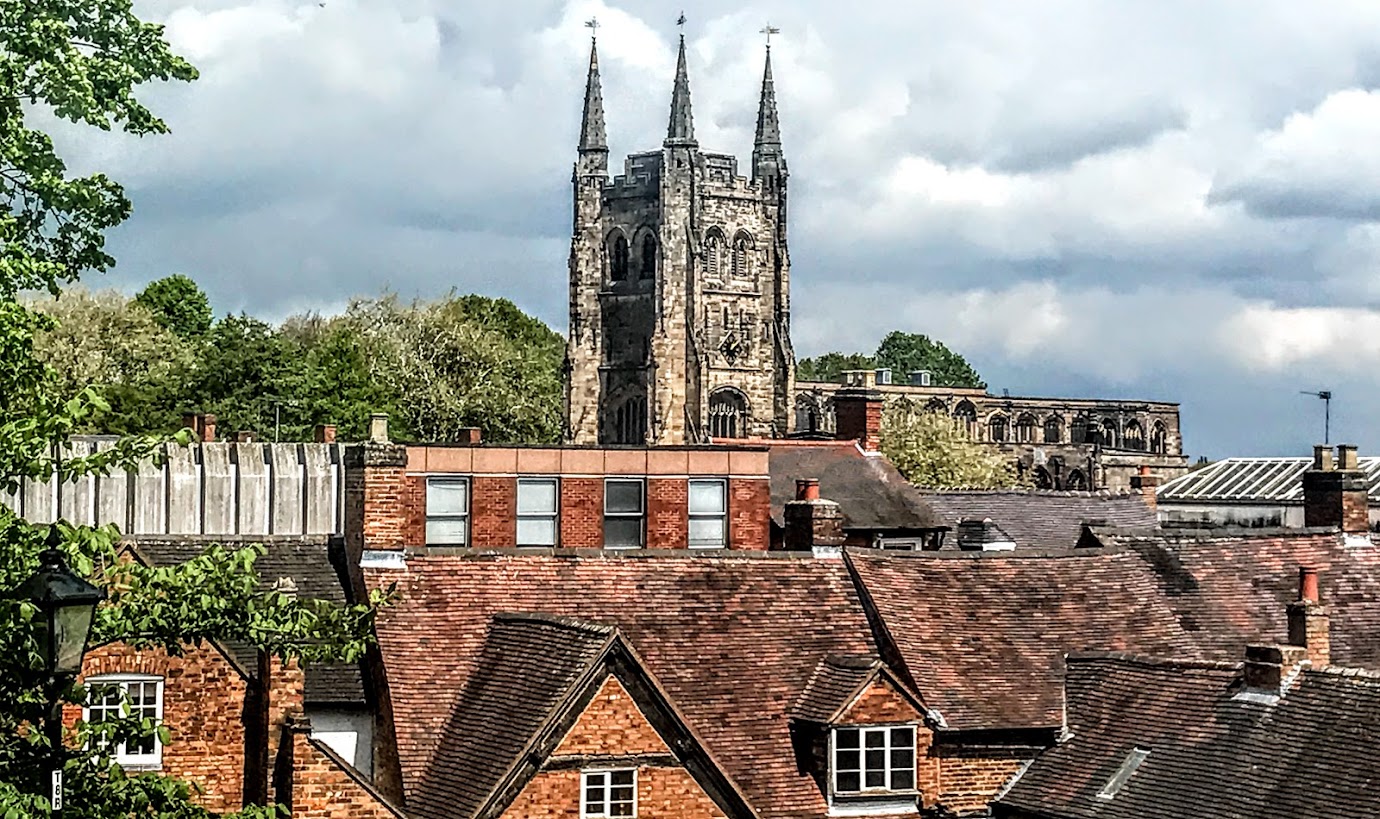
‘Our town has underused churches and underappreciated ancient monuments’ … Saint Editha’s Church and the town seen from Tamworth Castle (Photograph: Patrick Comerford)
I was back in Tamworth last week, visiting some places associated with the Comberford family. So, my choice of poem this morning is another poem about Tamworth by Mal Dewhirst, ‘Our Town.’
Mal Dewhirst, who died in 2021, became Staffordshire’s first poet laureate in 2012. He lived in Tamworth and Tamworth inspired a number of his poems.
He was a writer and film maker, and his plays have been performed across the Midlands, including ‘The Fell Walker’ in Tamworth and ‘At the Crossroads’ at the Garrick in Lichfield, which was commissioned by the Lichfield Mysteries.
Mal was a poet-in-residence in a town market and an archaeological dig, his work has been published in many magazines and journals, and he appeared on BBC Radio and Radio Wildfire. He was also responsible for the Polesworth Poets Trail.
Mal was a regular reader on the Midlands poetry scene and was part of the Coventry Cork Literature exchange in 2011, performing readings in Cork City and Limerick. As a film director, his film Double Booked was shown at the Corona Fastnet Short Film Festival in Ireland in 2014.
He hoped to bring ground-breaking writing to new audiences, always seeking to redefine boundaries, and wanted to develop and improvise new work as collaborations with other artists and performers in unexpected places as a melding of ideas, skills and talents.
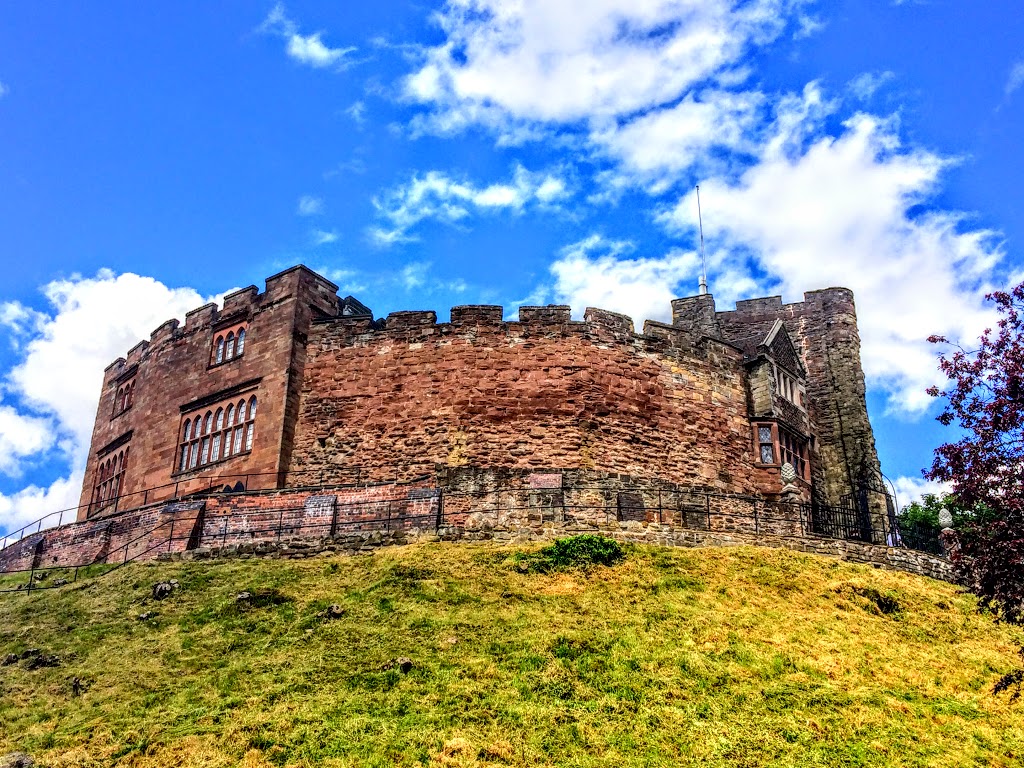
Tamworth Castle, on a mound above the town (Photograph: Patrick Comerford)
Our Town, by Mal Dewhirst:
Our town is being defined
by the corporate; coffee shop, pseudo design brand clothing stores, token music shop and two branches of a major pharmacy,
mixed in with charity shops for our hearts, the aged, the hospice and cancer.
It has an out of town retail park
with two supermarkets, a pet store, two electrical shops and a DIY store,
all mingled among a disruptive road network.
I know what you’re thinking,
Our town sounds just like your town.
It has several co-ops, a flower shop, a row of; banks and building societies,
travel agents and estate agents, solicitors and accountants,
they all group together, power in numbers,
creating quarters, where they know each others secrets.
Then there is the local council office, the tourist information centre,
pubs and restaurants, cafes and Kebab shops,
cheep booze emporiums,
where Chateauneuf-du-Pape is not even an aspiration.
Market stalls on xdays and ydays,
for the purveyors of:
fleeces and fruit, trainers and towels,
books and batteries, rugs and rollers,
cheese and chutney,
Our town sounds just like your town
Our town has a Non-league football team,
whose fans chant about coming from our town,
how nobody likes us but we don’t care,
just like they do in your town.
We have a leisure centre, with swimming pool and gym,
all franchised out to entrepreneurs from the Dragons den.
Our town has underused churches and underappreciated ancient monuments,
it has some green open spaces with swings and a slide
and some artworks, that just appeared as if dropped by aliens.
There is a carnival in the summer,
where lorries squeeze through open backed streets
and the sea cadets, girl guides and boy scouts
hold on for dear life, whilst the spectators thrown coins at them.
The carnival, when they crown a local girl as queen
who smiles for the camera and hopes that there is more to fame than this.
Our town has the battle of the bands in the autumn,
when young testosterone filled teenagers
thrash guitars and grunt about being misunderstood.
Our town has a bonfire and fireworks in the park,
except now it’s only fireworks
because the fire destroys the grass.
Our town sounds just like your town
Our town was badly re-planned in the sixties and has a local newspaper
that keeps reminding us, by printing pictures from the past.
Our town’s car parks are free after seven pm
but demands payment for a minimum of two hours at all other times.
Our town has its Assembly rooms where fading sixties bands strut their Zimmer tunes,
and the local dance groups hold their annual shows,
followed by the X factor rejects, grabbing their last gigs
before disappearing into Wikipedia.
Our town has its taxi ranks where A2B vie for business with Ourtown Taxi’s,
there is a bus garage that is in the narrowest most inappropriate part of town,
the multiplex Cinema surround sounds an American Diner.
Pedestrianised streets where
there are sometimes fights at weekends,
tears and bruises, over indulgent consequences.
Fading hotels, who have offers for weddings
where suits feel uncomfortable
upon their wearers
and women wear large bright hats.
Our town sounds just like your town.
Our town has bred several footballers, rock musicians and the odd writer,
all of whom no longer live here,
and never mention that they ever lived here,
We do have many other worthies, who were named after the roads,
where boy racers now avoid the awkward speed bumps
as they tear up the worthy tarmac.
Our town has its own crest,
is tripleted with several foreign towns,
one in Germany, as an act of reconciliation,
another in France, although I did not realise Agincourt still ran so deep,
and the obvious one, the one with same name, in a former British colony.
Our town used to produce things,
was known for producing certain things;
now either people don’t want our things,
or they can be made cheaper in Eastern Europe or China,
our town has lost its industry
has become overspill for the city
has more incomers who commute to work,
than those who are born and bred and speak with a local accent,
use local sayings; know everyone and who they are related too.
OK, In our town there is a familiar feeling
that our town is just like your town.
© Mal Dewhirst
‘Our town has its own crest’ … the Tamworth Arms on Lichfield Street (Photograph: Patrick Comerford)
USPG Prayer Diary:
The theme in the USPG Prayer Diary this week is the ‘Opening Our Hearts.’ This theme is introduced this morning by James Roberts, Christian Programme Manager at the Council of Christians and Jews, who reflects on Holocaust Memorial Day and World Interfaith Harmony Week.
Holocaust Memorial Day, which we commemorated on Friday, and World Interfaith Harmony Week, which begins on Wednesday, require us to open our hearts, both to the memory of the past and towards a more tolerant and loving future.
Holocaust Memorial Day is when we remember all the victims of Nazi persecution, including the six million Jews who were murdered in the Holocaust, and all subsequent genocides. In order to authentically witness to the memory of the Holocaust, we need to open our hearts to the pain of the past. We need to inform ourselves of this shameful history, and to hold the memory of the victims in our minds. We may even look inwards and ask ourselves how we might do more to stand up for those who are persecuted, abused, or rejected in our world today.
To look forward towards a better future, towards a world where genocide will be no more, we must also open our hearts to the other — to our neighbours, to people who are different from us. In interfaith harmony week, we think especially of people of other faiths.
To open our hearts to the memory of the past, and to our neighbours, is to actively and prayerfully strive towards harmony between all people, so that we may grow one step closer to a world united in love.
The USPG Prayer Diary today invites us to pray in these words:
Lightness our darkness, O Lord,
and reveal the unspeakable
lest we forget the victims of our inhumanity.
Turn our hearts to repentance and our actions to justice.
Yesterday’s reflection
Continued Tomorrow
‘Our town has … underappreciated ancient monuments’ … the Comberford monument in Saint Editha’s Church, Tamworth (Photograph: Patrick Comerford, 2023)
28 January 2023
Praying through poetry and
with USPG: 28 January 2023
Tamworth Castle and the Moat House, the former Comberford home on Lichfield Street, decorate the welcome sign at Tamworth Railway Station (Photograph: Patrick Comerford, 2023)
Patrick Comerford
Christmas is not a season of 12 days, despite the popular Christmas song. Christmas is a 40-day season that lasts from Christmas Day (25 December) to Candlemas or the Feast of the Presentation on Thursday next (2 February).
Throughout the 40 days of this Christmas Season, I am reflecting in these ways:
1, Reflecting on a seasonal or appropriate poem;
2, a prayer from the USPG prayer diary, ‘Pray with the World Church.’
I interrupted that pattern to mark the Week of Prayer for Christian Unity, which came to an end on Wednesday.
I have an appointment in Milton Keynes University Hospital later this morning. But, before the day gets busy, I am taking some time for prayer and reflection.
Inside Saint Editha’s Church, Tamworth (Photograph: Patrick Comerford, 2023)
I was back in Tamworth earlier this week, visiting some places associated with the Comberford family. So, my choice of poem this morning is Mal Dewhirst’s ‘We are Tamworth,’ a poem commissioned for ‘This is Tamworth’ at Birmingham Symphony Hall on 3 July 2014.
Mal Dewhirst, who died in 2021, became Staffordshire’s first poet laureate in 2012. He lived in Tamworth and Tamworth inspired a number of his poems.
He was a writer and film maker, and his plays have been performed across the Midlands, including ‘The Fell Walker’ in Tamworth and ‘At the Crossroads’ at the Garrick in Lichfield, which was commissioned by the Lichfield Mysteries.
Mal was a poet-in-residence in a town market and an archaeological dig, his work has been published in many magazines and journals, and he appeared on BBC Radio and Radio Wildfire. He was also responsible for the Polesworth Poets Trail.
Mal was a regular reader on the Midlands poetry scene and was part of the Coventry Cork Literature exchange in 2011, performing readings in Cork City and Limerick. As a film director, his film Double Booked was shown at the Corona Fastnet Short Film Festival in Ireland in 2014.
He hoped to bring ground-breaking writing to new audiences, always seeking to redefine boundaries, and wanted to develop and improvise new work as collaborations with other artists and performers in unexpected places as a melding of ideas, skills and talents.
Sir Robert Peel’s statue outside the Town Hall in Tamworth (Photograph: Patrick Comerford, 2023)
We are Tamworth, by Mal Dewhirst:
We are Tamworth
We are Tamworth
We are Tamworth
From the Lamb
from Stonydelph, Wincote, Belgrave, Amington, Two Gates, Lakeside, Riverside, Coton Green, Gillway, Perrycrofts. The Leys, Leyfields, Glascote and its Heath, Bolehall, Dosthill, Kettlebrook, Bitterscote, Castle and town and all our blessed lands.
We are Tamworth.
Where Tame meets Anker,
bringing Birmingham and Black Country tales
to mix with the Anker's Warwickshire words,
all the ripple and flow from here, to the Trent, to the Humber, to the Sea.
Rivers spilling full lap through meadowlands:
where Offa palaced in the castled grounds
of Sandybacks and Plastic Pigs,
Aetheflaeda proclaimed
build me a bridge, a Lady Bridge,
then guard it so that only I might cross.
Build me a mound, a castled mound,
where I might live and watch for dust.
This is Tamworth.
Where Saxon and Viking built their border,
we gave camp to the knights of Bosworth field,
where Roundhead met Cavalier on the Tame bridges
and we gave tea to soldiers as they passed on to the Somme,
always trying to bring some comfort to conflict.
This is Tamworth
where Enigma Heroes learned to swim,
ski’s ride summers of man-made frosts,
Rawlett, preached his legacy of learning,
where Guy built a town hall and gave Alms
then took them away when he didn’t get the vote
and Policeman Peel built his weaving mills,
warp and weft, webbing and tape,
building his new manifesto.
This is Tamworth where the Beatles and the Stones played,
in their constant touring, egg and chip days.
Tamworth, where the original Teardrop Exploded,
and Wolfsbane gave us a massive noise injection,
where every year we see the Assembly Rooms
host the next Battle of the Bands,
which is not when young testosterone filled teenagers
thrash guitars and grunt about being misunderstood.
It is when, just maybe, our Beatles and Rolling Stones might be heard.
Ventura Park and Ankerside, the retail lands
of designer brands and coffee shops,
supermarkets, house and homes,
enclosed by roads that circle and twist and never want to let you leave.
Market on Tuesdays and Saturdays,
for the purveyors of:
fleeces and fruit, cakes and clothes, trainers and towels,
books and batteries, rugs and rollers,
cheese and chutney, shoes and socks, games and gifts.
Town has several co-ops, flower shops, a row of: banks and building societies,
travel agents and estate agents, solicitors and accountants,
they all group together, power in numbers,
creating quarters, where they know each others secrets.
All watched over by the Philosophers of Upstairs, Downstairs, Sidewalk Cafe.
This is Tamworth
Our housing estates that are built on themes; of counties, of plants,
cars, poets, space travel and stately homes – and we don’t waste
people’s time in naming our roads, don’t see the point of adding road or
street or close – makes it so much easier to write an envelope.
And have you noticed that many of our famous people were named after the streets.
Famous people: Marmion, Ferrers, Robert Peel. Thomas Guy, John Rawlett, William McGregor, Colin Grazier, Tom Williams back to Ethelflaeda and Offa, and onward to Julian Cope, Blayze Bailey, Phil Bates, Mark Albrighton. Miss Pym and her suffragettes –
All worthies who have a staked a claim in Tamworth.
Along with the miners of Glascote and Amington, the car workers of Reliant, the spinners and weavers, the potters and warehouse crews. The choirs and bands all hammering the sound of Tamworth.
This is created in Tamworth, along with the crafts and cakes, the paintings and
sculpted forms that bring all the welcomes into the light of valued art.
This is Tamworth
Where the Herald reports our community woes and triumphs
then reminds of how the town used to look.
Tamworth, home where the Tamworth Two were trying to return,
and the Lambs raise goals to the songs of the shed choir.
Tamworth where the town hall is like an orange, it has Peel on the outside,
where the Olympic torch chose to catch its breath,
and jousters, fireworks, skateboarders,
families all strut their thought in the castle grounds.
Tamworth with our French and German twins
Sharing culture and song
Poetry and peace
Bringing markets to share cheese and meat and finest wine.
Tamworth where we race for life.
bring help to heroes
and support those in need.
This Tamworth where our dialect is spoken with a distinction, alright me duck.
These are our words that tell of a proud heritage built on toil
and a strength that sees one Tamworth, perfectly placed
to create our piece of theatre in the world
and remember who we are and where we are from
we can shed a tear and raise a smile
as we share our town with all those who choose to come.
Because we are Tamworth
Super Tamworth
We are Tamworth
from our land.
© Mal Dewhirst 2014
Aetheflaeda ‘enclosed by roads that circle and twist and never want to let you leave’ (Photograph: Patrick Comerford, 2023)
USPG Prayer Diary:
The theme in the USPG Prayer Diary this week is the ‘Myanmar Education Programme.’ This theme was introduced on Sunday with a reflection from a report from the Church of the Province of Myanmar.
The USPG Prayer Diary today invites us to pray in these words:
Let us give thanks for the Myanmar Education Programme. May its work amongst the rural communities of its dioceses resource and empower them.
Yesterday’s reflection
Continued Tomorrow
The former Peel School at 17 Lichfield Street, Tamworth (Photograph: Patrick Comerford, 2023)
28 August 2022
Another stage comes
to an end in half a
century of journalism
A two-page illustrated feature on Padua in the February 2022 edition of the ‘Church Review’, the Dublin and Glendalough diocesan magazine
Patrick Comerford
Sometimes anniversaries can come and go with a note of forgetfulness rather than nostalgia. I was reminded the other day that it is 20 years this summer since I left The Irish Times in the summer of 2002, and it is 50 years since I joined the Wexford People as a staff journalist in the summer of 1972.
I must seem unkind in my forgetfulness at times when it comes to birthdays or anniversaries. But it’s a trait that probably provides an insight into why I cannot recall the exact dates when I joined the Wexford People 50 years ago and left The Irish Times 20 years ago.
I was reminded of these anniversaries, of starting at the Wexford People and leaving The Irish Times, when I read a few days ago that Paul O’Neill is retiring as the Editor of The Irish Times.
I had worked as a journalist for over 30 years, starting as freelance contributor to the Lichfield Mercury and the Tamworth Herald, followed by almost three years with the Wexford People and almost 28 years with The Irish Times, the last eight as Foreign Desk Editor.
The past 20 years have brought their own changes and challenges too. By then I had been ordained for two years. I worked for four years with the Church Mission Society, and combined that with four years of part-time academic life, lecturing in church history and social theology, before becoming a full-time academic, lecturing in liturgy and church history in the Church of Ireland Theological Institute and becoming an adjunct assistant professor in Trinity College Dublin.
I continued in priestly ministry throughout those years, as an honorary curate in Whitechurch parish, Dublin, and a canon of Christ Church Cathedral Dublin. I spent the last five years as the Priest-in-Charge of the Rathkeale Group of Parishes in west Limerick and north Kerry, and Canon Precentor of Saint Mary’s Cathedral, Limerick, and Saint Flannan’s Cathedral, Killaloe.
I had planned on retiring some time this summer, but a stroke in mid-March brought that forward, and I retired on 31 March. Of course, one retires from an appointment or employment. But a priest never ceases to be a priest, and a writer or journalist never ceases to write.
When the Revd Stephen Hilliard was leaving The Irish Times to enter full-time parish ministry, the then deputy editor, Ken Gray, joked that he was moving from being a ‘column of the Times’ to being a ‘pillar of the church.’
Later, when I asked Stephen to define the different challenges of journalism and parish ministry, I was told: ‘In many ways they’re the same. We’re supposed to be comforting the afflicted and afflicting the comfortable.’
In my 30 or more years as a full-time journalist and writer, I had tried to work at the point where faith meets the major concerns of the world. That work has made me a witness to the great conflicts and disasters of the last century.
I have seen the evil consequences of the Holocaust in museums, memorials and synagogues. I have met the survivors of Hiroshima and Nagasaki and the children of Chernobyl. I have been in the midst of the Israeli-Palestinian conflict in the Middle East.
I have witnessed the evils of apartheid and racism, seen military occupation, poverty, and the deprivations of famine in Africa and South Asia, and talked and prayed with the victims of torture and violence.
I have family experiences of the social terror left behind by the old regimes in East Europe. I have friends who were tortured and exiled by the colonels in Greece but who went on to make major contributions to the arts, diplomacy and politics.
Through those years I have been inspired by the courage of people who refuse to become victims and instead become fearless and articulate witnesses to the truths that good can overcome evil, that there is hope in the face of oppression, that faith is not a mere comfort but can inspire, motivate and provide vision for what can be – for what must be.
Like many academics, over the past 20 years I have contributed chapters and papers to books and journals. But, after leaving The Irish Times 20 years ago, I continued to write regularly in other formats too. My daily blog has been a daily exercise. But I continued to write occasionally for The Irish Times, and only last month I contributed a news feature to the Wexford People.
I have written too for the Lichfield Gazette and CityLife in Lichfield, returning to the place where I began working as a journalist. I also wrote for a number of Church publications, including the Church of Ireland Gazette and the Church Times.
But perhaps the one enduring and continuing exercise in journalism was a monthly column that I wrote first for the Diocesan Magazine in the Diocese of Cashel, Ferns and Ossory, and then for the Church Review in the Diocese of Dublin and Glendalough.
It was first commissioned about a quarter of a century ago by the Revd Nigel Waugh when he heard me speaking in Saint Iberius Church, Wexford, about the Church of Ireland during the 1798 Rising. The column made brief appearances in other diocesan magazines in Limerick and Meath and Kildare, and eventually came to an end in the Diocesan Magazine with a new editor some years ago. But I continued to write for the Church Review until this summer.
For years, I had an encouraging and tolerant editor who rejoiced in my thoughts on a broad range of topics, from travels in Greece and Italy to the cathedrals of England and the thoughts of Samuel Johnson and TS Eliot to the church in China, Egypt and Romania.
Perhaps my ideas were eccentric or even eclectic at times. I was seldom controversial, but I hope I was always thought-provoking and that I provided one diocese with a window onto the world. The response of readers was always generous, and some have shared with me how, because of my column, they decided to visit places as diverse as Lichfield Cathedral and Crete and the Greek islands.
The diocesan website continues to describe it as ‘a very popular and informative monthly column.’
But, sadly, the time has come to sign off on this column too. All good things have to come to an end.
Nadine Gordimer, in a lecture in London 20 year ago, argued that a writer’s highest calling is to bear witness to the evils of conflicts and injustice. But that is the calling of a priest too. I shall continue to write.
Patrick Comerford
Sometimes anniversaries can come and go with a note of forgetfulness rather than nostalgia. I was reminded the other day that it is 20 years this summer since I left The Irish Times in the summer of 2002, and it is 50 years since I joined the Wexford People as a staff journalist in the summer of 1972.
I must seem unkind in my forgetfulness at times when it comes to birthdays or anniversaries. But it’s a trait that probably provides an insight into why I cannot recall the exact dates when I joined the Wexford People 50 years ago and left The Irish Times 20 years ago.
I was reminded of these anniversaries, of starting at the Wexford People and leaving The Irish Times, when I read a few days ago that Paul O’Neill is retiring as the Editor of The Irish Times.
I had worked as a journalist for over 30 years, starting as freelance contributor to the Lichfield Mercury and the Tamworth Herald, followed by almost three years with the Wexford People and almost 28 years with The Irish Times, the last eight as Foreign Desk Editor.
The past 20 years have brought their own changes and challenges too. By then I had been ordained for two years. I worked for four years with the Church Mission Society, and combined that with four years of part-time academic life, lecturing in church history and social theology, before becoming a full-time academic, lecturing in liturgy and church history in the Church of Ireland Theological Institute and becoming an adjunct assistant professor in Trinity College Dublin.
I continued in priestly ministry throughout those years, as an honorary curate in Whitechurch parish, Dublin, and a canon of Christ Church Cathedral Dublin. I spent the last five years as the Priest-in-Charge of the Rathkeale Group of Parishes in west Limerick and north Kerry, and Canon Precentor of Saint Mary’s Cathedral, Limerick, and Saint Flannan’s Cathedral, Killaloe.
I had planned on retiring some time this summer, but a stroke in mid-March brought that forward, and I retired on 31 March. Of course, one retires from an appointment or employment. But a priest never ceases to be a priest, and a writer or journalist never ceases to write.
When the Revd Stephen Hilliard was leaving The Irish Times to enter full-time parish ministry, the then deputy editor, Ken Gray, joked that he was moving from being a ‘column of the Times’ to being a ‘pillar of the church.’
Later, when I asked Stephen to define the different challenges of journalism and parish ministry, I was told: ‘In many ways they’re the same. We’re supposed to be comforting the afflicted and afflicting the comfortable.’
In my 30 or more years as a full-time journalist and writer, I had tried to work at the point where faith meets the major concerns of the world. That work has made me a witness to the great conflicts and disasters of the last century.
I have seen the evil consequences of the Holocaust in museums, memorials and synagogues. I have met the survivors of Hiroshima and Nagasaki and the children of Chernobyl. I have been in the midst of the Israeli-Palestinian conflict in the Middle East.
I have witnessed the evils of apartheid and racism, seen military occupation, poverty, and the deprivations of famine in Africa and South Asia, and talked and prayed with the victims of torture and violence.
I have family experiences of the social terror left behind by the old regimes in East Europe. I have friends who were tortured and exiled by the colonels in Greece but who went on to make major contributions to the arts, diplomacy and politics.
Through those years I have been inspired by the courage of people who refuse to become victims and instead become fearless and articulate witnesses to the truths that good can overcome evil, that there is hope in the face of oppression, that faith is not a mere comfort but can inspire, motivate and provide vision for what can be – for what must be.
Like many academics, over the past 20 years I have contributed chapters and papers to books and journals. But, after leaving The Irish Times 20 years ago, I continued to write regularly in other formats too. My daily blog has been a daily exercise. But I continued to write occasionally for The Irish Times, and only last month I contributed a news feature to the Wexford People.
I have written too for the Lichfield Gazette and CityLife in Lichfield, returning to the place where I began working as a journalist. I also wrote for a number of Church publications, including the Church of Ireland Gazette and the Church Times.
But perhaps the one enduring and continuing exercise in journalism was a monthly column that I wrote first for the Diocesan Magazine in the Diocese of Cashel, Ferns and Ossory, and then for the Church Review in the Diocese of Dublin and Glendalough.
It was first commissioned about a quarter of a century ago by the Revd Nigel Waugh when he heard me speaking in Saint Iberius Church, Wexford, about the Church of Ireland during the 1798 Rising. The column made brief appearances in other diocesan magazines in Limerick and Meath and Kildare, and eventually came to an end in the Diocesan Magazine with a new editor some years ago. But I continued to write for the Church Review until this summer.
For years, I had an encouraging and tolerant editor who rejoiced in my thoughts on a broad range of topics, from travels in Greece and Italy to the cathedrals of England and the thoughts of Samuel Johnson and TS Eliot to the church in China, Egypt and Romania.
Perhaps my ideas were eccentric or even eclectic at times. I was seldom controversial, but I hope I was always thought-provoking and that I provided one diocese with a window onto the world. The response of readers was always generous, and some have shared with me how, because of my column, they decided to visit places as diverse as Lichfield Cathedral and Crete and the Greek islands.
The diocesan website continues to describe it as ‘a very popular and informative monthly column.’
But, sadly, the time has come to sign off on this column too. All good things have to come to an end.
Nadine Gordimer, in a lecture in London 20 year ago, argued that a writer’s highest calling is to bear witness to the evils of conflicts and injustice. But that is the calling of a priest too. I shall continue to write.
Subscribe to:
Posts (Atom)