‘If it is by the finger of God that I cast out the demons, then the kingdom of God has come to you’ (Luke 11: 20) … the finger of God touches Adam in Michelangelo’s ceiling in the Sistine Chapel (1508-1512)
Patrick Comerford
We are continuing in Ordinary Time in the Church Calendar, and the week began with the Nineteenth Sunday after Trinity (Trinity XIX).
The calendar of the Church of England in Common Worship today remembers Ethelburga (675), Abbess of Barking, and James the Deacon 7th century), companion of Paulinus.
In the Jewish calendar, Yom Kippur, the Day of Repentance, begins this evening, and I hope to attend the Kol Nidre service in Milton Keynes and District Reform Synagogue this evening. But, before today begins, I am taking some quiet time this morning to give thanks, and for reflection, prayer and reading in these ways:
1, today’s Gospel reading;
2, a reflection on the Gospel reading;
3, a prayer from the USPG prayer diary;
4, the Collects and Post-Communion prayer of the day.
‘He casts out demons by Beelzebul, the ruler of the demons’ (Luke 11: 15) … a gargoyle at Lichfield Cathedral (Photograph: Patrick Comerford)
Luke 11: 15-26 (NRSVA):
15 But some of them said, ‘He casts out demons by Beelzebul, the ruler of the demons.’ 16 Others, to test him, kept demanding from him a sign from heaven. 17 But he knew what they were thinking and said to them, ‘Every kingdom divided against itself becomes a desert, and house falls on house. 18 If Satan also is divided against himself, how will his kingdom stand? – for you say that I cast out the demons by Beelzebul. 19 Now if I cast out the demons by Beelzebul, by whom do your exorcists cast them out? Therefore they will be your judges. 20 But if it is by the finger of God that I cast out the demons, then the kingdom of God has come to you. 21 When a strong man, fully armed, guards his castle, his property is safe. 22 But when one stronger than he attacks him and overpowers him, he takes away his armour in which he trusted and divides his plunder. 23 Whoever is not with me is against me, and whoever does not gather with me scatters.
24 ‘When the unclean spirit has gone out of a person, it wanders through waterless regions looking for a resting-place, but not finding any, it says, “I will return to my house from which I came.” 25 When it comes, it finds it swept and put in order. 26 Then it goes and brings seven other spirits more evil than itself, and they enter and live there; and the last state of that person is worse than the first.’
‘When a strong man, fully armed, guards his castle, his property is safe’ (Luke 11: 21) … Ballybur Castle, the former seat of the Comerford family near Callan, Co Kilkenny (Photograph: Patrick Comerford)
Today’s reflection:
In this morning’s Gospel reading, Christ is challenged about whether his work is the work of God or the work of the Devil.
Too often, when I am offered the opportunity to do the right thing, to make a difference in this society, in this world, I ask: ‘What’s in this for me?’ And how often do I challenge others when they are doing the right thing, questioning their motives and wondering ‘Wat’s in it for them?’
When I am asked to speak up for those who are marginalised or oppressed, this should be good enough reason in itself. But then I wonder how others are going to react – react not to the marginalised or oppressed, but to me, and then jealous or feeling hubris when others are seeing to do the right thing when I failed to respond?
How often have I seen what is the right thing to do, but have found an excuse that I pretend is not of my own making?
How often do I think of doing the right thing only if it is going to please my family members or please my neighbours?
How often do I use the Bible to justify not extending civil rights to others?
How often do I use the Bible to condemn others when I know, deep down, that they are doing the right thing for other people?
How often do I use obscure Bible texts to prop up my own prejudices, forgetting that any text in the Bible, however clear or obscure it may be, depends, in Christ’s own words, on the two greatest commandments, to love God and to love one another.
We can convince ourselves that we are doing the right thing when we are doing it for the wrong reason. A wrong decision taken once, thinking it is doing the right thing, but for the wrong reason, is not just an action in the present moment. It forms habits and it shapes who we are, within time and eternity.
The Revd Martin Niemöller (1892-1984), a prominent German Lutheran pastor and an outspoken opponent of Hitler, spent the last seven years of Nazi rule in concentration camps. He once said:
First they came for the socialists, and I did not speak out –
Because I was not a socialist.
Then they came for the trade unionists, and I did not speak out –
Because I was not a trade unionist.
Then they came for the Jews, and I did not speak out –
Because I was not a Jew.
Then they came for me – and there was no one left to speak for me.
What we do today or fail to do today, even if we think it is the right thing to do but we do it for the wrong reasons, reflects how we have formed ourselves habitually in the past, is an image of our inner being in the present, and has consequences for the future we wish to shape.
As TS Eliot writes:
Time present and time past
Are both perhaps present in time future
And time future contained in time past (‘Burnt Norton’).
How is the Church to recover its voice and speak up for the oppressed and the marginalised, not because it is fashionable or politically correct today, but because it is the right thing to do today and for the future?
Surely all our actions must depend on those two great commandments – to love God and to love one another.
‘Now if I cast out the demons by Beelzebul, by whom do your exorcists cast them out?’ (Luke 11: 19) … an image at La Lonja de la Seda in Valencia (Photograph: Patrick Comerford)
Today’s Prayers (Friday 11 October 2024):
The theme this week in ‘Pray With the World Church’, the Prayer Diary of the Anglican mission agency USPG (United Society Partners in the Gospel), is the ‘Humanitarian Corridors project in Leuven, Belgium.’ This theme was introduced on Sunday with a programme update by Rebecca Breekveldt, Second Secretary, Central Committee of the Anglican Church in Belgium.
The USPG Prayer Diary today (Friday 11 October 2024) invites us to pray:
We pray for all of the chaplains throughout the Diocese in Europe and for all the projects and work they do to support displaced people.
The Collect:
O God, forasmuch as without you
we are not able to please you;
mercifully grant that your Holy Spirit
may in all things direct and rule our hearts;
through Jesus Christ your Son our Lord,
who is alive and reigns with you,
in the unity of the Holy Spirit,
one God, now and for ever.
The Post Communion Prayer:
Holy and blessed God,
you have fed us with the body and blood of your Son
and filled us with your Holy Spirit:
may we honour you,
not only with our lips
but in lives dedicated to the service
of Jesus Christ our Lord.
Additional Collect:
Faithful Lord,
whose steadfast love never ceases
and whose mercies never come to an end:
grant us the grace to trust you
and to receive the gifts of your love,
new every morning,
in Jesus Christ our Lord.
Yesterday’s reflection
Continued tomorrow
‘Time present and time past / Are both perhaps present in time future / And time future contained in time past’ (TS Eliot, ‘Burnt Norton’) … the clock on Donegall House in Lichfield (Photograph: Patrick Comerford, 2024)
Scripture quotations are from the New Revised Standard Version Bible: Anglicised Edition copyright © 1989, 1995 National Council of the Churches of Christ in the United States of America. Used by permission. All rights reserved worldwide. http://nrsvbibles.org
Showing posts with label Michelangelo. Show all posts
11 October 2024
07 August 2024
The fresco at Frescoes
brings Michelangelo
and the Sistine Chapel
to the streets of Bedford
Michelangelo’s ‘Libyan Sibyl’ has been reproduced on the gable end of Frescoes coffee shop in Bedford (Photograph: Patrick Comerford, 2024; click on images for full-screen viewing)
Patrick Comerford
Part of Michelangelo’s ‘Libyan Sibyl’ has become an eye-catcher on the gable wall of a café in the centre of Bedford. The fresco at Frescoes in Mill Street is a reproduction of Michelangelo's Libyan Sibyl.
The Libyan Sibyl, named Phemonoe, was the prophetic priestess presiding over the Oracle of Zeus-Ammon at the Siwa Oasis in the Libyan Desert. She is one of the 12 prophetic figures on the ceiling in the Sistine Chapel in the Vatican in 1511 because in classical mythology she foretold the ‘coming of the day when that which is hidden shall be revealed.’
Now the half-mortal, half-divine oracle, who was said to foretell the future, can be seen on the café gable wall on the corner of Mill Street and Howard Street, almost facing the former Howard Chapel and just a few steps away from the Bunyan Meeting Church. She was recreated by the artist Iain Carstairs who painted her using a technique that dates back to ca 1500 BCE.
The fresco was commissioned for the outside wall of the café by then owner of Frecoes, Kevin Kavanagh, who described himself as a ‘bit of an art lover’.
The fresco was created for Frescoes in 2012-2013 by the artist Iain Carstairs and the plasterer Jim Smith. They spent two or three months working from scaffolding on their own version of the masterpiece using pigment paint on lime plaster, a technique that dates back to ancient Greece, ca 1500 BCE.
‘It’s so pleasing to see and it’s prettier than I thought,’ said Iain Carstairs. ‘The most exciting thing is looking out of the window and seeing people’s reaction to it. They seem to connect and react to it.’
‘Painting on lime with pigment paint gives it longevity, which is why you can see works of art around the world which have lasted for hundreds of years,’ he said. ‘The lime plaster mix that you put on first, you could hit it with a sledgehammer and it wouldn’t break.’
The fresco measures about 34 square metres and it took three months to complete. Kevin Kavanagh claimed would ‘last for a thousand years’, saying: ‘The building will fall down before it fades’.
Kevin Kavanagh describes himself as a ‘bit of an art lover’. It cost about £12,000 to complete, and most of that cost came from his own pocket, saying it was his way of ‘adding to the culture of the town’.
Iain Carstairs and Jim Smith began working on their fresco in Bedford on 31 October 2012, 500 years to the day after the unveiling of the ceiling in the Sistine Chapel, and completed their work on 1 January 2013. The artist Iain Carstairs said: ‘I hadn’t realised how tricky it would be but I am very happy with the result and want to do some more.’
The fresco on the gable end of Frescoes measures about 34 sq m (Photograph: Patrick Comerford, 2024)
‘It’s had a tremendous impact locally and really taken off,’ Kevin Kavanagh said. ‘People have been amazed to see the incredible work that has gone into it and the final result certainly has the wow factor.’
He has now moved on to running Blue Glass wine bar in St Peter’s Street. Since 2021. Frescoes Coffee House has been under the management of Xanthe Jackson, a former employee, who had worked at Frecoes for 16 years.
Xanthe Jackson said at the time: ‘I’ve always loved this work and now I am excited to take on the new challenge of being the owner as we come out of lockdown.’
Frescoes regularly displays pieces from local artists and is a cosy, independent coffee shop spread over three styled rooms in a former bookshop on Mill Street, with a blend of traditional comfort and contemporary décor.
It has a traditional shop front on Mill Street, with a downstairs seating area, an outside dining space on sunny days, and a creaky staircase leading to two rooms each with their own display of original works by an artist in residence. There are regular art and music evenings, including a glass of wine.
And the fresco at Frescoes continues to give people in Bedford an unusual Italian experience, continuing to bring Michelangelo to Mill Street and the Sistine Chapel to the street with the former Howard Chapel.
A plaque on the corner of Mill Street and Howard Street tells the story of the fresco at Frescoes (Photograph: Patrick Comerford, 2024)
Patrick Comerford
Part of Michelangelo’s ‘Libyan Sibyl’ has become an eye-catcher on the gable wall of a café in the centre of Bedford. The fresco at Frescoes in Mill Street is a reproduction of Michelangelo's Libyan Sibyl.
The Libyan Sibyl, named Phemonoe, was the prophetic priestess presiding over the Oracle of Zeus-Ammon at the Siwa Oasis in the Libyan Desert. She is one of the 12 prophetic figures on the ceiling in the Sistine Chapel in the Vatican in 1511 because in classical mythology she foretold the ‘coming of the day when that which is hidden shall be revealed.’
Now the half-mortal, half-divine oracle, who was said to foretell the future, can be seen on the café gable wall on the corner of Mill Street and Howard Street, almost facing the former Howard Chapel and just a few steps away from the Bunyan Meeting Church. She was recreated by the artist Iain Carstairs who painted her using a technique that dates back to ca 1500 BCE.
The fresco was commissioned for the outside wall of the café by then owner of Frecoes, Kevin Kavanagh, who described himself as a ‘bit of an art lover’.
The fresco was created for Frescoes in 2012-2013 by the artist Iain Carstairs and the plasterer Jim Smith. They spent two or three months working from scaffolding on their own version of the masterpiece using pigment paint on lime plaster, a technique that dates back to ancient Greece, ca 1500 BCE.
‘It’s so pleasing to see and it’s prettier than I thought,’ said Iain Carstairs. ‘The most exciting thing is looking out of the window and seeing people’s reaction to it. They seem to connect and react to it.’
‘Painting on lime with pigment paint gives it longevity, which is why you can see works of art around the world which have lasted for hundreds of years,’ he said. ‘The lime plaster mix that you put on first, you could hit it with a sledgehammer and it wouldn’t break.’
The fresco measures about 34 square metres and it took three months to complete. Kevin Kavanagh claimed would ‘last for a thousand years’, saying: ‘The building will fall down before it fades’.
Kevin Kavanagh describes himself as a ‘bit of an art lover’. It cost about £12,000 to complete, and most of that cost came from his own pocket, saying it was his way of ‘adding to the culture of the town’.
Iain Carstairs and Jim Smith began working on their fresco in Bedford on 31 October 2012, 500 years to the day after the unveiling of the ceiling in the Sistine Chapel, and completed their work on 1 January 2013. The artist Iain Carstairs said: ‘I hadn’t realised how tricky it would be but I am very happy with the result and want to do some more.’
The fresco on the gable end of Frescoes measures about 34 sq m (Photograph: Patrick Comerford, 2024)
‘It’s had a tremendous impact locally and really taken off,’ Kevin Kavanagh said. ‘People have been amazed to see the incredible work that has gone into it and the final result certainly has the wow factor.’
He has now moved on to running Blue Glass wine bar in St Peter’s Street. Since 2021. Frescoes Coffee House has been under the management of Xanthe Jackson, a former employee, who had worked at Frecoes for 16 years.
Xanthe Jackson said at the time: ‘I’ve always loved this work and now I am excited to take on the new challenge of being the owner as we come out of lockdown.’
Frescoes regularly displays pieces from local artists and is a cosy, independent coffee shop spread over three styled rooms in a former bookshop on Mill Street, with a blend of traditional comfort and contemporary décor.
It has a traditional shop front on Mill Street, with a downstairs seating area, an outside dining space on sunny days, and a creaky staircase leading to two rooms each with their own display of original works by an artist in residence. There are regular art and music evenings, including a glass of wine.
And the fresco at Frescoes continues to give people in Bedford an unusual Italian experience, continuing to bring Michelangelo to Mill Street and the Sistine Chapel to the street with the former Howard Chapel.
A plaque on the corner of Mill Street and Howard Street tells the story of the fresco at Frescoes (Photograph: Patrick Comerford, 2024)
14 June 2021
Praying in Ordinary Time 2021:
16, the Duomo, Florence
The Duomo of Florence and the Palazzo Vecchio seen from the terraces of the Uffizi (Photograph: Patrick Comerford)
Patrick Comerford
During this time in the Church Calendar known as Ordinary Time, I am taking some time each morning to reflect in these ways:
1, photographs of a church or place of worship;
2, the day’s Gospel reading;
3, a prayer from the prayer diary of the Anglican mission agency USPG (United Society Partners in the Gospel).
This week my photographs are of seven cathedrals in Italy. This morning (14 June 2021), my photographs are of the Duomo or Cathedral of Santa Maria del Fiore in Florence.
With its Duomo and baptistry, palazzi and basilicas, the Uffizi and the Ponte Vecchio, Florence was ‘the engine room of the Renaissance’ (Photograph: Patrick Comerford)
I have visited Florence, the city of architectural beauty and Renaissance grandeur, on a number of occasions. With its Duomo and baptistry, palazzi and basilicas, the Uffizi and the Ponte Vecchio, it outdid its rivals and its richest citizens sought to outdo one another. This was ‘the engine room of the Renaissance.’
The cathedral complex in the Piazza del Duomo includes the Duomo, the Baptistry and Giotto’s Campanile. The dome of the Duomo is the city’s iconic landmark and stands, alongside the Leaning Tower of Pisa and the Coliseum in Rome as Italy’s three most photographed sites.
Work on building the Duomo or Cattedrale di Santa Maria del Fiore (Cathedral of Saint Mary of the Flower) began in 1296. It was designed in a Gothic style by Arnolfo di Cambio and was completed by 1436 with the dome by Filippo Brunelleschi.
The exterior walls of the Duomo are faced in alternate vertical and horizontal bands of polychrome marble from Carrara (white), Prato (green), Siena (red), Lavenza and other places. The original façade, designed by Arnolfo di Cambio but usually attributed to Giotto, was begun 20 years after Giotto’s death.
The great brick dome of the Duomo is the city’s iconic landmark and stands alongside the Leaning Tower of Pisa and the Coliseum in Rome as one of Italy’s three most photographed sites. The dome, built in 1436 by Filippo Brunelleschi, is comprised of two domes – an outer and inner shell bound together with rings of sandstone.
This also the city of Michelangelo, who had a fraught relationship with the Medici family and designed the Medici mausoleum in the Basilica di San Lorenzo. Michelangelo fell from favour when he supported a rebellion against his own masters.
The octagonal, 11th century Baptistry of Saint the Baptist stands across the square in Piazza di San Giovanni. It is older than the cathedral and was built between 1059 and 1128. It has the status of a minor basilica in its own right.
The Baptistry is renowned for its three sets of bronze doors with relief sculptures. The south doors were created by Andrea Pisano and the north and east doors by Lorenzo Ghiberti. Michelangelo named the east doors the ‘Gates of Paradise.’ Dante and other Renaissance figures, including members of the Medici family, were baptised in the Baptistry.
The original façade, designed by Arnolfo di Cambio but usually attributed to Giotto, was begun 20 years after Giotto’s death (Photograph: Patrick Comerford)
Matthew 5: 38-42 (NRSVA):
[Jesus said:] 38 ‘You have heard that it was said, “An eye for an eye and a tooth for a tooth.” 39 But I say to you, Do not resist an evildoer. But if anyone strikes you on the right cheek, turn the other also; 40 and if anyone wants to sue you and take your coat, give your cloak as well; 41 and if anyone forces you to go one mile, go also the second mile. 42 Give to everyone who begs from you, and do not refuse anyone who wants to borrow from you.’
The octagonal, 11th century Baptistry of Saint the Baptist (Photograph: Patrick Comerford)
Prayer in the USPG Prayer Diary:
The Prayer in the USPG Prayer Diary today (14 June 2021) invites us to pray:
Let us pray for the people of Kenya and Ethiopia, whose land is particularly vulnerable to desertification and drought. May we work to improve this situation, becoming more aware of the links between our overconsumption and climate change.
Yesterday’s reflection
Continued tomorrow
The Duomo and the Baptistry of Saint the Baptist … Michelangelo named the east doors of the Baptistry the ‘Gates of Paradise’ (Photograph: Patrick Comerford)
Scripture quotations are from the New Revised Standard Version Bible: Anglicised Edition copyright © 1989, 1995, National Council of the Churches of Christ in the United States of America. Used by permission. All rights reserved worldwide. http://nrsvbibles.org
Patrick Comerford
During this time in the Church Calendar known as Ordinary Time, I am taking some time each morning to reflect in these ways:
1, photographs of a church or place of worship;
2, the day’s Gospel reading;
3, a prayer from the prayer diary of the Anglican mission agency USPG (United Society Partners in the Gospel).
This week my photographs are of seven cathedrals in Italy. This morning (14 June 2021), my photographs are of the Duomo or Cathedral of Santa Maria del Fiore in Florence.
With its Duomo and baptistry, palazzi and basilicas, the Uffizi and the Ponte Vecchio, Florence was ‘the engine room of the Renaissance’ (Photograph: Patrick Comerford)
I have visited Florence, the city of architectural beauty and Renaissance grandeur, on a number of occasions. With its Duomo and baptistry, palazzi and basilicas, the Uffizi and the Ponte Vecchio, it outdid its rivals and its richest citizens sought to outdo one another. This was ‘the engine room of the Renaissance.’
The cathedral complex in the Piazza del Duomo includes the Duomo, the Baptistry and Giotto’s Campanile. The dome of the Duomo is the city’s iconic landmark and stands, alongside the Leaning Tower of Pisa and the Coliseum in Rome as Italy’s three most photographed sites.
Work on building the Duomo or Cattedrale di Santa Maria del Fiore (Cathedral of Saint Mary of the Flower) began in 1296. It was designed in a Gothic style by Arnolfo di Cambio and was completed by 1436 with the dome by Filippo Brunelleschi.
The exterior walls of the Duomo are faced in alternate vertical and horizontal bands of polychrome marble from Carrara (white), Prato (green), Siena (red), Lavenza and other places. The original façade, designed by Arnolfo di Cambio but usually attributed to Giotto, was begun 20 years after Giotto’s death.
The great brick dome of the Duomo is the city’s iconic landmark and stands alongside the Leaning Tower of Pisa and the Coliseum in Rome as one of Italy’s three most photographed sites. The dome, built in 1436 by Filippo Brunelleschi, is comprised of two domes – an outer and inner shell bound together with rings of sandstone.
This also the city of Michelangelo, who had a fraught relationship with the Medici family and designed the Medici mausoleum in the Basilica di San Lorenzo. Michelangelo fell from favour when he supported a rebellion against his own masters.
The octagonal, 11th century Baptistry of Saint the Baptist stands across the square in Piazza di San Giovanni. It is older than the cathedral and was built between 1059 and 1128. It has the status of a minor basilica in its own right.
The Baptistry is renowned for its three sets of bronze doors with relief sculptures. The south doors were created by Andrea Pisano and the north and east doors by Lorenzo Ghiberti. Michelangelo named the east doors the ‘Gates of Paradise.’ Dante and other Renaissance figures, including members of the Medici family, were baptised in the Baptistry.
The original façade, designed by Arnolfo di Cambio but usually attributed to Giotto, was begun 20 years after Giotto’s death (Photograph: Patrick Comerford)
Matthew 5: 38-42 (NRSVA):
[Jesus said:] 38 ‘You have heard that it was said, “An eye for an eye and a tooth for a tooth.” 39 But I say to you, Do not resist an evildoer. But if anyone strikes you on the right cheek, turn the other also; 40 and if anyone wants to sue you and take your coat, give your cloak as well; 41 and if anyone forces you to go one mile, go also the second mile. 42 Give to everyone who begs from you, and do not refuse anyone who wants to borrow from you.’
The octagonal, 11th century Baptistry of Saint the Baptist (Photograph: Patrick Comerford)
Prayer in the USPG Prayer Diary:
The Prayer in the USPG Prayer Diary today (14 June 2021) invites us to pray:
Let us pray for the people of Kenya and Ethiopia, whose land is particularly vulnerable to desertification and drought. May we work to improve this situation, becoming more aware of the links between our overconsumption and climate change.
Yesterday’s reflection
Continued tomorrow
The Duomo and the Baptistry of Saint the Baptist … Michelangelo named the east doors of the Baptistry the ‘Gates of Paradise’ (Photograph: Patrick Comerford)
Scripture quotations are from the New Revised Standard Version Bible: Anglicised Edition copyright © 1989, 1995, National Council of the Churches of Christ in the United States of America. Used by permission. All rights reserved worldwide. http://nrsvbibles.org
12 May 2020
A lockdown ‘virtual
tour’ of a dozen
churches in Tuscany
Brunelleschi’s dome and Giotto’s campanile of the Duomo … the skyline of Florence (Photograph: Patrick Comerford; click on images for full-screen viewing)
Patrick Comerford
The lockdown introduced as a response to the Covid-19 pandemic continues to grip most of Europe, and the latest discussions indicate there may be no travel from Ireland to other parts of Europe for the rest of 2020.
But I can still travel in my mind’s eye. And, so, in the spirit of my recent ‘virtual tours’ over the past month or two, I invite you to join me this evening on a virtual tour of a dozen or more churches and basilicas in Tuscany, similar to recent virtual tours of churches in Rome, Venice and Bologna.
These churches in Florence, Pusa, Lucca, San Gimignano, Pistoia and Siena are among the most photographed and most visited churches in Europe, and many of them are associated with some of the greatest creative minds in Italian culture, from Dante and Catherine of Siena, to Giotto, Brunelleschi and Michelangelo.
In these times of pandemic, it is interesting how some of these churches are associated with the plague and the Black Death. There is even a surprise association in the cloisters of the Basilica of Santa Croce with Florence Nightingale, who was born in Florence on this day 200 years ago, 12 May 1820.
1, Florence: the Duomo, Campanile and Baptistry:
The Duomo in Florence is one of Italy’s three most photographed sites (Photograph: Patrick Comerford)
I have visited Florence, the city of architectural beauty and Renaissance grandeur, on a number of occasions. With its Duomo and baptistry, palazzi and basilicas, the Uffizi and the Ponte Vecchio, it outdid its rivals and its richest citizens sought to outdo one another. This was ‘the engine room of the Renaissance.’
The cathedral complex, in Piazza del Duomo, includes the Duomo, the Baptistry and Giotto’s Campanile. The dome of the Duomo is the city’s iconic landmark and stands, alongside the Leaning Tower of Pisa and the Coliseum in Rome as Italy’s three most photographed sites.
Work on building the Duomo or Cattedrale di Santa Maria del Fiore (Cathedral of Saint Mary of the Flower) began in 1296. It was designed in a Gothic style by Arnolfo di Cambio and was completed by 1436 with the dome by Filippo Brunelleschi. The dome is comprised of two domes – an outer and inner shell bound together with rings of sandstone.
The exterior walls of the Duomo are faced in alternate vertical and horizontal bands of polychrome marble from Carrara (white), Prato (green), Siena (red), Lavenza and other places. The original façade, designed by Arnolfo di Cambio but usually attributed to Giotto, was begun 20 years after Giotto’s death.
The Duomo and the Baptistry of Saint the Baptist … Michelangelo named the east doors of the Baptistry the ‘Gates of Paradise’ (Photograph: Patrick Comerford)
The octagonal, 11th century Baptistry of Saint the Baptist stands across the square in Piazza di San Giovanni. It is older than the cathedral and was built between 1059 and 1128. It has the status of a minor basilica in its own right.
The Baptistry is renowned for its three sets of bronze doors with relief sculptures. The south doors were created by Andrea Pisano and the north and east doors by Lorenzo Ghiberti. Michelangelo named the east doors the ‘Gates of Paradise.’ Dante and other Renaissance figures, including members of the Medici family, were baptised in the Baptistry.
2, Florence: The Basilica of Santa Croce:
The Basilica di Santa Croce with its façade completed in the 19th century (Photograph: Patrick Comerford)
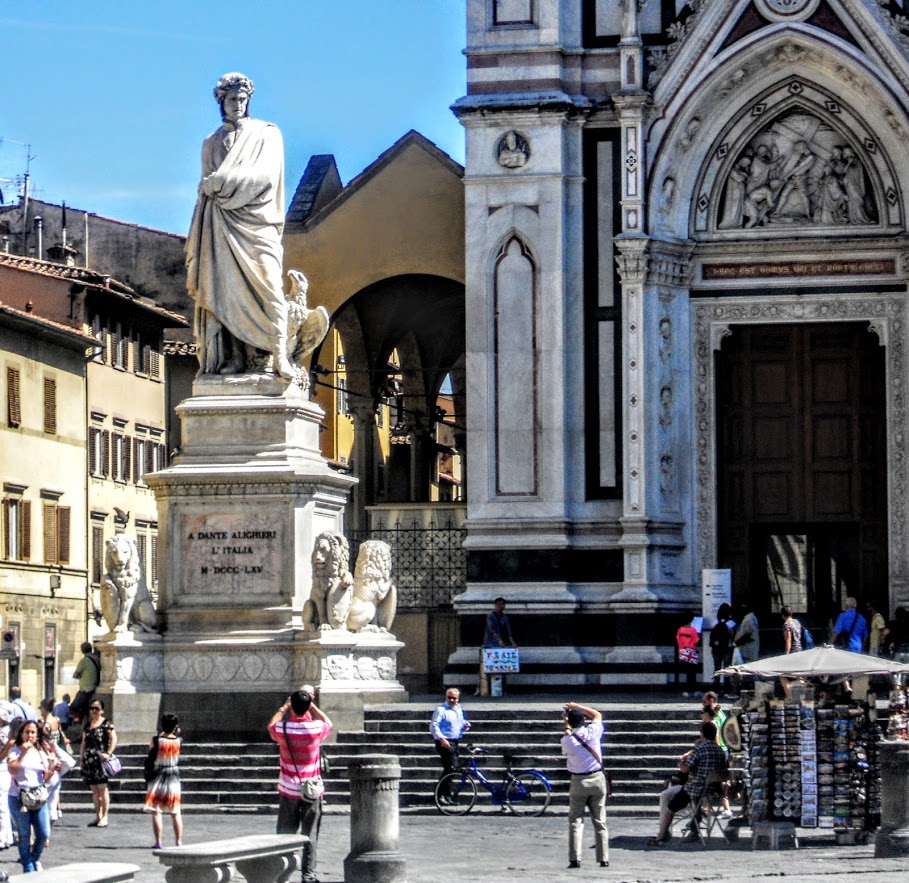
The Basilica di Santa Croce (Basilica of the Holy Cross) in the Piazza di Santa Croce is the burial place of many Florentines, including Michelangelo, Galileo, Machiavelli, Foscolo and Rossini. For this reason, it is also known as the Tempio dell’Itale Glorie, the Temple of the Italian Glories. Although Dante was exiled from Florence and buried in Ravenna, his statue stands in the wide, open square, in front of the basilica.
When the site was first chosen it was in marshland outside the city walls. Later, the square was the venue for burning heretics and it is still used once a year for the calcio storico, the Florentine version of a rough-and-tumble mediaeval game of football.
Santa Croce is about 800 meters south-east of the Duomo. It is a minor basilica, the principal Franciscan church in Florence, and the largest Franciscan church in the world.
Legend says that Santa Croce was founded by Saint Francis. The present church was built in 1294, replacing an older building, and was consecrated by Pope Eugene IV in 1442.The Basilica’s features include its 16 chapels, many decorated with frescoes by Giotto and his pupils, and its tombs and cenotaphs.
The Primo Chiostro, the main cloister, houses the Cappella dei Pazzi, built as the chapter house and completed in the 1470s. Filippo Brunelleschi, who designed the dome of the Duomo, was involved in designing the main cloister and the inner cloister, which was completed in 1453.
The statue of Dante in front of the Basilica of Santa Croce (Photograph: Patrick Comerford)
The façade of the church remained unfinished for more than three centuries, and the neo-Gothic marble façade dates from 1857-1863. The Jewish architect, Niccolo Matas (1798-1872) from Ancona, designed the façade, working a prominent Star of David into his composition. Matas wanted to be buried with his peers but, because he was Jewish, he was buried outside the main door of the basilica, under the threshold.
The complex became public property in 1866 when the Italian government suppressed many religious houses after Italian unification.
The Museo dell’Opera di Santa Croce is in the refectory, off the cloisters. The cloisters also have a monument to Florence Nightingale, who was born in Florence on this day 200 years ago (12 May 1820).
The basilica is undergoing a multi-year restoration programme. It was closed to visitors in 2017 after falling masonry killed a Spanish tourist.
3, Florence: Chiesa di Santa Maria Maggiore and Basilica of Santa Maria Novella:
The Chiesa di Santa Maria Maggiore is one of the oldest surviving churches in Florence (Photograph: Patrick Comerford)
The Duomo in Florence is dedicated to Santa Maria, but there are many other churches in the city with similar dedications, including the Chiesa di Santa Maria Maggiore and the Basilica of Santa Maria Novella.
The Church of Santa Maria Maggiore di Firenze is one of the oldest surviving churches in Florence. This Romanesque and Gothic-style church was first built in the 11th century and there were extensive renovations to the façade and the sides of the church in the 13th century. The bell tower survives from the Romanesque building and has a Roman head embedded in its walls, known popularly as Berta.
The original church dated from the eighth century and is first noted in 931. However, a legend saying it was founded in 580 by Pope Pelagius II is not reliable.
The church became a collegiate church in 1176, and was put under papal direct protection by Lucius III in 1183. When the church was handed over to the Cistercians in the 13th century, it was rebuilt in the Gothic style, apart from the original external walls and the vaults. The church was transferred to Carmelites from Mantua in 1521.
The Basilica of Santa Maria Novella seen from Piazza Unità d’Italia (Photograph: Patrick Comerford)
The Basilica of Santa Maria Novella stands opposite the main railway station in Florence and gives its name to the station. It is the first great basilica in Florence and is the city’s principal Dominican church.
This church was called Santa Maria Novella or New Saint Mary’s because it was built on the site of a ninth-century oratory of Santa Maria delle Vigne. When the site was assigned to the Dominican Order in 1221, they decided to build a new church and cloisters. Building began ca 1246, and lasted 80 years, ending with the completion of the Romanesque-Gothic bell tower and sacristy.
A series of Gothic arcades was added to the façade in 1360, intended for sarcophagi for leading local families. The church was consecrated in 1420.
The church treasures include frescoes by Gothic and early Renaissance masters. They were financed by the most important Florentine families who wanted funerary chapels on consecrated ground. The cadaver tomb of the Lenzi family includes in Latin the epigram: ‘I was once what you are, and what I am you will become.’
The frescoes in the Cappella Strozzi di Mantova by Nardo di Cione (1350-1357) are inspired by Dante’s Divine Comedy. The frescoes in chancel were painted in 1485-1490 by Domenico Ghirlandaio, whose apprentice was the young Michelangelo.
The pulpit, commissioned by the Rucellai family in 1443, was designed by Filippo Brunelleschi and executed by his adopted son Andrea Calvalcanti. It was from this pulpit that the first attack was made on Galileo Galilei.
The square in front the church was used by Cosimo I for the yearly chariot race (Palio dei Cocchi). This custom continued from 1563 into the late 19th century. The two Obelisks of the Corsa dei Cocchi, marking the start and finish of the race, were set up to imitate an antique Roman circus.
4, Florence: the Chiesa e Museo di Orsanmichele:
Orsanmichele was a grain market before being converted into a guild church (Photograph: Patrick Comerford)
Orsanmichele, or the ‘Kitchen Garden of Saint Michael,’ was on the site of the kitchen garden of the monastery of San Michele which no longer exists. The church, which stands on the Via Calzaiuoli, was first built as a grain market in 1337.
Between 1380 and 1404, it was converted into a church and it served as the chapel of the powerful craft and trade guilds in Florence. The arches on the ground floor of the square building originally formed the loggia of the grain market. The second floor provided offices, while the third floor was one of the city’s great grain storehouses, planned to withstand famine or siege.
The statues of saints in the niches of Orsanmichele were commissioned by the guilds of Florence (Photograph: Patrick Comerford)
Late in the 14th century, the guilds were ordered by the city to commission statues of their patron saints to fill the façades of the church. The three richest guilds decided to make their figures in bronze, which cost ten times the amount of the stone figures. The originals have since been moved to museums to protect them from the elements and vandalism, and the sculptures in their place today are copies.
Inside the church is Andrea Orcagna’s richly jewelled Gothic Tabernacle (1355-1359) encasing a repainting by Bernardo Daddi of an older icon of the ‘Madonna and Child.’
5, Pisa: Cattedrale di Pisa, Baptistry and Tower:
The Duomo, Baptistry and Campanile or ‘Leaning Tower’ are in the heart of Pisa (Photograph: Patrick Comerford)
The ‘Leaning Tower’ of Pisa, alongside the Duomo in Florence, and the Coliseum in Rome, is one of the three most photographed sites in Florence. They stand beside each other in the Piazza del Duomo (Cathedral Square) or Piazza dei Miracoli (Square of Miracles), a wide, walled, partly-paved and partly-grassed area in the heart of the city.
At the heart of the piazza is the Duomo or Cathedral of Santa Maria Assunta, a five-nave cathedral built in 1064 by Buscheto in the distinctive Pisan-Romanesque style.
Pisa’s most famous son, Galileo Galilei, is said to have formulated his theory about the movement of a pendulum by watching the swinging of the sanctuary lamp hanging in the cathedral nave.
Inside the Duomo, where Galileo watched the swinging sanctuary lamp and developed his theory about the movement of a pendulum (Photograph: Patrick Comerford)
The Baptistry, which dates from 1153, was completed in the 14th century when the top storey and dome were added by Nicola and Giovanni Pisano. This is the largest baptistry in Italy, and is even a few centimetres higher than the Leaning Tower. The Baptistry is also known for its acoustics, and I have been treated to a short singing demonstration of this by one of the guards.
The ‘Leaning Tower,’ which is about 60 metres high, was built originally as the campanile or bell tower of the cathedral.
Building began in 1173 and the bell-chamber was added only in 1372. But five years after building began, as work reached the third-floor level, sinking began due to the weak subsoil and the poor foundations. The building was left alone for a century, the subsoil stabilised and the building was saved from collapsing.
Building work resumed in 1272, and the upper floors were added, with one side taller than the other. The seventh and final floor was added in 1319. But by then the building was leaning one degree, or 80 cm from vertical. Today, the tower is leaning by about four degrees.
6, Lucca: Duomo di San Martino:
The façade and bell tower of the Duomo in Lucca (Photograph: Patrick Comerford)
Lucca was saved from bombing during World War II and so the city has been preserved within its walls which also remain intact. This was the birthplace of Puccini, and there is a bronze statue of the composer in the square close to the house where he was born.
Lucca Cathedral or the Duomo di Lucca or Cattedrale di San Martino is dedicated to Saint Martin of Tours. Building work was begun in 1063 by Bishop Anselm of Lucca, later Pope Alexander II.
The great apse, with its tall columns and arcades, and the campanile survive from the original building. The nave and transepts were rebuilt in the Gothic style in the 14th century. The west front was begun in 1204 by Guido Bigarelli of Como, and has a vast portico of three magnificent arches, with three ranges of open galleries filled with sculptures above.
A small shrine in the nave holds the Volto Santo di Lucca (‘Holy Face of Lucca’), said to be an image of Christ carved from cedar-wood for a crucifix by Nicodemus, and brought miraculously to Lucca in 782. The figure of Christ is clothed in a long sleeveless garment. The cathedral also has works by Matteo Civitali, Jacopo della Quercia, Domenico Ghirlandaio, Federico Zuccari, Jacopo Tintoretto and Fra Bartolomeo.
Each column of the façade is different. According to local lore, when they were about to be decorated, the people of Lucca announced a contest for the best column. Each artist made a column, but the people decided to take all of them without paying the artists and used all the columns.
A labyrinth embedded in the right pier of the portico and is believed to date from the 12th or 13th century, and may pre-date the labyrinth in Chartres. The Latin inscription translates: ‘This is the labyrinth built by Dedalus of Crete; all who entered therein were lost, save Theseus, thanks to Ariadne’s thread.’
7, Lucca: Chiesa dei Santi Giovanni e Reparata:
The church of Santi Giovanni e Reparata in Piazza San Giovanni … once the cathedral of Lucca (Photograph: Patrick Comerford)
The church of Santi Giovanni e Reparata in Piazza San Giovanni was the first seat of the Bishops of Lucca, and was the cathedral from the eighth century until the cathedra was transferred to San Martino. Since then, the two churches have retained a close relationship.
The Santa Reparata complex was built in the fifth century on the site of an earlier Roman settlement. The area became a cemetery in the sixth century, and a church was built here in the eighth century.
The crypt dates from the ninth century, and the relics of San Pantaleone were found there in 1714. The church was altered at the turn of the 10th and 11th centuries, and the present layout dates from rebuilding in the second half of the 12th century.
The new church – with three naves supported by columns with composite capitals, with an apse and transept – was similar in size to the earlier church. The decorative figures on the capitals inside the church include leafy masks, harpies and dragons. However, little remains today of the works from the second half of the 14th century.
The church was refurbished in the late 16th and early 17th century. The most striking result of this work is the new façade, which reuses most of the mediaeval façade. Inside, the coffered ceiling and the decoration of the apse date from this phase.
The Chapel of Sant’Ignazio, one of the most interesting baroque creations of Lucca, dates from the end of the 17th century. It is entirely covered in polychrome marble with fresco decorations in the dome, attributed to Ippolito Marracci, depicting the Glory of Saint Ignatius.
The church was confiscated during the Napoleonic occupation in the early 19th century and all its furnishings were lost in the plans to convert into an archive. When it reopened for worship in 1821, it was a very changed church, with new altars and new paintings.
8, Lucca: San Michele in Foro:
San Michele in Foro was built on the site of the Roman forum in Lucca (Photograph: Patrick Comerford)
San Michele in Foro, dedicated to the Archangel Michael, was built over the ancient Roman forum, and the church is first mentioned in 795 as ad foro or ‘in the forum.’
The church was rebuilt after 1070 at the request of Pope Alexander II. Until 1370, it was the seat of the Consiglio Maggiore or Major Council of Lucca.
The façade, dating from the 13th century, has a large collection of sculptures and inlays, many of them remade in the 19th century. The lower part has a series of blind arcades.
The upper part has four orders of small loggias. The four-metre statue of Saint Michael the Archangel at the top of the façade is flanked by two other angels.
The statue of Saint Michael the Archangel at San Michele in Foro is flanked by two angels (Photograph: Patrick Comerford)
On the lower right corner of the façade, the statue of the Madonna Salutis Portus was sculpted by Matteo Civitali in 1480 to mark the end of the plague in 1476.
Inside, the church has a nave, two aisles with transept and semi-circular apse. The bell tower, built in the 12th-14th centuries, has a series of single, double and triple mullioned windows.
9, San Gimignano: Duomo di San Gimignano:
The Collegiate Church of Santa Maria Assunta faces onto the Piazza del Duomo in the centre of San Gimignano (Photograph: Patrick Comerford)
The centre of San Gimignano, including the church, is a Unesco heritage site. The Collegiate Church of Santa Maria Assunta, facing onto the Piazza del Duomo in the heart of San Gimignano, is sometimes known as the ‘duomo’ or cathedral, although it has never been the seat of a bishop; instead, it is a collegiate church and a minor basilica.
The church is famous for its fresco cycles that include works by Domenico Ghirlandaio, Benozzo Gozzoli, Taddeo di Bartolo, Lippo Memmi and Bartolo di Fredi. Unesco has described these frescoes as ‘works of outstanding beauty.’
The first church on the site was built in the 10th century. The importance of San Gimignano and the church grew in the 12th century because of the town’s place on the Via Francigena, the pilgrimage route to Rome. The present church was consecrated in 1148 and dedicated to Saint Geminianus (San Gimignano) in the presence of Pope Eugenius III and 14 bishops.
The church, like Saint Peter’s Basilica in Rome, has a west-east liturgical orientation rather than the traditional east-west orientation. The façade, which has little decoration, is approached from the square by a wide staircase and has a door into each of the side aisles, but no central portal. The doorways are surmounted by stone lintels with recessed arches above them.
There is a central ocular window at the end of the nave and a smaller one giving light to each aisle. Beneath the central ocular window, a slot marks the place of a window that lit the chancel of the earlier church. Some scholars suggest this may be the most visible sign of the church’s reorientation in the 12th century rebuilding.
The campanile on the north side of the church may be that of the earlier church, as it appears to mark the extent of the original west façade, or it may have been one of the city’s many tower houses.
In the 13th, 14th and 15th centuries, the church was enriched with the addition of frescoes and sculpture. The western end (liturgical east) was altered and extended by Giuliano da Maiano in 1466-1468, and the church became a collegiate church in 1471. The church holds the relics of Saint Geminianus, Bishop of Modena and patron saint of the town, whose feast day is on 31 January.
The power and authority of the city of San Gimignano continued to grow and it eventually achieved autonomy. On 8 May 1300 Dante Alighieri came to San Gimignano as the Ambassador of the Guelph League in Tuscany. Girolamo Savonarola preached from the pulpit of the church in 1497.
The church was damaged during World War II, but was restored in 1951.
10, Pistoia: San Zeno and Baptistry:
The Cattedrale di San Zeno or Cathedral of Saint John in Pistoia (Photograph: Patrick Comerford)
One day, when I insisted in using my poor and limited Italian to buy train tickets in Tuscany, I ended up in Pistoia instead of Viareggio. But for this mistake, I might not have visited Pistoia and the Cattedrale di San Zeno, or Cathedral of Saint John, with its beautiful Pisan-Romanesque façade that is crowned with a lunette by Andrea della Robbia.
Inside the duomo, in the Capella di San Jacopo in the north aisle, is a silver altarpiece that took two centuries to erect and that was completed by Brunelleschi.
The 14th century octagonal Baptistry in Pistoia (Photograph: Patrick Comerford)
In the crypt of the duomo, at the back of a simple chapel, are the tombs of many past Bishops of Pistoia. The side walls above are decorated with monuments to many more past bishops, including Alessandro di Medici who later became Pope Leo XI and had a short reign of only 26 days.
Beside the cathedral is the former bishops’ palace, now a museum, and opposite the west door of the cathedral is the 14th century octagonal Baptistry, with its distinctive green-and-white marble stripes.
11, Siena: the Duomo:
The Duomo in Siena … work stopped with the Black Death in 1348 (Photograph: Patrick Comerford)
Siena Cathedral (Duomo di Siena) is dedicated to the Assumption of the Virgin Mary, and is the episcopal seat of the Diocese of Siena, now the Archdiocese of Siena-Colle di Val d’Elsa-Montalcino.
The exterior and interior are built of white and greenish-black marble in alternating stripes, with the addition of red marble on the façade. Black and white are the symbolic colours of Siena, linked to black and white horses of the city’s legendary founders, Senius and Aschius. The finest Italian artists completed works in the cathedral, including Nicola and Giovanni Pisano, Donatello, Pinturicchio, Lorenzo Ghiberti, and Bernini.
There was a church on the site in the ninth century church with a bishop’s palace. A synod in this church in December 1058 elected of Pope Nicholas II and deposed the antipope Benedict X.
The cathedral masons’ guild, the Opera di Santa Maria, was commissioned in 1196 to build a new cathedral. Work began on the north and south transepts and it was planned to add the main, larger body of the cathedral later, although this enlargement was never accomplished.
The cathedral was designed and completed in 1215-1263 on the site of an earlier church. It is in the shape of a Latin cross with a slightly projecting transept, a dome and a bell tower. The dome was completed in 1264, and the lantern was added by Gian Lorenzo Bernini. The bell tower has six bells, the oldest cast in 1149.
A second major addition to the cathedral was planned in 1339. This would have more than doubled its size, with of an entirely new nave and two new aisles.
Building work began under the direction of Giovanni di Agostino, but came to a halt with the Black Death in 1348 and never resumed. The outer walls, remains of this extension, can now be seen to the south of the Duomo. The floor of the incomplete nave is now a parking lot and a museum. One unfinished wall can be climbed by a narrow stairs for a high view of the city.
The bell tower of the Duomo in Siena has six bells (Photograph: Patrick Comerford)
The façade is one of the most fascinating in Italy. Each of the cardinal points – west, east, north, and south – has its own distinct work. The most impressive is the west façade, a beautiful example of Sienese workmanship, which serves as the main entrance to the Duomo.
This west façade was built in two stages and combines elements of French Gothic, Tuscan Romanesque and Classical architecture. Work on lower part of the west façade began ca 1284. It was built in polychrome marble, and the work was overseen by Giovanni Pisano.
The lower portion of the façade follows Pisano’s original plans. Built in Tuscan Romanesque style, it emphasises a horizontal unity of the area around the portals at the expense of the vertical bay divisions. The three portals, surmounted by lunettes, are based on Pisano’s original designs, as are much of the sculpture and orientation surrounding the entrances. The areas around and above the doors and the columns between the portals are richly decorated with acanthus scrolls, allegorical figures and biblical scenes.
Pisano left Siena abruptly in 1296, and his work on the lower façade was continued by Camaino di Crescentino, who made a number of changes to the original plan. These included the instillation of a larger rose window based on designs by Duccio di Buoninsegna. But work on the west façade came to an abrupt end in 1317 when the all efforts were redirected to the east façade.
The upper part of the west façade may have been completed in 1360-1370, using Pisano’s plans with some adaptations by Giovanni di Cecco, who was heavily influenced by French Gothic architecture. The upper portion also features heavy Gothic decoration in marked contrast to the simple geometric designs common to Tuscan Romanesque architecture.
Three large mosaics on the gables of the façade were made in Venice in 1878. The large central mosaic, the Coronation of the Virgin, is the work of Luigi Mussini. The smaller mosaics on each side, the Nativity of Christ and the Presentation of Mary in the Temple, are the work of Alessandro Franchi. The bronze central door, known as the Porta della Riconoscenza, dates from 1946.
On the left corner pier of the façade, a 14th-century inscription marks the grave of Giovanni Pisano. A column next to the façade has a statue of the Contrade Lupa, a wolf breast-feeding Romulus and Remus. According to local legend, Senius and Aschius, sons of Remus and founders of Siena, left Rome with the statue which they had stolen from the Temple of Apollo.
12, Siena: the Basilica San Domenico, Basilica Cateriniana:
The Basilica of San Domenico in Siena is also known as the Basilica Cateriniana (Photograph: Patrick Comerford)
The Basilica of San Domenico in Siena, also known as the Basilica Cateriniana, is one of the most important churches in the city.
This Dominican church was begun in 1226-1265, and was enlarged in the 14th century, giving the church the Gothic appearance it has today. Parts of the Gothic structure were destroyed in fires in 1443, 1456 and 1531, and further damage later caused by military occupation in 1548-1552.
This large building in brick, with a lofty bell tower that was reduced in height after an earthquake in 1798. The interior layout follows an Egyptian cross plan with a large nave covered by trusses and with a transept featuring high chapels.
The church has several relics of Saint Catherine of Siena, whose family house is nearby. The Cappella delle Volte is the former chapel of Dominican nuns and is associated with several events in life of Saint Catherine of Siena.
An altar on the right side of the nave has a reliquary with the relics of Saint Catherine. Saint Catherine’s Chapel holds the saint’s head and thumb.
The Duomo of Siena seen from the Basilica Cateriniana (Photograph: Patrick Comerford)
Some recent ‘virtual tours’:
A dozen Wren churches in London;
Ten former Wren churches in London;
More than a dozen churches in Lichfield;
More than a dozen pubs in Lichfield;
A dozen former pubs in Lichfield;
A dozen churches in Rethymnon;
A dozen restaurants in Rethymnon;
A dozen churches in other parts of Crete;
A dozen monasteries in Crete;
A dozen sites on Mount Athos;
A dozen historic sites in Athens;
A dozen historic sites in Thessaloniki;
A dozen churches in Thessaloniki;
A dozen Jewish sites in Thessaloniki.
A dozen churches in Cambridge;
A dozen college chapels in Cambridge;
A dozen Irish islands;
A dozen churches in Corfu;
A dozen churches in Venice.
A dozen churches in Rome.
A dozen churches in Bologna.
The vineyards and terraced slopes of Tuscany (Photograph: Patrick Comerford)
Patrick Comerford
The lockdown introduced as a response to the Covid-19 pandemic continues to grip most of Europe, and the latest discussions indicate there may be no travel from Ireland to other parts of Europe for the rest of 2020.
But I can still travel in my mind’s eye. And, so, in the spirit of my recent ‘virtual tours’ over the past month or two, I invite you to join me this evening on a virtual tour of a dozen or more churches and basilicas in Tuscany, similar to recent virtual tours of churches in Rome, Venice and Bologna.
These churches in Florence, Pusa, Lucca, San Gimignano, Pistoia and Siena are among the most photographed and most visited churches in Europe, and many of them are associated with some of the greatest creative minds in Italian culture, from Dante and Catherine of Siena, to Giotto, Brunelleschi and Michelangelo.
In these times of pandemic, it is interesting how some of these churches are associated with the plague and the Black Death. There is even a surprise association in the cloisters of the Basilica of Santa Croce with Florence Nightingale, who was born in Florence on this day 200 years ago, 12 May 1820.
1, Florence: the Duomo, Campanile and Baptistry:
The Duomo in Florence is one of Italy’s three most photographed sites (Photograph: Patrick Comerford)
I have visited Florence, the city of architectural beauty and Renaissance grandeur, on a number of occasions. With its Duomo and baptistry, palazzi and basilicas, the Uffizi and the Ponte Vecchio, it outdid its rivals and its richest citizens sought to outdo one another. This was ‘the engine room of the Renaissance.’
The cathedral complex, in Piazza del Duomo, includes the Duomo, the Baptistry and Giotto’s Campanile. The dome of the Duomo is the city’s iconic landmark and stands, alongside the Leaning Tower of Pisa and the Coliseum in Rome as Italy’s three most photographed sites.
Work on building the Duomo or Cattedrale di Santa Maria del Fiore (Cathedral of Saint Mary of the Flower) began in 1296. It was designed in a Gothic style by Arnolfo di Cambio and was completed by 1436 with the dome by Filippo Brunelleschi. The dome is comprised of two domes – an outer and inner shell bound together with rings of sandstone.
The exterior walls of the Duomo are faced in alternate vertical and horizontal bands of polychrome marble from Carrara (white), Prato (green), Siena (red), Lavenza and other places. The original façade, designed by Arnolfo di Cambio but usually attributed to Giotto, was begun 20 years after Giotto’s death.
The Duomo and the Baptistry of Saint the Baptist … Michelangelo named the east doors of the Baptistry the ‘Gates of Paradise’ (Photograph: Patrick Comerford)
The octagonal, 11th century Baptistry of Saint the Baptist stands across the square in Piazza di San Giovanni. It is older than the cathedral and was built between 1059 and 1128. It has the status of a minor basilica in its own right.
The Baptistry is renowned for its three sets of bronze doors with relief sculptures. The south doors were created by Andrea Pisano and the north and east doors by Lorenzo Ghiberti. Michelangelo named the east doors the ‘Gates of Paradise.’ Dante and other Renaissance figures, including members of the Medici family, were baptised in the Baptistry.
2, Florence: The Basilica of Santa Croce:
The Basilica di Santa Croce with its façade completed in the 19th century (Photograph: Patrick Comerford)
The Basilica di Santa Croce (Basilica of the Holy Cross) in the Piazza di Santa Croce is the burial place of many Florentines, including Michelangelo, Galileo, Machiavelli, Foscolo and Rossini. For this reason, it is also known as the Tempio dell’Itale Glorie, the Temple of the Italian Glories. Although Dante was exiled from Florence and buried in Ravenna, his statue stands in the wide, open square, in front of the basilica.
When the site was first chosen it was in marshland outside the city walls. Later, the square was the venue for burning heretics and it is still used once a year for the calcio storico, the Florentine version of a rough-and-tumble mediaeval game of football.
Santa Croce is about 800 meters south-east of the Duomo. It is a minor basilica, the principal Franciscan church in Florence, and the largest Franciscan church in the world.
Legend says that Santa Croce was founded by Saint Francis. The present church was built in 1294, replacing an older building, and was consecrated by Pope Eugene IV in 1442.The Basilica’s features include its 16 chapels, many decorated with frescoes by Giotto and his pupils, and its tombs and cenotaphs.
The Primo Chiostro, the main cloister, houses the Cappella dei Pazzi, built as the chapter house and completed in the 1470s. Filippo Brunelleschi, who designed the dome of the Duomo, was involved in designing the main cloister and the inner cloister, which was completed in 1453.
The statue of Dante in front of the Basilica of Santa Croce (Photograph: Patrick Comerford)
The façade of the church remained unfinished for more than three centuries, and the neo-Gothic marble façade dates from 1857-1863. The Jewish architect, Niccolo Matas (1798-1872) from Ancona, designed the façade, working a prominent Star of David into his composition. Matas wanted to be buried with his peers but, because he was Jewish, he was buried outside the main door of the basilica, under the threshold.
The complex became public property in 1866 when the Italian government suppressed many religious houses after Italian unification.
The Museo dell’Opera di Santa Croce is in the refectory, off the cloisters. The cloisters also have a monument to Florence Nightingale, who was born in Florence on this day 200 years ago (12 May 1820).
The basilica is undergoing a multi-year restoration programme. It was closed to visitors in 2017 after falling masonry killed a Spanish tourist.
3, Florence: Chiesa di Santa Maria Maggiore and Basilica of Santa Maria Novella:
The Chiesa di Santa Maria Maggiore is one of the oldest surviving churches in Florence (Photograph: Patrick Comerford)
The Duomo in Florence is dedicated to Santa Maria, but there are many other churches in the city with similar dedications, including the Chiesa di Santa Maria Maggiore and the Basilica of Santa Maria Novella.
The Church of Santa Maria Maggiore di Firenze is one of the oldest surviving churches in Florence. This Romanesque and Gothic-style church was first built in the 11th century and there were extensive renovations to the façade and the sides of the church in the 13th century. The bell tower survives from the Romanesque building and has a Roman head embedded in its walls, known popularly as Berta.
The original church dated from the eighth century and is first noted in 931. However, a legend saying it was founded in 580 by Pope Pelagius II is not reliable.
The church became a collegiate church in 1176, and was put under papal direct protection by Lucius III in 1183. When the church was handed over to the Cistercians in the 13th century, it was rebuilt in the Gothic style, apart from the original external walls and the vaults. The church was transferred to Carmelites from Mantua in 1521.
The Basilica of Santa Maria Novella seen from Piazza Unità d’Italia (Photograph: Patrick Comerford)
The Basilica of Santa Maria Novella stands opposite the main railway station in Florence and gives its name to the station. It is the first great basilica in Florence and is the city’s principal Dominican church.
This church was called Santa Maria Novella or New Saint Mary’s because it was built on the site of a ninth-century oratory of Santa Maria delle Vigne. When the site was assigned to the Dominican Order in 1221, they decided to build a new church and cloisters. Building began ca 1246, and lasted 80 years, ending with the completion of the Romanesque-Gothic bell tower and sacristy.
A series of Gothic arcades was added to the façade in 1360, intended for sarcophagi for leading local families. The church was consecrated in 1420.
The church treasures include frescoes by Gothic and early Renaissance masters. They were financed by the most important Florentine families who wanted funerary chapels on consecrated ground. The cadaver tomb of the Lenzi family includes in Latin the epigram: ‘I was once what you are, and what I am you will become.’
The frescoes in the Cappella Strozzi di Mantova by Nardo di Cione (1350-1357) are inspired by Dante’s Divine Comedy. The frescoes in chancel were painted in 1485-1490 by Domenico Ghirlandaio, whose apprentice was the young Michelangelo.
The pulpit, commissioned by the Rucellai family in 1443, was designed by Filippo Brunelleschi and executed by his adopted son Andrea Calvalcanti. It was from this pulpit that the first attack was made on Galileo Galilei.
The square in front the church was used by Cosimo I for the yearly chariot race (Palio dei Cocchi). This custom continued from 1563 into the late 19th century. The two Obelisks of the Corsa dei Cocchi, marking the start and finish of the race, were set up to imitate an antique Roman circus.
4, Florence: the Chiesa e Museo di Orsanmichele:
Orsanmichele was a grain market before being converted into a guild church (Photograph: Patrick Comerford)
Orsanmichele, or the ‘Kitchen Garden of Saint Michael,’ was on the site of the kitchen garden of the monastery of San Michele which no longer exists. The church, which stands on the Via Calzaiuoli, was first built as a grain market in 1337.
Between 1380 and 1404, it was converted into a church and it served as the chapel of the powerful craft and trade guilds in Florence. The arches on the ground floor of the square building originally formed the loggia of the grain market. The second floor provided offices, while the third floor was one of the city’s great grain storehouses, planned to withstand famine or siege.
The statues of saints in the niches of Orsanmichele were commissioned by the guilds of Florence (Photograph: Patrick Comerford)
Late in the 14th century, the guilds were ordered by the city to commission statues of their patron saints to fill the façades of the church. The three richest guilds decided to make their figures in bronze, which cost ten times the amount of the stone figures. The originals have since been moved to museums to protect them from the elements and vandalism, and the sculptures in their place today are copies.
Inside the church is Andrea Orcagna’s richly jewelled Gothic Tabernacle (1355-1359) encasing a repainting by Bernardo Daddi of an older icon of the ‘Madonna and Child.’
5, Pisa: Cattedrale di Pisa, Baptistry and Tower:
The Duomo, Baptistry and Campanile or ‘Leaning Tower’ are in the heart of Pisa (Photograph: Patrick Comerford)
The ‘Leaning Tower’ of Pisa, alongside the Duomo in Florence, and the Coliseum in Rome, is one of the three most photographed sites in Florence. They stand beside each other in the Piazza del Duomo (Cathedral Square) or Piazza dei Miracoli (Square of Miracles), a wide, walled, partly-paved and partly-grassed area in the heart of the city.
At the heart of the piazza is the Duomo or Cathedral of Santa Maria Assunta, a five-nave cathedral built in 1064 by Buscheto in the distinctive Pisan-Romanesque style.
Pisa’s most famous son, Galileo Galilei, is said to have formulated his theory about the movement of a pendulum by watching the swinging of the sanctuary lamp hanging in the cathedral nave.
Inside the Duomo, where Galileo watched the swinging sanctuary lamp and developed his theory about the movement of a pendulum (Photograph: Patrick Comerford)
The Baptistry, which dates from 1153, was completed in the 14th century when the top storey and dome were added by Nicola and Giovanni Pisano. This is the largest baptistry in Italy, and is even a few centimetres higher than the Leaning Tower. The Baptistry is also known for its acoustics, and I have been treated to a short singing demonstration of this by one of the guards.
The ‘Leaning Tower,’ which is about 60 metres high, was built originally as the campanile or bell tower of the cathedral.
Building began in 1173 and the bell-chamber was added only in 1372. But five years after building began, as work reached the third-floor level, sinking began due to the weak subsoil and the poor foundations. The building was left alone for a century, the subsoil stabilised and the building was saved from collapsing.
Building work resumed in 1272, and the upper floors were added, with one side taller than the other. The seventh and final floor was added in 1319. But by then the building was leaning one degree, or 80 cm from vertical. Today, the tower is leaning by about four degrees.
6, Lucca: Duomo di San Martino:
The façade and bell tower of the Duomo in Lucca (Photograph: Patrick Comerford)
Lucca was saved from bombing during World War II and so the city has been preserved within its walls which also remain intact. This was the birthplace of Puccini, and there is a bronze statue of the composer in the square close to the house where he was born.
Lucca Cathedral or the Duomo di Lucca or Cattedrale di San Martino is dedicated to Saint Martin of Tours. Building work was begun in 1063 by Bishop Anselm of Lucca, later Pope Alexander II.
The great apse, with its tall columns and arcades, and the campanile survive from the original building. The nave and transepts were rebuilt in the Gothic style in the 14th century. The west front was begun in 1204 by Guido Bigarelli of Como, and has a vast portico of three magnificent arches, with three ranges of open galleries filled with sculptures above.
A small shrine in the nave holds the Volto Santo di Lucca (‘Holy Face of Lucca’), said to be an image of Christ carved from cedar-wood for a crucifix by Nicodemus, and brought miraculously to Lucca in 782. The figure of Christ is clothed in a long sleeveless garment. The cathedral also has works by Matteo Civitali, Jacopo della Quercia, Domenico Ghirlandaio, Federico Zuccari, Jacopo Tintoretto and Fra Bartolomeo.
Each column of the façade is different. According to local lore, when they were about to be decorated, the people of Lucca announced a contest for the best column. Each artist made a column, but the people decided to take all of them without paying the artists and used all the columns.
A labyrinth embedded in the right pier of the portico and is believed to date from the 12th or 13th century, and may pre-date the labyrinth in Chartres. The Latin inscription translates: ‘This is the labyrinth built by Dedalus of Crete; all who entered therein were lost, save Theseus, thanks to Ariadne’s thread.’
7, Lucca: Chiesa dei Santi Giovanni e Reparata:
The church of Santi Giovanni e Reparata in Piazza San Giovanni … once the cathedral of Lucca (Photograph: Patrick Comerford)
The church of Santi Giovanni e Reparata in Piazza San Giovanni was the first seat of the Bishops of Lucca, and was the cathedral from the eighth century until the cathedra was transferred to San Martino. Since then, the two churches have retained a close relationship.
The Santa Reparata complex was built in the fifth century on the site of an earlier Roman settlement. The area became a cemetery in the sixth century, and a church was built here in the eighth century.
The crypt dates from the ninth century, and the relics of San Pantaleone were found there in 1714. The church was altered at the turn of the 10th and 11th centuries, and the present layout dates from rebuilding in the second half of the 12th century.
The new church – with three naves supported by columns with composite capitals, with an apse and transept – was similar in size to the earlier church. The decorative figures on the capitals inside the church include leafy masks, harpies and dragons. However, little remains today of the works from the second half of the 14th century.
The church was refurbished in the late 16th and early 17th century. The most striking result of this work is the new façade, which reuses most of the mediaeval façade. Inside, the coffered ceiling and the decoration of the apse date from this phase.
The Chapel of Sant’Ignazio, one of the most interesting baroque creations of Lucca, dates from the end of the 17th century. It is entirely covered in polychrome marble with fresco decorations in the dome, attributed to Ippolito Marracci, depicting the Glory of Saint Ignatius.
The church was confiscated during the Napoleonic occupation in the early 19th century and all its furnishings were lost in the plans to convert into an archive. When it reopened for worship in 1821, it was a very changed church, with new altars and new paintings.
8, Lucca: San Michele in Foro:
San Michele in Foro was built on the site of the Roman forum in Lucca (Photograph: Patrick Comerford)
San Michele in Foro, dedicated to the Archangel Michael, was built over the ancient Roman forum, and the church is first mentioned in 795 as ad foro or ‘in the forum.’
The church was rebuilt after 1070 at the request of Pope Alexander II. Until 1370, it was the seat of the Consiglio Maggiore or Major Council of Lucca.
The façade, dating from the 13th century, has a large collection of sculptures and inlays, many of them remade in the 19th century. The lower part has a series of blind arcades.
The upper part has four orders of small loggias. The four-metre statue of Saint Michael the Archangel at the top of the façade is flanked by two other angels.
The statue of Saint Michael the Archangel at San Michele in Foro is flanked by two angels (Photograph: Patrick Comerford)
On the lower right corner of the façade, the statue of the Madonna Salutis Portus was sculpted by Matteo Civitali in 1480 to mark the end of the plague in 1476.
Inside, the church has a nave, two aisles with transept and semi-circular apse. The bell tower, built in the 12th-14th centuries, has a series of single, double and triple mullioned windows.
9, San Gimignano: Duomo di San Gimignano:
The Collegiate Church of Santa Maria Assunta faces onto the Piazza del Duomo in the centre of San Gimignano (Photograph: Patrick Comerford)
The centre of San Gimignano, including the church, is a Unesco heritage site. The Collegiate Church of Santa Maria Assunta, facing onto the Piazza del Duomo in the heart of San Gimignano, is sometimes known as the ‘duomo’ or cathedral, although it has never been the seat of a bishop; instead, it is a collegiate church and a minor basilica.
The church is famous for its fresco cycles that include works by Domenico Ghirlandaio, Benozzo Gozzoli, Taddeo di Bartolo, Lippo Memmi and Bartolo di Fredi. Unesco has described these frescoes as ‘works of outstanding beauty.’
The first church on the site was built in the 10th century. The importance of San Gimignano and the church grew in the 12th century because of the town’s place on the Via Francigena, the pilgrimage route to Rome. The present church was consecrated in 1148 and dedicated to Saint Geminianus (San Gimignano) in the presence of Pope Eugenius III and 14 bishops.
The church, like Saint Peter’s Basilica in Rome, has a west-east liturgical orientation rather than the traditional east-west orientation. The façade, which has little decoration, is approached from the square by a wide staircase and has a door into each of the side aisles, but no central portal. The doorways are surmounted by stone lintels with recessed arches above them.
There is a central ocular window at the end of the nave and a smaller one giving light to each aisle. Beneath the central ocular window, a slot marks the place of a window that lit the chancel of the earlier church. Some scholars suggest this may be the most visible sign of the church’s reorientation in the 12th century rebuilding.
The campanile on the north side of the church may be that of the earlier church, as it appears to mark the extent of the original west façade, or it may have been one of the city’s many tower houses.
In the 13th, 14th and 15th centuries, the church was enriched with the addition of frescoes and sculpture. The western end (liturgical east) was altered and extended by Giuliano da Maiano in 1466-1468, and the church became a collegiate church in 1471. The church holds the relics of Saint Geminianus, Bishop of Modena and patron saint of the town, whose feast day is on 31 January.
The power and authority of the city of San Gimignano continued to grow and it eventually achieved autonomy. On 8 May 1300 Dante Alighieri came to San Gimignano as the Ambassador of the Guelph League in Tuscany. Girolamo Savonarola preached from the pulpit of the church in 1497.
The church was damaged during World War II, but was restored in 1951.
10, Pistoia: San Zeno and Baptistry:
The Cattedrale di San Zeno or Cathedral of Saint John in Pistoia (Photograph: Patrick Comerford)
One day, when I insisted in using my poor and limited Italian to buy train tickets in Tuscany, I ended up in Pistoia instead of Viareggio. But for this mistake, I might not have visited Pistoia and the Cattedrale di San Zeno, or Cathedral of Saint John, with its beautiful Pisan-Romanesque façade that is crowned with a lunette by Andrea della Robbia.
Inside the duomo, in the Capella di San Jacopo in the north aisle, is a silver altarpiece that took two centuries to erect and that was completed by Brunelleschi.
The 14th century octagonal Baptistry in Pistoia (Photograph: Patrick Comerford)
In the crypt of the duomo, at the back of a simple chapel, are the tombs of many past Bishops of Pistoia. The side walls above are decorated with monuments to many more past bishops, including Alessandro di Medici who later became Pope Leo XI and had a short reign of only 26 days.
Beside the cathedral is the former bishops’ palace, now a museum, and opposite the west door of the cathedral is the 14th century octagonal Baptistry, with its distinctive green-and-white marble stripes.
11, Siena: the Duomo:
The Duomo in Siena … work stopped with the Black Death in 1348 (Photograph: Patrick Comerford)
Siena Cathedral (Duomo di Siena) is dedicated to the Assumption of the Virgin Mary, and is the episcopal seat of the Diocese of Siena, now the Archdiocese of Siena-Colle di Val d’Elsa-Montalcino.
The exterior and interior are built of white and greenish-black marble in alternating stripes, with the addition of red marble on the façade. Black and white are the symbolic colours of Siena, linked to black and white horses of the city’s legendary founders, Senius and Aschius. The finest Italian artists completed works in the cathedral, including Nicola and Giovanni Pisano, Donatello, Pinturicchio, Lorenzo Ghiberti, and Bernini.
There was a church on the site in the ninth century church with a bishop’s palace. A synod in this church in December 1058 elected of Pope Nicholas II and deposed the antipope Benedict X.
The cathedral masons’ guild, the Opera di Santa Maria, was commissioned in 1196 to build a new cathedral. Work began on the north and south transepts and it was planned to add the main, larger body of the cathedral later, although this enlargement was never accomplished.
The cathedral was designed and completed in 1215-1263 on the site of an earlier church. It is in the shape of a Latin cross with a slightly projecting transept, a dome and a bell tower. The dome was completed in 1264, and the lantern was added by Gian Lorenzo Bernini. The bell tower has six bells, the oldest cast in 1149.
A second major addition to the cathedral was planned in 1339. This would have more than doubled its size, with of an entirely new nave and two new aisles.
Building work began under the direction of Giovanni di Agostino, but came to a halt with the Black Death in 1348 and never resumed. The outer walls, remains of this extension, can now be seen to the south of the Duomo. The floor of the incomplete nave is now a parking lot and a museum. One unfinished wall can be climbed by a narrow stairs for a high view of the city.
The bell tower of the Duomo in Siena has six bells (Photograph: Patrick Comerford)
The façade is one of the most fascinating in Italy. Each of the cardinal points – west, east, north, and south – has its own distinct work. The most impressive is the west façade, a beautiful example of Sienese workmanship, which serves as the main entrance to the Duomo.
This west façade was built in two stages and combines elements of French Gothic, Tuscan Romanesque and Classical architecture. Work on lower part of the west façade began ca 1284. It was built in polychrome marble, and the work was overseen by Giovanni Pisano.
The lower portion of the façade follows Pisano’s original plans. Built in Tuscan Romanesque style, it emphasises a horizontal unity of the area around the portals at the expense of the vertical bay divisions. The three portals, surmounted by lunettes, are based on Pisano’s original designs, as are much of the sculpture and orientation surrounding the entrances. The areas around and above the doors and the columns between the portals are richly decorated with acanthus scrolls, allegorical figures and biblical scenes.
Pisano left Siena abruptly in 1296, and his work on the lower façade was continued by Camaino di Crescentino, who made a number of changes to the original plan. These included the instillation of a larger rose window based on designs by Duccio di Buoninsegna. But work on the west façade came to an abrupt end in 1317 when the all efforts were redirected to the east façade.
The upper part of the west façade may have been completed in 1360-1370, using Pisano’s plans with some adaptations by Giovanni di Cecco, who was heavily influenced by French Gothic architecture. The upper portion also features heavy Gothic decoration in marked contrast to the simple geometric designs common to Tuscan Romanesque architecture.
Three large mosaics on the gables of the façade were made in Venice in 1878. The large central mosaic, the Coronation of the Virgin, is the work of Luigi Mussini. The smaller mosaics on each side, the Nativity of Christ and the Presentation of Mary in the Temple, are the work of Alessandro Franchi. The bronze central door, known as the Porta della Riconoscenza, dates from 1946.
On the left corner pier of the façade, a 14th-century inscription marks the grave of Giovanni Pisano. A column next to the façade has a statue of the Contrade Lupa, a wolf breast-feeding Romulus and Remus. According to local legend, Senius and Aschius, sons of Remus and founders of Siena, left Rome with the statue which they had stolen from the Temple of Apollo.
12, Siena: the Basilica San Domenico, Basilica Cateriniana:
The Basilica of San Domenico in Siena is also known as the Basilica Cateriniana (Photograph: Patrick Comerford)
The Basilica of San Domenico in Siena, also known as the Basilica Cateriniana, is one of the most important churches in the city.
This Dominican church was begun in 1226-1265, and was enlarged in the 14th century, giving the church the Gothic appearance it has today. Parts of the Gothic structure were destroyed in fires in 1443, 1456 and 1531, and further damage later caused by military occupation in 1548-1552.
This large building in brick, with a lofty bell tower that was reduced in height after an earthquake in 1798. The interior layout follows an Egyptian cross plan with a large nave covered by trusses and with a transept featuring high chapels.
The church has several relics of Saint Catherine of Siena, whose family house is nearby. The Cappella delle Volte is the former chapel of Dominican nuns and is associated with several events in life of Saint Catherine of Siena.
An altar on the right side of the nave has a reliquary with the relics of Saint Catherine. Saint Catherine’s Chapel holds the saint’s head and thumb.
The Duomo of Siena seen from the Basilica Cateriniana (Photograph: Patrick Comerford)
Some recent ‘virtual tours’:
A dozen Wren churches in London;
Ten former Wren churches in London;
More than a dozen churches in Lichfield;
More than a dozen pubs in Lichfield;
A dozen former pubs in Lichfield;
A dozen churches in Rethymnon;
A dozen restaurants in Rethymnon;
A dozen churches in other parts of Crete;
A dozen monasteries in Crete;
A dozen sites on Mount Athos;
A dozen historic sites in Athens;
A dozen historic sites in Thessaloniki;
A dozen churches in Thessaloniki;
A dozen Jewish sites in Thessaloniki.
A dozen churches in Cambridge;
A dozen college chapels in Cambridge;
A dozen Irish islands;
A dozen churches in Corfu;
A dozen churches in Venice.
A dozen churches in Rome.
A dozen churches in Bologna.
The vineyards and terraced slopes of Tuscany (Photograph: Patrick Comerford)
Labels:
Architecture,
Cathedrals,
Church History,
Dante,
Dominicans,
Florence,
Franciscans,
Italy,
Lucca,
Michelangelo,
Pisa,
Pistoia,
San Gimignano,
Siena,
Theology and Culture,
Tuscany,
Virtual Tours
16 August 2018
Why Byrne’s monumental
church in Athlone is often
mistaken for a cathedral
The Church of Saint Peter and Saint Paul dominates the west bank of the River Shannon in Athlone (Photograph: Patrick Comerford, 2018)
Patrick Comerford
My few days at Wineport Lodge on the shore of Lough Ree this week offered the opportunity to visit a number of cathedrals and churches in the Midlands, including the Church of Saint Peter and Saint Paul in Athlone, Co Westmeath.
This towering church stands on a prominent site on the Roscommon or Connaught side of Athlone and it dominates the west bank of the River Shannon in the centre of the town. The size and scale of this church means it is often mistaken for a cathedral, and it is certainly a monumental witness to the confidence, power and the authority of the Roman Catholic Church in post-independence and pre-war Ireland.
The church was built between 1932 and 1939, and it is a superb essay in a Baroque style, with many classical references. It is defined by strong horizontal lines and has planar layers of carefully designed facades. The whole composition, inside and outside, is handled strongly, with skilful mastery of its spaces, the materials and its details.
The Church of Saint Peter and Saint Paul is a monumental witness to the confidence of a post-independence church (Photograph: Patrick Comerford, 2018)
This is a three-bay, double-height church, with copper-plated pitched roofs, a copper dome and twin towers with clock faces that flank the pedimented entrance façade.
The church is built on a north-south axis, instead of an east-west axis, and has an apsidal chancel on the north or liturgical east side. The towers are surmounted by Doric Baroque campaniles, each crowned by an octagonal tower and an ogee copper dome with a cross finial above.
The projecting central bay on the front façade (south) has a single-storey, tetrastyle Doric porch. The ground floor is built in Portland stone, with ashlar limestone above.
The façade is richly decorated with classical details, including heavy cornices, string courses, recessed panels and carved swags.
There are large round-headed windows in the round-headed recesses throughout, with square-headed openings in the towers and a flanking central round-headed opening at the first floor level of the front façade.
There is a round-headed recess with double timber panelled doors at the centre of the main façade.
The baroque baldacchino is modelled on Bernini’s baldacchino in Saint Peter’s Basilica, Rome (Photograph: Patrick Comerford, 2018)
Inside, the spacious interior is formed by three vaulted cells supported on Corinthian pilasters made of Connemara marble shafts. The baroque baldacchino is supported on barley sugar columns in red and white marble, and its design may have been inspired by Bernini’s baldacchino in Saint Peter’s Basilica, Rome.
The richly adorned side chapels have mosaic work by the Alinari brothers, and a number of marble statues, including copies of Michelangelo’s Pieta in Saint Peter’s Basilica, Rome, and of Michelangelo’s statue of Moses in the Church of San Pietro in Vincoli in Rome.
The stained-glass windows in the church include works by the Harry Clarke Studio, as well as windows by AE Child, Sarah Purser and the Earley Studios.
The church is set back from the road in its own grounds with cut-stone gate piers, turned through 45 degrees, surmounted by cast-iron lamp standards. There is a snecked limestone wall to the road frontage.
The site of Saint Peter and Saint Paul was part of Custume Barracks until 1930 and had previously housed an armour store and a schoolhouse. The Roman Catholic Church built ordnance stores in Custume Barracks to compensate the military for this loss of site.
This impressive church dominates the skyline of the west side of Athlone and contributes very significantly to the architectural heritage of the locale. However, this church seems slightly out of place in its riverside location facing the massive bulk of the mediaeval castle.
Inside the Church of Saint Peter and Saint Paul … a triumph of 20th century classicism (Photograph: Patrick Comerford, 2018)
This church is a triumph of 20th century classicism by the Dublin-born architect Ralph Henry Byrne (1877-1946), who brought a range of international influences to create a unique fusion of historical style with a contemporary interpretation.
Byrne was born in Largo House, 166 Lower Rathmines Road, Dublin, on 25 April 1877, the third but second surviving son of the architect William Henry Byrne (1844-1917), who had been a pupil of JJ McCarthy.
He was educated at home until he was sent to school in England at Saint George's School, Weybridge. He was articled to his father in 1896 for five years. He then spent six months in the office of Thomas Edward Marshall in Harrogate before entering into partnership with his father on 10 April 1902.
He was elected a member of the Royal Institute of on Architects of Ireland in 1902, proposed by George Coppinger Ashlin and seconded by Thomas Drew and William Mansflield Mitchell, and he was elected a member of the Architects Association of Ireland in 1906.
His father became blind in about 1913 and died on 28 April 1917. Following his father’s death, Byrne carried on the business under the name of William H Byrne & Son. In 1936, he took his wife's nephew, Simon Aloysius Leonard (1903-1976), into partnership.
In 1919, Ralph Byrne and Thomas George Smith were awarded third prize in the Daily Express competition for designing model homes for clerical workers in connection with the Model Homes exhibition in Central Hall, Westminster.
Byrne worked from 20 Suffolk Street, Dublin, and his pupils and assistants included Arnold Francis Hendy, Sheila Tindal and Guy Hemingway Yeoman.
He was elected a fellow of the RIAI (FRIAI) in 1920 and served as vice-president in 1938.
The statue of Moses in Athlone is a copy of Michelangelo’s Moses in the Church of San Pietro in Vincoli in Rome (Photograph: Patrick Comerford, 2018)
Byrne favoured the classical idiom for much of his church designs, moving away from the Gothic Revival-style, which had been in vogue since the early 19th-century for Roman Catholic church building projects.
His many notable works include the Cathedral of Christ the King, Mullingar, Co Westmeath, the Cathedral of Saint Patrick and Saint Felim, Cavan, Saint Patrick’s Church, Ringsend, Dublin, and the Church of the Four Masters, Donegal Town.
Byrne died at his house, 9 Ailesbury Road, Ballsbridge, on 15 April 1946 and was buried in Glasnevin cemetery. He had married Mary Josephine Mangan of Dunboyne Castle, Co Meath, in 21 November 1905. She died in 1957. Their only son, Frank William Barrett Mangan Byrne, a captain in the Royal Irish Fusiliers, was born in 1910 and died in Malta on 30 May 1940.
I found the windows in Byrne’s church in Athlone were so attractive this week that I shall discuss them later today.
A copy of Michelangelo’s Pieta in Byrne’s church in Athlone (Photograph: Patrick Comerford, 2018)
Patrick Comerford
My few days at Wineport Lodge on the shore of Lough Ree this week offered the opportunity to visit a number of cathedrals and churches in the Midlands, including the Church of Saint Peter and Saint Paul in Athlone, Co Westmeath.
This towering church stands on a prominent site on the Roscommon or Connaught side of Athlone and it dominates the west bank of the River Shannon in the centre of the town. The size and scale of this church means it is often mistaken for a cathedral, and it is certainly a monumental witness to the confidence, power and the authority of the Roman Catholic Church in post-independence and pre-war Ireland.
The church was built between 1932 and 1939, and it is a superb essay in a Baroque style, with many classical references. It is defined by strong horizontal lines and has planar layers of carefully designed facades. The whole composition, inside and outside, is handled strongly, with skilful mastery of its spaces, the materials and its details.
The Church of Saint Peter and Saint Paul is a monumental witness to the confidence of a post-independence church (Photograph: Patrick Comerford, 2018)
This is a three-bay, double-height church, with copper-plated pitched roofs, a copper dome and twin towers with clock faces that flank the pedimented entrance façade.
The church is built on a north-south axis, instead of an east-west axis, and has an apsidal chancel on the north or liturgical east side. The towers are surmounted by Doric Baroque campaniles, each crowned by an octagonal tower and an ogee copper dome with a cross finial above.
The projecting central bay on the front façade (south) has a single-storey, tetrastyle Doric porch. The ground floor is built in Portland stone, with ashlar limestone above.
The façade is richly decorated with classical details, including heavy cornices, string courses, recessed panels and carved swags.
There are large round-headed windows in the round-headed recesses throughout, with square-headed openings in the towers and a flanking central round-headed opening at the first floor level of the front façade.
There is a round-headed recess with double timber panelled doors at the centre of the main façade.
The baroque baldacchino is modelled on Bernini’s baldacchino in Saint Peter’s Basilica, Rome (Photograph: Patrick Comerford, 2018)
Inside, the spacious interior is formed by three vaulted cells supported on Corinthian pilasters made of Connemara marble shafts. The baroque baldacchino is supported on barley sugar columns in red and white marble, and its design may have been inspired by Bernini’s baldacchino in Saint Peter’s Basilica, Rome.
The richly adorned side chapels have mosaic work by the Alinari brothers, and a number of marble statues, including copies of Michelangelo’s Pieta in Saint Peter’s Basilica, Rome, and of Michelangelo’s statue of Moses in the Church of San Pietro in Vincoli in Rome.
The stained-glass windows in the church include works by the Harry Clarke Studio, as well as windows by AE Child, Sarah Purser and the Earley Studios.
The church is set back from the road in its own grounds with cut-stone gate piers, turned through 45 degrees, surmounted by cast-iron lamp standards. There is a snecked limestone wall to the road frontage.
The site of Saint Peter and Saint Paul was part of Custume Barracks until 1930 and had previously housed an armour store and a schoolhouse. The Roman Catholic Church built ordnance stores in Custume Barracks to compensate the military for this loss of site.
This impressive church dominates the skyline of the west side of Athlone and contributes very significantly to the architectural heritage of the locale. However, this church seems slightly out of place in its riverside location facing the massive bulk of the mediaeval castle.
Inside the Church of Saint Peter and Saint Paul … a triumph of 20th century classicism (Photograph: Patrick Comerford, 2018)
This church is a triumph of 20th century classicism by the Dublin-born architect Ralph Henry Byrne (1877-1946), who brought a range of international influences to create a unique fusion of historical style with a contemporary interpretation.
Byrne was born in Largo House, 166 Lower Rathmines Road, Dublin, on 25 April 1877, the third but second surviving son of the architect William Henry Byrne (1844-1917), who had been a pupil of JJ McCarthy.
He was educated at home until he was sent to school in England at Saint George's School, Weybridge. He was articled to his father in 1896 for five years. He then spent six months in the office of Thomas Edward Marshall in Harrogate before entering into partnership with his father on 10 April 1902.
He was elected a member of the Royal Institute of on Architects of Ireland in 1902, proposed by George Coppinger Ashlin and seconded by Thomas Drew and William Mansflield Mitchell, and he was elected a member of the Architects Association of Ireland in 1906.
His father became blind in about 1913 and died on 28 April 1917. Following his father’s death, Byrne carried on the business under the name of William H Byrne & Son. In 1936, he took his wife's nephew, Simon Aloysius Leonard (1903-1976), into partnership.
In 1919, Ralph Byrne and Thomas George Smith were awarded third prize in the Daily Express competition for designing model homes for clerical workers in connection with the Model Homes exhibition in Central Hall, Westminster.
Byrne worked from 20 Suffolk Street, Dublin, and his pupils and assistants included Arnold Francis Hendy, Sheila Tindal and Guy Hemingway Yeoman.
He was elected a fellow of the RIAI (FRIAI) in 1920 and served as vice-president in 1938.
The statue of Moses in Athlone is a copy of Michelangelo’s Moses in the Church of San Pietro in Vincoli in Rome (Photograph: Patrick Comerford, 2018)
Byrne favoured the classical idiom for much of his church designs, moving away from the Gothic Revival-style, which had been in vogue since the early 19th-century for Roman Catholic church building projects.
His many notable works include the Cathedral of Christ the King, Mullingar, Co Westmeath, the Cathedral of Saint Patrick and Saint Felim, Cavan, Saint Patrick’s Church, Ringsend, Dublin, and the Church of the Four Masters, Donegal Town.
Byrne died at his house, 9 Ailesbury Road, Ballsbridge, on 15 April 1946 and was buried in Glasnevin cemetery. He had married Mary Josephine Mangan of Dunboyne Castle, Co Meath, in 21 November 1905. She died in 1957. Their only son, Frank William Barrett Mangan Byrne, a captain in the Royal Irish Fusiliers, was born in 1910 and died in Malta on 30 May 1940.
I found the windows in Byrne’s church in Athlone were so attractive this week that I shall discuss them later today.
A copy of Michelangelo’s Pieta in Byrne’s church in Athlone (Photograph: Patrick Comerford, 2018)
26 July 2018
The Cathedral of the Assumption
in Thurles is McCarthy’s only
Romanesque-style cathedral
The Cathedral of the Assumption in Thurles, Co Tipperary, was designed by JJ McCarthy and built in 1865-1879 (Photograph: Patrick Comerford, 2018)
Patrick Comerford
I was in Thurles, Co Tipperary, on Wednesday morning [25 July 2018], and for the first time ever I visited the Cathedral of the Assumption, the cathedral church of the Roman Catholic Archdiocese of Cashel and Emly.
In the Church of Ireland, the cathedral on the Rock of Cashel was closed for worship in 1721, and a new Georgian cathedral completed in 1784 was named the Cathedral Church of Saint John the Baptist and Saint Patrick’s Rock.
The Cathedral of the Assumption on Cathedral Street in Thurles is striking and unusual for its style and stands on the site of earlier chapels that at one time were the only Roman Catholic churches in Thurles.
‘I am the True Vine’ … a stained glass window in a side chapel in Thurles Cathedral (Photograph: Patrick Comerford, 2018)
The cathedral is the fourth church to stand on this site. The first one recorded was a Carmelite church founded by the Butler family in the late 13th or early 14th century. The Carmelite friary was dissolved on 28 March 1540 with the dissolution of the monastic houses at the Reformation, it fell into disrepair and was later demolished.
The second church, known as the ‘Old Chapel’ or the ‘Mathew Chapel,’ was built around the 1730 under the patronage of a the Mathew family, cousins of the Dukes of Ormonde.
The third church, the ‘Big Chapel’, was dedicated to Saint Patrick, and was a spacious, T-shaped building built in 1807-1808 at a cost of £10,000. The Big Chapel served as the cathedral until the early 1860s.
Rome had left the Diocese of Cashel vacant for some years after the death of Archbishop John Brenan before Pope Innocent XII appointed Edward Comerford as the Roman Catholic Archbishop of Cashel on 14 November 1695. He was also the Administrator of the Dioceses of Kilfenora and Emly, and correspondence indicates he lived in Thurles with the protection of the Matthew family of Annfield and Thurles, and through them enjoyed the patronage of the Butlers of Ormond.
The Nenagh county sessions in Co Tipperary heard on 17 July 1704 that Edward Comerford, who was then 60, was then the Parish Priest of Thurles, but there is no mention of his episcopal claims. He continued as parish priest of Thurles under the protection of the Mathew family, living at Annfield, the home of Toby Mathew.
Archbishop Comerford died in office on 21 February 1710, and was succeeded as archbishop by Christopher Butler (1711-1757), a member of the Ormonde family, and a native of Westcourt, Callan, Co Kilkenny. While he was archbishop, the Diocese of Emly was incorporated into Cashel by a decree issues by Pope Clement XI in 1718. The Mathew family built a large thatched chapel, known as the ‘Old Chapel’ or ‘Mathew Chapel,’ near the friary ruins in 1730.
Archbishop Christopher Butler was succeeded in turn by two other members of the Butler family, James Butler I (1757-1774) and James Butler II (1774-1791).
When James Butler II was appointed by the Pope in 1774, he formalised the move of the archbishop’s cathedra and residence from Cashel to Thurles, where his successors continue to have their seat today.
His successor, Archbishop Thomas Bray (1792-1820) was never able to realise his vision for ‘a cathedral worthy of the Archdiocese of Cashel and Emly’ but in 1809 he built the ‘Big Chapel’ that replaced the ‘Mathew Cathedral’ and served as a cathedral.
Inside the Cathedral of the Assumption, Thurles … the highly ornate interior was completed by George Coppinger Ashlin (Photograph: Patrick Comerford, 2018)
Archbishop Patrick Leahy (1857-1875) was appointed in 1857, and in 1862 he announced his plan to replace the ‘Big Chapel’ in Thurles, which was being used as a parish church, with a new cathedral.
The cathedral stands on the site of the mediaeval Carmelite priory and forms part of a group the other church buildings on Cathedral Street, including the Bishop’s Palace, the former seminary at Saint Patrick’s College, the presbytery and the neighbouring convents.
The style of this cathedral is informed by North Italian Romanesque architecture, and both the façade and the Baptistry are modelled on those at the cathedral in Pisa. The exterior was designed by the architect James Joseph McCarthy (1817-1882), who claimed the mantle of AWN Pugin.
Archbishop Leahy was an enthusiastic student of Roman history and architecture. McCarthy abandoned his normal preference for the Gothic revival style to accommodate Leahy’s tastes, and designed the building in the Italianate Romanesque style, modelled on the Cathedral in Pisa in Italy, with additional elements of Irish Romanesque and the hybrid Lombardic-Romanesque styles.
The Baptistry is modelled on the Baptistry at the Cathedral in Pisa (Photograph: Patrick Comerford, 2018)
Work on the cathedral began in 1865 and it was built on a Latin cross plan. The variety of stone and the high-quality masonry in the façade, with its blind arcading, are striking.
The cathedral is oriented on a south-north axis rather than the traditional east-west axis found in most churches. The seven-stage bell tower or campanile on the west (liturgical north) side is 38 metres high and is the most important landmark in Thurles. The clock at the top of the tower was a gift of Archbishop Thomas Croke in 1895.
On the east side (liturgical south) of the cathedral, the free-standing round-plan, Byzantine-style Baptistry is an unusual feature in Ireland and resembles the Baptistry in Pisa and at other European cathedrals. The copper roof was added in 1927, and is topped by a gilt archiepiscopal cross.
The Baptistry in Pisa was completed in the 14th century, when the top storey and dome were added by Nicola and Giovanni Pisano. This is the largest baptistery in Italy, and is even a few centimetres higher than the Leaning Tower. It is known for its acoustics, and when I visited in 2012 I was treated to a short singing demonstration of this by one of the guards.
Both the campanile and the Baptistry in Thurles are integrated into the overall composition of the highly-ornate façade.
The cathedral has a three-bay gable entrance front and eight-bay aisle elevations, with side aisles and ambulatory. Barry McMullen was the main builder, and the cathedral was built at a cost of £45,000.
McCarthy was later replaced as architect by Pugin’s son-in-law, George Coppinger Ashlin (1837-1921), who completed the highly-ornate interior.
The 16th century marble Italian baroque tabernacle was designed by Giacomo della Porta (Photograph: Patrick Comerford, 2018)
Inside, the cathedral has the proportions of a basilica, with an aisled nave of four bays, high round arches and a clerestory.
The architectural features in the cathedral include an impressive rose window in the façade, designed by Mayer and Co of Munich.
The 16th century marble Italian baroque tabernacle was designed by Giacomo della Porta (1537-1602), a pupil of Michelangelo, for the Church of the Gesù, the leading Jesuit church in Rome.
This tabernacle remained in the Gesù in Rome for 300 years, until it was discarded during 19th century renovations. It was bought for Thurles Cathedral by Archbishop Leahy while he was in Rome attending the First Vatican Council.
The High Altar was donated by Pope Pius IX (Photograph: Patrick Comerford, 2018)
The High Altar was donated by Pope Pius IX. The pulpit, erected in 1878, has carved representations of Christ and the Four Evangelists.
The carved limestone piers are topped with lamps and cross finials, and there are cast-iron gates and railings to site boundary. These too are the work of Ashlin.
When Archbishop Leahy died on 26 January 1875, he was buried in the uncompleted cathedral. The cathedral was consecrated by his successor, Archbishop Thomas Croke (1875-1902), on 21 June 1879.
The interior of the cathedral was reordered in 1979 to meet the tastes of the post-Vatican II liturgical reforms and to mark the centenary of the consecration of the cathedral, and the reordered cathedral was reconsecrated on 21 June 1979.
The statue of Archbishop Patrick Leahy by Pietro Lazzarini was erected in the cathedral forecourt in 1911 (Photograph: Patrick Comerford, 2018)
Patrick Comerford
I was in Thurles, Co Tipperary, on Wednesday morning [25 July 2018], and for the first time ever I visited the Cathedral of the Assumption, the cathedral church of the Roman Catholic Archdiocese of Cashel and Emly.
In the Church of Ireland, the cathedral on the Rock of Cashel was closed for worship in 1721, and a new Georgian cathedral completed in 1784 was named the Cathedral Church of Saint John the Baptist and Saint Patrick’s Rock.
The Cathedral of the Assumption on Cathedral Street in Thurles is striking and unusual for its style and stands on the site of earlier chapels that at one time were the only Roman Catholic churches in Thurles.
‘I am the True Vine’ … a stained glass window in a side chapel in Thurles Cathedral (Photograph: Patrick Comerford, 2018)
The cathedral is the fourth church to stand on this site. The first one recorded was a Carmelite church founded by the Butler family in the late 13th or early 14th century. The Carmelite friary was dissolved on 28 March 1540 with the dissolution of the monastic houses at the Reformation, it fell into disrepair and was later demolished.
The second church, known as the ‘Old Chapel’ or the ‘Mathew Chapel,’ was built around the 1730 under the patronage of a the Mathew family, cousins of the Dukes of Ormonde.
The third church, the ‘Big Chapel’, was dedicated to Saint Patrick, and was a spacious, T-shaped building built in 1807-1808 at a cost of £10,000. The Big Chapel served as the cathedral until the early 1860s.
Rome had left the Diocese of Cashel vacant for some years after the death of Archbishop John Brenan before Pope Innocent XII appointed Edward Comerford as the Roman Catholic Archbishop of Cashel on 14 November 1695. He was also the Administrator of the Dioceses of Kilfenora and Emly, and correspondence indicates he lived in Thurles with the protection of the Matthew family of Annfield and Thurles, and through them enjoyed the patronage of the Butlers of Ormond.
The Nenagh county sessions in Co Tipperary heard on 17 July 1704 that Edward Comerford, who was then 60, was then the Parish Priest of Thurles, but there is no mention of his episcopal claims. He continued as parish priest of Thurles under the protection of the Mathew family, living at Annfield, the home of Toby Mathew.
Archbishop Comerford died in office on 21 February 1710, and was succeeded as archbishop by Christopher Butler (1711-1757), a member of the Ormonde family, and a native of Westcourt, Callan, Co Kilkenny. While he was archbishop, the Diocese of Emly was incorporated into Cashel by a decree issues by Pope Clement XI in 1718. The Mathew family built a large thatched chapel, known as the ‘Old Chapel’ or ‘Mathew Chapel,’ near the friary ruins in 1730.
Archbishop Christopher Butler was succeeded in turn by two other members of the Butler family, James Butler I (1757-1774) and James Butler II (1774-1791).
When James Butler II was appointed by the Pope in 1774, he formalised the move of the archbishop’s cathedra and residence from Cashel to Thurles, where his successors continue to have their seat today.
His successor, Archbishop Thomas Bray (1792-1820) was never able to realise his vision for ‘a cathedral worthy of the Archdiocese of Cashel and Emly’ but in 1809 he built the ‘Big Chapel’ that replaced the ‘Mathew Cathedral’ and served as a cathedral.
Inside the Cathedral of the Assumption, Thurles … the highly ornate interior was completed by George Coppinger Ashlin (Photograph: Patrick Comerford, 2018)
Archbishop Patrick Leahy (1857-1875) was appointed in 1857, and in 1862 he announced his plan to replace the ‘Big Chapel’ in Thurles, which was being used as a parish church, with a new cathedral.
The cathedral stands on the site of the mediaeval Carmelite priory and forms part of a group the other church buildings on Cathedral Street, including the Bishop’s Palace, the former seminary at Saint Patrick’s College, the presbytery and the neighbouring convents.
The style of this cathedral is informed by North Italian Romanesque architecture, and both the façade and the Baptistry are modelled on those at the cathedral in Pisa. The exterior was designed by the architect James Joseph McCarthy (1817-1882), who claimed the mantle of AWN Pugin.
Archbishop Leahy was an enthusiastic student of Roman history and architecture. McCarthy abandoned his normal preference for the Gothic revival style to accommodate Leahy’s tastes, and designed the building in the Italianate Romanesque style, modelled on the Cathedral in Pisa in Italy, with additional elements of Irish Romanesque and the hybrid Lombardic-Romanesque styles.
The Baptistry is modelled on the Baptistry at the Cathedral in Pisa (Photograph: Patrick Comerford, 2018)
Work on the cathedral began in 1865 and it was built on a Latin cross plan. The variety of stone and the high-quality masonry in the façade, with its blind arcading, are striking.
The cathedral is oriented on a south-north axis rather than the traditional east-west axis found in most churches. The seven-stage bell tower or campanile on the west (liturgical north) side is 38 metres high and is the most important landmark in Thurles. The clock at the top of the tower was a gift of Archbishop Thomas Croke in 1895.
On the east side (liturgical south) of the cathedral, the free-standing round-plan, Byzantine-style Baptistry is an unusual feature in Ireland and resembles the Baptistry in Pisa and at other European cathedrals. The copper roof was added in 1927, and is topped by a gilt archiepiscopal cross.
The Baptistry in Pisa was completed in the 14th century, when the top storey and dome were added by Nicola and Giovanni Pisano. This is the largest baptistery in Italy, and is even a few centimetres higher than the Leaning Tower. It is known for its acoustics, and when I visited in 2012 I was treated to a short singing demonstration of this by one of the guards.
Both the campanile and the Baptistry in Thurles are integrated into the overall composition of the highly-ornate façade.
The cathedral has a three-bay gable entrance front and eight-bay aisle elevations, with side aisles and ambulatory. Barry McMullen was the main builder, and the cathedral was built at a cost of £45,000.
McCarthy was later replaced as architect by Pugin’s son-in-law, George Coppinger Ashlin (1837-1921), who completed the highly-ornate interior.
The 16th century marble Italian baroque tabernacle was designed by Giacomo della Porta (Photograph: Patrick Comerford, 2018)
Inside, the cathedral has the proportions of a basilica, with an aisled nave of four bays, high round arches and a clerestory.
The architectural features in the cathedral include an impressive rose window in the façade, designed by Mayer and Co of Munich.
The 16th century marble Italian baroque tabernacle was designed by Giacomo della Porta (1537-1602), a pupil of Michelangelo, for the Church of the Gesù, the leading Jesuit church in Rome.
This tabernacle remained in the Gesù in Rome for 300 years, until it was discarded during 19th century renovations. It was bought for Thurles Cathedral by Archbishop Leahy while he was in Rome attending the First Vatican Council.
The High Altar was donated by Pope Pius IX (Photograph: Patrick Comerford, 2018)
The High Altar was donated by Pope Pius IX. The pulpit, erected in 1878, has carved representations of Christ and the Four Evangelists.
The carved limestone piers are topped with lamps and cross finials, and there are cast-iron gates and railings to site boundary. These too are the work of Ashlin.
When Archbishop Leahy died on 26 January 1875, he was buried in the uncompleted cathedral. The cathedral was consecrated by his successor, Archbishop Thomas Croke (1875-1902), on 21 June 1879.
The interior of the cathedral was reordered in 1979 to meet the tastes of the post-Vatican II liturgical reforms and to mark the centenary of the consecration of the cathedral, and the reordered cathedral was reconsecrated on 21 June 1979.
The statue of Archbishop Patrick Leahy by Pietro Lazzarini was erected in the cathedral forecourt in 1911 (Photograph: Patrick Comerford, 2018)
Labels:
Architecture,
Ashlin,
Cashel,
Cathedrals,
Church History,
Co Tipperary,
Family History,
JJ McCarthy,
Local History,
Michelangelo,
Pisa,
Pugin,
Rome,
Sculpture,
Stained Glass,
Thurles
Subscribe to:
Posts (Atom)