

Patrick Comerford
Saint Martin’s Day or Martinmas and historically called Old Halloween or Old All Hallows’ Eve, is the feast day of Saint Martin of Tours and is celebrated in the liturgical year on 11 November. In the Middle Ages and early modern period, it was an important festival in many parts of Europe, including Ireland.
Traditionally, in many parts of Europe, Saint Martin’s Day marked the end of the harvest and the beginning of winter. The feast coincides with the end of the Octave of Allhallowtide or All Saints’ Day. The day marked the end of the harvest season and beginning of winter and the ‘winter revelling season’. Traditions include ‘Martinmas goose’ or ‘Martinmas beef’, drinking the first wine of the season, and mumming.
Saint Martin of Tours (died 397 CE) was a Roman soldier who was baptised as an adult and became a bishop in Gaul. He is best known for the legend whereby he cut his cloak in half with his sword to give half to a beggar who was dressed in only rags in the depth of winter. That night Saint Martin had a vision of Christ wearing the half-cloak.
There was a common belief in Co Wexford to never go fishing on 10 November (Saint Martin’s Eve) or 11 November (Saint Martin’s Day). Wexford fishermen had many superstitions about the day, and many herring boats would never venture out on this night or the night before, in some cases, no matter how good the conditions or the fishing were.
There are many accounts of tragedies in folklore relating to fishermen who ignored this custom, from Arklow to Wexford Town to Ballyhealy. The best-known account dates back to 1702 in Wexford Bay. One well-documented account relates to Saint Martin’s Eve and a disaster in Wexford Bay in 1762, when 70 fishermen from Wexford Town were drowned when they did not pay heed to the warning to stay off the sea. It was recalled by John Boyle O’Reilly in his poem ‘The Fishermen of Wexford’.
Saint Martin’s Day has lost some of its cultural significance, and there are few places where it is a significant day in the Church Calendar. But to mark the day, I thought I would offer a ‘virtual tour’ today of 12 cathedrals, churches and chapels dedicated to Saint Martin, including three cathedrals (Leicester, Bratislava and Lucca), and spread across five countries: England, Ireland, Italy, Sarawak in Malaysia and Slovakia.
1, Cathedral Church of Saint Martin, Leicester:

Leicester Cathedral, or the Cathedral Church of Saint Martin, is near the centre of the mediaeval old town and is best-known today as the burial place of King Richard III. Over 100,000 people visit Leicester Cathedral every year, mainly to see the tomb of the last English monarch to die in battle.
Leicester Cathedral has been a cathedral since 1927, following the formation of a new Diocese of Leicester the previous year. In terms of size, it is the fifth smallest cathedral in the Church of England – smaller than Christ Church, Oxford, but bigger than the cathedrals in Birmingham, Chelmsford, Carlisle and Derby.
The Middle Angles had a bishopric in 680 and the Anglo-Saxon cathedral may have stood close to or on the site of the present cathedral in Leicester. Affter the invasion by the Danes ca 870 and the establishment of the Danelaw in 886, the seat of the diocese moved first to Dorchester and then to Lincoln.
The 19th century suffragan bishops of Leicester were part of the Diocese of Peterborough until the Diocese of Leicester was formed in 1926, and Saint Martin’s Church, Leicester, became the cathedral of the new see. The seven figures in sandstone niches on the south porch or ‘Vaughan Porch’ embody the story of the diocese and the cathedral.
Leicester Cathedral has a large nave and chancel with two chancel chapels, and a 220-ft tower and spire that were added in the 1860s. The restoration projects over the centuries include work by the Victorian architect John Raphael Rodrigues Brandon (1817-1877), and the building appears largely Gothic in style today.
Saint Martin’s Church was built on the site of Roman ruins. Archaeological discoveries show evidence of a Roman building on the site, with many believing it was the site of a Roman temple.
The church is dedicated to Saint Martin of Tours, a fourth century Roman officer who became a bishop. Parts of the present church can be traced to a 12th century Norman church that was rebuilt in the 13th and 15th centuries. In the Middle Ages, its site next to the Guild Hall made Saint Martin’s the civic church of Leicester, with strong ties to the merchants and guilds of the town.
Much of the present building is predominantly Victorian, including the tower, completed in 1862, and the 220-ft spire added in 1867. This Victorian work by the architect Raphael Brandon is in the Early English style, although his work in other parts of the church is in the perpendicular style. The architectural historian Sir Nikolaus Pevsner says the tower and spire are ‘intentionally impressive’.

The Chapel of Christ the King, with the Great East Window, was created at the east end of the cathedral in the former chancel as part of re-ordering the cathedral for the burial of Richard III.
The East Window, a monument to the dead of World War I, features unusual but beautiful colours of stained glass designed by Christopher Whall. Christ the King sits enthroned, with one hand raised in blessing and the other holding a starry orb, his feet resting on the earth or creation.
Surrounding the figure of Christ are eight angels with wings made from a red glass. To the left and right stand Saint George and Saint Michael the Archangel, each standing on a vanquished dragon. The bottom row depicts the deposition from the cross in the three centre panels, with Saint Joan of Arc and Saint Martin of Tours in the side panels.
Richard III was killed in 1485 at the Battle of Bosworth Field in Leicestershire and was buried hastily, with little ceremony, in the Greyfriars, Leicester. Leicester City Council, the University of Leicester, and the Richard III Society, inspired by the work of Philippa Langley, began a search for his remains at a car park in August 2012. His remains were exhumed and following DNA testing were confirmed in February 2013.
After five days of commemorative events, Richard III was reburied in Leicester Cathedral on 26 March 2015 at a service conducted by Archbishop Justin Welby of Canterbury and the Irish-born Dean of Leicester, the Very Revd David Monteith.
2, Saint Martin’s Cathedral, Bratislava:

Saint Martin’s Cathedral in Bratislava stands at the western edge of the old city centre in the capital of Slovakia, beneath the slopes of Bratislava Castle. Its 85 metre spire dominates the skyline of the old town; it is the largest and one of the oldest churches in Bratislava, and it was used as the coronation church of the Kingdom of Hungary from 1563 to 1830.
Long before the cathedral was built, the site had been the crossroads in the old town centre, with a market and perhaps also a chapel. At the time, the main centre of worship was a chapel in Bratislava Castle that was used by the provost and chapter of Bratislava. An earlier Moravian church built in the eight century was replaced by a second church dedicated to the Saviour. It was rebuilt in 1221, and the site is still marked out on the castle hill.
As Bratislava grew, the church became insufficient for its needs, and the building of a new, three-nave, Gothic cathedral began in 1311 on the site of an earlier church and cemetery. The church was built as part of the city walls, and its tower served as a defensive bastion in the mediaeval city fortifications.
The building project was delayed due to its location of the site and a lack of funding in the early 15th century, and came to a halt during the Hussite Wars. The cathedral was finally completed and consecrated in 1452, although work continued into the 15th century.

Saint Martin’s was the coronation church for Hungarian kings and their consorts from 1563 to 1830. It became the coronation church in succession to the Church of the Virgin Mary in Székesfehérvár, after that city was conquered by the Ottomans. The Crown of Saint Stephen was placed on the head of Maximilian II, son of Emperor Ferdinand I of Habsburg, in 1563.
In all, 11 kings and queens and eight of their consorts from the Habsburg dynasty were crownedt here between 1563 and 1830, including Maria Theresa of Austria. This role is marked to this day by the 300 kg gilded replica of the Hungarian royal crown perched on top of the 85-metre-tall neo-Gothic tower.
The first monumental work of central-European sculpture made from lead can be found inside the cathedral. It depicts Saint Martin as a typical Hungarian hussar on his horse, bending to a beggar and cutting his coat to share it with a poor beggar. It was created by Georg Rafael Donner for the main altar in 1734, but this now stands in a side nave as a free-standing statue.

The top of the Gothic tower was struck by lightning in 1760 and later replaced by a Baroque tower. This was later destroyed by fire in 1835 and rebuilt in 1847 and topped with a gold-plated replica of the crown of Saint Stephen.
The cathedral was ‘re-Gothicised’ in 1869-1877 after it was damaged by fire, war, earthquake and other disasters. The three crypts under the cathedral include the archbishops’ crypt, the Jesuit crypt and the Pálffy family crypt.
The cathedral serves the Archdiocese of Bratislava, first formed in 1922. Pope Paul VI made it a diocese and renamed it the Archdiocese of Trnava in 1977, and it was renamed the Archdiocese of Bratislava-Trnava in 1995. The Archdiocese of Bratislava was formed in 2008, and its seat was moved from Trnava to Bratislava, which became the seat of the Slovak church.
The cathedral was declared a national cultural monument since in 2002. Since 2003, the cathedral’s former role as the coronation church of Hungarian monarchs has been celebrated in style and with fun at the beginning of September each year, when the pomp and circumstance of the coronation procession returns to Bratislava in a reconstruction of the ceremony.
3, Cattedrale di San Martino, Lucca (Duomo di Lucca):

Lucca was saved from bombing during World War II, leaving intact the walls, the tiny squares, the narrow streets and the alleyways, with their fountains, statues, and mediaeval churches.
Lucca was the birthplace of Puccini, and there is a bronze statue of the composer in the square close to the house where he was born. The squares of Lucca have statues of Garibaldi and links with Napoleon, and there are many churches in the narrow streets and alleyways, including the Church of San Michele and the duomo or Cattedrale di San Martino.
Lucca Cathedral or the Duomo di Lucca or Cattedrale di San Martino is dedicated to Saint Martin of Tours. Building work was begun in 1063 by Bishop Anselm of Lucca, later Pope Alexander II.
The great apse, with its tall columns and arcades, and the campanile survive from the original building. The nave and transepts were rebuilt in the Gothic style in the 14th century. The west front was begun in 1204 by Guido Bigarelli of Como, and has a vast portico of three magnificent arches, with three ranges of open galleries filled with sculptures above.
A small shrine in the nave holds the Volto Santo di Lucca (‘Holy Face of Lucca’), said to be an image of Christ carved from cedar-wood for a crucifix by Nicodemus, and brought miraculously to Lucca in 782. The figure of Christ is clothed in a long sleeveless garment. The cathedral also has works by Matteo Civitali, Jacopo della Quercia, Domenico Ghirlandaio, Federico Zuccari, Jacopo Tintoretto and Fra Bartolomeo.

Each column of the façade is different. According to local lore, when they were about to be decorated, the people of Lucca announced a contest for the best column. Each artist made a column, but the people decided to take all of them without paying the artists and used all the columns.
A labyrinth embedded in the right pier of the portico is believed to date from the 12th or 13th century, and may pre-date the labyrinth in Chartres. The Latin inscription translates: ‘This is the labyrinth built by Dedalus of Crete; all who entered therein were lost, save Theseus, thanks to Ariadne’s thread.’
The Church of Santi Giovanni e Reparata in Piazza San Giovanni was the first seat of the Bishops of Lucca, and was the cathedral from the eighth century until the cathedra was transferred to San Martino. Since then, the two churches have retained a close relationship.
The Santa Reparata complex was built in the fifth century on the site of an earlier Roman settlement. The area became a cemetery in the sixth century, and a church was built there in the eighth century.
4, Saint Martin-in-the Fields, London:

Saint Martin-in-the-Fields has a prominent position looking out across Trafalgar Square that makes it one of the best-known churches in London. Architecturally, spiritually, culturally and socially, Saint Martin’s has helped to form the world around it, and it is a welcoming place where people of different faiths regularly pray together.
For many years, a photograph of a former Vicar of Saint Martin’s, Canon Dick Sheppard, hung over my desk in my study in a house in Dublin where I lived for 20 years until the mid-1990s. His pacifism and his social activism were among the many influences on the development of my Anglicanism and my spirituality.
Saint Martin’s was involved in founding the Anti-Apartheid Movement and many other campaigns and charities, including Amnesty International, Shelter and The Big Issue, and over the decades has been supportive of the Campaign for Nuclear Disarmament and Christian CND. It is one of the churches in London that is a joy to drop into, whether to have coffee or lunch in the crypt or to pray in the church.
There has been a church on the site since at least the medieval period, when the area was farmlands and fields beyond the London wall. The site is outside the city limits of Roman London, a mile west of Ludgate, and excavations have uncovered burials dating from around the year 350. But the earliest surviving reference to the church is in 1222.
Henry VIII rebuilt the church in 1542 to keep plague victims away from the Palace of Whitehall. At this time, the church was ‘in the fields’, in an isolated position between the cities of Westminster and London. It was enlarged eastward over the old burial ground in 1606, when it was ‘repaired and beautified.’
Galleries were added later in the 17th century to accommodate more people, and burials there in the 17th century included Robert Boyle and Nell Gwyn. Parliament passed an act in 1720 to rebuild the church, and the architect James Gibbs was commissioned to design the new church.
The foundation stone of the new church was laid on 19 March 1722, and the last stone of the spire was put in position in December 1724. Gibbs drew on the works of Sir Christopher Wren in his plans, but departed from Wren’s practice in his integration of the tower into the church. The spire rises 59 metres (192 ft) above the level of the church floor.

The work of the church today is informed by the practical Christianity, exemplified in the life of its patron saint. After a career in the Roman army, Saint Martin became Bishop of Tours. In an instinctive act of generosity, he shared his cloak with a beggar. But the ultimate blessing was given to Saint Martin when the beggar returned to him in a dream as Christ.
The example of Saint Martin was followed by Canon Hugh Richard Laurie (Dick) Sheppard (1880-1937), who was the Vicar of Saint Martin’s from 1914-1927. During World War I, he gave refuge to soldiers on their way to France. He began programmes for the area’s homeless and saw Saint Martin’s as ‘the church of the ever-open door’ – and the doors have remained open ever since.
His book We Say No (1935) was published a year before he founded the Peace Pledge Union in 1936, and he was involved in the formation of the Anglican Pacifist Fellowship shortly before he died.
Dick Sheppard’s immediate successor, Canon William Patrick Glyn (‘Pat’) McCormick (1877-1940), who was vicar in 1927-1940, came from a prominent Irish clerical (and cricket playing) family. His father, Canon Joseph McCormick (1834-1914), played cricket for Ireland under the alias of J Bingley, the name of one of the schools he had attended, to disguise his participation from his parishioners in Dunmore East, Co Waterford.
Pat McCormick was an international cricketer and rugby player, and was supported by SPG (now USPG) as a priest working in South Africa in 1903-1914. At Saint Martin-in-the-Fields, he did much to help the homeless and poor, he regularly preached on BBC Radio and was the first clergyman to appear on British television. During his time, the crypt in Saint Martin’s was restored in 1937.
With changing needs in society in the 1960s, Saint Martin’s was concerned for the welfare of new arrivals in the emerging Chinatown and welcomed a Chinese congregation. Today, the Ho Ming Wah Chinese People’s Day Centre provides vital services for the Chinese community in London.
The church has a close relationship with the royal family, whose parish church it is, and with 10 Downing Street and the Admiralty. But it is also familiar to anyone and everyone who has taken part in a protest that has ended in Trafalgar Square.
A new East Window designed by Shirazeh Houshiary, the Iranian-born English sculptor, artist and painter, was installed above the High Altar in 2008 to mark the final stage of the project. The Altar was designed by Shirazeh Houshiary and Pip Horne, creators of the East Window, and was dedicated at the Patronal Festival of Saint Martin of Tours on 13 November 2011. Mike Chapman’s sculpture ‘In the Beginning’ was commissioned to mark the new millennium and was part of the 1999 Trafalgar Square Christmas celebrations. Carved in a 4.5 tonne block of Portland Stone, it is permanently on display at the entrance to the church.
5, Saint Martin within Ludgate, London:

Saint Martin within Ludgate is a Guild Church and a Wren Church on Ludgate Hill, just a few steps west of Saint Paul’s Cathedral and almost opposite City Thameslink station (Ludgate Hill exit). After the Great Fire of London, the church was rebuilt by Sir Christopher Wren in 1677-1684.
The church takes its name from Saint Martin of Tours, a patron saint of travellers. Churches dedicated to him often stand within city gates. Ludgate was the westernmost gate in London Wall. The name survives in Ludgate Hill, an eastward continuation of Fleet Street, Ludgate Circus and Ludgate Square.
William Penn, who was married in the church in 1643, was the father of William Penn, the Quaker founder of Pennsylvania.

The Great Fire of London engulfed Saint Martin’s on 4 September 1666. Rebuilding was not immediate, was largely completed by 1680, but not finally until 1703. At the same time the church was set back from the old site, as Ludgate Hill was widened.
Saint Martin’s is one of Wren’s later rebuildings and its slender lead spire was most carefully considered in relation to the dome of Saint Paul’s Cathedral. The view eastward from Ludgate Circus towards Saint Paul’s is one of the most memorable in London.
From the lower part of Fleet Street, the steeple of Saint Martin’s stands between the viewer and the dome of Saint Paul’s. Wren’s steeple at Saint Martin’s has a sharp obelisk steeple that has been described as ‘somewhat like an exclamation mark!’
An interesting feature inside is the 17th century baptismal font has a Greek palindrome: Νιψον Ανομηματα Μη Μοναν Οψιν (Nipson anomemata me monan opsin, ‘Cleanse my sin and not my face only’).
6, Saint Martin’s, Carfax Tower, Oxford:
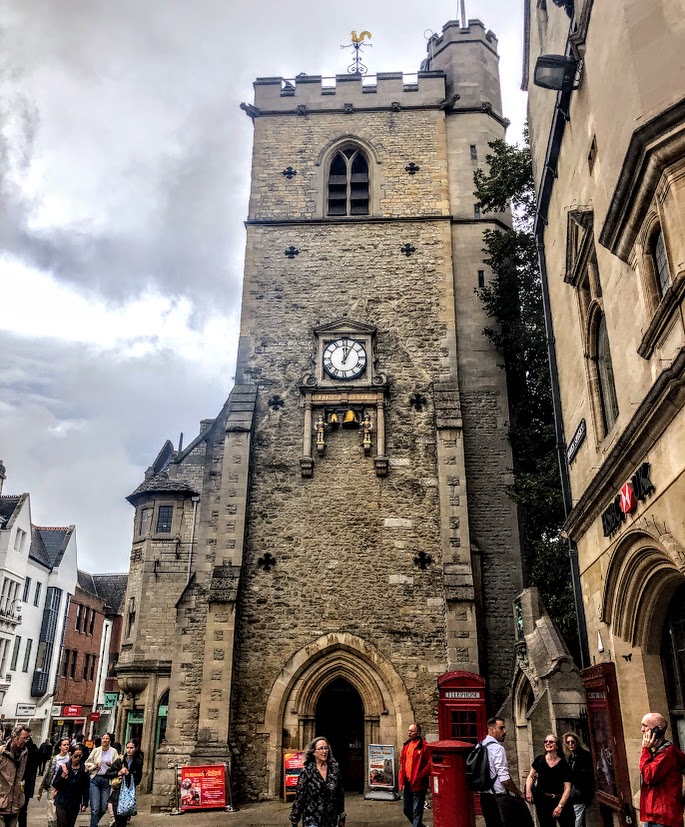
Carfax Tower at the junction of Saint Aldate’s, Cornmarket, Queen Street and High Street in Oxford, is all that remains of the 12th century Saint Martin’s Church. The tower, also known as Saint Martin’s Tower, is a prominent landmark, and Carfax is regarded as the centre of Oxford.
The name ‘Carfax’ derives from the Latin quadrifurcus through the French carrefour, meaning ‘crossroads’. Although the name Carfax is often used to refer to the tower, it is properly the name of the crossroads, and the tower is Carfax Tower, or, more accurately, Saint Martin’s Tower.
The Church of Saint Martin of Tours was the official City Church of Oxford and the Mayor and civic officials were expected to worship there, from ca 1122 until 1896, when the church was demolished. At least 20 Mayors of Oxford were buried in the church, dating back to Richard Carey in 1349. It is possible that council meetings were held in the church before Oxford had a dedicated city hall.
The Mayor and Corporation appointed the Rector and four City Lecturers. Sermons were given by each of four city lecturers in turn, and it was customary for the Rector to be one of the lecturers.
Saint Martin’s was demolished in 1820 after the building had become unstable, but the 13th century west tower was spared, a new church was built, and it opened in June 1822. The new Gothic Revival church had large traceried windows and a large clock facing onto Carfax. Inside, the church had a Corporation Pew for civic officials and, unusually, a Ladies’ Corporation Pew.
Eventually, the second Saint Martin’s Church was pulled down in 1896 when the roads were widened to improve traffic flow. But this remains one of the busiest junction in Oxford and it is also a popular gathering place for tourists and tour groups.

When Saint Martin’s Church was demolished, the tower was spared. The civic church was moved to All Saints’ Church on High Street, and it remained the City Church for 75 years. When All Saints’ Church became the library of Lincoln College, Saint Michael at the North Gate, Cornmarket, became the City Church.
A solitary gravestone behind Carfax Tower commemorates William Butler, a former Mayor of Oxford, who died in 1865. He was buried in Saint Martin’s churchyard with his wife Elizabeth and their daughters. When Saint Martin’s was demolished, the grave was overlooked and remains in place.
The clock on the east side of Carfax is a copy of the original church clock, with mechanical figures called ‘quarterboys’ that hammer out the quarter hour on a pair of late 19th century bells, cast by John Taylor & Co of Loughborough in 1898. The clock’s current dial and surroundings were designed by Sir TG Jackson and installed in 1898. The clock mechanism was replaced in 1938-1939 with an electric one made by Gents’ of Leicester. The tower also has a ring of six bells.
The tower is 23 metres (74 ft) high, with views out across Oxford. Carfax plays a role in the disciplinary regulations of the University of Oxford comparable to the role of Saint Mary the Great in Cambridge. For example, the university requires some students to reside within six miles (9.7 km) of Carfax.
7, Saint Martin in the Bull Ring, Birmingham:

I have known the Church of Saint Martin in the Bull Ring, the original parish church in Birmingham, since my teens, travelling between Birmingham and Lichfield, and have also visited it when I have been in Birmingham for USPG meetings.
Saint Martin’s is known as ‘the Mother Church of Birmingham’ and stands between the Bull Ring Shopping Centre and the markets. The Selfridge’s building facing Saint Martin’s in the Bull Ring has become a modern architectural symbol of Birmingham.
The name of Birmingham is Anglo-Saxon, but it is not known whether there was a church there at that time. When the new town of Birmingham was developed at the time of the Market Charter of 1166, Peter de Birmingham may have moved his manor house to the Moat Lane site and built Saint Martin’s as a new church.
The present Victorian church was built on the site of a 13th century predecessor, which dated from 1263 or earlier. The church was enlarged in mediaeval times, with a lofty nave and chancel, north and south aisles and a north-west tower with a spire. By the mid-16th century, the church had a clock and chime maintained by the Guild of the Holy Cross at an annual cost of four shillings and four pence.
John Cheshire rebuilt 40 ft of the spire in 1781, which was strengthened by an iron spindle running up its centre for a length of 105 ft. It was secured to the sidewalls at every 10 feet by braces. Several metres from the top of the spire were replaced in 1801, when they were found to have decayed. The tops of the four pinnacles surrounding the main spire were also rebuilt. By 1808, the spire had been struck by lightning three times.
The brick casing was removed from the tower in 1853 by Philip Charles Hardwick, who added the open-air pulpit.
The church was demolished in 1873 and rebuilt by the Birmingham architect Julius Alfred Chatwin (1830-1907), who retained the earlier tower and spire. During the demolition, mediaeval wall paintings and decorations were found in the chancel, including one showing the charity of Saint Martin dividing his cloak with a beggar. Two painted beams were also found behind the plaster ceiling.

The exterior is built of rock-faced Grinshill stone. The interior is of sandstone with an open timber roof, which shows the influence of the great hammerbeam roof of Westminster Hall, where Chatwin had worked under Charles Barry and AWN Pugin. Chatwin also enlarged Saint Philip’s Cathedral, Birmingham m in 1884-1888.
The beams are decorated with fine tracery and end in large carvings of angels. The roof weights 93 tons (94.5 tonnes), spans 6.7 metres over the 30.4 metre long nave and is 18.2 metres high.
The Victorian floor tiles are by Minton and display the quartered arms of the de Bermingham family. From east to west, the length of the church is 47 metres (155 ft), including the chancel, the arch of which rises to 18 metres (60 ft).
The Pre-Raphaelite window in the South Transept by Sir Edward Burne-Jones was made by William Morris in 1875. The West window is a copy made in 1954 of the window made by Henry Hardman in 1875 and destroyed in the Blitz.
The mediaeval-style stone statues on the north and west fronts were designed by Chatwin and sculpted by Robert Bridgeman’s of Lichfield. They depict King Richard I in commemoration of his visit to Birmingham ca 1189 confirming the market charter, and Saint Martin of Tours giving his cloak to a beggar.
8, Saint Martin le Grand, York:

Saint Martin le Grand on the south side of Coney Street in York is dedicated Saint Martin of Tours, and while the church is generally known as Saint Martin le Grand, this title was coined in the 1830s and is not its official name.
The church is the official civic church of York and was described in Victorian times as ‘one of the most beautiful churches in the city.’
The earliest masonry is from ca 1080, although the church is thought to be older. The tower was built in the 15th century.
The church was restored in 1853-1854 by JB and W Atkinson of York. The south side and east ends of the aisles were rebuilt, and the pierced battlement was added, to replace one removed 40 years earlier. The porch was added at the east end into Coney Street, and a south porch also added near the tower. New stained glass windows by William Wailes were added.
The church is known for the prominent clock on the east front overhanging the street. The clock was added in 1856 by Mr Cooke, with a carved figure of the ‘Little Admiral’ dating from 1778 – although the admiral seemed to be on shore leave on recent occasions when I went looking for him during visits to York.
The church was largely destroyed in a bombing raid on 29 April 1942, but the 15th century tower and south aisle remain, with a new vestry and parish room at the west end of the site. The Saint Martin window (ca 1437) was removed before the raid for safety. It now occupies a new transept opposite the south door, and it is the largest mediaeval window in York outside the Minster.
The church restoration by the architect George Gaze Pace in 1961-1968 is considered one of the most successful post-war church restorations in England, successfully blending the surviving 15th-century remains with contemporary elements. The reredos screen was designed by Frank Roper.

Another church dedicated to Saint Martin in York is the Church of Saint Martin-cum-Gregory in the Parish of Holy Trinity, Micklegate, now a stained glass centre. The church was originally only dedicated to Saint Martin, but acquired its present name when it merged with Saint Gregory’s Church in 1585.
The church dates from the 11th century. Part of the nave and the north and south arcades date from the 13th century, the north aisle dates form the mid-14th century, and the chancel, chapels and arcades were rebuilt around 1430.
The north porch was added in 1655, and the west tower was refaced with brick in 1677. The clock was added in 1680. The upper stages of the tower were rebuilt again in 1844-1845 by JB and W Atkinson of York.
The church was restored in 1875 when the interior was cleared of the old square pews, the west gallery and the organ. The floor was levelled and laid with red and black tiles. The columns, arcades and walls were scraped and repaired. The roof of the nave was restored and painted. The organ was enlarged by Mr Denman of Skeldergate. New seating was fitted in the nave and Gurney stoves were introduced for heating.
A further restoration was carried out in 1894, when the chancel was re-roofed. The parish was united with Holy Trinity Church, Micklegate, in 1953. After being made redundant, the church served as a public hall. Since 2008, it has been developed as a stained-glass centre and it is an occasional arts venue.
9, Saint Martin-at-Palace, Norwich:

Saint Martin at Palace Plain was a casualty of parochial re-ordering in Norwich and closed in 1971. The church is mediaeval but was heavily restored by Edward Hakewill in the mid 19th century.
After it closed, the church was used as the store for the Diocesan Furnishings Officer, re-homing unneeded church furniture. It was taken over by the Probation Service in 1987, because it is conveniently close to the Law Courts.
MoveOn East, the successor of the Probation Service, left the building in 2012, and it stood empty until 2017, when the NHCT relocated its administrative offices there.

There was another church in mediaeval Norwich dedicated to Saint Martin: the Church of Saint Martin in Balliva was also known as Saint Martin in the Bailey, and was referred to as at ‘Ber Street’ or at ‘Timber Hill.’
There was a church on the site during the mediaeval period. A fraternity of friars had a house in the churchyard before they were joined to the Whitefriars or Carmelites.
The church was totally demolished in 1562, when the parish was united with Saint Michael’s. At one time, all persons dying in the castle and all criminals executed. were buried in the churchyard. When the church was demolished, this right was transferred to Saint Michael’s at Thorn.
10, Saint Martin of Tours Church, Culmullen, Co Meath:

The Roman Catholic parish church in Culmullen, near Dunshaughlin, Co Meath, is dedicated to Saint Martin of Tours and was renovated in 1989, but dates back to last quarter of the 19th century.
This is a single-cell Gothic Revival church designed in 1876 by the architect William Hague (1840–1899), a protégé of AWN Pugin. Hague was active as a church architect in Ireland throughout the mid and late 19th century, working mainly from his offices at 50 Dawson Street, Dublin. He was born in Co Cavan, the son of William Hague, a builder from Butlersbirdge who moved to Cavan town in 1838. William Hague jr designed several churches in Ireland, many in the French Gothic style. He was a pupil of Sir Charles Barry (1795-1860), the English architect who designed the Houses of Parliament in Westminster.
Hague opened an office at 175 Great Brunswick Street, Dublin, in 1861. Later he supervised the completion of the unfinished church of Saint Augustine and Saint John in Thomas Street (John’s Lane), Dublin, begun by Pugin’s son, Edward Pugin, and George Coppinger Ashlin in 1862.
In the year Saint Martin’s Church was built in Culmullen, Hague married Anne Frances Daly, the daughter of a Dublin solicitor, Vesey Daly of Eccles Street. They were married in Saint Michan’s Church, Dublin, on 26 April 1876, and they were the parents of two sons, William Vesey Hague, the writer and philosopher, and Joseph Patrick Clifford Hague, and two daughters.
Hague had a flourishing practice, particularly as a prolific designer of Roman Catholic churches, designing or altering 40 to 50 throughout Ireland. He was the architect to Saint Patrick’s Catholic Cathedral, Armagh, in the 1880s and 1890s.

Saint Martin’s Church in Culmullen, which was dedicated on 1 September 1878, was built by Hall and Son. The church is a good example of Gothic Revival church architecture. It is worth looking out for is the use of structural polychromy throughout the exterior which adds textural contrast with the rock-faced limestone. The conical bell tower and stained glass give artistic effect.
The church is built of rock-faced limestone with polychrome brick detailing and string courses. It has a pitched two-tone natural slate roof, with decorative terracotta ridge tiles and cast-iron rainwater goods.
There is a five-bay nave with pointed-arched stained glass windows, some in pairs, and stone sills. The windows are by Early and Powell, who worked in many of the Pugin and Gothic Revival churches in Ireland. The gable-fronted west porch has a pointed-arch door opening with brick surrounds and a pair of timber doors. The bell tower is designed on a rectangular plan with conical slate spire, and is topped with a cast-iron weather vane, attached to the west at the junction of the nave and the chancel.
There is a single-bay chancel to the north with a gable-fronted sacristy attached to the west. Three lancet windows illustrating the life story of Saint Martin of Tours light the chancel and the nave is lit by three lancet windows above five smaller lights, all with brick surrounds. Both the nave and chancel gables are surmounted with carved stone crosses. The marble altar was designed by Neill and Co, and the octagonal font is said to be late mediaeval. The roof is supported on king post trusses with diagonal struts.
Hague designed churches, convents, colleges, schools and town halls throughout Ireland. He completed Saint Macartan’s Cathedral, Monaghan, after the death of JJ McCarthy, often known as the ‘Irish Pugin’, and was responsible for the spire, the tower and the interior of McCarthy’s chapel at Saint Patrick’s College, Maynooth, which were completed after his death in 1905. He completed the interior of the Church of Saint Peter and Saint Paul in Monasterevin, Co Kildare, in 1880, when Bishop Michael Comerford was the parish priest. He also designed many of the buildings at Saint Patrick’s College, Maynooth, and Saint Eunan’s Cathedral, Letterkenny, Co Donegal.

Hague’s acceptance of commissions was ecumenical in scope. His many other works include the Archbishop’s Palace, Drumcondra, Dublin; Belturbet Presbyterian Church, Co Cavan; Cavan Methodist Church; the Protestant Hall, Cavan; Saint Aidan’s Church, Butlersbridge, Co Cavan; Saint Bridget’s Church, Killeshandra, Co Cavan; Saint John’s Church (Church of Ireland), Cloverhill, Butlersbirdge, Co Cavan; Saint Patrick’s Church, Ballybay, Co Monaghan; Saint Patrick’s Church, Trim, Co Meath; Saint Patrick’s College, Cavan; the Town Halls in Carlow and Sligo; Waterside Presbyterian Church, Derry; and the Westenra Arms Hotel, Monaghan.
Hague had become a Justice of the Peace (JP) for Co Cavan by 1885. He died of pneumonia at his house at 21 Upper Mount Street, Dublin, on 22 March 1899 and was buried at Glasnevin Cemetery three days later.
He worked from: 175 Great Brunswick Street, Dublin, and Cavan (1861-1872); 44 Westland Row and Cavan (1872-1877); 44 Westland Row (1879); 40 Dawson Street, Dublin (1879-1881); 62 Dawson Street (1881-1887); and 50 Dawson Street (1888-1899). He lived at 21 Upper Mount Street, and Kilnacrott House, Ballyjamesduff, Co Cavan.
After his death, his former student and managing assistant, Thomas Francis McNamara (1867-1947), took over most of his work under the business name of Hague & McNamara.
11, San Martino Vescovo (Saint Martin the Bishop), Burano, Venice:

The Chiesa San Martino Vescovo or the Church of Saint Martino the Bishop is a 16th or 17th century church on Piazza Baldassarre Galuppi, the main square on the small island of Burano in the Venetian Lagoon. It can be seen from a distance in the Lagoon, marked out by its leaning tower.
This is a large church for such a small island. The first church on the site was built in the ninth century, and some time after the year 1000 the parish church was dedicated to Saint Martin of Tours. It has been restored and rebuilt several times, and it took its present appearance between 1500 and 1600.
The restored or rebuilt church was reconsecrated on 29 October 1645 by the Bishop of Torcello, Marco Antonio Martinengo.
Seen from outside, the church seems to have no main entrance. In fact, it is entered at the side through a Renaissance door beside the neighbouring Chapel of Santa Barbara. This entrance consists of a vast atrium, with an 18th century statue of the Madonna attributed to Girolamo Bonazza.
The interior, in Lombard-Baroque style, is in the shape of a Latin cross, with three naves ending in a chapel, divided by neoclassical pillars supporting full-arched arches and ending in Corinthian-style capitals. The floor has typical red and white square tiles.
The central nave, including the chancel and choir, is about 47 metres long and has a barrel-vaulted ceiling. The high altar is adorned with six elegant columns of red marble from France and another four from ancient oriental marble. The altar, built in 1673, has a large Baroque tabernacle with a small bronze statue of the Risen Christ above.
The unsafe central nave was renovated in 1867. The vault of the side naves and the central transept fell in 1874. In May 1913, a fire destroyed the ceiling of the main nave in May 1913, and the organ, built by Callido in 1767, was destroyed too. Callido’s organ was considered among the best organ masterpieces in Venice, and was replaced by an organ built by the Mascioni firm of Cuvio.
The unsafe central nave was renovated in 1867. The vault of the side naves and the central transept fell in 1874. In May 1913, a fire destroyed the ceiling of the main nave in May 1913, and the organ, built by Callido in 1767, was destroyed too. Callido’s organ was considered among the best organ masterpieces in Venice, and was replaced by an organ built by the Mascioni firm of Cuvio.
The works of art in the church include ‘The Crucifixion’ (1725) by Giambattista Tiepolo, showing the Madonna collapsed at the foot of the Cross, grey with grief. This ambitious early work by Tiepolo was strongly influenced by Tintoretto’s ‘Crucifixion’ in the Scuola di San Rocco.
There are statues of Sant’ Albano and San Martino, both by Girolamo Bonazza, and works by Francesco Fontabasso, Giovanni Mansueti and Girolamo da Santacroce. The icon near the main altar is a 19th century copy of the Russian icon of the Madonna of Kazan, a masterpiece of enamelwork with astonishingly bright, lifelike eyes.

The church is best known for its leaning tower, built on a square shape with Renaissance and neoclassical architectural features. It is 53 meters high and it on a base 6.2 metres wide. But, due to land subsidence, the tower has inclined by 1.83 meters from its axis.
The tower has undergone several restorations over the centuries, especially in the upper part of the belfry. The most notable maintenance works were carried out by Tirali in 1703-1714.
The top of the tower was crowned by an angel until it fell in a storm in 1867 and was replaced with a cross of iron.
The Oratory of Saint Barbara (Oratorio di Santa Barbara) next door contains relics of the saint who is said to have been martyred in Heliopolis or Nicomedia in the year 290. The Emperor Justin II exhumed her body in Nicomedia in 565 and moved her relics to the Church of the Holy Saviour in Constantinople. Her relics were taken from Constantinople to Venice by the Doge Pietro Orseolo II in 1003 and placed in the ducal chapel.
Her remains were moved to the Church of San Giovanni Evangelista on Torcello in 1009. They remained there for eight centuries, until it was suppressed by Napoleon I in 1806. They were moved with the remains of San Sisinnio, a bishop, to the Church of San Martino in Burano on 10 March 1811.
12, Saint Martin’s Chapel, Nyiru Grait, Sarawak:

It is now two years since the Revd Dr Jeffry Renos Nawie took two of us on whirlwind tours of several churches and chapels in the Diocese of Kuching in Sarawak, including parishes and mission areas in vast rural areas south of Kuching.
Nyiru Grait is a village with a Bidayuh majority, with small Chinese and Iban minorities. Saint Martin’s Chapel has a Sunday congregation of about 200. The chapel bell was made from an old truck wheel.
Saint Martin’s Chapel was consecrated by Bishop Made Katib of Kuching on 20 April 1996.


No comments:
Post a Comment